Muistatko Tanja Poutiaisen, joka pukeutui väärennettyyn saamelaispukuun ja aiheutti melkoisen kohun? Jostain oudosta syystä Lapin alueen asukkaat pitävät hyväksyttävänä naamioitua saamelaiseksi.
Yksi näistä henkilöistä on Perussuomaisten kansanedustaja Sara Seppänen. Kysyin saamelaiselta, mitä hän ajatteli Seppäsen tempusta.
Lähde: Facebook
”Ehdottomasti ei saamelainen, ei edes lähelläkään. Hän cosplaytaa väärennettyä identiteettiä puhtaasti poliittisen opportunismin vuoksi.”
Media, pääasiassa tabloidit, ovat hiljaa ja tukevat hiljaisuudellaan halveksuntaa saamelaisia ja muita vähemmistöjä kohtaan.
HUOMAUTUS: PS kansanedustaja Sara Seppänen EI ole saamelainen, parhaimmillaan hän on feikki saamelainen.
Miksi kulttuurinen omiminen on loukkaava ja väärin?
“Kun tarkastelemme sortoa kokevaa kulttuuria, se on usein seurausta kolonialismista, jossa hallitseva ryhmä on ottanut omistukseensa maan ja sen kansan. Kun hallitseva ryhmä jatkaa ei-hallitsevan kulttuurin osien varastamista, se jatkaa kyseisen kulttuurin taloudellista sortoa ja epäedullista asemaa,” ReachOut mukaan.
Kulttuurinen omiminen on myös vallan käytöä.
Saara Seppänen, lakkaa teeskentelemästä olevasi saamelainen, kun et todellakaan ole sitä.
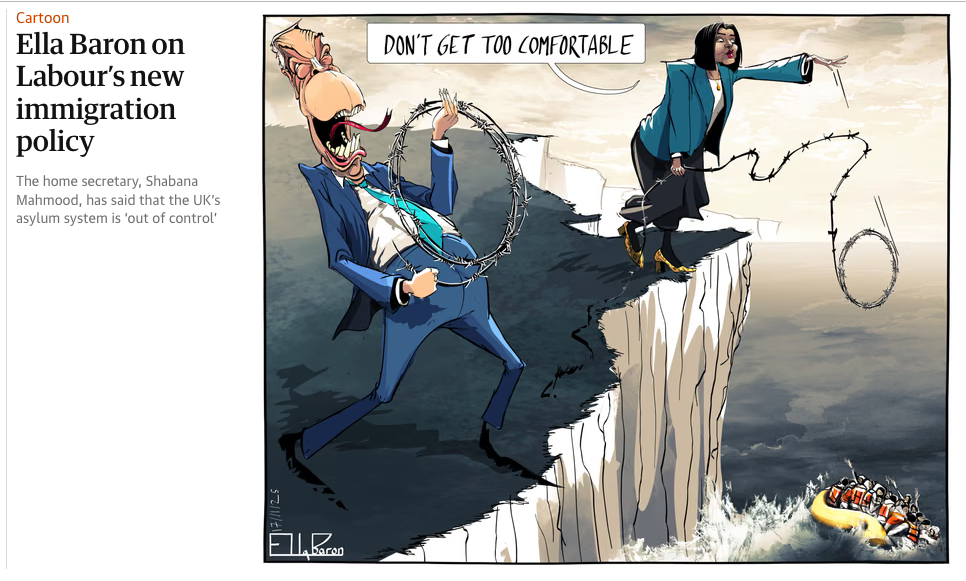
Why are home secretaries of minority ethnic backgrounds pushing the most racist and radical immigration policies? Home Secretary Shabana Mahmoud follows in the footsteps of other dubious home secretaries like Sajid Javid (2018-19), Pritte Partal (2019-22), Suela Braveman (2022-23), and James Cleverly (2023-24).
All of the above have something in common: they hate migrants, especially asylum seekers.
In some respects, these home secretaries represent the role of the Ukrainians at Nazi concentration camps who did the dirty work, like terrorizing victims and sending them to the gas chambers. In the same way, these home secretaries want to make the lives of asylum seekers are difficult and painful as possible.
Some may believe that since it is a brown person adopting such a draconian migration policy, it must be ok. It’s not, but disgraceful.
If there is something we can learn from these ideological hard-right home secretaries masquerading as members of the Labor Party, ethnic background has little to do with your political views. The most important matter is your upbringing and what moral lessons forged you into a human being.
Mahmoud is a disgrace to her immigrant parents and their suffering.
Some see Denmark as an Islamophobic country on steroids. Mahmoud wants to adopt Denmark’s immigration policy in the UK.
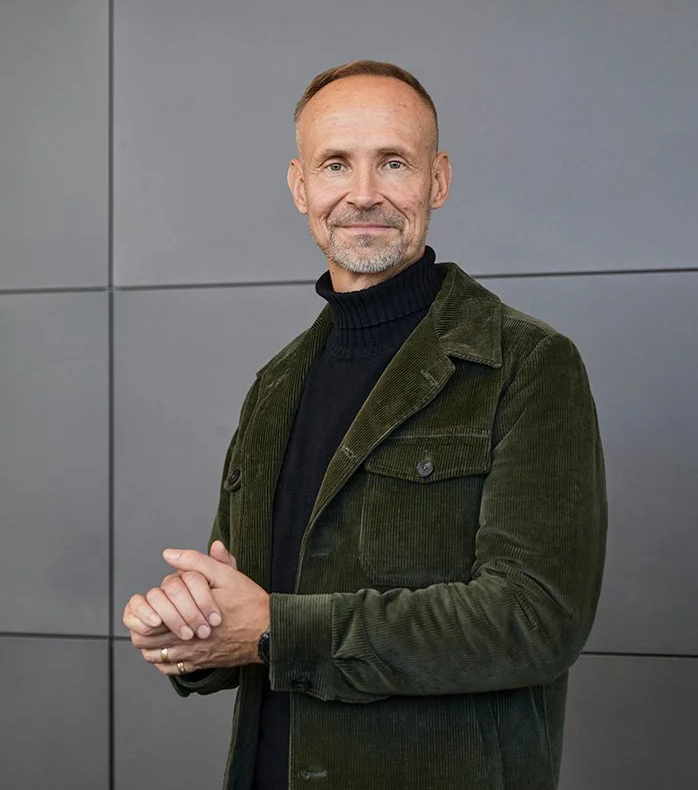
After three decades in uniform and the completion of a doctoral dissertation, former police superintendent Jari Taponen made the decision to leave the force. His departure, he says, followed a growing sense that policing and the society it serves were drifting apart.
“The police have become politicised, and no one wants to admit it,” Taponen said.
Jari Taponen
According to him, the organisation’s claims of political neutrality are at odds with its operational structures. “Performance targets come directly from the government programme. In that sense, the police carry out political will whether they want to or not.”
After his resignation, Taponen founded a company called Prevenza together with Susanna Makaroff. The company focuses on social safety, community resilience and evidence-based crime prevention.
A central source of frustration for Taponen was what he describes as the police organisation’s inability to adapt to societal change. “Preventive work gave me a broader perspective on issues like community strength, integration, and reducing polarization,” he says. “But the organisation did not evolve in that direction.”
The breaking point became even clearer during his doctoral research. As he examined the effects of police actions on crime and public safety, he realised that reliable research data was extremely scarce, despite strong assumptions in public debate.
“It is commonly assumed that police actions have clear and predictable effects. But research shows they are highly context-dependent — and sometimes neutral or even negative.”
For Taponen, this lack of research leaves room for interpretations based on assumptions. “There is little research, and official communication often relies more on impressions than on reality.”
While working in the Helsinki police, Taponen followed recurring claims of rising youth crime and talk of gangs involving young people with immigrant backgrounds. According to him, these narratives do not emerge spontaneously.
Kolmen vuosikymmenen virkauran ja väitöskirjan valmistumisen jälkeen entinen ylikomisario Jari Taponen päätti jättää poliisin tehävät. Päätöksen taustalla oli hänen mukaansa kasvava kokemus siitä, että poliisin toiminta ja yhteiskunta olivat ajautumassa erilleen.
”Poliisi on politisoitunut, eikä sitä haluta myöntää”, Taponen sanoo.
Jari Taponen
Hänen mukaansa organisaation väitteet poliittisesta neutraaliudesta ovat ristiriidassa sen toimintarakenteiden kanssa. ”Tulosohjaus tulee suoraan hallitusohjelmasta. Siinä mielessä poliisi toteuttaa poliittista tahtoa halusi tai ei.”
Eroamisensa jälkeen Taponen perusti yhdessä Susanna Makaroffin kanssa Prevenza-nimisen yrityksen, joka keskittyy sosiaaliseen turvallisuuteen, yhteisöjen resilienssiin ja tutkittuun tietoon perustuvaan rikosten ehkäisyyn.
Keskeinen turhautumisen lähde Taposelle oli hänen mukaansa poliisiorganisaation kyvyttömyys sopeutua yhteiskunnan muutokseen. ”Ennalta ehkäisevä työ antoi minulle laajemman näkymän asioihin kuten yhteisöjen vahvuuteen, integraatioon ja polarisaation vähentämiseen”, hän sanoo. ”Mutta organisaatio ei kehittynyt siihen suuntaan.”
Ero kävi entistä selvemmäksi hänen väitöstutkimuksensa aikana. Tutkiessaan poliisin toimien vaikutuksia rikollisuuteen ja turvallisuuteen hän huomasi, että luotettavaa tutkimustietoa oli hyvin vähän, vaikka julkisessa keskustelussa oletukset olivat vahvoja.
”Ajatellaan, että poliisin toimilla on selvät ja ennustettavat vaikutukset. Mutta tutkimus osoittaa, että vaikutukset ovat hyvin kontekstisidonnaisia — ja joskus neutraaleja tai jopa negatiivisia.”
Taposesta tämä tutkimustiedon puute jättää tilaa oletuksille perustuville tulkinnoille. ”Tutkimusta on vähän, ja viranomaisviestintä nojaa usein enemmän mielikuviin kuin todellisuuteen.”
Even if Finland reported on Monday a record rise in suspected hate crime cases in 2024, there has been little reaction by the government about the worrying trend. The silence and inaction, despite assurances by Prime Minister Petteri Orpo of the failed anti-racism program, speak volumes about the social ill.
The inaction and the hands-off approach of the government towards racism, despite assurances of the contrary, are at the heart of the problem. The government fuels racism by not doing anything.
Like with the government’s economic policies and promises to end indebtedness and create jobs and growth, it has failed as well in making Finland a less racist country.
While the Finnish government has publicly emphasized the importance of tackling discrimination, civil society groups and anti-racism advocates say that some political decisions and public rhetoric over the past years have normalized racism. They point particularly to immigration reforms, political disputes surrounding equality initiatives, and several controversies involving ministers.
Researchers note that Finland has long struggled with underreported racism, and that rising figures can also reflect increased reporting and awareness. Still, the pace and scale of the latest spike have killed debate over whether current policies are alleviating—or aggravating—the problem.
Government officials have not yet commented directly on the hate-crime report. Still, authorities have previously said that combating hate crime remains a priority, even if the report shows the tip of the iceberg.
Migrant Tales correctly predicted in 2023 that hate crimes would soar to new records the following year. The trend, unfortunately, will continue. 2025 will be another record year for hate crimes in Finland.
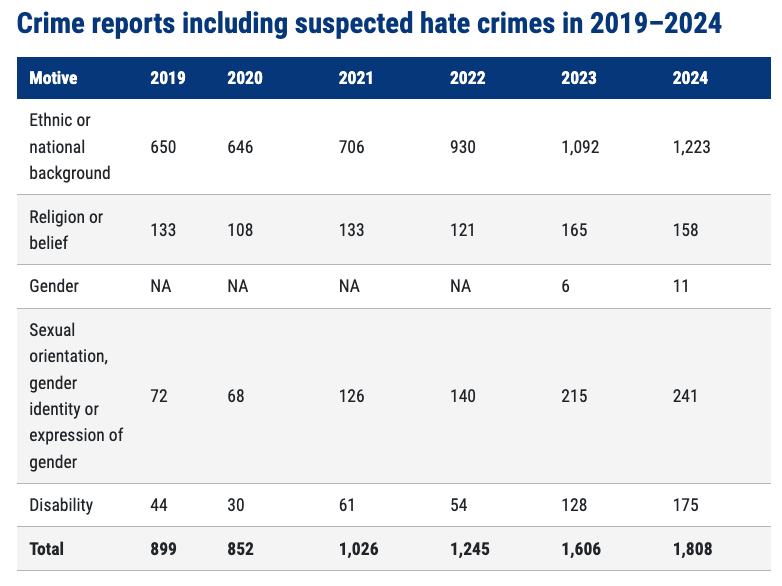
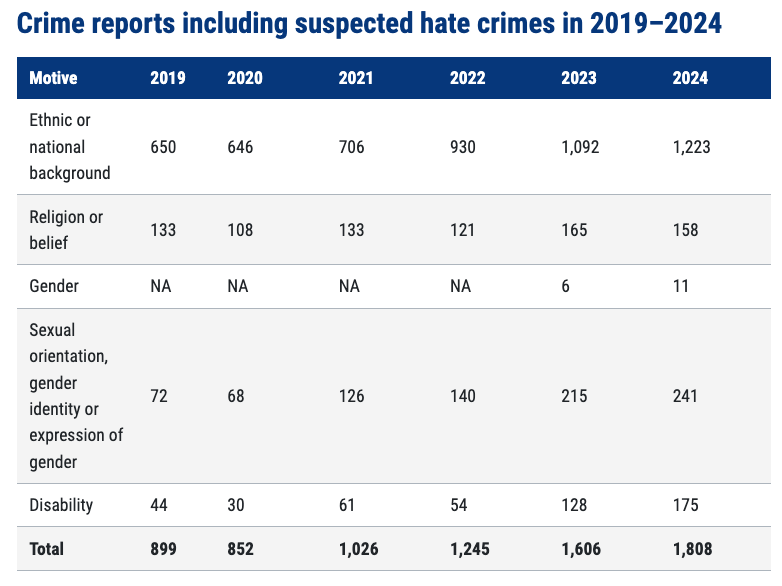
As Migrant Talescorrecty predicted, 2024 was going to report a new record in suspected hate crimes after 2023 broke a new record. Suspected hate crimes,* (1) which is only a tip of the iceberg, soared in 2024 by 12.58% to 1,808 cases versus 1,606 cases the previous year, according to the Police University College.
As in 2023, the majority (67.6%) of cases were due on ethnic and national origin, rising by 12% to 1,223 cases from 1,092 cases. While hate crime due to religion retreated by 8.75 to 158 cases (8.7% of all cases), hate crime due to disability soared by 36.7% to 175 (9.67%) cases with sexual orientation totalling 241 (13.3%), up 12.09%.
The report cited Muslims and Syrians in particular as the most victimized groups.
Source: Police University College
“Jenita Ranta, the author of the report, blamed the record rise of hate crime cases in 2023 on factors like Russian aggression in Ukraine and the poor economic situation. While the report did not cite specific reasons for the new rise in hate crimes in Finland, it’s clear that the economy and the weak response of the government to racism are at the heart of the problem.”
Some see the National Coalition Party (NCP) as the enabler of the Perussuomalaiset’s (PS)* extreme immigration policy, which constantly labels Muslims and other minorities as “the problem.”
But it would be misleading to just blame the government and the economy for the rise in suspected hate crimes. The media is another culprit that rarely challenges and gives a voice to migrants and minorities.
(1) The Police University College report defines suspected hate crimes as reports where a hate motive is manifest. In 2024, the number of suspected hate crimes increased in all motive groups in the report, except for crimes related to religion or belief. The most common motive was the victim’s ethnic or national background.
Migrant Tales is the oldest antiracist blog in Finland founded in 2007. We have a wealth of material collected during those years that should not be forgotten. Welcome to Migrant Tales oldies.
This is an awkward and offensive ad by Wille Rydman who doctored his face brown to look like a migrant, claiming he is helping migrants (Sic!). The person standing behind Rydman is Mukhtar Abib (see message below).
My Messenger message fo Mukhtar Abib: “Hi Mukhtar, I’m Enrique Tessieri from Migrant Tales (www.migranttales.net). What a turn of events in the Wille Rydman case. It would be great to hear your views, considering that you supported him in the 2011 elections. Best regards, Enrique Tessieri, 040 8400773.” He never replied.
Wille Rydman claims that he dares to speak his mind and to make what he says a reality. Let’s see below some of his scandalous quotes.
In those messages, Rydman called asylum seekers who came in 2015 “desert monkeys” and used other racist words for blacks, Muslims, and Jews. He wrote that a certain flower, the lilly of the valley, spreads and multiplies like Somalis. Rydman said he’d be ready to forbid the person wearing the hijab instead of the veil.
Rydman ran into problems a year earlier in 2022 when Helsingin Sanomat published an investigative story where a number of young women, some of whom were minors, claimed they were harassed by him.
The scandal caused Rydman to be suspended from the National Coalition party. He later joined the Perussuomalaiset party.* He was minister for economic affairs during 2023-2025.
“There’s that much evidence thatcould have all of the people locked up for the rest of their lives. Why are they still walking around free?”
Virginia Roberts Giuffre (1983-2025)
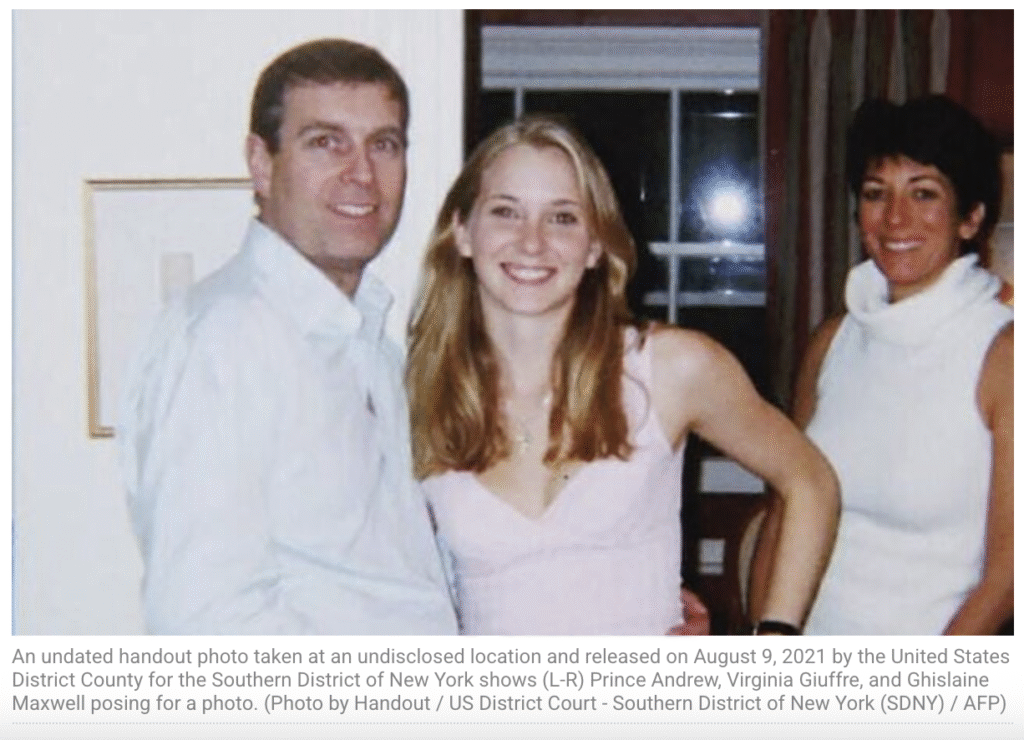
A very good question posed by Virgina Roberts Giuffre, the late sex trafficked victim of Jeffrey Epstein and Ghislaine Maxwell. One of the suspects she refers to is former Prince Andrew, who had all of his royal titles withdrawn and is now a commoner, Andrew Mountbatten Windsor.
Here is the bottom line: The royal family has taken too long to react and strip Andre Mountatten Windsor of his titles. To add salt on injury, the former prince will be paid for moving out of his 30-room Royal Lodge mansion near Windsor Castle.
Shouldn’t Andrew Mountbatten Windsor be in court, convicted and behind bars for allegedly raping minors?
Those who have been following the Epstein scandal and the coverup by the likes of the US President Donald Trump, have been led on a wild-goose chase to release the Epstein files. It’s clear that those files and the scandal could mean an end to Trump and all those implicated.
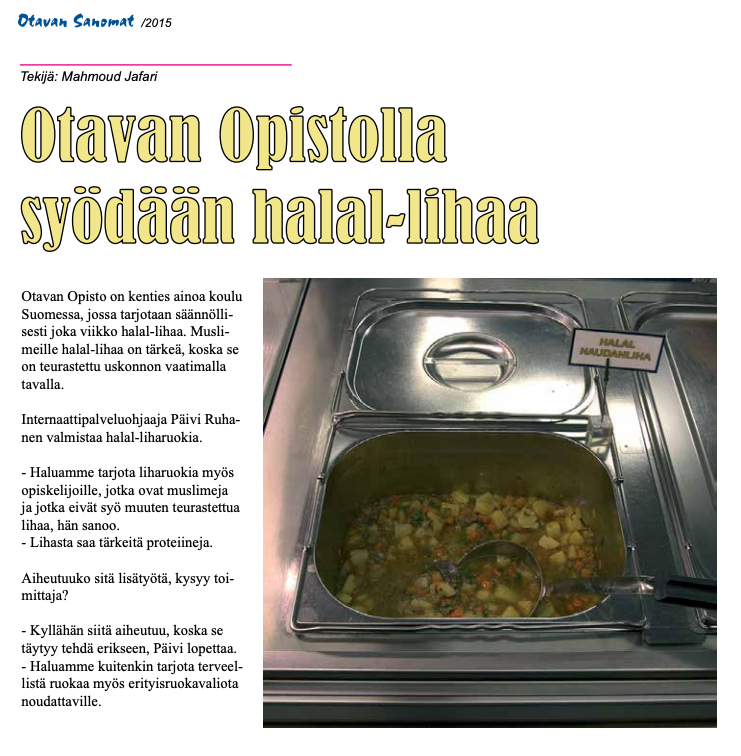
In 2010, when Otava Folk High School, located 14 km from Mikkeli, started offering halal meat on a regular weekly basis to its Muslim students, it became one of the first, if not the first, learning institutions to offer such meat to students. All of this, however, came to an abrupt end when the principal, Harri Jokinen, discontinued the service a few years later.
Jokinen blamed cost-cutting for the decision.
Päivi Ruhanen, who was a cook at the school’s cafeteria, stated that the primary motivation for serving halal meat to Muslim students was to provide them with a source of protein, which is an essential component of their diet.
When asked if preparing halal meat dishes caused more work for the cafeteria staff, she said that it did.
“Yes, it does,” Ruhanen was quoted as saying in the school publication Otavan Sanomat, “because it has to be done separately. However, we also want to offer healthy food for those who follow special diets.”
Considering that Islam is the second-biggest religion in Finland offering halal meat is still an exception in Finland. Even if cities like Helsinki, Vantaa, Espoo, Tampere and Turku have a large number of people who don’t speak Finnish or Swedish as their mother tongue, all five cities take special dietary requirements into account (allergies, vegetarian/vegan food). However, none of them offer at their schools halal meat on a regular basis.
Thanks to migration, Finland’s demographic makeup has changed. In Helsinki alone, the number of pupils in 2024 who have another mother tongue other than Finnish, Swedish, and Sami, has risen to 25.7% of the city’s population from 13.5% ten years ago. Such demographic changes have placed new challenges and a rethink on comprehensive schools and education in general.
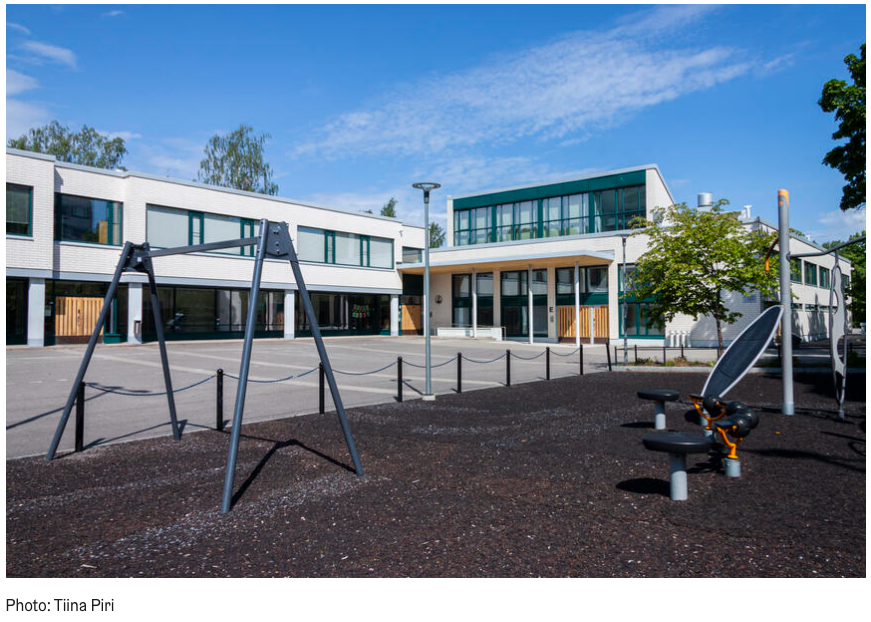
For Suaad Onniselkä, a deputy principal of Helsinki’s Puistopolku Comprehsnvie School, the challenge is is not merely a logistical issue—it’s a matter of equity and dignity. She believes that Finnish schools, while striving for neutrality, often overlook how structural and cultural biases shape the experiences of minority students.
Onniselkä describes the holy month of Ramadan as one of the clearest moments when Islamophobia appears in schools.
“In some extreme cases, pupils are forced to eat while fasting,” she said. “Even if poverty is an issue in some homes and food may be scarce, some schools are especially worried that a Muslim student might die during one month of the year. Forcing a pupil to eat doesn’t belong anywhere.”
There have even been cases in smaller cities, where social workers have suggested reporting fasting families to child protection authorities.
The Finnish Muslim Forum (Suomen Muslimifoorumi) has repeatedly emphasized that fasting during Ramadan is a matter of religious freedom, not neglect.
“Yet, no one [at school] even says ‘Happy Ramadan’ to me,” Onniselkä noted. “Then they talk in a negative tone. But I’m the principal of the school—and I feel bad about it. How does that young student feel? How much time and energy would it take for a teacher to simply say, ‘Hey, happy Ramadan, it’s wonderful that this special time has begun?’ That’s what amazes me.”
According to Onniselkä, prejudice in schools often manifests in subtle ways: through low expectations, stereotypes, or lack of representation.
“You can either ‘other’ or empower,” she said. “Too many pupils are victims of prejudice at school. The question is whether teachers see the student on their own terms—or through the lens of the majority culture.”
Finland’s national curriculum allows teaching pupils’ mother tongues and religions, but qualified teachers of Islam remain in short supply.
“In many schools, non-Muslim teachers are hired to teach Islam,” she explained. The main textbook, Salam by Sirkku Aboulfaouz and published by the Finnish National Agency for Education, does not address Islamophobia directly. “It’s up to the teacher to bring up the topic, even though many students experience it daily.”
Structural racism and the “gang” narrative
Onniselkä also connects Islamophobia to broader social anxieties, including recent societal and political debates on youth “gangs” and urban safety.
“I think the political parties like Perussuomalaiset (PS)*, the police, and even the press have taken advantage of this,” said Onniselkä. “They all win—except for the [labelled] young people involved. Teachers’ fears make the situation seem much worse than it really is.”
The so-called gang problem, she argued, has its roots in structural racism and stereotyping rather than in real organized violence.
“In the 2000s, white Finnish students would tattoo their postal code numbers—like ‘94’ for th eastern Helsinki nighborhood of Kontula—and no one called it gang behavior. Now, if a Muslim or if a student of so-called migrant background does the same, it’ becomes a ‘gang issue.’ That double standard speaks volumes.”
Onniselkä is also concerned about ethnic profiling by police, which she says is “quite commonplace” in some Helsinki neighborhoods.
“Students are stopped, photographed, and asked for ID,” she said. “Yes, there are human rights violations happening. And yet, police receive little or no anti-racism training.”
Anti-racism education
In her view, Finland lacks genuine anti-racism education.
“The fact that we get a 90-minute anti-racism course once every five years is basically a joke,” she said. “It should be systematic and part of every school’s equality plan.”
Onniselkä also challenges Finland’s narrow interpretation of equality.
“Equality doesn’t mean treating everyone the same,” she argued. “It means giving each student what they need to succeed. The new legislation on learning support recognizes this for academic needs—but not for cultural or linguistic ones.”
Structural racism also extends to teacher recruitment, according to her.