The Media Monitoring Group of Finland has received some disturbing news about how Perussuomalaiset (PS) Minister for Foreign Trade Wille Rydman allegedly sent hostile messages to Alex Rühle, the Nordic correspondent of the Munich-based daily Süddeutsche Zeitung.
We offer our 100% support to Rühle and condemn forcibly Rydman, the PS, and the government for intimidating the media.
In a message below retrieved from Twitter, Rühle states that he’s received another “disgusting, poisoned letter from Rydman.”
Source: Twitter
The embattled minister, whose racist emails were made public in July by Helsingin Sanomat, Rydman has accused certain Finnish activists and academics of conspiring with the foreign media to discredit the government.
Rydman’s action against the daily is an affront to press freedom. We shouldn’t be surprised by Rydman’s behavior since it is the way radical right parties operate. If they don’t get their way, they attack democratic institutions like the media.
For further reading: The daily has covered (in German) numerous scandals of Prime Minister Petteri Orpo’s government:
[1] Media Monitoring Group of Finland aims to promote fair and accurate reporting by the Finnish media of underrepresented cultural, racial, ethnic, and religious groups. As Finland’s cultural diversity continues to grow, the role of the media in forming public opinion and attitudes about minorities becomes even more relevant.
As a Tunisian who has spent the last three years in Finland, I often find myself reflecting on recent events that have influenced my life. The revolution in Tunisia is known for having been “from the people, [but] appropriated by the others.” This phrase resonates with me deeply, as I can relate to the highs and lows, the gap between expectations and reality, and the stark difference between what the media portrays and the actual situation.
One word that carries great power in this context is “the media,” and for good reason. The media has a significant impact on how people perceive their world and how they formulate their beliefs. It plays a crucial role in shaping public opinion and influencing societal attitudes. The media can either promote understanding, empathy, and inclusivity or perpetuate prejudice, discrimination, and exclusion.
When I think about the challenges faced by immigrants trying to integrate into a new community, the metaphor of a “foreign body” comes to mind. Just as an organism can reject an organ or implant, a society can be as hostile towards immigrants who want to fit in and participate as full members. Prejudice, discrimination, language barriers, and other obstacles contribute to social exclusion, segmented neighborhoods, and isolation, hindering the development of a cohesive and inclusive social fabric.
Overcoming these obstacles requires a society that fosters tolerance, empathy, and open-mindedness toward newcomers. Just as the immune system must be modified to accept “the foreign body,” the culture of a society needs to make it possible to embrace diversity and provide equal opportunities for all. Education plays a crucial role in this process by promoting cultural awareness, intercultural discourse, and improving language abilities.
But when the media is predominantly biased, it erects barriers against the “foreign body” and fails to give a voice to immigrants. The media’s portrayal of immigrants can shape public perceptions and influence societal attitudes. Negative or stereotypical portrayals perpetuate societal preconceptions and hatred, while the lack of diverse representation in the media hinders communication and feeds biases.
The Finnish media, in particular, has been a source of cultural shock for me. Much like the media back home, it often presents a negative and disturbing image, which can be subtly regarded as racist. This portrayal in the media reinforces stereotypes and perpetuates discrimination. For Finland to truly embrace diversity and inclusivity, the media must take on a more inclusive and impartial role. Journalists and media experts should make an effort to portray immigrants and their contributions to society in a nuanced and factual way, highlighting inspiring stories and a variety of experiences that accurately depict the realities of cultural diversity.
The Finnish media also has a responsibility to uphold ethical reporting standards and combat prejudice by discouraging hate speech. Fact-checking, diversifying information sources, and encouraging intercultural conversation are crucial steps toward fairer reporting. Failure to do so not only spreads prejudice and stereotypes but also poses a significant risk, as biased and deceptive media can become the perfect platform for opportunistic politicians to rise to power and manipulate public opinion.
In the face of the growth of extremist politicians and parties, it is essential to recognize the potential risks posed by a biased and even deceptive media. Such politicians target the disenchanted, the manipulated, and the frustrated electorate, using the media’s power to formulate public opinion to their advantage. They exploit the portrayal of immigrants as outcasts, even monsters, winning the support of individuals who feel marginalized by the current political climate. Furthermore, they understand the influence they can have on younger generations, who are already shaping society and are particularly susceptible to media influence.
I am often asked about my experience in Finland and whether I encountered any culture shock. In most cases, unless I am talking to people I trust and know well, I tend to give a half-truth response to avoid long and pointless debates where my thoughts might be disregarded due to my background and as a newcomer still learning and struggling with the language. I usually say, “I really enjoy it here, and Finland has my heart.” I mention the country’s robust social and political system, natural beauty, favorable weather, and cultural diversity. This answer helps me navigate discussions without getting caught up in unnecessary arguments.
However, if I were to speak truthfully, the cultural shock I experienced in Finland was primarily due to the Finnish media. As I mentioned earlier, in many ways, it was reminiscent of what I had experienced back home. Most of the time, the media presents a negative and disturbing image that could be subtly regarded as racist—an insidious form of racism. This is where my culture shock originated.
The Finnish media must adopt a more inclusive and impartial role, akin to the adaptive immunological response of the body. Journalists and other media experts can be linked to antibodies, who should make an effort to portray immigrants and their contributions to society in a nuanced and factual way. This entails highlighting inspiring stories, triumphs, and a diverse range of experiences that accurately depict the realities of cultural diversity.
The Finnish media also bears responsibility for spreading prejudice and stereotypes when ethical reporting standards are not upheld. To curb the dissemination of hate speech and advance a more accurate portrayal of immigrants, fact-checking, diversifying information sources, and encouraging intercultural conversation are crucial steps towards fairer reporting.
Asmaa is a black woman born in Finland who studies at the South-Eastern Finland University of Applied Sciences (Xamx). She was adamant about why she does not trust,never mind reads, the Finnish media. She emaileda response: I don’t read Finnish newspapers and none in particular. I find them very taxing to read. Constantly, people who look like me are vilified, branded as the devil himself and the root cause of all problems.“
Asmaa’s reply is an earnest response to a problem that reflects the media and Finnish society.
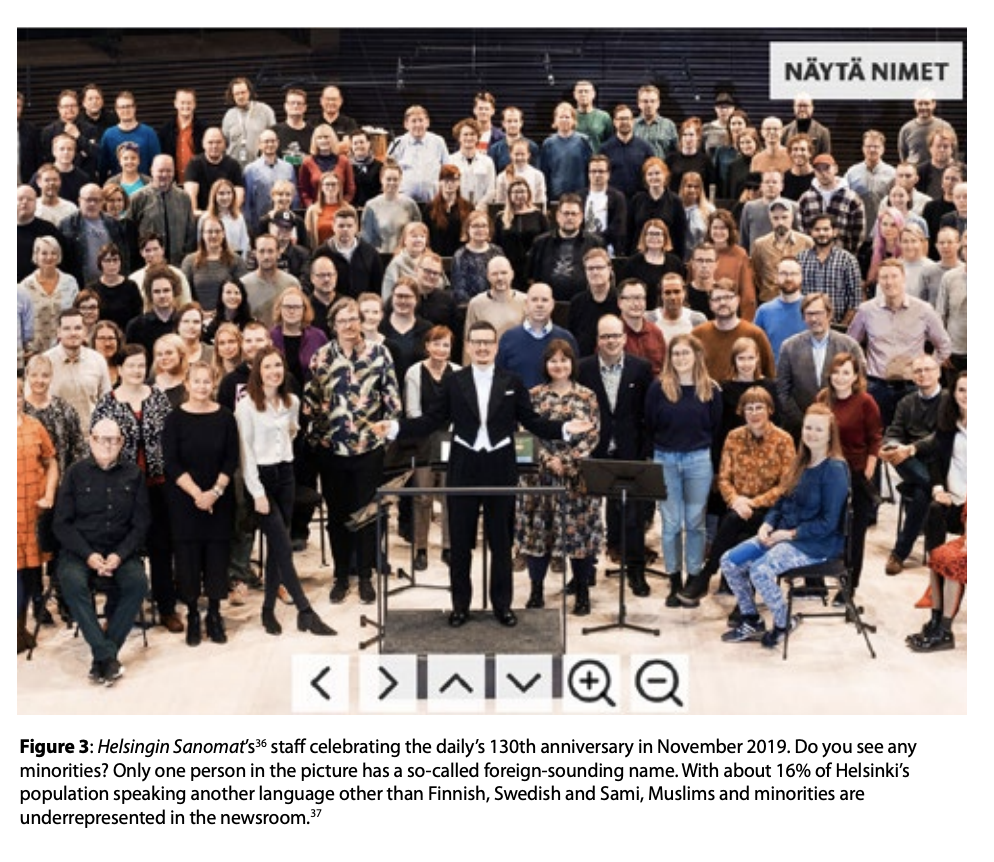
What are Finnish media giants like Helsingin Sanomat and others doing to fix the chronic lack of credibility in the eyes of some minorities? I suspect the answer is short and to the point: Nothing spectacular.
Although we remain hopeful and trust that the Finnish strive for impartial and equitable reporting that acknowledges the nation’s growing cultural diversity, progress has been sluggish.
Just like in the last four parliamentary elections, narratives such as migrant crime spread by the far-right anti-immigration Finns Party (PS) paid off handsomely. It is not, however, the only reason why the PS was able to win a record 46 seats but was helped by the National Coalition Party, which won the election with 48 seats.
Despite the good result of the Eurosceptic party, the Social Democratic Party, which came in third place with 43 seats, Green League, Left Alliance and Swedish People’s Party announced they would not form a new government with the PS.
The election was a disappointment to underrepresented cultural, racial, ethnic, and religious groups. Especially parties like the PS, threatened to weaken the civil rights of minorities with a heavy hand.
PS head Riikka Purra made clear her worrying immigration stance on numerous occasions:
The PS will not form part of a government that does not tighten immigration policy further.
Stop people from outside the EU from moving and working in Finland.
Islam and white Finland are incompatible.
Seeking asylum is not a human right but a privilege.
Cultural programs are a luxury.
Nearly everything that does not work in society is due to poor immigration policy.
Long-term plan to exclude foreigners from getting social welfare.
Leave the European Union in the long term.
Harden criminal sentences, especially when migrants or minorities are involved.
It is important to note that many of these radical proposals breach human rights and Finnish law and can lead to further discrimination and inequality against minorities. Defending diversity and social equality in society are important to every member of society and political parties should work to uphold such rights.
In the face of these radical proposals by the Finns Party, it should not come to a surprise that some newspapers abroad like The Guardian, Le Monde, El País and other call, among other names, the PS a far-right party.
We believe in the media’s watchdog role to protect the rights of all people in Finland irrespective of their background. Unfortunately, watching the news and what is discussed on it after the election, reveals that civil and human rights are not high up on the priority list.
*Media Monitoring Group of Finland aims to promote fair and accurate reporting by the Finnish media of underrepresented cultural, racial, ethnic, and religious groups. As Finland’s cultural diversity continues to grow, the role of the media in forming public opinion and attitudes about minorities becomes even more relevant.
It is surprising how the foreign and local media treat the Perussuomalaiset (PS)*differently, even if The Guardian and El País of Madrid refer to the party as far right. Other adjectives are used, like Eurosceptic, nationalistic, and right-wing populist.
In Finland, we rarely, if ever, see such descriptions of the PS. Yle News, for example, refers to the radical right party as “nationalist.”
The fact that the media treats the PS as a “normal” party explains how its radical policies are becoming normalized.
Here are some things PS head Riikka Purra has spread recently:
The PS will not form part of a government that does not tighten immigration policy further.
Stop people from outside the EU from moving and working in Finland.
Islam and white Finland are incompatible.
Seeking asylum is not a right.
Cultural programs are a luxury.
Everything that does not work is due to poor immigration policy.
Only Finnish citizens can get social welfare.
Leave the European Union in the long term.
Harden criminal sentences, especially when migrants or minorities are involved.
If these are “normal” political opinions, they are nothing more than a betrayal of our most important values based on human rights and human dignity. The fact that the media appears not to take such opinions seriously, coming from the second-biggest party in Finland, reveals our country’s denial of the social ill.
I don’t read Finnish newspapers and none in particular. I find them very taxing to read. Constantly, people who look like me are vilified, branded as the devil himself and the root cause of all problems. I have always known the correct term for an event that bothers me, and when I learned it, I sighed with relief. I no longer had to doubt myself and had facts to back up my feelings. It is dog-whistle politics, and even though I am a “Finn” on paper, the media reminds me that I am not wanted here. If I didn’t feel under constant attack, I could read papers.
– Asmaa
“Minä en lue suomenkielisiä sanomalehtiä enkä erityisesti mitään Suomalaisia lehtiä. Koen, että ne kuormittavat erittäin paljon, kun niitä lukee. Jatkuvasti ihmiset jotka näyttävät minulta mustamaalataan, leimataan itse piruksi ja kaikkien ongelmien juuri syyksi. Olen aina tiennyt, että tapahtumalle, joka häiritsee minua on oikea termi ja kun opin sen huokaisin helpotuksesta. Enää ei tarvinnut epäillä itseäni ja sain faktoja tukemaan minun tunteitani. Se on koirapilli politiikkaa (eng. dog whistle politics) Vaikka olen paperilla “suomalainen” niin lehdistö muistuttaa minua, etten ole haluttu tänne. Mikäli en kokisi olevani jatkuvan hyökkäyksen alaisena niin voisin lukea lehtiä.”
The chairperson of the Finns Party, Riikka Purra, has said on several occasions that her party’s long-term goal is that only Finnish citizens have the right to social welfare.
While such a plan is highly discriminatory, even racist, it is unfortunate that journalists don’t ask Purra what she means and what challenges would arise if they ban social welfare for foreigners. Apart from requiring a change in the constitution, which would have to get a two-thirds majority, is such a plan only a campaign stand and a pipe dream?
Apart from breaching EU law and human rights and being discriminatory, should foreigners in Finland pay less taxes since they will not be eligible for social welfare? Are there other hidden charges like tuition for children attending comprehensive school and health care?
According to some estimates, Finland needs about 40,000 labor migrants a year to plug its chronic labor shortage.
Such measures by the PS will certainly make Finland unattractive to labor migrants.
Why would you want to move to a country that treats you like a second-class member of society?
*Media Monitoring Group of Finland aims to promote fair and accurate reporting by the Finnish media of underrepresented cultural, racial, ethnic, and religious groups. As Finland’s cultural diversity continues to grow, the role of the media in forming public opinion and attitudes about minorities becomes even more relevant.
We are a small group called the Media Monitoring Group of Finland, represented by people from different minority backgrounds. Today we published our first report in English and Finnish.
Has media coverage of “youth gangs” and the security guards scandal been fair?
In our opinion, coverage has been problematic. Please read the report and see our findings.
After reading 77 stories published by Yle (9 stories), Helsingin Sanomat (19), Iltalehti (6), Ilta-Sanomat (30), and MTV (13) about the Avarn Security scandal, only one story alleges racism as a factor in the working culture of security guards. Another story by Ilta-Sanomat, which wrote about excessive force, only mentioned once a “person of foreign background” was apprehended by security guards.
Meanwhile, according to various media reports, a woman died on Saturday at Espoo’s Iso Omena shopping center. The woman was being escorted out of the shopping center by Securitas security guards. The police suspect that manslaughter is the cause of death.
Avarn Security guards holding down a victim. Source: Helsingin Sanomat.
While the youth gang stories hyped by the media have no problem labeling “persons of foreign background” as a source of the “problem,” there is no mention of ethnic profiling as a factor. Surprisingly, non of the 77 stories mention ethnic profiling at all.
Helsingin Sanomat asked in a story what the security guards’ motives were in using excessive violence and humiliating their victims. Another story by the daily alleged that excessive force is used against socially venerable and disadvantaged people.
What do they mean? The homeless? Drunks? Old people? People of color? Other minorities?