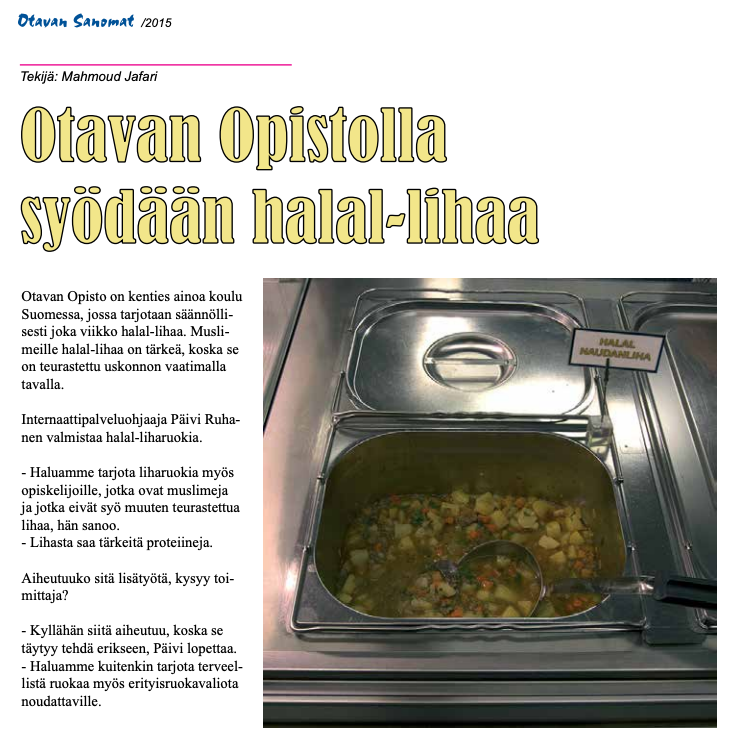
In 2010, when Otava Folk High School, located 14 km from Mikkeli, started offering halal meat on a regular weekly basis to its Muslim students, it became one of the first, if not the first, learning institutions to offer such meat to students. All of this, however, came to an abrupt end when the principal, Harri Jokinen, discontinued the service a few years later.
Jokinen blamed cost-cutting for the decision.
Päivi Ruhanen, who was a cook at the school’s cafeteria, stated that the primary motivation for serving halal meat to Muslim students was to provide them with a source of protein, which is an essential component of their diet.
When asked if preparing halal meat dishes caused more work for the cafeteria staff, she said that it did.
“Yes, it does,” Ruhanen was quoted as saying in the school publication Otavan Sanomat, “because it has to be done separately. However, we also want to offer healthy food for those who follow special diets.”
Considering that Islam is the second-biggest religion in Finland offering halal meat is still an exception in Finland. Even if cities like Helsinki, Vantaa, Espoo, Tampere and Turku have a large number of people who don’t speak Finnish or Swedish as their mother tongue, all five cities take special dietary requirements into account (allergies, vegetarian/vegan food). However, none of them offer at their schools halal meat on a regular basis.
Thanks to migration, Finland’s demographic makeup has changed. In Helsinki alone, the number of pupils in 2024 who have another mother tongue other than Finnish, Swedish, and Sami, has risen to 25.7% of the city’s population from 13.5% ten years ago. Such demographic changes have placed new challenges and a rethink on comprehensive schools and education in general.
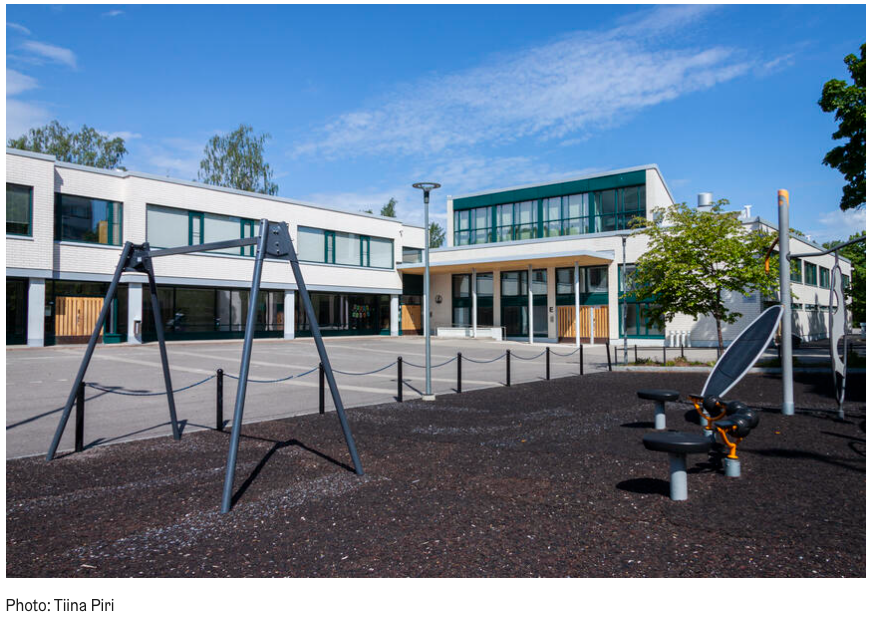
For Suaad Onniselkä, a deputy principal of Helsinki’s Puistopolku Comprehsnvie School, the challenge is is not merely a logistical issue—it’s a matter of equity and dignity. She believes that Finnish schools, while striving for neutrality, often overlook how structural and cultural biases shape the experiences of minority students.
Onniselkä describes the holy month of Ramadan as one of the clearest moments when Islamophobia appears in schools.
“In some extreme cases, pupils are forced to eat while fasting,” she said. “Even if poverty is an issue in some homes and food may be scarce, some schools are especially worried that a Muslim student might die during one month of the year. Forcing a pupil to eat doesn’t belong anywhere.”
There have even been cases in smaller cities, where social workers have suggested reporting fasting families to child protection authorities.
The Finnish Muslim Forum (Suomen Muslimifoorumi) has repeatedly emphasized that fasting during Ramadan is a matter of religious freedom, not neglect.
“Yet, no one [at school] even says ‘Happy Ramadan’ to me,” Onniselkä noted. “Then they talk in a negative tone. But I’m the principal of the school—and I feel bad about it. How does that young student feel? How much time and energy would it take for a teacher to simply say, ‘Hey, happy Ramadan, it’s wonderful that this special time has begun?’ That’s what amazes me.”
According to Onniselkä, prejudice in schools often manifests in subtle ways: through low expectations, stereotypes, or lack of representation.
“You can either ‘other’ or empower,” she said. “Too many pupils are victims of prejudice at school. The question is whether teachers see the student on their own terms—or through the lens of the majority culture.”
Finland’s national curriculum allows teaching pupils’ mother tongues and religions, but qualified teachers of Islam remain in short supply.
“In many schools, non-Muslim teachers are hired to teach Islam,” she explained. The main textbook, Salam by Sirkku Aboulfaouz and published by the Finnish National Agency for Education, does not address Islamophobia directly. “It’s up to the teacher to bring up the topic, even though many students experience it daily.”
Structural racism and the “gang” narrative
Onniselkä also connects Islamophobia to broader social anxieties, including recent societal and political debates on youth “gangs” and urban safety.
“I think the political parties like Perussuomalaiset (PS)*, the police, and even the press have taken advantage of this,” said Onniselkä. “They all win—except for the [labelled] young people involved. Teachers’ fears make the situation seem much worse than it really is.”
The so-called gang problem, she argued, has its roots in structural racism and stereotyping rather than in real organized violence.
“In the 2000s, white Finnish students would tattoo their postal code numbers—like ‘94’ for th eastern Helsinki nighborhood of Kontula—and no one called it gang behavior. Now, if a Muslim or if a student of so-called migrant background does the same, it’ becomes a ‘gang issue.’ That double standard speaks volumes.”
Onniselkä is also concerned about ethnic profiling by police, which she says is “quite commonplace” in some Helsinki neighborhoods.
“Students are stopped, photographed, and asked for ID,” she said. “Yes, there are human rights violations happening. And yet, police receive little or no anti-racism training.”
Anti-racism education
In her view, Finland lacks genuine anti-racism education.
“The fact that we get a 90-minute anti-racism course once every five years is basically a joke,” she said. “It should be systematic and part of every school’s equality plan.”
Onniselkä also challenges Finland’s narrow interpretation of equality.
“Equality doesn’t mean treating everyone the same,” she argued. “It means giving each student what they need to succeed. The new legislation on learning support recognizes this for academic needs—but not for cultural or linguistic ones.”
Structural racism also extends to teacher recruitment, according to her.
Social Welfare Minister Sanni Grahn-Laasonen, who said recently that she would ban children from using the niqaba and burka at school, blamed poor integration of foreigners into the labor market for high unemployment and welfare levels.
Even if Grahn-Laasonen places the blame on foreigners for not finding work, we should treat her words with tweezers and suspicion. She is not interested in foreigners getting work, should be seen as just another way for the government to punish migrants and minoirities.
“In other words,” she was quoted as saying in MTV, “we need to improve integration so that immigrants can find employment as quickly as possible and also have access to education. For example, the long periods of childcare allowance could be shortened, and we have two reforms underway in my department related to this.”
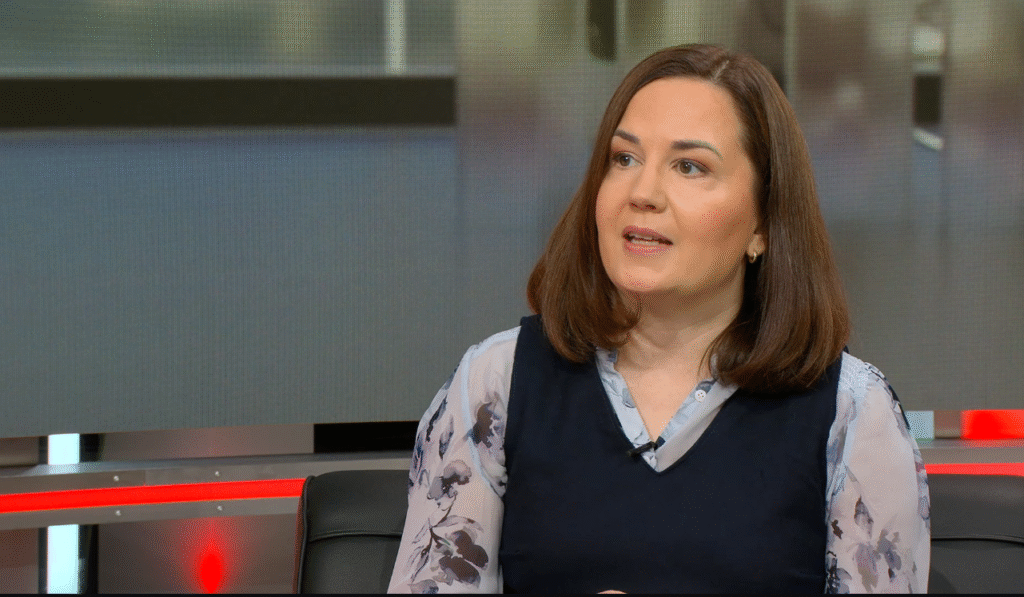
Social Welfare Minister Sanni Grahn-laasonen. How can a politician like GrahnLaasonen look after th migrants’ best interests if she wants to ban children from using the niqab and burka at school and shorten childcare allowance? Source: MTV.
When tightening immigration policy, ministers like Grahn-Laasonen turn to other Nordic countries.
“For example, the long periods of childcare allowance could be shortened, and we have two changes in the law underway in my department related to this: the preparation of integration support,” she continued. “[One of the changes] is the reform of childcare allowance based on the Norwegian model. which requires three years of residence to receive childcare allowance. The aim is to get immigrant mothers into work and, on the other hand, to get children into early childhood education to learn the language and get the best possible start to their school career.”
One of the challenges to these types of reforms is if they are constitutional.
The shame and contempt that the government of Prime Minister Petteri Orpo through their Perussuomalaiset (PS)* partners is iincomprehensible if you are a sensible-minded person. The PS was, is and will continue to be a racist party where its toxicity level varies. But mark my words: racism is its fuel and raison d’être, reason for being.
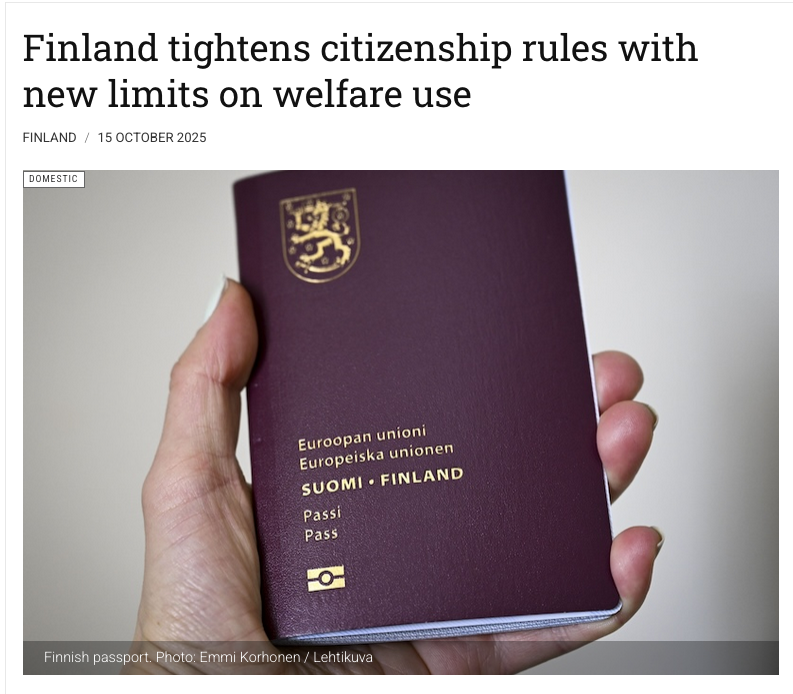
One of the most toxic decisions of the PS and the government has been to extend citizenship period from five to eight years, and now disqualifying people who are forced to live off welfare. The final step is to implement a citizenship test, which most Finns won’t pass.
Writes Helsinki Times: “The revised legislation, adopted by 103 votes to 58, forms the second stage of the government’s broader reform of the Citizenship Act. The main objective is to require applicants to demonstrate financial self-sufficiency through employment or business income, excluding most forms of public support.”
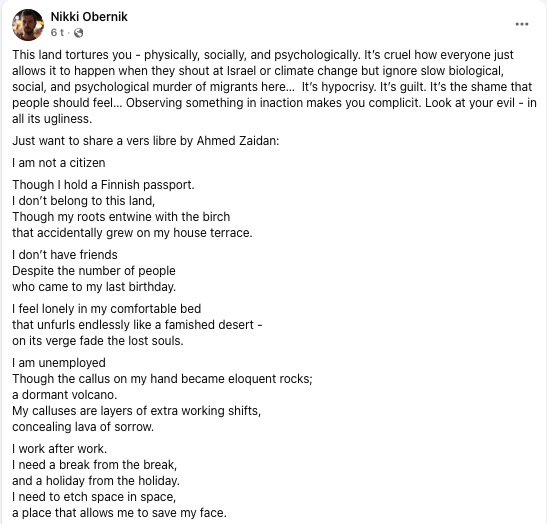
Some, like Nikki Obernik, saw the new phase of the citizenship act as a hostile phase.
The biggest problem with Finland’s tightening of migration policy swims in racism and aims to exclude and oppress foreigners. The laws, like the citizenship act, send out a clear message: We don’t trust you, we do not give you the benefit of the doubt, LEAVE unless you leave your identity and rights at the door!
The Perussuomalaiset (PS)* party is waging a hostile Islamophobic campaign to boost their low standings in opinion polls. The party is confident that the job will be done by increasing attacks on the migrant and minority community. That is the reason you hear and read PS politicians bashing migrants to divert attention from their disastrous economic policies.
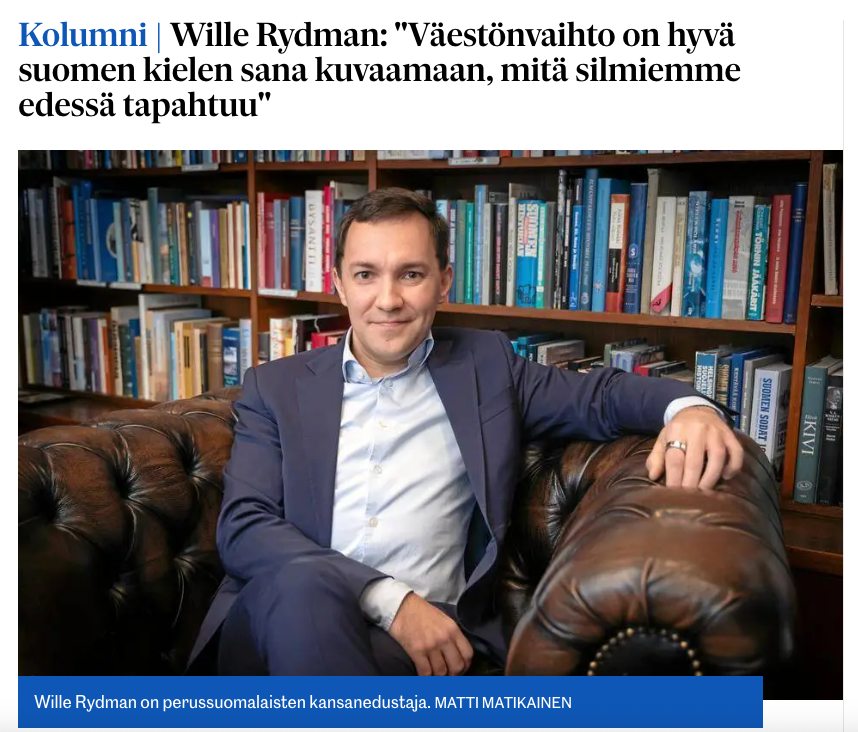
One of these PS politicians is Wille Rydman whose shameful writing exposes the lie behind the story.
He claims in a column in a community paper, which the mainstream media would most likely never publish, that the far-right Great Replacement Theory is a perfect term to describe what is happening in Finland.
“All this is happening completely openly and largely as a result of political decisions. There is no conspiracy, nor is one needed. The end result is a Finland that is becoming less and less Finnish. A country that is rapidly being populated by people who are anything but Finnish,” he claimed.
So what’s wrong with the statement? For one, he is talking about foreigners taking over Finland and that white Finns will become a minority, a typical Great Replacement Theory conspiracy theory that has led in 2019 to the mass killing of Muslims in Christchurch, New Zealand.
When you read the writings of people like Rydman, they forget to mention that following matters:
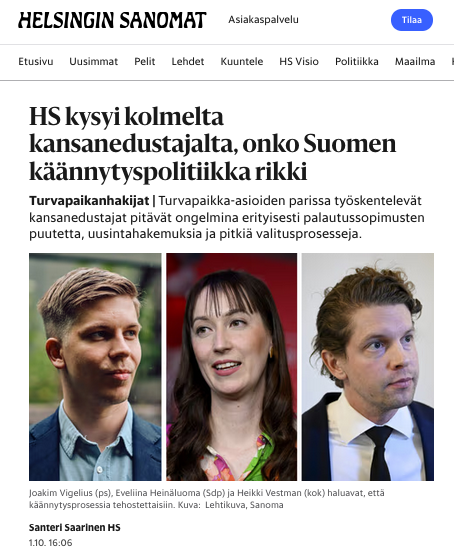
Think of it. Finland’s largest daily, Helsingin Sanomat, publishes a story if the country’s deportation. system is broken. For the story, the daily uses as sources well-known xenophobie Joakim Vigelius of the Perussuomalaiset (PS)* party, Social Democrat MP Eveliina Heinäluoma, who has a wishy-washy stance on migrants, and National Coalition Party MP Heikki Vestman, who justified as chairperson of the constitutional committee the shelving of Finland’s human rights obligations on the passage of the pushback law.
The migration debate in Finland seems very much like the lack of pushback against President Donald Trump by republican legislators. In Finland, we consider migrants, especially Muslim asylum seekers as a threat. We do not give such people the benefit of doubt.
The article is highly revealing exposing what Helsingin Sanomat thinks of undocumented migrants which it slaps on the “illegal” label.
Vigelius, who like Vestman to trash international agreements, said that the present asylum system is based on “outdated” international human rights conventions and that these should change.
‘It cannot be right that even after ten years and ten rejected applications, an asylum seeker is still residing in Finland,” he pointed out.
Apart from using MPs who would care less about undocumented migrants, a big shortfall of the article is that is does not care to mention the suffering present laws cause on such people. Migrant Tales has documented many such cases.
The Ulysses Syndrome is a chronic disorder and helps understand the trauma suffered by undocumented migrants.
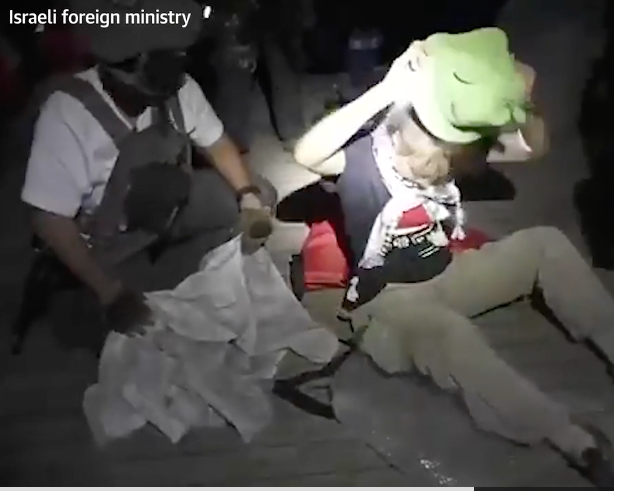
The silence of the Finnish government about Israel’s illegal action to stop the Global Sumud flotilla from reaching war-ravaged Gaza, where Palestinians are suffering from hunger, genocide and ethnic cleansing.
While governments from different countries were condemning Isreal’s action to stop the flotilla, Prime Minister Petter Orpo and his government went silent even if there were at least five Finns who took part and were detained by Israel.
The true “value” of Europe
There is a moral death that precedes the collapse of civilization and one day in the near future, when the truth will be told about the morals and values of Europe, it will be very short: none! with a footnote *for they were selective, reserved for the “chosen ones.”
A freedom of looking away, of choosing to dismiss and deny, a mainstream one way of disciple media championing an iron clad tightly “monitored freedom,” the freedom to accept what you’re told.