
Thanks to migration, Finland’s demographic makeup has changed. In Helsinki alone, the number of pupils in 2024 who have another mother tongue other than Finnish, Swedish, and Sami, has risen to 25.7% of the city’s population from 13.5% ten years ago. Such demographic changes have placed new challenges and a rethink on comprehensive schools and education in general.
For Suaad Onniselkä, a deputy principal of Helsinki’s Puistopolku Comprehsnvie School, the challenge is is not merely a logistical issue—it’s a matter of equity and dignity. She believes that Finnish schools, while striving for neutrality, often overlook how structural and cultural biases shape the experiences of minority students.
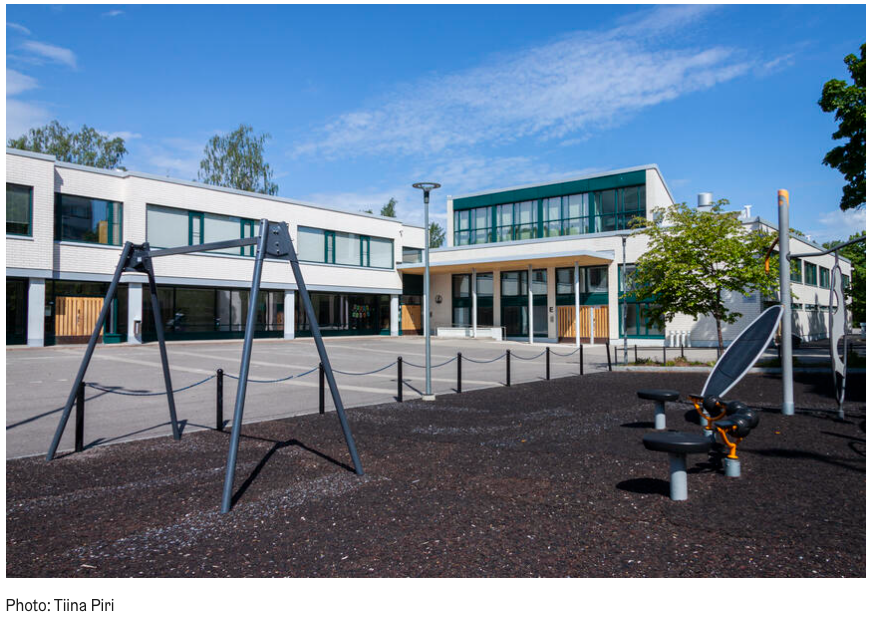
Puistopolku Comprehsnvie School is located in the Eastern Helsinki neighborhood of Vuosaari.
Ramadan and Islamophobia
Onniselkä describes the holy month of Ramadan as one of the clearest moments when Islamophobia appears in schools.
“In some extreme cases, pupils are forced to eat while fasting,” she said. “Even if poverty is an issue in some homes and food may be scarce, some schools are especially worried that a Muslim student might die during one month of the year. Forcing a pupil to eat doesn’t belong anywhere.”
There have even been cases in smaller cities, where social workers have suggested reporting fasting families to child protection authorities.
The Finnish Muslim Forum (Suomen Muslimifoorumi) has repeatedly emphasized that fasting during Ramadan is a matter of religious freedom, not neglect.
“Yet, no one [at school] even says ‘Happy Ramadan’ to me,” Onniselkä noted. “Then they talk in a negative tone. But I’m the principal of the school—and I feel bad about it. How does that young student feel? How much time and energy would it take for a teacher to simply say, ‘Hey, happy Ramadan, it’s wonderful that this special time has begun?’ That’s what amazes me.”
According to Onniselkä, prejudice in schools often manifests in subtle ways: through low expectations, stereotypes, or lack of representation.
“You can either ‘other’ or empower,” she said. “Too many pupils are victims of prejudice at school. The question is whether teachers see the student on their own terms—or through the lens of the majority culture.”
Finland’s national curriculum allows teaching pupils’ mother tongues and religions, but qualified teachers of Islam remain in short supply.
“In many schools, non-Muslim teachers are hired to teach Islam,” she explained. The main textbook, Salam by Sirkku Aboulfaouz and published by the Finnish National Agency for Education, does not address Islamophobia directly. “It’s up to the teacher to bring up the topic, even though many students experience it daily.”
Structural racism and the “gang” narrative
Onniselkä also connects Islamophobia to broader social anxieties, including recent societal and political debates on youth “gangs” and urban safety.
“I think the political parties like Perussuomalaiset (PS)*, the police, and even the press have taken advantage of this,” said Onniselkä. “They all win—except for the [labelled] young people involved. Teachers’ fears make the situation seem much worse than it really is.”
The so-called gang problem, she argued, has its roots in structural racism and stereotyping rather than in real organized violence.
“In the 2000s, white Finnish students would tattoo their postal code numbers—like ‘94’ for th eastern Helsinki nighborhood of Kontula—and no one called it gang behavior. Now, if a Muslim or if a student of so-called migrant background does the same, it’ becomes a ‘gang issue.’ That double standard speaks volumes.”
Onniselkä is also concerned about ethnic profiling by police, which she says is “quite commonplace” in some Helsinki neighborhoods.
“Students are stopped, photographed, and asked for ID,” she said. “Yes, there are human rights violations happening. And yet, police receive little or no anti-racism training.”
Anti-racism education
In her view, Finland lacks genuine anti-racism education.
“The fact that we get a 90-minute anti-racism course once every five years is basically a joke,” she said. “It should be systematic and part of every school’s equality plan.”
Onniselkä also challenges Finland’s narrow interpretation of equality.
“Equality doesn’t mean treating everyone the same,” she argued. “It means giving each student what they need to succeed. The new legislation on learning support recognizes this for academic needs—but not for cultural or linguistic ones.”
Structural racism also extends to teacher recruitment, according to her.
“To get a permanent position, a teacher must have level six proficiency in Finnish—an excellent level. That effectively blocks teachers born outside Finland, even if they’re fully qualified. Do we really need it to be that strict?”
When she began hiring teachers with diverse linguistic and cultural backgrounds, some Finnish colleagues reacted negatively.
“Collegiality turned into policing,” she recalled. “But after careful work and open discussion, it yielded good results. Now we have teachers who truly belong in this community. But it’s been a very long road.”
Trust and inclusion
Onniselkä believes that two-way inclusion, where both majority and minority communities learn from each other, is the key to meaningful change.
“If we have a hard attitude toward minorities, they will become hard too. But if we are soft and give them a chance to be part of this society, they will respond positively.”
She says racism at school often appears in “small things”—a careless comment, a biased assumption.
“No child should have to face racism,” she said. “Children have no means of defending themselves, and that causes lifelong trauma.”
Ultimately, Onniselkä believes that Finland’s schools can do better—by listening, by learning, and by taking responsibility.
“Anti-racism training must be regular and systematic,” she said. “It’s not just about teachers—it’s about principals, too. Respectful interaction belongs to everyone. And if a teacher does not treat a minority student with respect, they are guilty of misconduct.”
For her, education is not just about learning facts, but about shaping society.
“When new people join us, we must see them as a strength and an opportunity,” she said.
“That’s how we empower—not other.”
