
Further evidence of the National Coalition Party’s (NCP) swing to undemocratic xenophobism was the recent proposal by Foreign Minister Elina Valtoen to ban Russian tourists from Europe, ostensibly because of the Ukraine war. This would amount to an administrative reconstruction of the Iron Curtain, something Finland once famously sought to bring down or at least lower in the spirit of the Helsinki Conference of 1975 which championed freedom of movement and family reunification.
To ban travel by hundreds of millions for fear that some of them might be spies is the diproportionate sort of administrative overoppression that most human rights legislation is intended to prevent.
It is likely also that among many Russians who travel to the West are people who are not endeared with their coutry’s militarism and are looking for life chances elsewhere. I does little to serve the Ukrainian cause to embitter these people by shutting the borders to them and seperate them from friends and family in the West.
The National Coalition Party’s closet racists (kravattipersut)
This week was a unveiled even more the racist face of the National Coalition Party (NCP). In Finland, there is a perfect term to refer to NCP closet racists as kravattipersu. One of these kravattipersut is MP Atte Kaleva, who helped draft the NCP’s new policy againt migrants. In his opinion, and that of most of his party, Finland’s migration laws must be tightened even further.
If Kaleva and the NCP parliamentary group have their way, Finland will not have asylum seekers in the future—who will be sent to detention centers abroad—family reunification will be made more difficult, S2 Finnish classes for non-native speakers will be done away with, and there will be no more language courses for chidren in their mother tongue.
Kaleva said that the big matter differentiating the NCP from the far-right Perussuomalaiset is their view of labor migration. NCP are in favor of labor migration while the PS oppose it.
If there is anything positive to say about the tightening of the NCP’s migration policies, it’s the fact that not all approved his suggestion.
Kaleva has called himself in the past a “researcher” of Islam, but this has been widely disputed. Kaleva does not hold a doctorate degree. To some, he appeared on talk shows as a “researcher,” but his “researching” revealed more of his anti-Muslim racism.
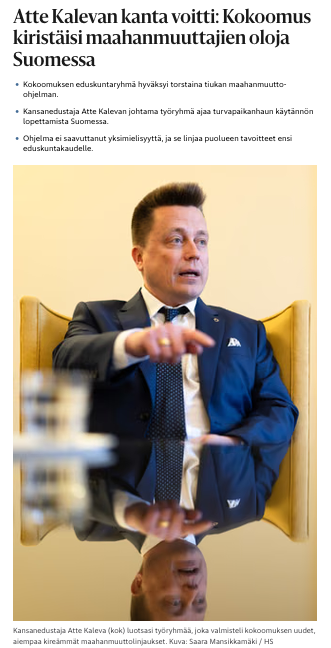
Read the full story in Finnish here. Source: Helsingin Sanomat
Another NCP MP that has receive criticism for his treatment of asylum seekers is Heikki Vestman.
Continue reading “The National Coalition Party’s closet racists (kravattipersut)”Our surprise at racism and fascism shouldn’t surprise us
The eagle never lost so much time, as when he submitted to learn of the crow.
Wiliam Blake
The worsening fortunes of Prime Minister Petteri Orpo’s National Coalition Party (NCP) hit hard in the latest Yle opinion poll, which showed the far-right Perussuomalaiset (PS)* overtaking the NCP in second place.
What is the lesson to be learned? A racist far-right party will never change its ways because it is in its DNA.
Under Orpo, racism has become normalized in Finland.
How is this horrible despite Orpo’s assurances of the government’s no tolerance for racism?
But what can you expect?
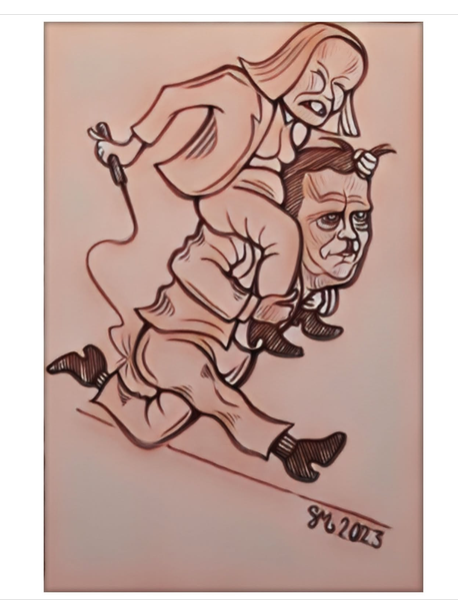
Purra riding on Orpo. Source: Mora Sixi
In a column headlined “Three years of zero tolerance for racism: zero results,” Helsingin Sanomat reporter Satu Vasantola shows how the government has advanced and strengthened racism thanks to coalition partners of the PS.
But the big question is not how Orpo has fed racism, but the media’s and politicians’ reaction.
You may ask how it is possible to utter a few meaningless anti-racism catchphrases and remain indifferent. We can thank the government and how it has protected institutional racism. That is why you can be racist and get away with it in Finland.
What to do? Keep fighting, inspire social movements, and remember what Argentinian human rights activist Taty Almeida said: “The only battle you lose is the one you abandon.”
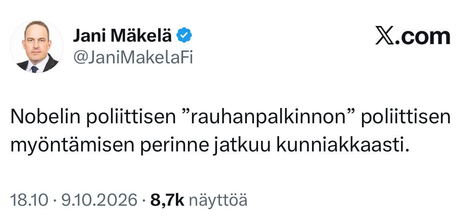
In this snub to Navi Pillay for being awarded the Nobel Peace Prize, Jani Mäkelä, the chair of the PS parliamentary group, parrots Tump’s disappointment. “The tradition of Nobel’s political ‘peace prize proudly continues.” Source: X
YLE poll: NCP demoted to third place
In the latest opinion poll published by Yle, the National Coalition Party (NCP) has fallen into third place after the anti-immigration Perussuomalaiset (PS)*. The Social Democrats continue to lead the poll.
In the face of scandals like Garden Helsinki hitting the National Coaltion Party, the result did not come as a surprise.
The poor showing of the government and weak leadership of Prime Minister Petteri Orpo are to blame for the PS’ good fortunes at the cost of the NCP. One observer put it well: the PS are straightforward about their racism while the NCP is still in the closet about it.
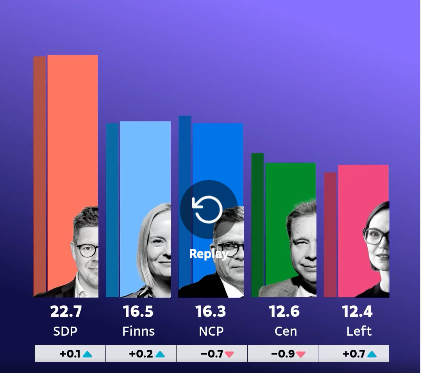
Source: Yle News
The fact that the PS are pouring it on with their racist rhetoric as the NCP is near silent, it’s clear that Finland continues to have a notable racism problem.
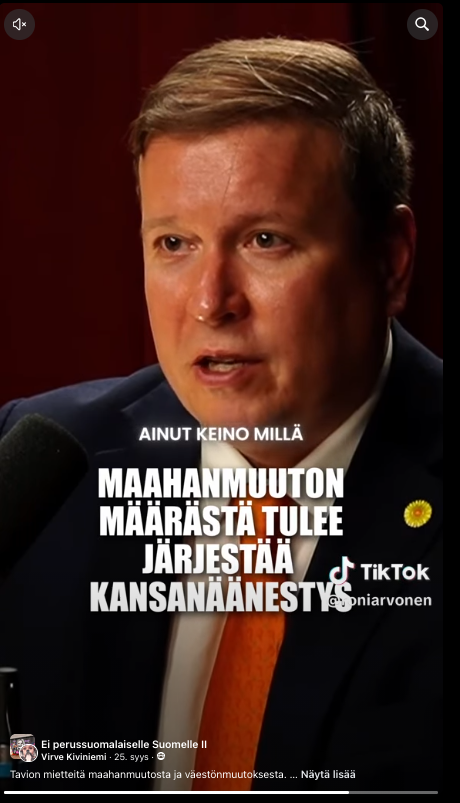
Ministeri Tavio haluaa järjestää kansanäänestyksen, jolla maahanmuutto Suomeen rajoitettaisiin muutamaan tuhanteen
Perussuomalaisten ulkomaankauppa- ja kehitysministeri Ville Tavio on varmasti yksi Petteri Orpon hallituksen radikaaleimmista ministereistä. Sen lisäksi, että hän levittää salaliittoteorioita väestönvaihdosta, hän ehdottaa, että Suomessa pitäisi järjestää kansanäänestys, jolla ulkomaalaisten määrä maahan rajoitettaisiin 0,1 prosenttiin eli noin 5 000 henkilöön vuosittain!
Tavio esittää nämä törkeät väitteet Roni Arvosen blogissa, entinen Kokommukselainen jäsen, joka erotettiin radikaalien näkemyksiensä vuoksi.
Maan suurin päivälehti Helsingin Sanomat julkaisi lauantaina hänestä artikkelin, mikä toi hänelle lisää näkyvyyttä ja samalla hyväksyntää.
Katso kela täältä
Vaikka näitä selvästi rasistisia ehdotuksia esitetään, pääministeri Petteri Opron hiljaisuus on korvia huumaavaa.
Tavion ja hallituksen passiivisuus rasismia kohtaan on otollista maaperää institutionaaliselle rasismille. Nykyisen kaltaisen hallituksen vallitessa on selvää, ettei Suomessa tule tapahtumaan mitään muutosta, paitsi että maa liukuu yhä syvemmälle äärioikeiston maailmaan.
Häpeä myös Helsingin Sanomille siitä, että se on antanut kritiikittömästi äänen poliitikolle, joka liikkuu Sebastian Tynkkysen, Atte Kalevan, Jussi Halla-ahon, Tere Sammallahtin ja heidän kaltaistensa seurassa.
Can you be Finnish and non-white? Certainly!
The question is not if you can be Finnish but who is tying up but who or what is denying you from being Finnish?
Even if we can blame parties like the openly xenophobic Perussuomalaiset (PS)* for making immigration issues as the bedrock of their identity.
In Finland, coalition partners like the National Coalition Party (NCP), Swedish People’s Party and Christian Democrats, which collude with the PS and make their restrictive policies towards migrants and minorities possible, are also culprits.

Finance Minister Riikka Purra (right) stated that there is no room for Muslims in Finland. “Finland and Finnishness are based on Christian values,” said Interioir Minister Mari Rantanen. Purra stated that she considers Islam an “aggressive” culture that is preying on Finns’ tolerance, friendliness, and kindness. “But Finns must not give up their language, culture, values, nothing to such groups!” she said. Source: Facebook, https://www.facebook.com/reel/1460584212024116
nstitutional racism is another culprit that dominates the debate. The police considers “a person of foreign background” anyone whose parents weren’t born in Finland. If one of the parents is a Finns, that person is “of Finnish background.”
Since Sari Essayah’s farther is Moroccan, she is never referred to as a “person of Finnish descent.”
Apart from being exclusive and racist, these types of labels are used at schools to not only separate Finns and non-Finns, but to reinforce that they will always be second-class members of society.
I have lived on and off for over forty years in Finland and have faced exclusion since the beginning when I moved here. What have all these years and challenges taught me? That Finland is my home no matter how racists try to convince me of the opposite.
Reija Härkönen: Suomen hallitsevat äärioikestolaiset rasistit

Hallitus on lähettänyt puolustusministeri Antti Häkkäsen Israeliin tukemaan Netanjahun toimia muslimilasten hävittämiseksi ihmiskunnasta. Häkkäsen muslimiviha on entuudestaan tunnettu ja höpsöt vihjailut ”sharia-lain” mahdollisesta tulosta Suomen lain tilalle ovat saaneet mennä mediassakin lävitse ilman asianmukaista taustoitusta tai kommentointia. Nyt Häkkänen pääsee Israelin varjolla toteuttamaan muslimisopeutusta ihan melkein pyssy kädessä.
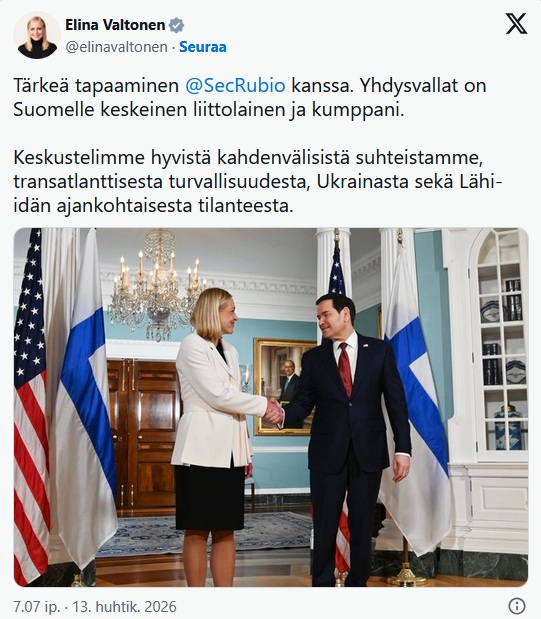
Ulkoministeri Elina Valtonen luikahti eduskuntaan rasistisilla, muslimivastaisilla kirjoituksilla ja jatkaa nyt työtään pitämällä yllä kiinteää suhdetta USA:n äärioikeistohallituksen ulkoministeriin. Harva kokoomuslainen tuota lukiessaan huomaa, että ”Lähi-idän tilanne” tarkoittaa Valtosenkin tukemaa, yhä jatkuvaa muslimimurhaa usealla eri rintamalla.
Sisäministeri Mari Rantanen on saanut toimensa nojalla rauhassa toteuttaa muslimivihaansa ja tuoda Suomeen yhä rasistisemman ilmapiirin. Hänen alaisensa suojelupoliisi ja rajavartiosto toimivat jo kuin konsanaan natsi-Saksan aikaiset järjestys- ja terrorilaitokset.
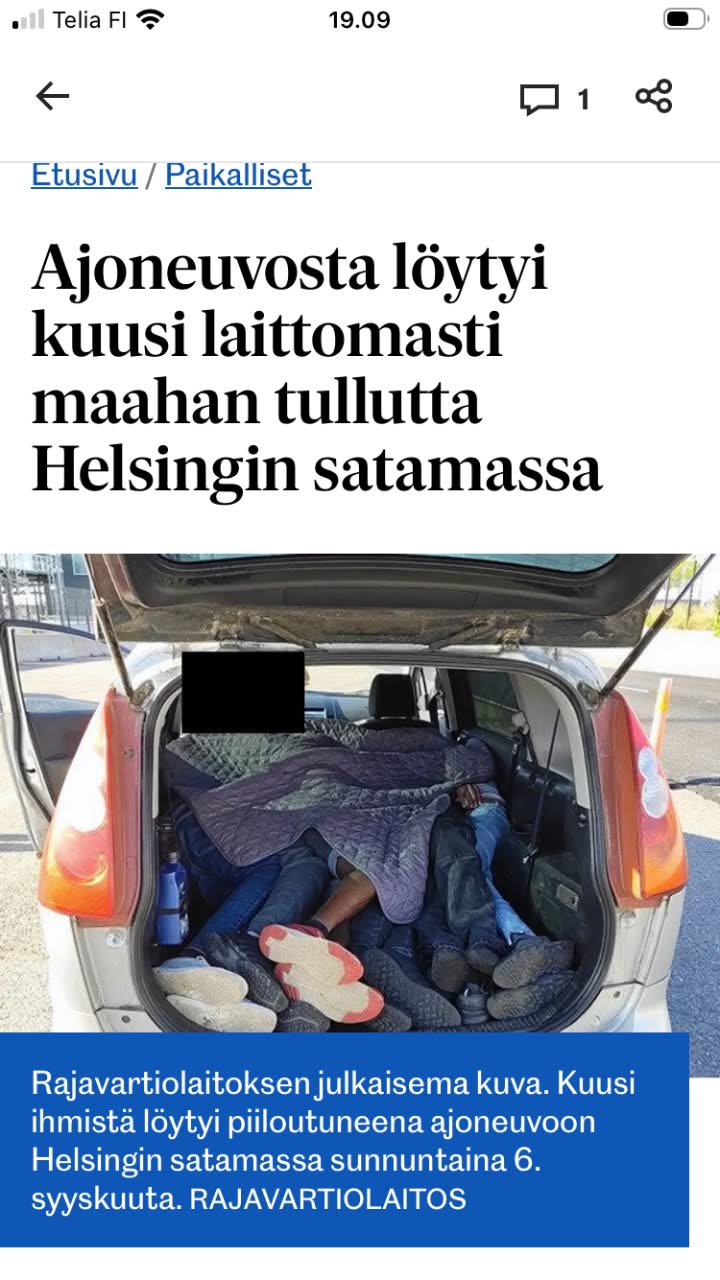
Ministeri Mari Rantanen on epäpätevä kiihkoilija
Mistä Mari Rantanen ja hänen puolueensa syvään juurtunut rasismi juontuu? Onko se tietämättömyys vai suorastaan vihaa, josta hän ammentaa voimaansa?
Olen aina väittänyt, että tärkein syy, miksi hallitus päätti sulkea Suomen ja Venäjän välisen rajan, oli sen ”nolla turvapaikanhakijaa” -unelman toteuttaminen.
Rantanen vahvistaa tämän viestissään, jossa hän sanoi, että jos asia olisi hänen päätettävissään, hän toteuttaisi nollatavoitetta hakijoiden vastaanottamisessa, nolla vastaanottorahaa.
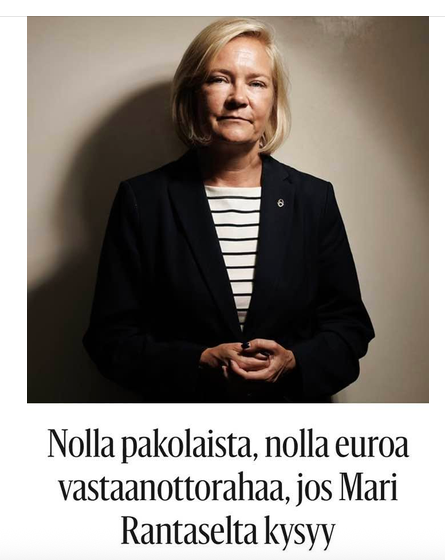
Rantasen tietämättömyyden lisäksi, , hän on sisäministerinä täysin epäpätevä. Hänen puolueensa vihamielinen politiikka maahanmuuttajia ja vähemmistöjä kohtaan on yksi syy siihen, miksi Suomi kärsii pitkästä taantumasta.
Kiitos Lea Korhoselle vinkistä.
Miten suomalaiset tiedotusvälineet ylläpitävät stereotypioita ja epäluuloa vähemmistöjä kohtaan
Tässä on jälleen yksi esimerkki siitä, kuinka suomalaiset tiedotusvälineet pitävät kiinni mustien ja ruskeaihoisten nuorten leimaamisesta rikollisiksi otsikolla, jossa esitetään melko tyhmä kysymys: ”Miksi nuoret liittyvät jengeihin?”
Pihla Loulain artikkelista käy selväksi, että hän on kiinnostunut erityisesti leimaamaan nuoria, joilla on maahanmuuttaja- tai vähemmistötausta. Hän totesi artikkelin alussa, että 90 % jengiläisistä on ”ulkomaisesta taustasta tulevia nuoria”.
Hän on jälleen yksi nuori toimittaja, joka yrittää valottaa nuorisojengien kaltaista yhteiskunnallista ongelmaa, mutta epäonnistuu, koska hänellä ei ole riittävää syvällisyyttä eikä tietoa asiasta.
Toimittaja haastattelee kahta nuorta, Abbasia ja Leoa, jotka kertovat nimettömästi siitä, miten he päätyivät jengielämään ja rikollisuuteen.
Näiden kahden nuoren on tarkoitus edustaa kaikkia ulkomaalaistaustaisia nuoria. Hänen tavoitteensa on ilkeämielinen: tällaiset ihmiset ovat rikollisia ja uhka yhteiskunnallemme.
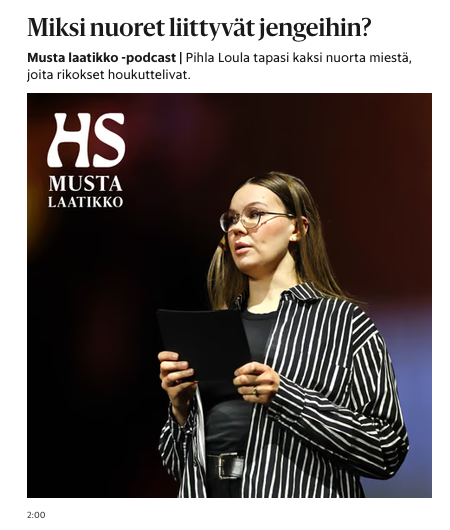
Source: Helsingin Sanomat
Migrant Tales julkaisi raportin siitä, kuinka tiedotusvälineet, poliisi ja poliitikot vahvistavat rasistisia stereotypioita maahanmuuttajista.
Lue raportti täältä.
Loulan ja Helsingin Sanomien artikkeli on häpeällinen ja puolueellinen, ja se osoittaa, kuinka syvälle maahanmuuttajia kohtaan tunnettu viha ja stereotypiat ovat juurtuneet suomalaiseen yhteiskuntaan.
Finnish government: Backpedaling on human rights and the rule of international law
THIS POST WAS UPDATED
A scoop by Yle exposed how the Finnish defense ministry silently signed a 10-year memorandum of defense (MoD) material cooperation with the government of Israel to 2034. Even though Finland’s opposition parties have strongly criticized the government and National Coalition Party (NCP) Defense Minister Antti Häkkänen, the latest scandal shows how far the country has regressed on human rights and the rule of law.
Minister Häkkänen’s Islamopobic and Russophobic views are well known.
All four parties in government, the NCP, Perussuomalaiset (PS)*, Swedish People’s Party and Chritian Democrats, are to blame for the situation. Despite NCP Prime Minister Petteri Orpo’s leadership in challenging racism, we have seen the opposite happen in Finland.
Racism has grown and become normalized under the present government and therefore ha lost a big chunk of its credibility.
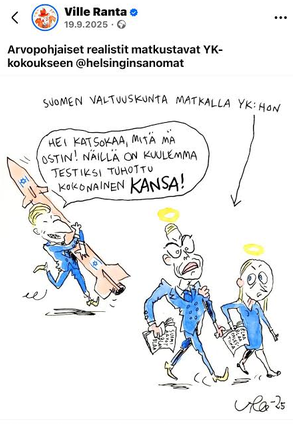
Antti Häkkänen together with President Alexander Stubb and Foreign Minister Elina Valtonen. “Hey look what I bought,” said Häkkänen. “I have heard that these have been tested on erasing a whole people.” Helsingin Sanomat
The MoD was signed when Israel started the killing of over 70,000 children and women in Gaza. Green League chair Sofia Virta described the government’s Israel policy as a “historic shame.”
“When we demanded pressure on Israel, the government tightened cooperation,” she was quoted as saying in the Helsinki Times, “When we demanded that dependencies on Israel be reduced, the government deepened them,” Virta said in a party statement.”
Left Alliance Chairperson Minja Koskela asked if Prime Minister Orpo and Foreign Minister Elina Valtonen had been adequately informed. “The silence does not surprise me, because the chosen line is intolerably shameful,” Koskela said in a statement.
The interesting question to watch is if the government will, like its continuous racism scandals, sweep the issue under the rug with silence and inaction.