Migrant tales
Menu
  • #MakeRacismHistory “In Your Eyes”
  • About Migrant Tales
  • It’s all about Human Rights
  • Literary
  • Migrant Tales Media Monitoring
  • NoHateFinland.org
  • Tales from Europe
Menu

Category: Fadumo Dayib

Migrant Tales (December 9, 2013): Fadumo Dayib – Run, Nigger, Run

Posted on May 21, 2015 by Migrant Tales

Fadumo Dayib

I came to this country as a refugee in 1990, at the time of recession and when foreigners where a rarity. As a result, we had become a “Somali shock” overnight. It was common at the time to hear racial slurs, to wake up to the sounds of “perkele”, to drink tea to “mutakuono” and to dance to “vitun neekeri”. People would stop to gawk on the streets, kids yelling “look mommy, a nigger”. Grandmothers would ambush me in the swimming hall shower and scrub me down, hoping to wash the color off. Others, after a few pints, would come over to touch my hair and make inappropriate propositions. I went from being an individual, with aspirations, feelings and rights, to a degraded sub-human: a “mud face”, “nigger”, “whore”, and “social loafer”.

Näyttökuva 2015-5-21 kello 9.18.28

Continue reading “Migrant Tales (December 9, 2013): Fadumo Dayib – Run, Nigger, Run”

Fadumo Dayib: Rape is a frequent occurence in Somalia, here, rape is normal

Posted on March 8, 2014 by Migrant Tales

Fadumo Dayib

Somalia: Women Shouldn’t Live in Fear of Rape According to this HRW report published last month, ” The UN reported nearly 800 cases of sexual and gender-based violence in Mogadishu alone for the first six months of 2013, although the actual number is likely much higher. Many victims will not report rape and sexual assault because they lack confidence in the justice system, are unaware of available health and justice services or cannot access them, and fear reprisal and stigma. When Human Rights Watch asked one survivor why she did not report being raped, she shrugged: “Rape is a frequent occurrence in Somalia. Here, rape is normal.”

<iframe width=”560″ height=”315″ src=”//www.youtube.com/embed/1V1KV6-dvGM” frameborder=”0″ allowfullscreen></iframe>

It is troubling to read these reports day in and day out. The government turns a blind eye, the society blames the rape survivors and their communities ostracizes them.

If the survivors seek justice, they will, in worst cases, be subjected to a traditional court and possibly be even forced to marry their rapists. The traditional court is a tea shop for older Somali men who think that marriage is the solution to every problem facing Somali women. Can you imagine that? What kind of justice is that?

Finding the above option unappealing, other survivors opt to have their cases handled by the government. This is a government confined to a few areas in Mogadishu and which is fighting for its existence. These poor survivors eventually end up being imprisoned and possibly even subjected to even more sexual violence.

Either way, they’re damned.

Read original column here.

This piece was reprinted by Migrant Tales with permission.


Fadumo Dayib: To research, or not to research Somalis, is the question

Posted on February 24, 2014 by Migrant Tales

I am here today to reflect on being the other, on othering. I am not here as a PhD student from this University but as an activist, a blogger and as your research object.

Kuvankaappaus 2014-2-24 kello 10.10.30

Read full essay here.

The previous presenter raised a very important point that activism does not put bread on your table. I concur with her.

In fact, I want to expound further on that point by arguing that one cannot be paid and be an activist at the same time. By that I mean, if I was receiving funding from an entity that is unethical, could I be an activist? Would I have the freedom, the backbone to question their unethical practices knowing the repercussions? What if they claimed to work on equality but never hired minorities? If they claimed to fight racism while having a white board? Could I be involved in these institutions and claim to be an activist? Can a colonialist be an anti-colonialist while still in the colonialist establishment? My answer is no.

I came to Finland, as a fleeing refugee, with a battered suitcase and a chunk of halwa in my kiondo in 1990. While I slept soundlessly in a motel called Matkakoti in Helsinki, dreaming of cardamom tea in Xamar, the Finnish press was busy selling mass hysteria. A man saw the opportunities the newcomers brought with them and quickly sat down to write. As a result, the first descriptive text on Somalis, or rather their invasion of Finland, was penned. That text was aptly titled “Somali Shock”. I stumbled upon it years after I’d arrived, dazed from all the racist slurs but still desperate to belong. I sought answers, comprehension but never got any.

Somalis became an interesting phenomenon to study. Why would all these young, mostly good looking young men want to come to Finland? Why were they all coming through Russia? Why were they not malnourished, with flies buzzing over their runny noses? Why Finland when thousands are migrating elsewhere? These questions woke a few hibernating researchers who then devoted their time to their new pets. After all, the Somalis looked, smelled and acted differently. They mistreated their women, neglected their children, ran away from fighting in Somali, were loud and had a fetish for Finnish women. In addition, they also had a liking for extravagance, shiny stuff, perky breasts, driving in BMWs, and at the cost of the generous welfare system. This was a phenomenon worthy of a study. I never had the pleasure of meeting these researchers personally but followed their activities through the grapevine.

Fast forward to 1995, a Finnish woman married to a Somali man is in our house, asking questions about death and studying how we deal with grief. She is doing a PhD on Somalis, is dressed as a Somali, henna on her hands, gold bangles jiggling. She is more Somali than I am. You see, this is very important. A researcher must resemble the natives, must eat as they do, must be part of them and must behave like them. After all, this is an ethnographic research. But does that mean she knows what I am feeling? What it is to be me? What it is to be a Somali woman, a Muslim from Africa? No. She is a privileged white woman. The power dynamics are skewed in her favor. No amount of dressing, mannerisms, is going to change that reality.

She shoots her Finnish questions relentlessly, her tongue darting in and out of her mouth. I don’t hear her, my mind is on my mother, the only solid foundation in my life, crumpling under my feet. My mother who is slowly dying in her sterile hospital room. My mother who has always been by my side, is going on a long journey, alone. The persistent chatter from the researcher never ceases. It floats above the community din, overwhelming my dulled senses.

As death went about his business, I tried to negotiate for a few days, hours, minutes. He shook his head, stood above her, and coaxed her soul to depart. I kissed her face, wiping away her sweat and my tears. Death, the only certainty in life, had accomplished his mission. The researcher hovered about, notebook in hand. She asked me something, pink mouth moving silently. I looked away, ear cocked, head turned to the side, listening for any sounds from my mother. I heard someone explaining something to her. No, you cannot take pictures. No, you cannot go to the grave. No, because women are not allowed to.

The next day, she stayed with us at home, observing our grief. As my brother was putting my mother’s head in the grave, kilometers away, her husband came out with his camera and started snapping away. The camera was wrestled from his grip and taken away.

Years later, I read her PhD research and could not place myself in her writings. That is not what happened on that day, at that hour, I fumed. I should know, that is when my mother died. We were never presented with the findings and were never involved with her research in any way. However, her research, her participatory research, claims otherwise.

Now fast forward to 1999, the start of the research avalanche. The Somali communities had researcher commandos coming through their front doors, back doors, windows and even through their roofs. You could hire a Somali to open their community for you, rush in and pick your research objects. If you were a feminist, you’d pick the Somali woman with her pregnant forehead. If you were a youth activist, you’d pick her adolescents with their protruding teeth. If you were a social worker, you’d pick her children with their swollen bellies. For some strange reason, the Somali man, lucky bastard, was never picked on as a study subject. As a researcher, you’d work your way up from a novice researcher to an expert, to a specialist on Somalis. This was the golden era in Somali research.

Now fast forward to 2002, the research specialists linked up with associations/NGOs and put their drinking straws into the blood of the Somalis. The trend was to publish your research, then set up an EU-funded project and call it a name like “half-an ass”, your momma”, “save a skinny Somali” or something like that. To gain legitimacy, you’d scrawl Somalis on your cover page and disregard any ethical considerations. It did not matter that you did not interview all the Somalis; that you only interviewed a handful. It did not matter whether you consulted your target group, what they thought of the labels attached to them, of your findings. All that mattered was gaining recognition and making a livelihood. Once you had that project which allowed you to overnight in Mogadishu, dine in Nairobi and drink in New York, you were set for at least four years or more.

Now fast forward to 2006, I am a development expert and planning a project for a certain country. I fled Finland as a refugee, fled from xenophobia, to faraway sunny places. Obsessed with doing good deeds, I spent endless hours working on plans, calling meetings the next day and getting signatures from the parties involved by that evening. The plan was given to them for implementation, along with funding. When the reporting time neared, the implementing party sat and churned out a report to my liking. Instead of teaching them how to fish, I taught them how to relay on donors. I bought the ingredients, cooked the food, invited them over, offered it to them and even told them how to eat it. And so life went on. My point here is that I know what it feels like to plan for people, to take away their agency instead of planning with them.

Now fast forward to 2014, I am a PhD researcher. As I embark on my research, I am mindful of my two roles, of being a researcher as well as the researched. I sit with you, not as an object but as an equal being and challenge you to think outside of the box. As I stand here, I know that there are some here who think that I don’t belong. You’d rather exclude me. Perhaps you believe that exclusion and inclusion are only concepts? You would rather continue seeing me as the other, the exotic, the victim. You want to silence me so that you can continue to speak for me, speak over me. Do you think you can tell my story better than me?

I also know that there are some here who are offended by what I am saying. But as you’re stewing in your indignation, please remember that it is not about you. It isn’t and has never been about you. It is about the other, the communities that have been researched to death. It is about producing the same bull year in and year out.

Then there are those from these communities who cry wolf, who blame others for entering and researching these communities. I understand their views. Like them, I want the researchers to stop focusing on producing disempowering narratives on Somalis. I want them to stop generalizing their findings to all the Somalis: to the Farah and Farhiyo eating peanuts peacefully in Puijonlaakso. However, my response to them has been that as long as there are people among us who let in these researchers, then they should also be blamed. It takes two to tango. The reasons for letting in these researchers are various. Some of us let in these researchers, hoping to get something out of it. But when that does not materialize beyond consultancy fees, salary,  acknowledgement or a career as a used fiddle in the hands of your fiddler, what then?

If your research has nothing new to add, then please don’t do it. It does not help that you recruit assistants from these communities, that the gates have been opened to you, that your team has people from these communities. If the end result is the same as your findings in 2001, then it is time to call it quits. Or is it?

Thank you.

Read original column here.

This piece was reprinted by Migrant Tales with permission.

Fadumo Dayib: The Cannibalistic Clan Club aka CCC

Posted on February 1, 2014 by Migrant Tales

Fadumo Dayib

Caraweelo, both fists raised in defiance, body contorted in mockery and eyes wide open with belligerence, burst into this world with a single, loud, blood-curling scream. Her kin, upon seeing the jewel between her legs, drew back with disgust and disappointment, all the while murmuring verses of protection.

A few old men, scared out of their wits and way past their due date, lay comatose on the scorching ground, recovering from the chilling scream. God help their kin from this abomination, this vile curse. What a waste of space, of humanity. She was and would never be of use to their kin. Surely, the drought and this creature were Satan’s antics, his offspring. Caraweelo, who could read their minds, spread her legs wide, reached for her jewel and rained on the land. She knew she had a long journey ahead of her, a destiny to fulfill. She looked into the tired eyes of her mother, laughed and reached for sustenance.

Caraweelo was blessed with the gift of insight, reflection and observation. She watched quietly, hidden in the safe zone in her mind. Women, in colorful robes, flirted back and forth, selling their dreams. Their men, fat and belching, the leeches, sat on mats chatting and chilling. They were discussing important matters, Caraweelo was told, and should not be disturbed. But Caraweelo knew better. She chewed her lips, drawing blood. She shuddered with resentment. They were fools in skirts, cowards who never ventured into war. Instead, they sat, plotted and planned the down-fall of an unseen rival. After dark, they would jump on their bone-weary wives and gallop into the sunset, alone.

When Caraweelo was six, her grandfather came for her one dark night and took her worth away. As she lay, bleeding and petrified, he proved why blood was thicker than water. You see, charity starts at home. Yes, it is true that nobody has the power to hurt you as your kin. It did not matter that she was still in stitches, recovering from mutilation, in strict observation of culture and tradition. She was their rubbish bin, their semen cup. That was all she was good for and would ever be good for. Caraweelo’s mother told her to bite her tongue, to sit on her lips and to conform. A good girl should not be seen, should not be heard and should aim to please. Hush child. This is your destiny, your role in life. Caraweelo disagreed silently. Her day would come one day.

When Caraweelo was thirteen, her grandfather gave her to his close friend…his distant cousin. He had trained her well and knew that she would bring prestige to her family. She watched from afar as the two old men sat, whispering and giving her furtive glances. Her 50-something year old husband looked at her, smacking his wrinkled lips. With the exchange of one camel and two cows, Caraweelo moved into the camp of her kin, her grandfather. That night, Caraweelo tasted bondage, tasted fear and blood. She had flashbacks of her violent initiation, her rape, into her kin…her clan. Her 13-year old body curled into itself, begging for mercy. He was oblivion to her cries, heaving and gasping. Shush. You’re a woman amidst millions of other women with similar faiths and destinies. You’re nothing. You don’t count. You don’t belong to any clan. Caraweelo bit down, swallowing her screams, cursing and vehemently disagreeing.

Caraweelo’s husband came into some wealth and moved her to Mogadishu. She was a young mother and still proud. She was still standing…..still strong. War broke out and they had to flee their beloved country. Finland was open, welcoming….or so she thought. Her old husband found the new country tough and turned to bitterness.

As he grew old, diminishing, Caraweelo grew into a beautiful black swan. She learned the new language, the new culture and embraced the new world she’d stepped into. Hush woman. Stick to your four walls and raise your children. Enough of your madness. Shut up, Caraweelo yells. You don’t own me anymore. Shush woman. You’ll go to hell for disobeying God. Shut up, she yells back. Since when did you abide by God’s rules? Hush infidel. Her husband – a serial wife beating rapist – became a sheikh during the day. When religious blackmail failed, her husband resorted to karate chops and kicks. When the next karate chop came, her husband suddenly found himself on the floor of their flat, overpowered by emancipation and enlightenment.

Caraweelo’s kin, her clan came to reconcile the two. This was the day she had lived for all her life. They came, all men. Of course they were all men. The cannibalistic clan is an exclusive club for goat-fuckers, father-fuckers, mother-fuckers and daughter-fuckers. Caraweelo let it rip. She let the shit hit the fan. Hush woman. Blood is thicker than blood. You’re mistreating your grandfather….your next kin of blood. He has sole ownership over your body. Shut up, Caraweelo yells. Where were you when my kin was ripping me apart? Raping my innocence? Shush woman. He has rights over you, rights over your children. Please, she says and rolls her eyes. I am married to the Finnish government. It pays my bills, puts a warm roof over my head, educates my children and takes care of my worries. Hush woman. You kin, your clan are your blood and marrow. Please, she yells back. I was born into wilderness. I never belonged. I was never counted for.

Caraweelo, after getting rid of her nightmare, ended up with her son. A tyrant like his father.  When he fully slipped into his father’s shoes, she cut the umbilical cord and threw him out. She devoted her time, energy and love to raising queens, to raising warriors, to her daughters. She watches other women silently, with keen observation. She observes the clannish women. They look smart and educated on the exterior, but are rotten to their clan core. They parrot talk about emancipation, empowerment, nationalism, religion and equality during the day time and turn into clan cannibals when the sun sets. They conspire to congregate in dingy cafes, smelly alleys, forsaken homes and treacherous associations with their kin, their men, plotting and planning.

Caraweelo knows these women. After all, they are her cousins, her mother, her aunts, her grandmothers and her offspring. They are her and she is them. These are women who are more loyal to their clan than to their womanhood. Hush woman. Don’t hush me monster. You are repugnant….a traitor to womanhood……a traitor to Somalia. Instead of getting ahead based on qualifications, you resort to writing lists with your moronic kin. After all I went through, for you and for all the other women, this is what you do, she admonishes. I sold charcoal, my body and paid everything I had in my possession so that you could get to safety. Hush, I am Caraweelo. Let me speak. Let me put things into perspective for you.

You came to the Diaspora on the pretext of running from the clan militia, your cousins. What do you do upon reaching safety? You churn out lists, hate lists, of those you perceive to be better than you. Because it irks you that others are progressing, are making an honest living and getting ahead in life, you obsess over your lists. It irks you that you never managed to annihilate them from the face of the earth. You are a traitor, conspiring with men, your kin, your clan that raped you, molested you and your children. You are supporting a structure that enslaves you, dehumanizes you, denies you existence and that is uncivilized. Don’t you ever shush me! You never mattered to them and even as you conspire with them, they still despise you. Don’t you see my sister, my daughter, as long as you have a jewel between your legs, you’ll never matter to them.

Caraweelo speaks the truth. It hurts and is unpleasant. The cannibalistic clan mentality is deeply ingrained in these women. Every Friday or Saturday evening, they appear adorned in expensive robes and gold. They show up for their clans in the numerous weddings taking place almost every week. Yes, blood is thicker than water. Some of them have never worked a day in this country, can never write nor read any language. It is not uncommon to run into them at the health centers with back-aches, stomach-aches and other psychosomatic ailments. They’ll do anything to get out of going to school, work or reality. To becoming productive citizens. However, on that evening when their clan multiples, they’ll speak in languages. Hallelujah! When the lies start about her clan….how they rule the seas..even when they’ve never seen what it looks like and all of that shit….she’ll jump into the air, flick backwards, somersaulting all over the place and rolling on the carpet. Hallelujah! A miracle, she’s cured of her back-ache, her debilitating sickness. What a pity that the employment office staff, or the social worker, aren’t there to see this miracle.

Hush little girls. Give it up. Burn those lists. Desist with your malicious efforts. Your opponents still continue to exist despite your lists. Your hosts, although initially puzzled and supportive, now can see through your deception. No, she yelps, uncertainty in her eyes. I am my clan and they love me. Shush girl. That’s the devil talking in you, Caraweelo says. Desist with your poison. The CCC is not for you. It never was and it never will be. Cannibals eat each others. They’ll turn on you when all else has been eaten. Stop sponsoring your terrorist cousins. Cut their funding and put an end to their pillaging of Somalia. Somalia is one and will always be one. Put your clan flag away and unite under womanhood.

Shush little girl. You belong with the women folk, we are your womanhood, your sisterhood. You belong with me, with us. I will cure you of your disease, you’re dear to me, you’re my blood and marrow, Caraweelo says. Yes, Caraweelo, we hear you. Yes mama Caraweelo…..my queen…I hear and obey you. Yes, they are diseased and if they don’t want a cure, then they should leave. We turn, Caraweelo at the helm, both fists in the air and we scream in unison, shattering windows…eardrums. If you won’t join us, then go on and leave. You don’t belong in civilization. You are not worthy of Caraweelo. Go back to where you come from and indulge your sickness there. You’re not worthy of womanhood…of freedom. Your cage is open…yet you are still in bondage.

* Some background information on Queen Caraweelo (http://www.jaakoole.com/2010/02/queen-caraweelo/)

Read original column here.

This piece was reprinted by Migrant Tales with permission.

Fadumo Dayib: Don’t worship my hurt feelings for the road to FGM is paved with good intentions

Posted on January 12, 2014 by Migrant Tales

Fadumo Dayib

There is an angry mob ready to lynch. They’re gathering force, leaping over barriers, ululating, and blindly bulldozing civility in their wake. The drummers, hunched over the “SOS” drum, thumps out an angry condescending rhythm, rivers of sweat and recriminations running down their livid face. The steady drumming picks up pace, urging the mob to free themselves from inhibitions, to discard any rules of engagement, gradually ignites the mob in an incensed dance. The dance of hurt feelings, of good attentions, manifested in chest beating, raised fists, and swathed in the bright colors of morality, swells to a frenzy, and abruptly ends in an ecstatic orgasmic crescendo that is feverish. The mob, oiled and utterly convinced out their righteousness, is ready. Suddenly, it turns in unison, their gaze locking on two young women tending to their media business. Lurching, heaving, the mob manages to corner the two petrified young women, strips them naked of their humanity and drags them on the street for an all-night mob mania. There’s nothing like a mob action, especially when it is out to save the black woman, or more specifically in this case, her black ass.

Kuvankaappaus 2014-1-12 kello 12.56.44

Read full posting here.

Sorry guys, please give me a minute while I rein in my over-active imagination. Let me get a steaming mug of chamomile tea to sooth my frayed nerves before continuing this writing. What a beautiful Sunday morning it is. Yes sire. We finally have snow, finally.

Hmmm, where was I. Right, I remember now. There is a mob, ready for lynching and all because of our juicy, fat, and black as the night asses. They’re on a “Save the Clitless Clique” campaign and my endangered ass is on the line here. We’re talking about the ass population of millions of women. I should be happy right. I should be honored. I should be flattered. I should be grateful for being the victim. I should be quiet, ashamed of what has been done to me. But I am not. Instead, I am confused, bewildered.

This mob is offended on my behalf because of an article and photos on FGM published by Helsinki Sanomat, the biggest media outlet in Finland, over a week ago. The anger is not wholly targeted at the media outlet as such, but at two specific women, namely Anu Nouisianen and Meeri Koutaniemi, who both provided the narrative. The writing and the photos were, I must say, fantastic. The photos, though shocking and terrifying, appealed to my humanity. FGM is not beautiful. It is gruesome, chillingly terrifying and deadly. Men, glance down, look at your little brother in your pants, sit back comfortably and imagine the whole tip of your penises, without anesthesia, being slowly, excruciatingly, sliced away. That is mutilation and not circumcision. You must be out of your mind to even have the audacity to even insist that mutilation is the same as male circumcision.

Why are some people reacting so strongly to the HS piece, you ask? Beats me too but I’ll hazard a guess based on my observations. You see, Anu and Meeri were invited and given access to one of the remote Masai villages in Kenya, where preparations were underway for an upcoming FGM procedure. Their visit eventually culminated in the inhumane mutilation of two under-aged Masai girls. Mind you, these villages are not strange to Meeri because of her self-funded, decade-long anti-FGM work. That is a side dish and not to be mixed with the main course. Anyway, the discussions’ escalated from insidious insinuations to downright accusations of racism, colonialism, exploitation, opportunism, incompetence and arrogance etc. As a result, a lot of negative energy is invested in shifting the focus from this abhorrent practice, in diluting its importance and in silencing others.

There is no doubt that some of the ethical concerns raised about the piece are valid. Yes, exploitation is wrong. Yes, racism is wrong. Yes, children have rights and their privacy should be protected. Yes, we should not make a living out of the misery of others. These are rules of engagement that should apply to ALL, regardless of the context, color and creed. But is it fair, just, and ethical to accuse Anu and Meeri of these things? Why is there a need to question their intentions and in this very disrespectful manner? Why take things so personally?

This discussion minefield is shrouded in double standards. The loaded language of politics, of disempowerment, of patronization involved here is disturbing. If we are going to bring up the issue of exploitation, of making a living out of the misery out of others, how about the migrants here? How about tackling the million dollar integration business that we have going on here? How about broaching the disempowerment of the black migrant communities by the integration business people? How about questioning the over-representation of the indigenous Finns in the integration and development NGOs? How about their exclusive right to leadership and management positions in these initiatives? How about their over-representation in development projects? We have highly qualified and competent people that could be doing these jobs. But no, we have to relegate them to their position, their dirty territory, to deal with their kind. As if that is all they are capable of! The context of exploitation and by whom, is purely subjective and steeped in self-interest.

The black woman’s body, the bodies of her children, has been divided up for exploitation. We have experts on her madness, on her anger, on her ugliness, on her religious fanaticisms, her inability to care for her children. We have experts on her sexuality, experts on her lack of sexuality, experts on her hyper-sexuality, experts on her womanhood, on her femininity. She needs saving from herself, from her husband, her son. Never mind about engaging her as an equal. Hell, fuck that intersectionality shit, right? Continue to speak over her and for her in your researches, in your projects, in your documentaries and in your writings. And if she continues to insist on speaking for herself, label her as unreasonable, as lazy, as a mindless child producing factory, and if all fails, label her as nut case and put her on your blacklist. After all, she is half a woman, right? She is not the whole woman that you are, right? Isn’t that exploitation, modern day slavery, colonialism, racism, opportunism? If that isn’t exploitation, then what is?  How about tackling that? Why the selectivity? Is it because Meeri mentioned the P and the C word? Could that be it? She has a campaign and a project in the pipeline. What? How dare she encroach on a stamped body, the black woman’s body, on a stacked territory, whether here or elsewhere? How about not speaking for me at all? How about that?

I, as an FGM survivor, don’t see the burning need in whipping this horse to kingdom come. It is distasteful when some people choose to be selective in their lynching. I am not the victim portrayed in these discussions nor will I ever be. I am a survivor. I have survived this long and will continue to do so long after this debate is over. I dream, yearn and pray for the day when this level of organized interest, this level of passion, this level of energy and this level of commitment is dedicated to the fight against racism, is dedicated to the fight for equity, for equal representation of migrants in decision-making structures, institutions and matters that affect their well-being in Finland.

Read original column here.

This piece was reprinted by Migrant Tales with permission.
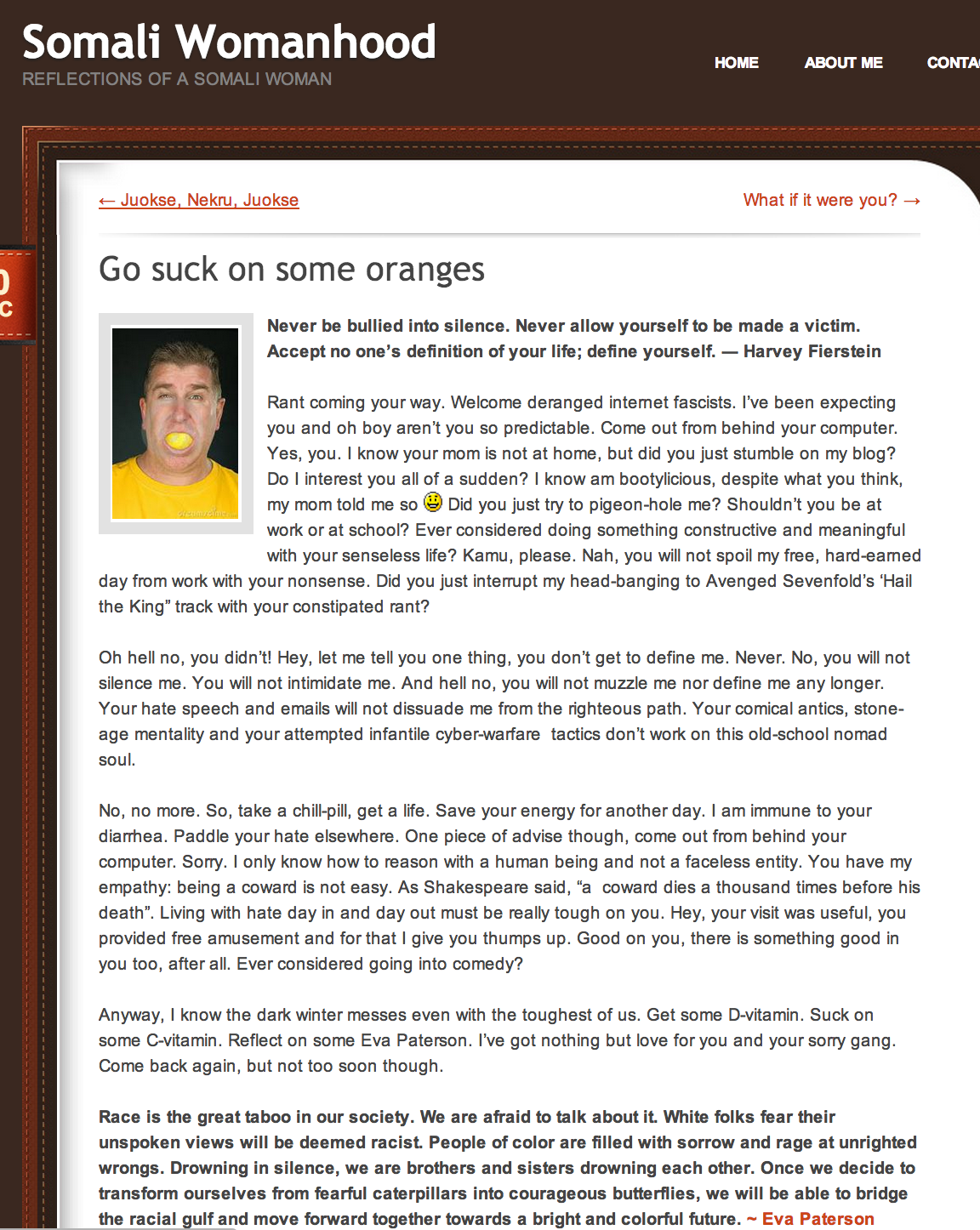
Fadumo Dayib: Go suck on some oranges

Posted on December 16, 2013 by Migrant Tales

Fadumo Dayib

Never be bullied into silence. Never allow yourself to be made a victim. Accept no one’s definition of your life; define yourself. ? Harvey Fierstein

Kuvankaappaus 2013-12-16 kello 17.10.05

Read full story here.

Rant coming your way. Welcome deranged internet fascists. I’ve been expecting you and oh boy aren’t you so predictable. Come out from behind your computer. Yes, you. I know your mom is not at home, but did you just stumble on my blog? Do I interest you all of a sudden? I know am bootylicious, despite what you think, my mom told me so :) Did you just try to pigeon-hole me? Shouldn’t you be at work or at school? Ever considered doing something constructive and meaningful with your senseless life? Kamu, please. Nah, you will not spoil my free, hard-earned day from work with your nonsense. Did you just interrupt my head-banging to Avenged Sevenfold’s ‘Hail the King” track with your constipated rant?

Oh hell no, you didn’t! Hey, let me tell you one thing, you don’t get to define me. Never. No, you will not silence me. You will not intimidate me. And hell no, you will not muzzle me nor define me any longer. Your hate speech and emails will not dissuade me from the righteous path. Your comical antics, stone-age mentality and your attempted infantile cyber-warfare  tactics don’t work on this old-school nomad soul.

No, no more. So, take a chill-pill, get a life. Save your energy for another day. I am immune to your diarrhea. Paddle your hate elsewhere. One piece of advise though, come out from behind your computer. Sorry. I only know how to reason with a human being and not a faceless entity. You have my empathy: being a coward is not easy. As Shakespeare said, “a  coward dies a thousand times before his death”. Living with hate day in and day out must be really tough on you. Hey, your visit was useful, you provided free amusement and for that I give you thumps up. Good on you, there is something good in you too, after all. Ever considered going into comedy?

Anyway, I know the dark winter messes even with the toughest of us. Get some D-vitamin. Suck on some C-vitamin. Reflect on some Eva Paterson. I’ve got nothing but love for you and your sorry gang. Come back again, but not too soon though.

Race is the great taboo in our society. We are afraid to talk about it. White folks fear their unspoken views will be deemed racist. People of color are filled with sorrow and rage at unrighted wrongs. Drowning in silence, we are brothers and sisters drowning each other. Once we decide to transform ourselves from fearful caterpillars into courageous butterflies, we will be able to bridge the racial gulf and move forward together towards a bright and colorful future. ~ Eva Paterson

Read original column here.

This piece was reprinted by Migrant Tales with permission.

Fadumo Dayib: Run, Nigger, Run

Posted on December 9, 2013 by Migrant Tales

Fadumo Dayib

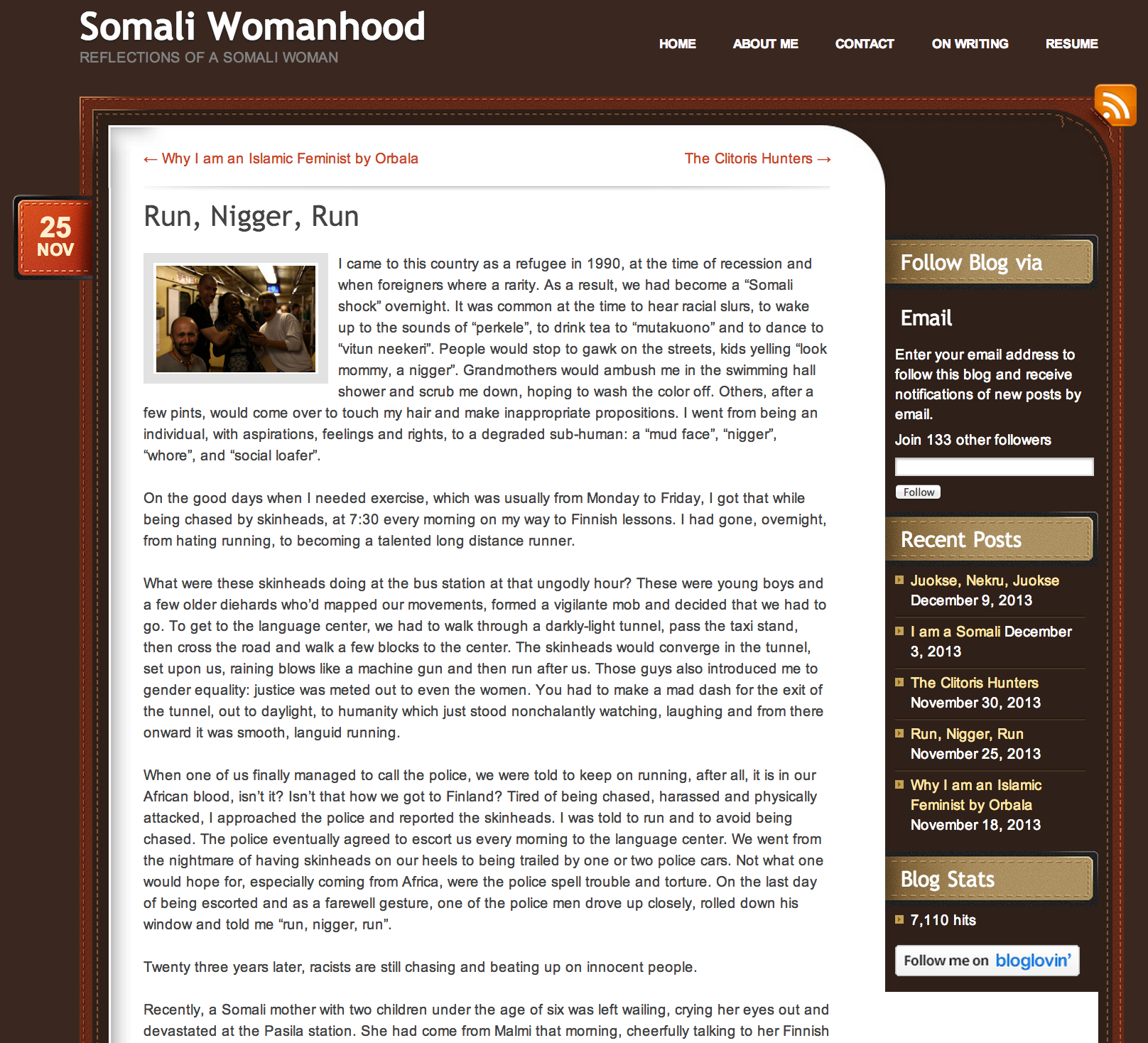
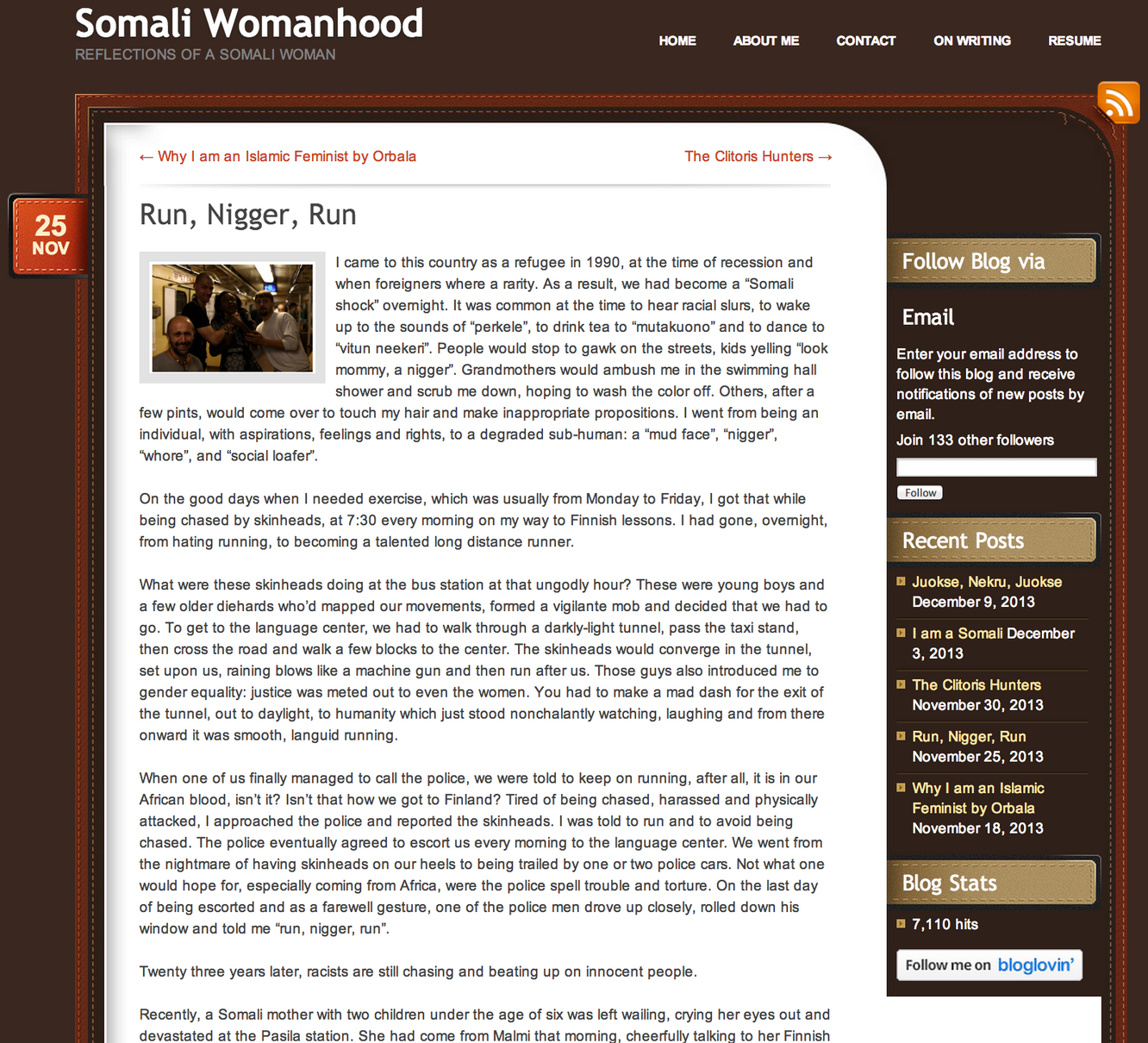
I came to this country as a refugee in 1990, at the time of recession and when foreigners where a rarity. As a result, we had become a “Somali shock” overnight. It was common at the time to hear racial slurs, to wake up to the sounds of “perkele”, to drink tea to “mutakuono” and to dance to “vitun neekeri”. People would stop to gawk on the streets, kids yelling “look mommy, a nigger”. Grandmothers would ambush me in the swimming hall shower and scrub me down, hoping to wash the color off. Others, after a few pints, would come over to touch my hair and make inappropriate propositions. I went from being an individual, with aspirations, feelings and rights, to a degraded sub-human: a “mud face”, “nigger”, “whore”, and “social loafer”.

Kuvankaappaus 2013-12-9 kello 19.59.28


On the good days when I needed exercise, which was usually from Monday to Friday, I got that while being chased by skinheads, at 7:30 every morning on my way to Finnish lessons. I had gone, overnight, from hating running, to becoming a talented long distance runner.

What were these skinheads doing at the bus station at that ungodly hour? These were young boys and a few older diehards who’d mapped our movements, formed a vigilante mob and decided that we had to go. To get to the language center, we had to walk through a darkly-light tunnel, pass the taxi stand, then cross the road and walk a few blocks to the center. The skinheads would converge in the tunnel, set upon us, raining blows like a machine gun and then run after us. Those guys also introduced me to gender equality: justice was meted out to even the women. You had to make a mad dash for the exit of the tunnel, out to daylight, to humanity which just stood nonchalantly watching, laughing and from there onward it was smooth, languid running.

When one of us finally managed to call the police, we were told to keep on running, after all, it is in our African blood, isn’t it? Isn’t that how we got to Finland? Tired of being chased, harassed and physically attacked, I approached the police and reported the skinheads. I was told to run and to avoid being chased. The police eventually agreed to escort us every morning to the language center. We went from the nightmare of having skinheads on our heels to being trailed by one or two police cars. Not what one would hope for, especially coming from Africa, were the police spell trouble and torture. On the last day of being escorted and as a farewell gesture, one of the police men drove up closely, rolled down his window and told me “run, nigger, run”.

Twenty three years later, racists are still chasing and beating up on innocent people.

Recently, a Somali mother with two children under the age of six was left wailing, crying her eyes out and devastated at the Pasila station. She had come from Malmi that morning, cheerfully talking to her Finnish children and looking forward to the day. A person behind her on the escalator violently pushed her three-year old baby out of the way and stood in front of her. She asked the person, a blond woman, why she pushed the child. The woman looked back, snickered and smacked the six-year old girl on the face, smashing her lips and nose wide open. The mother, shocked by the brutal act and the amount of blood spilling from the face of her daughter, yelled for the bystanders to stop the running woman. THEY JUST STOOD AND WATCHED, LIKE SPECTATORS IN A STADIUM. The mother could not run after the woman and leave her kids on the escalator.

When the police came, all the witnesses were slowly dispersing. They refused to step up and be responsible citizens. The mother implored the spectators, tried to appeal to their decency and humanity, but to no avail. Now the case has not gone far, the children are psychologically traumatized and the mother wrecked with feelings of hopelessness, anger and deep hatred. Why do Finnish people do this? Why did they choose to be passive, watching such a heinous act? This is a child, a child! I could understand if it were an adult being attacked. But a defenseless CHILD: that is just plain callousness. Please, if you were at Pasila that day, please go to the police and do your bit. That deranged woman needs to be brought to justice. The next child she attacks could be YOURS.

Times have changed, mostly for the better. The face of racism has changed from milky white to differing hues of yellow, red, chocolate and sometimes green. Racism is no longer exclusive to the Finns. No, we also have migrants doing that. It is okay to bash the Somalis, if only to score brownie points and curry favors. If you’re a frustrated migrant, with low self-esteem and disgruntled disposition, just walk up to a Finn and tell them how you despise those nasty Somalis, sit back and expect to be invited for coffee the next day. You’ll be sorely disappointed for your turn will come too one day. But as you attempt to do this, don’t forgot that you’re here, enjoying relative peace, because we did the running, bit the bullet, endured the worst and paved the way for you.

Why am I opening up old wounds if times are better, as I claim? Because I am tired of hearing that the Finns are racists. That we cannot integrate into this society because we are of a different color, religion and culture. That Finns want us to give up our culture and religion. If that were the case, why are our children learning, free of charge, their mother-tongue and religion in schools? Where else in the world do you have such endless and highly sought after educational opportunities, all paid for by the state?

I’m not denying that racism isn’t a problem in this country. Racism is a global phenomenon that can also be found in Somalis as well as in other migrant communities. Take the example of migrants running on the tickets of populist parties here. I am talking about the ones who glare at you, huge bucket loads of condescension dripping off them and whose mistreatment is even worse than the actual racists. God forbid you should run into them in the hospitals, the government offices and even on the streets.

However, I have a problem with generalizing it to the wider population. The majority of the Finns, often silent and in the background are tolerant, peace-loving and civilized people.

The racists, although vocal and visible, are a small minority in this country. How do you recognize them? They have one thing in common: hatred. It is targeted at people who are doing well, who have jobs, businesses, high salaries, education, good living standards and who speak languages other than just Finnish. They’re easily manipulated and gullible because of their low educational level. And so they take it out on people that they perceive to have led to their misfortune. They tend to live in denial and have a utopian outlook on life: like waking up one day to the sound of angels singing in harmony, violins playing and finding a colorless Finland.

If all Finns were racists, like some claim, then life here would be hellish. Imagine that for a moment, imagine it again for a little while longer, and let it sink in slowly.

Take the opportunities available in this country, learn the language, get an education, work hard and abide by the national laws/norms. If, despite all that, you still feel unwelcome and sick of it all. Don’t despair, there are other countries looking for competent workers and who will gladly take you in. Finland is fast becoming a country known for training and exporting highly skilled labor. But remember to come back. Running away is not the best and only solution. I write from experience here.

We need to engage the tolerant majority constructively, unite forces with them, find common goals and work towards an inclusive Finland. I believe that this is our country, no matter what, and we will be here long after the storm has died down. I love Finland and I love being a Somali-Finn. This is my country, my home, my mother is buried here and my children were born here. Stop being apologetic, stop complaining, roll back your sleeves and join us in finding a solution and building bridges.

Read original column here.

Kolumni voi lukea suomeksi tässä. 

This piece was reprinted by Migrant Tales with permission.

 Thank you Micah Christian for the heads-up!

Fadumo Dayib: Juokse, Nekru, Juokse

Posted on December 9, 2013 by Migrant Tales

Fadumo Dayib

Saavuin tähän maahan pakolaisena vuonna 1990, keskelle lamaa, aikana jolloin ulkomaalaiset olivat harvassa. Somalishokki toteutui yli yön. Tavan takaa kuulin rasistisia heittoja, heräsin ”perkele”-sointuihin, join teeni ”mutakuonona” ja tanssin ”vitun neekeri”-biisien tahtiin. Ihmiset pysähtyivät kadulla tuijottamaan, lapset kiljahtelivat ”kato äiti neekeri”. Isoäidit hyökkäsivät kimppuuni uimahallin suihkussa yrittäen pestä pois väriäni. Muutaman tuoppin rohkaisemina toiset tulivat koskettelamaan hiuksiani ja tekemään sopimattomia ehdotuksia. Muutuin tuntevasta, unelmoivasta ja oikeudellisesta yksilöstä alhaiseksi ali-ihmiseksi: mutakuonoksi, nekruksi, huoraksi ja sosiaalipummiksi.

Kuvankaappaus 2013-12-9 kello 20.13.03

Hyvinä päivinä jos satuin tarvitsemaan liikunta, sain sen maanantaista perjantaihin skinien jahdatessa minua aamuaikaan 07:30 matkallani suomenkielen tunneille. Yhdessä yössä minusta, juoksunvihaajasta, tuli kohtuullisen lahjakas pitkänmatkan juoksija. Mitä nuo skinit tekivät tuolla bussiasemalla tuohon aamuvarhaiseen aikaan? Siellä oli nuoria poikia ja pari ikääntyneempää jäärää, jotka olivat selvittäneet kulkureittimme – muodostaneet hyökkäysjoukkonsa ja päättäneet että meidän piti lähteä. Päästäksemme kielikeskukseen, meidän tuli kulkea erään varjoisan tunnelin kautta, ohittaa taksiasema ja kävellä pari korttelia keskukseen.

Skinit kokoontuivat tunneliin, hyökkäsivät kimppuumme, jakelivat iskuja kuin konekiväärin suusta ja lähtivät juosten peräämme. Samalla minut tutustutettiin sukupuoliseen tasa-arvoon; heidän oikeuttaan jaettiin niin naisille kuin miehillekin. Jouduin singahtamaan hullun lailla kohti tunnelin päätä, päivänvaloon, ihmiskunnan silmien alle, jotka seisoivat rennosti ihmettelemässä, naureskelemassa taksiasemalla. Ja sitten vain juostiin tasaisesti jolkottaen kohti kielikeskusta.

Kun vihdoin yksi meistä rohkaistui kutsumaan poliiseja apuun, meitä neuvottiin jatkamaan juoksua, sehän on kuulemma meillä afrikkalaisilla verissä? Silleenhän me Suomeenkin oltiin tultu? Väsyneinä jahdatuksi tulemiseen, pahoinpitelyyn ja nimittelyyn käännyin poliisin puoleen ja tein skineistä ilmoituksen. Minua kehoitettiin juoksemaan ja välttämään jahdatuksi tulemista. Lopulta poliisi suostui aamuisin saattamaan meitä kielikeskukseen. Siirryimme skinien jahdin painajaisesta poliisin seurannan alaisuuteen. Sekään ei ollut helppoa, sillä Afrikassa, jätetyssä kotimaassa poliisiviranomainen tarkoitti monasti ongelmia ja kidutusta. Viimeisenä päivänä, ilmeisesti jäähyväistervehdyksenä, poliisiauto ajoi lähellemme ja poliisi huikkasi minulle ”juokse, nekru, juokse”.

Nyt, kaksikymmentäkolme vuotta myöhemmin, rasistit edelleen ajavat takaa ja hakkaavat viattomia ihmisiä. Vastikään eräs kahden lapsen somaliäiti istui yksin, silmät päästään itkeneenä Pasilan poliisiasemalla. Hän oli samaisena aamuna matkustanut Malmilta iloisena suomalaisille lapsilleen jutellen, toiveikkaana päivää odottaen. Liukuportaissa heidään takanaan seissyt henkilö työnsi voimalla kolmevuotiaan pois edestään ja asettui äidin eteen. Tämä kysyi miksi hän oli tuuppinut pientä lasta. Vaaleatukkainen nainen tuijotti takaisin, hihitti ja läimäytti kuusivuotista kasvoihin halkaisten lapsen huulen ja nenä alkoi vuotamaan verta. Lasten äiti meni shokkiin yllättävästä väkivallasta ja huusi sivustakatsojia ottamaan juoksevaa naista kiinni. HE VAIN SEISOIVAT JA KATSOIVAT, STADIONIN YLEISÖN LAILLA. Äiti ei voinut lähteä pahoinpitelijän perään jättäen
lapsiaan liukuportaisiin.

Poliisin saapuessa, silminnäkijät hupenivat, kieltäytyivät kertomasta näkemäänsä vastuullisina kansalaisina. Äiti vetosi katsojiin, heidän oikeudentuntoonsa ja inhimillisyyteen, mutta turhaan. Nyt oikeutta ei saa, lapset ovat psyykkisesti traumatisoituneita ja äiti on voimattomuuden, vihan ja inhon tunteiden murtama. Miksi suomalaiset tekevät näin ? Miksi he päättivät olla auttamatta nähdessään tämän julman teon? Se oli lapsi, LAPSI! Olisin ehkä ymmärtänyt teon jos kohteena olisi ollut aikuinen, mutta puolustuskyvyttömän lapsen kimppuun hyökkääminen on puhdasta ilkeyttä.

Pyydän. Jos olit Pasilassa tuona päivänä ja näit tämän, mene poliisin puheilla ja tee velvollisuutesi jotta tämä mielenhäiriöinen hyökkääjä saadaan oikeuden eteen. Seuraavan hyökkäyksen kohde voi olla sinun lapsesi.

Ajat ovat muuttuneet, enimmäksen parempaan suuntaan. Rasismin kasvot ovat vaihtaneet värejään maidonvalkoisesta eri keltaisiin, punaisiin, ruskeisiin ja joskus vihreisiin säyvyihin. Rasismi ei enää ole mikään suomalaisten oikeus, vaan sitä harrastavat myös maahanmuuttajat keskuudessaan.Somaleja voi aina vetää turpaan vaikka ihan tonttupisteiden ja arvostuksen vuoksi. Turhautuneena maahanmuuttajana voit aina kävellä suomalaisen luokse ja kertoa miten halveksit noita tyhmiä somaleja ja jäädä odottamaan kutsua kahville seuraavana päivänä. Tulet pettymään sillä oma hetkesi tulee minä päivänä hyvänsä. Jos näin kuitenkin toimit, muista että nykyhetken suhteellinen rauha ansaittiin, kun me aikanaan juoksimme, otimme turpaan ja tasoitimme tiesi.

Miksi revin auki vanhoja haavoja, vaikka ajat ovat muuttuneet parempaan? Koska olen väsynyt kuulemaan miten rasistisia suomalaiset ovat. Että me emme voi integroitua yhteiskuntaan värimme, uskontomme tai ulttuurimme takia. Että suomalaiset vaativat meitä luopumaan kulttuuristamme ja uskonnostamme. Jos näin olisi, miksi lapsemme ovat opiskelemassa kieltä ja uskontoa kouluissa? Missä muualla maailmassa valtio tarjoaa parasta oppia ja koulutusta – loputtomia mahdollisuuksia?
En kiellä Suomen rasismiongelmaa. Kyseessä on maailmanlaajuisesta, niin Somaliassa kuin maahanmuuttajien joukossa kytevästä ilmiöstä. Esimerkkeinä populististen puolueiden listoille asettuvat siirtolaiset – juuri ne jotka häikäisevät ämpärikaupalla valuvilla alentavilla lausahduksillaan, joiden jälkeen olosi on paljon varsinaisten rasistien käsittelyn jälkeistä pahempi. Jumala varjelkoon törmäämästä heihin sairaaloissa, virastoissa tai edes kaduilla.
En kuitenkaan millään pysty yleistämään ongelmaa laajempaan väestöön. Enemmistö suomalaisista, hiljaisina ja taustalla, ovat maltillisa, rauhaa rakastavia ja sivistyneitä. Äänekkäät ja näkyvät rasistit ovat pieni vähemmistö tässä maassa. Mistä heidät tunnistaa? Yhteisenä tunnusmerkkinä heillä on viha. Se kohdistuu ihmisiin, jotka pärjäävät, ovat töissä, omistavat yrityksiä, nostavat korkeaa palkkaa, koulutettuihin, korkeaan elintasoon, kielitaitoisiin kansalaisiin. He ovat helposti manipuloitavissa ja purkavat pahan olonsa lähimpänä oleviin ihmsiin, jotka kokevat aiheuttaneen heidän tilansa. Yleensä elävät kieltäen kaiken ja uskovat utopiaan, että eräänä päivänä he heräävät harppua soittavien enkelien kuoroon värittömään Suomeen.

Jos kaikki suomalaiset olisivat rasisteja, kuten jotkut väittävät – elämä olisi helvettiä. Mieti asia hetken, ja vielä lisää, hitaasti.

Tartu tämän maan tarjoamiin mahdollisuuksiin, opi kieli, kouluttaudu, tee lujasti töitä ja tottele lakeja, noudata normeja. Jos et siitä huolimatta tunne itsesi tervetulleeksi, älä huolehdi – maailmassa on monia maita, jotka hamuavat pätevää ja koulutettua työväkeä. Suomesta on nopeasti tulossa maa, joka tunnetaan korkeatasoisesta koulutuksesta ja vinhasta aivoviennistä. Muista kuitenkin palata. Pakoon juokseminen on harvoin se ainoa ja paras ratkaisu. Usko minua, puhun kokemuksesta.

Meidän on yhteistuumin ryhdyttävä suvaitsevan enemmistön voimaannuttamiseen, löydettävä yhteisiä tavoitteita ja tehtävä töitä kaiken kattavan suomalaisuuden eteen. Uskon tämän olevan maamme, satoi tai paistoi, ja olemme täällä myös myrskyn laannuttua. Rakastan Suomea ja olla somali-suomalainen. Tämä on maani, kotini, paikka johon olen haudannut äitini ja johon olen synnyttänyt lapseni. Lakatkaa pahoittelemasta, valittamasta, käärikäämme hihat etsimään ratkaisuja ja rakentamaan siltoja.

Käännös Alexander Holthoer

Alkuperäisen blogikirjoituksen voi lukea tästä.

Read the column in English here. 

Tämä blogikirjoitus julkaistiin Migrant Talesissä luvalla.

Read more about documentary film
Read more

Recent Posts

  • Finland Bridge (2000): A year in Mediolanum,* Italy
  • Lahti is the latest city to prohibit the niqab and burka
  • Finland’s tabloids Iltalehti and Ilta-Sanomat are the pits
  • Riikka Purra’s Dr Jekyll and Mr Hyde mask
  • Double standards

Recent Comments

  1. Absolutely Socking: Racist Finnish Facebook group against human rights gets flooded with socks on Musta Barbaari’s mother and sister charged by the police in “ethnic profiling” case
  2. Ilkka Nuotio on Pekka Myrskylä: “Tilastot kertovat toista kuin poliittinen keskustelu”
  3. Genrih Soinkara on The war in Ukraine and the Russian-Finnish border crisis are showing Finland’s ugly side
  4. Ahti Tolvanen on Comment by Ahti Tolvanen on the Helsinki +50 conference
  5. Angel Barrientos on Angel Barrientos is one of the kind beacons of Finland’s Chilean community

Archives

  • June 2026
  • May 2026
  • April 2026
  • March 2026
  • February 2026
  • January 2026
  • December 2025
  • November 2025
  • October 2025
  • September 2025
  • August 2025
  • July 2025
  • June 2025
  • May 2025
  • April 2025
  • March 2025
  • February 2025
  • January 2025
  • December 2024
  • November 2024
  • October 2024
  • September 2024
  • August 2024
  • July 2024
  • June 2024
  • May 2024
  • April 2024
  • March 2024
  • February 2024
  • January 2024
  • December 2023
  • November 2023
  • October 2023
  • September 2023
  • August 2023
  • July 2023
  • June 2023
  • May 2023
  • April 2023
  • March 2023
  • February 2023
  • January 2023
  • December 2022
  • November 2022
  • October 2022
  • September 2022
  • August 2022
  • July 2022
  • June 2022
  • May 2022
  • April 2022
  • March 2022
  • February 2022
  • January 2022
  • December 2021
  • November 2021
  • October 2021
  • September 2021
  • August 2021
  • July 2021
  • June 2021
  • May 2021
  • April 2021
  • March 2021
  • February 2021
  • January 2021
  • December 2020
  • November 2020
  • October 2020
  • September 2020
  • August 2020
  • July 2020
  • June 2020
  • May 2020
  • April 2020
  • March 2020
  • February 2020
  • January 2020
  • December 2019
  • November 2019
  • October 2019
  • September 2019
  • August 2019
  • July 2019
  • June 2019
  • May 2019
  • April 2019
  • March 2019
  • February 2019
  • January 2019
  • December 2018
  • November 2018
  • October 2018
  • September 2018
  • August 2018
  • July 2018
  • June 2018
  • May 2018
  • April 2018
  • March 2018
  • February 2018
  • January 2018
  • December 2017
  • November 2017
  • October 2017
  • September 2017
  • August 2017
  • July 2017
  • June 2017
  • May 2017
  • April 2017
  • March 2017
  • February 2017
  • January 2017
  • December 2016
  • November 2016
  • October 2016
  • September 2016
  • August 2016
  • July 2016
  • June 2016
  • May 2016
  • April 2016
  • March 2016
  • February 2016
  • January 2016
  • December 2015
  • November 2015
  • October 2015
  • September 2015
  • August 2015
  • July 2015
  • June 2015
  • May 2015
  • April 2015
  • March 2015
  • February 2015
  • January 2015
  • December 2014
  • November 2014
  • October 2014
  • September 2014
  • August 2014
  • July 2014
  • June 2014
  • May 2014
  • April 2014
  • March 2014
  • February 2014
  • January 2014
  • December 2013
  • November 2013
  • October 2013
  • September 2013
  • August 2013
  • July 2013
  • June 2013
  • May 2013
  • April 2013
  • March 2013
  • February 2013
  • January 2013
  • December 2012
  • November 2012
  • October 2012
  • September 2012
  • August 2012
  • July 2012
  • June 2012
  • May 2012
  • April 2012
  • March 2012
  • February 2012
  • January 2012
  • December 2011
  • November 2011
  • October 2011
  • September 2011
  • August 2011
  • July 2011
  • June 2011
  • May 2011
  • April 2011
  • March 2011
  • February 2011
  • January 2011
  • December 2010
  • November 2010
  • October 2010
  • September 2010
  • August 2010
  • July 2010
  • June 2010
  • May 2010
  • April 2010
  • March 2010
  • February 2010
  • January 2010
  • December 2009
  • November 2009
  • October 2009
  • September 2009
  • August 2009
  • July 2009
  • December 2008
  • November 2008
  • October 2008
  • September 2008
  • August 2008
  • July 2008
  • June 2008
  • May 2008
  • April 2008
  • March 2008
  • February 2008
  • January 2008
  • November 2007
  • October 2007
  • September 2007
  • August 2007
  • July 2007
  • June 2007
  • May 2007

Categories

  • ?? Gia L?c
  • ????? ?????? ????? ???????? ?? ??????
  • ???????
  • @HerraAhmed
  • @mondepasrond
  • @nohatefinland
  • @oula_silver
  • @Varathas
  • A Pakistani family
  • äärioikeisto
  • Abbas Bahmanpour
  • Abdi Muhis
  • Abdirahim Hussein Mohamed
  • Abdirahim Husu Hussein
  • Abdirisak Mahamed
  • About Migrant Tales
  • activism
  • Adam Al-Sawad
  • Adel Abidin
  • Afrofinland
  • Ahmed IJ
  • Ahti Tolvanen
  • Aino Pennanen
  • Aisha Maniar
  • Alan Ali
  • Alan Anstead
  • Alejandro Díaz Ortiz
  • Alekey Bulavsev
  • Aleksander Hemon
  • Aleksanterinliitto
  • Aleksanterinliitto ry
  • Aleksanterinliitto ry:n hallitus
  • Alex Alex
  • Alex Mckie
  • Alexander Nix
  • Alexandra Ayse Albayrak
  • Alexis Neuberg
  • Ali Asaad Hasan Alzuhairi
  • Ali Hossein Mir Ali
  • Ali Rashid
  • Ali Sagal Abdikarim
  • Alina Tsui
  • Aline Müller
  • All categories
  • Aman Heidari
  • Amiirah Salleh-Hoddin & Jana Turk
  • Amin A. Alem
  • Amir Zuhairi
  • Amkelwa Mbekeni
  • Ana María Gutiérrez Sorainen
  • Anachoma
  • Anders Adlecreutz
  • Angeliina Koskinen
  • Anna De Mutiis
  • Anna María Gutiérrez Sorainen
  • Anna-Kaisa Kuusisto ja Jaakko Tuominen
  • Annastiina Kallius
  • Anneli Juise Friman Lindeman
  • Announcement
  • Anonymous
  • Antero Leitzinger
  • anti-black racism
  • Anti-Hate Crime Organisation Finland
  • Anudari Boldbaatar
  • Arshiya Nasser
  • Aspergers Syndrome
  • Asylum Corner
  • Asylum seeker 406
  • Athena Griffin and Joe Feagin
  • Autism
  • Avaaz.org
  • Awale Olad
  • Ayan Said Mohamed
  • AYY
  • Barachiel
  • Bashy Quraishy
  • Beatrice Kabutakapua
  • Beri Jamal
  • Beri Jamal and Enrique Tessieri
  • Bertolt Brecht
  • Boiata
  • Boodi Kabbani
  • Bruno Gronow
  • Carmen Pekkarinen
  • Çelen Oben and Sheila Riikonen
  • Chiara Costa-Virtanen
  • Chiara Costa-Virtanen
  • Chiara Sorbello
  • Christian Thibault
  • Christopher Wylie
  • Clara Dublanc
  • Dana
  • Daniel Malpica
  • Danilo Canguçu
  • David Papineau
  • David Schneider
  • Dexter He
  • Don Flynn
  • Dr Masoud Kamali
  • Dr. Faith Mkwesha
  • Dr. Theodoros Fouskas
  • Edna Chun
  • Eeva Kilpi
  • Emanuela Susheela
  • En castellano
  • ENAR
  • Enrique
  • Enrique Tessieri
  • Enrique Tessieri & Raghad Mchawh
  • Enrique Tessieri & Yahya Rouissi
  • Enrique Tessieri and Muhammed Shire
  • Enrique Tessieri and Sira Moksi
  • Enrique Tessieri and Tom Vandenbosch
  • Enrique Tessieri and Wael Che
  • Enrique Tessieri and Yahya Rouissi
  • Enrique Tessieri and Zimema Mhone
  • Epäluottamusmies
  • EU
  • Europe
  • European Islamophobia Report
  • European Islamophobia Report 2019,
  • European Union
  • Eve Kyntäjä
  • Ezequiel Caldeiro
  • Facebook
  • Fadumo Dayib
  • Faisa Kahiye
  • Farhad Manjoo
  • Fasismi
  • Finland
  • Fizza Qureshi
  • Flyktingar och asyl
  • Foreign Student
  • Fozia Mir-Ali
  • Frances Webber
  • Frida Selim
  • Gareth Rice
  • Ghyslain Vedeaux
  • Global Art Point
  • Great Replacement
  • Habiba Ali
  • Hami Bahadori
  • Hami Bahdori
  • Hamid
  • Hamid Alsaameere
  • Hamid Bahdori
  • Handshake
  • Harmit Athwal
  • Hassan Abdi Ali
  • Hassan Muhumud
  • Heikki Huttunen
  • Heikki Wilenius
  • Helsingin Sanomat
  • Henning van der Hoeven
  • Henrika Mälmsröm
  • Hser Hser
  • Hser Hser ja Mustafa Isman
  • Husein Muhammed
  • Hussain Kazemian
  • Hussain Kazmenian
  • Ibrahim Khan
  • Ida
  • Ignacio Pérez Pérez
  • Iise Ali Hassan
  • Ilari Kaila & Tuomas Kaila
  • Imam Ka
  • inside-an-airport
  • Institute of Race Relations
  • Iraqi asylum seeker
  • IRR European News Team
  • IRR News Team
  • Islamic Society of Norhern FInland
  • Islamic Society of Northern Finland
  • Islamophobia
  • Jacobinmag.com
  • Jallow Momodou
  • Jan Holmberg
  • Jane Elliott
  • Jani Mäkelä
  • Jari Luoto
  • Jari Taponen
  • Jegor Nazarov
  • Jenni Stammeier
  • Jenny Bourne
  • Jessie Daniels
  • Joe Davidow
  • Johannes Koski
  • John D. Foster
  • John Grayson
  • John Marriott
  • Jon Burnett
  • Jorma Härkönen
  • Jos Schuurmans
  • José León Toro Mejías
  • Josue Tumayine
  • Jouni Karnasaari
  • Juan Camilo
  • Jukka Eräkare
  • Julian Abagond
  • Julie Pascoet
  • Jussi Halla-aho
  • Jussi Hallla-aho
  • Jussi Jalonen
  • JusticeDemon
  • Kadar Gelle
  • Kaksoiskansalaisuus
  • Kansainvälinen Mikkeli
  • Kansainvälinen Mikkeli ry
  • Katherine Tonkiss
  • Kati Lepistö
  • Kati van der Hoeven-Lepistö
  • Katie Bell
  • Kättely
  • Kerstin Ögård
  • Keshia Fredua-Mensah & Jamie Schearer
  • Khadidiatou Sylla
  • Khadra Abdirazak Sugulle
  • Kiihotus kansanryhmää vastaan
  • Kirsi Crowley
  • Koko Hubara
  • Kristiina Toivikko
  • Kubra Amini
  • KuRI
  • La Colectiva
  • La incitación al odio
  • Laura Huhtasaari
  • Lauri Finér
  • Leif Hagert
  • Léo Custódio
  • Leo Honka
  • Leontios Christodoulou
  • Lessie Branch
  • Lex Gaudius
  • Leyes de Finlandia
  • Liikkukaa!
  • Linda Hyökki
  • Liz Fekete
  • M. Blanc
  • Maarit Snellman
  • Mahad Sheikh Musse
  • Maija Vilkkumaa
  • Malmin Kebab Pizzeria Port Arthur
  • Marcell Lorincz
  • Mari Aaltola
  • María Paz López
  • Maria Rittis Ikola
  • Maria Tjader
  • Marja-Liisa Tolvanen
  • Mark
  • Markku Heikkinen
  • Marshall Niles
  • Martin Al-Laji
  • Maryan Siyad
  • Matt Carr
  • Mauricio Farah Gebara
  • Media Monitoring Group of Finland
  • Micah J. Christian
  • Michael McEachrane
  • Michele Levoy
  • Michelle Kaila
  • Migrant Tales
  • Migrant Tales Literary
  • Migrantes News
  • Migrants' Rights Network
  • MigriLeaks
  • Mikko Kapanen
  • Miriam Attias and Camila Haavisto
  • Mohamed Adan
  • Mohammad Javid
  • Mohammad M.
  • Monikulttuurisuus
  • Monisha Bhatia and Victoria Canning
  • Mor Ndiaye
  • Muh'ed
  • Muhamed Abdimajed Murshid
  • Muhammed Shire
  • Muhammed Shire and Enrique Tessieri
  • Muhis Azizi
  • Musimenta Dansila
  • Muslimiviha
  • Musulmanes
  • Namir al-Azzawi
  • Natsismi
  • Neurodiversity
  • New Women Connectors
  • Nils Muižnieks
  • No Labels No Walls
  • Noel Dandes
  • Nuor Dawood
  • Omar Khan
  • Otavanmedia
  • Oula Silvennoinen
  • Paco Diop
  • Pakistani family
  • Pentti Stranius
  • Perussuomalaiset
  • perustuslaki
  • Petra Laiti
  • Petri Cederlöf
  • Pia Grochowski
  • Podcast-lukija Bea Bergholm
  • Pohjois – Suomen Islamilainen Yhdyskunta
  • Pohjois Suomen Islamilainen Yhyskunta
  • Polina Kopylova
  • Race Files
  • racism
  • Racism Review
  • Raghad Mchawh
  • Ranska
  • Rashid H. and Migrant Tales
  • Rasismi
  • Raul Perez
  • Rebecka Holm
  • Reem Abu-Hayyeh
  • Refugees
  • Reija Härkönen
  • Remiel
  • Reza Nasri
  • Richard Gresswell
  • Riikka Purra
  • Risto Laakkonen
  • Rita Chahda
  • Ritva Kondi
  • Robito Ibrahim
  • Roble Bashir
  • Rockhaya Sylla
  • Rodolfo Walsh
  • Roger Casale
  • Rostam Atai
  • Roxana Crisólogo Correa
  • Ruth Grove-White
  • Ruth Waweru-Folabit
  • S-worldview
  • Sadio Ali Nuur
  • Sami Rusanen
  • Sandhu Bhamra
  • Sara de Jong
  • Sarah Crowther
  • Sari Alhariri
  • Sarkawt Khalil
  • Sasu
  • Scot Nakagawa
  • Shabana Ahmadzai
  • Shada Islam
  • Sharon Chang blogs
  • Shenita Ann McLean
  • Shirlene Green Newball
  • Sini Savolainen
  • Sira Moksi
  • Sonia K.
  • Sonia Maria Koo
  • Steverp
  • Stop Deportations
  • Suldaan Said Ahmed
  • Suomen mediaseurantakollektiivi
  • Suomen Muslimifoorumi ry
  • Suomen viharikosvastainen yhdistys
  • Suomen viharikosvastainen yhdistys ry
  • Suomi
  • Supermen
  • Susannah
  • Suva
  • Syrjintä
  • Talous
  • Tapio Tuomala
  • Taw Reh
  • Teivo Teivainen
  • The Daily Show
  • The Heino
  • The Supermen
  • Thomas Elfgren
  • Thulfiqar Abdulkarim
  • Tim McGettigan
  • Tino Singh
  • Tito Moustafa Sliem
  • Tobias Hübinette and L. Janelle Dance
  • Transport
  • Trica Danielle Keaton
  • Trilce Garcia
  • Trish Pääkkönen
  • Trish Pääkkönen and Enrique Tessieri
  • Tuulia Reponen
  • Uncategorized
  • UNITED
  • University of Eastern Finland
  • Uyi Osazee
  • Väkivalta
  • Vapaa Liikkuvuus
  • Venla-Sofia Saariaho
  • Vieraskynä
  • W. Che
  • W. Che an Enrique Tessieri
  • Wael Ch.
  • Wan Wei
  • Women for Refugee Women
  • Xaan Kaafi Maxamed Xalane
  • Xassan Kaafi Maxamed Xalane
  • Xassan-Kaafi Mohamed Halane & Enrique Tessieri
  • Yahya Rouissi
  • Yasmin Yusuf
  • Yassen Ghaleb
  • Yle Puhe
  • Yuliet Tresa
  • Yve Shepherd
  • Zahra Khavari
  • Zaker
  • Zalina Ametova
  • Zamzam Ahmed Ali
  • Zeinab Amini ja Soheila Khavari
  • Zimema Mahone and Enrique Tessieri
  • Zimema Mhone
  • Zoila Forss Crespo Moreyra
  • ZT
  • Zulma Sierra
  • Zuzeeko Tegha Abeng
© 2026 Migrant tales | Powered by Minimalist Blog WordPress Theme