Migrant tales
Menu
  • #MakeRacismHistory “In Your Eyes”
  • About Migrant Tales
  • It’s all about Human Rights
  • Literary
  • Migrant Tales Media Monitoring
  • NoHateFinland.org
  • Tales from Europe
Menu

Category: Zuzeeko Tegha Abeng

The Finnish League for Human Rights: Is Finland in need of hate crimes prevention law?

Posted on May 29, 2017 by Migrant Tales

Hate crimes affect members of minority groups all over the world. Some countries take it more seriously than others by passing and enacting hate crime prevention laws, and by investigating suspected cases and prosecuting perpetrators so as to deliver justice to victims. The number of suspected hate crimes registered by Finnish police have increased more than fifty per cent between 2014 and 2015.

Every year since 2008 Finland’s Police University College publishes a report on hate crime based on data of suspected hate crimes reported to the police. The report provides insights into the state of hate crimes in the country. Currently, the Finnish penal code does not define hate crime or racist crime. However, since 2011 the racist motive has been an increasing ground for punishments. Hate motives such as race, skin color, religion or sexual orientation are taken into consideration by courts during sentencing, and they may lead to an enhanced penalty. However, it appears that the police, prosecutors and judges have challenges in recognizing the potential hate motive in the crime process.


Read the full story here.

Current legal measures may not be enough

A total of 1250 suspected cases of hate crimes were brought to the attention of the police in 2015, according to police data. Compared to the previous year the figure represents a 52 percent increase in suspected hate crimes. Majority of suspected cases in 2015 had racist features based on ethnicity and national background.

Continue reading “The Finnish League for Human Rights: Is Finland in need of hate crimes prevention law?”

Zuzeeko’s blog: 1960-style racial abuse in a store in Finland, and silent onlookers

Posted on October 1, 2014 by Migrant Tales

Zuzeeko Tegha Abeng*

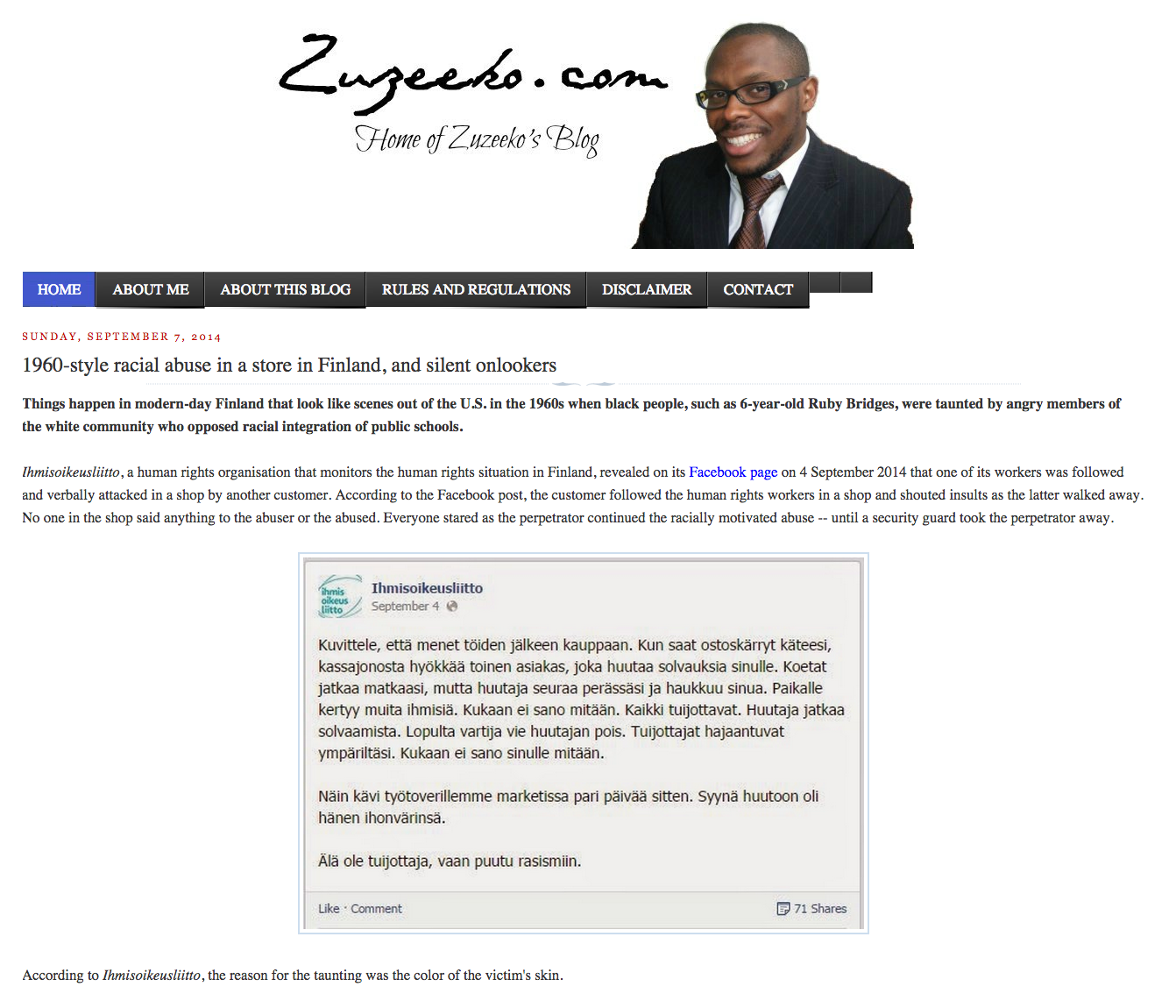
Things happen in modern-day Finland that look like scenes out of the U.S. in the 1960s when black people, such as 6-year-old Ruby Bridges, were taunted by angry members of the white community who opposed racial integration of public schools.

Ihmisoikeusliitto, a human rights organisation that monitors the human rights situation in Finland, revealed on its Facebook page on 4 September 2014 that one of its workers was followed and verbally attacked in a shop by another customer. According to the Facebook post, the customer followed the human rights workers in a shop and shouted insults as the latter walked away. No one in the shop said anything to the abuser or the abused. Everyone stared as the perpetrator continued the racially motivated abuse — until a security guard took the perpetrator away.


Näyttökuva 2014-10-1 kello 17.31.11

According to Ihmisoikeusliitto, the reason for the taunting was the color of the victim’s skin.

Keep in mind that the reported racist taunting happened is 2014, not 1960. It’s unconscionable that such a thing happens in modern-day Finland, and not a single onlooker lifts a finger.

When I read the Facebook post, the story of Ruby Bridges came to mind.

Ruby Bridges was the first black student to attend a formerly all-white elementary school in New Orleans in 1960. When public schools were required by federal law to desegregate, she was the first African American to go to William Frantz Elementary School. For security reasons, Ruby was escorted to and from school by U.S. Marshals dispatched by president Eisenhower. White parents and students shouted insults and pointed fingers at Ruby as she went to school under the protection of U.S. Marshals. And white parents rushed their children out of the school in protest. Even teachers refused to teach.

In my view, shouting insults at someone in a public place in Finland because of the color of his or her skin is as shameful as the racially motivated taunting of Ruby Bridges in New Orleans in 1960. The verbal abuse reported by Ihmisoikeusliitto is, to an extent, similar to abuse faced by Ruby Bridges in the 1960s. The only difference lies in the scale of the abuse.

Unlike Ruby, the victim in the shop in Finland was taunted by a single abuser. Although the perpetrator acted alone, the silent onlookers in the shop, I believe, took the side of the perpetrator. My belief that the “spectators” were complicit is hinged on the words of archbishop Desmond Tutu: “If you are neutral in situations of injustice, you have chosen the side of the oppressor”.

I have argued before in previous blog posts, such as in the piece about the plight of Finland’s black taxi drivers, and I’ll argue again, that blatant racism persists in modern-day Finland because members of the public and people with the power to change things let it persist. Perpetrators are emboldened by the silence of onlookers. People of good conscience and people in positions of authority in Finland should stand up and speak up forcefully against racism. Until then, racists will continue to drag Finland’s international image in the mud by repeatedly perpetrating 1960-style racial abuse in modern-day Finland.Read original blog entry here.

*Zuzeeko Tegha Abeng is an associate editor of Migrant Tales. 

Zuzeeko’s blog: Racist vandalism is costly for Helsinki city

Posted on May 28, 2014 by Migrant Tales

Perpetrators of racism (racists) give all sorts of reasons in an attempt to justify or explain their twisted perception or treatment of fellow human beings who happen to look different. Sometimes economic reasons are evoked. Some in Finland argue, for instance, that migrants from Africa and elsewhere are “welfare shoppers” who move to the country to tap welfare benefits and deplete state funds. Despite their concerns, many racists go around vandalizing public spaces with racist writings and graffiti — forgetting that cleaning up the mess will be financially costly for the state and the city they seek to “protect” from “invaders”.

Näyttökuva 2014-5-28 kello 21.05.42
Read full blog entry here. 

The City of Helsinki has cleaned up a bus stop (see pictures) that was vandalized with racist writings and drawings.

In a 2011 blog post, I wrote about the ugly face of racism at a bus stop in east Helsinki. The bus stop, which is next to Edupoli — an adult education centre in Hertoniemi, was vandalized with a scary, racist text and drawing of the swastika.

Driving past the bus stop in the spring of 2014 – about three years since the vandalism was first spotted – I noted that the bus stop had been condoned off and work was going on there. A few days later I stopped at the bus stop to see what was happening, and realized that the bus stop had been given a makeover. The vandalized glass at the back had been replaced and everything was looking nice, clean and welcoming to all.

In my mind, I wondered when driving off the bus stop how much the City of Helsinki spent cleaning up the mess left behind by a racist. Although unable to confirm how much was spent renewing the bus stop, I am confident the renovation was not free of charge. The city council must have allocated some money that could have been used for something else – if some disturbed individual hadn’t vandalized that bus stop.

Mindful of the fact that racist vandalism is not uncommon around Helsinki, it is plausible to conclude that the authorities spend lots of money cleaning up and making the city welcoming to all persons, irrespective of race, color, religion or gender.

Personally, I think the actions of racist vandals cost the city money and gives it a bad name. I welcome Helsinki city’s decision to do away with manifestations of racism at the bus stop in Hertoniemi. Although costly, cleaning up makes the city more welcoming and goes a long way to protect the image of Helsinki – World Design Capital 2012. The authorities should get rid of manifestations of racism in other parts of city. Vandals on their part should do their city (our city) a favor — stop messing up public spaces and forcing the city to use resources that could be put to better use.

If racists, who describe themselves these days as “patriots”, truly love their country and care about its economic situation they won’t vandalize public spaces and force city authorities to spend resources cleaning up racist writings and drawings in bus stops and other public spaces.

Read original blog entry here.

*Zuzeeko Tegha Abeng is an associate editor of Migrant Tales. 

Zuzeeko’s blog: Skin color matters in Finland, Yle hidden camera shows

Posted on October 17, 2013 by Migrant Tales

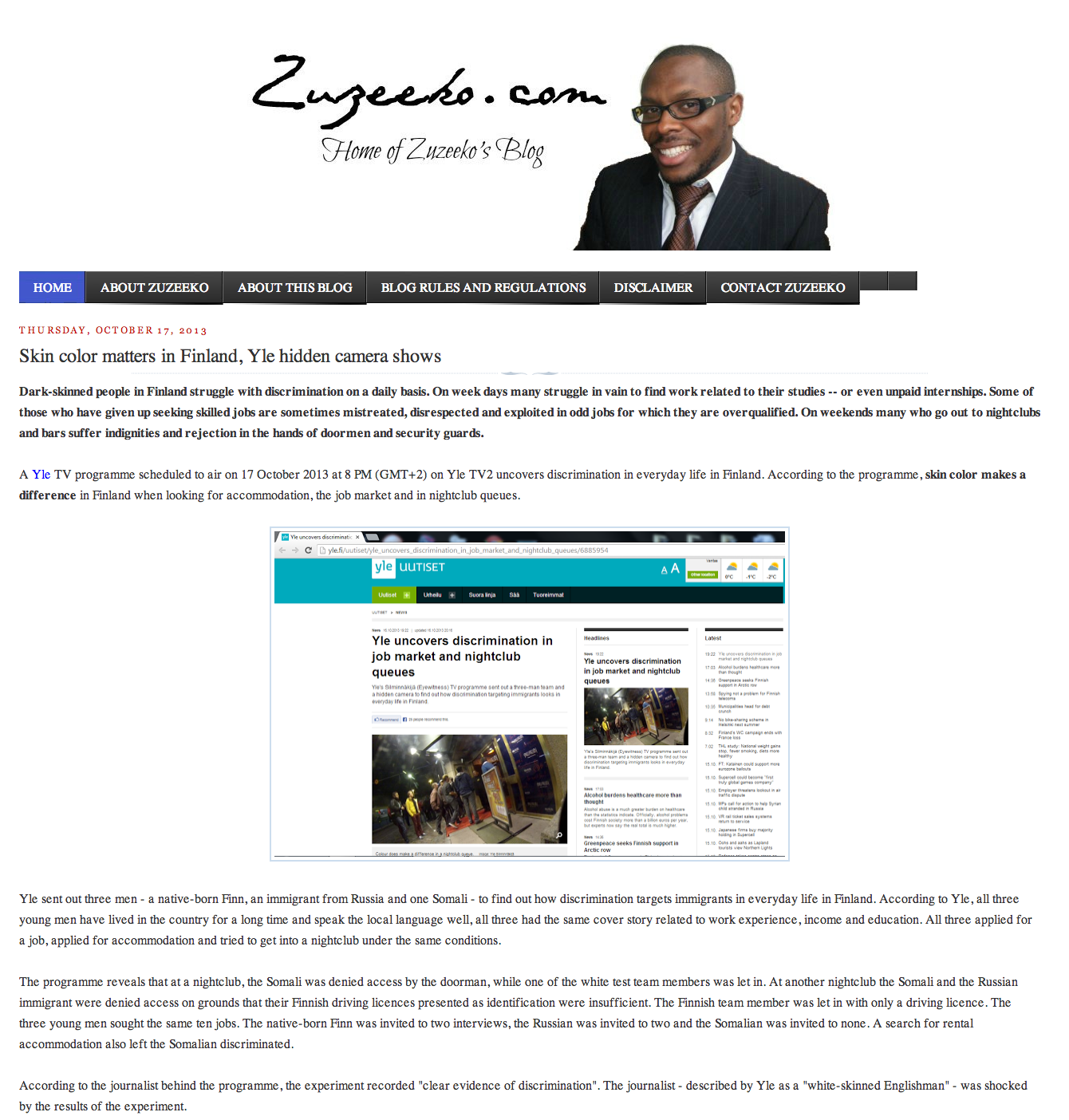
Dark-skinned people in Finland struggle with discrimination on a daily basis. On week days many struggle in vain to find work related to their studies — or even unpaid internships. Some of those who have given up seeking skilled jobs are sometimes mistreated, disrespected and exploited in odd jobs for which they are overqualified. On weekends many who go out to nightclubs and bars suffer indignities and rejection in the hands of doormen and security guards.

A Yle TV programme scheduled to air on 17 October 2013 at 8 PM (GMT+2) on Yle TV2 uncovers discrimination in everyday life in Finland. According to the programme, skin color makes a difference in Finland when looking for accommodation, in the job market and in nightclub queues.

Kuvankaappaus 2013-10-17 kello 8.25.47

Read full blog entry here.

Yle sent out three men – a native-born Finn, an immigrant from Russia and one Somali – to find out how discrimination targets immigrants in everyday life in Finland. According to Yle, all three young men have lived in the country for a long time and speak the local language well, all three had the same cover story related to work experience, income and education. All three applied for a job, applied for accommodation and tried to get into a nightclub under the same conditions.

The programme reveals that at a nightclub, the Somali was denied access by the doorman, while one of the white test team members was let in. At another nightclub the Somali and the Russian immigrant were denied access on grounds that their Finnish driving licences presented as identification were insufficient. The Finnish team member was let in with only a driving licence. The three young men sought the same ten jobs. The native-born Finn was invited to two interviews, the Russian was invited to two and the Somalian was invited to none. A search for rental accommodation also left the Somalian discriminated.

According to the journalist behind the programme, the experiment recorded “clear evidence of discrimination”. The journalist – described by Yle as a “white-skinned Englishman” – was shocked by the results of the experiment.

Personally, I am not shocked by the findings. As a person of African descent who has lived in Finland for over four years, I have faced my share of discrimination. For instance, a couple of years ago, a group of friends and I were denied entry into a nightclub in Helsinki. Of course we thought it was discriminatory and refused to leave the queue. The doorman said he would call the police if don’t leave. Believing that the police won’t allow discrimination, we implored the doorman to call. The police came and told us – to our surprise and disappointment – that doormen have the right to deny us entry. They suggested that we should find another club. I’ve also been denied access to a nightclub on grounds that I didn’t have a [winter] jacket.

In another shocking incident which I experienced first-hand, a young man of Somali origin came out of a nightclub for a smoke. The doormen denied him access when he tried to return. When he insisted they restrained him on the ground and called the police. One of the guards had a knee on the Somali’s head against concrete. When the police came, the Somali was handcuffed and taken into the police van.

In my view, the TV programme by Yle uncovers the plight of the average dark-skinned person in Finland. While it may shock some viewers, I am convinced that dark-skinned people who have lived in the country long enough will relate to the experience of the Somali in the programme and will not be surprised by the abysmal discrimination.

Read original blog entry here.

*Zuzeeko Tegha Abeng is an associate editor of Migrant Tales. 

Zuzeeko’s blog: Minorities in Finland face unequal treatment, even in death

Posted on September 22, 2013 by Migrant Tales

Zuzeeko Tegha Abeng*

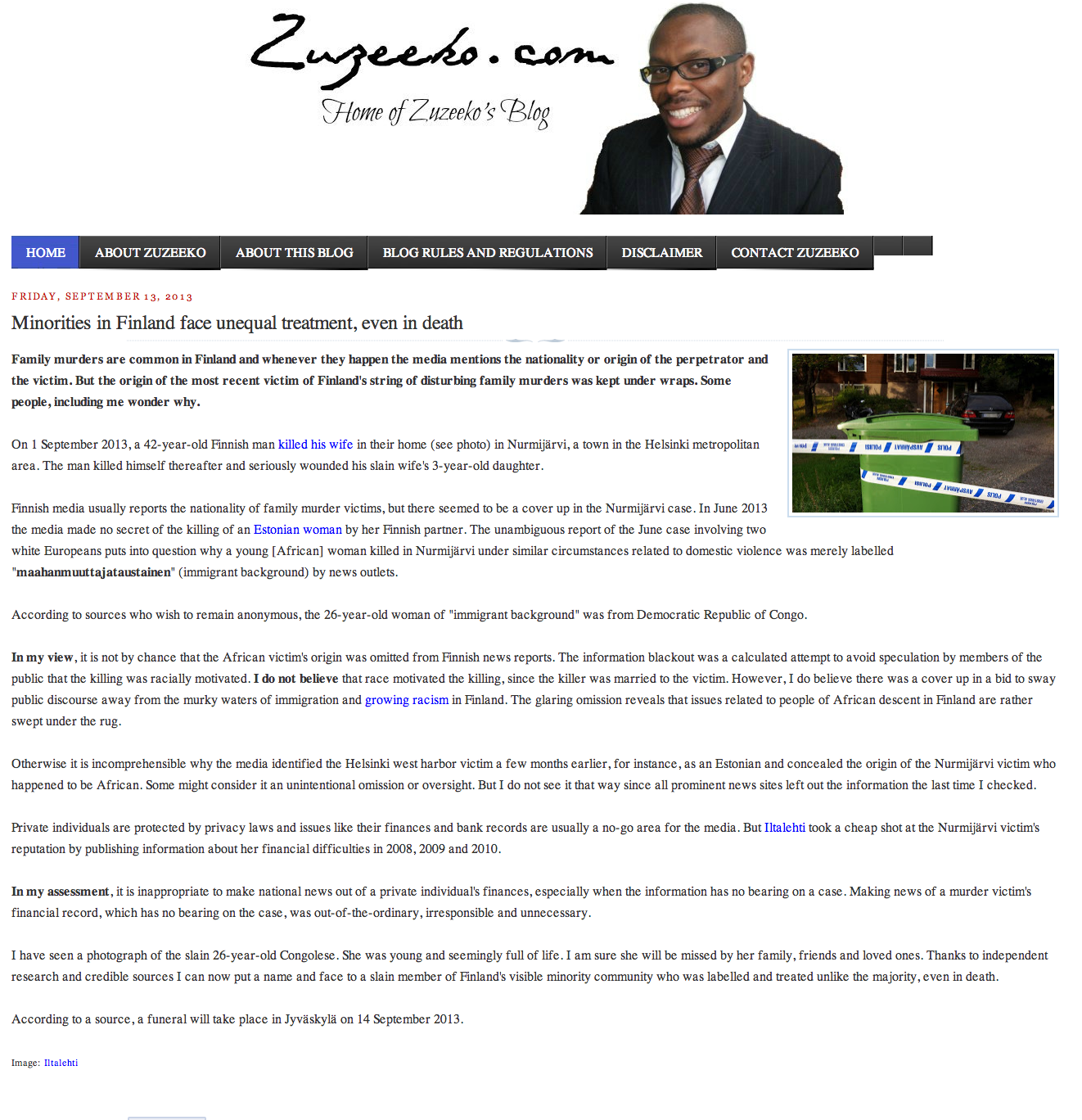
Family murders are common in Finland and whenever they happen the media mentions the nationality or origin of the perpetrator and the victim. But the origin of the most recent victim of Finland’s string of disturbing family murders was kept under wraps. Some people, including me wonder why.

Kuvankaappaus 2013-9-22 kello 13.55.26

On 1 September 2013, a 42-year-old Finnish man killed his wife in their home (see photo) in Nurmijärvi, a town in the Helsinki metropolitan area. The man killed himself thereafter and seriously wounded his slain wife’s 3-year-old daughter.

Finnish media usually reports the nationality of family murder victims, but there seemed to be a cover up in the Nurmijärvi case. In June 2013 the media made no secret of the killing of an Estonian woman by her Finnish partner. The unambiguous report of the June case involving two white Europeans puts into question why a young [African] woman killed in Nurmijärvi under similar circumstances related to domestic violence was merely labelled “maahanmuuttajataustainen” (immigrant background) by news outlets.

According to sources who wish to remain anonymous, the 26-year-old woman of “immigrant background” was from Democratic Republic of Congo.

In my view, it is not by chance that the African victim’s origin was omitted from Finnish news reports. The information blackout was a calculated attempt to avoid speculation by members of the public that the killing was racially motivated. I do not believe that race motivated the killing, since the killer was married to the victim. However, I do believe there was a cover up in a bid to sway public discourse away from the murky waters of immigration and growing racism in Finland. The glaring omission reveals that issues related to people of African descent in Finland are rather swept under the rug.

Otherwise it is incomprehensible why the media identified the Helsinki west harbor victim a few months earlier, for instance, as an Estonian and concealed the origin of the Nurmijärvi victim who happened to be African. Some might consider it an unintentional omission or oversight. But I do not see it that way since all prominent news sites left out the information the last time I checked.

Private individuals are protected by privacy laws and issues like their finances and bank records are usually a no-go area for the media. But Iltalehti took a cheap shot at the Nurmijärvi victim’s reputation by publishing information about her financial difficulties in 2008, 2009 and 2010.

In my assessment, it is inappropriate to make national news out of a private individual’s finances, especially when the information has no bearing on a case. Making news of a murder victim’s financial record, which has no bearing on the case, was out-of-the-ordinary, irresponsible and unnecessary.

I have seen a photograph of the slain 26-year-old Congolese. She was young and seemingly full of life. I am sure she will be missed by her family, friends and loved ones. Thanks to independent research and credible sources I can now put a name and face to a slain member of Finland’s visible minority community who was labelled and treated unlike the majority, even in death.

According to a source, a funeral will take place in Jyväskylä on 14 September 2013.

Read original blog entry here.

*Zuzeeko Tegha Abeng is an associate editor of Migrant Tales. 

Zuzeeko’s blog: MPs ignore bigger fish to fry in Finnish society

Posted on September 6, 2013 by Migrant Tales

Zuzeeko Tegha Abeng

Public discourse in Finnish online forums and blogs written by far-right elements and Finns Party MPs suggest that immigration is the biggest problem in Finland, but a closer look at Finnish society reveals more pertinent issues that people on the far-right of the political divide ignore, including domestic violence, family killings and violence against women and children.

Kuvankaappaus 2013-9-6 kello 6.52.16

Read original posting here.

Populist Finns Party members lead the way in fanning flames of hate against immigrants and other minorities in Finland. They slam immigrants and refugees and portray Muslims as villains. MPs like James Hirvisaari and Jussi Halla-aho have been convicted by Finnish courts for inciting hatred, but they remain defiant. Another notorious MP from the populist right-wing Finns Party, Teuvo Hakkarainen, more recently wrote a controversial blog post in which he described Muslims in Turku as the “worst Jihadists”. It’s worthy to remember that Hakkarainen used the n-word to describe people of African descent in a video interview on his first day in parliament.

From writings and utterances of Finns Party lawmakers (who also happen to be lawbreakers), you would think that immigration is the most serious problem in Finland.

In my view, there are bigger fishes to fry in Finnish society.

Numerous women and children have been killed in Finland as a result of domestic and family violence and the authorities have not done enough to arrest the problem.

According to Helsingin Sanomat, 55 people – including 48 children have been killed since 2003 as a result of family murders and the authorities have not acted adequately. For example, verbal threats of violence are usually not taken seriously. Helsingin Sanomat gathered 11 cases of family murders since 2011 – the most recent being a twin murder in Jyväskylä in August 2013.

The list of family murders doesn’t include the 1 September 2013 case where a Finnish man killed his immigrant wife and seriously wounded her three-year-old daughter with a handgun, nor the 15 June 2013 killing of an Estonian woman in broad daylight by her Finnish partner in a parking lot in Helsinki’s west harbor.

By my rough count, there have been three cases of family-related murders in less than three months this year – resulting in death of three women. This, in my assessment, is a more serious societal problem than immigration.

Finns Party MPs and other proponent of extreme views shared by Norway’s mass murderer Anders Breivik shouldn’t waste durable time in parliament taking cheap shots at immigrants and refugees. They should focus on tackling crippling societal problems like alcoholism, domestic violence and family killings.

A disturbing report revealed that a homicide is committed in Finland every third day. Majority of the perpetrators are discriminated, unemployed and alcoholic men. According to the report, more homicides are committed in Finland than in any other Nordic country.

MPs like Hakkarainen, Hirvisaari and Halla-aho focus on inciting hatred and shy away from discussing life-threatening problems that plague their constituencies. Perhaps, given their track record, the MPs would address the issues if perpetrators were mostly Muslims, immigrants, Roma or other minorities.

Read original blog entry here.

This piece was reprinted by Migrant Tales with permission.

Zuzeeko’s blog: Finland – Discrimination accounts for high Somali unemployment

Posted on June 24, 2013 by Migrant Tales

Zuzeeko Tegha Abeng

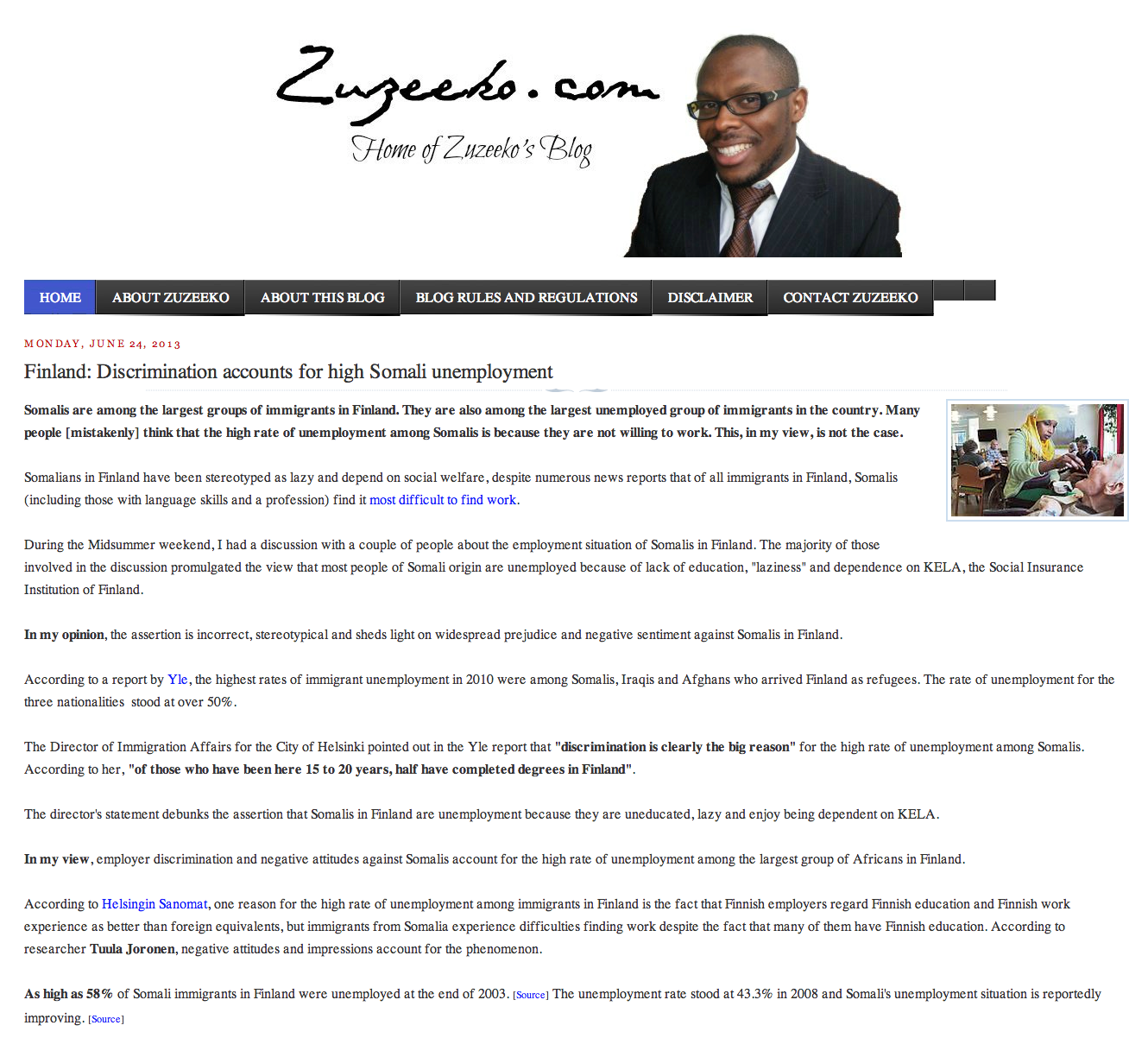
Somalis are among the largest groups of immigrants in Finland. They are also among the largest unemployed group of immigrants in the country. Many people [mistakenly] think that the high rate of unemployment among Somalis is because they are not willing to work. This, in my view, is not the case.
Kuvankaappaus 2013-6-24 kello 15.04.55Read original posting here.

Somalians in Finland have been stereotyped as lazy and depend on social welfare, despite numerous news reports that of all immigrants in Finland, Somalis (including those with language skills and a profession) find it most difficult to find work.

During the Midsummer weekend, I had a discussion with a couple of people about the employment situation of Somalis in Finland. The majority of those involved in the discussion promulgated the view that most people of Somali origin are unemployed because of lack of education, “laziness” and dependence on KELA, the Social Insurance Institution of Finland.

In my opinion, the assertion is incorrect, stereotypical and sheds light on widespread prejudice and negative attitudes towards Somalis in Finland.

According to a report by Yle, the highest rates of immigrant unemployment in 2010 were among Somalis, Iraqis and Afghans who arrived Finland as refugees. The rate of unemployment for the three nationalities  stood at over 50%.

The Director of Immigration Affairs for the City of Helsinki pointed out in the Yle report that “discrimination is clearly the big reason” for the high rate of unemployment among Somalis. According to the director, “of those who have been here 15 to 20 years, half have completed degrees in Finland”.

The director’s statement debunks the assertion that Somalis in Finland are unemployment because they are uneducated, lazy and enjoy being dependent on KELA.

In my view, employer discrimination and negative attitudes towards Somalis account for the high rate of unemployment among Finland’s largest group of Africans.

According to Helsingin Sanomat, one reason for the high rate of unemployment among immigrants in Finland is the fact that Finnish employers regard Finnish education and Finnish work experience as better than foreign equivalents. But immigrants from Somalia experience difficulties finding work, despite the fact that many of them have Finnish education. According to researcher Tuula Joronen, negative attitudes and impressions account for the phenomenon.

As high as 58% of Somali immigrants in Finland were unemployed at the end of 2003. [Source] The unemployment rate stood at 43.3% in 2008. [Source]

In 2010 and 2011, the risk of unemployment was highest among Somali speakers than among any other language group in Finland – according to Statistics Finland. Followed by high risk among Arabic, Persian and Kurdish speakers.

A poll revealed that Somalis and Muslims are among the groups most affected by racism and intolerance in Finland.

It is plausible to conclude from the aforementioned that prejudice, negative attitudes and employer discrimination against Somalis partly account for the high rate of unemployment in the Somali community. Many Somalis have learnt Finnish language and many have Finnish degrees and training. They should be employed without discrimination.

There was a total of 7,468 Somalians in Finland in 2012.

Read original blog entry here.

This piece was reprinted by Migrant Tales with permission.

 

City of Helsinki shouldn’t contract companies exploiting foreign workers

Posted on May 25, 2013 by Migrant Tales

By Zuzeeko Tegha Abeng

Foreign workers in the cleaning services sector in Finland face exploitation and abuse from employers and sometimes from customers. The authorities, including city councils that award cleaning contracts to companies that violate employment rules and collective agreements share the blame.

cleanersImage: The Copenhagen Post

According to a Yle report, work safety inspections conducted in about 20 cleaning companies that employ foreign workers revealed problems at every company inspected, and the City of Helsinki is considering contracting the services of one of the companies.

Violations uncovered by inspections carried out this year include irregularities in registering work hours, payment irregularities and employment of workers without work permits.

As a foreign national with experience and connections in Finland’s cleaning sector, I am not surprised by news that inspections turned up problems in every cleaning company inspected. What is surprising to me is that the City of  Helsinki is considering contracting a company that violates employment standards.

In my view, companies that do not register work hours exploit workers – intentionally or unintentionally – by not remunerating all work hours since some hours “slip through the cracks”. Payment irregularities could mean workers are not paid as per their work contracts and collective agreements. For instance, some foreign employees work without a fixed payment date, hence they can’t plan payment of bills, rents and other living expenses because they don’t know when they’ll be paid.

Workers employed without work permits, in my opinion are vulnerable and subject to exploitation and abuse since they mostly work in hiding and cannot take legal action against exploitation and abuse. Employers take advantage of undocumented workers.

Background checks

The City of Helsinki and all other authorities in Finland, including private sector businesses requesting bids should ensure that bidding companies respect labor laws and collective agreements before contracting their services. This can be done by working closely with labor inspectors and trade unions.

Service suppliers should be subjected to background checks before bid contracts are accepted.

In 2009 I wrote a complaint to the City of Espoo about the exploitation of workers (mostly Africans and Chinese) by a cleaning company operating in Espoo. In reply to my complaint a lawyer at the City of Espoo said, that before contracting companies the city ensures that the companies comply with labor laws and collective agreements. It was hard to believe the lawyer because the company in question, in my assessment, violated many labor standards and collective agreements in the cleaning services sector, including the obligation to register hours spent on the job by all employees. (Read my story, in Finnish, on PAM-lehti).

Exploitative companies that disregard labor regulations, collective agreements and workers’ rights should not be given contracts. Contracting such companies sends a wrong message that exploitation of foreign workers is acceptable in Finland.

Read original blog entry here.

This piece was reprinted by Migrant Tales with permission.

Zuzeeko’s blog: Ask Finland’s Minister of Interior to stop detention of innocent children

Posted on May 9, 2013 by Migrant Tales

Zuzeeko Tegha Abeng

The International Convention on the Rights of the Child – to which Finland is party – outlaws the detention of children, unless as a last resort and for the shortest possible time (see article 37[b]) and obligates States Parties to ensure that a child seeking asylum receives appropriate protection and assistance (see Article 22). Despite obligations under international law, Finland detains, as a first resort, children seeking asylum for long periods of time.

Amnesty International, Finnish section, launched a petition to stop detention of children seeking asylum in Finland.

According to Amnesty International, children should be in day care centres, schools or skateparks – not in police detention. Finland detains thousands of people yearly, including people who have fled persecution, war or poverty. They are held in prison-like conditions, although guilty of no crime.

There are children seeking asylum in Finland who live behind closed doors on a daily basis.

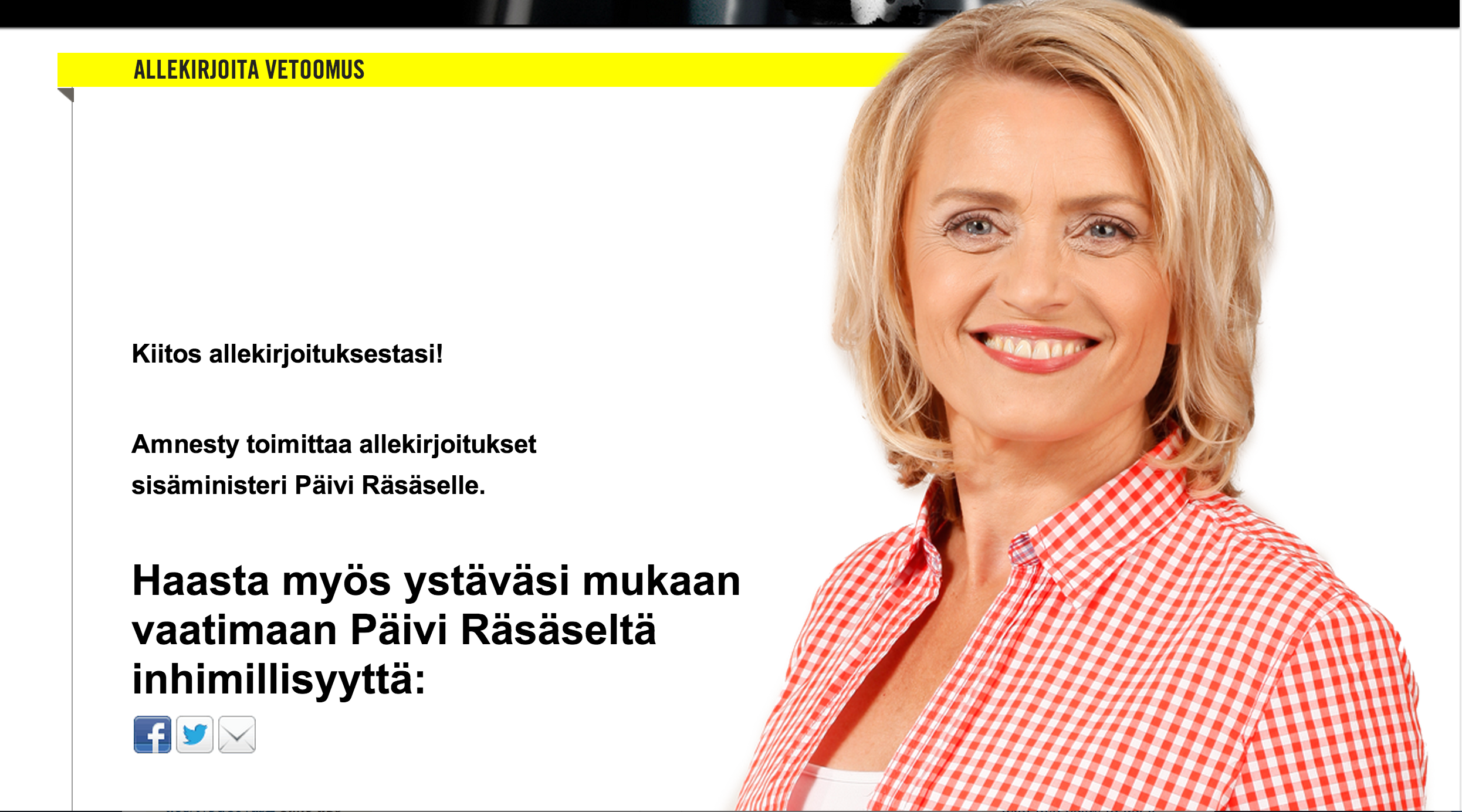
I have signed Amnesty International’s petition asking Minister of Interior Päivi Räsänen whether innocent children belong in police prisons. I believe children should be in homes, preschools, schools and playgrounds – not locked up.

Detention is not in the best interest of a child.

Kuvankaappaus 2013-5-10 kello 14.19.50 Kuvankaappaus 2013-5-10 kello 14.22.01
Sign the Amnesty International petition here. Finnish Interior Minister Päivi Räsänen.

Amnesty’s petition urges Minister Räsänen to:

  1. Fulfill the promise to stop detention of unaccompanied children.
  2. Immediately terminate detention of all children, expectant mothers and people traumatized by torture.
  3. Ensure that detention is used only as a last resort and for the shortest possible time. Detention places should develop less restrictive alternatives.
  4. Ensure that Finland comply with human rights obligations in detention.
Sign the petition.
According to Amnesty International, the government of Finland promised in 2011 to forbid the detention of unaccompanied children and to develop alternatives to detention. The promise was written in the government’s program, but it has not been fulfilled. Alternatives to detention have not yet been developed and children are still detained.
Amnesty International states that seeking asylum or a better life is not a crime and detained asylum seekers are not criminals.I have visited Metsälä Detention Centre, one of the facilities where asylum seekers in Finland are detained. It is located in Helsinki and I can confirm that the facility is like a prison. Children are detained there. It has one “playground” with no appropriate recreational facilities for kids.

In my view, the Metsälä facility is called a “detention centre”, but it is in fact a prison. It is no place for children, especially children who have done absolutely nothing wrong.

Read original blog entry here.

This piece was reprinted by Migrant Tales with permission.
 

Read more about documentary film
Read more

Recent Posts

  • Finland Bridge (2000): A year in Mediolanum,* Italy
  • Lahti is the latest city to prohibit the niqab and burka
  • Finland’s tabloids Iltalehti and Ilta-Sanomat are the pits
  • Riikka Purra’s Dr Jekyll and Mr Hyde mask
  • Double standards

Recent Comments

  1. Absolutely Socking: Racist Finnish Facebook group against human rights gets flooded with socks on Musta Barbaari’s mother and sister charged by the police in “ethnic profiling” case
  2. Ilkka Nuotio on Pekka Myrskylä: “Tilastot kertovat toista kuin poliittinen keskustelu”
  3. Genrih Soinkara on The war in Ukraine and the Russian-Finnish border crisis are showing Finland’s ugly side
  4. Ahti Tolvanen on Comment by Ahti Tolvanen on the Helsinki +50 conference
  5. Angel Barrientos on Angel Barrientos is one of the kind beacons of Finland’s Chilean community

Archives

  • June 2026
  • May 2026
  • April 2026
  • March 2026
  • February 2026
  • January 2026
  • December 2025
  • November 2025
  • October 2025
  • September 2025
  • August 2025
  • July 2025
  • June 2025
  • May 2025
  • April 2025
  • March 2025
  • February 2025
  • January 2025
  • December 2024
  • November 2024
  • October 2024
  • September 2024
  • August 2024
  • July 2024
  • June 2024
  • May 2024
  • April 2024
  • March 2024
  • February 2024
  • January 2024
  • December 2023
  • November 2023
  • October 2023
  • September 2023
  • August 2023
  • July 2023
  • June 2023
  • May 2023
  • April 2023
  • March 2023
  • February 2023
  • January 2023
  • December 2022
  • November 2022
  • October 2022
  • September 2022
  • August 2022
  • July 2022
  • June 2022
  • May 2022
  • April 2022
  • March 2022
  • February 2022
  • January 2022
  • December 2021
  • November 2021
  • October 2021
  • September 2021
  • August 2021
  • July 2021
  • June 2021
  • May 2021
  • April 2021
  • March 2021
  • February 2021
  • January 2021
  • December 2020
  • November 2020
  • October 2020
  • September 2020
  • August 2020
  • July 2020
  • June 2020
  • May 2020
  • April 2020
  • March 2020
  • February 2020
  • January 2020
  • December 2019
  • November 2019
  • October 2019
  • September 2019
  • August 2019
  • July 2019
  • June 2019
  • May 2019
  • April 2019
  • March 2019
  • February 2019
  • January 2019
  • December 2018
  • November 2018
  • October 2018
  • September 2018
  • August 2018
  • July 2018
  • June 2018
  • May 2018
  • April 2018
  • March 2018
  • February 2018
  • January 2018
  • December 2017
  • November 2017
  • October 2017
  • September 2017
  • August 2017
  • July 2017
  • June 2017
  • May 2017
  • April 2017
  • March 2017
  • February 2017
  • January 2017
  • December 2016
  • November 2016
  • October 2016
  • September 2016
  • August 2016
  • July 2016
  • June 2016
  • May 2016
  • April 2016
  • March 2016
  • February 2016
  • January 2016
  • December 2015
  • November 2015
  • October 2015
  • September 2015
  • August 2015
  • July 2015
  • June 2015
  • May 2015
  • April 2015
  • March 2015
  • February 2015
  • January 2015
  • December 2014
  • November 2014
  • October 2014
  • September 2014
  • August 2014
  • July 2014
  • June 2014
  • May 2014
  • April 2014
  • March 2014
  • February 2014
  • January 2014
  • December 2013
  • November 2013
  • October 2013
  • September 2013
  • August 2013
  • July 2013
  • June 2013
  • May 2013
  • April 2013
  • March 2013
  • February 2013
  • January 2013
  • December 2012
  • November 2012
  • October 2012
  • September 2012
  • August 2012
  • July 2012
  • June 2012
  • May 2012
  • April 2012
  • March 2012
  • February 2012
  • January 2012
  • December 2011
  • November 2011
  • October 2011
  • September 2011
  • August 2011
  • July 2011
  • June 2011
  • May 2011
  • April 2011
  • March 2011
  • February 2011
  • January 2011
  • December 2010
  • November 2010
  • October 2010
  • September 2010
  • August 2010
  • July 2010
  • June 2010
  • May 2010
  • April 2010
  • March 2010
  • February 2010
  • January 2010
  • December 2009
  • November 2009
  • October 2009
  • September 2009
  • August 2009
  • July 2009
  • December 2008
  • November 2008
  • October 2008
  • September 2008
  • August 2008
  • July 2008
  • June 2008
  • May 2008
  • April 2008
  • March 2008
  • February 2008
  • January 2008
  • November 2007
  • October 2007
  • September 2007
  • August 2007
  • July 2007
  • June 2007
  • May 2007

Categories

  • ?? Gia L?c
  • ????? ?????? ????? ???????? ?? ??????
  • ???????
  • @HerraAhmed
  • @mondepasrond
  • @nohatefinland
  • @oula_silver
  • @Varathas
  • A Pakistani family
  • äärioikeisto
  • Abbas Bahmanpour
  • Abdi Muhis
  • Abdirahim Hussein Mohamed
  • Abdirahim Husu Hussein
  • Abdirisak Mahamed
  • About Migrant Tales
  • activism
  • Adam Al-Sawad
  • Adel Abidin
  • Afrofinland
  • Ahmed IJ
  • Ahti Tolvanen
  • Aino Pennanen
  • Aisha Maniar
  • Alan Ali
  • Alan Anstead
  • Alejandro Díaz Ortiz
  • Alekey Bulavsev
  • Aleksander Hemon
  • Aleksanterinliitto
  • Aleksanterinliitto ry
  • Aleksanterinliitto ry:n hallitus
  • Alex Alex
  • Alex Mckie
  • Alexander Nix
  • Alexandra Ayse Albayrak
  • Alexis Neuberg
  • Ali Asaad Hasan Alzuhairi
  • Ali Hossein Mir Ali
  • Ali Rashid
  • Ali Sagal Abdikarim
  • Alina Tsui
  • Aline Müller
  • All categories
  • Aman Heidari
  • Amiirah Salleh-Hoddin & Jana Turk
  • Amin A. Alem
  • Amir Zuhairi
  • Amkelwa Mbekeni
  • Ana María Gutiérrez Sorainen
  • Anachoma
  • Anders Adlecreutz
  • Angeliina Koskinen
  • Anna De Mutiis
  • Anna María Gutiérrez Sorainen
  • Anna-Kaisa Kuusisto ja Jaakko Tuominen
  • Annastiina Kallius
  • Anneli Juise Friman Lindeman
  • Announcement
  • Anonymous
  • Antero Leitzinger
  • anti-black racism
  • Anti-Hate Crime Organisation Finland
  • Anudari Boldbaatar
  • Arshiya Nasser
  • Aspergers Syndrome
  • Asylum Corner
  • Asylum seeker 406
  • Athena Griffin and Joe Feagin
  • Autism
  • Avaaz.org
  • Awale Olad
  • Ayan Said Mohamed
  • AYY
  • Barachiel
  • Bashy Quraishy
  • Beatrice Kabutakapua
  • Beri Jamal
  • Beri Jamal and Enrique Tessieri
  • Bertolt Brecht
  • Boiata
  • Boodi Kabbani
  • Bruno Gronow
  • Carmen Pekkarinen
  • Çelen Oben and Sheila Riikonen
  • Chiara Costa-Virtanen
  • Chiara Costa-Virtanen
  • Chiara Sorbello
  • Christian Thibault
  • Christopher Wylie
  • Clara Dublanc
  • Dana
  • Daniel Malpica
  • Danilo Canguçu
  • David Papineau
  • David Schneider
  • Dexter He
  • Don Flynn
  • Dr Masoud Kamali
  • Dr. Faith Mkwesha
  • Dr. Theodoros Fouskas
  • Edna Chun
  • Eeva Kilpi
  • Emanuela Susheela
  • En castellano
  • ENAR
  • Enrique
  • Enrique Tessieri
  • Enrique Tessieri & Raghad Mchawh
  • Enrique Tessieri & Yahya Rouissi
  • Enrique Tessieri and Muhammed Shire
  • Enrique Tessieri and Sira Moksi
  • Enrique Tessieri and Tom Vandenbosch
  • Enrique Tessieri and Wael Che
  • Enrique Tessieri and Yahya Rouissi
  • Enrique Tessieri and Zimema Mhone
  • Epäluottamusmies
  • EU
  • Europe
  • European Islamophobia Report
  • European Islamophobia Report 2019,
  • European Union
  • Eve Kyntäjä
  • Ezequiel Caldeiro
  • Facebook
  • Fadumo Dayib
  • Faisa Kahiye
  • Farhad Manjoo
  • Fasismi
  • Finland
  • Fizza Qureshi
  • Flyktingar och asyl
  • Foreign Student
  • Fozia Mir-Ali
  • Frances Webber
  • Frida Selim
  • Gareth Rice
  • Ghyslain Vedeaux
  • Global Art Point
  • Great Replacement
  • Habiba Ali
  • Hami Bahadori
  • Hami Bahdori
  • Hamid
  • Hamid Alsaameere
  • Hamid Bahdori
  • Handshake
  • Harmit Athwal
  • Hassan Abdi Ali
  • Hassan Muhumud
  • Heikki Huttunen
  • Heikki Wilenius
  • Helsingin Sanomat
  • Henning van der Hoeven
  • Henrika Mälmsröm
  • Hser Hser
  • Hser Hser ja Mustafa Isman
  • Husein Muhammed
  • Hussain Kazemian
  • Hussain Kazmenian
  • Ibrahim Khan
  • Ida
  • Ignacio Pérez Pérez
  • Iise Ali Hassan
  • Ilari Kaila & Tuomas Kaila
  • Imam Ka
  • inside-an-airport
  • Institute of Race Relations
  • Iraqi asylum seeker
  • IRR European News Team
  • IRR News Team
  • Islamic Society of Norhern FInland
  • Islamic Society of Northern Finland
  • Islamophobia
  • Jacobinmag.com
  • Jallow Momodou
  • Jan Holmberg
  • Jane Elliott
  • Jani Mäkelä
  • Jari Luoto
  • Jari Taponen
  • Jegor Nazarov
  • Jenni Stammeier
  • Jenny Bourne
  • Jessie Daniels
  • Joe Davidow
  • Johannes Koski
  • John D. Foster
  • John Grayson
  • John Marriott
  • Jon Burnett
  • Jorma Härkönen
  • Jos Schuurmans
  • José León Toro Mejías
  • Josue Tumayine
  • Jouni Karnasaari
  • Juan Camilo
  • Jukka Eräkare
  • Julian Abagond
  • Julie Pascoet
  • Jussi Halla-aho
  • Jussi Hallla-aho
  • Jussi Jalonen
  • JusticeDemon
  • Kadar Gelle
  • Kaksoiskansalaisuus
  • Kansainvälinen Mikkeli
  • Kansainvälinen Mikkeli ry
  • Katherine Tonkiss
  • Kati Lepistö
  • Kati van der Hoeven-Lepistö
  • Katie Bell
  • Kättely
  • Kerstin Ögård
  • Keshia Fredua-Mensah & Jamie Schearer
  • Khadidiatou Sylla
  • Khadra Abdirazak Sugulle
  • Kiihotus kansanryhmää vastaan
  • Kirsi Crowley
  • Koko Hubara
  • Kristiina Toivikko
  • Kubra Amini
  • KuRI
  • La Colectiva
  • La incitación al odio
  • Laura Huhtasaari
  • Lauri Finér
  • Leif Hagert
  • Léo Custódio
  • Leo Honka
  • Leontios Christodoulou
  • Lessie Branch
  • Lex Gaudius
  • Leyes de Finlandia
  • Liikkukaa!
  • Linda Hyökki
  • Liz Fekete
  • M. Blanc
  • Maarit Snellman
  • Mahad Sheikh Musse
  • Maija Vilkkumaa
  • Malmin Kebab Pizzeria Port Arthur
  • Marcell Lorincz
  • Mari Aaltola
  • María Paz López
  • Maria Rittis Ikola
  • Maria Tjader
  • Marja-Liisa Tolvanen
  • Mark
  • Markku Heikkinen
  • Marshall Niles
  • Martin Al-Laji
  • Maryan Siyad
  • Matt Carr
  • Mauricio Farah Gebara
  • Media Monitoring Group of Finland
  • Micah J. Christian
  • Michael McEachrane
  • Michele Levoy
  • Michelle Kaila
  • Migrant Tales
  • Migrant Tales Literary
  • Migrantes News
  • Migrants' Rights Network
  • MigriLeaks
  • Mikko Kapanen
  • Miriam Attias and Camila Haavisto
  • Mohamed Adan
  • Mohammad Javid
  • Mohammad M.
  • Monikulttuurisuus
  • Monisha Bhatia and Victoria Canning
  • Mor Ndiaye
  • Muh'ed
  • Muhamed Abdimajed Murshid
  • Muhammed Shire
  • Muhammed Shire and Enrique Tessieri
  • Muhis Azizi
  • Musimenta Dansila
  • Muslimiviha
  • Musulmanes
  • Namir al-Azzawi
  • Natsismi
  • Neurodiversity
  • New Women Connectors
  • Nils Muižnieks
  • No Labels No Walls
  • Noel Dandes
  • Nuor Dawood
  • Omar Khan
  • Otavanmedia
  • Oula Silvennoinen
  • Paco Diop
  • Pakistani family
  • Pentti Stranius
  • Perussuomalaiset
  • perustuslaki
  • Petra Laiti
  • Petri Cederlöf
  • Pia Grochowski
  • Podcast-lukija Bea Bergholm
  • Pohjois – Suomen Islamilainen Yhdyskunta
  • Pohjois Suomen Islamilainen Yhyskunta
  • Polina Kopylova
  • Race Files
  • racism
  • Racism Review
  • Raghad Mchawh
  • Ranska
  • Rashid H. and Migrant Tales
  • Rasismi
  • Raul Perez
  • Rebecka Holm
  • Reem Abu-Hayyeh
  • Refugees
  • Reija Härkönen
  • Remiel
  • Reza Nasri
  • Richard Gresswell
  • Riikka Purra
  • Risto Laakkonen
  • Rita Chahda
  • Ritva Kondi
  • Robito Ibrahim
  • Roble Bashir
  • Rockhaya Sylla
  • Rodolfo Walsh
  • Roger Casale
  • Rostam Atai
  • Roxana Crisólogo Correa
  • Ruth Grove-White
  • Ruth Waweru-Folabit
  • S-worldview
  • Sadio Ali Nuur
  • Sami Rusanen
  • Sandhu Bhamra
  • Sara de Jong
  • Sarah Crowther
  • Sari Alhariri
  • Sarkawt Khalil
  • Sasu
  • Scot Nakagawa
  • Shabana Ahmadzai
  • Shada Islam
  • Sharon Chang blogs
  • Shenita Ann McLean
  • Shirlene Green Newball
  • Sini Savolainen
  • Sira Moksi
  • Sonia K.
  • Sonia Maria Koo
  • Steverp
  • Stop Deportations
  • Suldaan Said Ahmed
  • Suomen mediaseurantakollektiivi
  • Suomen Muslimifoorumi ry
  • Suomen viharikosvastainen yhdistys
  • Suomen viharikosvastainen yhdistys ry
  • Suomi
  • Supermen
  • Susannah
  • Suva
  • Syrjintä
  • Talous
  • Tapio Tuomala
  • Taw Reh
  • Teivo Teivainen
  • The Daily Show
  • The Heino
  • The Supermen
  • Thomas Elfgren
  • Thulfiqar Abdulkarim
  • Tim McGettigan
  • Tino Singh
  • Tito Moustafa Sliem
  • Tobias Hübinette and L. Janelle Dance
  • Transport
  • Trica Danielle Keaton
  • Trilce Garcia
  • Trish Pääkkönen
  • Trish Pääkkönen and Enrique Tessieri
  • Tuulia Reponen
  • Uncategorized
  • UNITED
  • University of Eastern Finland
  • Uyi Osazee
  • Väkivalta
  • Vapaa Liikkuvuus
  • Venla-Sofia Saariaho
  • Vieraskynä
  • W. Che
  • W. Che an Enrique Tessieri
  • Wael Ch.
  • Wan Wei
  • Women for Refugee Women
  • Xaan Kaafi Maxamed Xalane
  • Xassan Kaafi Maxamed Xalane
  • Xassan-Kaafi Mohamed Halane & Enrique Tessieri
  • Yahya Rouissi
  • Yasmin Yusuf
  • Yassen Ghaleb
  • Yle Puhe
  • Yuliet Tresa
  • Yve Shepherd
  • Zahra Khavari
  • Zaker
  • Zalina Ametova
  • Zamzam Ahmed Ali
  • Zeinab Amini ja Soheila Khavari
  • Zimema Mahone and Enrique Tessieri
  • Zimema Mhone
  • Zoila Forss Crespo Moreyra
  • ZT
  • Zulma Sierra
  • Zuzeeko Tegha Abeng
© 2026 Migrant tales | Powered by Minimalist Blog WordPress Theme