The sentencing of a respected scholar on racism of aggravated defamation by a Turku Court is more of a warning to others who may protest against ethnic profiling by security guards and the police. The verdict raises a lot of answered questions.
One of these is why was the seventeen-year-old put in handcuffs for not having a valid ticket. If he were white, would he have received the same treatment by the ticket inspectors and security guards?
The Helsinki Police, and the Finnish police in general, have a dismal reputation for dealing with ethnic profiling. It wasn’t too long ago when the police admitted that they did not ethnically profile anyone.
Why did the media think it is important to constantly identify the victim as “a dark-skinned” person?
It is usually the rule rather than the exception that everywhere EU’s Frontex polices with local border guards the border, “European values” are thrown under the bus or underwater in most cases. For this reason, some fear that Finland’s pushback law will be just another example of the corruption, violations, and death that characterize the policing of EU borders.
Migrant Tales was recently in touch with an Iraqi asylum seeker who was caught this month on the Greek side of the Ervos River. Migrant Tales took part of a documentary about the abuses and violations at the Evros River.
The point where the asylum seeker was apprehended, robbed, and beaten by the Greek authorities. Source: Asylum seeker.
He alleges:
“Yes, [I was beten] in my hand, in my head, and in my back. They put me on the ground and took off all my clothes. I was hiding money in my underwear, an amount of 5,000 euros, a wedding ring with my name and my ex-wife’s name written on it, name omitted, a ring, a silver bracelet, a watch that my wife bought as a wedding gift, and a phone. iPhone 11 Pro Max I bought it in Finland name of city omitted. My wife bought it for me as a gift and it contains a Finnish SIM card and phone numbers; I also bought a Galaxy phone from Turkey and headphones. They hit me in the head because I did not accept to open the phone for them and then they hit me again and I could not bear it and gave them the code. All of this was taken from me, all of this in front of the Greek Army.”
“…the job of the politician is to guarantee the safety of its own citizens and to guard its borders, and that’s what Finns expect.”
Perussuomalaiset (PS)* MP Laura Huhtasaari, A-studio(3.6.2024)
The answer given by PS MP Huhtasaari to justify pushbacks and deaths is a raw example of the inhumanity used during Nazi Germany to justify the wholesale slaughter of Jews, minorities and other enemies of the régime.
The question answered by Huhtasaari is on the Yleelection compass and a poll, which asks: “A person trying to reach Europe can be turned back at the external border, even if it would put their lives in danger.”
What else can we expect from politicians who justify the deaths of people after pushbacks? What kind of treacherous slippery slope are we on in Finland?
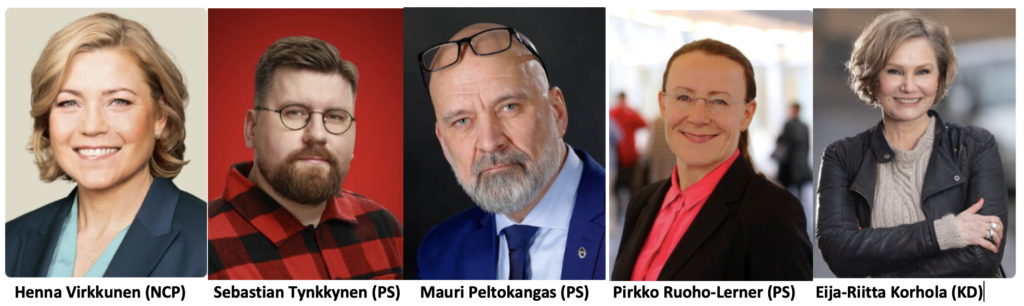
The above MEP candidates in the 2019 MEP election didn’t mind if people drowned in the Mediterranean. All of them, except Eija-Riitta Korhola, have moderated their radical stances. Henna Virkkunen, Sebastian Tykkynen, Mauri Peltokangas, and Pirkko Ruoho-Lerner would care less for a person’s safety and life if he or she were a victim of pushbacks at the border. Source: Yle
If we want and to shed light on what may happen at the Finnis-Russian border, we can look at the inhumane treatment suffered by asylum seekers in other EU borders.
Of these, there is the Greek-Turkish Evros River border, where pushbacks and human rights violations are the order of the day. Migrant Tales was a small part of this important documentary.
One of the questions not addressed by the media, never mind politicians, is what will spare the Finnish-Russian border from becoming another shameful EU example of violent pushbacks and Human Rights violations?
How is it possible that we do not hear a word from the government about three suspects tried on terrorism charges in Lahti. Helsingin Sanomat published an editorial Tuesday about the threat of far-right violence in Finland.
Writes Helsingin Sanomat: “However, the case is a fresh reminder that the extreme right is a real threat to Finland’s security. The assessment made by the Finnish Security Police (SUPO) a couple of years ago is correct; in addition to the terrorist threat from radical Islamists, the terrorist threat from the far right has increased.”
As if trying to divert attention from far-right terrorism, Interior Minister Mari Rantanen has preferred to talk about migrant youth gang violence and new questionable methods to give the police more search- and-seizure powers.
For many years, groups like Migrant Tales, historian Oula Silvenoinen, and columnist Saku Timonen have warned about the ties of the radical-right Perussuomalaiset (PS)* party and far-right groups. Is it a surprise that one of the main suspects in the terrorist trial in Lahti is a former PS member Viljam Nyman?
Finnish prosecutors have charged four men in the Lahti terrorism trial that are believed to be able to produce semiautomatic weapons using a 3D printer and attacking critical infrastructure, politicians, anti-racism activists and NGOs. One of the targets was believed to be former prime minister, Sanna Marin.
Finnish news server YLE reported that the four suspects follow neo-Nazi ideology linked to accelerationism, which claims that fundamental societal transformations can be achieved only by accelerating different processes in society.
“The government must unequivocally distance itself from racism,” emphasizes Anna-Maja Henriksson, Swedish People’s Party chairperson and minister of education. National Coalition Party Prime Minister Petteri Orpo, declares, “As a government, we maintain a policy of zero tolerance for racism.”
Upon hearing the above-mentioned statements, one should not be surprised why some are in a state of doubt and shock, especially when people are told that they should forget and forgive the racist statements of some MPs who were appointed as ministers in June.
For example, Perussuomalaiset (PS)* MP Vilhelm Junnila resigned in disgrace after about 10 days as trade minister but was recently elected as the first vice chairperson of the PS parliamentary group.
Junnila’s successor, Wille Rydman, assumed the role of trade minister but faced a scandal due to his racist, anti-Semitic, and dehumanizing private messages, which were made public by Helsingin Sanomat. These messages also exposed Rydman’s disturbing Nazi views and ideologies. Surprisingly, the minister did not offer a public apology for the offensive messages.
The series of scandals involving the PS this summer prompts us to question whether these so-called self-proclaimed saviors of Finland understand the term “racism.” It’s important to note that Finland is bound by various international agreements aimed at addressing the social ill:
· Finland has ratified the International Convention on the Elimination of All Forms of Racial Discrimination, which places significant obligations on the government to dismantle racially discriminatory structures in society. Additionally, freedom from discrimination is enshrined in several UN treaties and the Universal Declaration of Human Rights.
· The Durban Declaration and Program of Action, adopted in the World Conference against Racism in 2001, commit states to anti-racist efforts and addressing the consequences of colonialism.
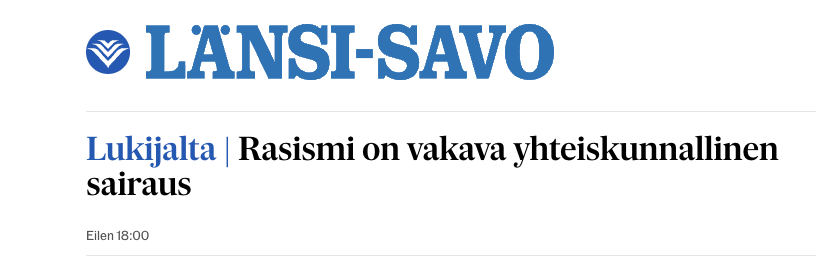
An article in Mikkeli-based daily Länsi-Savo (10 August) interviewed three members of the Finns Party (PS) from the South Savo region who claimed that racism has no place in the party. If this is true, it is significant and welcome news.
In the face of the numerous racism scandals that have overshadowed the activities of the PS over the years and, at the latest, in July, the claim by the members of the party is fantastical. We believe that racism has historically been as important to the PS as the Swedish language is to the Swedish People’s Party.
But in the name of fairness, I (Tessieri) would like to thank the PS who, in the meetings of the Mikkeli City Council that I have attended, do not speak of immigrants in a demeaning way like their fellow MPs in parliament.
However, the PS is historically the first major contemporary Finnish party to have benefited from the polarization between different groups and to have attacked other ones, such as Muslims, Africans, and other non-EU nationals, as unequals.
Racism is a serious social illness in which groups of people are treated as inferior due to their ethnic origin, skin color, nationality, culture, or religion.
While the party may not necessarily recognize its immigration policy as racist, it is highly discriminatory. The changes proposed by the government, especially the PS, in the new policy promote inequality and make it more difficult for migrants to participate in our society as equals.
We also disagree with Jani Sension that this summer’s numerous racism scandals is something made up by the media.
If the racism scandals have highlighted an important point, it is the Finnish media’s important role in defending the rule of law and the fundamental rights of all people, regardless of background.
PS Minister of the Interior Mari Rantanen, who has also published racist and far-right posts and removed them from her social media sites, has said that the government’s immigration policy will undergo a paradigm shift.
We hope that in light of these racism scandals, the media will experience its own paradigm shift in its role as the nation’s watchdog and not leave a stone unturned in its important work.
Enrique Tessieri, Yahya Roussi
The authors are members of the board of Kansainvälinen Mikkeli, a registered associationpromoting diversity. Tessieri is also a deputy city councilperson of the Mikkeli City Council.