
In 2010, when Otava Folk High School, located 14 km from Mikkeli, started offering halal meat on a regular weekly basis to its Muslim students, it became one of the first, if not the first, learning institutions to offer such meat to students. All of this, however, came to an abrupt end when the principal, Harri Jokinen, discontinued the service a few years later.
Jokinen blamed cost-cutting for the decision.
Päivi Ruhanen, who was a cook at the school’s cafeteria, stated that the primary motivation for serving halal meat to Muslim students was to provide them with a source of protein, which is an essential component of their diet.
When asked if preparing halal meat dishes caused more work for the cafeteria staff, she said that it did.
“Yes, it does,” Ruhanen was quoted as saying in the school publication Otavan Sanomat, “because it
has to be done separately. However, we also want to offer healthy food for those who follow special diets.”
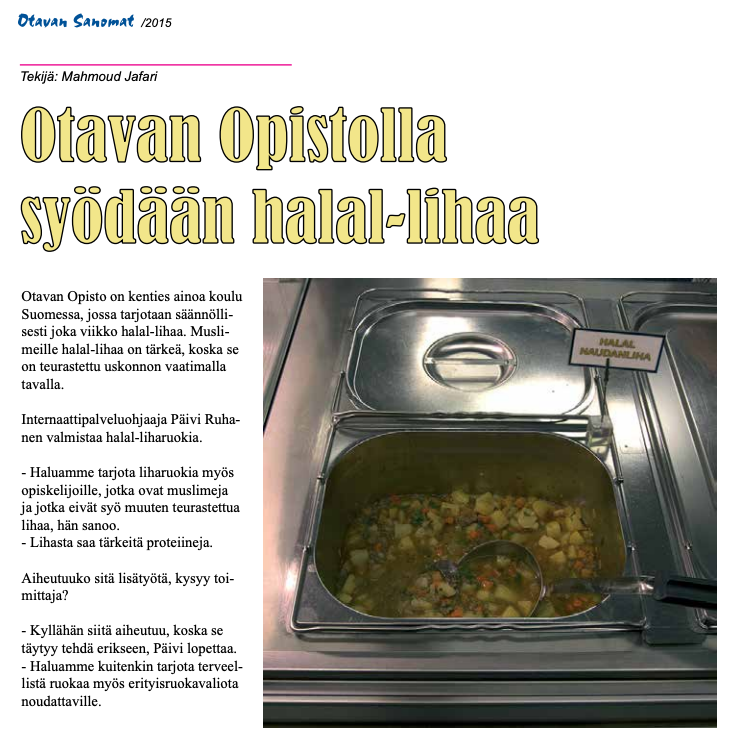
Read the original story here.
Considering that Islam is the second-biggest religion in Finland offering halal meat is still an exception in Finland. Even if cities like Helsinki, Vantaa, Espoo, Tampere and Turku have a large number of people who don’t speak Finnish or Swedish as their mother tongue, all five cities take special dietary requirements into account (allergies, vegetarian/vegan food). However, none of them offer at their schools halal meat on a regular basis.
Even if the decision to offer halal meat was an exemplary move at Otava Folk High School, the publication of the 111,855-strong Finnish Teachers’ Union (OAJ) turned down an opportunity to publish a story about halal meat at the folk high school.
Their rejection speaks volumes about perceptions of the role of religious minorities like Muslims at schools. In plain English, it means that we will need to cede space to their special needs.
Otava Folk High School took other bold steps to promote inclusiveness. Students were no longer called migrant students but multicultural students, according to The Shifting Global World of Youth and Education (2018), edited by Mabel Ann Brown.
All of these innovative and culturally sensitive measures came to an abrupt halt around 2018, which offers us insight into what conditions cultural diversity survives at Finnish learning institutions.
Lessons learned?
Even if offering halal meat places more demands on the cafeteria staff, it pays off since it promotes inclusion, and students feel more connected to the school.
In order for it to succeed, you need strong support from the principal and the cafeteria staff.
Without them, the project is doomed to fail like at Otava Folk High School, where it came and went.