I have always said that if there were another government, preferably without the National Coalition Party (NCP) and Perussuomalaiset (PS)*, the decision to shut the Russian-Finnish border would have some credibility.
Source: X (formerly Twitter).
The decision to close the border is first and foremost a political decision. It is a good way to shift attention from the painful austerity measures Prime Minister Petteri Orpo plans to implement.
The closing of the border also reinforces what we’ve known for a long time: the PS and NCP don’t care about human rights.
According to the Guardian, Annika Sandlund, the UN refugee agency’s representative to the Nordic and Baltic countries, said closing all border crossing points would be “contrary to international law”.
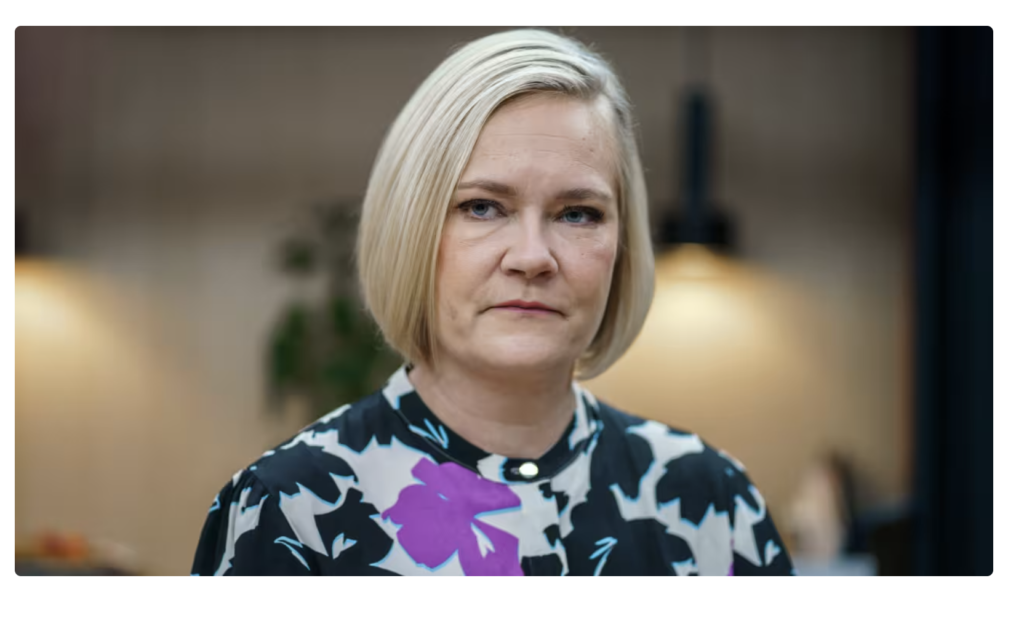
Radical right Perussuoalaiset (PS)* chairperson, Riikka Purra, like Interior Minister Mari Rantanen, loathes Muslims and other minorities. Slamming and suggesting that Deputy Chancellor of Justice Mikko Puumalainen is a”liberal moron,” exposes her hatred and desperation.
Purra, the one who said she’d shoot migrant youths on a train in 2008, now takes out her crystal ball and claims to be a clairvoyant.
She writes that the people coming from Russia to the border “are not genuine asylum seekers,” adding that they “have nothing to worry about and are not fleeing [war].”
If Purra claims that these people aren’t real asylum seekers, we could say that her concern about “national security” due to a few hundred asylum seekers coming to the border is hogwash. In 2015, we had thousands of asylum seekers entering Finland from Iraq and Afghanistan and nobody raised serious outcries about national security. As we can see, it is all a political stunt by Purra and her party.
But here is the question: Why is Purra so eager about trashing our international agreements that are protected, according to her, by “liberal morons.”
In order to expose the lies of Prime Minister Petteri Orpo’s government, just look at the flagrant denials and outrageous claims. There are two that fit the far-right playbook to a tee: (1) We can shut the Finnish-Russian border and deny people the right to asylum; and (2) Vladimir Putin can get political asylum in Finland.
Both are false claims intended for public consumption.
When it comes to migrants, the far-right playbook works in the following manner:
Make an outrageous claim like we can shut the whole eastern border and deny asylum.
Even if the media will disprove your claim later, it does not matter because the news is already out there.
Your followers have received the fictitious claim.
The government is now offering two lies for the price of one. First lie: We can shut the whole Finnish-Russian border and tell asylum seekers to go fly a kite. Second lie: Vladimir Putin can get refuge in Finland by simply mentioning the magic word, “asylum,” at the border.
The first lie, that the government can shut the border to asylum seekers, is a campaign promise made by the National Coalition Party and PS, whose leader Riikka Purra falsely misled voters to believe that her party’s get-ough stance on migrants meant denying their rights to asylum.
The government has adopted far-right rhetoric. In this ad, the government claims that its measures at the border are to “stop illegal migration.” The claim is as absurd as labeling people as “illegal refugees.” Is there such a thing? The spread of misinformation is as full wing.
Many mainstream politicians have adopted and amplified the language of the far right
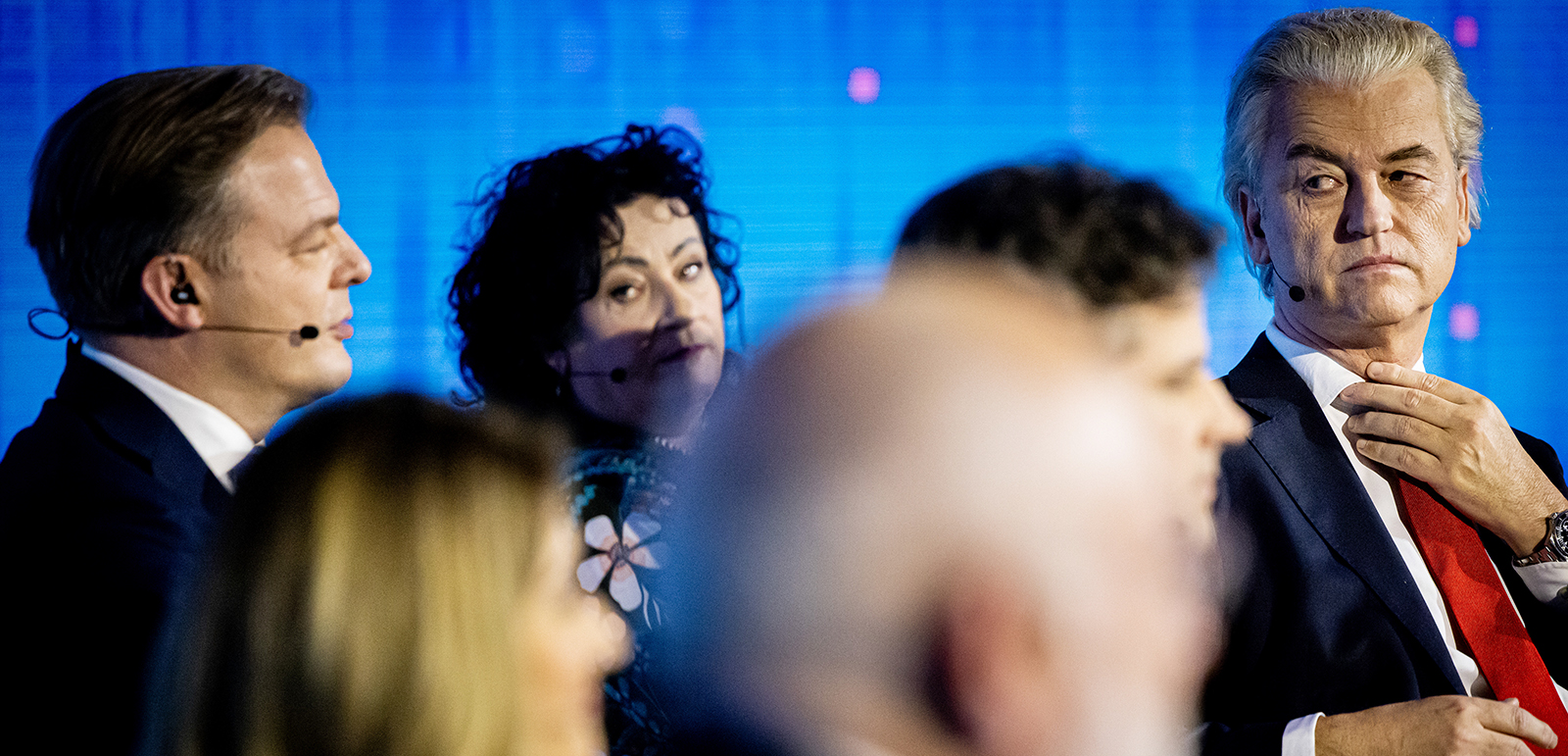
On the far right, Geert Wilders of PVV looks on during the last debate in the Dutch parliamentary elections on 21 November, 2023 in The Hague, Netherlands. Photo by Patrick van Katwijk/Getty Images
Dutch far-right and anti-Islam politician Geert Wilders’ success in this week’s elections in the Netherlands has been widely described as a “shock” result. It is nothing of the sort.
Wilders’ Party for Freedom (PVV), whose manifesto calls for bans on mosques and the wearing of Islamic headscarves in government buildings, won 37 seats in the 150-seat parliament, more than doubling its previous number.
Instead, sections of the media described Wilders as “charismatic” and failed to challenge him, even as he called Moroccan migrants “scum” and said Islam is “the ideology of a retarded culture”. He was also courted unashamedly by Dilan Yeşilgöz-Zegerius, leader of the liberal VVD party, which has been in power for the past 10 years.
The shock for those of us who have observed the resurgence of far-right politics in Europe is not that Wilders may become Dutch prime minister. It is that today in Europe, for people of colour, there appears to be no hiding place.
Almost all of Europe’s mainstream politicians — in varying degrees — have adopted and amplified the racist, xenophobic, anti-migration and Islamophobic views of Wilders, France’s Marine Le Pen and Hungary’s Viktor Orban.
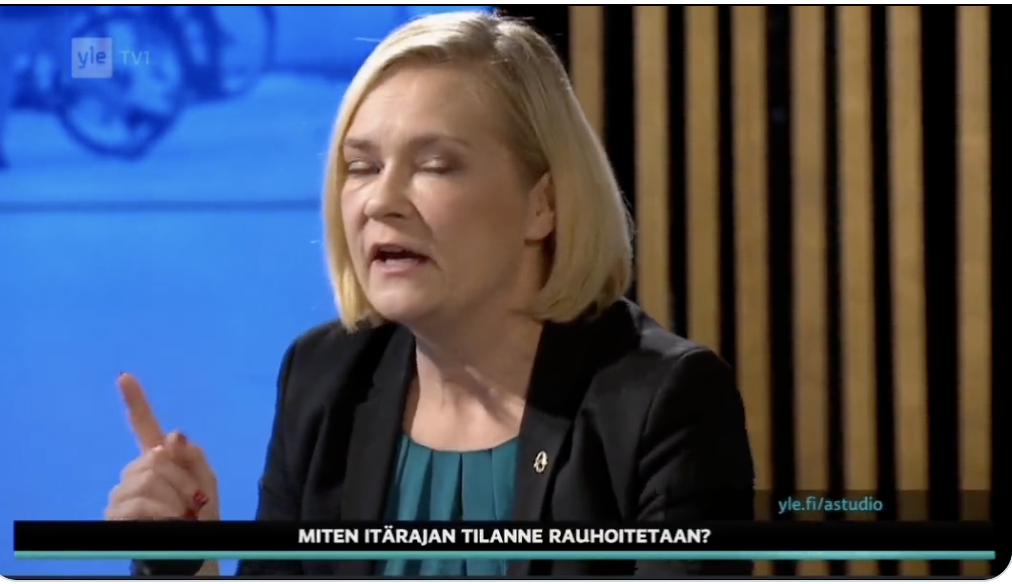
Thursday’s A-talk not only exposed Perussuoomalaiset (PS)* Interior Minister Mari Rantanen’s total disregard and desire to trash international refugee agreements, but her propensity to spread disinformation to her voter base.
The logic is the same that we’ve seen throughout history: I hate this group and this entitles me to spread lies about them at will.
Rantanen makes an off-the-cuff claim:
“It [present refugee system] means that if we continue on this path it means that anyone from anywhere, and it means [she shows excitement] if Vladimir Putin crosses the border and says, ‘asylum,’ he can stay indefinitely [in Finland] – it also means that,” said Rantanen. Left Alliance Chairperson Li Andersson laughs at Rantanen’s claim and stresses that it does not mean that. Putin would be arrested and sent to the International Cour of Justice at The Hague. Rantanen continues: “You can’t send [Putin] back to Russia because it isn’t a safe country.”
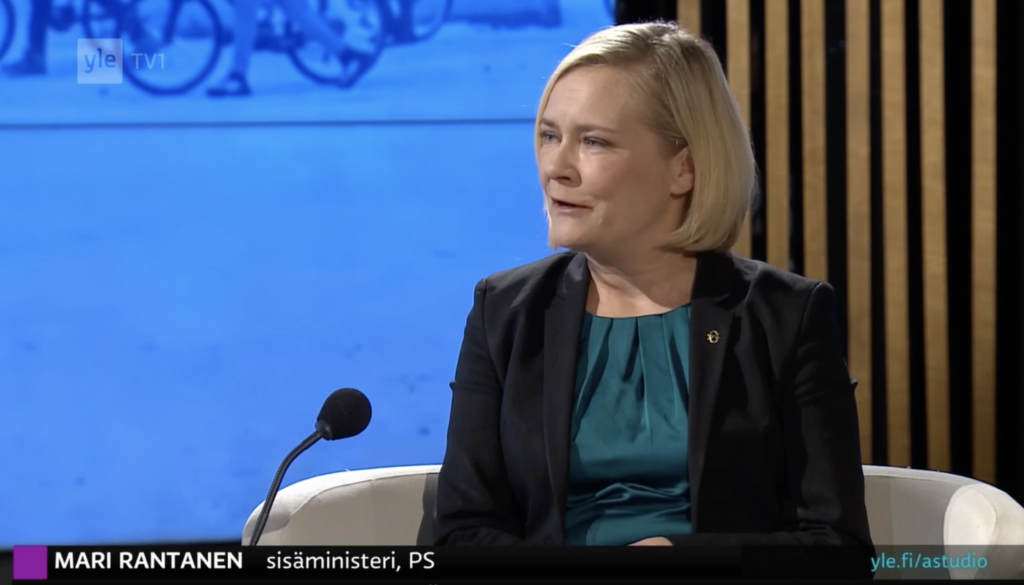
IRadical-right nterioir Minister Rantanen commonly spreads disinformation about asylum seekers and migrants. She is a hateful politician who has built her political career on xenophobia. Source: Yle
Politicians like Rantanen use an old trick to spread disinformation. It involves making an outrageous claim, like Putin cannot be returned to Russia if he applies for asylum. The news spreads like a wildfire to her voter base. Even if journalists refute her claim later, it does not matter because it is too late. The news is already out there.
Thursday’s A-talk exposed once again Interior Minister Mari Rantanen for what she is: A minister with a far-right worldview who loathes Muslims and other people of color. During the talk, she was ready to shelve international agreements that give foreign nationals the right to seek asylum.
“Yes, I would urge us to reconsider and start thinking about whether in this security environment we can guarantee the safety of our citizens by following precisely old agreements [The 1951 Refugee Convention and human rights agreements] that were made in a totally different era,” she said but fell short of fully trashing such agreements.
“These agreements were made in a completely different period,” she continued but then fell short of trashing all of Finland’s obligations to asylum seekers.
“This does not mean that we wouldn’t follow present international agreements during normal times,” she added.
With war raging in Ukraine since February 2022, the latest decision by Prime Minister Petteri Orpo’s government to shut all the border crossings except for one is an example of how both countries are playing hardball with asylum seekers and the Finland’s largest national group, the Russians.
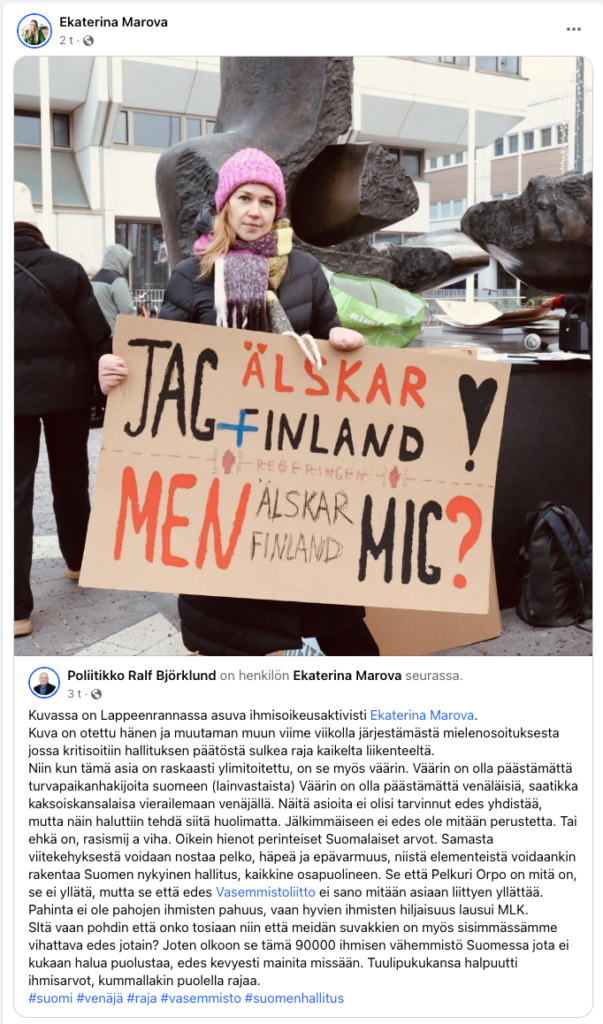
Katja Marova is a human rights activist and a member of the Left Alliance of Lappeenranta, a border city located next to the Russian border.
“Those who suffer most because of these measures are people of Russian descent [in Finland] who have family in Russia,” she said, adding that on Sunday there were up to 300 people in Lappeenranta who attended a demonstration against the closing of the border.
“I have received tens of hostile messages telling me to pack my bags and go back to Russia,” she continued. “If there was hostility against the Russian community before, it has grown since the war started.”
“The photo shows Ekaterina Marova, a human rights activist living in Lappeenranta. The photo was taken at a demonstration she and a few others organized last week to criticize the government’s decision to close the border. So while this issue is grossly overblown, it is also wrong. It is wrong not to allow asylum seekers into Finland (illegal) It is wrong not to allow Russians, let alone dual citizens, to visit Russia. There was no need to combine these things, but they [the government] wanted to do so anyway. There is not even any justification for the latter. Or maybe there is, racism and hatred. Very fine traditional Finnish values. Fear, shame and insecurity can be taken from the same frame of reference, and it is from these elements that the current Finnish government, with all its parties, can be built. The fact that [Prime Minister Petteri] Orpo the coward is what he is is not surprising, but the fact that not even the Left Alliance is saying anything about it is surprising. The worst thing is not the evil of bad people, but the silence of good people, as MLK once said. So I just wonder if it is really the case that we tolerant people have to hate at least something deep down inside? So let it be this minority of 90,000 [Russian] people in Finland that no one wants to defend, even lightly mention anywhere. Ordinary people downgraded human dignity, on both sides of the border.”Finland #Russia #border #leftwing #fFinnishgovernment
Source: Facebook
“It is surprising that we allow some 60,000 Ukrainians to freely move to Finland, but when a few hundred [from countries like Syria, Yemen, Somalia and other ones] attempt to get asylum we immediately shut the border.”
Marova said that one matter that has given strength to the Russian community in Finland is that they dare to speak and express their views more freely than before.
As a non-white Finn, it’s amazing how the Perussuomalaiset (PS)*, with the support of the National Coalition Party (NCP),* work with tiny numbers and speak in the conditional. In Sweden, there are tens of thousands of people in gangs while in Finland their number total 150-200.
The same strategy goes for the closing of the Finnish-Russian border. We are talking about tens of people seeking asylum, not tens of thousands like those crossing the Mediterranean.
On Sunday, there were around 16 asylum seekers who came to the Vartius border checkpoint, according to Yle. That’s 16, not 160 or 1,600, but 16!
The border crossing points of Niirala, Imatra, Nuijamaa, and Vaalimaa will be closed until 18.2.2024. The Vainikkala border crossing is only for rail traffic. Asylum seekers now have to apply for asylum at the Salla and Vartius border crossings in remote northern Finland. Source: Yle
How can you trust a party and government that builds its support on conspiracy theories about asylum seekers? You can if you are gullible.
Due to over 300 asylum seekers who came from countries with terrible human rights issues due to wars like Syria, Yemen, and Somalia, the Finnish government has decided to shut four border crossing points until 18 February 2024.
The coverage by the Finnish media of the issue and the statements given by government officials and the Finnish Border Guards resemble a taring-and-feathing event.
Perussuomalaiset Interior Minister Mari Rantanen is the ugly face of Finnish Islamophobia.. She has a long history of spreading conspiracy theories and anti-Muslim racism. Apart from tightening the screws on asylum seekers, her radical anti-immigration views are littered by hateful quotes, which have been deleted from her social media pages. Some of these are founded on the far-right great replacement theory. “Source: Yle.
Even if the trickle of asylum seekers coming to Finland are from countries with serious human rights violations, officials and the media prefer to label them as “illegal” migrants. Even President Sauli Niiinistö, whose past statements against Muslims and asylum seekers reveal his disdain for such groups, he has unsurprisingly given his support to the government.
Even the council of state defends its decision to shut the Finnish-Russian border on stopping “illegal immigration.” The anti-Muslim and anti-immigration campaign by the government is at full swing. Source: valtioneuvosto.fi
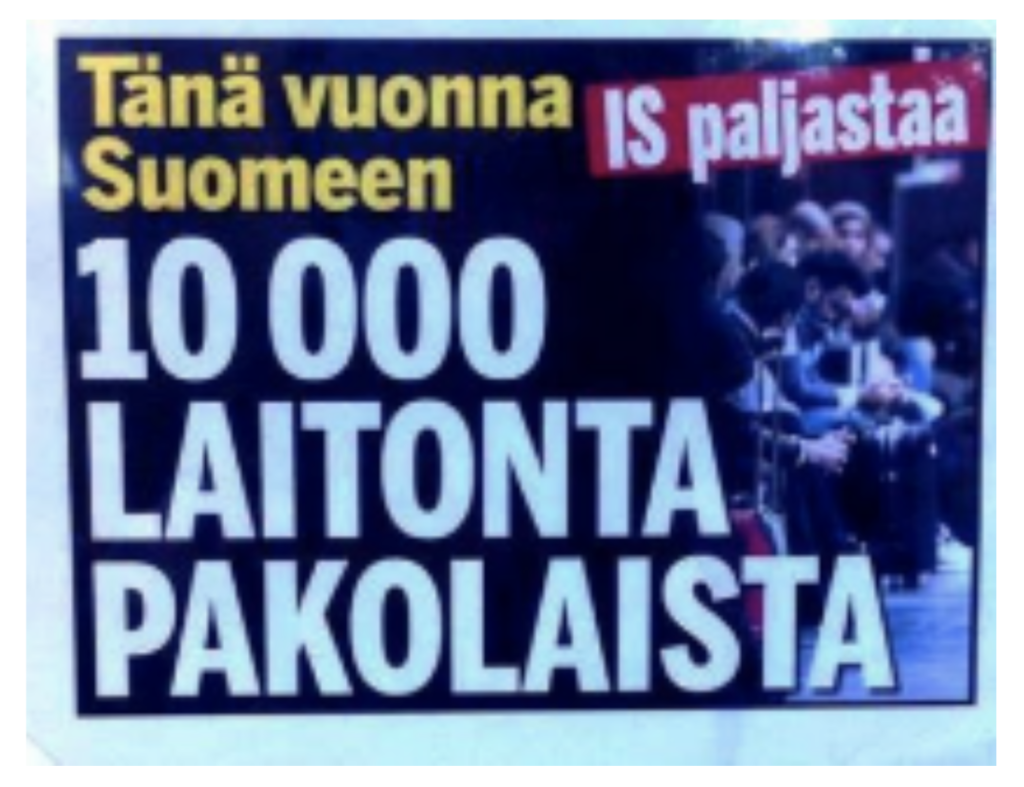
Some of the Finnish media continues to see refugees as “illegal” migrants. In this billboard, tabloid Ilta-Sanomat wants that “this year 10,000 illegal refugees” will arrive in Finland.
President Niinistö has stuck his foot in his mouth a number of times when he opens his mouth about asylum seekers. One of his most infamous comments is about an Iraqi asylum seeker, culture inside four walls.
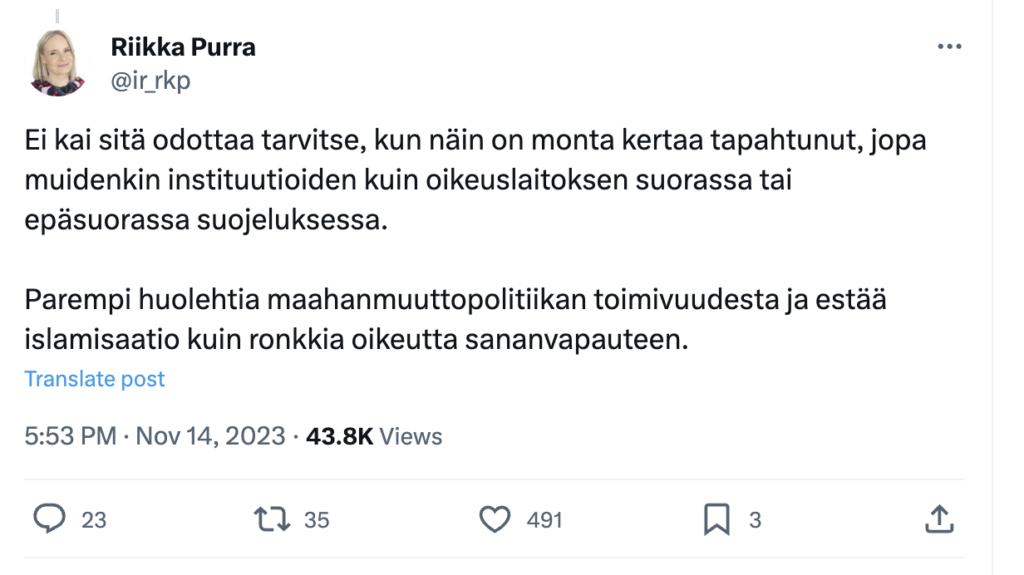
Purra tweets: “You don’t have to wait for that, as it has happened many times, even to other institutions like the judiciary which is under direct or indirect protection.
Yle: “Today [Wednesday] about 70 asylum seekers asked for asylum [at the Russian border].”
A-studio: “One hundred thousand people attempt to cross the Mediterranean annually [to enter Europe].”
I’ve been quiet, watching with manifest unease, the actions of the government spearheaded by the Islamophobic Perussuomalaiset (PS)* party about the trickle of asylum seekers arriving at the Finnish -Russian border. For the PS, even President Sauli Niinistö, it’s the usual pouring fuel on the xenophobic flames.
Racism and xenophobia are such a powerful political force in Finland these days that it threatens to take Finland to the political backwoods, a stuffy place where we mistrust everyone different from us and win elections and brownie points by spreading hatred and conspiracy theories of minorities like Muslims.
Interior Minister Mari Rantanen, who has a dubious history of spreading conspiracy theories and bigotry of Muslims, is one matter, but why is PS Finance Minister Riikka Purra beating viciously the Islamophobic drum?
The answer lies with PS immigration policy and halting Muslims and other asylum seekers from developed countries from coming to Finland.
Purra tweets: “You don’t have to wait for that, as it has happened many times, even to other institutions like the judiciary which is under direct or indirect protection.