The scandal that has rocked and come to public light about Avarn Security gets more incriminating by the day, revealing a culture of downplaying and coverup. Avarn Security Managing Director Niclas Sacklén’s initial reaction to Helsingin Sanomat was disbelief.
According to the daily, Sacklén considered the allegations “unbelievable.” Moreover, he initially would not confirm if the company, which has an annual turnover of 100 million euros, terminated the employment of the suspected security guards.
Sacklén has denied in repeated interviews with Helsingin Sanomat that the company as zero tolerance for violence by security guards. Now he admits that the company has failed in this task.
Sacklén’s assurances are nothing more than a coverup. A security company that does not provide security but terrorizes people is highly problematic. The problem reveals a wider problem in Finnish society, which lacks the will to regulate itself. Sacklén should resign from his job.
Avarn Security Managing Director Niclas Sacklén’s said upon seeing the video was “truly terribly,” according to Helsingin Sanomat, which has uncovered several cases of assault like the one above. The video is of another incident that does not involve the suspects held in custody by the police. What is worrying and suggests that the violence by Avarn Security guards is more widespread and a bigger problem than Sacklén admits. Continue reading “Avarn Security Managing Director Niclas Sacklén should step down”
Helsingin Sanomat has closely followed the story about six Avarn Security guards suspected of assault. In the latest stories, the daily reports that four security guards have now been remanded into custody. It also raises three unanswered questions about the scandal.
Mikko Minkkinen, crime commissioner of the Eastern Uusimaa Police Department, said in a statement Wednesday: “In the suspected offenses, the security guards transported the victims they encountered during their work to a more sheltered location near the train stations, after which they assaulted the victims and filmed the acts.”
Helsingin Sanomatraises three important questions about the scandal.
Source: Avast Security
One of the questions is motive. The second is if Avarn Security has done enough to prevent such a thing. Finally, an essential yet obvious question is if security guards are under enough scrutiny. Here is question number four: How many security guards have been sentenced for using excessive force?
Hopefully, this case will not end up like so many involving the police and other public services that abuse their power.
Migrant Tales has written several stories about how security guards on local trains in Helsinki and the Greater Helsinki Area have suffered brought treatment by security guards. The Eastern Uusimaa Police Department announced Monday in a statement investigating assault cases in which at least six employees of Avarn Security are suspected of assault.
“In the suspected offenses, the security guards transported the victims they encountered during their work to a more sheltered location near the train stations, after which they assaulted the victims and filmed the acts,” says Mikko Minkkinen, crime commissioner of the Eastern Uusimaa Police Department.
The crime was revealed when a bystander reported the assault to the police.
So far, six people have been arrested for the crime. The police said that the number of suspects might increase.
For the security guards to have a “system” of assaulting victims shows that the practice could be widespread. It also reveals poor management on behalf of Avarn Security.
“What happened shows that there are problems with hiring the right people for the job,” said a security guard who spoke on condition of anonymity. “There are all types. Some are pretty violent by nature and should pass rigorous psychological tests, like the police, before being hired.”
A comprehensive study in 2018 on ethnic profiling by the University of Helsinki showed how ethnic profiling, especially by security staff, was a source of special concern.
“Many said [in the study] that security guards were often rude and treated them roughly, even violently,” said the University of Helsinki Professor Suvi Keskinen of one of the ethnic profiling study’s findings.
What kind of reaction can you expect from a country that continues to see foreigners like Muslims and other people of color as a threat?
Remember Oulu and the sexual harassment cases that spun out of control thanks to the fuel that politicians, the media, and the police were feeding? It’s déjà-vu again: politicians, the media, and the police are at it again.
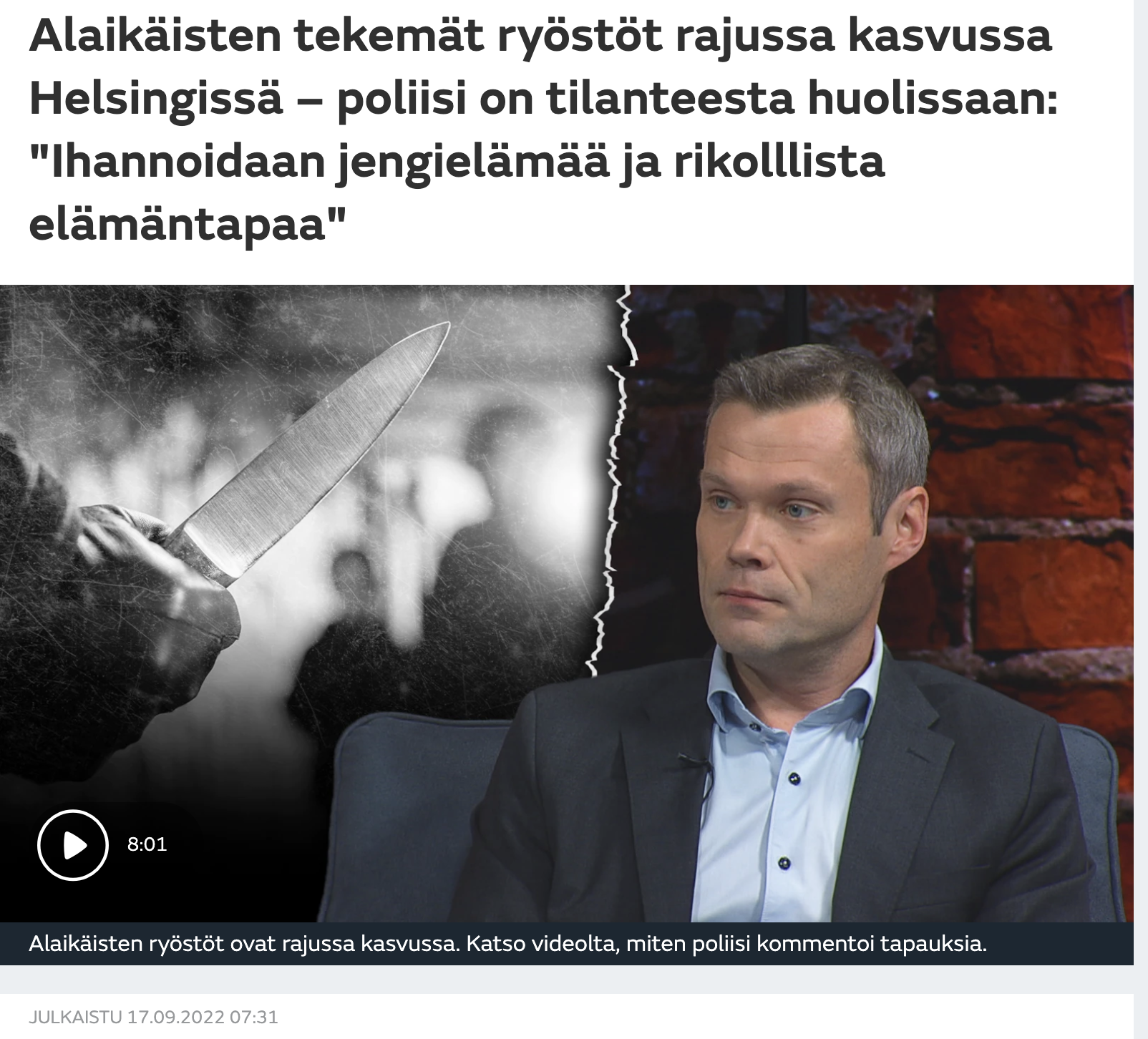
Instead of sexual harassment of minors caused by asylum seekers, we now have youth gangs “of foreign background” terrorizing our streets.
The first story I found was published six days after Sweden’s September 11 election, where youth gang violence was turned into a political campaign issue by the far-right Sweden Democrats and the National Coalition Party’s sister party, Moderates. The knife in the picture is intended for extra drama. Source: MTV
Let’s go back to 2019.
The media, politicians, and the police caved into their exaggerated lies by turning an important issue into a storm in a teacup.
It was a social media lynching like I have rarely seen in Finland. While politicians will go to any lengths to get votes, a black stain remains on the media and police.
Has the media and police learned anything from the Oulu case?
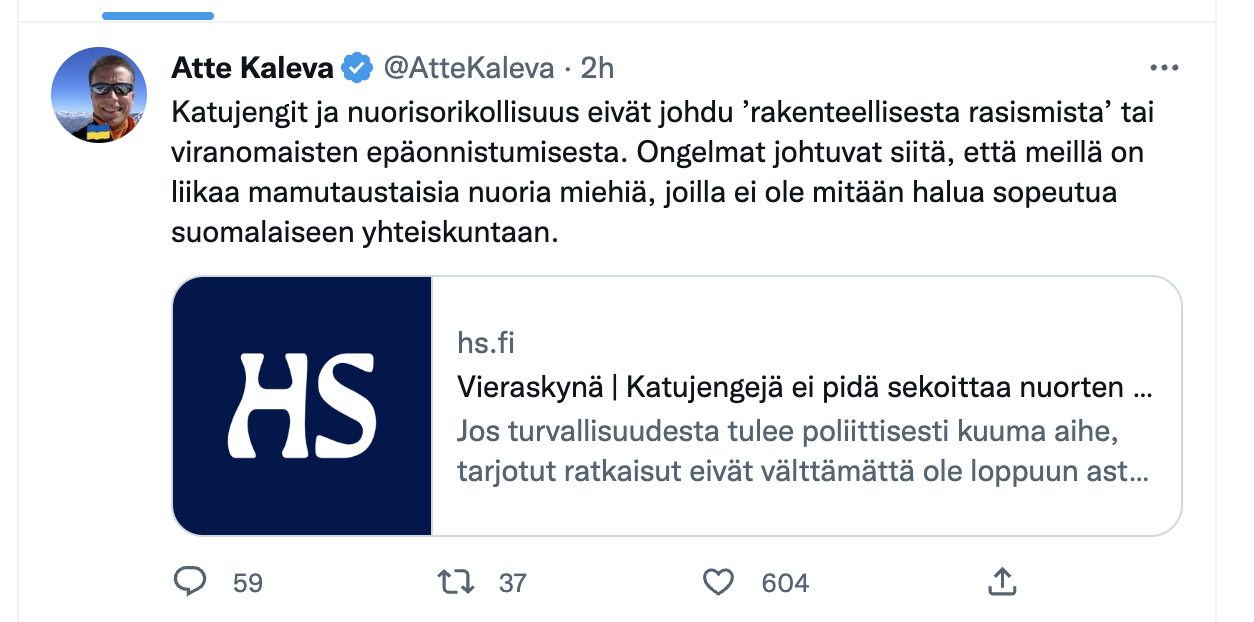
Parliamentary elections are in April. How can I tell? When National Coalition Party (Kokoomus) politicians like MP Atte Kaleva spread lies and populist soundbites about migrants.
Kaleva has a tough time stomaching criticism, and usually, his answers are knee-jerk reactions.
One of these is when he charged Professor Panu Ratikiainen with defamation because he called him a racist.
Did the media notice? No.
There was one, however: Seiska, the lowest gossip journalism you can find in Finland.
Can you take him, MP Kaleva, seriously? Do his words carry any weight?
Not an ounce but he can surely pile it high and deep with his anti-immigration tirades.
MP Kaleva calls migrants or so-called “people with foreign background,” mamus. Mamu is the Finnish n-word for migrant.
Yassin, a father of a two-month-old daughter, was pinned to the floor by three security guards and handcuffed at the Helsinki-Vantaa Airport. The ordeal ended at 23:30 am after trying, without luck, to get on a Lufthansa flight to Frankfurt. His wife and two-month-old daughter accompanied Yassin.
“I have never been handcuffed in my life and pinned down to the floor with three security guards,” said Yassin, a native Moroccan naturalized Finn. “My [Italian] wife said she does not want to step on Finnish soil again. You can go back yourself!”
He said he will press charges against the security guards and send a complaint to Lufthansa.
While it is difficult to prove, some who know the ticket agents who served Yassin and are not Lufthansa employees have had racial issues. “I don’t believe that a white Finn would have been treated as I was,” said Yassin.
The ordeal happened when Yassin, his wife, and baby were supposed to board a Lufthansa flight to Frankfurt with a connection to Trieste, their final destination. According to him, they faced delays and poor service from Lufthansa for about twelve hours.
Yassin’s family traveled during the holidays for their daughter to visit for the first time her grandparents. “After we passed the security check, we received an email 10 minutes
“After we passed the security check, we received an email 10 minutes later that our connection flight from Frankfurt to Trieste is cancelled and that we’d have to spend the night in Frankfurt,” he said. “We started to worry about our baby’s luggage that would be sent to Trieste and where we’d get things like diapers.”
I would go as far as to predict that after the election in April, the youth gang issue will disappear. It was the case in Oulu when Finland became hysterical about sexual assaults committed by migrants.
We’re in the same situation today. True, we have to address social problems with good social policy. Fortunately, Finland has a comprehensive welfare state. Still, parties like the Perusuomalaiset (PS)* and the National Coalition Party (Kokoomus), who want to slash such spending if they win the election, lead us towards a cycle of exclusion and deception.
Remember what happened in Oulu in 2008-2009?
Let me refresh your memory. The media, politicians, and even the police caved into their exaggerated lies by turning an important issue into a storm in a teacup.
Every sexual assault is too much, period. However, if we look at the coverage of these cases, we see the same problem as in 2018-2019 with the so-called “rising” of youth gang violence that Yle and other media are spiking.
Similarities with the Oulu sexual assault cases: parliamentary elections, gang violence, a winning issue in Sweden’s election, and lack of correct checks and balances by the media and politicians.
For the police, it is also a winning issue. It ensures that more funds will be earmarked for them.
Have any of you seen any statistics about youth crime violence?
Why are the police and politicians holding back?
Considering that Finland’s gang “problem” is only a drop in the bucket compared to Sweden, the debate has revealed some nasty things about politicians and the media: washing our hands of the problem, simplifying and scapegoating migrants and minorities, and outright racism. President Sauli Niinistö, who never has anything positive to say about Muslims and people of color, joined the populist bandwagon over a week ago. Shameful.
Despite all the fear-mongering, it is a good sign that papers like Helsingin Sanomat are questioning the populism and hardline stance to solve the problem by parties like the PS and Kokoomus.
Quoting David Saudsdal, a sociologist at Lund University, he claims there is no proof that tougher laws against gang violence in Denmark have worked.
When the media speaks of youth gang violence, it usually spikes it with provocative adjectives and fear-mongering. MTV’s interview and good comments by Elina Pekkarinen, ombudswoman for children, were exceptions.
If you want a good example of how the media frames this topic, look at the picture behind the host. It reads “violence” next to a fisted hand that looks like it has grease. Is it the fist of a black Finn?
Thank you, Pekkarinen, for making the following comment: “We have to acknowledge at the same time minors who are discriminated against and victims of racism; [if this is the case there is no point wondering why this phenomenon exists.”
Two hard-hitting editorials by Helsingin Sanomat on the mistreatment of labor migrants could indicate how the Islamophobic Perussuomalaiset* will do in the parliamentary election. I makesuch a claim because I am an optimist.
We saw something similar in the US Midterm elections, which showed how voters rebuked Donald Trump and his election deniers.
Apart from two important editorials, good reporting on the case of a Mongolian nurse showed the good side of the media exposing and defending people’s rights.
The first Helsingin Sanomat editorial, published on Saturday, highlights what Migrant Tales mentioned weeks ago: Youth gang violence is a campaign topic for the opposition. The last one strongly criticizes the Finnish Immigration Service for arbitrarily mishandling Mongolian nurse Anudari Boldbaatar.
Struggling with the slow pace of due process in Finland to challenge Migri’s deportation order, a district court eventually overturned it, Boldbaatar had had enough and moved to another country.
I agree with both editorials and commend Finland’s biggest daily for speaking out against the hostile environment against migrants and minorities. The editorial on Boldbaatar asks how it is possible that Migri can ruin a person’s live and get away with an apology.
“The Agency [Migri] has traditionally played an important role in Finland’s immigration policy, mainly aimed at preventing foreigners from entering Finland.”
Katja Marova, a Russian speaker from the border city of Lappeenranta, spoke to Migrant Tales about how the war in Ukraine had impacted her life as that of other Russian speakers in her home city. Russian speakers are the biggest group in Finland (88,000) followed by Estonian speakers (50,000).
The Russian border is only a stone’s throw away from Lappeenranta. According to Marova, the atmosphere in her home city is different from Helsinki and other parts of Finland.
Katja Marova lives in the Finnish border city of Lappeenranta.
“The [Russophobic] situation is worse here than in Helsinki and related to fear,” she said. “Since we are next to the Russian border, people are afraid because we’d be the first to experience a military strike if a conflict broke out.”
Making matters worse are news stories by Yle on Lappeenranta’s bomb shelters and where people would be evacuated. Marova said that when people start to fear, they act strangely.
“This has led the city [of Lappeenranta] not to follow the example of other cities like Helsinki, which openly condemn all forms of racism,” she continued. “The city has not agreed to make a public statement against discrimination and racism.”
Marova said that she had asked victims of racist harassment to contact the Non-Discrimination Ombudsman.