When the media speaks of youth gang violence, it usually spikes it with provocative adjectives and fear-mongering. MTV’s interview and good comments by Elina Pekkarinen, ombudswoman for children, were exceptions.
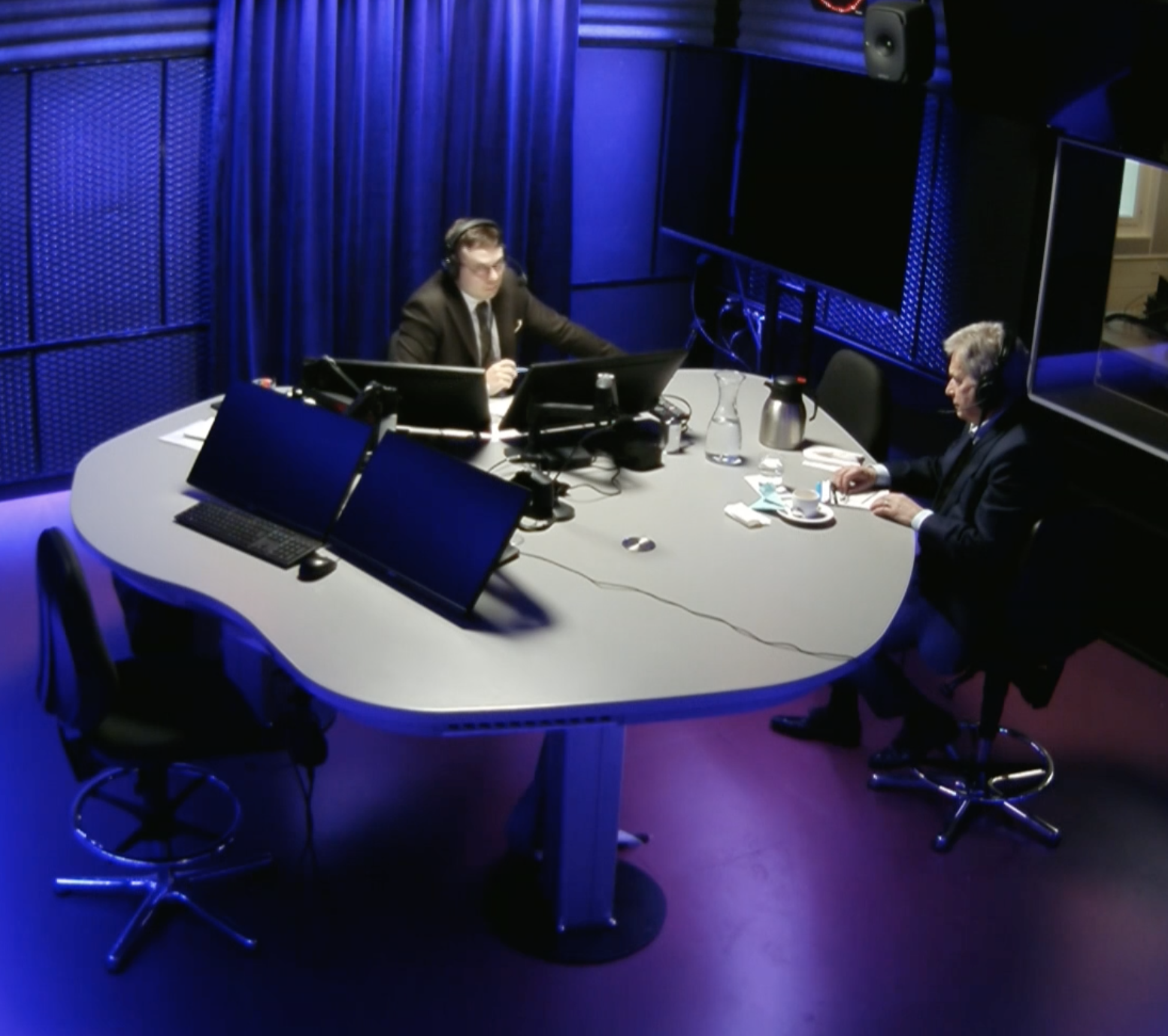
If you want a good example of how the media frames this topic, look at the picture behind the host. It reads “violence” next to a fisted hand that looks like it has grease. Is it the fist of a black Finn?
Thank you, Pekkarinen, for making the following comment: “We have to acknowledge at the same time minors who are discriminated against and victims of racism; [if this is the case there is no point wondering why this phenomenon exists.”
Two hard-hitting editorials by Helsingin Sanomat on the mistreatment of labor migrants could indicate how the Islamophobic Perussuomalaiset* will do in the parliamentary election. I makesuch a claim because I am an optimist.
We saw something similar in the US Midterm elections, which showed how voters rebuked Donald Trump and his election deniers.
Apart from two important editorials, good reporting on the case of a Mongolian nurse showed the good side of the media exposing and defending people’s rights.
The first Helsingin Sanomat editorial, published on Saturday, highlights what Migrant Tales mentioned weeks ago: Youth gang violence is a campaign topic for the opposition. The last one strongly criticizes the Finnish Immigration Service for arbitrarily mishandling Mongolian nurse Anudari Boldbaatar.
Struggling with the slow pace of due process in Finland to challenge Migri’s deportation order, a district court eventually overturned it, Boldbaatar had had enough and moved to another country.
I agree with both editorials and commend Finland’s biggest daily for speaking out against the hostile environment against migrants and minorities. The editorial on Boldbaatar asks how it is possible that Migri can ruin a person’s live and get away with an apology.
“The Agency [Migri] has traditionally played an important role in Finland’s immigration policy, mainly aimed at preventing foreigners from entering Finland.”
Katja Marova, a Russian speaker from the border city of Lappeenranta, spoke to Migrant Tales about how the war in Ukraine had impacted her life as that of other Russian speakers in her home city. Russian speakers are the biggest group in Finland (88,000) followed by Estonian speakers (50,000).
The Russian border is only a stone’s throw away from Lappeenranta. According to Marova, the atmosphere in her home city is different from Helsinki and other parts of Finland.
Katja Marova lives in the Finnish border city of Lappeenranta.
“The [Russophobic] situation is worse here than in Helsinki and related to fear,” she said. “Since we are next to the Russian border, people are afraid because we’d be the first to experience a military strike if a conflict broke out.”
Making matters worse are news stories by Yle on Lappeenranta’s bomb shelters and where people would be evacuated. Marova said that when people start to fear, they act strangely.
“This has led the city [of Lappeenranta] not to follow the example of other cities like Helsinki, which openly condemn all forms of racism,” she continued. “The city has not agreed to make a public statement against discrimination and racism.”
Marova said that she had asked victims of racist harassment to contact the Non-Discrimination Ombudsman.
President Sauli Niinistö, who has a track record of speaking disparagingly about Muslims and asylum seekers, was quoted as saying on Yle’s 8:30 news that he fears Finland “apparently” is “moving a bit” on Sweden’s path concerning youth gang violence.
“It’s a very, very unfortunate and dangerous phenomenon, we seem to be following a bit behind Sweden [concerning youth gang violence], he said.
Like other programs, Yle added fuel to the topic by stating that “youth gangs terrorize the streets of the Nordic region and now also in Finland.” “Terrorize” is a strong word, and such a claim should be backed up with hard statistical facts and sources with names.
President Sauli Niinistö talking to Yle.The yellow press magnifying what President Niinistö said about youth gangs. Thank you Ambrosius Wollstén.
It is surprising, if not incredible that President Niinistö does not offer us as well hard statistical facts about the “rising” problem of youth gang violence in Finland. His message reinforces what I have stated before: He isn’t and never was the president of all Finns, never mind that of our non-white communities.
Olin hyvin surullinen kun kuulin mongolialaisen Anudari Boldbaatarin vastoinkäymisiä Maahanmuuttotviraston (Migri) kanssa. Maahanmuuttoviraston ylijohtaja Ilkka Haahtela antaa “vilpitön ja syvä anteeksipyyntö” Boldbaatarille.
Valitettavasti näitä “vilpitön ja syviä anteeksipyynnöt” kuulostavat samalla kun Yhdysvalloissa on viattomia ihmisiä tapettu aseilla. Poliitikot, jotka eivät tee mitään, lausuvat, “We send our thoughts and prayers,” eli lähetämme ajatuksemme ja rukouksemme.
Olemme tienneet monen vuoteen Migrin ongelmista. Miksi jatkamme yhä lähettämällä vain valituksia ja anteeksipyyntöjä?
Aloitin syyskuussa Maahanmuuttoviraston ylijohtajana. Ja tänään aloitan täällä Twitterissä aktiivisena. Ensimmäinen kommenttini on vilpitön ja syvä anteeksipyyntö asiakkaaltamme ja Suomelta. Olemme virastona epäonnistuneet hänen asiansa käsittelyssä perusteellisesti. 1/3
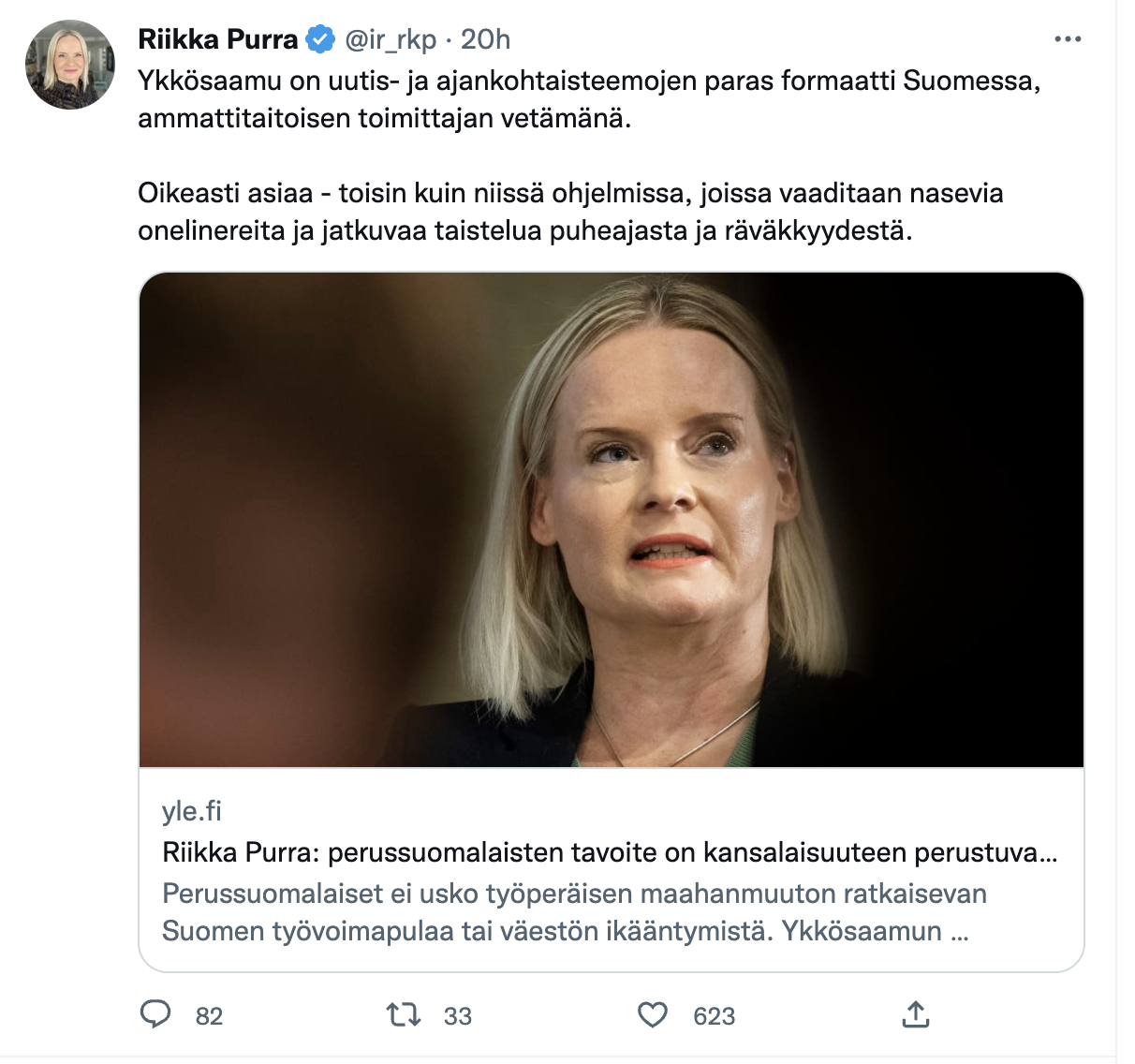
Perussuomalaiset (PS)* chairperson Riikka Purra praised Ykkösaamu, claiming that it “has the best news and current affairs format in Finland, led by a professional journalist.” It is further proof of how the host, Seija Vaaherkumpa, didn’t do her job but offered journalistic lipservice to a radical right party with ties to violent groups in the far right.
I have said it once and will repeat it: If I ever win an award for my many years of anti-racism activism, I have failed and become complacent.
Vaaherkumpa should take the same advice. If the head of the PS hurls kudos at her for being “a professional journalist,” maybe it is time she retires or takes a long and hard look in the mirror.
Apart from not using Purra hard questions, Vaaherkumpa played along, even agreeing with her on generalizing about “rising” gang violence.
Yle should and can do a better job. Even so, the state-owned broadcaster is responsible for spreading unsubstantiated facts and leaving out important questions.
One of these is why we haven’t seen any hard statistics on “rising” youth gang violence. Another is why some media, like Yle,allow Purra to lie and openly distort the facts.
Alarm bells should start to ring when politicians like Purra warn about “taking Sweden’s path” and that Denmark, which has one of the toughest immigration policies in the EU, is a country we should copy. We should remember that migration continues to help Sweden’s economy and that some 750,000 Finns moved there after World War 2. “Finland’s path” is not doing anything and scapegoating immigration.
Saturday’s interview with Perussuomalaiset (PS)* chairperson Riikka Purra on Ykkösaamu was a good example of how the media avoids asking tough questions, never mind doing fact-checking. Purra was able to spread her urban tales about migrants. Considering that the PS is a radical right party, host Serija Vaaherkumpu did not as one question about the party’s ties with far-right groups.
The PS’ cooperation and links with far-right groups in Finland is topical today considering that in Germany the police had arrested a far-right group that was aiming to overthrow the government.
Moreover, the police announced a year ago Finland’s first neo-Nazi group that was planning a terrorist attack. Detective inspector Toni Sjöblom confirmed to Migrant Tales at the end of November in an email that charges would be brought against the five suspects “within a few weeks.”
The interview with Riikka Purra revealed how much the PS wants to keep non-white Finns and migrants as second-class members of society when the PS chairperson said that only Finns could get social welfare. Shameful that Purra would suggest it and toothless reporting by Vaaherkumpu for not asking if excluding people’s civil rights is ethical.
“The Perussuomalaiset’s long-term aim is to make social welfare rights based on nationality, but this will, unfortunately, not happen in the next [parliamentary] term but is a long-term aim,” said Purra.
Mid-week on British tv, the lead news story was of the racism, caught in Buckingham Palace. The victim is a black British woman who helps female assault victims. The offender is an elderly white woman who has been many years in an honor position. It was a huge embarrassment for the Royal Family, and the offender resigned immediately after being called on it.
Although the victim was not in danger, it was fortunate that the room was packed with other people, and there were witnesses to the racist statements and questions. An hour or two later, it was the lead story on the 6 pm news. If what happened wasn’t important, then you likely don’t know that racism is a CRIME.
After that, I was full of mixed emotions. I was glad that the offender was caught, heartfelt for the victim who had to deal with it, and brave enough to call it out. I was also frustrated and envious because the Finnish police here do not take this crime seriously. I am still bearing the brunt of the racism, Anglophobia, and ageism from a Finnish offender who was in a power position over me because when you have no justice – you have no peace.
Read Yve Sheper’s earlier essay here about life in Finland.
The struggle to be accepted as normal, legal, equal, capable, and human is a burden foreigners don’t usually expect from a country like Finland – and it is a huge burden because the bar is set higher in many ways for non-Finns.
Originally I had planned to update you that I am still waiting for the ( replacement) permanent residence that was promised to me by October 6, 2022 – and emphasize how my new police ID can be processed in 8 weeks, and yet I have to wait more than a year for a status, and, in the meantime get questioned by officials while at the same time paying taxes and having your benefit put on hold. But the first part of this report blends into the second – and becomes continual disrespect.
Remember when 32,476 asylum seekers came to Finland in 2015? Remember how Finland patted itself on the back by stating it did a great job housing many people, mainly from Iraq and Afghanistan?
There are mixed results about Finland’s “great job” in housing so many asylum seekers in such a short time. Some reception centers did a good job, others were vandalized, while others did a terrible job.
From January to November 31, 2022, 45,267 Ukrainians arrived in Finland, according to the Finnish Immigration Service (Migri). Their numbers are expected to rise in 2023 as the war continues and intensifies in that country.
Not only did asylum seekers face unprofessional treatment at reception centers, but many were targets of arson attacks. Source: Migrant Tales
Some of the biggest problems that emerged when Migrant Talescovered asylum reception centers throughout 2016 were the following: lack of qualified staff; management did little to resolve the problems of reception center residents; very few courses on life in Finland; bad food; too long lines to see the nurse, among others.
Déjà-vu: Some Ukrainians at the privately-owned company Luona’s Nihtisilta asylum reception center of Espoo are airing the same complaints. The very complaints are similar to what the company faced in 2016.
An Iraqi, 33, who came to Finland in 2015, alleges that his employer of a Vantaa cleaning company asked him for 10,000 euros to give him a letter to the Finnish Immigration Service so he’d get a residence permit. He made a deal with the Finnish employer in 2019, and he would pay the sum by working long hours and for lower pay.
The Iraqi said that he knows of 4-5 other employees at the company who were in the same situation as he.
The present case is an example of how some employers take advantage of vulnerable migrants who want to get a residence permit but need a job.
Even if the employee in the drawing appears happy, it is a very different story for many migrants who are exploited by cleaning companies in order to get a residence permit. Source: GoogleSheets
“I work long 16- to 18-hour days seven days a week for 10.50 euros an hour,” he said. “I have worked for the firm for three years and never got a vacation, never mind vacation pay or overtime, either.”
A person with no experience can make 11.25 euros an hour and up to 11.82 an hour if they have experience. A degree in cleaning from a vocational school can get you over 12 euros an hour.
The Iraqi, who does not know how much he is supposed to make after working long hours because his pay slips don’t reflect the actual hours he works, ended up recently in a heated argument with the owner, who had not paid him for two months.
The incident led to shouting and pushing with the police arrived. With no interpreter, the police told the Iraqi to contact Riku, a victim support group.