Migrant tales
Menu
  • #MakeRacismHistory “In Your Eyes”
  • About Migrant Tales
  • It’s all about Human Rights
  • Literary
  • Migrant Tales Media Monitoring
  • NoHateFinland.org
  • Tales from Europe
Menu

Former Finnish PS councilman to be charged for inciting ethnic hatred

Posted on December 12, 2012 by Migrant Tales

Tommi Rautio, the former city councillor of Köyliö in western Finland, who suggested giving a medal to a killer after he shot and killed a Muslim at an Oulu pizzeria in February, will be charged for inciting ethnic hatred, reports YLE. 

Kuva 97

YLE reported that the Satakunta region prosecutor wants to slap Rautio with “a heavy fine” for threatening, defamatory and abusive language against immigrants.

Rautio wrote on his Facebook page:  “If Janne is the one [who shot the foreigners at the pizzeria] then we should give Janne a medal…there is already a war going on and in every war [soldiers] are decorated.”

The cold-blooded killing in Oulu, was one of four Muslim deaths reported during a tragic four-week period in January-February.

Rautio was sacked in March from the PS.

The former councilman ran again for councilman but was not reelected. He got nine votes.

One of the matters that raised some eyebrows after the Rautio affair was being covered nationally by the media, were plans by the police to not investigate the case.

The police announced three days later that it would, however, carry out an investigation whether Rautio incited racial hatred with his statements.


Common Ground News Service: Spreading “anti-rumours” about immigrants

Posted on December 11, 2012 by Migrant Tales

By María-Paz López

Barcelona, Spain –“They are invading us”, “They don’t respect the rules”, “They don’t pay taxes”, “They don’t want to integrate”, “They get special subsidies to open businesses”, are just a few of the often repeated accusations against immigrant communities in Spain.

To deal with rising prejudices, Barcelona City Council is now beginning its second training season of volunteer citizens, nicknamed anti-rumour patrols, whose job it will be to counter rumours or stereotypes about immigrants.

The volunteers take free courses to acquire skills to tackle prejudice. For example, in everyday situations at work, in the neighbourhood, in the supermarket or at the gym, an anti-rumour agent who might overhear someone saying, “You know, Moroccan immigrants are collapsing the Health system, they are always queuing for a doctor, with their many kids …,” could step in and counter with fact. “You know, actually, according to the authorities, immigrants go to the doctor 50 per cent less than natives, and their healthcare costs are only 4.6 per cent of the total in Spain”.

According to 2012 census data, the largest national minority groups in Barcelona are Pakistanis (23,281 individuals), Italians (22,909), Chinese (15,875) and Ecuadorians (15,551), in a city with some 1,630,000 inhabitants.

The promoters of the programme, which began two years ago, could have opted for an ideological, philosophical or human rights’ approach. Instead, they have chosen a down-to-earth, factual one.

“It is more effective” says Miquel Esteve, Town Hall commissioner for Immigration and Intercultural Dialogue. “The programme strategy always uses accurate and objective information to deactivate false perceptions such as the belief that immigrants monopolise social aid, do not pay taxes, get subsidies to start businesses, collapse emergency rooms or abuse the health system.”

Using factual data and statistics, the anti-rumour agent seeks to invalidate the rumour right in front of the person who is disseminating it.

Last spring, 436 citizens received the free Town Hall trainings. A new course starting this month includes workshops that analyse how rumours, stereotypes and prejudice are created and divulged, and how they contribute to constructing an overwhelmingly negative opinion within the host community of what diversity means.

Citizens enrolled in the courses also learn to deal with their own prejudices, something that, as the trainers say, they never think they have.

Among the most frequently repeated rumours that affect the whole foreign population, the most dreadful one may be “They are invading us”. To fight it, anti-rumour agents respond: “It is actually the opposite. The foreign population in Barcelona remains very stable. Foreign residents as of 1 January 2012 totalled 282,178, or 17.4 per cent of residents, and that number in January 2011 was 278,320, 17.3 per cent of total residents. That is not fast growing”.

Another typical stereotype about immigrants – “They don’t respect the rules” – can be invalidated by saying, “You know, from 2006 to 2010, only 18 per cent of fines due to violations of the local Ordinance of Civility were for foreigners residing in Barcelona”.

Even if the economic crisis in Spain is causing municipalities to drastically cut budgets, not one Town Hall official in Barcelona – now led by a conservative nationalist mayor – has suggested cancelling this programme.

There is wide consensus of its importance for social cohesion in the city. “When we started…we discovered that false rumours about immigrants were something pretty widespread, that they harmed conviviality, and that it was something we definitely had to address”, explains Daniel de Torres, who was the Town Hall commissioner for Immigration and Intercultural Dialogue when the programme started.

Good “rumours” are spreading about its success in the region. Other municipalities in the Barcelona metropolitan area have shown an interest in establishing similar programmes, and they are getting the advice and materials to do so.

It’s a powerful way for civil society to become involved in improving respect for diversity in an urban context, and it’s an idea that can travel.

###

* Barcelona-based author Maria-Paz Lopez is Senior Religion Writer at the Spanish daily La Vanguardia and chairs the steering committee of the International Association of Religion Journalists (IARJ). This article was written for the Common Ground News Service (CGNews).

Source: Common Ground News Service (CGNews), 04 December 2012, www.commongroundnews.org
Copyright permission is granted for publication.

Read original blog entry here.

This piece was reprinted by Migrant Tales with permission.

How discrimination works in Finnish basketball

Posted on December 11, 2012 by Migrant Tales

If there is a game that is played by people from diverse backgrounds, that game is basketball. When I moved to the United States as a child, basketball was my door to new friends and acceptance. 

Basketball was a way of life in Hollywood, California, for many young people like me.

In Finland it is a mixed story if you are a referee. There are very good referees who understand that prejudice is pernicious, while others still don’t have a clue.

I know from experience that if you complain about discrimination to the Finnish Basketball Association, you won’t be taken seriously. In my case, you’ll end up getting a scornful look suggesting that you are using “the racism card.”

I have refed for close to ten years all types of games not only in Finland but in in Madrid, Spain, where I lived and worked for about a year.

Discrimination is difficult to measure in sports but not impossible. In many respects it’s like measuring corruption in journalism. It’s fine to accept your host to pay your lunch but wrong if this happens every time.

Consistency is a good benchmark when studying how refs are discriminated in Finland. Is the person with a non-Finnish name the one that is always the umpire and the person with the Finnish name the ref?

I was refing for one year all-nation games for seventeen-year-olds in Finland around 2006. I was always the umpire and my partner, with the Finnish name, who had roughly the same experience as I,  was the ref.

When I brought this case to the attention of the Finnish Basketball Association, I got the cold shoulder. I was made to feel that my complaint wasn’t valid and that I was using the “racism card.”

The whole incident was as a result forgotten.

The stick that broke the camel’s back happened on Sunday when my former partner, who is the regional ref that names other refs for games, told me that I would be umpire in a game because I could not control my temper and lacked experience. Adding salt to injury with the help of prejudice, he laughed trying to drive home his point.

I couldn’t believe what I was hearing. According to him, I was “hot-tempered” because it’s the national character of southern Europeans (sic!).

As I mentioned, I have refed for about ten years and have learned the art of remaining calm under pressure. My job as a teacher and working with immigrants has taught me that staying calm is a key virtue at all times.

I ref to train and strengthen such virtues.

If you have suffered similar cases while doing sports in Finland, Migrant Tales would be happy to hear your story.


Social inclusion is never voluntary in a land where racism is king

Posted on December 10, 2012 by Migrant Tales

Freedom is never voluntarily given by the oppressor; it must be demanded by the oppressed.

Martin Luther King Jr.

Even if the late King Jr. was gunned down in 1968, that quote is still valid today. In Finland it would read in the following manner: “Social equality is never voluntarily given by the majority; it must be demanded by the oppressed.” 

We have discussed on many Migrant Tales blog entries about racism and social exclusion. If we look at this social ill in Finland, it could be placed in two periods: pre- and post-April 2011.

Before last year’s historic parliamentary election, when an anti-EU, anti-immigration and especially anti-Islam party won 39 seats, it’s clear that racism and xenophobia are influential political forces that not only give you votes, but power.

No modern political party in this country has ever tapped the undercurrent of Finnish racism as successfully as the Perussuomalaiset (PS).  Even if the popularity of the PS has weaned from 2011, its anti-immigration candidates did well in the October municipal elections.

Racism has found a good home in Finland to spread roots and survive. The same social ill that is impoverishing our country today by scaring away skilled immigrants and foreign investment, has been around since we became an independent nation in 1917.

Back then, our racism and xenophobia were mainly fueled by the former Soviet Union and Russia.

Racism flourishes in these parts because it is profitable and because too many want to keep it that way.

Racism destroys lives in Finland by robbing opportunities. If you aren’t resourceful to challenge this social ill as an immigrant or visible minority, it will keep you in limbo indefinitely.

One reason why large political parties in Finland have been so slow to react to the menace of the PS is that they too are white. Many house the same reactive attitudes about “otherness” as the PS.

Some parties are now waking up to the PS threat. It’s not because they are anti-racist, but because they see that party as a threat to their political base.

Since we understand a little how racism operates and grows in these parts, the most important step we should take is to trust ourselves.  We are the only ones who will spearhead our inclusion and acceptance issues in this society.

Here are some things you can do now to start changing things:

  • Learn as much as you can about the society you live in
  • Learn how social exclusion and racism thrive in such a society
  • Standing up for your rights will help your discover your new identity in your new homeland
  • Start up a blog or join one like Migrant Tales
  • Get politically active and speak out
  • Be outspoken, brave and have empathy
  • Demonstrate if needed
  • Go on hunger strike if needed
  • Start a petition if needed
  • Lead by example (we cannot change the world but we can influence those around us)
  • Be patient and persistent


FRA: Hate crime a daily matter in the European Union

Posted on December 9, 2012 by Migrant Tales

Two recent reports published by the European Union Agency for Fundamental Rights (FRA) confirm that hate crime happens daily throughout the European Union (EU). One of the reports reveals that 32% of Somalis interviewed by the agency that live in Finland reported being victims of hate crimes during the past 12 months.

Other countries in the dubious league with Finland and the Czech Republic included Denmark, Malta, Greece, Poland, Ireland, Italy, Hungary, Slovakia, Germany and Cyprus (see table below).

Do you think that this incident/any of these incidents in the last 12 month happened partly or completely because of you immigrant/minority background? Source : FRA, EU-MIDIS Data in Focus 6 – Minorities as Victims of Crime, Figure 5

The FRA states that the only way to combat hate crime, the EU needs to make these crimes more visible and hold perpetrators to account. Greater political will is needed “on the part of decision makers to counter pervasive prejudice against certain groups and compensate for the damage.”

This may be easier said than done. The question we must ask is not only why victims are unwilling to report such crimes to the police, but why such institutions and the government don’t make a big deal about it.

“Hate crimes create an ‘us and them’ mentality that does tremendous psychological damage,” says FRA Director Morten Kjaerum. “They undermine the basic democratic tenets of equality and non-discrimination. Hate crimes thus harm not only the victim, but also other people belonging to the same group – many of whom are terrified that they will become the next target – and society as a whole.”

Just like a recent Race Council Cymru study published by the BBC that reveals how racism goes “under-reported” in Wales, the FRA confirms this trend in other European countries. It states: “…victims are often unable or unwilling to seek redress against perpetrators, with many crimes remaining unreported and unprosecuted and, therefore, invisible.”

Hate crime statistics for 2011 will be published in Finland before end-year, according to the Police College of Finland.

Read the full FRA report here.


Mulitucltural Ireland’s vision should be ours as well

Posted on December 9, 2012 by Migrant Tales

Why is it that we don’t hear Finnish politicians speaking in the same manner as Ireland’s President Michael D. Higgins, who said that a major task of the country’s EU presidency should be to remove ignorance and misunderstanding, which lead to “incipient forms of racism,” writes the Irishtimes.com. 

Speaking at the launch of the Neighborhood Week, an annual event at the Islamic Cultural Center in Clonskeagh, Higgins said that “the Europe we aspire to does not recoil from fears based on ignorance.”

He admitted that there were dangers to society when there is segregated space allocated to individual cultures. “Ghettoizing of [all] ethnic groups and the erection of cultural barriers, built on fear, prejudice or ignorance,” he said, “[should] be avoided at all costs.”

Higgins said that the country’s new citizens, which included Muslims, play an important role in “shaping and crafting our shared future.”

In order to practice equality, the head of state said it was important to understand that “belonging is not based on imitation or the subservience of one culture to another.”

Diverse cultures should instead bring about a new sense of human solidarity and an understanding that integration is a two-way process.

Why haven’t we heard any Finnish politicians speak in the same inclusive fashion about immigrants and visible minorities as Higgins? Is it because Ireland has no anti-immigration parties like Finland? Is it because the Perussuomalaiset are the third-largest political force in Finland?

The silence and even cowardice that seeps through our inaction helps, as Higgins warned, promote “incipient forms of racism” in this country.


Police College of Finland: 2011 hate crime statistics will be published before end-year

Posted on December 7, 2012 by Migrant Tales

The Police College of Finland is taking a long time to publish its hate crime statistics for 2011. A spokesperson of the Police College told Migrant Tales Friday that hate crime data will be published “in a few weeks,” or before end-year.  

Migrant Tales spoke to the Police College in early November. A spokeswoman said back then that the hate crime statistics would be published “by the end of November.”

Hate crime statistics for 2010 were published last year on October 27.

Internet policeman Marko Forss has hinted that hate crime statistics for 2011 may “rise a little” from 2010, when they fell by 15% to 860 cases from 1,007 in the previous year.

While former interior ministry officials like Ritva Viljanen are happy to note that hate crimes retreated in 2010, they have grown during a longer period.

Perussuomalaiset (PS) chairman Timo Soini has used such statistics to point out that racism isn’t a problem in Finland, never mind in his party.

The “low” number of hate crimes reported in Finland could be attributable to many factors. Some of these are ignorance of one’s rights, language and cultural barriers, fear of reprisals, lack of trust and difficulty of reporting such crimes to the police.

If we look at neighboring Sweden, which is years ahead of Finland when it comes to cultural diversity, the Swedish National Council for Crime Prevention states the following about hate crimes:

Hate crimes are characterized by a large number of unrecorded cases, i.e. cases not reported to the police. For this reason the statistics cannot be said to reflect the actual extent of hate crime in Sweden. The Swedish Crime Survey  is used as a complement to the statistics on police reports with identified hate crimes. It should be noted though that regarding exposure to hate crime, the results in the Swedish Crime Survey is uncertain due to low numbers of respondents, why the true extent might be under- or over-rated.

Most hate crimes reported in Sweden in 2011 were identified as xenophobic and/or racist. A total of 3,900 xenophobic/racist cases were reported, of which 800 were Afrophobic and just over 180 anti-Roma.

Statistics in Sweden report anti-religious motives (650 cases), while 902 cases were reported as homophobic, biphobic, transphobic and heteroephobic.

Nine percent of all hate crimes were ideologically motivated (white power).


Finland celebrates its 95th independence day

Posted on December 6, 2012 by Migrant Tales

As Finland celebrates today its 95th anniversary as an independent nation, the noble values of acceptance, respect and inclusion should resonate in the Finnish expat community and in this country, from Helsinki all the way north to Ohcejohka (Utsjoki).  What is the big picture we should strive for as a society in this century? 

English poet W.H. Auden (1907-73) offers us an eloquent answer. He once said civilizations should be measured by ”the degree of diversity attained and the degree of unity retained.”

This is the exact yardstick that Finland should use to measure its success as a society in the twenty-first century.

While Finland guarantees and promotes cultural diversity in the spirit of its laws, what happens on the ground is unfortunately a different story.

Too many Finns still shun, and are even hostile to, cultural diversity.

If we look at our second- and third-generation Finns, those whose parents or grandparents moved to this country as immigrants or refugees, it becomes evident that we still have a long way to go as a nation when promoting a society based on mutual acceptance and respect.

In many respects, the Russification period (1899-1905 and 1908-1917), when Czar Nicholas II unilaterally  attempted to compromise Finland’s autonomy and its cultural unity, is similar but in a different context to the indifference and hostility that expats, immigrants and visible minorities face today.

Just like Russification aimed at weakening this country, groups like the Perussuomalaiset (PS), Suomen Sisu, Suomalaisuuden liitto and others are doing the same thing. Their aim is to render useless, destroy and socially exclude new Finns who are and never will be like them.

Not only have these anti-immigration groups declared open war on Finland’s “others,” they have kidnapped our national icons in the process to spread their brand of racism and prejudice.

The good news is that these pro-racism groups will fail because, like with Russification, they will be bitten hard by the very hatred that they promote.

Just like the first phase (1899-1905) of Russification suffered a blow thanks to the defeat of the Russians in the Russo-Japanese War, the modern version of that historical watershed is Anders Breivik. Without the Norwegian mass murderer, the anti-immigration message of those groups that are hostile to immigrants and visible minorities would have gotten stronger and louder in Finland and elsewhere in the Nordic region.

I have confidence in Finland and the Finns to rid themselves of groups that flirt with the most destructive forces that promote racism, far-right ideologies and blind nationalism.

That is why I am celebrating this important date, December 6.


Husein Muhammed: Saako sitä jouluna juhlia?

Posted on December 5, 2012 by Migrant Tales

Husein Muhammed* pohtii kolumnissaan sitä, ketkä oikein haluavatkaan kristilliset perinteet pois koulujen joulujuhlista.

Jos viime vuosien perusteella jotain voi jouluajan uutisoinnista päätellä, kohta koko keltainen lehdistö seuraa haukkana, missä koulussa on jätetty jokin osa joulujuhlista väliin.

Jo lokakuun kunnallisvaaleissa eräs pääkaupungissa läpimennyt ehdokas julisti valtakunnan ykköslehdessä: “Joulu tulee, myös kouluihin – vietetään se meidän tavallamme.” Maahanmuuttajalasten määrän lisäännyttyä suomalaisissa peruskouluissa on viime aikoina toistuvasti kiistelty suomalaisten, lähinnä kristinuskoon perustuvien perinteiden asemasta kouluissa. Näihin perinteisiin kuuluvat niin koulujen uskonnolliset aamunavaukset, joulujuhlat kuin Suvivirren laulaminen. Kun on vaadittu perinteiden vaalimista tai niistä luopumista, keskusteluissa on nostettu esille nimenomaan muslimioppilaat.

Todellisuudessa kyse on ensisijaisesti ollut kantaväestön eri linjoja edustavien osapuolten erimielisyyksistä, ei niinkään muslimien tai muiden maahanmuuttajataustaisten näkemyksistä. Osa kantasuomalaisten oppilaiden vanhemmista haluaa eroon näistä perinteistä tai ainakin osasta niitä, pyrkimyksenään erottaa valtio ja uskonto toisistaan. Toinen osa vanhemmista haluaa pitää perinteistä kiinni joko uskonnollisista syistä tai siksi, että kyse on suomalaisista perinteistä, vaikka niiden taustalla onkin alun perin ollut uskonto.

Argumenteissa perinteiden vaalimiseksi tai poistamiseksi on käytetty esimerkkinä muslimeja. Itse muslimioppilailta tai heidän vanhemmiltaan asiaa on kysytty harvoin.

Muslimienemmistöllä ei kuitenkaan ole mitään näiden perinteiden ylläpitoa eikä niistä luopumista vastaan. Onkin tärkeää, että suomalaisen yhteiskunnan enemmistön – ei muslimien tai jonkin muun vähemmistön – kanta ratkaisisi sen, luovutaanko näistä perinteistä vai ei.

Muslimit ovat ehkä keskimäärin suomalaisia uskonnollisempia, mutta he osaavat arvostaa myös muiden uskontojen perinteitä. Muslimioppilaiden onkin hyvä tutustua valtaväestön perinteisiin, jotta vältyttäisiin demonisoimasta näitä perinteitä tai muuta suomalaisuutta.

Suomalaisten kouluperinteiden kohdalla kyse ei ainakaan nykyisin ole enää kaikkien oppilaiden sitomisesta kristinuskoon. Koulujen aamunavauksissa oppilaita evästetään hyvillä elämänohjeilla ja viisauksilla, joilla yritetään auttaa oppilaita kasvamaan vastuullisiksi kanssaihmisiä kohtaan. Tällaiset neuvot ovat yhtä hyviä ja tarpeellisia myös muslimilapsille, vaikka niiden antaja olisi kristitty pappi.

Joulujuhlissa esitetään muun ohjelman ohella muslimeillekin tärkeä Jeesuksen syntymä. Jumalan armoa ja ihmetöitä ylistävässä Suvivirressä ei siinäkään ole mitään, mitä uskovainen muslimi ei voisi allekirjoittaa.

Suomalaisten perinteiden karsimisen sijaan monikulttuurisissa kouluissa voitaisiin huomioida muslimien ja muiden uskontojen perinteitä. Ainakin kouluissa, joissa on suuri määrä muslimioppilaita, voitaisiin järjestää joitakin muslimien juhlia myös koulun puolesta. Näin myös suomalaiset oppilaat pääsisivät tutustumaan muslimien perinteisiin.

Monikulttuurisuuden tulisi muutenkin tarkoittaa kulttuuritarjonnan ja kulttuuriperinteiden monipuolistumista, ei suomalaisten perinteiden kieltämistä tai karsimista.

Monikulttuurisuuden pitää tarkoittaa lisää kulttuuria. Se ei saa johtaa kulttuurittomuuteen.

* Kirjoittaja on lakimies ja tietokirjailija sekä Etelä-Suomen etnisten suhteiden neuvottelukunnan puheenjohtaja (2011 – 2015)

Alkuperäisen blogikirjoituksen voi lukea tästä.

Tämä blogikirjoitus julkaistiin Migrant Talesissä luvalla.


Exposición de Colonia Finlandesa, Argentina

Posted on December 4, 2012 by Migrant Tales

Esta exposición sobre la Colonia Finlandesa, Argentina, fue expuesta en las ciudades finlandesas de Kitee, Helsinki, Peräseinäjoki, Mikkeli, Tampere y Turku entre 2007 y 2010. La colonización finlandesa nace en 1906, cuando Arthur Thesleff lleva un grupo de ciento y pico de finlandeses a colonizar las selvas de Misiones en el noreste argentino. Los inmigrantes son mayormente sueco-parlantes y de ciudades como Helsinki. 

Esta exposición de la Colonia Finlandesa es una muestra humilde de esas historias que contarían si estuvieran vivos hoy.

Pinche aquí si quiere escuchar a los fino-argentinos que están en la exposición.

1/9: Llegada a Colonia Finlandesa

En la primera colina

a la derecha un yerbatal

a la izquierda una zona desmontada

los troncos cortados esperan

ser transportados a un aserradero.

Caminando colonia adentro

se acerca un hombre

de unos sesenta años

no es finlandés

con un diente de oro.

No se conocen

pero se saludan

porque el ladrido lejano de un perro

no hay nadie más que ustedes;

en alguna parte se escucha el viento

que acaricia los pinos

pero también se esfuma.

Todo parece tan vacío.

(Miércoles, 29 de agosto de 1984)

2/9: Svea Gumberg: Nacer en la historia

Tengo que admitir algo:

siempre he tenido miedo

de irme de esta colonia

proque es aquí

donde me siento segura.

Cuando venía

la gente del censo o autoridades,

yo me escapaba al monte.

Nunca me he ido de aquí

a no ser por una emergencía.

No tengo documentos

y por eso ninguna

autoridad sabe que existo.

Me da miedo que algún día

alguna autoridad me lleve de aquí.

Nadie en la Argentina se atreve

salir de su casa sin documentos

la policía y el ejército paran

a cualquiera hoy en día

con mucha facilidad.

Me voy otra vez de visita.

Me puse mi mejor ropa:

un vestido blanco,

decorado con flores azules.

Y zapatos nuevos.

(Svea murió el día siguiente cuando la entrevisté el 19 de diciembre de 1977. Ella murió cuando una víbora la picó. Nació en 1906, el mismo año que fue fundada Colonia Finlandesa.)

3/9: De Kitee a las selvas de Misiones

Karelianos, principalmente de Kitee,

buenos agricultores

plantaban tabaco y yerba mate (un té local)

que los finlandeses llamaban kuija.

También plantaban otros cultivos.

Los karelianos trajeron consigo

a Colonia Finlandesa läskisoosi

(salsa de tocino acompañado con papas)

y los carelianos la disfrutaron con buen apetito

aún con una temperatura ambiente de 35 grados;

algunos la comían diariamente.

Drante los 1920

llegó a Colonia Finlandesa

de Kitee casi un pueblo entero:

Los Laasonen, los Pirhonen, los Heino, los Malinen

dos familias Hirvonen y cuatro familias Lemmetyinen,

muchos Putkuri.

De soltero de Kitee llegaron

por lo menos Jussi Makkonen y Eino Parkkulainen.

Eran diferentes a los finlandeses de origen sueco

que llegaron en 1906

a muy pocos gustaba trabajar como agricultores.

Los de Kitee se identificaban con el trabajo de la tierra.


4/9: Antti Lemmetyinen despertó el interés en Misiones

El viejo Antti solía decir:

“No soy antipático, soy Antti Lemmetyinen.”

…Era el viejo Antti Lemmetyinen

quien despertó el interes de muchos de Kitee

a Colonia Finlandesa.

El viejo Antti llegó a la Finlandesa en 1908.

Se decía que él se había fugado de su mujer.

A veces Antti contaba

que había dejado a su mujer.

Algunas veces él se sentaba sobre

una caja de madera

deprimido y con la cabeza agachada.

Una ves Hedvig Niskanen le preguntó:

“¿Qué estás pensando?”

Entonces Antti le pediía que cantara

canciones finlandesas de amor.

Al escucharlas a Antti

le empezaba a caer

grandes lágrimas y dijo:

“Vuelvo a Finlandia.”

(Regresó a Misiones en 1920 con su esposa Maija Liisa, y su yerna Olga y su nieto Sulo. Pekka y Herman Lemmetyinen se establicieron en Colonia Finlandesa en 1914.)

5/9: Eino Parkkulainen: El Chermau Blanco

No tenía ninguna razón para irme,

pero quería ver el mundo;

tenía 22 años y era soltero

de la parroquia de Kitee,

del pueblo de Juurikkajärvi,

de la localidad de Kokkoniemi

y quería ver al mundo…

El jefe indio me dio

un nombre de honor: Chermau Blanco (Hermano Blanco).

Es el honor más grande,

que un indio guaraní puede darle a un forastero.

Conseguí todo tipo de invitaciones al campamento indio.

El jefe indio mandó

cinco hombres armados

para ser mis guaraespaldas durante el viaje.

Unos paraguayos

trabajando en la ruta preguntaron

si ellos podrían ir también a la fiesta

uno de los guaraespaldas le respondió:

“Sí, pueden venir,

pero no sé si regresarán.

Chermau Blanco si regresará.”

Fue la mejor parte de mi vida.

6/9: Helena Haksluoto: Encuentro con la muerte

Cuando vivía en Colonia Finlandesa

siempre estaba con finlandeses

estos argentinos son tan diferentes a nosotros.

Mi prima Anita me dijo una vez de visita:

“Nosotros los Vatanen somos bien finlandeses.”

Me siento netamente finlandesa

aunque mi mamá me dio a luz en esta tierra.

***

Era un mediodía de abril

de repente cayó un rayo en la casa

escuché una explosión fuerte

en la otra habitación

de repente la casa etaba en llamas.

Vi a mi marido en el piso, desnudo

tenía toda la ropa quemada

sus dedos estaban resbalosos como el jabón.

El cuerpo de Eino se había quemado

y ablandado cuando lo arrastraba

salían pedazos enteros de su carne.

No hace mucho tiempo,

Eino me visitó en un sueño

estaba sentado tranquilo,

con sus manos cruzadas; su anillo

brillaba intensamente.

Eino me había visitado para decirme:

“Todo lo que ha pasado es culpa de tu tía Ruusa

pero no tiene ninguna importancia.”

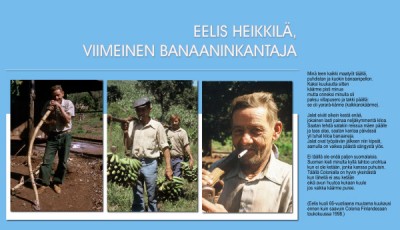
7/9: Eelis Heikkilä: El último recolector

Yo hago todo el trabajo aquí

limpio y carpo el bananal.

Hace dos meses me picó una víbora

suerte que tenía puesto

un pulóver grueso y un saco:

era un yarará (Bothrops alternatus).

Mis pies no aguantan más

cada cargamento que llevo pesa cuarenta kilos

puede ser que haga hasta 100 cargamentos por día

puede ser que en un día

haya cargado más de mil kilos de bananas.

Mis pies ya no aguantan más

mis pies están doloridos

después de un día de trabajao

es difícil levantarse en la mañana.

No hay en esta zona tantos finlandeses

Me estoy olvidando del finlandés

no tengo con quien hablar.

Colonia Finlandesa es un lugar triste

como nadie vive cerca de mí

me quedaría solo tirado

y nadie escucharía a mi socorro

si me picara una víbora.

(Eelis falleció a los 66 años unos meses antes de que visitara a Colonia Finlandesa en mayo de 1998.)

8/9: Helga y Artturi Heino se enamoran y se quedan

Siempre en el campo

conseguí un poco de fuerza

pensando que este sería

el último año

que hiciera este trabajo.

Lo único que nos faltaba

era un comprador para la chacra

todo estaba listo

pero después me embarazé.

Cuando nació Jussi

había estallado en Europa

la Segunda Guerra Mundial

pero nos quedo una pequeña esperanza:

Nos mudaríamos cuando

terminara la guerra.

Pero cuando terminó la guerra

había nacido

una pequeña hija,

Elena, en 1941.

Teníamos cuatro hijos

y poco dinero.

Artturi siempre añoraba

a Finlandia y toda su vida

vivió con la esperanza

de volver a su país natal.

9/9: Últimos pensamientos

El poeta fancés, Edmond Haraucourt (1856-1941), creía que la imagen de la muerte aparece siempre cuando dos personas se separan. Dijo: “El partir es morir un poco, es morir a lo que uno ama.”

El ritual de la despedida era una experiencia más traumática a comienzos del siglo pasado que hoy.  En aquellos tiempos, las personas que no se volverían a ver nunca más, por el destino o las circunstancias de la geografía, tuvieron que disfrazar las despedidas con grandes dosis de esperanza. Tuvieron que convencerse de que pronto se volverían  a ver, aunque nunca lo hicieran.

¿Cuántos inmigrantes de Finlandia y de otros países hubieran dejado a sus seres queridos si hubieran sabido que sería la última vez que los vieran? Seguramente la historia de la humanidad se hubiera escrito de manera distinta si hubiéramos tenido el don de saber si nuestros adioses eran los últimos.

  • Previous
  • 1
  • …
  • 405
  • 406
  • 407
  • 408
  • 409
  • 410
  • 411
  • …
  • 535
  • Next
Read more about documentary film
Read more

Recent Posts

  • Finland’s tabloids Iltalehti and Ilta-Sanomat are the pits
  • Riikka Purra’s Dr Jekyll and Mr Hyde mask
  • Double standards
  • Perussuomalaiset: Uusi logo, sama vanha juttu
  • Taco Trump

Recent Comments

  1. Absolutely Socking: Racist Finnish Facebook group against human rights gets flooded with socks on Musta Barbaari’s mother and sister charged by the police in “ethnic profiling” case
  2. Ilkka Nuotio on Pekka Myrskylä: “Tilastot kertovat toista kuin poliittinen keskustelu”
  3. Genrih Soinkara on The war in Ukraine and the Russian-Finnish border crisis are showing Finland’s ugly side
  4. Ahti Tolvanen on Comment by Ahti Tolvanen on the Helsinki +50 conference
  5. Angel Barrientos on Angel Barrientos is one of the kind beacons of Finland’s Chilean community

Archives

  • June 2026
  • May 2026
  • April 2026
  • March 2026
  • February 2026
  • January 2026
  • December 2025
  • November 2025
  • October 2025
  • September 2025
  • August 2025
  • July 2025
  • June 2025
  • May 2025
  • April 2025
  • March 2025
  • February 2025
  • January 2025
  • December 2024
  • November 2024
  • October 2024
  • September 2024
  • August 2024
  • July 2024
  • June 2024
  • May 2024
  • April 2024
  • March 2024
  • February 2024
  • January 2024
  • December 2023
  • November 2023
  • October 2023
  • September 2023
  • August 2023
  • July 2023
  • June 2023
  • May 2023
  • April 2023
  • March 2023
  • February 2023
  • January 2023
  • December 2022
  • November 2022
  • October 2022
  • September 2022
  • August 2022
  • July 2022
  • June 2022
  • May 2022
  • April 2022
  • March 2022
  • February 2022
  • January 2022
  • December 2021
  • November 2021
  • October 2021
  • September 2021
  • August 2021
  • July 2021
  • June 2021
  • May 2021
  • April 2021
  • March 2021
  • February 2021
  • January 2021
  • December 2020
  • November 2020
  • October 2020
  • September 2020
  • August 2020
  • July 2020
  • June 2020
  • May 2020
  • April 2020
  • March 2020
  • February 2020
  • January 2020
  • December 2019
  • November 2019
  • October 2019
  • September 2019
  • August 2019
  • July 2019
  • June 2019
  • May 2019
  • April 2019
  • March 2019
  • February 2019
  • January 2019
  • December 2018
  • November 2018
  • October 2018
  • September 2018
  • August 2018
  • July 2018
  • June 2018
  • May 2018
  • April 2018
  • March 2018
  • February 2018
  • January 2018
  • December 2017
  • November 2017
  • October 2017
  • September 2017
  • August 2017
  • July 2017
  • June 2017
  • May 2017
  • April 2017
  • March 2017
  • February 2017
  • January 2017
  • December 2016
  • November 2016
  • October 2016
  • September 2016
  • August 2016
  • July 2016
  • June 2016
  • May 2016
  • April 2016
  • March 2016
  • February 2016
  • January 2016
  • December 2015
  • November 2015
  • October 2015
  • September 2015
  • August 2015
  • July 2015
  • June 2015
  • May 2015
  • April 2015
  • March 2015
  • February 2015
  • January 2015
  • December 2014
  • November 2014
  • October 2014
  • September 2014
  • August 2014
  • July 2014
  • June 2014
  • May 2014
  • April 2014
  • March 2014
  • February 2014
  • January 2014
  • December 2013
  • November 2013
  • October 2013
  • September 2013
  • August 2013
  • July 2013
  • June 2013
  • May 2013
  • April 2013
  • March 2013
  • February 2013
  • January 2013
  • December 2012
  • November 2012
  • October 2012
  • September 2012
  • August 2012
  • July 2012
  • June 2012
  • May 2012
  • April 2012
  • March 2012
  • February 2012
  • January 2012
  • December 2011
  • November 2011
  • October 2011
  • September 2011
  • August 2011
  • July 2011
  • June 2011
  • May 2011
  • April 2011
  • March 2011
  • February 2011
  • January 2011
  • December 2010
  • November 2010
  • October 2010
  • September 2010
  • August 2010
  • July 2010
  • June 2010
  • May 2010
  • April 2010
  • March 2010
  • February 2010
  • January 2010
  • December 2009
  • November 2009
  • October 2009
  • September 2009
  • August 2009
  • July 2009
  • December 2008
  • November 2008
  • October 2008
  • September 2008
  • August 2008
  • July 2008
  • June 2008
  • May 2008
  • April 2008
  • March 2008
  • February 2008
  • January 2008
  • November 2007
  • October 2007
  • September 2007
  • August 2007
  • July 2007
  • June 2007
  • May 2007

Categories

  • ?? Gia L?c
  • ????? ?????? ????? ???????? ?? ??????
  • ???????
  • @HerraAhmed
  • @mondepasrond
  • @nohatefinland
  • @oula_silver
  • @Varathas
  • A Pakistani family
  • äärioikeisto
  • Abbas Bahmanpour
  • Abdi Muhis
  • Abdirahim Hussein Mohamed
  • Abdirahim Husu Hussein
  • Abdirisak Mahamed
  • About Migrant Tales
  • activism
  • Adam Al-Sawad
  • Adel Abidin
  • Afrofinland
  • Ahmed IJ
  • Ahti Tolvanen
  • Aino Pennanen
  • Aisha Maniar
  • Alan Ali
  • Alan Anstead
  • Alejandro Díaz Ortiz
  • Alekey Bulavsev
  • Aleksander Hemon
  • Aleksanterinliitto
  • Aleksanterinliitto ry
  • Aleksanterinliitto ry:n hallitus
  • Alex Alex
  • Alex Mckie
  • Alexander Nix
  • Alexandra Ayse Albayrak
  • Alexis Neuberg
  • Ali Asaad Hasan Alzuhairi
  • Ali Hossein Mir Ali
  • Ali Rashid
  • Ali Sagal Abdikarim
  • Alina Tsui
  • Aline Müller
  • All categories
  • Aman Heidari
  • Amiirah Salleh-Hoddin & Jana Turk
  • Amin A. Alem
  • Amir Zuhairi
  • Amkelwa Mbekeni
  • Ana María Gutiérrez Sorainen
  • Anachoma
  • Anders Adlecreutz
  • Angeliina Koskinen
  • Anna De Mutiis
  • Anna María Gutiérrez Sorainen
  • Anna-Kaisa Kuusisto ja Jaakko Tuominen
  • Annastiina Kallius
  • Anneli Juise Friman Lindeman
  • Announcement
  • Anonymous
  • Antero Leitzinger
  • anti-black racism
  • Anti-Hate Crime Organisation Finland
  • Anudari Boldbaatar
  • Arshiya Nasser
  • Aspergers Syndrome
  • Asylum Corner
  • Asylum seeker 406
  • Athena Griffin and Joe Feagin
  • Autism
  • Avaaz.org
  • Awale Olad
  • Ayan Said Mohamed
  • AYY
  • Barachiel
  • Bashy Quraishy
  • Beatrice Kabutakapua
  • Beri Jamal
  • Beri Jamal and Enrique Tessieri
  • Bertolt Brecht
  • Boiata
  • Boodi Kabbani
  • Bruno Gronow
  • Carmen Pekkarinen
  • Çelen Oben and Sheila Riikonen
  • Chiara Costa-Virtanen
  • Chiara Costa-Virtanen
  • Chiara Sorbello
  • Christian Thibault
  • Christopher Wylie
  • Clara Dublanc
  • Dana
  • Daniel Malpica
  • Danilo Canguçu
  • David Papineau
  • David Schneider
  • Dexter He
  • Don Flynn
  • Dr Masoud Kamali
  • Dr. Faith Mkwesha
  • Dr. Theodoros Fouskas
  • Edna Chun
  • Eeva Kilpi
  • Emanuela Susheela
  • En castellano
  • ENAR
  • Enrique
  • Enrique Tessieri
  • Enrique Tessieri & Raghad Mchawh
  • Enrique Tessieri & Yahya Rouissi
  • Enrique Tessieri and Muhammed Shire
  • Enrique Tessieri and Sira Moksi
  • Enrique Tessieri and Tom Vandenbosch
  • Enrique Tessieri and Wael Che
  • Enrique Tessieri and Yahya Rouissi
  • Enrique Tessieri and Zimema Mhone
  • Epäluottamusmies
  • EU
  • Europe
  • European Islamophobia Report
  • European Islamophobia Report 2019,
  • European Union
  • Eve Kyntäjä
  • Ezequiel Caldeiro
  • Facebook
  • Fadumo Dayib
  • Faisa Kahiye
  • Farhad Manjoo
  • Fasismi
  • Finland
  • Fizza Qureshi
  • Flyktingar och asyl
  • Foreign Student
  • Fozia Mir-Ali
  • Frances Webber
  • Frida Selim
  • Gareth Rice
  • Ghyslain Vedeaux
  • Global Art Point
  • Great Replacement
  • Habiba Ali
  • Hami Bahadori
  • Hami Bahdori
  • Hamid
  • Hamid Alsaameere
  • Hamid Bahdori
  • Handshake
  • Harmit Athwal
  • Hassan Abdi Ali
  • Hassan Muhumud
  • Heikki Huttunen
  • Heikki Wilenius
  • Helsingin Sanomat
  • Henning van der Hoeven
  • Henrika Mälmsröm
  • Hser Hser
  • Hser Hser ja Mustafa Isman
  • Husein Muhammed
  • Hussain Kazemian
  • Hussain Kazmenian
  • Ibrahim Khan
  • Ida
  • Ignacio Pérez Pérez
  • Iise Ali Hassan
  • Ilari Kaila & Tuomas Kaila
  • Imam Ka
  • inside-an-airport
  • Institute of Race Relations
  • Iraqi asylum seeker
  • IRR European News Team
  • IRR News Team
  • Islamic Society of Norhern FInland
  • Islamic Society of Northern Finland
  • Islamophobia
  • Jacobinmag.com
  • Jallow Momodou
  • Jan Holmberg
  • Jane Elliott
  • Jani Mäkelä
  • Jari Luoto
  • Jari Taponen
  • Jegor Nazarov
  • Jenni Stammeier
  • Jenny Bourne
  • Jessie Daniels
  • Joe Davidow
  • Johannes Koski
  • John D. Foster
  • John Grayson
  • John Marriott
  • Jon Burnett
  • Jorma Härkönen
  • Jos Schuurmans
  • José León Toro Mejías
  • Josue Tumayine
  • Jouni Karnasaari
  • Juan Camilo
  • Jukka Eräkare
  • Julian Abagond
  • Julie Pascoet
  • Jussi Halla-aho
  • Jussi Hallla-aho
  • Jussi Jalonen
  • JusticeDemon
  • Kadar Gelle
  • Kaksoiskansalaisuus
  • Kansainvälinen Mikkeli
  • Kansainvälinen Mikkeli ry
  • Katherine Tonkiss
  • Kati Lepistö
  • Kati van der Hoeven-Lepistö
  • Katie Bell
  • Kättely
  • Kerstin Ögård
  • Keshia Fredua-Mensah & Jamie Schearer
  • Khadidiatou Sylla
  • Khadra Abdirazak Sugulle
  • Kiihotus kansanryhmää vastaan
  • Kirsi Crowley
  • Koko Hubara
  • Kristiina Toivikko
  • Kubra Amini
  • KuRI
  • La Colectiva
  • La incitación al odio
  • Laura Huhtasaari
  • Lauri Finér
  • Leif Hagert
  • Léo Custódio
  • Leo Honka
  • Leontios Christodoulou
  • Lessie Branch
  • Lex Gaudius
  • Leyes de Finlandia
  • Liikkukaa!
  • Linda Hyökki
  • Liz Fekete
  • M. Blanc
  • Maarit Snellman
  • Mahad Sheikh Musse
  • Maija Vilkkumaa
  • Malmin Kebab Pizzeria Port Arthur
  • Marcell Lorincz
  • Mari Aaltola
  • María Paz López
  • Maria Rittis Ikola
  • Maria Tjader
  • Marja-Liisa Tolvanen
  • Mark
  • Markku Heikkinen
  • Marshall Niles
  • Martin Al-Laji
  • Maryan Siyad
  • Matt Carr
  • Mauricio Farah Gebara
  • Media Monitoring Group of Finland
  • Micah J. Christian
  • Michael McEachrane
  • Michele Levoy
  • Michelle Kaila
  • Migrant Tales
  • Migrant Tales Literary
  • Migrantes News
  • Migrants' Rights Network
  • MigriLeaks
  • Mikko Kapanen
  • Miriam Attias and Camila Haavisto
  • Mohamed Adan
  • Mohammad Javid
  • Mohammad M.
  • Monikulttuurisuus
  • Monisha Bhatia and Victoria Canning
  • Mor Ndiaye
  • Muh'ed
  • Muhamed Abdimajed Murshid
  • Muhammed Shire
  • Muhammed Shire and Enrique Tessieri
  • Muhis Azizi
  • Musimenta Dansila
  • Muslimiviha
  • Musulmanes
  • Namir al-Azzawi
  • Natsismi
  • Neurodiversity
  • New Women Connectors
  • Nils Muižnieks
  • No Labels No Walls
  • Noel Dandes
  • Nuor Dawood
  • Omar Khan
  • Otavanmedia
  • Oula Silvennoinen
  • Paco Diop
  • Pakistani family
  • Pentti Stranius
  • Perussuomalaiset
  • perustuslaki
  • Petra Laiti
  • Petri Cederlöf
  • Pia Grochowski
  • Podcast-lukija Bea Bergholm
  • Pohjois – Suomen Islamilainen Yhdyskunta
  • Pohjois Suomen Islamilainen Yhyskunta
  • Polina Kopylova
  • Race Files
  • racism
  • Racism Review
  • Raghad Mchawh
  • Ranska
  • Rashid H. and Migrant Tales
  • Rasismi
  • Raul Perez
  • Rebecka Holm
  • Reem Abu-Hayyeh
  • Refugees
  • Reija Härkönen
  • Remiel
  • Reza Nasri
  • Richard Gresswell
  • Riikka Purra
  • Risto Laakkonen
  • Rita Chahda
  • Ritva Kondi
  • Robito Ibrahim
  • Roble Bashir
  • Rockhaya Sylla
  • Rodolfo Walsh
  • Roger Casale
  • Rostam Atai
  • Roxana Crisólogo Correa
  • Ruth Grove-White
  • Ruth Waweru-Folabit
  • S-worldview
  • Sadio Ali Nuur
  • Sami Rusanen
  • Sandhu Bhamra
  • Sara de Jong
  • Sarah Crowther
  • Sari Alhariri
  • Sarkawt Khalil
  • Sasu
  • Scot Nakagawa
  • Shabana Ahmadzai
  • Shada Islam
  • Sharon Chang blogs
  • Shenita Ann McLean
  • Shirlene Green Newball
  • Sini Savolainen
  • Sira Moksi
  • Sonia K.
  • Sonia Maria Koo
  • Steverp
  • Stop Deportations
  • Suldaan Said Ahmed
  • Suomen mediaseurantakollektiivi
  • Suomen Muslimifoorumi ry
  • Suomen viharikosvastainen yhdistys
  • Suomen viharikosvastainen yhdistys ry
  • Suomi
  • Supermen
  • Susannah
  • Suva
  • Syrjintä
  • Talous
  • Tapio Tuomala
  • Taw Reh
  • Teivo Teivainen
  • The Daily Show
  • The Heino
  • The Supermen
  • Thomas Elfgren
  • Thulfiqar Abdulkarim
  • Tim McGettigan
  • Tino Singh
  • Tito Moustafa Sliem
  • Tobias Hübinette and L. Janelle Dance
  • Transport
  • Trica Danielle Keaton
  • Trilce Garcia
  • Trish Pääkkönen
  • Trish Pääkkönen and Enrique Tessieri
  • Tuulia Reponen
  • Uncategorized
  • UNITED
  • University of Eastern Finland
  • Uyi Osazee
  • Väkivalta
  • Vapaa Liikkuvuus
  • Venla-Sofia Saariaho
  • Vieraskynä
  • W. Che
  • W. Che an Enrique Tessieri
  • Wael Ch.
  • Wan Wei
  • Women for Refugee Women
  • Xaan Kaafi Maxamed Xalane
  • Xassan Kaafi Maxamed Xalane
  • Xassan-Kaafi Mohamed Halane & Enrique Tessieri
  • Yahya Rouissi
  • Yasmin Yusuf
  • Yassen Ghaleb
  • Yle Puhe
  • Yuliet Tresa
  • Yve Shepherd
  • Zahra Khavari
  • Zaker
  • Zalina Ametova
  • Zamzam Ahmed Ali
  • Zeinab Amini ja Soheila Khavari
  • Zimema Mahone and Enrique Tessieri
  • Zimema Mhone
  • Zoila Forss Crespo Moreyra
  • ZT
  • Zulma Sierra
  • Zuzeeko Tegha Abeng
© 2026 Migrant tales | Powered by Minimalist Blog WordPress Theme