National Coalition Party MP Pertti Salolainen got himself in hot water Saturday due to a comment he made on YLE Aamu TV morning talk show about USAmerican Jews, reports Helsingin Sanomat. The vice chairman of the foreign policy committee said that American Jews have vast control over the wealth and media in the United States. As a result, this hinders Washington from remaining neutral toward the Palestinians.
You can read about Salolainen’s statement on the Jerusalem Post as well.
In my opinion, the biggest mistake that Salolainen did was making such a gross generalization in the first place. USAmerican Jews may control part of the country’s wealth and media, how much is another point.
Moreover, for a vice chairman of the foreign policy committee to make such a generalization adds salt to Salolainen’s inopportune comment.
So what’s the lesson we should learn from Salolainen’s mistake?
Never generalize about ethnic and religious groups because you are going to get yourself in big trouble especially if that group has the means to defend itself.
Too many politicians and policy-makers in this country make similar generalizations about immigrants and other ethnic groups.
This explains in party why their policies and expectations aren’t realistic. They are based on stereotypes and myths that aren’t simply true.
The lives of stateless persons in Finland isn’t easy by a long shot. On the one hand we want newcomers to adapt to our society but deny them a basic right like opening a bank account. Think for a moment how complicated life would be without a bank account.
If you are a stateless person and lucky enough to open a bank account, you may not have access to online banking. This means that every bill you get must be paid at the bank for a fee.
Thirty years ago Finns paid their bills this way.
Not everyone can open a bank account in Finland. Only people who have a valid document. Banks consider a passport a valid document.
Just like society punishes you for belonging to a minority, the lives of stateless persons are penalized because they came from war-torn countries.
Some employees at banks like Sampo appear to make their own rules. One stateless person with a passport told me that a teller said she could not open a bank account because she didn’t have a driver’s license!
I know of one case where a stateless person has travelled over 100 kilomters to his hometown to get money from the Social Insurance Institution of Finland (Kela). The journey by train implies spending a chunk of his small monthly earnings, never mind the time lost, in doing something that would take a few seconds at an ATM machine.
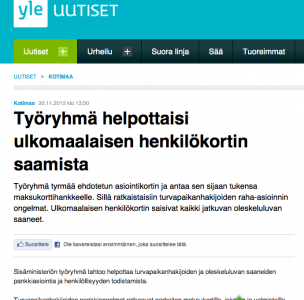
There’s some hope on the way. The ministry of interior wants to change matters so it would be easier for newly arrived immigrants to get an id card with which to get a debit card from the bank, according to YLE.
How long will it take before this very important issue is addressed effectively by the bank and state authorities?
Because it appears that the aim of these two institutions is to make life as difficult as possible for these people, don’t expect anything soon to happen.
The first question that came to mind when I read a disturbing study of Russian, Somali and Kurdish immigrants by the National Institute for Health and Welfare (THL) is why now? If the THL study is the first-ever of its kind in Finland about immigrants’ health and living conditions, why has it taken such a long time to materialize?
One of the biggest surprises of the study was the high amount of immigrants who suffered from mental-health problems, THL researcher, Seppo Kosinen, was quoted as saying on Helsingin Sanomat.
In the study, males were healthier than women.
Taking into account the high amount of mental health issues that the THL study reveals, probably the biggest surprise is how little the health authorities knew about the state of health of some immigrant groups in Finland.
Does one need to be an expert to grasp that unemployment, discrimination, social exclusion and poverty are some culprits behind the mental health problems of immigrants? Certainly there are other ones like traumas endured in their former war-ravaged home countries.
Another matter that bothered me about the study was its shortened name, Maamu, which sounds like mamu, the shortened form of the Finnish name for immigrant, or maahanmuuttaja.
While some immigrants don’t have a problem with this word, some do. If Finns call immigrants mamu is it then ok to refere to men or women as äijä (dude) or gimma (chick), respectively.
Migrant Tales welcomes the belated THL study since it shows that Finnish health authorities are starting to take a real interest in the well-being of immigrants in this country.
Helsingin Sanomat uutisoi (29.11.) Terveyden ja hyvinvoinnin laitoksen THL:n laajasta tutkimuksesta, jonka mukaan maahanmuuttajat voivat fyysisesti ja henkisesti huonosti. THL on selvittänyt kurdi-, somali- ja venäläistaustaisten vähemmistöjen hyvinvointia Suomessa. Erityisen huolestuttava tilanne on omalla yhteisölläni, kurdeilla.
Asian myönteinen puoli on se, että tällä kertaa poikkeuksellisesti juuri näkymätön kurdivähemmistö nousi esille. Kahden muun tässä tutkimuksessa olleen ryhmän tilanne puolestaan nousee aika usein esille. Venäläiset ovat suurin ryhmä, somalit ihonvärinsä ja ainakin oletetusti myös kulttuurinsa puolesta hyvin suomalaisista poikkeava ja siksi huomiota herättävä ryhmä.
Juuri terveyden ja nimenomaan kurdien heikon tilanteen esille nousemisen pitäisi saada maahanmuuttajien kotouttamisesta ja etnisestä yhdenvertaisuudesta vastaavat viranomaiset arvioimaan toimintaansa melko radikaalisti uudelleen. Yksinkertaistettuna tämän pitäisi tarkoittaa ensisijaisen huomion kiinnittämistä valtaväestön todellisen tai oletetun rasismin sijaan vähemmistöjen sisällä yksilöihin kohdistuvaan syrjintään.
Rasismia ja siihen puuttumista ei voi väheksyä, mutta tosiasiassa yhdenvertaisuuden toteutuminen vähemmistöihin kuuluville ei ole mahdollista puuttumatta vähemmistöjen sisällä vallitseviin haitallisiin perinteisiin ja rooleihin. Näitä kulttuureihin liittyviä asioita ovat esimerkiksi somaleilla hyvin konservatiivisen uskonnollisuuden nousu, kurdeilla kunniaväkivalta sekä romaneilla väistämisvelvollisuus ja kulttuurista johtuvat poikkeukselliset asumisjärjestelyt. Muillakin ryhmillä on näitä ja/tai muita kulttuurista johtuvia haitallisia perinteitä, joihin pitää puuttua.
Maahanmuuttokeskustelu Suomessa on juuttunut jo vuosien ajan siihen, saako Suomeen tulla maahanmuuttajia. On korkea aika päästä tosissaan keskusteluun siitä, miten täällä ollaan. Asian edistymistä vaikeuttaa se, että – toisin kuin vaikka seksuaalivähemmistöjä, vammaisia tai ruotsinkielisiä – maahanmuuttajia eivät kotouttamisessa tai yhdenvertaisuuden valvonnassa edusta maahanmuuttajat vaan heidän asiantuntijoinaan esiintyvät valtaväestön edustajat.
Vähemmistöjen ulkopuolella asuvilla valtaväestön edustajilla ei kuitenkaan ole todellista kosketusta vähemmistöryhmien sisälle. Eikä varsinkaan uskallusta puuttua vähemmistöjen sisällä tapahtuvaan syrjintään. Siksi kotouttamis- ja yhdenvertaisuusviranomaisilla ei joko ole ehdotuksia tällaiseen syrjintään ja syrjäytymiseen puuttumiseen tai ehdotukset ovat todellisuudelle vieraita. Tilanne vaatii pikaista maahanmuuttajien merkittävää mukaanottoa kotouttamisen ja yhdenvertaisuuden suunnittelussa ja toteutuksessa.
Kirjoittaja on lakimies ja tietokirjailija sekä Etelä-Suomen etnisten suhteiden neuvottelukunnan puheenjohtaja (2011 – 2015)
Sweden Democrat (SD) MP Lars Isovaara is resigning his seat after he spat at a parliamentary security guard, reports The Local. The latest scandal to the far-right party follows an earlier one this month after Swedish tabloid Expressen published a video of an SD MP who got rowdy in public and hurled racist and sexist insults.
SD party chairman, Jimmie Åkesson, stated that Isovaara’s behvior had eaten away his credibility, adding that the former MP has ”personal problems.”
Writes The Local: ”Isovaara reportedly oinked like a pig and spat at a security guard in the early hours of Wednesday morning after he had reported a robbery. He called the Expressen newspaper himself and urged them to publish the story, however the paper later published information that suggested the robbery never took place.”
An article on Turun Sanomat quotes Turku School of Economics professor, Kari Liuhto, stating that dual citizenship rights in Finland were a mistake in light of the recent child custody row that erupted in October between Finland and Russia.
Liuhto believes that dual citizenship rights granted in 1999 in this country give Russia the opportunity to increase its influence in our national affairs.
Finland has about 60,000 people with dual citizenship, according to Turun Sanomat.
Is dual citizenship such a big of a threat to Finland as Liuhto claims?
While we can discuss the pros and cons of dual and multiple citizenship, those who see it as a bad thing are usually driven by nationalism, suspicion and loyalty issues.
Some countries permit dual or multiple citizenship while others, like India and China, do not.
The United States, which allows dual citizenship, keeps their citizens on a short leash through the Internal Revenue System (IRS). If you are a U.S. citizen and live abroad and have dual citizenship, you are obliged to file your annual tax statement to the IRS.
It is doubtful that tightening dual citizenship laws will change matters never mind calm Liuhto’s fear of Russia’s influence in Finland. That’s more of an in-between-your-ears issue. But the more nationalism and fear we spread, the greater will be our fear of the outside world and its citizens.
Liuto’s concern is only the tip of an iceberg of a far greater threat facing Finland and Europe these days: nationalism and intolerance.
Apart from draft laws to ban male circumcision and to make it easier to deport foreign convicts from Finland, parties like the Perussuomalaiset (PS) would certainly like to spike dual citizenship rights. You don’t have to be a rocket scientist to grasp this.
This video clip of a draft law spearheaded by PS MP Jussi Halla-aho shows the crackpot stuff these types of politicians say and do to gain attention, listeners and votes.
Finland used to have very strict citizenship laws in the 1919 Constitution. Only the children of male Finnish citizens were given citizenship automatically. If you were a citizen of another country, you lost your Finnish citizenship.
The children of female Finnish citizens were granted full citizenship rights in 1984.
Finnish Internet policeman, Marko Forss, has been criticized for spreading stereotypes on Twitter about a Roma who tried to steal a frozen chicken from a market, according to tabloid Iltalehti. Shouldn’t Forss, who monitors hate sites and was named policeman of the year in 2011, know better?
If it is surprising that Forss can make such a joke publicly, what is even more surprising is his excuse: ”I don’t see any racism in such a joke.”
What did Forss tweet? “Some funny things happen in police work, and for some reason these incidents often involve gypsies. In the best one a gypsy woman drops a frozen chicken from under her clothing in a shop. When police take the group into custody one of the men loudly objects: ‘come on, own up! Who threw that chicken at our Ally?’”*
The issue is not what he thought but how others could interpret and be offended by his so-called joke. Does Forss think that the Roma in Finland are so weathered by racism and social exclusion that they can take a joke that reinforces prejudices that they shoplift for a living?
Let’s imagine for a moment that the Finnish Internet policeman would be working for the Metropolitan Police in London and would make a similar joke about an ethnic group like Pakistanis.
Would he be able to get away with a I-didn’t-think-it-was-racist excuse?
I doubt it.
While we should be careful not to label all Finnish police as public servants who lack cultural sensitivity and savvy, Forss’ comment shows how few visible minorities there are in the Finnish police force.
* Many thanks go to Justice Demon for the translation.
Despite the fact that the debate in Finland on immigrants and immigration has taken a turn for the worse in some respects, it’s not as bad as it used to be before the April 2011 parliamentary elections and when Anders Breivik went on his murderous rampage on July 22, 2011. While anti-immigration politicians still want to inflame public debate, their message no longer carries the same weight as before.
Certainly there are still many Finns who believe that what these anti-immigration politicians say is true but not as many as such politicians would like.
Take a look at this video clip of a then-confident Perussuomalaiset (PS) MP Jussi Halla-aho being interviewed in 2009 on Voice Häräämö. Why doesn’t he appear any longer on such programs as an “immigration expert (sic!)?”
Answer: loss of credibility and because reporters are more critical than before of their message.
It must be frustrating for politicians, who base their popularity on anti-immigration rhetoric, to see their message fall on its face after being cut off at the knees by time.
This situation especially worries the biggest anti-immigration loudmouths of the party like MP James Hirvisaari, who recently claimed the PS did poorly in the municipal elections because it wasn’t outspoken enough on immigration issues as before.
Is this the main reason for the PS’ poor showing due to the credibility of its anti-immigration message? Did they do poorly in the municipal elections because of the crackpot stuff they say and do to gain attention?
Most likely.
If anti-immigration politicians of the PS are interviewed by the media today, it’s doubtful that any sensible person would take them seriously never mind any good reporter.
The same ogres that these politicians unleashed against immigrants follow them around like ghosts: racism, fascism and far-right ideology.
Finland is slowly but surely learning to distinguish between what is and what isn’t racism, what is and what isn’t far-right ideology.
This is a positive matter, but a lot more work needs to be done to rid this menace that threatens our society today.
“Lincoln” (2012) is a Steven Spielberg film about the passing of the Thirteenth Amendment, the one that freed the slaves. It stars Daniel Day-Lewis as Abraham Lincoln, Sally Field as his wife and Tommy Lee Jones as Radical Republican Congressman Thaddeus Stevens. Gloria Reuben plays Elizabeth Keckley, Mrs Lincoln’s dressmaker and friend.
The film is based in part on the book “Team of Rivals” (2006) by Doris Kearns Goodwin.
Executive summary: “The Help” as costume drama – though Daniel Day-Lewis is amazing as Lincoln.
Best line: When Gloria Reuben says to Lincoln:
White people don’t want us here – any of them. Do you?
Like the “The Help”, Participant Media lists this as one of its films about social action. And like “The Help” it rewrites history as a story about a well-meaning white person, who is not one bit racist, helping blacks by fighting against n-word-using white racists – while blacks largely take a back seat.
While “The Help” had fleshed-out black characters, this film has none. Gloria Reuben comes the closest – she is listed 17th in the credits. In this film about freeing slaves not a single slave appears.
On the other hand it does show black soldiers in the opening scene – so the Helpless Darkies in this one are not quite so helpless.
Although the film takes great pains to make Daniel Day-Lewis look like Lincoln, talk like Lincoln and walk like Lincoln, it whitewashes Lincoln.
In real lifeLincoln used the n-word. Spielberg’s Lincoln does not – even though others in the film do.
In real life Lincoln said stuff like this:
… there is a physical difference between the white and black races which I believe will for ever forbid the two races living together on terms of social and political equality.
Spielberg’s Lincoln never says stuff like that. He is for equal rights! This is no longer history, but fantasy. Lincoln was against giving blacks the vote till the last week of his life, and even then it would only be for veterans and the “very intelligent” – Jim Crow stuff.
In real life Lincoln was for ethnic cleansing. He wanted to send blacks away after the war – till Frederick Douglass (not in the film) talked him out of it.
Douglass 11 years after Lincoln’s death said:
President Lincoln was a white man, and shared the prejudices common to his countrymen towards the coloured race.
Racism is not a matter of some misguided whites, like in a Hollywood film. Most whites are not Basically Good, as this film would have you suppose. Most are racist, morally compromised. Lincoln was no different.
What sets Lincoln apart was that he fought against his own racism, against his fallen nature, and did right in spite of it. Instead of giving into it and calling it right. That is the story that went untold. It would be far truer, far more interesting and far more helpful as a model for social action. Instead we get yet another feel-good White Saviour fantasy flick.
We must change the ever-adverse debate against immigrants and visible minorities in Finland. The way to end it is by giving our silence a voice and by sending kudos to those who have the courage to speak out against racism and prejudice.
Migrant Tales would like to give kudos Tuija Väyrynen of the city of Kouvola, who said that racism and social exclusion are on the rise in her city.
For a city official to show her concern about such a worrisome social ill is one matter, but publishing it in the local newspaper with her real name shows courage and sets a good example.
In Finland, there are many people from all walks of life who are just as concerned about the rise of intolerance as Migrant Tales. We should therefore take the time to show our admiration to such people for the bravery.
To read the original story on Kouvolan Sanomat click here.