Pia Growchoski asks an important question on her recent blog entry on Migrant Tales: Why is the national media so interested in far right groups and their resentful rhetoric? Why do we give space to Perussuomalaiset (PS) chairman Timo Soini’s blatant incompetence on our Facebook pages? Are we in denial about what these groups represent or just being entertained by them?
In many respects, far right politicians are like show wrestlers. We know about their antics but we don’t mind being fooled.
Soini is one politician who plays the show political game very well. He plays it so well that it took a year and ten months after the PS’ historic election victory of 2011 to be grilled on HARDtalk about racism in his party.
How many in Finland have done the same?
After some major adjustments and training, lots of far right politicians could make it as show wrestlers and even become as popular as Ric Flair. Source: Best of Ric Flair going nuts.
A good example of the public’s fascination with the far right in Finland is the media coverage that PS MP Olli Immonen got as the new president of the extremist Suomen Sisu association.
Some of the most outrageous matters that Immonen, who is a security guard by profession, has claimed is an inevitable so-called clash of cultures between “Christian” and “Muslim” Europe.
Sensible people understand that this is a lot of hogwash like 99.99% of what show wrestlers rant theatrically in front of television cameras.
Immonen writes on the Suomen Sisu website that it is a good matter that anti-immigration groups are not taking the law in their hands but organizing legally.
Then the show wrestler appears like from a jack-in-the-box bouncing from side to side: “I personally condemn racism and I don’t accept that any person is marginalized or favored in working life based of his ethnic background,” he continues. “Similarly, I condemn all forms of political violence be it from persons belonging to the left, center or right.”
Why would Immonen state such things?
If you want to see what people really think and represent, see what they deny.
Irrespective of the political theatrics, it would be a mistake to underestimate the influence and potential harm these types of groups can inflict on our society. That is why we must be vigilant and ready to confront and defeat them wherever they me be.
Today these far right groups are active in countries like Greece and Hungary.
“My friends, love is better than anger. Hope is better than fear. Optimism is better than despair. So let us be loving, hopeful and optimistic. And we’ll change the world.”
These were the final words written by the late Canadian leader of the opposition, Jack Layton, just hours before his untimely death of cancer. I reflect upon these words with a desire in my heart to challenge the current status quo in Finland. While the words were part of a message towards all Canadians to carry us through period of darkness with the untimely passing of one of our leaders; these words have enormous relevance.
I wish to question what appears to be, to me at least, too much coverage of the far right, racism, the perussuomalaiset. I question the tactics from many liberally minded people that discussions I have had always tend to fall down the path of concern for what the äärioikeus, or far right, said; many are rightfully shocked, disgusted, and concerned at the long-term implications of their dogma, their horrific ideas. Rather than despair in such statements, I feel we must look with optimism towards alternatives. To allow us to be channels wherein people with the capacity to change, with a vision for inclusion can get a voice. The more I read of äärioikeus, the more I realize how silly it all is. These individuals promote sensational ideas, which I believe will never be manifested, but can be framed in such a way that will shock and awe the public and sell newspapers. The more they are covered and discuss in the media, the more we are at risk of having them get the promotion we want. While criticizing their views, we must take care to provide a reasoned answer that defines out values and ideals with the means of seeing them through.
My plea in writing this is that we need to hear more visionary voices; we need to see more alternatives. Now is the time to act, now is the time to hope, and be optimistic. There are so many wonderful people in this country with great messages of diversity, great potential for change; why do we let a character like Soini win the walls of our facebook pages with his blatant incompetence, and subtle racism in a BBC interview. In the last presidential election an openly homosexual man, with a foreign partner came to the final round. This wouldn’t be possible without some desire of the people in this country accepting and supporting the very things the äärioikeus hopes to remove. I am becoming more inclined not let the äärioikeus use me as a channel for their voices, as I believe such spaces are better used by alternatives, reasoned voices that can offer real solutions rather than fear. I believe they have fed us with enough proof that they are no longer worth our time, our anger. I believe that we can deal with this problem; I believe that we can lead by example, we can provide ideas, we can solve problems, and we can do better.
Don’t get me wrong, covering racism is important, and some may, still, be unaware of the extent of it all; but we also need to reflect on giving more space to voices that have a vision for an inclusive, dynamic, progressive Finland. At times I worry that all these ideological extremes victimize immigrants. While focusing on all that frustrates us, all the problems, we also need to take time and focus on all that we can and will change. Love is better than anger.
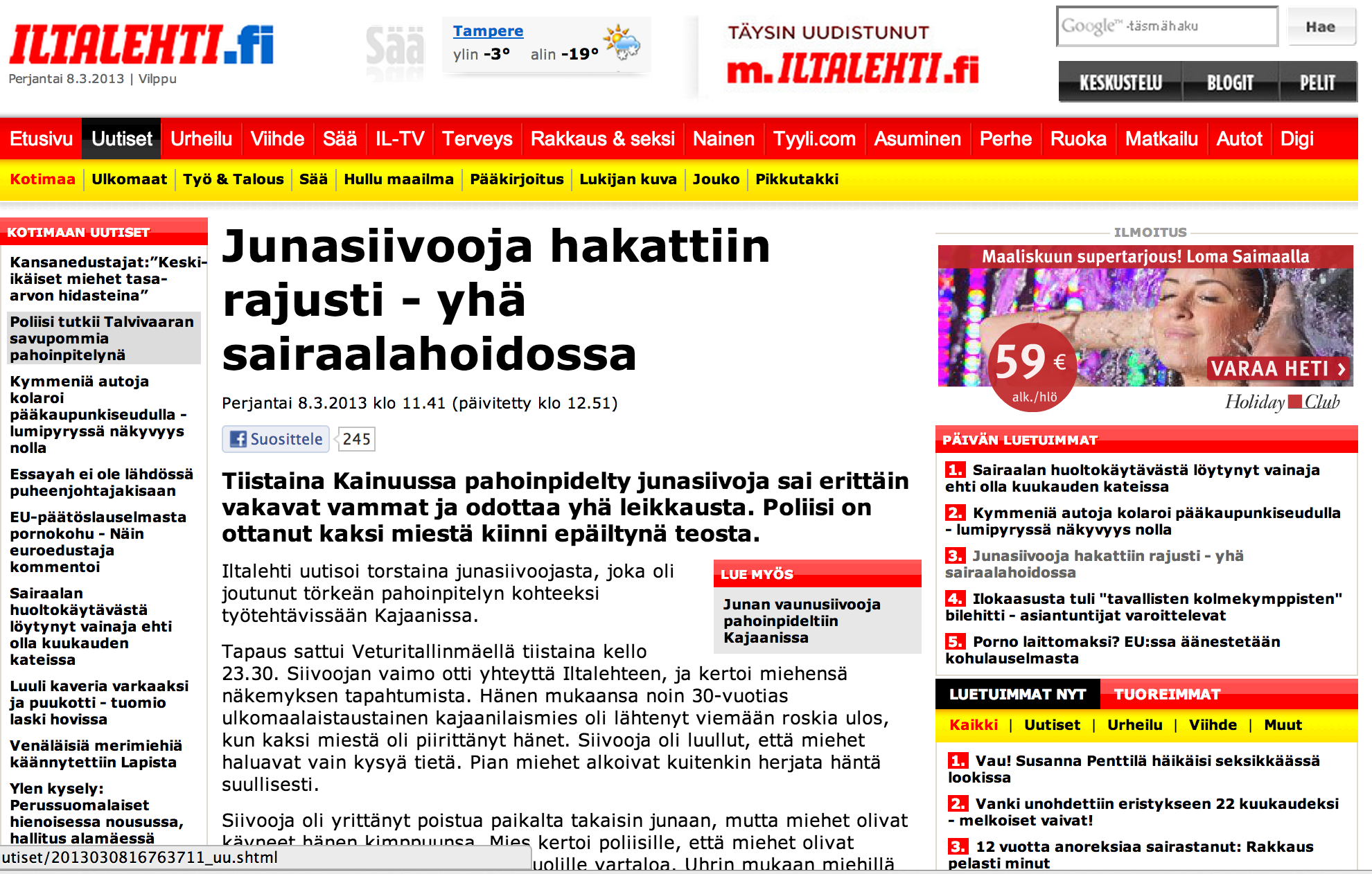
The police have apprehended the suspect who violently attacked on Tuesday a black train cleaner working for state railways, VR, reports Kainuun Sanomat. The suspect, who is a foreigner, admitted to the police of attacking the VR worker, who has returned home after being operated twice in hospital.
Just because a person is a foreigner doesn’t mean he cannot commit a hate crime. See what is happening in countries like Hungary, Slovakia and Greece, where racism and xenophobia have scapegoated visible immigrants, the Roma and Jews.
Moreover, the mere thought that people act like “cultural zombies” reveals your ignorance and prejudices, which are kept alive thanks to generalizations made of other groups.
Is the police treating what happened in Kajani as a hate crime? We still don’t know but they should if the victim was attacked because of his ethnic background.
Some Finns, who clump all foreigners in one group, believe that immigrants cannot house racist thoughts about other groups. This assertion could not be further from the truth. The same type of intolerance we find in some sectors of white Finnish society can be uncovered among some foreigners, who see themselves as white but may loathe blacks.
Our message to these people should be the same: racism, prejudice and intolerance are unacceptable in our society. Cross the line and you will have to deal with the law.
When we address a social ill like intolerance, the message must go to everyone in our society. Our aim must be zero tolerance.
Imagine if the Internet existed when Christopher Columbus landed on Hispaniola in 1492 and we’d read about what ensued. Would our selective memory get the best of us and keep us in the dark for centuries about the systematic extermination of the Amerindians? Even if Bartolemé de las Casas (1484-1566), a historian and Dominican friar, wrote about these atrocities , we still teach children at our schools about a “great man” called Columbus.
The most harrowing fact about the conquest of the Americas by Europeans is that nobody was sentenced for the genocide and mass destruction that took place there. All the spoils went to the victors.
Surprisingly some anti-immigration groups oddly compare the colonization of the Americas by Europeans to immigrants moving to Europe. This is wrong because immigrants bring a service and economic growth to a country instead of pillage and destroy it. Anti-immigration groups, who use this argument, have been watching too many Hollywood Westerns.
Bartolomé de las Casas’ Brief account of the destruction of the Indies (Brevísima relación de la destruición de las Indias) was published in 1542.
Why is Columbus pictured as a hero when he brought so much destruction on Native Americans? Columbus proves that we can live with our collective heads stuck deeply in the ground for centuries.
When we read the history of the Americas, it’s usually from the white man’s perspective. Women, like Amerindians, don’t have much of a role or say in the history of that region.
Conversely, some may ask why the European media doesn’t bother to report enough about the prejudice, racism and plight of minorities in Europe. The Romany minority as a good example. The answer is simple: Our media is not controlled by minorities.
If a major Finnish daily writes about family reunification of refugees, for example, it will rarely write about the human tragedy that our tightened laws have caused on people who must live separated from their loved ones for years.
Even if De las Casas did a service by documenting the barbarity that he saw in the New World, he wasn’t against abolishing slavery.
Our reaction to intolerance, thanks to the Internet, must be faster today. We cannot wait for centuries to correct an injustice. As we challenge social ills more effectively, we reduce the likelihood of future wars and conflicts, which definitely have their roots in the fifteenth century, when Europeans started to colonize and pillage the New World.
What happened to Amerindians in the Americas is an example of the destruction that blind racism and greed can foster. Even if we don’t go around burning people at the steak as happened during de la Casas’ time, the white man has devised ingenious ways to destroy the self-esteem of minorities.
Malcolm X said it eloquently in the following quote: “Racism is like a Cadillac, they bring out a new model every year.”
The Indies were discovered in the year one thousand four hundred and ninety-two. Forty nine years have passed since the first settlers penetrated the land. The first, being the large and most happy isle called Hispaniola, perhaps the most densely populated place in the world.
There must be close to two hundred leagues of land on this island. And all the land so far discovered is a bee hive of people; it is though God crowded into these lands the great majority of mankind. And of all the infinite universe of humanity, these people are the most guideless, most devoid of wickedness and duplicity, the most obedient and faithful to their native masters, the Spanish Christians they serve. And because they are so weak and complacent, they are less able to endure heavy labor and soon die of no matter what malady, yet into this sheepfold, in to this land of meek outcasts, there came some Spaniards who immediately behaved like ravening wild beasts, wolves, tigers or lions that have been starved for many days, killing, terrorizing, afflicting, torturing and destroying the native peoples.
Doing all this with the strangest and most varied methods of cruelty never seen or heard of before, and to such a degree that this island of Hispaniola of once so populace, having a population I estimated to be more than three million, has now a population of barely 200 persons. Their reasons for killing and destroying such an infinite number of souls is that Christians have an ultimate aim is to acquire gold and to swell themselves with riches in a very brief time disproportionate to their merits.
It should be kept in mind that their insatiable greed and ambition, the greatest ever seen in the world, is the cause of their villainess. And also, those lands are rich and so felicitous that the native peoples, so meek and patient, so easy to subject, that all Spanish have no more consideration for them than beasts. No, for thank be to god, they have treated beasts with more respect; I should say instead like excrement on the public squares.
The Indian began to seek ways to throw the Christians out of their lands. They took up arms, but their weapons were very weak and little service in offence and still less in defense . The Christians with their horses and swords and pikes began to carry out massacres and strange cruelties against them. They attacked the towns and spared neither the children nor the aged nor the pregnant women nor women in childbed, not only stabbing them and dismembering them, but cutting them to pieces as if dealing with sheep in a slaughterhouse. They made some low wide gallows on which they hanged victims’ feet almost touched the ground, stringing their victims in lots of 13, in memory of our redeemer and twelve apostles, then set burning wood at their feet and thus burn them alive.
When tied to the stake, the cacique Hathaway, a very important noble, was told by a Franciscan friar about the god of the Christians and the articles of faith, and he was told what he could do in the brief time that remained to him in order to be saved and go to heaven.
The cacique Hatuey, who had never heard any of this before, was told he would go to inferno where if he not adopt the Christian faith, he would suffer eternal torment. Asked the Christian friar, if Christians all went to heaven, when told that they did, he said he would prefer to go to hell.*
Source: Bartolemé de la Casa´s Breif account of the devastation of the Indies (1542).
Just like over a year ago, during Black February, when three Muslims died under violent circumstances in a span of about three weeks, Migrant Tales learned of a new tragedy in the city of Kaajani. A black man, who is a train cleaner for the state railways company VR, was violently attacked by two men on Tuesday, according to Iltalehti and Kainuun Sanomat.
Irrespective of who are the suspects, these types of crimes are simply unacceptable in our country and should not only be condemned by law but by society as well.
It is incredible that such violence can still happen in our country due to a person’s ethnic background.
If we must search for the real culprit of this crime, it is the ever-growing intolerance we find Finland. This adverse climate for immigrants and visible minorities has been forged not only by the present economic situation, but by our lame stance against racism, social exclusion and prejudice.
One must look at the big picture when looking at cultural diversity and tolerance. What does it say about the state of our society when Perussuomalaiset (PS)-spirited associations like Suomalaisuuden liitto, Vapaa kielivalinta associaiton, and the youth wing of the PS and National Coalition Party spearhead a petition to do away with mandatory Swedish?
It sadly reveals that some prominent groups in our society are ready to sacrifice other people’s civil rights to satisfy their hunger for greater intolerance. If these organizations ever got their way concerning the role of the Swedish language in Finland, they would continue to search for new “enemies” because their reason for being hinges on creating and attacking scapegoats.
Moreover, undermining diversity enables populist parties who loathe civil rights for their “enemies,” to drive home their political ideology more effectively. If I were a dictator, the first matter I’d eliminate is the opposition, or diversity. Adolf Hitler did this effectively with the Jews and other enemies of the state. At the end of the day, there was no opposition.
What has happened before can happen again in Europe. The fact that Finland has few minorities and immigrants explains why intolerance is not only accepted but encouraged by some circles. It explains why a party like the PS rose from semi-obscurity to become Finland’s third-biggest party in parliament in 2011.
It is surprising that the National Coalition Party’s youth wing has gone to bed with far right associations like the Suomalaisuuden liitto on the language issue. Even so, it is an excellent example of the traditional party’s mixed view of intolerance in Finland. Thanks to their unclear stand on the issue, they have permitted anti-immigration parties like the PS to grow into major political players in this country.
We at Migrant Tales hope that the perpetrators are brought swiftly to justice and the victim a swift recovery. This may be better said than done because the injuries of the victim are apparently so serious that he can never return to work at VR.
A black train cleaner working for VR, the state-owned railways company, was violently attacked on Tuesday by two men in the city of Kajaani, located in the region of Kainuu, according to Iltalehti. The wounds the attackers inflicted on the man are so serious that he will be operated.
Iltalehti repors that the wife of the victim told the tabloid that her husband was attacked on Tuesday at 11:30pm. According to her, her thirty-year-old husband took the trash out when two men surrounded him. The black man thought that the two men were asking for directions but that is when they started to insult him in a racist manner.
Two Finnish suspects were detained by the police but released. The police is now looking for two foreigners.
Migrant Tales will report more on what happened when it gets more information from its own sources.
On a recent Migrant Tales blog entry we wrote about racist harassment and bullying at schools. For some parents, the problem is so serious at some schools that the only solution is to move to another city like Helsinki, where there are more visible minorities and immigrants.
Why are we still in the anti-racism farm league if we have to tools, resources and competence to do much better?
The answer may not please everyone: Our prejudices are one factor holding back our full potential to challenge a social ill like racism. This is understandable considering that racism doesn’t affect us directly since we are white.
In many respects, our attitude towards intolerance is like our view of alcohol in our society. Alcohol is bad but we accept and even tolerate the social problems it brings with it.
Why should we be worried about racism and prejudice?
Because these social ills are contradictions that question the very values that our successful society is based on. Why do we want to return to a period when people in Finland were treated with scorn thirty to fifty years ago due to their social class? Those people who are treated in such a way are immigrants and visible minorities.
We must do better in Finland when it comes to challenging intolerance especially at our schools, which should be places where inclusion, acceptance and respect are promoted, not discouraged.
A high school physical education teacher back in Hollywood, California, told us a long time ago that when we compete we must strive for first place. If we aim for second or third place, we’ll most likely come in fourth or fifth, according to him. “Go for first place because most likely you’ll end up in second or third place,” he said.
Our approach to intolerance and racism should be the same: We should not only strive to neutralize it, but nip it in the bud. Let’s go for gold when challenging intolerance.
If we don’t aim for zero tolerance, we permit intolerance to live another day at our schools and in our society.
Let’s launch a campaign with the following slogans at our schools: Say no to racist harassment and bullying.
Diversity has sometimes been considered as an abstract principle, divorced from macro-economic trends and global realities. Research by Quamrul Ashraf and Oded Galor of Brown University, suggests otherwise. In a paper released by the National Bureau of Economic Research in 2011, Ashraf and Galor crystallize their findings on the interplay between cultural assimilation and cultural diffusion in relation to economic development. They theorize that pre-industrial societies in agricultural stages of development may have benefitted from geographical isolation, but the lack of cultural diversity had a negative impact on the adaption to a new technological paradigm and income per capita in the course of industrialization. This “Great Divergence” in the developmental paths of nations has occurred since the Industrial Revolution.
Ashraf and Galor indicate that cultural assimilation enhances the accumulation of society-specific human capital, reducing diversity through standardization of sociocultural traits. Cultural diffusion, by contrast, promotes greater cultural fluidity and flexibility that expands knowledge allowing greater adaption to new technological paradigms.
One of the prominent questions long debated by scholars is why China failed to industrialize at the time of the Industrial Revolution and suffered from “economic retardation,” a question raised by Joseph Chai in Chapter VI of his new book An Economic History of Modern China. In their paper, Ashraf and Galor outline the early benefits of China’s geographical isolation as the “Middle Kingdom” or the center of civilization as evidence of the benefits of cultural assimilation in the agricultural stage of development. They also refer to the state-imposed isolation throughout the Ming (1368-1644) and Ching eras (1644-1911) that caused China to remain impervious to external influences. Although Ashraf and Galor do not expand upon the further ramifications of their theory in this example, the absence of cultural diffusion was clearly a major factor in China’s late development in the sciences and technology.
What does all this mean for diversity practitioners in the United States today? Clearly, the important benefits of cultural diversity need to be understood in broader, global, and historic terms. As Alvin Evans and I argue in Bridging the Diversity Divide: Globalization and Reciprocal Empowerment in in Higher Education, globalization is a catalyst for diversity change, representing an urgent mandate that can no longer be ignored. With the erosion of barriers of time and place, rapid evolution of technological modes of communication, increasing diversity of the American population, rising demands from diverse consumers, and importance of talent as a differentiator in organizational performance, organizations now must focus upon creation of inclusive talent management practices. In our forthcoming book, The New Talent Frontier: Integrating HR and Diversity Strategy (Stylus, 2013), we examine this global imperative and the emergence of common themes in diversity transformation across all sectors including private corporations, not-for-profits, and institutions of higher education.
It’s time for diversity’s skeptics and naysayers to get over their hang-ups. The evidence is mounting that geographical openness and cultural diversity and tolerance are not by-products but key drivers of economic progress. . . . Indeed, one might even go so far as to suggest that they provide the motive force of intellectual, technological, and artistic evolution.
Darkness cannot drive out darkness; only light can do that. Hate cannot drive out hate; only love can do that.
Martin Luther King, Jr.
A guest speaker gave on Friday her recipe on how young adolescents from different countries living in Finland could build a space for themselves in society. Two matters struck me from the twenty-one-year-old young woman’s talk: The first and foremost matter is acceptance of oneself and to reach out — if possible — to those who loathe you.
The woman, whose father is a Black USAmerican and mother Finnish, kept the class mesmerized by these two key points.
She said that in Finland and the United States she was always seen as a foreigner. “In Finland people asked me where I was from and in the United States people thought I was from Finland,” she said. “One day it dawned on me that instead of looking for people’s acceptance, I had to first accept myself. It happened on a chat site when I read a comment by a black woman.”
Some may claim that being white in Finland is easier than being a visible minority. Since visible minorities cannot hide from the sometimes hostile stares of society, visible minorities can. Hiding, even denying, one’s identity can, however, have devastating impact on one’s self-esteem.
If one would want to write a shocking book about racism in Finland, all they’d have to do is find Russians who attended elementary and middle school during the 1990s. Apart from being ridiculed at school for having a Russian background by the classmates, this happened with the silent approval of the teachers.
Even if my mother is Finnish, I am happy that I did all my schooling in the United States from grade two. How much ridicule would I have had to take in the Finnish school system in the 1960s and 1970s? At least my otherness was acknowledged, even respected, in the United States.
In theory, the answer is straightforward: Finnish schools should respect cultural diversity but a lot depends on the school and the principle. If we compare how elementary and middle schools treated visible minority students in the 1990s, we hope that matters have improved since then. But have they?
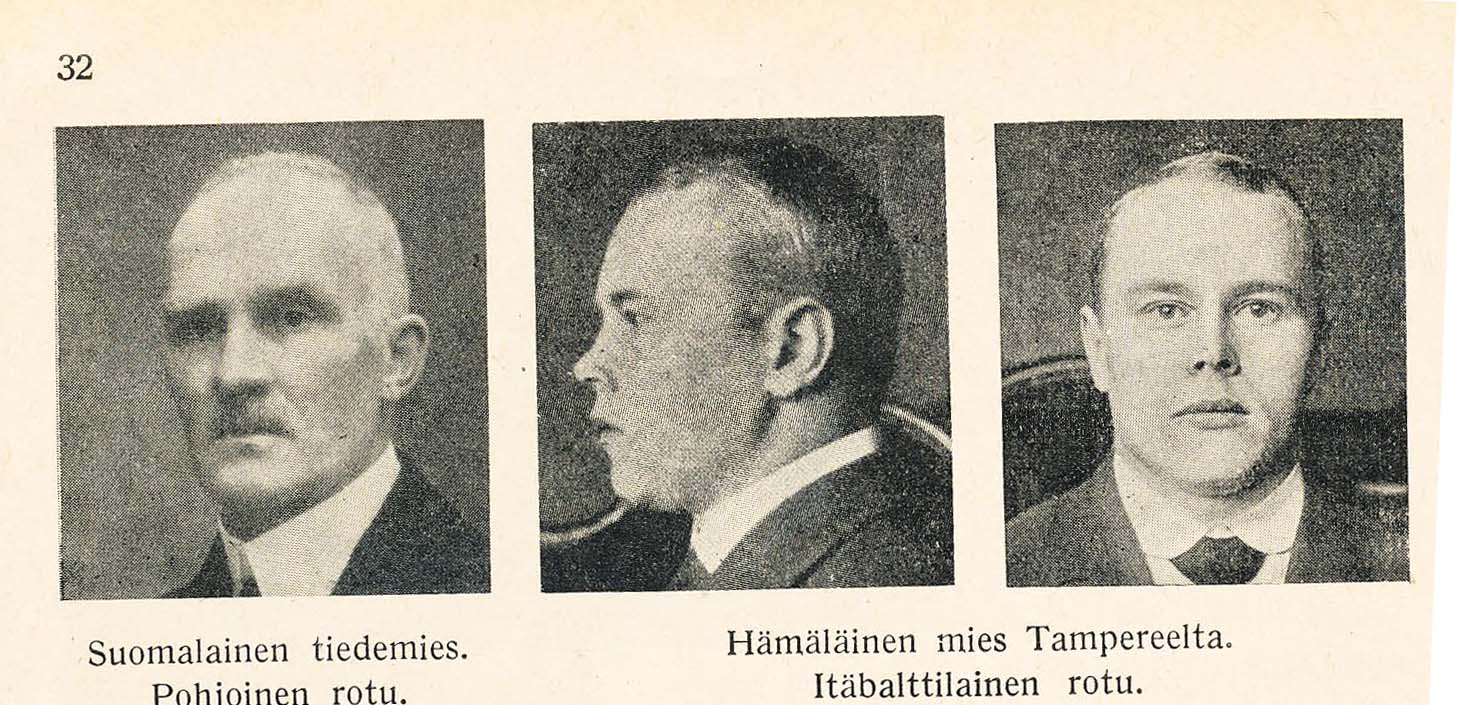
Cultural diversity in Finland up to the 1970s divided Finns in some history books into the “Nordic and Eastern Baltic races.” This picture was taken from an elementary school book published in 1941.
If our expectations are on the right path and we have the right values as a society to make cultural diversity work, what then is the challenge? The answer is the following: If we don’t have yet as a society a big picture of what immigrants and their children are doing here, it means that we are still walking blindly towards the future with a seeing-eye dog called Chance.
Migrant Tales has documented numerous cases of racist harassment and bullying at Finnish schools from people like Ida, Micha and Abdulah.
Abdulah was seven when he moved from Somalia to Finland in the early 1990s and attended elementary school for the first time in Hyvinkää, a city located near Helsinki.
“I’ve been bullied, called names like the n-word, insulted, kicked and hit hard at school,” he said. “The only way to survive was to be quiet and roll with the punches. There was nothing else I could do because the teachers never believed me. They were always on the side of the white students.”
Not only is the hostile behavior they received from their classmates at school shameful, but more worrying has been the silence of some of the teachers.
I know of one student who, like a gay person coming out of the closet, proudly accepted as a young adult her Russian background. According to her, she was bullied so much at school because of her background, that her former classmates still harass her at her hometown of North Karelia. She has a better weapon against this type of hostility: She is today proud of her Russian and Finnish heritage.
If somebody would like to expose the ogre of racism in this country, I am certain you’d find it in the tales of those immigrant children who attended Finnish school in the 1990s and even today.
It saddened me to hear that the mother of a black child from my hometown of Mikkeli, moved to Helsinki because of the racist bullying her child got at elementary school.
What did his classmates say? Every insult in the book to reinforce that he was different from his classmates and to destroy his self-esteem.
Part of the global fame that the Finnish educational system has enjoyed in recent years comes from the high scores achieved on the PISA exam, which focuses on young people’s ability to use their reading, mathematics and science skills. How would Finnish schools fare if they had to resolve and adapt to diversity at school?
Would their scores be as impressive if they had to resolve and adapt to cultural diversity at school?
The Finnish National Board of Education’s core curriculum for primary and pre-primary education is a reflection of our noble values as a Nordic state. The existing curriculum, which was published in 2004, states the following: “The values and aims of the curriculum hinge on human rights, social equality, democracy, biodiversity, maintaining environmental sustainability as well as the acceptance of multiculturalism.“
It is incredible but pupils who aren’t your typical white Finn, even though they were born or have lived most of their lives in this country, are called at schools students with immigrant backgrounds, or maahanmuuttajataustainen. The interesting question to ask is why this label, which in my opinion promotes social inequality, is used in the first place if many of these children are Finns with different ethnic backgrounds.
If Finland has the laws and the resources to build a successful culturally diverse society in this century, what are the challenges we face?
The biggest one are our prejudices and the tools we use to confront them.
How can we integrate people into our society if we are rejecting them with our prejudices?
Thus the laws and what happens on the ground at school reveal our expectations and reality concerning cultural diversity.
The fact that we still hear dear little about the racist bullying and harassment at Finnish schools reveals a wider problem we haven’t yet tackled as a society.