I’ve lived and worked in countries like Colombia and Argentina during the dirty war (1976-83), where people were and still are killed for what they write. Never would I have imagined that I’d receive my first death threats twenty years ago in this country, Finland. The threats and harassment haven’t stopped.
When I read about this serious problem affecting university researchers who study a social ill like racism and even journalists, I not only wonder how we have got here but how long it will take before something snaps.
Unions representing university researchers brought up the issue in mid-February, stating that threats to their members at the University of Eastern Finland have been on the rise. A new story on MTV3 today reveals the same problem on a much wider scale.
Another sad example was Jyväskylä, were a group of neo-Nazi thugs disrupted a book event on the far right in Finland.
It’s clear that those who harass and threaten people for what they do or write, have little respect for our democratic institutions. They are like lawless vigilantes full of bravado but turn to cowards when their identity is exposed.
Racism and hatred are sexy for some people. Some politicians fall in love with them because it brings them to the public light and feeds their low self-esteem, narcissism and bizarre ego trips. What they don’t know – or don’t want to know – is that racism and hatred know no master. It can bite back, and hard.
Anders Breivik is a good example. He’s the dog on the short leash that turned into a mass murderer. The smoking gun were the hate sites he visited and that fed his twisted world where, like in a fairy tale, you can rewrite history to suit your ignorance.
What is Perussuomalaiset (PS) leader Timo Soini going to do about the extremists in the PS like MP Jussi Halla-aho, James Hirvisaari, Olli Immonen, Juho Eerola and others?
Nothing because he can’t and because he has already let the ogre out of the cage. Living on an overdose of wishful thinking, the PS leader believes he has control over the violence that his party has sown but well understands that he is now a hostage.
That monster that lurks in our society spreading hatred is the same one that is threatening university researchers, journalists and writers that challenge it.
Like a cancer, we must isolate and neutralize it.
Or maybe we should continue covering our eyes and leave everything to chance.
Minulle se tarkoittaa paljon, koska siinä ei arvostella ihmisiä heidän taustan mukaan. Kaikki eivät tiedä tarpeeksi ihmisistä koska he ovat erilaisia. Tämä selittää miksi ennakkoluulot ovat olemassa.
Eri ihmisillä voi olla erilaiset tapoja. Vaikka he ovat erilaisia se ei tarkoita ettei he voisivat tulla toimeen keskenään. Kun puhun erilaisuudesta, tarkoitan maahanmuuttajia sekä vammaisia
Haluan kertoa omasta sairaudestani. Minulla on CP-vamma ja haluan, että minua kohdellaan tasavertaisesti riippumatta niitä esteitä mitä minulla voi olla.
Et tarvitse hävetä, ärsyyntyä tai inhoa minua koska olen mitä olen.
Perussuomalaiset (PS) MP James Hirvisaari, who was convicted for ethnic agitation in December, announced Saturday on Twitter that he was “pressured” to resign from the extremist Suomen Sisu association. He announced on Friday that he was resigning from Suomen Sisu because he was too old to belong to “a youth organization.”
Hirvisaari tweets, “The truth: I was pressured to resign from Suomen Sisu.”
In his usual far right tone, Hirvisaari wrote on his blog: ”[I didn’t resign] because there was something wrong with the association, but because it is a youth organization.”
And continues: “I thank Suomen Sisu’s smart young men and women for their inspiring, intelligent, peaceful and authentic love for the fatherland and for their company and great example.”
So what does this latest piece of news about Hirvisaari’s motive to resign from Suomen Sisu tell us? It reveals that there is a big struggle in the PS between the far right faction led by MP Jussi Halla-aho and the party’s chairman Timo Soini.
Hirvisaari now regrets resigning from Suomen Sisu.
Is this tweet by Hirvisaari an outright declaration of war against Soini?
As Finland awakens to the reality that it is a culturally diverse society, one of the biggest threats and challenges we face doesn’t come from abroad but from our backyard. When the Civil Rights Movement ended in the United States in 1968, the first matter that we learned we should stop doing is generalizing about blacks and other groups.
It’s sad to admit that some prejudices in Finland are so old that people believe them to be scientific fact. Prejudice is a powerful political force that was capitalized by the anti-immigration Perussuomalaiset party in the April 2011 election.
Finns are even prejudiced against themselves. Some believe that Hämäläinens in southern Finland are “slow” and that people from Savo in eastern Finland are “crooked.”
Racism has powerful roots in Finland. One could even see it on a Suomen Kuvalehti article published in 1940 that attempted to show how superior the Finnish white soldier was to blacks.
Blacks are no longer found on racist ads but other ethnic groups like Latinos. This picture was taken at the Pieksämäki train station in July 2007. The owners of the café no longer use this sign outside their premises.
Giving up one’s prejudices isn’t easy but not impossible.
We fortunately have great laws that are based on social equality (tasa-arvo) and respect. Our successful society would be nothing today without these laws. Instead of building bridges of acceptance, respect and tolerance, we’d be destroying those bridges with intolerance.
How, then, is it possible that such an exemplary society like ours could breed people with so much hatred and prejudice against other groups?
While there are many people who understand the importance of cultural diversity in this country, there are still too many who are reactive to it.
Despite the spirit of our present laws, they mean little and are robbed of their power if they are caged by prejudice, racism and above all by our silence.
Blaming our history on some of our intolerance is a too simple but it is one answer that sheds light on the present problem.
Few young people in Finland know that we used to be a very closed country only thirty years ago and our laws reflected this situation as well.
Foreigners were not only barred from investing in the country but the Aliens’ Office made everything possible to ensure you didn’t move here.
If is shameful that a country that saw over 1.2 million emigrate between 1860 and 1999, treated immigrants in Finland like stateless persons who didn’t even have the right to habeas corpus. Immigrants were seen at the time as a threat to national security.
Prior to our first Aliens’ Act of 1983, which came into force sixty-five years after independence, foreigners could be arrested at will by the police, held indefinitely in jail and deported without the right to appeal.
During the Great Depression, Finland enacted the Restricting Act of 1939 that kept foreigners and outside investment to a minimum. The act prohibited foreigners from owning real estate and acquiring a majority stake in Finnish companies – limiting this to 20% normally and 40% under special permission.
The act stipulated that foreigners could not own shares in sectors such as forestry, securities trading, transportation, mining, real estate and shipping.
To maintain this climate of suspicion against foreigners, the school played an important role in teaching young Finns myths in order to be prejudiced against other groups.
At schools, Finnish children were taught at an early age that “n” stands for the n-word.
Perussuomalaiset (PS) MP James Hirvisaari, who was convicted for ethnic agitation in December, announced on his blog that he has resigned from the extremist Suomen Sisu association. The whole announcement is fishy: Why is Hirvisaari resigning now? Does it make any difference? Who cares.
Hirvisaari’s blog is as eerie as his far right ideology and views of Muslims.
PS MP Juho Eerola, who is in the same far right ideological league as Hirvisaari, resigned in June from Suomen Sisu because he was aiming to become MP Jussi Halla-aho’s successor as chairman of the administration committee.
Halla-aho was forced to resign as chairman of the administration committee when the Supere Court convicted him in June for ethnic agitation and breaching the sanctity of religion.
In his usual far right tone, Hirvisaari writes: ”[I didn’t resign] because there was something wrong with the association, but because it is a youth organization.”
And continues: “I thank Suomen Sisu’s smart young men and women for their inspiring, intelligent, peaceful and authentic love for the fatherland and for their company and great example.”
A Finnish expert on the far right, who spoke to Migrant Tales on condition of anonymity, said that nobody can resign from the association because it’s like leaving the Mafia. Suomen Sisu is neither a registered association nor does it have an official list of members.
“Considering that someone can say out loud publicly that he is resigning from Suomen Sisu doesn’t mean anything at all if [the person’s] ideology remains unchanged,” said the expert on the far right. “Suomen Sisu is no longer an active organization because it has the Perussuomalaiset under its full control and they can do pretty much what they please [in that party].”
One area where Suomen Sisu wields a lot of power over the PS is in the party’s immigration policy.
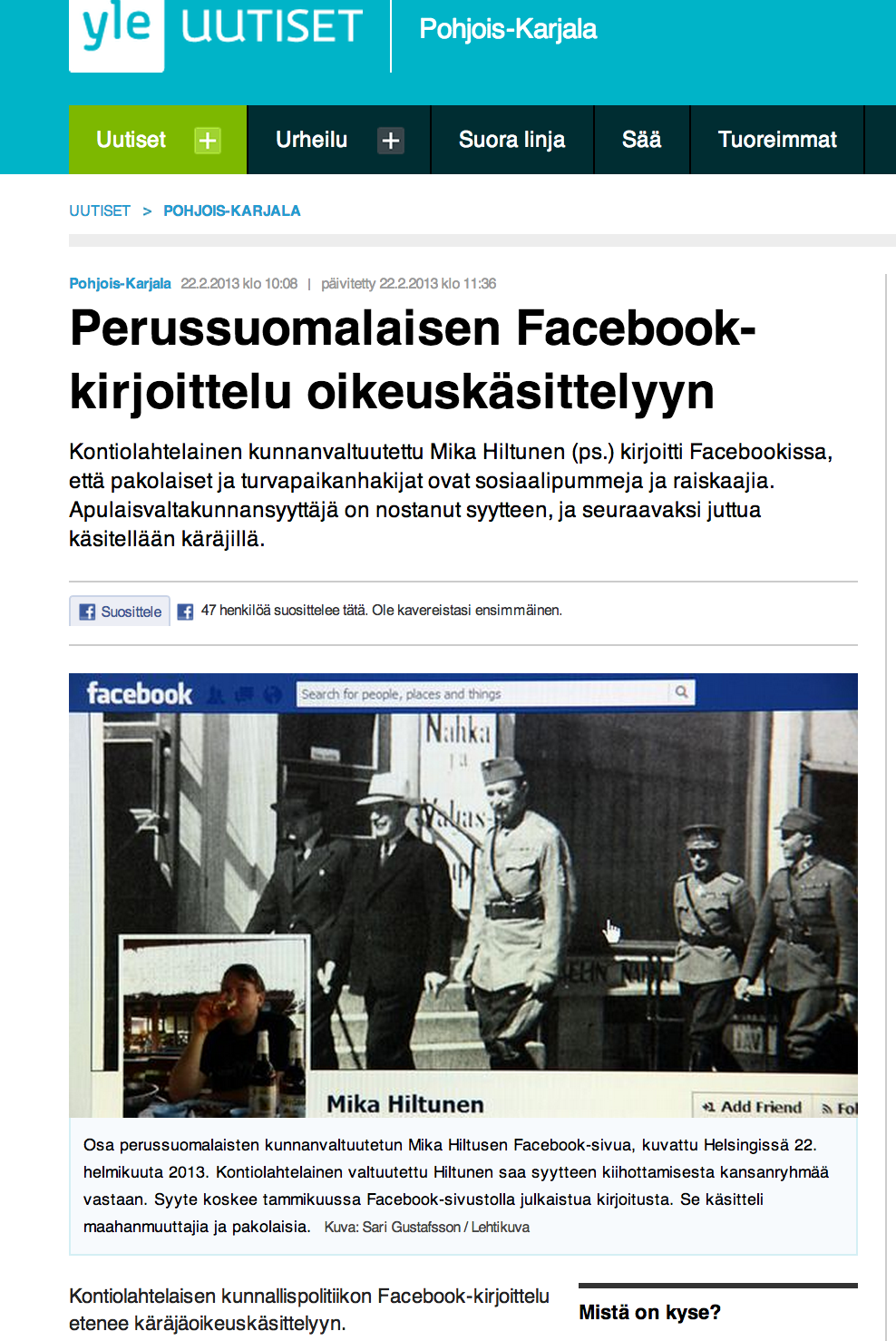
Charges of ethnic agitation will be brought by deputy state prosecutor Jorma Kalske against Kontiolahti councilman Mika Hiltunen, reports YLE. Hiltunen claimed on his Facebook page in January that refugees and asylum seekers “are social-welfare bums and rapists.”
JusticeDemon asks an interesting question about the case: “… this particular statute [Section 10 of chapter 11 of the Finnish Penal Code] has evidently become Lex Persu. Is it my imagination, or can we say that ALL convictions for this particular offense in the last 5 years have been more or less closely associated with this specific political faction?”‘
Another important question we can ask concerning Hiltunen is why doesn’t the PS sack the councilman? Remember the answer PS chairman Timo Soini gave on HARDtalk when he was asked about sacking MP Teuvo Hakkarainan for calling black people the n-word?
Soini’s answed: “Why should I?”
It’s pretty certain that Soini won’t sack Hiltunen.
Kuuntelin eilen työmatkalla tiistailta lataamaani Jari Sarasvuon radio-ohjelmaa, joka lähetetään Yle Puheen kautta. Sarasvuo on fantastinen radiossa jos hänen kuuntelemiselleen on varata aikaa häiriötön tunti. Taustakuunteluna se toiminee huonommin, sen verran paljon asiaa käsitellään yhden iltapäivätunnin aikana. Vaikka se ei varsinaisesti tämän viikon aihe ollutkaan, viittasi Sarasvuo muutamaan otteeseen viime viikonlopun Helsingin Sanomien juttuun, jossa esiteltiin tutkimusta, jonka keskeisenä kohteena oli orjakaupan vaikutus siitä kärsineisiin maihin. Ensimmäisellä kertaa Sarasvuo puhui ”valkoisen miehen syyllisyydestä”, jota hän oli tuntenut artikkelia lukiessaan ja toisella kertaa hän sanoi, että ”…nää afrikkalaisethan myi toinen toisiaan orjiksi…”, joka oli se hetki jolloin päätin, että laitan lauantai-iltana Hesarille kirjoittamani viestin aiheesta julkiseksi. En siksi, ettei Sarasvuon analyysi Hesarin jutusta ollut täsmälleen oikea vaan siksi, että se oli.
*****
Palaute artikkelista “Tutkija: Orjuus teki Afrikasta köyhän, ei siirtomaatalous”
Luin verkkopalvelustanne kirjoituksen ”Tutkija: Orjuus teki Afrikasta köyhän, ei siirtomaatalous” (16.2.2013) ja haluaisin kiinnittää huomiota sen puutteisiin. Tiedeartikkelissa, jota tässä on referoitu, ei puhuta siirtomaataloudesta millään merkittävällä tavalla ja mielestäni sen vetäminen mukaan teidän kirjoitukseenne on harhaanjohtavaa. Itse ihmettelen suuresti alkuperäisten kirjoittajien luottamusta heidän löytämänsä datan yksioikoisuudesta ja siitä, että historian muilla muuttujilla ei olisi ollut sen suurempaa merkitystä asioiden kanssa. Erityisesti näin, kun kyseessä olevien alueiden historia on ollut monien vastoinkäymisten ja usein myös hirmutekojen värittämä, mutta vaikka itse olenkin skeptinen heidän lopputulemiensa suhteen, ei minulla ole mitään sitä vastaan, että heidän tutkimustaan jaetaan laajemmalle suomalaiselle lukijakunnalle. En kuitenkaan koe, että jo artikkelin otsikossa mainittu siirtomaakauden vastuun minimointi edustaa sitä, mitä tutkijat ovat tutkineet ja mielestäni kirjoituksen sävy – joka on tietysti tulkinnanvarainen – johtaa siihen lopputulokseen, että siirtomaa-aika on nyt päästetty pannasta ja orjakauppiaitakin olivat pääasiassa afrikkalaiset itse. Sekään ei ole mielestäni alkuperäisen tiedeartikkelin hengessä ja on harmillista, että kaltaisenne merkittävä julkaisu lähtee asiaa näin harhaanjohtavasti kuvaamaan.
Terveisin, Mikko Kapanen
*****
En ole kuullut asiasta mitään viestin lähettämisen jälkeen; en oikein mitään odotakaan, mutta asia on kuitenkin mielestäni oleellinen erityisesti nykyisen kansalaiskeskustelun tason huomioon ottaen. Ymmärrän, että tutkimusta voi tulkita sen jälkeen kun se on julkaistu, mutta on aika harmillista, että näin spekulatiivisen tutkimuksen perusteella kirjoitetaan lehtijuttu, johon otetaan ulottuvuuksia, joita tutkimuksessa ei ole käsitelty ja sitten myydään sisältö näillä lisukkeillä. Myymisellä tarkoitan sitä verkossa tapahtuvaa klikkausta, jonka lehti itselleen haluaa ja otsikot ovat tässä tietysti keskeisessä osassa. Mielestäni siinä vapaalla tulkinnalla annetaan ammuksia niille, jotka jo valmiiksi mielellään vetoavat kovaan ääneen ties mihin etnisten eturyhmien pohdiskeluihin. Toisaalta, ihmisiähän me toimittajatkin vain olemme ja samalla tavalla, kun vaikka paperimiehet lähestymme maailmaa omien jo ennalta olemassa olevien ajatusmallien kautta.
Nykyään vaikuttaa muutenkin muodikkaalta tehdä muka-radikaaleja kannanottoja. Yhdysvalloissa tätä aikaa kutsutaan, pääsääntöisesti kai Obaman presidenttiyden johdosta, termillä ”post-racial”, mikä on tietenkin ihan täyttä höpöhöpöä, mutta vaikuttaa myös siltä, että osa suomalaisista kokee heidän itsensä elävän jonkinlaista rasismin jälkeistä tai yläpuolista aikaa. Enkä muuten puhu tässä Sarasvuosta – en ensinkään – mutta näyttää siltä, että monet kokevat itse tietävänsä, että eivät ole oman arvionsa mukaan rasisteja ja siksi heillä on oikeus sanoa asioita melko huolimattomasti ja provosoivasti. Saatan olla väärässä, mutta intuitiivisesti itse yhdistän tämän Hesarin jutun tähän ilmiöön.
Siirtomaa-aika oli millä tahansa mittarilla katsottuna melkoista rosvousta. Sen tuntuu moni hahmottavan, mutta kyllä Franz Fanon -vainaalla olisi Suomessakin sarkaa näiden kokemusten psykologisten vaikutusten selittämisessä. Alueet, joista tutkimuksessa puhutaan, ovat käyneet läpi paljon myös orjakauppa-ajan jälkeen, ja vaikka tutkimus osoittaa korrelaatioita, jää se hataraksi lopullisen syy- ja seuraussuhteen todistamisessa. Varmaa on kuitenkin se, ettei tutkimus siirtomaa-ajasta kerro. Voit tarkastaa asian jos et usko minua.
Lopuksi vielä Al Jazeeran dokumenttiohjelma siirtomaa-ajan ja kylmän sodan vaikutuksista Afrikan mantereellla. Se on mielenkiintoinen kokonaisuus vaikka unohtaakin Arabi-maailman osuuden Afrikan historiassa. Jostainhan se Islamkin on maanosaan tullut, mutta se on aiheena toinen.
Perussuomalaiset (PS) chairman, Timo Soini, claimed on BBC’s HARDtalk that his party doesn’t have a strand of racism because there were only “one or two [racist] outbursts” in the past. Only one or two?! Try a long and disgraceful list of racist outbursts, criminal convictions and shameful denials Mr. Soini.
The HARDtalk interview with Stephen Sackur doesn’t leave us without doubt: Soini and the PS are a breeding ground for intolerance and racism.
The PS chairman has made similar denials in the past: In December 2011 he said there are only “one, two or three” racists in the party. In April 2011, he claimed to journalists with a poker face there were no racists in the PS.
How can Soini claim the above and get away with it in Finland? For how long can he continue to play the good-cop role of the PS?
The rise of the PS doesn’t say anything pretty about ourselves as a society. Some factors that helped the PS to become one of Finland’s largest parties were the complacency of other political parties and of ours as well to the anti-EU, anti-immigration and anti-Islam party as a social phenomenon.
Another reason why Soini can get away with his ludicrous claims and denials is because most of us don’t want to believe them. How can a small and noble country that defended itself against the former Soviet Union in the Winter War, house so much prejudice, racism and hatred to become a political force?
Here’s a sobering fact: If we don’t challenge the cancer of intolerance presently taking root in Finland, it will end up consuming us. Remaining silent about this social ill is giving it the green light to continue spreading in our society.
The HARDtalk interview reinforced what Migrant Tales has been saying all along: Intolerance in general, our approval of prejudice and of the PS in particular, are poisoning Finland.
Finally Perussuomalaiset (PS) chairman, Timo Soini, has met his match Wednesday on the BBC’s HARDtalk. The Finnish media should take notes on how BBC journalist Stephen Sackur doesn’t let Soini off the hook when it comes to racism. In a short part of the interview, Saucker reveals Soini and the PS for what they are: a sham and a party that treats racism with kid gloves.
The last time that Soini got thrown a good question was not by Finnish journalists but by high school students in Järvenpää during the presidential election.
My favorite question by Sackur to Soini: “Is there a strand of racism inside your party?”
Soini: “No. I’m a Catholic Christian by definition, I cannot be a racist.”
Sackur: “I’m not sure that would convince everyone listening to this interview. Is there a strand of racism inside your party?”
Soini: “No I don’t hate anybody, nobody is hated by the Finns Party…Of course there are one or two outbursts but we have 19% out of people voting for us…If there are some individuals or even some MPs you cannot personally be in charge.”
Sackur: “You’re a leader. That’s your job. ”
Soini: “That is my job I’m not a kindergarten [teacher]…”
Sackur: “You have 39 MPs and you are saying it’s simply impossible to ensure that none come up with a racist statement?”
And a little later on Saucker brings up PS MP Teuvo Hakkarainen and his use of the n-word in Finland which is “completely unacceptable and racist.”
Soini: “I said [to Hakkarainen] don’t use that kind of [racist] language.”
Sackur: “Why didn’t you fire him?”
Soini: “Why should I?”
Saucker: “Because if people use that sort of completely derogatory word towards people of a different race it suggests that they are racist.”
Soini: “Yes, but he hasn’t said he’s a racist and I don’t believe he is a racist.”
Sackur: “So if you use that kind of language, inflammatory language, then deny you’re a racist, that’s ok.”
Soini: “That’s not ok . You should be improving in your behavior.”
Perussuomalaiset (PS) chairman, Timo Soini, said on BBC’s HARDTalk that the five-year ordeal that lead to a Supreme Court ruling against PS MP Jussi Halla-aho for inciting ethnic hatred was enough punishment, according to YLE. Soini had promised previously to sack any member of the party if they were sentenced by a court for hate speech.
“He’s been in purgatory for five years,” Soini said of Halla-aho. “In my opinion it’s hard-enough punishment.”
Certainly Soini doesn’t want to get rid of Halla-aho because that would be costly for the party. Since the PS MP was voted to parliament thanks to hate speech, he can now move to phase two: put into action his plans, which include spreading suspicion and making life as difficult as possible for immigrants in Finland.
The BBC asked if Soini believed he had passed the peak of his popularity.
”Everything is possible,” he said. “I’ve been in parliament for ten years. In that respect, I’m a pretty tough guy because I do what I believe in.”
According to YLE, Soini was asked about the Slovak National Party, which belongs, like the PS, to the xenophobic and right-wing populist Europe of Freedom & Democracy group in the European Parliament. It’s leader, Jan Slota, stated that “The Hungarians are a cancer in the body of the Slovak nation” and that the only homosexual he’d accept is one in the closet.
In Soini’s usual style, he didn’t answer the question. He said that when the party won the election in 2011, the Swedish media had called the PS leader “the plague.”
“How does that stand for Swedish values?” he said.
The HARDTalk show can only be viewed in the U.K.
On the BBC website, it introduces Soini in the following manner: writes: “Europe’s prolonged economic crisis has prompted a populist backlash against the powers that be. In Finland, the EU’s prosperous northern outpost, the big beneficiary has been Timo Soini, leader of the Eurosceptic, nationalist party long known as the True Finns. He wants to see the Eurozone dismantled, immigration curbed, traditional values restored. Critics have labelled the party xenophobic – is this the angry politics of European disintegration?”
Here’s another interview that Soini gave to CNBC on Finland’s membership in the European Union.