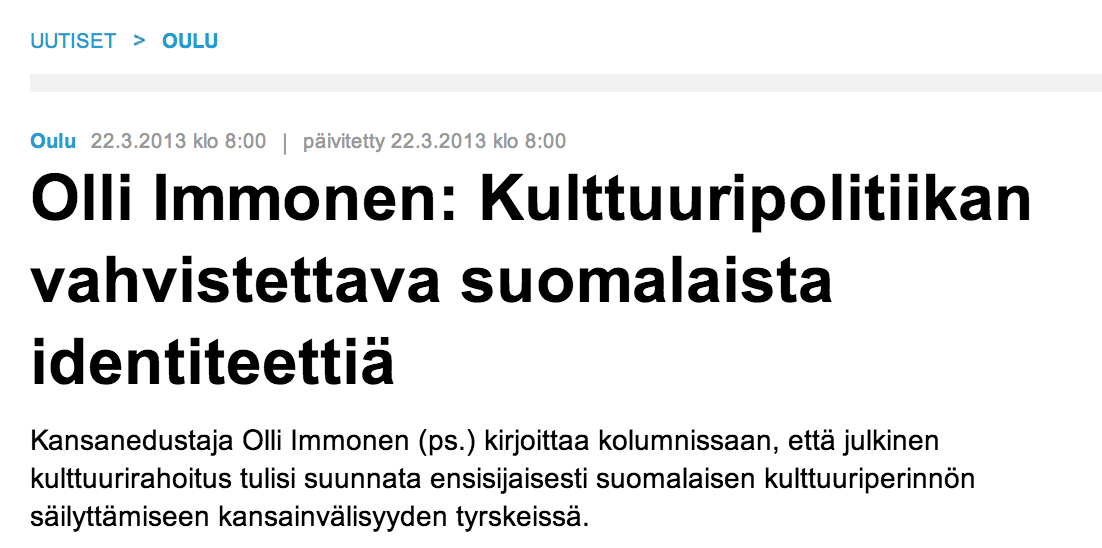
Finnish Broadcasting Company (YLE) appears to have published ad verbum an opinion piece by the new Suomen Sisu president, Olli Immonen, as “news.” Nowhere in the story does it tell readers that this is an opinion piece written by the Perussuomalaiset (PS) MP but presents it instead as a news story, which it is not.
If this is the case, one may ask what kind of journalism and journalists are working for YLE in Oulu. Any self-respecting journalist does not regurgitate news ad verbum.
For some odd reason Suomen Sisu, an extremist anti-immigration association, got free ad space on YLE. Read original story (in Finnish) here.
Suomen Sisu has been called a lot of things in the past, from Nazi-spirited to extremist by the Finnish Security Intelligence Service (Supo). The group still lives in the murky world of eugenics, a disgraced pseudo-science whose aim was to create a master white race by wiping out other ones.
Suomen Sisu openly supports “racial hygiene” and discourages white Finns from marrying foreigners.
Migrant Tales understands that employees of banks like Nordea, Osuuspankki and Handelsbanken in Kouvola and Mikkeli tell Somalis that they must be Finnish citizens in order to have access to online banking. A blog entry published in March 2012 highlighted the difficulties that stateless persons face in opening a bank account never mind gaining access to online banking.
Migrant Tales reported a year ago that a Nordea bank employee in Mikkeli told a stateless passport holder that he would need a valid passport to open an account.
Banks refuse to serve stateless passport holders because the person’s former identity cannot be confirmed on the document.
If one asks ten African immigrants if they have online banking or not, some will tell you that they have while others don’t, even if they are all stateless passport holders. This suggests that banks treat stateless persons and/or some Africans arbitrarily.
According to a stateless passport holder, some branch offices will give you online banking servies, while other’s won’t. Some banks require a passport and others a driver’s license to open a bank account.
“We went to the Osuuspankki branch office in Kouvola and inquired about online banking,” said a Somali-born immigrant. “The bank employee told me that I need to be a Finnish citizen before I can have online banking services. I should inquire to the police about this, the employee said.”
JusticeDemon said a year ago that there is a clear administrative problem over what counts as proof of identity and over the implementation of the 1954 Convention relating to the Status of Stateless Persons (Accession by Finland on 10 October 1968).
One point of that Convention is Article 27 (Identity papers), which states, “The Contracting States shall issue identity papers to any stateless person in their territory who does not possess a valid travel document.”
According to the Ombudsman for Minorities contacted last year by Migrant Tales, an identity card issued by the police should count as valid identification just like a passport.
The National Discrimination Tribunal of Finland (Syrjintälautakunta) gave Nordea Bank Finland a conditional fine of 5,000 euros for not accepting a French identity card as proof of identity, the Tribunal said in a statement. Moreover, the Tribunal considered the bank’s refusal to serve the client and his removal from the premises as an infringement on his dignity and integrity.
Ei tarvitse mennä kauas todetakseen, että tulevaisuus on jo laskenut Etelä-Savossa: Sulkavan kunnassa 31,1 prosenttia väestöstä on eläkeläisiä ja vastaavat luvut Heinävedellä ja Puumalassa kiipeävät 30 prosenttiin. Mikkelissä asiat ovat hieman paremmin (20,3 prosenttia), mutta huonommat jos vertailemme koko maata (18,1 prosenttia).
Etelä-Savo ei ole pelkästään nähnyt sen väestön ikääntymistä nopealla vauhdilla, väestökato on ollut toinen vitsaus. Vuonna 1980 eteläsavolaisia oli 174?619, mutta 2011 se oli laskenut 153?738:aan.Eri ennusteet povaavat sama menoa: vuonna 2020 väestömäärä laskee 146?042:een, ja vuonna 2030 määrän arvioidaan laskevan jo lukuun 141?059.
Lähteenä lukuihin on Etelä-Savon maakuntaliitto.
On ihmeellistä, että jotkut mikkeliläiset kunnallispoliitikot uskovat yhä, ettemme tarvitse osaavaa työvoimaa muualta kuin Suomesta.Näyttää siltä että näille politiikoille ainoa vastaus nykymenoon on jättää tulevaisuutemme Etelä-Savossa sattuman varaan ja populismiin.
Mitä merkitsee Etelä-Savon maakunnalle väestökato ja vanheneminen? Vastaus on yksinkertainen: alikehitystä ja itsenäisen päätöksenteon menettämistä isompaan kasvukeskukseen. Tämä kehitys on jo alkanut maakunnassamme.
Tarvitsemme enemmän kun koskaan johtajuutta ja isoa kuvaa siitä, miten ratkaisemme väestöllisiä ja taloudellisia haasteita. Yksi menestyksen pilari lepää osaavan työvoiman saamisessa Suomesta ja ulkomailta maakuntaan sekä moninaisuuden hyväksyminen.
Kansainvälisyys ja maahanmuutto ovat vanha ja tehokas keino korjata väestökadon puutteet. Tätä on käytetty ennen, nyt ja käytetään tulevaisuudessakin.
Samalla tavalla kuin maat houkuttelevat yrityksiä, jotka luovat uusia työpaikkoja, sama asia koskee osaavaa työvoimaa ulkomailta.
Isänmaallisuus merkitsee asennetta, jossa toimitaan maan parhaiksi. Etelä-Savon parhain intressin puolustaminen on taata sen väestöllinen ja taloudellinen hyvinvointi niin tänään kun tulevaisuudessakin. Ilman ulkomaalaista työvoimaa tämä ei onnistu.
Maakunta jota me kannustamme, ei ole pelkästään kansainvälinen ja moninainen, se on samalla ylpeä omista eteläsavolaisista juurista eilen, tänään ja tulevaisuudessakin.
Enrique Tessieri
Veysi Zengil
Hamid H. Alsammarraee
Mustafa Mohamed Ahmed
Kansainvälinen Mikkeli ry
Comment: This story appeared on Suomen Kuvalehti’s website shortly after the US-led coalition invaded Iraq in March 2003. All you needed back then was common sense to understand that the invasion of Iraq was a huge and costly lie.
The column reposted in June 2007, shortly after the birth of Migrant Tales in May of that year.
________
As U.S.-led coalition military forces continue to pound Iraqi army positions and the war claims its share of mounting civilian casualties, one matter appears certain: U.S. and U.K. forces are not being greeted by the population as liberators.
Whatever the reasons may be for stiffer Iraqi resistance, it is incredible that Washington has overlooked one very elementary fact: People are nationalistic and don’t like to be invaded by foreign armies.
Loyalty and love of one’s country are the first facts children learn at school no matter how poor or rich their country is. The United States is no exception.
When I was thirteen years old and studying at a Catholic school in California, the history teacher spoke often about how “evil” the former Soviet Union was and how “right” our system of government is.
“People in the (former) Soviet Union live in a prison,” the U.S. history teacher said. “If you open the doors of Russia, millions of people will flee to freedom.”
Having lived in a number of countries, I openly disagreed with the teacher. I tried to use logic: “If the Russians have never traveled anywhere in their lives, surely they consider their country the best in the world,” I said.
A silence descended over the classroom and I felt naively that I had made my point. The teacher looked at me, and then snapped: “What are you – a communist! If you don’t like America go live in Russia!”
Coup vs. régime change
As time moves on so do geopolitical perceptions. One of these is the George W. Bush doctrine’s view of how governments are changed. The new term is “régime change,” which has sidelined a fancier French word used before known as coup d’etat.
Latin America was a region where coups – oops! régime change — occurred on a grand scale. If experience of how the U.S. influenced Latin America in the last century is anything to go by, the people of the Middle East are in big trouble.
In the 1970s, some Latin Americans accused Washington of double standards. Why did the U.S. support despotic and brutal military régimes south of its border if it is a model of a western democracy?
The list of tyrants that ruled Latin America is a long and tragic one. Few will question the CIA’s role in regime change during the cold-war era. Its director during 1976-77 was none other than former President George Bush Sr.
We were told back then by Washington that the justification for régime change and military juntas was to defend Latin Americans from communist tyranny. Even so, any serious student of the region understands that Washington’s main goal was to defend its national security interests.
Will U.S. national security prevail in the Middle East as the driving force of President Bush’s administration as new geopolitical maps are redrawn of the troubled region? There is nothing to suggest the contrary, considering Bush’s obstinacy for a military solution for disarming Iraq and the present administration’s suspicion of the UN.
The scars left by ruthless dictators have traumatized Latin Americans for generations, like the Iraqis, who will not only be haunted by a past tyrant — but by a terrible war waged by the U.S. in the name of a questionable invasion.
Intolerance doesn’t only originate from the majority group, but is alive and kicking among some immigrants as well. White immigrants may have prejudices against their fellow black ones, gays against heterosexuals, religion x against religion y. In sum, there’s a lot of intolerance promoted out there that reveals itself in the most surprising places.
One of the pillars of our integration program in Finland should be to teach immigrants how to live in a culturally diverse society and the importance of mutual acceptance and respect for others. This may be easier said than done, taking into account that immigration and cultural diversity are new to some Finns.
Here’s the crux of the problem: If we don’t practice what we teach we encourage at the end of the day newcomers to hold the same negative values as us. Don’t we make a mockery of our own values like social equality (tasa-arvo) if we don’t practice what we preach?
Some immigrants have adapted so well to our society that they even parrot the language and jokes of those that loathe them.
I was quite surprised to hear an immigrant make a joke about another immigrant.
Here’s what he said: There was a bomb explosion at a white Finns’ and immigrants’ home. Why didn’t the Finns die?
Answer: Because the Finns were at work and their children at school. The immigrants were all at home because neither their parents were employed nor did their children attend school.
What?!
A black unemployed immigrant telling such a tasteless “joke” about other immigrants in Finland?
As far as our integration program is concerned, it got a big “FAIL” with this person.
The National Discrimination Tribunal of Finland (Syrjintälautakunta) has given Nordea Bank Finland a conditional fine of 5,000 euros for not accepting a French identity card as proof of identity, the Tribunal said in a statement. Moreover, the Tribunal considered the bank’s refusal to serve the client and his removal from the premises as an infringement on his dignity and integrity.
Writes JusticeDemon: “A conditional fine is similar to a suspended prison sentence. Just as the felon must report to the parole office and stay out of trouble, a party that has been fined in this way must report back to the authority on its further conduct.”
“The Tribunal considered that no official instructions or the Bank’s own instructions prevented the Bank from accepting the petitioner’s French identity card as proof of identity. Because the petitioner’s French identity card is accepted as a travel document across the European Union, its reliability is comparable to an identity card issued by Finnish authorities when establishing a person’s identity,” according to the statement.
Foreigners who are stateless have had an especially hard time in opening bank accounts in Finland because it says on their passport that the person’s identity cannot be verified, Migrant Tales reported in March 2011.
Even so, some banks have given stateless persons a bank account but without the right to online banking. Other banks require a valid driver’s license, while other ones don’t accepted it as valid identification.
The National Discrimination Tribunal is an impartial and independent judicial body established under the Non-Discrimination Act and appointed by the Government.
What does the U.K. do differently from us in Finland when it comes to racism? They take a social ill like racism more seriously than us. Few if any sensible politicians, except from xenophobic parties like the BNP or UKIP, deny that racism isn’t an issue in the country or that this is caused by immigrants.
Despite the rise of an anti-EU and anti-immigration party in 2011 in this country, the Perussuomalaaiset (PS) and its leader Timo Soini continue to play down racism with quaint sound bites like, “I cannot be a racist because I am a Catholic.”
Soini tried this line on HARDtalk and got torn to shreds. PS MP James Hirvisaari, an anti-immigration extremist who was sentenced for ethnic agitation, tried the same approach on a blog entry, Kristitty ei voi olla rasisti (A Christian cannot be a racist).
It’s pretty obvious that Hirvisaari, who must be worried about his image as a racist and extremist, must have asked Soini what to do about this. The head of the PS must have advised him to write a blog entry and argue that he, a Christian, cannot be racist.
Even if the credibility of such claims from Soini, Hirvisaari and others are questionable to say the least, they reveal two matters about those who make them: (1) They have no idea what racism and how damaging it is and therefore don’t take it seriously; and/or (2) know what racism is but are its junkies because it feeds their hunger for power and brings them media attention.
PS town concillor Mika Hiltunen is the latest politician to face ethnic agitation charges. There are, unfortunately, many others who build their political careers on spreading racism, prejudice and intolerance in all forms and shapes.
You may ask why doesn’t the media see things the same way like Migrant Tales. It does. The problem is that 99% of the national media is run by white Finns who have never faced racism. People like Soini and his band of followers aren’t yet a threat to them never mind white Finns.
If there is a model we could start to look at on how to deal with racism in our country, one good country to start is the U.K. never mind Canada and Australia. All three countries have adopted multiculturalism as their official integration policy.
Check out what happened to councillor Christ Joannides of the Conservative Tory Party after he made Islamophobic comments on his Facebook page. Right. He got in hot water and is now facing a police investigation but he hasn’t been kicked out of the party.
The Tories continue to have their racism issues in the party as this story on North London Newspapers reveals. To give the boot or not, that is the question.
Contrarily, Migrant Tales wrote about Tory MP Aidan Burley and how he was sacked from the party after attending a “Nazi” stag party.
By breaking his campaign promise, that any PS politician, especially an MP, would get sacked if sentenced by court for ethnic agitation, sends a mixed message: We’re sort of against racism but we’re not really. Carry on.
Shameful and disgraceful behavior coming from the leader of Finland’s third-largest party in parliament.
While racism and the PS may be in vogue today, history will judge them as a racist party that never got it when it came to cultural diversity.
Should we be worried by the latest polls, which show the Perussuomalaiset (PS) party vying for second place? What does the rise of the PS say about the present state of Finland? What will happen if the party matches its 2011 election result in 2015?
Right after the disappointing municipal election, PS head Timo Soini promised that his party aims to become the biggest in 2014, when Finland holds European parliamentary elections.
If you are an optimist, the rise of the PS in 2011 could be seen as a knee-jerk reaction to Finland’s ever-growing cultural diversity, globalization and especially to the economic crisis that has hit the European Union and our country.
In my hometown of Mikkeli, we had our first refugee center in the early 1990s. The initial reaction was hostile, sometimes even violently towards the newcomers. That fortunately changed with time and today it’s nothing uncommon to see immigrants in Mikkeli.
While matters have changed for the better, others like institutionalized racism, prejudice and intolerance haven’t. They linger on because nobody has challenged these problems seriously enough.
Kansainvälinen Mikkeli, an association promoting cultural diversity and internationalization, approached by email some candidates before the April 2011 parliamentary election who wanted to tighten immigration policy and cut funding to such groups. Kansainvälinen Mikkeli published these responses on their Facebook page and thereby opened debate with these candidates.
The email was important because it showed these candidates that their views concerning immigrants were being heard.
While it’s clear that time will change matters for the better in this country for immigrants and visible minorities, what if the PS match their last parliamentary election result in 2015? What would happen if they become the biggest party two and a half years from now and its leader, Soini, becomes prime minister?
While the latter scenarios are unlikely, such an election victory by the PS in 2015 would end up polarizing our society ever more. Soini’s and the PS’ answer, with the silent blessing of the bigger and some smaller parties, would play down intolerance by denying it as a minor problem.
It’s pretty clear that immigrants and visible minorities will never be treated as equals in Finland as long as they leave this important work to others. We must rise to the occasion and we must take charge of our own future.
One of the reasons why the PS has grown to such a big party and why our answer to their discourse has been so ambiguous, is because too many white Finns don’t feel threatened by them.
Leadership is needed more than ever today to drive home a fact that Finland is a culturally divers society.
No matter how much the racists and extremists kick and bitch about this fact, that’s what’s written in stone.
A news story on Green Party’s Vihreä Lanka asks if the wolf population of Finland has fallen to under 120 from an estimated 120-135 by Game and Fisheries Research. How many and what threat do they pose to people is part of an ongoing debate in Finland that is very similar to how some Finns see cultural diversity and immigration.
News stories about killing wolves that are a threat to inhabitants are quite common in Finland. Read whole story here.
The wolf is a protected species in the EU. Even so, poachers, like vigilanti mobs, are taking the law in their hands. One story by YLE this month suggests that one wolf pack in South Savo was probably poached by hunters.
Should we be surprised that Perussuomalaiset (PS) MP Pentti Oinonen, who staunchly opposes gay rights, wants to wipe wolves off the biodiversity map in Finland? He said that there were some 30,000 wolves ready to ”migrate” to Finland from Russia.
Comparing wild and dangerous animals to immigrants is nothing new. On a thread on Facebook with TU tennis, Ulla Pyysalo compared immigrants to animals and plants. ”Yes, transplanting animals or plants in a new environment has always ended in failure,” she wrote last year on Facebook.
Pyysalo said that immigrants are like racoon dogs. ”I heard just recently that hunters are encouraged to kill these raccoon dogs,” she writes. ”God dang it how racist and terrible [my comment is]. Eeek help! DDDD,”
Ever since the PS rose from political obscurity to become the third-largest party in parliament with 39 seats in 2011, the atmosphere for anything that strays from the perceived norm has worsened.
Any person who is against cultural diversity and gays like Oinonen must feel uncomfortable about biodiversity. Their prescription to the problem is biosameness like so-called monoculture (sic!) if we speak of society.
The adverse atmosphere against diversity and immigrants has sadly now targeted wolves.
Even if Suomen Sisu president Olli Immonen and Jussi Halla-aho, both MPs of the Perussuomalaiset (PS) party, tried to assure television viewers Thursday on A-Talk that the association is neither racist nor far right, nothing could be further from the truth.
In order to keep immigrants and visible minorities disenfranchised, Suomen Sisu must come up with new arguments and sound bites to justify their intolerance.
One of the matters that Suomen Sisu does is spread stereotypes about certain immigrants. Tabloids like Ilta-Sanomat paved the way for such stereotypes in the early 1990s, when Finland’s immigrant population started to grow.
Claude M. Steele’s whistling vivaldi reveals how detrimental stereotypes can be.
The provost of Columbia University writes: “But this book offers an important qualification to this creed: that by imposing on us certain conditions of life, our social identities can strongly affect things as important as our performances in the classroom and on standardized tests, our memory capacity, our athletic performance, the pressure we feel to prove ourselves, even the comfort level we have with people of different groups – all things we typically think of as being determined by individual talents, motivations, and preferences.”
If what Steele claims holds any truth, the spreading of generalizations and stereotypes about certain ethnic groups in Finland can be devastating.
The A-Talk show made one matter clear: Suomen Sisu’s new synonym for racism is its loathing for cultural diversity. Instead of attacking all immigrants, they are now pointing their guns at Muslims and non-white people from outside the EU.
As Migrant Tales wrote on Friday, Immonen’s and Halla-aho’s opposition to cultural diversity and their support for assimilation (one-way integration) was near-constantly revealed on the program while denying at the same time that Suomen Sisu wasn’t a racist and far right association.
The new Suomen Sisu president couldn’t have put his opposition to cultural diversity clearer on A-Talk: “Is there anything wrong [that an association] says that different [ethnic] groups and cultures shouldn’t mix, which I interpret as a multicultural society and what we don’t want to have in Finland?”
Even if one natural symptom of denial is convenient memory loss, Immonen disagreed that Suomen Sisu was against people of different ethnicities marrying and having children. Just like the Ku Klux Klan and the U.S. American Party, Immonen, however, believes that it is only a question of time when Christian Europe and Muslims will be at war.
He was quoted as saying right after the April 2011 election on Iltalehti: “Due to the present trend of multiculturalism, I believe we will see in the future of Europe a number of terrorist strikes and civil war in which the other warring adversary will be notably the representatives of Islam.”
It’s pretty clear what will happen in Finland if the PS’ chairman, Timo Soini, ever becomes the prime minister of Finland. It will mean greater clout for Suomen Sisu to spread its far right ideology and policies, which will not only polarize society but even threaten to put in cold storage our noble Nordic democracy and values such as social equality. Racism, xenophobia and intolerance in general will become more normal as our society strays from our present democratic values.
Halla-aho said that Suomen Sisu, which was founded in 1998, has played a crucial role in fostering anti-immigration sentiment (he calls it critiquing immigration) in Finland through platforms like Hommaforum and the PS.
Even so, there is nothing Finnish about Suomen Sisu’s ideology, which is copied from other far right groups in Europe. The only difference is that it is put in a Finnish context.
How different is the neo-Nazi party of Greece, Golden Dawn, from Suomen Sisu? One of its MPs Illias Panagiotaros claims in the video below: “[Immigrants] having a very nice life with extra good food, heating, air-conditioned [living quarters] and at the same time Greeks, millions of Greeks, don’t have foot to eat. They don’t have a place to stay, they don’t have anything.”
As far as we know, immigrants in Greece live in overcrowded apartments and detention centers. Many fear walking in public for fear of being attacked by far right mobs and the police.
Considering that Greece’s population is about 11 million, Panagiotaros claim that “millions of Greeks” are without food while the immigrants live a plush life is a gross exaggeration to put it lighly. It is, however, a common argument used by far right groups. It is used by Suomen Sisu and politicians like PS MP James Hirvisaari, who claims without proof that immigrants get more social-welfare benefits than white Finns.
If Finland lost its nerve by making the PS the biggest party and giving Suomen Sisu more power, it would be a slippery slope that would lead us down a slippery slope called Hungary, gripped by the same xenophobia that Suomen Sisu spreads in Finland.