
Migrant tales
Menu
  • #MakeRacismHistory “In Your Eyes”
  • About Migrant Tales
  • It’s all about Human Rights
  • Literary
  • Migrant Tales Media Monitoring
  • NoHateFinland.org
  • Tales from Europe
Menu

Linkedin: Finland’s Interior Minister Mari Rantanen: Liar, liar, pants are on fire, your nose is longer than a telephone wire

Posted on November 24, 2024November 24, 2024 by Migrant Tales

I’m surprised that the media and politicians are surprised by far-right Finns Party (PS)Interior Minister Mari Rantanen’s double-talk about favoring Christians over Muslims in next year’s quota refugee pick.

Rantanen’s fishy denials that next year’s selection of quota refugees had anything to do with preferring Christians over Muslims, prompted the non-discrimination ombudsman to do some investigating, and guess what they uncovered: There was a plan after all to prefer Christian quota refugees over Muslims.

But let’s not take Rantanen’s or her temporary replacement, Lulu Ranne’s word. It is a clear matter that one of the Perussuomalaiset’s (PS) aims is to stop Muslim and other asylum seekers from coming to Finland.

In an Interview with the tabloid Iltalehti in 2023, PS chairperson Riikka Purra acknowledged that she aims for zero asylum seekers, like Denmark, from Muslim countries. Speaker of parliament, Jussi Halla-aho, who was convicted for ethnic agitation in 2012, has repeated the same aim.

One of the motivating factors behind the US Republican’s wish to promote anti-abortion is the fear that white USAmericans will become a minority in an ever-ethnically diverse country.

The PS expresses the same fear and motivation. They also believe that Finland will be “Islamized” and taken over by non-white people. Such a phobia is one of the biggest motives for the PS’ xenophobic migration and zero-tolerance refugee policy.

It’s still too early to see what political impact Rantanen’s lies will have on the party and trust in the rule of law in Finland. Like a slippery slope after the passage of the pushback law in July, which emboldened xenophobes in the government, was it a factor that encouraged the PS to introduce changes in the quota refugee system in Finland?

As the PS and government tear down the rule of law and stain our international and national image, all of this is done to feed the voracious hunger for racism and bolster sagging opinion polls.

Read the original posting here.

SomaliFinnPodcast #3: Build bridges instead of walls

Posted on November 20, 2024November 20, 2024 by Migrant Tales

In the podcast, Mahad Sheikh Musse, who has been a youth social worker in Helsinki for over 20 years, offers some sound advice on how why looking beyond stereotypes and our biases can help us to look past ethnic labels, which keeps us from treating youths with migrant backgrounds with for what they are: full of potential.

‹

One of Musse’s biggest points is that we must build bridges, not walls. Look at the individual don’t lace an ethnic stamp on his or her forehead and expect that youth to reinforce your prejudice.

Listen to the podcast here.

SomaliFinnPodcast#2: Everyone should be heard and respected

Posted on November 19, 2024November 19, 2024 by Migrant Tales

In Finland, immigrant-background families are often treated differently than other families when it comes to seeking help for their children.

Mahad Sheikh Musse, a multicultural youth work professional with over 20 years of experience, contends that this practice creates inequality and alienates families from support services. He emphasizes that cultural backgrounds should not dictate the methods of providing assistance and that every individual and family deserves to be treated equally and respectfully.

He believes that the best approach is to connect with parents, listen to their needs, and work together to find solutions, just as with any other family seeking support.

Listen to the podcast here.

SomaliFinnPodcast #1: Challenging our prejudices of youth with migrant backgrounds

Posted on November 16, 2024November 16, 2024 by Migrant Tales

Mahad Sheikh Musse is a youth social worker with over 20 years experience. Apart from his social work, he is an avid writer who speaks out against discrimintion of youth with migrant backgrounds.

In the first podcast, Musse speaks about how to tear down racist structures in society that reinforce discrimination. He said that one must “have empathy, open-mindedness and venture outside one’s comfort zone challenging our assumptions and biases.”

Even if change in society is slow, one must have patience. “Even small actions can hve a ripple effect,” he added.

Listen to the podcast here.

Linkedin: Islamophobia is on the rise in Finland: What is the role of the government?

Posted on November 2, 2024November 2, 2024 by Migrant Tales

If this question were asked to Prime Minister Petteri Orpo of the National Coalition Party, we would not have to guess his answer. Pointing to the anti-racism plan and a “very good” government program, Orpo would dodge the question in his usual style by sweeping the issue under the rug.

In other words, his response would be the government is not fueling racism.

But Orpo is no magician who can cover the sun with his finger with his denials and weak leadership. Each denial hides his disingenuous double-talk and outright lies but exposes them like foul air.

The policies that the government uses to oppress the most vulnerable members of society, single parents, the unemployed, migrants, and workers, include policies to undermine their power.

Two reports published in October show that matters will continue to worsen. The first one was published by the Police University College, which reported a record rise in suspected hate crime cases to 1,606 cases versus 1,245 cases the previous year.

As in previous years, the biggest victims were Muslims.

Due to the lame actions of the government against racism, I expect the number of suspected hate crimes to rise once again to a new record in 2024.

Last year was problematic for Muslims and minorities in Finland. Shortly after naming the new government in the summer, the government was marred by the resignation 11 days later of Perussuomalaiset (PS)* Minister of Economic Affairs Vilhelm Junnila. That was followed by the surfacing of 185 racist blog posts written in 2008 by Riikka Purra, the finance minister and PS chairperson.

Minister of Economic Affairs Wille Rydman’s 2016 posts came to public light, too. In one of them, he stated, “I’d still rather ban people wearing scarves than those scarves” and these “desert monkeys make me sick.”

The first weeks of the government were so scandalous that Munich-based daily Südddeutche Zeitung, christened Orpo’s government the “Chamber of Horrors,” while Frankfurter Allgemeine Zeitung called its start “a fiasco.”

Last month, the European Union Agency for Fundamental Rights (FRA), reported that “one in two Muslims in the EU face racism and discrimination in their daily life  – a sharp rise since 2016.”

Said FRA director Sirpa Rautio: “We are witnessing a worrying surge in racism and discrimination against Muslims in Europe. This is fuelled by conflicts in the Middle East and made worse by the dehumanizing anti-Muslim rhetoric we see across the continent.”

Continue reading “Linkedin: Islamophobia is on the rise in Finland: What is the role of the government?”

How the media feeds xenophobia in Finland and forgets to tell us that the sole aim of Denmark’s exteme migration policy is to keep Muslims out

Posted on October 29, 2024October 30, 2024 by Migrant Tales

In an interview with Helsingin Sanomat, Danish MP and Minister for European Affairs Maria Bjerre only had positive things to say about her country’s migration policy, one of the most restrictive in the EU. The interview by Elina Kervinen was in my opinion a good example of how the media feeds xenophobia by sidestepping some crucial points.

The whole article tells us things we already know, and its purpose is to absolve Denmark’s migration policy of racism, which we have described on Migrant Tales as working on steroids.


Read the full story (in Finnish) here.


Why does this interview wreak of opinionated hogwash?

– It mentions things we already know like doing away with “pull” factors that will discourage asylum seekers (the article brands them as “illegals”) from coming here.
– Bjerre is speaking in code. What she is saying are ways to effectively stop Muslims and other Third Worlders from comig to Europe. No mention in the article about the 6.168 million Ukrainian refugees in Europe, according to the United Nations High Commissioner for Refugees (UNHCR).
– In the face of the millions of Ukrainian refugees, it is absurd that Bjerre opportunistically claims that we have the biggest crisis since 2015 when over a million refugees came to Europe from the Middle East and elsehere.
– The chart below shows you that we are not in a crisis. In fact, Europe only gets the minority of refugees. 
– If we make it difficult for migrants to come here – excluding Ukrainians – who is going to replenish our aging population?


Does this chart back what Bjerre is claiming and which the reporter sidesteps? Source: Frontex and Spanish Ministry of Interior.


One of the matters the reporter does not answer is why other EU countries agree with Denmark’s extreme migration policy. There is no mention in the story about the rise of the rise of the xenophobic far right in many EU countries and their support for Albania-type refugee centers.

Continue reading “How the media feeds xenophobia in Finland and forgets to tell us that the sole aim of Denmark’s exteme migration policy is to keep Muslims out”

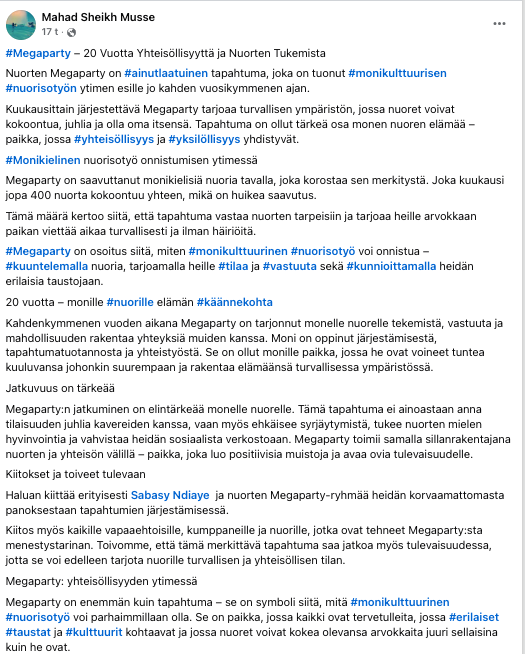
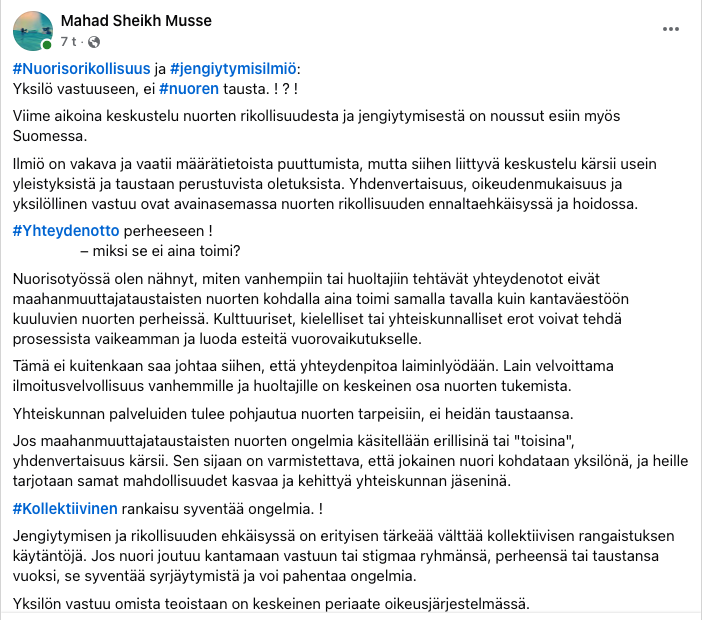
Mahad Sheikh Musse:* Maahanmuuttajataustaisen #nuoren #näkökulmasta – tasavertainen kohtelu & syrjinnän haasteet

Posted on October 26, 2024October 26, 2024 by Migrant Tales

Maahanmuuttajataustaisena nuorena eläminen tuo mukanaan monia haasteita, erityisesti kun kohtaa viranomaisia, ohjaajia tai muita toimijoita.

Näiden ammattilaisten asenteet ja toimintatavat vaikuttavat suoraan siihen, miten nuoria kohdellaan ja kuinka heidän tarpeisiinsa vastataan. Jos ohjaajat lähestyvät työtään stereotypioiden, tiedostamattomien ennakkoluulojen tai jopa avoimen maahanmuuttovastaisuuden kautta, se estää tasavertaisen kohtelun ja lisätä syrjäytymisen riskiä.

Kun nuori tuntee olonsa väheksytyksi tai ulkopuoliseksi, tämä heikentää hänen luottamustaan viranomaisiin ja vähentää halua osallistua yhteiskunnan toimintoihin, kuten koulutukseen tai työelämään.

On selvää, että viranomaisten ja ohjaajien asenteet vaikuttavat syvästi nuoren elämään: tuleeko hän kohdatuksi yksilönä vai ainoastaan. ” maahanmuuttajataustaisena ” nuorena?

Monet nuoret korostavat, että kulttuurinen sensitiivisyys on avainasemassa heidän kohtaamisessaan. Tämä tarkoittaa sitä, että ohjaajien tulisi olla tietoisia erilaisista taustoista ja kulttuurisista lähtökohdista, mutta ilman että he liioittelevat tai yksinkertaistavat näitä eroja.

Nuoren identiteetti voi olla moniulotteinen, eikä hän välttämättä halua tulla määritellyksi vain kulttuurinsa kautta.

Nuori kaipaa tunnustusta yksilönä, jolla on omat ainutlaatuiset tarpeet, kiinnostuksen kohteet ja toiveet. Toimijoilta ja ohjaajilta odotetaan myös aktiivista anti-rasismityötä. Pelkkä syrjinnän tunnistaminen ei riitä – siihen on myös puututtava systemaattisesti. Tämä edellyttää jatkuvaa koulutusta ja itsetutkiskelua ohjaajilta, jotta he ymmärtäisivät omat mahdolliset etuoikeutensa sekä rakenteellisen rasismin vaikutukset.

Yhdenvertaisuuden toteutuminen edellyttää, että nuoret kokevat tulevansa kuulluiksi ja nähdyiksi ilman, että heitä automaattisesti pidetään ongelmallisina tai syrjäytymisvaarassa olevina pelkästään taustansa vuoksi. Nuoret toivovat, että ohjaajat eivät ainoastaan tue heitä yksittäisissä tilanteissa, vaan tekevät pitkäjänteistä työtä syrjinnän ja rasististen rakenteiden purkamiseksi.

Tämä on välttämätöntä, jotta kotoutuminen voi onnistua ja nuoret voivat kokea kuuluvansa osaksi yhteiskuntaa. Ilman tätä jatkuvaa työtä syrjäytymisen riski kasvaa.

#HaitallinenIlmiö #Kollektiivinen #Vastuuttaminen & #Rangaistukset

Erityisen haitallisena nuoret kokevat kollektiivisen vastuuttamisen ja rangaistukset. Tämä tarkoittaa sitä, että yhden yksilön tekojen perusteella koko ryhmää tai yhteisöä pidetään vastuullisena. Esimerkiksi, jos maahanmuuttajataustainen nuori tekee rikoksen tai käyttäytyy häiritsevästi, koko ryhmä leimataan helposti “ongelmalliseksi” tai “sopeutumattomaksi.”

Tämä johtaa siihen, että kaikki maahanmuuttajataustaiset nuoret joutuvat kohtaamaan epäluuloa, syrjintää tai jopa suoraa rasismia, vaikka heillä ei olisi mitään tekemistä yksittäisten tapausten kanssa.

Nuorten näkökulmasta tämä on syvästi epäoikeudenmukaista ja vaikuttaa heidän käsitykseensä omista mahdollisuuksistaan. Jatkuva epäilyksen alla eläminen lisää eriarvoisuuden tunnetta ja synnyttää syvää turhautumista.

Kollektiivinen rangaistus heijastaa usein tiedostamattomia ennakkoluuloja ja rakenteellista rasismia, joissa maahanmuuttajataustaisia nuoria pidetään automaattisesti epäilyksen alaisina ja ongelmallisina. Lisäksi maahanmuuttajataustaisilta nuorilta odotetaan, että heidän on jatkuvasti todistettava oma “kelvollisuutensa” tai “sopeutumisensa” yhteiskuntaan. Tämä luo ylimääräistä painetta, joka voi vaikuttaa heidän hyvinvointiinsa, koulumenestykseensä ja mielenterveyteensä. Kun nuori kokee, että häntä arvioidaan ankarammin kuin kantaväestöön kuuluvia ikätovereitaan, tämä lisää hänen kokemaansa epäoikeudenmukaisuuden tunnetta.

#Kohtaaminen #Yksilöinä – tie eteenpäin.

Nuoret haluavat tulla kohdelluiksi yksilöinä, omien tekojensa ja kykyjensä perusteella, ilman että heidän taustansa määrittelee heidän kohteluaan. Kollektiivisen rankaisemisen ja vastuuttamisen sijaan olisi tärkeää edistää yksilöllistä kohtaamista ja tukemista.

Jokainen nuori on ainutlaatuinen, ja heidän kokemuksensa ja tarpeensa vaihtelevat suuresti. Näin voidaan välttää stereotypioiden vahvistaminen ja antaa kaikille nuorille mahdollisuus kehittää itseään täysivaltaisesti ilman ylimääräisiä esteitä. Maahanmuuttajataustaiset nuoret toivovat tasavertaista ja ennakkoluulotonta kohtelua.

He haluavat, että heidän potentiaalinsa tunnistetaan ja että he saavat mahdollisuuden rakentaa elämäänsä ilman, että heidän taustansa asettaa ylimääräisiä esteitä. Kulttuurisen sensitiivisyyden, anti-rasismityön ja yksilöllisen tuen avulla voidaan luoda sellainen ympäristö, jossa jokaisella nuorella on aito mahdollisuus menestyä ja kuulua osaksi yhteiskuntaa.

Yhteenveto Nuoren maahanmuuttajataustaisen näkökulmasta on selvää, että asenteilla on valtava merkitys. Ohjaajien ja toimijoiden tasavertainen suhtautuminen sekä kulttuurinen sensitiivisyys ovat avainasemassa, jotta nuoret voivat kokea olevansa osa yhteiskuntaa. Kollektiivisen vastuuttamisen ja rangaistusten sijaan tulisi panostaa yksilölliseen kohtaamiseen ja tukeen, jotta jokainen nuori voi tuntea tulevansa nähdyksi omana itsenään, ilman ylimääräisiä ennakkoluuloja ja stereotypioita.

*Mahad Sheikh Musse on nuorisotyön ammattilainen joka omaa vuosien kokemus viranomaisten ja eri yhteisöjen kanssa työskentelmisestä.

MTV reporter Ivan Puopolo has zero credibility

Posted on October 24, 2024October 24, 2024 by Migrant Tales

MTV reporter Ivan Puopolo must be the most opinionated reporter working for the mainstream media. His reporting is not credible because he breaks one of the golden rules of journalism: do not editorialize in your stories.

Puopolo’s interviews and stories are full of toxic opinions. Apart from his non-existent credibility, he does a lot of harm to MTV.

Apart from also being a mouthpiece for the far-right Perussuomalaiset (PS)* party, helping politicians like PS chairperson Riikka Purra spread the great replacement theory and victimizing migrant youths, a recent interview with Esko Aho is a case in point, whom he interviewed without mentioning the former prime minister´s links with Putn´s Russia.

Another question that I have asked MTV is Puopolo´s role in the television station’s ads below.

On the left MTV was active in portraying black and brown youths as criminals even if the police estimated at the time 150-200 youths belonged to gangs. On the right, Puopolo interviews Interior Minister Mari Rantanen about the new integration plan. Not the person with the knife. MTV has done a lot of harm in spreading racism and polarizing viewers. You can read more about the role of the media, police, and politicians in spreading racism.


I emailed this complaint to MTV but have not heard back from the private media company.

Mahad Sheikh Musse:* Nuorten kotouttaminen ja vanhempien tukeminen – luottamuksen avaimet

Posted on October 20, 2024October 20, 2024 by Migrant Tales

Monet maahanmuuttajataustaiset vanhemmat kohtaavat Suomessa vakavia haasteita lastensa kasvatuksessa, erityisesti silloin, kun nuoret ajautuvat ongelmiin päihteiden tai rikollisuuden parissa. Kun yhteys lapsiin katkeaa ja perheet kokevat viranomaisten tarjoaman tuen riittämättömäksi tai väärin ymmärretyksi, jotkut vanhemmat päätyvät äärimmäisiin ratkaisuihin, kuten lähettämään lapsensa takaisin kotimaahansa.

Tämä ei ole uusi ilmiö – jo 1990-luvulla vastaavanlaiset haasteet tulivat esiin, mutta tuolloin keskiössä oli usein ajatus, että heikko kielitaito olisi suurin este kotoutumiselle. Vaikka kielen oppiminen on tärkeää, se ei kuitenkaan yksin riitä ratkaisemaan monikielisten nuorten ja heidän perheidensä syvempiä kotoutumishaasteita. Keskeinen ongelma on luottamuspula viranomaisten ja vanhempien välillä.

Moni vanhempi kokee, että heidän perheensä erityistarpeet jäävät huomiotta tai että tarjotut palvelut eivät ymmärrä heidän kulttuuritaustaansa. Tämä johtaa siihen, että vanhemmat etsivät vaihtoehtoisia ratkaisuja, vaikka ne olisivatkin radikaaleja ja riskejä täynnä. Luottamuksen rakentaminen on avainasemassa, jos haluamme auttaa perheitä ja nuoria löytämään paikkansa suomalaisessa yhteiskunnassa ja vähentää näitä äärimmäisiä toimenpiteitä.

Yksi ensimmäisistä askelista on tarjota monikielistä ja kulttuurisensitiivistä tukea. On tärkeää, että viranomaisilla on riittävästi resursseja tarjota palveluja useilla eri kielillä, jotta perheet voivat ilmaista huolensa ja tarpeensa omalla äidinkielellään. Tämän lisäksi kulttuurisensitiivisyys tarkoittaa ymmärrystä siitä, että maahanmuuttajataustaisilla perheillä voi olla erilaisia tapoja käsitellä haasteita. Se, mikä on normaalia yhdessä kulttuurissa, voi olla täysin vierasta toisessa, ja siksi viranomaisten on mukautettava toimintaansa ymmärtääkseen paremmin perheiden taustoja ja tilanteita.

Luottamus viranomaisiin syntyy, kun he ovat läsnä ja helposti lähestyttäviä. Tämä edellyttää tiivistä yhteistyötä maahanmuuttajataustaisten yhteisöjen kanssa. Järjestöjen ja yhteisöjen rooli on tässä keskeinen, sillä ne tuntevat perheiden arjen ja haasteet ja voivat toimia siltana perheiden ja viranomaisten välillä.

Yhteisöissä toimivat kulttuuritulkkaajat tai mentorit voivat auttaa selittämään vanhemmille, miten suomalainen järjestelmä toimii, ja toisaalta tuoda viranomaisille ymmärrystä perheiden tilanteista. Tällä tavoin voidaan välttää väärinkäsityksiä ja luoda avointa ja rakentavaa dialogia.

Ennaltaehkäisy on tärkeä osa kotouttamistyötä. Monikielisten nuorten kohdalla varhainen tuki voi estää monia ongelmia kehittymästä. Kouluissa, nuorisotyössä ja muilla areenoilla on tärkeää tunnistaa nuorten haasteet ja tarjota heille turvallinen ympäristö, jossa he voivat käsitellä identiteettikriisejä, syrjinnän kokemuksia tai muita kohtaamiaan haasteita.

Mitä varhaisemmin näihin kysymyksiin puututaan, sitä paremmin voimme estää nuoria ajautumasta päihteisiin, rikollisuuteen tai muihin vaikeuksiin. Nuorten identiteetin tukeminen on ratkaisevaa. Monikielisillä ja monikulttuurisilla nuorilla on usein ristiriitainen suhde omaan identiteettiinsä: he voivat kokea, etteivät kuulu täysin suomalaiseen yhteiskuntaan, mutta eivät myöskään kokonaan omaan kulttuuriinsa.

Turvallinen ympäristö, jossa heidän taustansa hyväksytään ja sitä arvostetaan, on elintärkeä heidän hyvinvoinnilleen. Nuorille on tarjottava mahdollisuuksia löytää oma paikkansa suomalaisessa yhteiskunnassa samalla, kun he voivat kunnioittaa omia juuriaan. Monikulttuuriset nuorisotilat, vertaistukiryhmät ja koulun monikulttuurinen kasvatus ovat konkreettisia keinoja tukea nuoria heidän identiteettinsä rakentamisessa.

Lopulta kotouttamisen ja tukemisen perusta on luottamus. Tämä luottamus syntyy avoimesta vuorovaikutuksesta, kuuntelemisesta ja ymmärryksestä. Se ei kehity hetkessä, vaan vaatii jatkuvaa läsnäoloa ja sitoutumista. Viranomaiset voivat rakentaa tätä luottamusta olemalla aktiivisesti mukana monikielisten yhteisöjen arjessa, tarjoamalla selkeitä ja saavutettavia palveluja sekä kuuntelemalla perheiden tarpeita ja huolia.

Kun vanhemmat tuntevat, että heidän huolensa otetaan vakavasti ja että he voivat luottaa viranomaisten tarjoamaan tukeen, he eivät koe tarvetta turvautua äärimmäisiin ratkaisuihin, kuten lastensa lähettämiseen ulkomaille. Vahva yhteys vanhempien, nuorten ja viranomaisten välillä luo pohjan turvalliselle kasvulle ja kotoutumiselle. On tärkeää, että nuoret voivat kasvaa turvallisessa ympäristössä, jossa he voivat tuntea itsensä itsevarmoiksi ja osaksi yhteiskuntaa, taustastaan riippumatta.

Turvallinen ja itsevarma nuori, joka tuntee kuuluvansa osaksi sekä omaa kulttuuriaan että suomalaista yhteiskuntaa, on avain onnistuneeseen kotoutumiseen. Tässä onnistuminen vaatii meiltä kaikilta yhteistä ponnistusta: viranomaisilta, vanhemmilta, yhteisöiltä ja koko yhteiskunnalta. Meidän on luotava olosuhteet, joissa nuoret voivat kukoistaa ja löytää paikkansa, oli heidän taustansa mikä tahansa.

*Mahad Sheikh Musse, nuorisotyön ammattilainen.

The PS is fascist and racist to the core

Posted on October 17, 2024October 17, 2024 by Migrant Tales

On Wednesday’s A-studio talk show, viewers got once again a taste of the depths of fascism and racism of the Perussuomalaiset (PS) through MP Joakim Vigelius. One of the matters that surprised me was how the host, Petri Raivio, did not stop to fact-check Vigelius’ brazen lies.

Since the Finnish media rarely fact-checks or takes a clear stand in its editorials on migration policy issues, spreading lies and half-truths by xenophobes is fairly easy.

Apart from being a charlatan, Vigelius insulted on the show Social Democrat Vice President Nasima Razmyar with his racist remarks. The PS MP maintained that people from the Middle East and Africa should not come as quota refugees to Finland next year because they “don’t integrate” and are “a threat to society.”

He argued, in front of a woman who was born in Afghanistan that people like her are mostly unemployed, cannot live off their means, have problems following laws, and are prone to commit crimes even if she is a living example of the opposite of his lies.


PS MP Joakim Vigelius. Source Yle


Another incredible matter that came to light on the talk show was his exaggeration and racism about Europe’s migration problem. Imagine, Vigrlius is worried about such a problem even if Finland had last year 5,372 asylum seekers, according to Statistics Finland.

The asylum seekers coming to Europe are only a drop in the bucket of all those in the world fleeing strife.

Continue reading “The PS is fascist and racist to the core”
  • Previous
  • 1
  • …
  • 19
  • 20
  • 21
  • 22
  • 23
  • 24
  • 25
  • …
  • 535
  • Next
Read more about documentary film
Read more

Recent Posts

  • Through the most recent crisis, the PS continues to undermine democracy
  • Finland Bridge (2000): A year in Mediolanum,* Italy
  • Lahti is the latest city to prohibit the niqab and burka
  • Finland’s tabloids Iltalehti and Ilta-Sanomat are the pits
  • Riikka Purra’s Dr Jekyll and Mr Hyde mask

Recent Comments

  1. Absolutely Socking: Racist Finnish Facebook group against human rights gets flooded with socks on Musta Barbaari’s mother and sister charged by the police in “ethnic profiling” case
  2. Ilkka Nuotio on Pekka Myrskylä: “Tilastot kertovat toista kuin poliittinen keskustelu”
  3. Genrih Soinkara on The war in Ukraine and the Russian-Finnish border crisis are showing Finland’s ugly side
  4. Ahti Tolvanen on Comment by Ahti Tolvanen on the Helsinki +50 conference
  5. Angel Barrientos on Angel Barrientos is one of the kind beacons of Finland’s Chilean community

Archives

  • June 2026
  • May 2026
  • April 2026
  • March 2026
  • February 2026
  • January 2026
  • December 2025
  • November 2025
  • October 2025
  • September 2025
  • August 2025
  • July 2025
  • June 2025
  • May 2025
  • April 2025
  • March 2025
  • February 2025
  • January 2025
  • December 2024
  • November 2024
  • October 2024
  • September 2024
  • August 2024
  • July 2024
  • June 2024
  • May 2024
  • April 2024
  • March 2024
  • February 2024
  • January 2024
  • December 2023
  • November 2023
  • October 2023
  • September 2023
  • August 2023
  • July 2023
  • June 2023
  • May 2023
  • April 2023
  • March 2023
  • February 2023
  • January 2023
  • December 2022
  • November 2022
  • October 2022
  • September 2022
  • August 2022
  • July 2022
  • June 2022
  • May 2022
  • April 2022
  • March 2022
  • February 2022
  • January 2022
  • December 2021
  • November 2021
  • October 2021
  • September 2021
  • August 2021
  • July 2021
  • June 2021
  • May 2021
  • April 2021
  • March 2021
  • February 2021
  • January 2021
  • December 2020
  • November 2020
  • October 2020
  • September 2020
  • August 2020
  • July 2020
  • June 2020
  • May 2020
  • April 2020
  • March 2020
  • February 2020
  • January 2020
  • December 2019
  • November 2019
  • October 2019
  • September 2019
  • August 2019
  • July 2019
  • June 2019
  • May 2019
  • April 2019
  • March 2019
  • February 2019
  • January 2019
  • December 2018
  • November 2018
  • October 2018
  • September 2018
  • August 2018
  • July 2018
  • June 2018
  • May 2018
  • April 2018
  • March 2018
  • February 2018
  • January 2018
  • December 2017
  • November 2017
  • October 2017
  • September 2017
  • August 2017
  • July 2017
  • June 2017
  • May 2017
  • April 2017
  • March 2017
  • February 2017
  • January 2017
  • December 2016
  • November 2016
  • October 2016
  • September 2016
  • August 2016
  • July 2016
  • June 2016
  • May 2016
  • April 2016
  • March 2016
  • February 2016
  • January 2016
  • December 2015
  • November 2015
  • October 2015
  • September 2015
  • August 2015
  • July 2015
  • June 2015
  • May 2015
  • April 2015
  • March 2015
  • February 2015
  • January 2015
  • December 2014
  • November 2014
  • October 2014
  • September 2014
  • August 2014
  • July 2014
  • June 2014
  • May 2014
  • April 2014
  • March 2014
  • February 2014
  • January 2014
  • December 2013
  • November 2013
  • October 2013
  • September 2013
  • August 2013
  • July 2013
  • June 2013
  • May 2013
  • April 2013
  • March 2013
  • February 2013
  • January 2013
  • December 2012
  • November 2012
  • October 2012
  • September 2012
  • August 2012
  • July 2012
  • June 2012
  • May 2012
  • April 2012
  • March 2012
  • February 2012
  • January 2012
  • December 2011
  • November 2011
  • October 2011
  • September 2011
  • August 2011
  • July 2011
  • June 2011
  • May 2011
  • April 2011
  • March 2011
  • February 2011
  • January 2011
  • December 2010
  • November 2010
  • October 2010
  • September 2010
  • August 2010
  • July 2010
  • June 2010
  • May 2010
  • April 2010
  • March 2010
  • February 2010
  • January 2010
  • December 2009
  • November 2009
  • October 2009
  • September 2009
  • August 2009
  • July 2009
  • December 2008
  • November 2008
  • October 2008
  • September 2008
  • August 2008
  • July 2008
  • June 2008
  • May 2008
  • April 2008
  • March 2008
  • February 2008
  • January 2008
  • November 2007
  • October 2007
  • September 2007
  • August 2007
  • July 2007
  • June 2007
  • May 2007

Categories

  • ?? Gia L?c
  • ????? ?????? ????? ???????? ?? ??????
  • ???????
  • @HerraAhmed
  • @mondepasrond
  • @nohatefinland
  • @oula_silver
  • @Varathas
  • A Pakistani family
  • äärioikeisto
  • Abbas Bahmanpour
  • Abdi Muhis
  • Abdirahim Hussein Mohamed
  • Abdirahim Husu Hussein
  • Abdirisak Mahamed
  • About Migrant Tales
  • activism
  • Adam Al-Sawad
  • Adel Abidin
  • Afrofinland
  • Ahmed IJ
  • Ahti Tolvanen
  • Aino Pennanen
  • Aisha Maniar
  • Alan Ali
  • Alan Anstead
  • Alejandro Díaz Ortiz
  • Alekey Bulavsev
  • Aleksander Hemon
  • Aleksanterinliitto
  • Aleksanterinliitto ry
  • Aleksanterinliitto ry:n hallitus
  • Alex Alex
  • Alex Mckie
  • Alexander Nix
  • Alexandra Ayse Albayrak
  • Alexis Neuberg
  • Ali Asaad Hasan Alzuhairi
  • Ali Hossein Mir Ali
  • Ali Rashid
  • Ali Sagal Abdikarim
  • Alina Tsui
  • Aline Müller
  • All categories
  • Aman Heidari
  • Amiirah Salleh-Hoddin & Jana Turk
  • Amin A. Alem
  • Amir Zuhairi
  • Amkelwa Mbekeni
  • Ana María Gutiérrez Sorainen
  • Anachoma
  • Anders Adlecreutz
  • Angeliina Koskinen
  • Anna De Mutiis
  • Anna María Gutiérrez Sorainen
  • Anna-Kaisa Kuusisto ja Jaakko Tuominen
  • Annastiina Kallius
  • Anneli Juise Friman Lindeman
  • Announcement
  • Anonymous
  • Antero Leitzinger
  • anti-black racism
  • Anti-Hate Crime Organisation Finland
  • Anudari Boldbaatar
  • Arshiya Nasser
  • Aspergers Syndrome
  • Asylum Corner
  • Asylum seeker 406
  • Athena Griffin and Joe Feagin
  • Autism
  • Avaaz.org
  • Awale Olad
  • Ayan Said Mohamed
  • AYY
  • Barachiel
  • Bashy Quraishy
  • Beatrice Kabutakapua
  • Beri Jamal
  • Beri Jamal and Enrique Tessieri
  • Bertolt Brecht
  • Boiata
  • Boodi Kabbani
  • Bruno Gronow
  • Carmen Pekkarinen
  • Çelen Oben and Sheila Riikonen
  • Chiara Costa-Virtanen
  • Chiara Costa-Virtanen
  • Chiara Sorbello
  • Christian Thibault
  • Christopher Wylie
  • Clara Dublanc
  • Dana
  • Daniel Malpica
  • Danilo Canguçu
  • David Papineau
  • David Schneider
  • Dexter He
  • Don Flynn
  • Dr Masoud Kamali
  • Dr. Faith Mkwesha
  • Dr. Theodoros Fouskas
  • Edna Chun
  • Eeva Kilpi
  • Emanuela Susheela
  • En castellano
  • ENAR
  • Enrique
  • Enrique Tessieri
  • Enrique Tessieri & Raghad Mchawh
  • Enrique Tessieri & Yahya Rouissi
  • Enrique Tessieri and Muhammed Shire
  • Enrique Tessieri and Sira Moksi
  • Enrique Tessieri and Tom Vandenbosch
  • Enrique Tessieri and Wael Che
  • Enrique Tessieri and Yahya Rouissi
  • Enrique Tessieri and Zimema Mhone
  • Epäluottamusmies
  • EU
  • Europe
  • European Islamophobia Report
  • European Islamophobia Report 2019,
  • European Union
  • Eve Kyntäjä
  • Ezequiel Caldeiro
  • Facebook
  • Fadumo Dayib
  • Faisa Kahiye
  • Farhad Manjoo
  • Fasismi
  • Finland
  • Fizza Qureshi
  • Flyktingar och asyl
  • Foreign Student
  • Fozia Mir-Ali
  • Frances Webber
  • Frida Selim
  • Gareth Rice
  • Ghyslain Vedeaux
  • Global Art Point
  • Great Replacement
  • Habiba Ali
  • Hami Bahadori
  • Hami Bahdori
  • Hamid
  • Hamid Alsaameere
  • Hamid Bahdori
  • Handshake
  • Harmit Athwal
  • Hassan Abdi Ali
  • Hassan Muhumud
  • Heikki Huttunen
  • Heikki Wilenius
  • Helsingin Sanomat
  • Henning van der Hoeven
  • Henrika Mälmsröm
  • Hser Hser
  • Hser Hser ja Mustafa Isman
  • Husein Muhammed
  • Hussain Kazemian
  • Hussain Kazmenian
  • Ibrahim Khan
  • Ida
  • Ignacio Pérez Pérez
  • Iise Ali Hassan
  • Ilari Kaila & Tuomas Kaila
  • Imam Ka
  • inside-an-airport
  • Institute of Race Relations
  • Iraqi asylum seeker
  • IRR European News Team
  • IRR News Team
  • Islamic Society of Norhern FInland
  • Islamic Society of Northern Finland
  • Islamophobia
  • Jacobinmag.com
  • Jallow Momodou
  • Jan Holmberg
  • Jane Elliott
  • Jani Mäkelä
  • Jari Luoto
  • Jari Taponen
  • Jegor Nazarov
  • Jenni Stammeier
  • Jenny Bourne
  • Jessie Daniels
  • Joe Davidow
  • Johannes Koski
  • John D. Foster
  • John Grayson
  • John Marriott
  • Jon Burnett
  • Jorma Härkönen
  • Jos Schuurmans
  • José León Toro Mejías
  • Josue Tumayine
  • Jouni Karnasaari
  • Juan Camilo
  • Jukka Eräkare
  • Julian Abagond
  • Julie Pascoet
  • Jussi Halla-aho
  • Jussi Hallla-aho
  • Jussi Jalonen
  • JusticeDemon
  • Kadar Gelle
  • Kaksoiskansalaisuus
  • Kansainvälinen Mikkeli
  • Kansainvälinen Mikkeli ry
  • Katherine Tonkiss
  • Kati Lepistö
  • Kati van der Hoeven-Lepistö
  • Katie Bell
  • Kättely
  • Kerstin Ögård
  • Keshia Fredua-Mensah & Jamie Schearer
  • Khadidiatou Sylla
  • Khadra Abdirazak Sugulle
  • Kiihotus kansanryhmää vastaan
  • Kirsi Crowley
  • Koko Hubara
  • Kristiina Toivikko
  • Kubra Amini
  • KuRI
  • La Colectiva
  • La incitación al odio
  • Laura Huhtasaari
  • Lauri Finér
  • Leif Hagert
  • Léo Custódio
  • Leo Honka
  • Leontios Christodoulou
  • Lessie Branch
  • Lex Gaudius
  • Leyes de Finlandia
  • Liikkukaa!
  • Linda Hyökki
  • Liz Fekete
  • M. Blanc
  • Maarit Snellman
  • Mahad Sheikh Musse
  • Maija Vilkkumaa
  • Malmin Kebab Pizzeria Port Arthur
  • Marcell Lorincz
  • Mari Aaltola
  • María Paz López
  • Maria Rittis Ikola
  • Maria Tjader
  • Marja-Liisa Tolvanen
  • Mark
  • Markku Heikkinen
  • Marshall Niles
  • Martin Al-Laji
  • Maryan Siyad
  • Matt Carr
  • Mauricio Farah Gebara
  • Media Monitoring Group of Finland
  • Micah J. Christian
  • Michael McEachrane
  • Michele Levoy
  • Michelle Kaila
  • Migrant Tales
  • Migrant Tales Literary
  • Migrantes News
  • Migrants' Rights Network
  • MigriLeaks
  • Mikko Kapanen
  • Miriam Attias and Camila Haavisto
  • Mohamed Adan
  • Mohammad Javid
  • Mohammad M.
  • Monikulttuurisuus
  • Monisha Bhatia and Victoria Canning
  • Mor Ndiaye
  • Muh'ed
  • Muhamed Abdimajed Murshid
  • Muhammed Shire
  • Muhammed Shire and Enrique Tessieri
  • Muhis Azizi
  • Musimenta Dansila
  • Muslimiviha
  • Musulmanes
  • Namir al-Azzawi
  • Natsismi
  • Neurodiversity
  • New Women Connectors
  • Nils Muižnieks
  • No Labels No Walls
  • Noel Dandes
  • Nuor Dawood
  • Omar Khan
  • Otavanmedia
  • Oula Silvennoinen
  • Paco Diop
  • Pakistani family
  • Pentti Stranius
  • Perussuomalaiset
  • perustuslaki
  • Petra Laiti
  • Petri Cederlöf
  • Pia Grochowski
  • Podcast-lukija Bea Bergholm
  • Pohjois – Suomen Islamilainen Yhdyskunta
  • Pohjois Suomen Islamilainen Yhyskunta
  • Polina Kopylova
  • Race Files
  • racism
  • Racism Review
  • Raghad Mchawh
  • Ranska
  • Rashid H. and Migrant Tales
  • Rasismi
  • Raul Perez
  • Rebecka Holm
  • Reem Abu-Hayyeh
  • Refugees
  • Reija Härkönen
  • Remiel
  • Reza Nasri
  • Richard Gresswell
  • Riikka Purra
  • Risto Laakkonen
  • Rita Chahda
  • Ritva Kondi
  • Robito Ibrahim
  • Roble Bashir
  • Rockhaya Sylla
  • Rodolfo Walsh
  • Roger Casale
  • Rostam Atai
  • Roxana Crisólogo Correa
  • Ruth Grove-White
  • Ruth Waweru-Folabit
  • S-worldview
  • Sadio Ali Nuur
  • Sami Rusanen
  • Sandhu Bhamra
  • Sara de Jong
  • Sarah Crowther
  • Sari Alhariri
  • Sarkawt Khalil
  • Sasu
  • Scot Nakagawa
  • Shabana Ahmadzai
  • Shada Islam
  • Sharon Chang blogs
  • Shenita Ann McLean
  • Shirlene Green Newball
  • Sini Savolainen
  • Sira Moksi
  • Sonia K.
  • Sonia Maria Koo
  • Steverp
  • Stop Deportations
  • Suldaan Said Ahmed
  • Suomen mediaseurantakollektiivi
  • Suomen Muslimifoorumi ry
  • Suomen viharikosvastainen yhdistys
  • Suomen viharikosvastainen yhdistys ry
  • Suomi
  • Supermen
  • Susannah
  • Suva
  • Syrjintä
  • Talous
  • Tapio Tuomala
  • Taw Reh
  • Teivo Teivainen
  • The Daily Show
  • The Heino
  • The Supermen
  • Thomas Elfgren
  • Thulfiqar Abdulkarim
  • Tim McGettigan
  • Tino Singh
  • Tito Moustafa Sliem
  • Tobias Hübinette and L. Janelle Dance
  • Transport
  • Trica Danielle Keaton
  • Trilce Garcia
  • Trish Pääkkönen
  • Trish Pääkkönen and Enrique Tessieri
  • Tuulia Reponen
  • Uncategorized
  • UNITED
  • University of Eastern Finland
  • Uyi Osazee
  • Väkivalta
  • Vapaa Liikkuvuus
  • Venla-Sofia Saariaho
  • Vieraskynä
  • W. Che
  • W. Che an Enrique Tessieri
  • Wael Ch.
  • Wan Wei
  • Women for Refugee Women
  • Xaan Kaafi Maxamed Xalane
  • Xassan Kaafi Maxamed Xalane
  • Xassan-Kaafi Mohamed Halane & Enrique Tessieri
  • Yahya Rouissi
  • Yasmin Yusuf
  • Yassen Ghaleb
  • Yle Puhe
  • Yuliet Tresa
  • Yve Shepherd
  • Zahra Khavari
  • Zaker
  • Zalina Ametova
  • Zamzam Ahmed Ali
  • Zeinab Amini ja Soheila Khavari
  • Zimema Mahone and Enrique Tessieri
  • Zimema Mhone
  • Zoila Forss Crespo Moreyra
  • ZT
  • Zulma Sierra
  • Zuzeeko Tegha Abeng
© 2026 Migrant tales | Powered by Minimalist Blog WordPress Theme