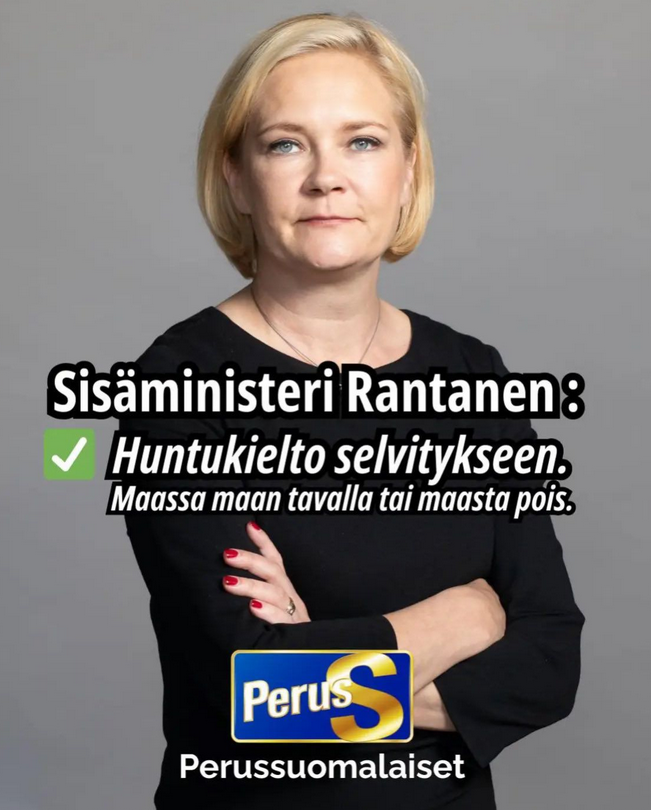
I’m always amused and saddened at the same time when political bullies like Perussuomalaiset (PS)* Interior Minister Mari Rantanen talk tough against migrants and other vulnerable minorities. The only way to challenge bullies is by giving them a taste of their own medicine
A tough (but in reality a weak) Rantanen slaps us with an ultimatum:
Studying the possibility of prohibiting Muslim women from wearing veils. Live like the locals or leave.
In my opinion, this is chickenshit populism that we should not underestimate. In the United States, we are seeing how the Trump Administration is targeting brown and black people.
Who is to say that something similar would not happen in Finland if the PS had the chance?
It’s no secret that the PS is a party that quietly supports Trump and his authoritarian tactics.
Even the party’s chairperson and finance minister, Riikka Purra, had warm words of support for US Vice J.D. Vance speech last year at the Munich Security Conference, which many see as a turning point in EU-US relations. Vance downplayed the threat of Russia, claiming that Europe’s greatest security threat was unregulated migration and the exclusion of far-right political groups. Purra praised Vance’s words as a great speech. “Freedom, freedom of speech, democracy; threats from within, inability to fight illegal immigration,” she posted on X.
Here is a very simple question: if President Donald Trump had treated racism in the same way he treated antisemitism, would the United States have made real progress in eradicating this social ill—or at least delivered a serious blow against it?
This contrast is striking. While Trump signed executive orders pledging to combat antisemitism on college campuses, his administration presides over arbitrary ICE crackdowns on visible minorities and emboldened white supremacists. These contradictions raise serious questions about the sincerity and scope of his efforts.
One reason Trump’s stance on antisemitism rings hollow is that he himself has been repeatedly accused of antisemitic rhetoric. These accusations are not typically about open expressions of hatred, but about his recurring use of stereotypes: framing Jews as “disloyal,” obsessed with money, or more devoted to Israel than America.
In May 2025, Trump used the word “Shylock” in a speech—a slur rooted in Shakespeare’s caricature of a Jewish moneylender. Although he later claimed ignorance of its antisemitic meaning, groups such as the Anti-Defamation League warned that such language reinforces centuries-old prejudices.
Trump has also frequently suggested that Jewish Americans who vote for Democrats are “disloyal” or “ungrateful,” invoking the age-old dual-loyalty trope that questions Jews’ commitment to their country. In October 2024, he went even further, declaring that “Christians love Israel more than Jews,” a remark widely criticized by Jewish leaders as divisive and condescending.
But let’s be honest: Trump’s antisemitism is disingenuous and a travesty. If he’d invest so much time in cracking down on all kinds of racism, the US would take the first step towards becoming a more racially just country.
Trump and antisemitism pledges are nothing more than the warravaged landscape of Gaza.
The careful screening of civil society members allowed to attend the Helsinki+50 conference by the Finnish Foreign Ministry almost succeed in steering away conversation from topic the Finnish Chairpersonship wanted to avoid.
Fortunately Finnish Foreign Scholars were able to schedule a pre-event July 30th at Helsinki University Library where the undersigned was able to lay out how extensive military spending by OSCE countries was diverting the funds to address a looming global climate catastrophe on behalf Climate Reality Leaders Finland. There seemed no room for agenda for organizations like ours nor for Bruce Knotts who represented the NGO Committee for Disarmament, Peace and Security at the UN. He was likely too outspoken in his condemnation of countries like Finland engaging in arms trade with Israel. Heidi Meinzolt of the Women’s International League for Peace and Freedom managed to get in an intervention on the dangerous comeback of the nuclear arms race in a July 31st side event, obviously a topic the organizers were having trouble keeping the lid on. This echoed Kati Juva’s warning of how even a limited nuclear exchange could trigger a civilization-destroying nuclear winter when she spoke on behalf of Physicians for the Prevention of Nuclear War at the university.
The elephant in the room was of course the ever more dictatorial behaviour of the Trump administration. Perhaps journalist and BBC interviewer Stephen Sackur forgot his briefing notes when he brought up how Trump had cut the funds for Radio Free Europe when questioning its CEO, Steve Capers about the imperilled state of the free media in parts of Europe?
Then there was the matter of the closure of Finland’s eastern border. Nothing on that of course much to the chagrin of the young Romanian woman, I met at a break, working for the UNHCR in Belorus with imprisoned migrant workers keep in dangerous and unhealthy cells after being pushed back for seeking the freedoms promised in the Helsinki Final Act. I mention her now because she never got a hearing of her experiences that day although travelling hundreds of kilometers to attend.
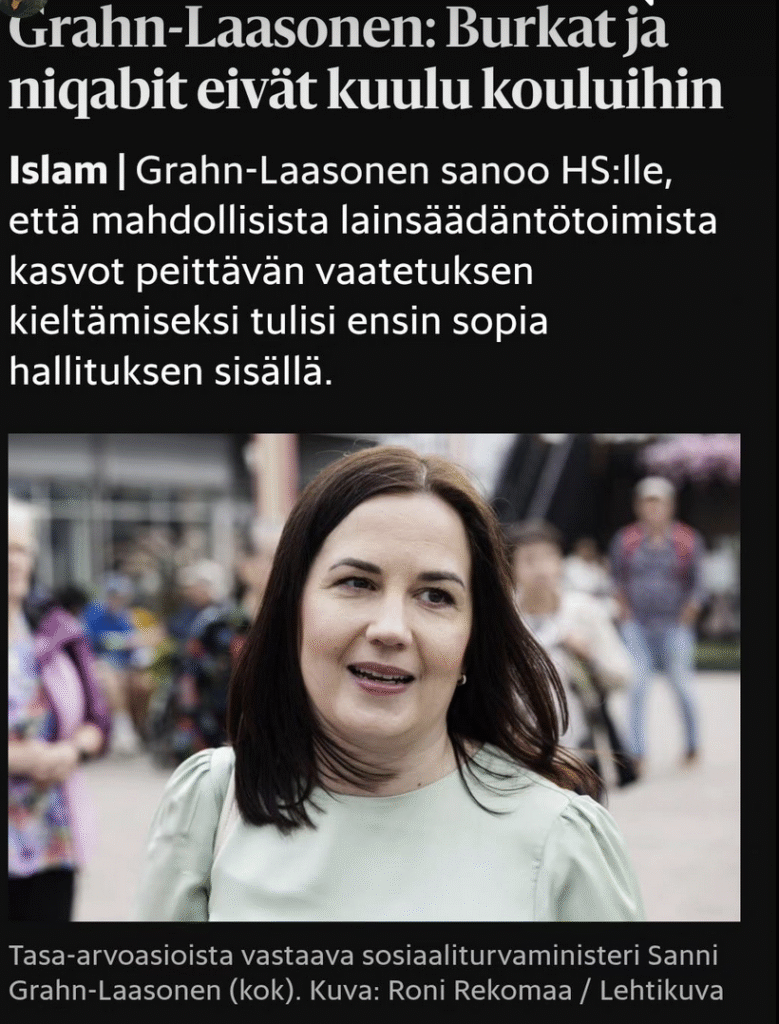
We all know about the vicious racist attacks by the Perussuomalaiset (PS)* party. Their partner in government, the National Coalition Party, has been flirting with populist-style racism as well—yesterday, Social Security Minister Sanni Grahn-Laasonen, whose responsibilities include gender equality.
On Tuesday, she told Helsingin Sanomat that she would be in favor of Finland joining the likes of France in prohibiting the niqab and burka. She added that these types of attire should be prohibited at school.
As Finland’s government parties continue to see their ratings go down in opinion polls, they are pulling these types of stunts to claw back voters.
The saddest matter is the harm that a minister like Grahn-Laasonen does to children who are Muslims and may use the niqab or veil. I wonder how many children Grahn-Laasonen has seen in Finland wearing a niqab or burka? This is an example of cheap populism.
Or should the issue play out in her world, where Muslim children will run up to her and thank her for liberating them?
The truth is that Grahn-Laasonen would care less for such children because she doesn’t believe in religious freedom.
Migrant Tales will begin to publish a regular weekly posting on the most racist/ xenophobic comments of the week. Why? Because the Perussuomalaiset (PS)* are bleeding in the polls and have therefore ratchet up their attacks against minorities like Muslims.
A new list will be published on Sundays.
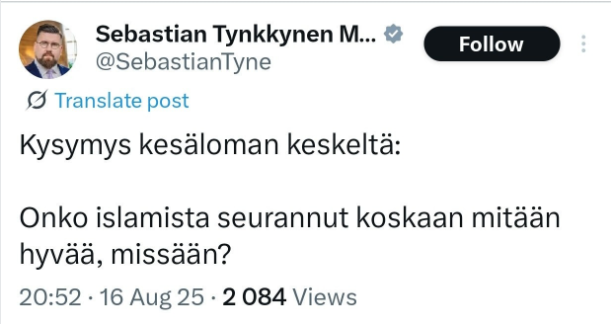
Member of the European Parliament Sebastian Tynkkynen Tweets: “A question in the middle of summer: Is there anything good about Islam anywhere?
PerussuomalaisetMEP Sebastian Tynkkynen, 16 August 2025
MT comment:The charlatan hypocrisy of MEP Tynkkynen is striking! Here is a politician who has been convicted three times for ethnic agitation.
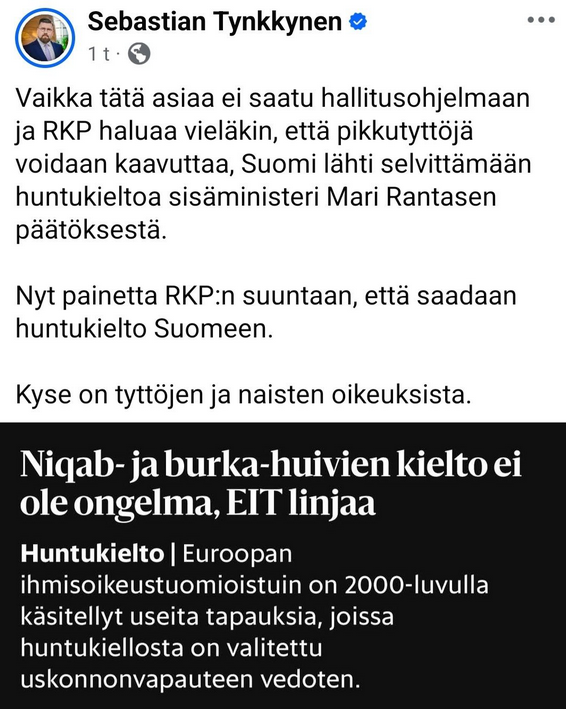
Tweets Tynkkynen: “Although this issue was not included in the government program and the RKP still believes that young girls can be veiled, Finland began investigating the ban on veils following a decision by Interior Minister Mari Rantanen.
Now pressure is being exerted on the RKP to introduce a ban on veils in Finland.
This is a matter of girls’ and women’s rights.”
Perussuomslaiset MEP Sebastian Tynkkynen, August 2025
MT comment:Read the above comment about Tynkkynen, who in our book is an opportunist poitician who would care less about the wellbeing of Muslim girls.
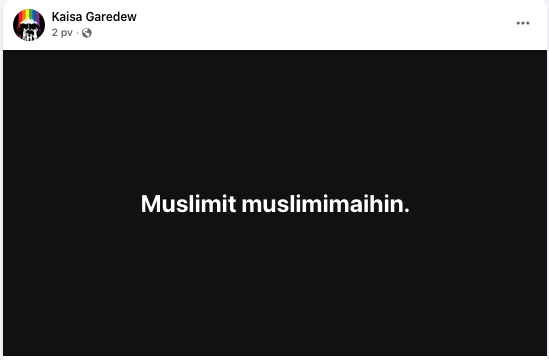
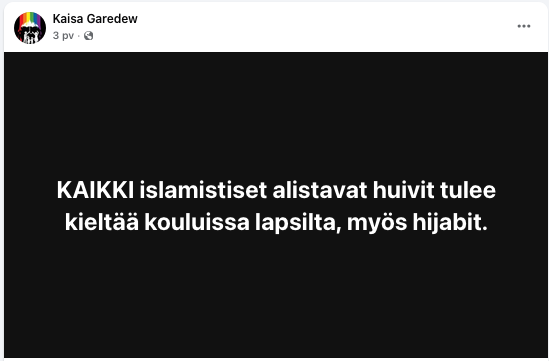
Kaisa Garedew is at it again with these two posts on Facebook: “Muslims to Muslim countries,” and “ALL oppresive Islamist headscarves in schools should be banned, including hijabs [veils].“
PS MP Kaisa Garedew, August 2025
MT Comment: It is pathetic that we have politicians like Garedew who believe that their mandate in parliament gives them the divine right to attack Muslims and sexual minorities.
PUBLISHED 12 AUGUST 2025
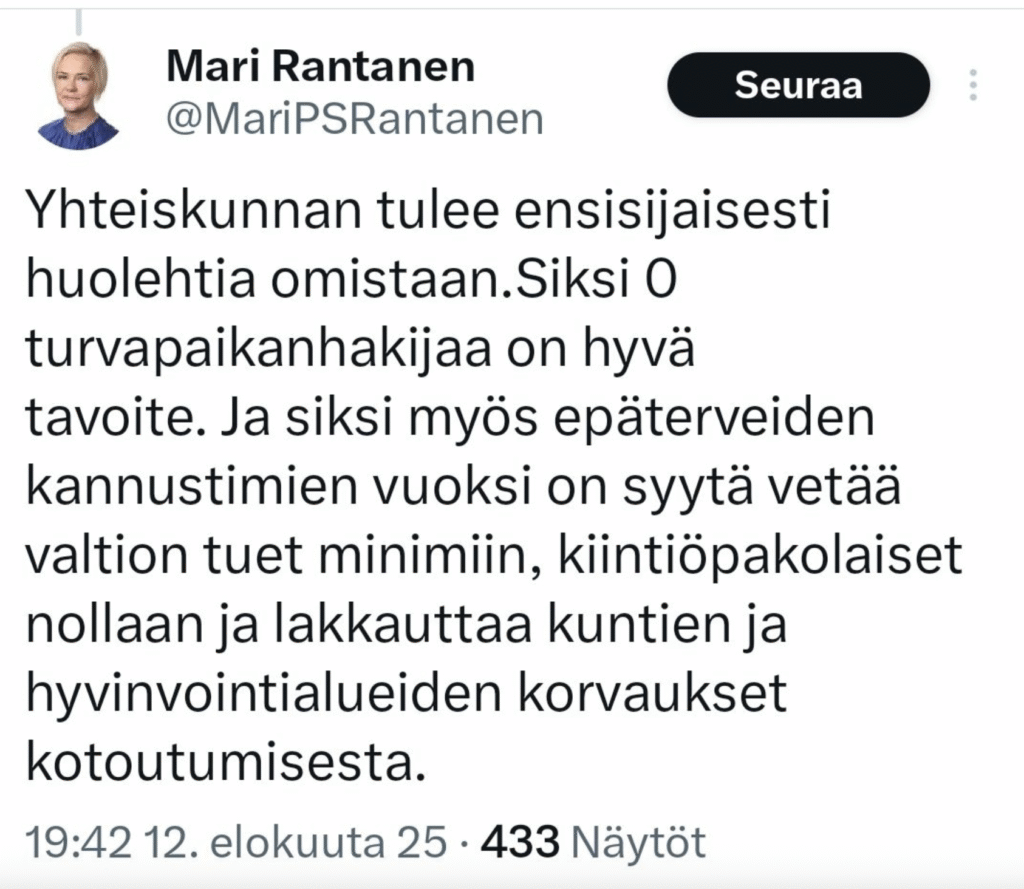
“Society must first and foremost take care of its own. That is why zero asylum seekers is a good goal. And that is also why, due to unhealthy incentives [to asylumm seekers], it is necessary to reduce state subsidies to a minimum, reduce the refugee-quota scheme to zero, and abolish municipal and regional area compensation for integration.“
Mari Rantanen, Perussuomalaiset (PS)* minister of the interior, 12 August 2025
MT comment:Mari Rantanen is spearheading the PS’ plan to halt asylum seekers to zero even if it means ditching our respect for human rights. Rantanen’s and the PS’ thinking is the following: never trust migrants and pass laws that message your great suspicion of them.
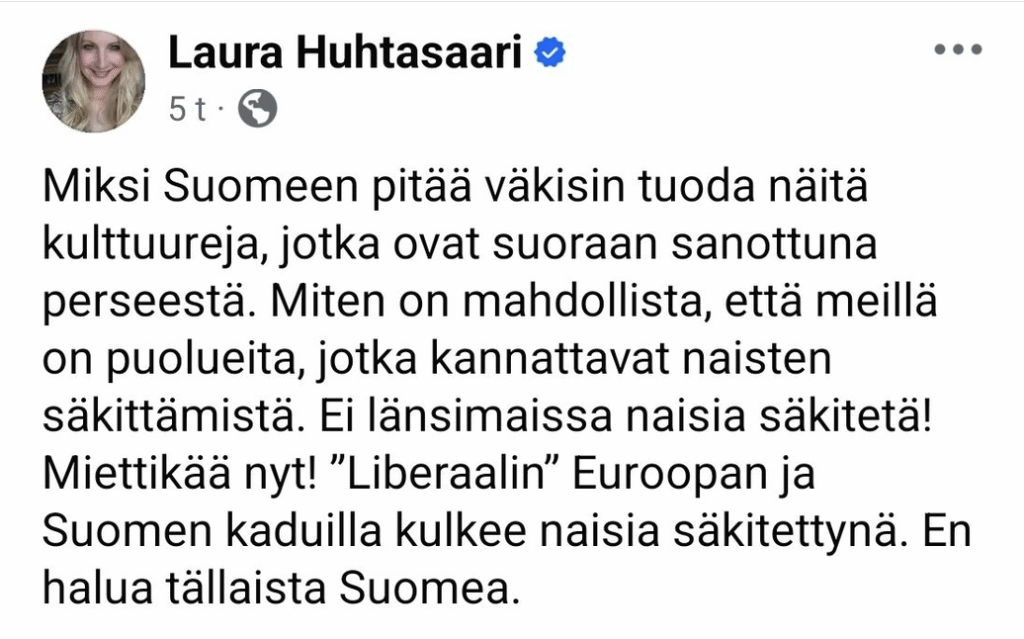
“Why do we have to force these cultures, which are frankly fucked, upon Finland? How is it possible that we have political parties that support the beating of women? Women are not beaten in Western countries! Think about it! Women are beaten on the streets of “liberal” Europe and Finland. I don’t want this kind of Finland.“
Laura Huhtasaari is an MP for PS, August 2025
MT comment:Huhtasaari was a rising star fuelled by her hatred of Muslims. As if rising from the grave after a long lapse of silence, Huhtasaari falsely claims that “women are not beaten in Western countries.” She forgets to mention that Finland is the second most violent place in Europe for women.
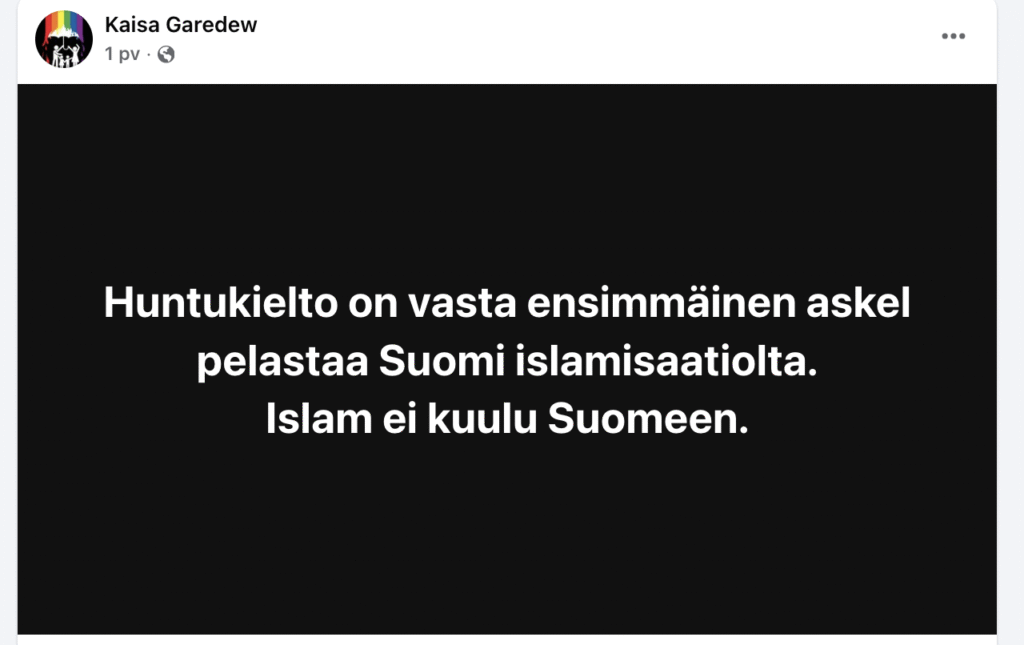
“The ban on headscarves is only the first step in saving Finland from Islamization. Islam does not belong in Finland.“
Kaisa Garedew, PS MP, 11 August 2025
MT comment: Kaisa Garedew is one of the most hateful politicians in Finland. Her comments about Islam show that she has unresolved issues.
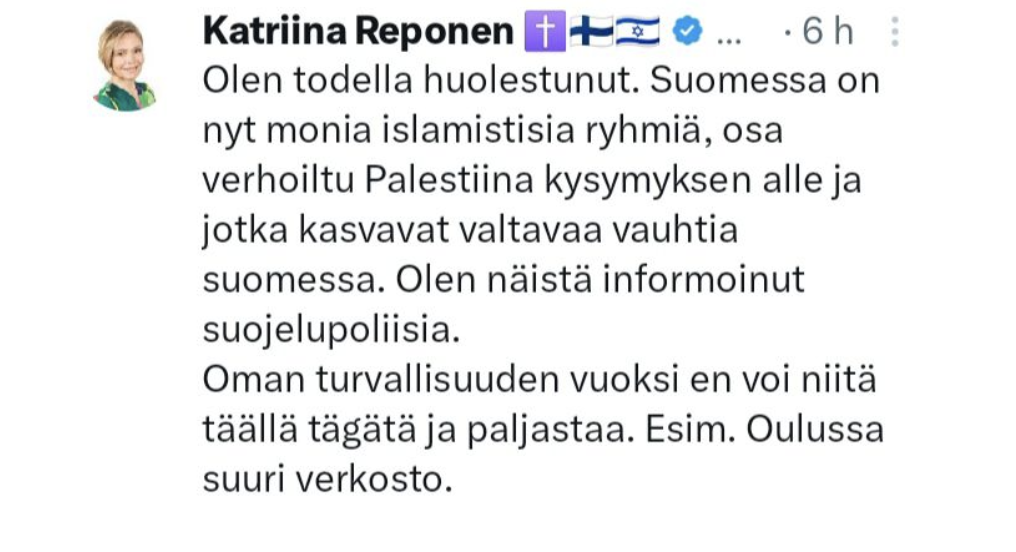
“I am truly concerned. There are many Islamic groups in Finland, some of which are covert. They operate under the guise of the Palestinian issue and are growing rapidly in Finland. I have informed the security police about them. For my own safety, I cannot name or reveal them here. For example, there is a large network in Oulu…
…I can provide further information about the organizations and their connections.“
Katariina Reponen, Hyvinkää city councilor, Perussuommalaiset, August 2025
MT comment: Reponen is another PS politicians who sees Muslims under her bed and even claims to work with the security police to uncover Islamic groups, which she claims are a danger to society. Paranoia?
Signed August 1st, 1975, by 35 nations including the United States, Canada, and nearly all European countries, The Helsinki Final Act was a landmark agreement aimed at reducing Cold War tensions and promoting cooperation across political, economic, and human rights domains. It enshrined principles such as sovereign equality, territorial integrity, the peaceful settlement of disputes and respect for human rights—ideals that remain aspirational in today’s fractured geopolitical landscape.
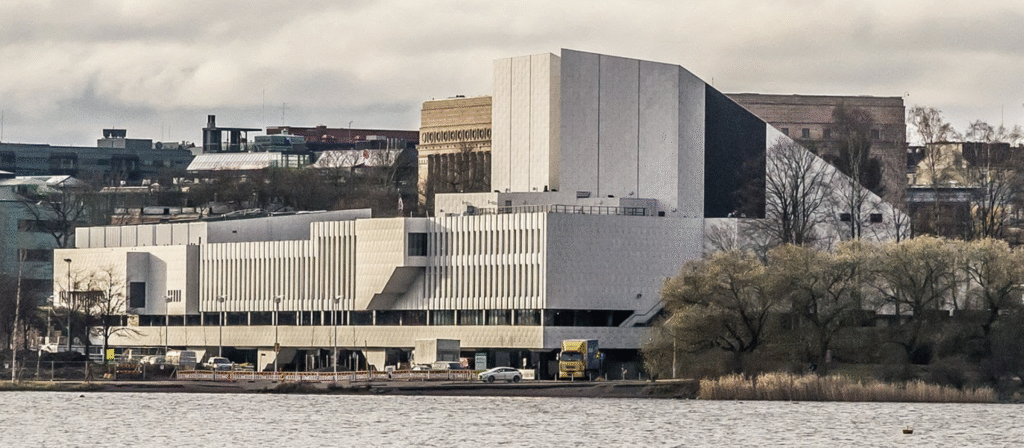
As the meeting to honour the 50th anniversary of The Helsinki Final Act opened on July 31st at Helsinki’s Finlandia Hall we were invited by the Finnish Chairpersonship to consider a program without reference to the looming threat of another nuclear arms race as limiting treaties expire and scant reference to a mounting environmental crises. Many countries that had signed in 1975 were now providing support to Ukraine fighting a Russian invasion and at the same time supporting Israel’s genocide of Gazans.
Finlandia Hall. Sourrce: Google
Meanwhile aggressive threats such as by President Trump to annex Canada and Greenland were mainly ignored on the agenda. Humanity’s existential climate and environmental crises received barely passing reference as billions are transferred to a massive environment-destroying military build-up. In fact these burning issues of the day might not have been mentioned at all were it not for the minority of carefully screened civil society attendees allowed in to join the nearly 1000 official delegates.
🧬 Humanity’s Expanding Biological Footprint
Since 1975, the global population has more than doubled, and with it, humanity’s biological footprint has surged. Industrial agriculture, deforestation, and fossil fuel consumption have accelerated biodiversity loss and climate change. The ecological overshoot—where human demand exceeds Earth’s regenerative capacity—has become a defining feature of the Anthropocene.
💰 World GDP: Then, Now, and Ahead
1975 World GDP: Estimated at around $5.5 trillion USD (nominal).
2025 World GDP: Surpasses $113 trillion USD.
Projected 2055 GDP: At a steady 2.5% annual growth, global GDP could reach approximately $240 trillion USD in 30 years, assuming compounding growth and relative stability.
This economic expansion has lifted billions out of poverty but also intensified resource extraction, emissions, and environmental deterioration.
🛡️ NATO’s Expansion and Contradictions
Since the Cold War’s end, NATO has expanded eastward, incorporating former Warsaw Pact members and Soviet republics such as Poland, Hungary, the Baltic states, and most recently Finland and Sweden. While framed as a stabilizing force, this expansion has been viewed by Russia as a strategic threat, contributing to tensions that culminated in the 2022 invasion of Ukraine.
NATO countries have largely condemned Russia’s aggression and provided extensive military aid to Ukraine. Yet, many of these same nations have continued arms sales and diplomatic support for Israel during its military campaign in Gaza, which human rights organizations and international observers have described as genocidal in scale. This duality has sparked criticism over selective application of international law and human rights norms.
💣 Military Spending and Emissions
NATO’s collective military spending has surged dramatically in the past decade, driven by renewed great-power competition and regional conflicts. The alliance’s defense budgets now exceed $1.3 trillion annually, with the U.S. alone accounting for nearly half.
This militarization carries an environmental cost: NATO’s greenhouse gas emissions exceed those of over 50% of the world’s nations, according to independent climate assessments. Military operations, supply chains, and infrastructure contribute significantly to global emissions, yet remain largely exempt from international climate treaties.
🧨 Nuclear Treaties and Strategic Instability
Key arms control agreements such as the INF Treaty and New START have either expired or been suspended, eroding decades of nuclear stability. The absence of binding treaties raises the spectre of a renewed arms race, with hypersonic weapons and AI-driven targeting systems adding complexity and risk.
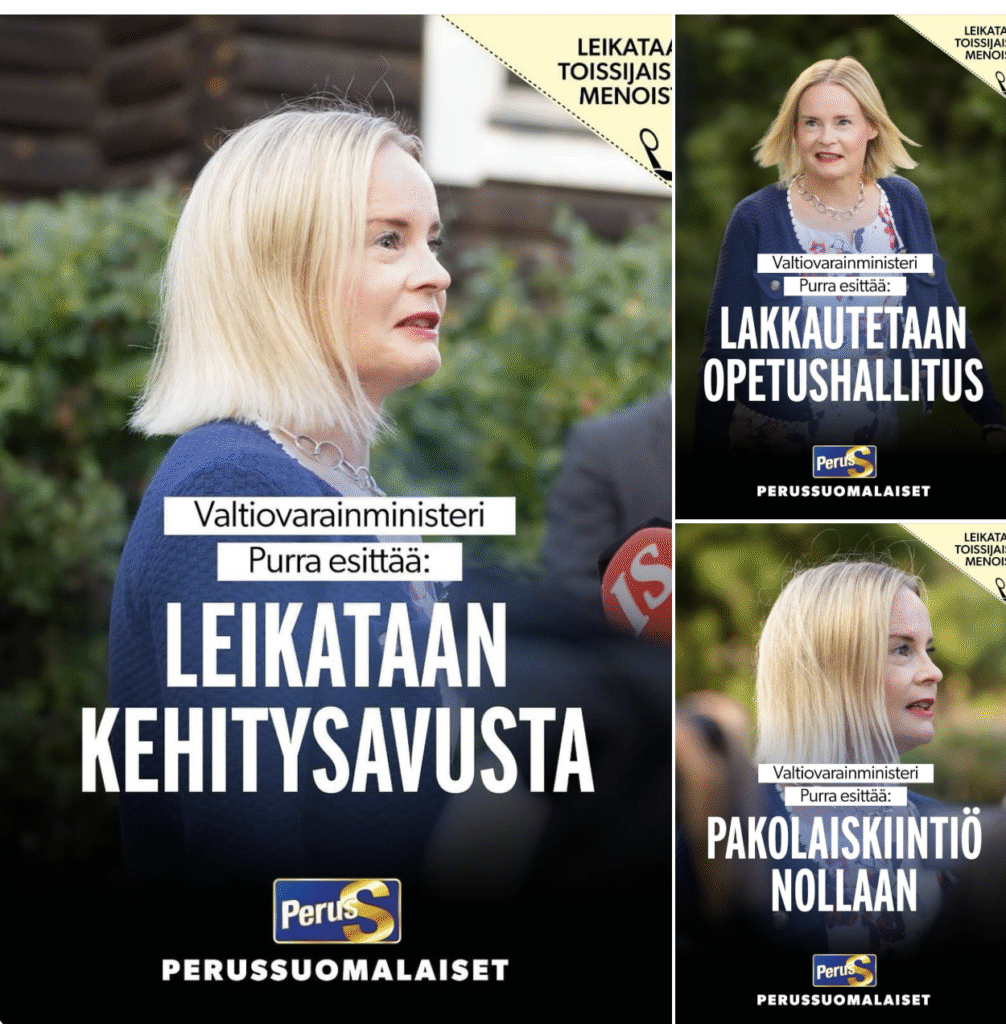
Perussuommslaiset (PS)* Finance Minister Riikka Purra’s announcement of 900-billion-euro cuts in next year’s budget is seen by some a political stunt with a strong anti-immigration PS stamp. On the same day as Purrra’s announcment, Matias Turkkila, the editor of the party’s newspaper and the main strategist of the PS’ xenophobic message, became Purra’s special advisor.
A coincidence? Not.
One Yle story described Turkkila as “a master of political provocation.”
And that is what he is. Turkkila is the perfect advisor to Purra because what he does well is to provoke and polarize.
It remains to be seen if Turkkila and breathing sronger life into the PS’ anti-immmigraion message will save it from itself.
Even so, I don’t believe Turkkila is very talented in his racist provocations. He knows, however, to exploit the racist undercurrent that flows in Finland.
Turkkila’s, Purra’s, and the PS’ victimization of minorities like Muslims is not only racist but affects, for example, innocent children at school. The most shameful matter is that the media and many politicians cannot muster up enough courage to denounce such racism, which explains why Turkkila is still kept in some regard by the mainstream media.
[Finance Minister Riikka] Purra’s conclusion was that the party would start focusing on communication and highlighting issues that were important to it more decisively than before.
Concerning the nosedive in opinion polls for the Perussuomalaiset (PS) and with three election setbacks behind them, it’s clear that the party is in crisis and will do everything possible to lure voters. Finland will hold its general election in April 2027.
One of these stunts was announced yesterday when Finance Minister Purra said that one billion euros would be cut from next year’s budget. For starters, the cuts would come from reducing development aid, ending the quota refugee system, and abolishing the National Board of Education.
Government partners like the National Coalition Party and the Swedish People’s Party have pushed back on Purra’s spending cuts.
The announcement by President Alexander Stubb that he is prepared to recognize the state of Palestine if the government of Prime Minister Petteri Stubb formally proposes it. Of the Nordic countries, Finland and Denmark are the only ones that have not recognized Palestine.
Iceland was the first country to recognize Palestine, followed by Sweden, the first EU country, and Norway in 2023.
The decision to recognize Palestine follows announcements by France, Canada, and the United Kingdom that they plan to do so during the UN General Assembly in September.
While we hope that Finland will follow suit, the matter is complicated since two government parties, the Christian Democrats and the Perussuomalaiset (PS)*, have expressed their opposition to such a move.
While the Finnish media has been following the rift and why Denmark refuses to recognize Palestine, there is little to no analysis on why and what the circumstances may be. Context is left out in stories, which leaves the door open for bias.
Both government parties, the Christian Democrats and PS, have a long anti-Muslim track record, which sheds light on why they are against Finland recognizing Palestine. Denmark, too, has a terrible record of being one of the most Islamophobic countries in the EU, which explains why we are with it in this shameful group.
There are many examples of how the Christian Democrats loathe refugees. In a 2019 EU election compass, question 13 asked: “Is it the obligation of the EU to save all those migrants who attempt to come to Europe and who are at risk of drowning in the Mediterranean?”
Days later,representatives of the Somali community come out and state that the tragic deaths of Somali boys should not be politicized. What on earth does the Finnish media, like Yle, wants to frame and message when they state that those who died of drowning were of Somali backgrounds?
It took several days for Yle to publish the Somali community’s concern about the harmful labeling.
Abdirazak Sugulle Mohamed, a representative of the Uusimaa Mosque Association, hopes that decision-makers will take a responsible approach to the issue. He believes that swimming skills should also be discussed in general in Finland, not just for Somalis or so-called people of foreign background.
“We shouldn’t just talk about the swimming skills of immigrants or Somalis,” he said.
But one could take this matter a big further and ask what the purpose of singling out people of color is? Is it to reinforce our racism and show falsely that white Finns are superior swimmers? Probably the most striking matter it reveals is the mainstream media’s racism problem.
Moreover, Helsingin Sanomat, Finland’s biggest daily, has not published a word about how the media labels minorities. They did, however, publish an article about how Muslim women go to swimming school. It was like a cultural peep show.