
Signed August 1st, 1975, by 35 nations including the United States, Canada, and nearly all European countries, The Helsinki Final Act was a landmark agreement aimed at reducing Cold War tensions and promoting cooperation across political, economic, and human rights domains. It enshrined principles such as sovereign equality, territorial integrity, the peaceful settlement of disputes and respect for human rights—ideals that remain aspirational in today’s fractured geopolitical landscape.
As the meeting to honour the 50th anniversary of The Helsinki Final Act opened on July 31st at Helsinki’s Finlandia Hall we were invited by the Finnish Chairpersonship to consider a program without reference to the looming threat of another nuclear arms race as limiting treaties expire and scant reference to a mounting environmental crises. Many countries that had signed in 1975 were now providing support to Ukraine fighting a Russian invasion and at the same time supporting Israel’s genocide of Gazans.
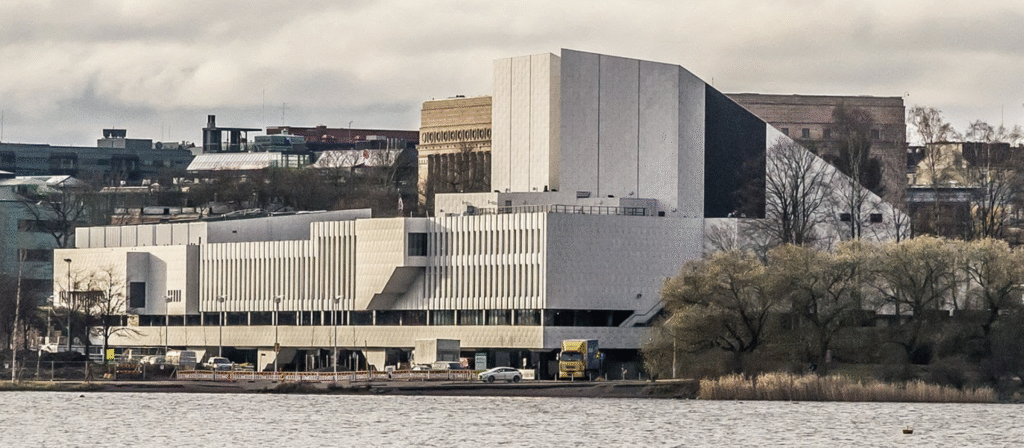
Finlandia Hall. Sourrce: Google
Meanwhile aggressive threats such as by President Trump to annex Canada and Greenland were mainly ignored on the agenda. Humanity’s existential climate and environmental crises received barely passing reference as billions are transferred to a massive environment-destroying military build-up. In fact these burning issues of the day might not have been mentioned at all were it not for the minority of carefully screened civil society attendees allowed in to join the nearly 1000 official delegates.
🧬 Humanity’s Expanding Biological Footprint
Since 1975, the global population has more than doubled, and with it, humanity’s biological footprint has surged. Industrial agriculture, deforestation, and fossil fuel consumption have accelerated biodiversity loss and climate change. The ecological overshoot—where human demand exceeds Earth’s regenerative capacity—has become a defining feature of the Anthropocene.
💰 World GDP: Then, Now, and Ahead
- 1975 World GDP: Estimated at around $5.5 trillion USD (nominal).
- 2025 World GDP: Surpasses $113 trillion USD.
- Projected 2055 GDP: At a steady 2.5% annual growth, global GDP could reach approximately $240 trillion USD in 30 years, assuming compounding growth and relative stability.
This economic expansion has lifted billions out of poverty but also intensified resource extraction, emissions, and environmental deterioration.
🛡️ NATO’s Expansion and Contradictions
Since the Cold War’s end, NATO has expanded eastward, incorporating former Warsaw Pact members and Soviet republics such as Poland, Hungary, the Baltic states, and most recently Finland and Sweden. While framed as a stabilizing force, this expansion has been viewed by Russia as a strategic threat, contributing to tensions that culminated in the 2022 invasion of Ukraine.
NATO countries have largely condemned Russia’s aggression and provided extensive military aid to Ukraine. Yet, many of these same nations have continued arms sales and diplomatic support for Israel during its military campaign in Gaza, which human rights organizations and international observers have described as genocidal in scale. This duality has sparked criticism over selective application of international law and human rights norms.
💣 Military Spending and Emissions
NATO’s collective military spending has surged dramatically in the past decade, driven by renewed great-power competition and regional conflicts. The alliance’s defense budgets now exceed $1.3 trillion annually, with the U.S. alone accounting for nearly half.
This militarization carries an environmental cost: NATO’s greenhouse gas emissions exceed those of over 50% of the world’s nations, according to independent climate assessments. Military operations, supply chains, and infrastructure contribute significantly to global emissions, yet remain largely exempt from international climate treaties.
🧨 Nuclear Treaties and Strategic Instability
Key arms control agreements such as the INF Treaty and New START have either expired or been suspended, eroding decades of nuclear stability. The absence of binding treaties raises the spectre of a renewed arms race, with hypersonic weapons and AI-driven targeting systems adding complexity and risk.
🧭 The Erosion of the Rules-Based Order
The Organization for Security and Co-operation in Europe (OSCE), born from the Helsinki Process, has struggled to assert its authority amid rising authoritarianism and geopolitical fragmentation. NATO, too, has faced internal contradictions—most notably during the Trump presidency, when threats to annex Canada and Greenland were floated, and alliance commitments were questioned.
These developments underscore a broader erosion of the rules-based international order envisioned in 1975. The principles of sovereignty, non-intervention, and peaceful dispute resolution have been repeatedly undermined by power politics and selective enforcement.
🕊️ A Call to Reaffirm Helsinki
As the world confronts climate collapse, nuclear instability, and widening inequality, the spirit of the Helsinki Final Act offers a compass. Recommitting to its foundational principles—dialogue, cooperation, and respect for human rights—is not merely nostalgic. It is essential.
The decline of respect for democracy, not only in Russia but also the USA, Hungary, Turkey and beyond, should be a core OSCE concern which can hardly be addressed by leaving it off the agenda.
As the two main actors in bringing the Helsinki Conference together in 1975, Russia and the USA, were mainly on the sidelines July 31st, and stood out as violators of key Helsinki principles. There might have been an opportunity to speak truth to power and call both superpowers that fathered the act equally to account.
While acting as OSCE chair Finland and foreign minister Elina Valtonen seem to only feel called upon to consider the violations of the peace by Russia. This was born out in her closing speech as well as remarks at a climate forum June 11th. While grave, Russia’s actions are far from the only explanation for inadequate action (or complete denial in the case of the US administration) of the environmental crises- in which every state plays its own part.
Finland is also playing the Russian card as it leads the way in giving short shrift to fundamental human rights instruments such as the Geneva Refugee Convention, having totally closed its Eastern border and refusing entry to asylum seekers- the only country bordering Russia to have done so.
Reviving the Helsinki Spirit demands courage: to confront contradictions, uphold universal norms, and prioritize diplomacy over domination. The Helsinki vision remains unfinished, and the world is clearly a more dangerous place then 50 years ago—and issue avoidance by the current Chairpersonship is allowing the vision to slip further away.