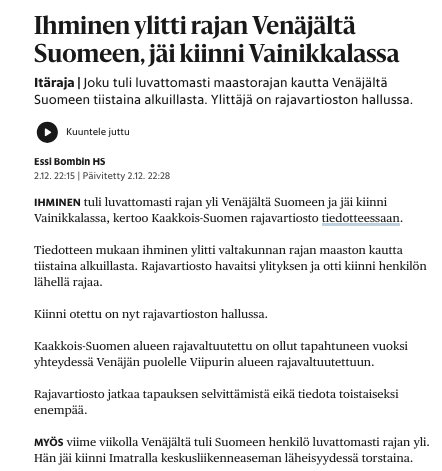
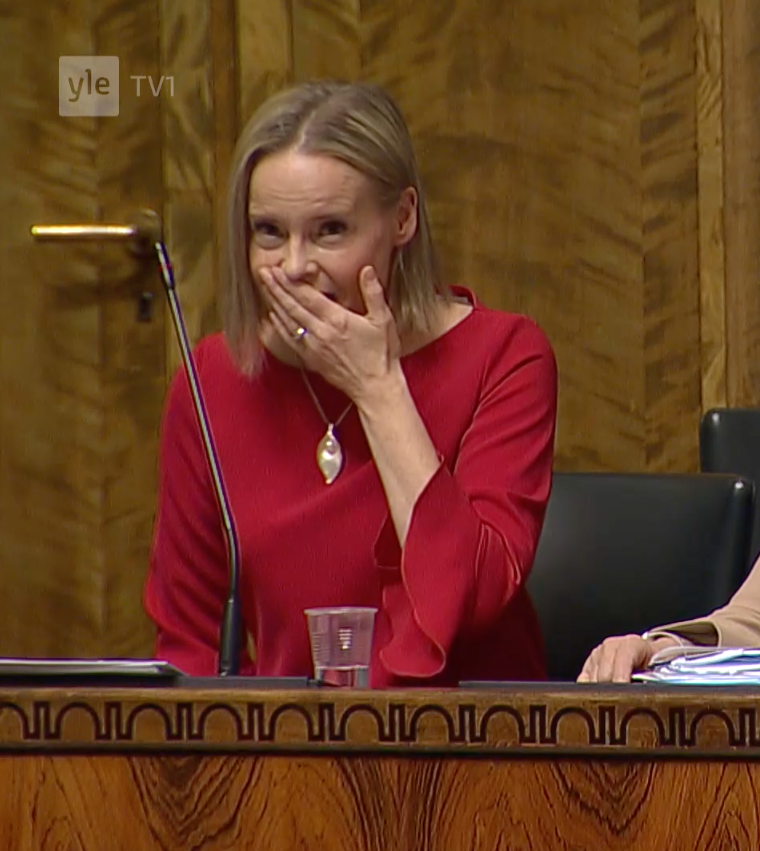
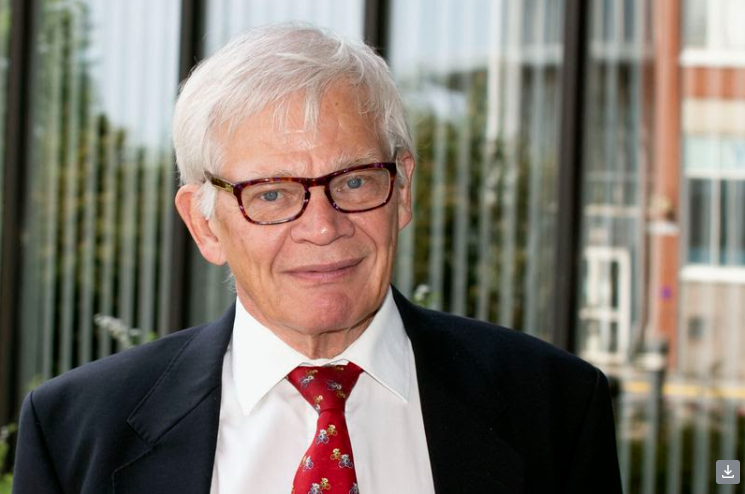
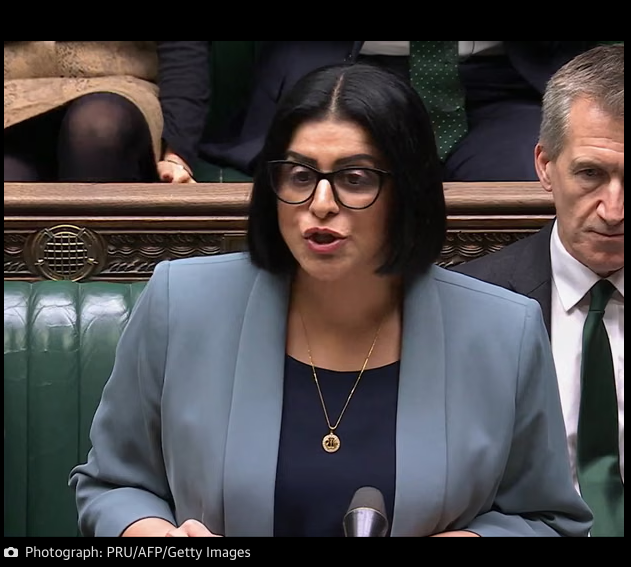
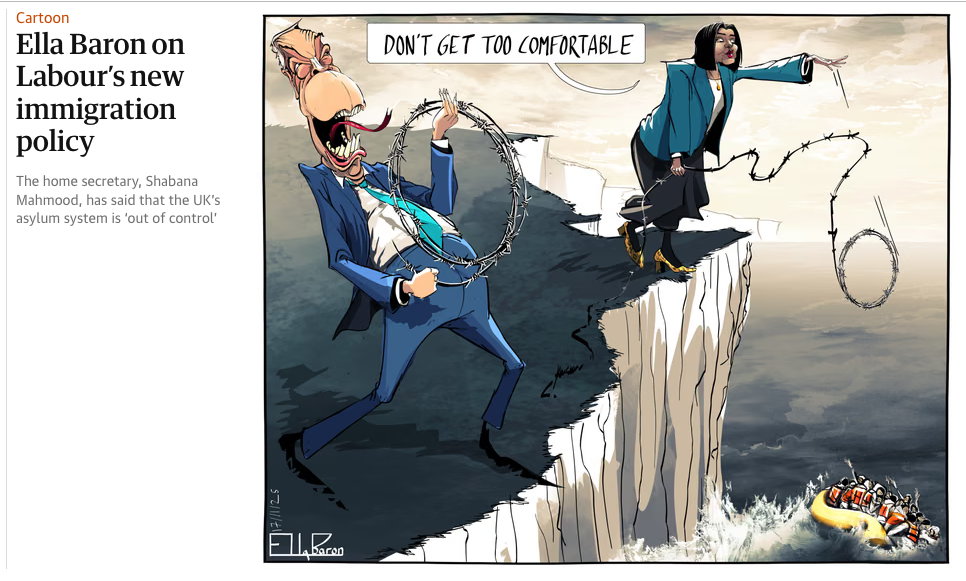
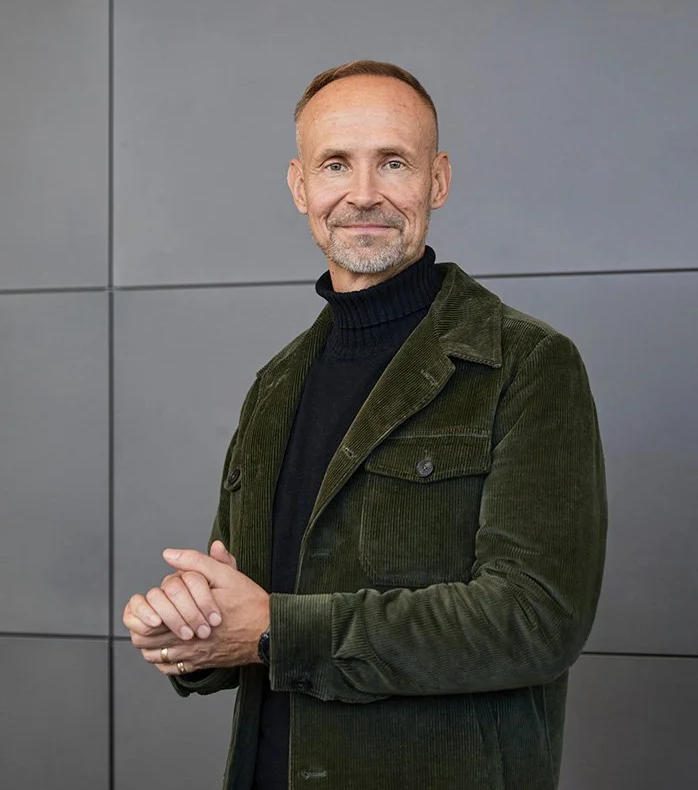
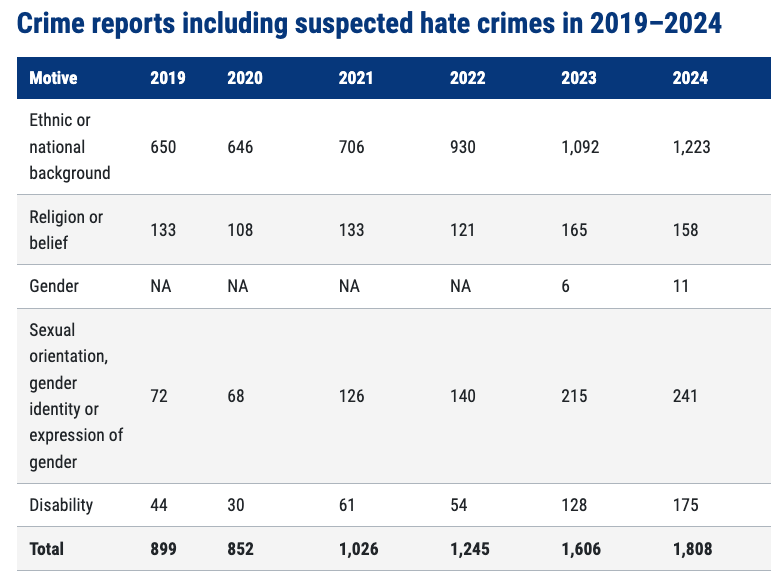
Think of it. Finland’s largest daily, Helsingin Sanomat, publishes a story if the country’s deportation. system is broken. For the story, the daily uses as sources well-known xenophobie Joakim Vigelius of the Perussuomalaiset (PS)* party, Social Democrat MP Eveliina Heinäluoma, who has a wishy-washy stance on migrants, and National Coalition Party MP Heikki Vestman, who justified as chairperson of the constitutional committee the shelving of Finland’s human rights obligations on the passage of the pushback law.
The migration debate in Finland seems very much like the lack of pushback against President Donald Trump by republican legislators. In Finland, we consider migrants, especially Muslim asylum seekers as a threat. We do not give such people the benefit of doubt.
The article is highly revealing exposing what Helsingin Sanomat thinks of undocumented migrants which it slaps on the “illegal” label.
Vigelius, who like Vestman to trash international agreements, said that the present asylum system is based on “outdated” international human rights conventions and that these should change.
‘It cannot be right that even after ten years and ten rejected applications, an asylum seeker is still residing in Finland,” he pointed out.
Apart from using MPs who would care less about undocumented migrants, a big shortfall of the article is that is does not care to mention the suffering present laws cause on such people. Migrant Tales has documented many such cases.
The Ulysses Syndrome is a chronic disorder and helps understand the trauma suffered by undocumented migrants.
If you want to see the face of Finland’s Islamophobic network, it is not dificult to find. The Perussuomalaiset party (PS)* continues to be one of the most important platforms of Finland’s Islamophobic network. All of the elected 46 MPs (out of a total of 216) of the Perussuomalaiset party based their campaign on anti-Muslim and xenophobic themes.
Moreover, all of these people in Finland’s Islamophobic network are waging a menacing culture war to impose their political will against the foundations of Finland’s social welfare state. Donald Trump and Vladimir Putin are waging such a war to destroy the EU.
PS ministers like Riikka Purra (Finance), Mari Rantanen (Interior), Wille Rydman (former Economic Affairs), Leena Meri (Justice), Ville Tavio (Foreign Trade), and Jussi Halla-aho (Speaker of Parliament) have all spread the Great Replacement theory with little to no consequences.
The list is even longer since we have not mentioned Joakim Vigelius, Matias Turkkila, Miko Bergbom, Teemu Keskisarja, Pekka Aitakumpu, Sanna Antikainen, Ari Koponen, Mauri Peltokangas, Jari Ronkainen, Saara Seppänen, Jaana Strandman, Simo Grönroos and many, many others. Is it a coincidence that all of the above are members of the PS? Oops! I forgot to mention Minister of Social Security Sanni Grahn-Laasonen of the National Coalition Party who suggested that wearing the niqab and burka at school should be prohibited.
Tavio and the government have gone as far as to link development aid to accepting deportees. MEP Sebastian Tynkkynen, who has three ethnic agitation convictions, and MP Kaisa Garedew both want Islam to be banned in Finland. Halla-aho, who was convicted in 2012 of ethnic agitation and of breaching the sanctity of religion, pressed charges against a comedian and deputy Helsinki councilor for calling him “a fascist.”
National Coalition Party (NCP) MPs like Atte Kaleva and Seida Sohrabi, an NCP politician, among others, use familiar anti-Muslim talking points. A strong supporter of Israel’s war policies in Gaza, Kaleva argues that Islam doesn’t need whitewashing because it is: “militant and intolerant.” Sohrabi has strongly advocated the banning of the veil, niqab, and burka, among other Muslim practices like children fasting at school during Ramadan.
Kuinka monta kuvaa olet nähnyt tummaihoisesta henkilöstä tai hijabia käyttävästä naisesta lastenvaunujen kanssa mediassa? Näitä kuvia toistetaan vuodesta toiseen, vaikka todellisuus on monimuotoisempi.
Tällainen vinoutunut kuvasto rakentuu valkoisten suomalaisten ennakkoluuloista ja tietämättömyydestä vähemmistöjä kohtaan. Se ruokkii rasistisia käsityksiä ja ylläpitää stereotyyppistä mielikuvaa “maahanmuuttajasta.”
Toinen epämiellyttävä totuus, jonka artikkeli tuo esiin, on se, että Suomen kotouttamisohjelma on hyvä – ei epäonnistunut, kuten poliitikot usein antavat ymmärtää.
Kysymys kuuluu: Miksi käytätte jatkuvasti näitä samoja kuvia, kun kyseiset ihmiset edustavat vain noin 10 % Suomen maahanmuuttajaväestöstä?
On aika vaatia mediaa muuttamaan linjaansa. Monimuotoisuus pitää näyttää todenmukaisesti – ei yksinkertaistettujen, kliseisten kuvien kautta.aan maahanmuuttajista tarkasti.
Only one conclusion arises after listening to President Donald Trump’s rant in the United States: culture war. This war aims to not only shift political power globally, but also in Europe from the center to the hard right.
Trump said that if we do not close our borders, forget about the climate crisis, and stop buying Russian oil, “our countries are going to hell.”
Apart from European far-right Trump sympathizers like Viktor Orbán of Hungary and Italy’s Georgia Meloni, there are several other cheerleaders in Finland, mainly from the Perussuomalaiset (PS)* party.
Vice President J.D. Vance’s speech at the Munich Security Conference, which many see as a turning point in EU-U.S. relations, was one where he downplayed the threat of Russia, claiming that Europe’s greatest security threat was unregulated migration and the exclusion of far-right political groups. In the face of widespread condemnation, PS Minister of Finance Riikka Purra praised Vance’s words as a great speech. “Freedom, freedom of speech, democracy; threats from within, inability to fight illegal immigration,” Purra posted on X.
If Purra’s comment was made in Spring, the latest one praising Trump came from Minister for Foreign Trade and Development Ville Tavio:
Writes Tavio on Facebook: “I don’t know how the mainstream media will report on this, but I listened to Trump’s speech at the UN today, and he made a lot of valid points about how open border policies are leading Europe to hell. Trump said that so-called asylum seekers are rewarding generosity with crime. European prisons are full of foreigners, who already make up more than half of the prison population in many countries. According to Trump, the migrant problem should be tackled head-on and those who do not belong in the country should be deported, but decision-makers are doing nothing because of political correctness. He also highlighted climate action as a failed scam that is impoverishing Europe and enriching China and others. Trump believed that Europeans are chasing unrealistic carbon targets and end up paying more for electricity and gasoline than others. Trump made these remarks to world leaders at the UN General Assembly, where it is unusual to hear such blunt talk that deviates from the narrative familiar to the mainstream media. What do you think? Will Europe finally take itself in hand, or will it continue to hush things up and bury its head in the sand?”
One wonders what can be done in light of this onslaught. For one, we should not give in and always place our arguments on the rule of law. Racism, for example, is against the law.
The last dictatorship (1976-83) we had in Argentina seemed invincible. Their downward spiral began when their mistaken invincibility turned against them, causing them to do foolish and terrible things.
In a desperate bid to cling on to power with the April 2027 general election approaching, Perussuomalaiset (PS)* MP Joakim Vigelius is inciting a social media lynch mob against a residence in Tampere used to house asylum seekers. Sending a Lynch mob is not the real problem, but the little pushback by other politicians and the media.
One of the latest lynch mobs is targeted against refugee children housed at an expensive house in Tampere. Leena Piipari, Solum CEO who runs the group home, told Yle that comments on social media could be classified as hate speech and individual threats.
The minors at the home came to Finland without guardians and have been granted residence permits or temporary protection.
“Some have fled war, for example, from Ukraine,” Piipari was quoted as saying in Yle.
A view of the house that politicians like Vegelius are targetting asylum seekers, which are also chilren. Source: Yle.
The government, in which the PS is a member, can, despite the anti-racism action plan, continue to spew racism and attack migrants, even if they are minors with few if any consequences.
The latter is not the main problem, but the silence and entitlement of racist politicians to say what they please about migrants, asylum seekers, and minorities. With their mouths covered by groups like the media, a non-white Finn has no other choice but to grin and bear it.
Arttu Rintanen is a local politician from Tampere. He was outraged by the actions of Vigelius and the PS:
Writes Rintanen: “If something angers supporters of the National Coalition Party, Center Party, Social Demorats becomes public, it will not necessarily lead to death threats… The reasons are clear: the PS is the number one party with the lowest education level, the most violent, and incapable of self-control.
Nothing in Finland has been the same since the Perussuomalaiset (PS) achieved their historic breakthrough in the 2011 general election, increasing their parliamentary seats from 5 to 39. If there is one matter that unites the PS and their coalition partner, the National Coalition Party, it is the systematic erosion of our democratic institutions.
We have let in a Trojan horse, and there is no one to blame but our political class, the media, and the segments of the public who endorsed it. The fuel for this assault has been migration and the rhetoric of “security.”
Beyond introducing the harshest immigration restrictions in a century, one of the most damaging measures came in 2024, when Parliament approved the so-called pushback law—later extended to the end of 2026.
It is dangerously naive to believe that abandoning basic civil rights and the rule of law will have no wider consequences on our society. Some may argue: “It will only affect migrants.” Wrong. We are already sliding further down this slope, with calls to strip non-citizens of social security and to ban schoolgirls from wearing the veil.
All of this racism spread by ministers like PS head and Finance Minister Riikka Purra are done with any consequences. The PS, which bases its support on Islamophobia, wants to have its cake and eat it by staying in government and spreading anti-Muslim hatred.
National Coalition Party (NCP) MPs like Tere Sammanlahti spread conspiracy theories about migrants. In his group are a number of politicians of the NCP. One of these is NCP Youth head Binga Tupamaki, who said that Finland is not a social welfare office for the world.
The politicians who are tearing down our democracy can mutate into mouthpieces of the far right. Some, as we recently saw with PS MP Mauri Peltokangas called migrants “vermin.” Even if he apologized, his use of the word is a copy from Hitler.
And let’s not forget PS MP Teemu Keskisarja, who denerated the human value of Muslims on A-studio. “Rather, the opposite is true,” he said. “Those who enable this [ethnic] replacement will turn [Finland] into a developing country of pig stys and bloodbaths. These are the reasons why the great replacement angers me and the Finns Party.”
If there is someone who has normalized the Islamophobic PS, that person is Mrkku Jokisipilä. He speaks for white Finland and rarely does he understand what harm and oppression the PS have brought on minorities. Source: Google
Hold on to your hats: the project to remake Finland—reshaping its institutions to serve only white Finns—is already underway.
Unless we push back against this destructive force, in ten years we may no longer recognize our own country.
The picture of a shirtless man celebrating shirtless with a Finnish flag, holding a can of beer, is one of the scariest pictures I’ve seen in Finland. It’s scary because we all know the deadly mix: alcohol and nationalism.
The picture below was taken when Finland won an ice hockey world championship match against Sweden in 2011.* Racialized people who turned up to celebrate were met by racist stares, even insults.
Surprisingly, Helsingin Sanomat still uses this picture, but for some, like me, what’s behind the person is scary.
Would you like to cross paths with this person?Source: Ilta-Sanomat
* We incorrectly stated that the picture above was taken after a 2016 match against Russia. The picture was taken in 2011 after Finland beat Sweden in the final world championship match. Thank you Niklas for pointing this out.
PS:n puheenjohtaja Riikka Purra ei näe mitään rasistista PS:n varapuheenjohtajan Teemu Keskisarjan purkauksessa A-studiossa. Miltä tilanne näyttäisi, jos korvaisimme sanan ”maahanmuuttaja” sanalla ”perussuomalainen”? Auttaisiko tämä Purraa ja hänen puoluettaan näkemään ongelman?
Alkuperänen sitaatti: “Väestönvaihto on ruma v-sana, mutta tosi. Yhden sukupolven saatossa yli kuusisataatuhatta ulkolaista Suomeen. Heitä on jo kaksi kertaa enemmän kuin suomenruotsalaisia.”
Päivitetty sitaatti: “Persunvaihto on ruma p-sana, mutta tosi. Yhden sukupolven saatossa yli kuusisataatuhatta perussuomalaisia Suomessa. Heitä on ja kaksi kertaa enemmän kun maahanmuuttajia.
Alkuperänen sitaatti: “Ja väestönvaihtajille yksi tärkeä huomautus. Pidot eivät parane väkeä vaihtamalla, pikemminkin päinvastoin. Siivot, suomalaiset pidot muuttuvat kehitysmaalaiseksi, sikalaksi ja verilöylyksi.”
Päivitetty sitaatti: “Ja persunvaihtajille yksi tärkeä huomautus. Pidot eivät parane väkeä vaihtamalla, pikemminkin päinvastoin. Siivot, pidot muuttuvat kehitysmaalaiseksi, sikalaksi ja verilöylyksi.”
Alkuperänen sitaatti: “Kutsui Suomeen tulevia maahanmuuttajia ‘heikkolaatuisiksi’.”
Alkuperänen sitaatti: “Onko joku meistä neljästä sitä mieltä, että esimerkiksi afrikkalaiset ja lähi-itäläiset ovat koulutuksellisesti, sivistyksellisesti, ammatillisesti samalla tasolla kuin suomalaiset?”
Päivitetty sitaatti: “Onko joku meistä neljästä sitä mieltä, että esimerkiksi perussuomalainen ja supisuomalainen ovat koulutuksellisesti, sivistyksellisesti, ammatillisesti samalla tasolla kuin monikultturisia suomalaisia?”
Alkuperäinen sitaatti: “Väestönvaihto on tilastollinen tosiseikka.” ja viitata “enimmäkseen heikkolaatuisiin tulokkaisiin”
Päivitetty sitaatti:“Persunvaihto on tilastollinen tosiseikka.” ja viitata “enimmäkseen heikkolaatuisiin tulokkaisiin”
While writing chapter on Finland for the European Islamophobia Report 2024, I interviewed an imam who offered a striking observation: our indifference to the war crimes and suffering in Gaza is mirrored in the way we tighten immigration policy and enforce austerity. Both, he argued, stem from the same root – a troubling social numbness and growing detachment from the suffering of others.
The hardening of immigration policy is creating insecurity for many migrants living in Finland. If the government’s stated goal is to make immigrants active citizens and full members of society, the measures chosen appear to move in the opposite direction. Many factors undermine integration and erode trust, such as the risk of deportation for the unemployed, the extension of the citizenship waiting period from five to eight years, and stricter requirements for permanent residency.
One of the most shameful decisions by Parliament was the passage and extension of the so-called Border Act, which disregards the human rights of asylum seekers and weakens the principles of the rule of law.
Welfare cuts, too, disproportionately affect migrants. More worryingly, they feed suspicion and reinforce the perception that immigrants cannot be trusted. This in turn makes harsher immigration policies appear acceptable, even though they deepen divisions and obstruct inclusion.
This indifference is reinforced by the media, political leaders, both government and opposition, and an almost complete silence from the public. Where are the editorials condemning structural racism? Where are the politicians’ genuine calls for a ceasefire, even as we continue arms trade with Israel?
How long must we endure empty slogans about Israel’s “right to defend itself”? Or Prime Minister Petteri Orpo’s claim that the government’s anti-racism program proves racism has no place in Finland – while the Finns Party openly repeats far-right tropes like the “great replacement” theory and speaks of minorities, such as non-ethnic Finns and Muslims, as if they do not belong here at all?
These phenomena feed each other. When we fail to feel empathy for suffering abroad, it becomes easier to ignore injustice at home. The will to care – especially for the most vulnerable, such as minorities and asylum seekers – is essential to any democratic society. Yet many have learned to shut down their emotions, letting injustice and cruelty wash over them like water off a duck’s back.
Ducks’ feathers repel water because they secrete oil and have a unique feather structure. In our society, this “oil” takes the form of denial, scapegoating, dehumanization, alienation, and the refusal to look suffering in the eye. Over time, our hearts risk becoming just as impermeable – shielded against empathy, justice, and humanity.
Martin Niemöller (1892–1984) warned us in his famous poem: “First they came for the communists, and I did not speak out… Then they came for me – and there was no one left to speak out for me.”
One of Finland’s most glaring injustices today is the way we treat asylum seekers and visible minorities, particularly Muslims. A recent episode of A-studio offered yet another example of how Muslims are portrayed in public. Finns Party vice-chair Teemu Keskisarja launched a harsh attack on Muslims and invoked the “great replacement” theory. According to him, referencing to a Finnish saying ‘pidot paranee‘: “You don’t improve the feast by replacing the guests. On the contrary – neat Finnish banquets turn into a developing-world pigsty and a bloodbath.”
At the start of her term, Interior Minister Mari Rantanen promised a “paradigm shift” in immigration policy. But if that shift is rooted in fear and mistrust – as it clearly is – what kind of society are we building? Instead of promoting inclusion, these laws entrench barriers to equality.
From the United States to many EU countries, we have seen how destructive polarizing politics can be. But we must not succumb to despair. That is precisely what those who profit from division and hatred hope for.
In my home country of Argentina, where military coups were a fact of life in my youth, we had a saying: Nada malo dura cien años – “No evil lasts a hundred years.”
Kirjoittaessani Suomen lukua European Islamophobia Report 2024 -raporttiin haastattelin imaamia, joka esitti pysäyttävän havainnon: välinpitämättömyytemme Gazan sotarikoksia ja kärsimystä kohtaan heijastuu siihen, miten kiristämme maahanmuuttopolitiikkaa ja toteutamme leikkauslinjaa. Hänen mukaansa molemmat ilmiöt kumpuavat samasta juuresta – huolestuttavasta sosiaalisesta turtumisesta ja kasvavasta vieraantumisesta toisten kärsimystä kohtaan.
Kiristyvä maahanmuuttopolitiikka tuo epävarmuutta monille Suomessa asuville maahanmuuttajille. Jos hallituksen tavoitteena on tehdä maahanmuuttajista aktiivisia kansalaisia ja yhteiskunnan täysivaltaisia jäseniä, mielestäni valitut keinot vievät kehitystä päinvastaiseen suuntaan. Esimerkiksi maasta poistamisen uhka työttömäksi joutuessa, kansalaisuuden saamisen ajan pidentäminen viidestä vuodesta kahdeksaan sekä pysyvän oleskeluluvan ehtojen kiristäminen ovat esimerkkejä tiukennuksista, jotka vaikeuttavat kotoutumista ja horjuttavat luottamusta.
Yksi eduskunnan häpeällisimmistä päätöksistä oli niin sanotun rajalain hyväksyminen ja jatkaminen. Laki sivuuttaa turvapaikanhakijoiden ihmisoikeudet ja heikentää oikeusvaltion periaatteita.
Sosiaaliturvaleikkaukset osuvat nekin monin tavoin maahanmuuttajiin. Vielä huolestuttavampaa on kuitenkin se, että ne ruokkivat epäluuloa ja vahvistavat mielikuvaa, ettei maahanmuuttajiin voi luottaa. Tällöin kiristyvä maahanmuuttopolitiikka näyttäytyy hyväksyttävänä, vaikka todellisuudessa se lisää jakolinjoja ja vaikeuttaa yhteiskuntaan kiinnittymistä.
Tätä välinpitämättömyyttä ruokkivat media, poliittinen johto, hallitus ja oppositio sekä lähes täydellinen yleisön hiljaisuus. Missä ovat pääkirjoitukset, jotka tuomitsevat rakenteellisen rasismin?Missä ovat poliitikkojen aidot vetoomukset tulitauon puolesta, kun samaan aikaan käymme asekauppaa Israelin kanssa?
Kuinka kauan joudumme kuuntelemaan tyhjää hokemaa Israelin oikeudesta puolustaa itseään? Tai pääministeri Petteri Orpon väitettä, että hallituksen antirasistinen ohjelma todistaa, ettei Suomessa ole sijaa rasismille – vaikka perussuomalaiset toistavat äärioikeistolaisia väitteitä, kuten “väestönvaihtoteoriaa”, ja puhuvat vähemmistöistä, kuten ei-kantasuomalaisista ja muslimeista, ikään kuin nämä eivät olisi tervetulleita Suomeen?
Nämä ilmiöt ruokkivat toisiaan. Kun emme tunne empatiaa ulkomailla tapahtuvaa kärsimystä kohtaan, on helpompi sulkea silmät myös kotimaan epäoikeudenmukaisuudelta. Halu välittää, erityisesti haavoittuvimmista – kuten vähemmistöistä ja turvapaikanhakijoista – on elintärkeää jokaiselle demokraattiselle yhteiskunnalle. Silti moni on oppinut sulkemaan tunteensa. Annamme epäoikeudenmukaisuuden ja julmuuden valua ohitsemme kuin veden hanhen selästä.
Hanhien höyhenet hylkivät vettä, koska ne erittävät rasvaa ja niiden sulkarakenne on ainutlaatuinen. Meidän yhteiskunnassamme tätä “rasvaa” ovat kieltäminen, syntipukkien etsiminen, epäinhimillistäminen, vieraantuminen ja haluttomuus katsoa kärsimystä silmiin. Ajan myötä sydämemme voivat muuttua yhtä vedenpitäviksi – suojautuen empatialta, oikeudenmukaisuudelta ja inhimillisyydeltä.
“Ensin ne tulivat hakemaan sosialistit, enkä puhunut mitään, koska en ollut sosialisti… [–] Sitten ne tulivat hakemaan minut, eikä ollut enää ketään, joka olisi puhunut puolestani.”
Yksi tämän päivän Suomen räikeimmistä epäoikeudenmukaisuuksista on se, miten kohtelemme turvapaikanhakijoita ja näkyviä vähemmistöjä, erityisesti muslimeja. Viime viikon A-studiossa nähtiin jälleen esimerkki siitä, miten muslimeja kohdellaan julkisuudessa. Perussuomalaisten varapuheenjohtaja Teemu Keskisarja kohdisti ohjelmassa kovaa kritiikkiä islaminuskoisiin ja viittasi puheenvuorossaan väestönvaihtoteoriaan. Keskisarjan mukaan ”pidot eivät parane väkeä vaihtamalla, pikemminkin päinvastoin – siivot suomalaiset pidot muuttuvat kehitysmaalaiseksi sikalaksi ja verilöylyksi”.
Sisäministeri Mari Rantanen lupasi hallituskautensa alussa “paradigman muutosta” maahanmuuttopolitiikkaan. Mutta jos tuo muutos perustuu pelkoon ja epäluottamukseen – kuten se selvästi tekee – millaista yhteiskuntaa olemme rakentamassa? Osallisuuden edistämisen sijaan nämä lait luovat esteitä yhdenvertaisuudelle.
Yhdysvalloista moniin EU-maihin olemme saaneet kokea, miten tuhoisaa polarisoiva politiikka voi olla, mutta meidän ei pidä vajota epätoivoon – juuri sitä toivovat ne, jotka hyötyvät jakolinjoista ja vihasta.
Kotimaassani Argentiinassa, jossa sotilasvallankaappaukset olivat arkipäivää nuoruudessani, meillä oli sanonta: Nada malo dura cien años – “Mikään paha ei kestä sataa vuotta”.