Even if the government of Prime Minister Petteri Orpo claims no racism or exclusion of migrants in Finland, the opposite is true. Finland has become an unfriendly , even hostile, country for migrants.
If there is one law that shows such disdain it is the new citizenship test that will come into force in the beginning of 2027.
In a council of state statement, anti-immigration Perussuomaliset (PS)* Interior Minister Mari Rantanen argues in favor of tightening migration laws and the citizenship test.
The government of Prime Minister Petteri Orpo turns a blind eye towards the racist policies and politics of the PS. Exaggerating youth crime, media like MTV see the tightening of integrtion laws in a violent light. Migrant Tales.
“We have already tightened the conditions for Finnish citizenship, including the required length of residence, income and integrity,” she said. “By introducing a citizenship test, we will further strengthen the principle that acquiring citizenship calls for successful integration into Finnish society and an understanding of its values.”
While it is important that new citizens understand their rights and how society’s institutions work, Rantanen’s citizenship shows suspicion, whitewashing and hypocrisy. Even if it points out that it is important to know gender and non-discrimination facts, it does nothing to expose the lies of the government on this front.
One clear case exposing hypocrisy is for the candidate to be knowledgeable of basic civil rights and human rights, which Rantanen and the government have watered down. Even if exam tests the candidates knowledge of gender and sexual minority rights, among others, it does not confront the racism in Finnish society towards minorities like Muslims spread by Rantanen’s party.
One of the most eceptionalist parts of the proposed test, in my opinion, is on custom and values.
Even if the candidate must know what are white Finnish customs and values are, there is nothing about how Finland is becoming ever-diverse. Does Rantanen falsely believe that people will eventually throw away their cultural habits and become white?
Does the test say anything about the government defending minority rights like Ramadan?
The new citizenship test and the tightening of citizenship law will further erode Finland’s and the present Finnish government’s credibility.
How can we believe in a government that is discriminating and oppressing minority rights now with citizenship tests that are a reflection of its racism and prejudice?
The old world is dying, and the new world struggles to be born: now is the time of monsters. Antonio Gramsci (1891-1937)
The quote by the Italian Marxist philosopher, writer and linguist, sheds light on the troubled times we are living in. We can witnes the wrecking ball in the United States, Gaza, and in many troubled regions of the world.
Trump’s National Security Strategy (NSS), which warns Europe of “white civilization erasure” and throws its support to far-right parties, is the best example of how the US is spreading its imperialist intentions.
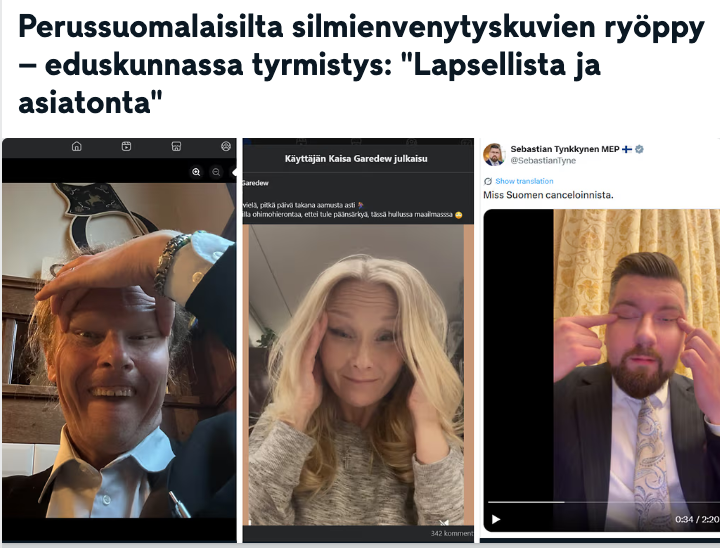
Even if Finland’s far-right Perussuomalaiset (PS)* party is silent but supports in principle the NSS, the recent racism slanted-eye scandal involving two MPs and an MEP, tells us that racism is the anti-immigration party’s DNA.
An interesting question we can ask is why this particuar racism scandal, which insulted Asians got so much attention? The party normally attacks Muslims and other racialized minorities without any major consequences.
Is it because Asians are considered closer to “white” Finns than say Arabs?
Below, is a shameful picture of the PS politicians who said they “didn’t mean to insult anyone.”
From left to right: Juho Eerola, Kaisa Garedew ja Euroopan parlamentin jäsen Sebastian Tynkkynen. Photo: Facebook.
At a recent parliamentary session Thursday, Finance Minister and PS chairperson Riikka Purra gave a surreal answer when grilled by opposition politicians abour the scandal.
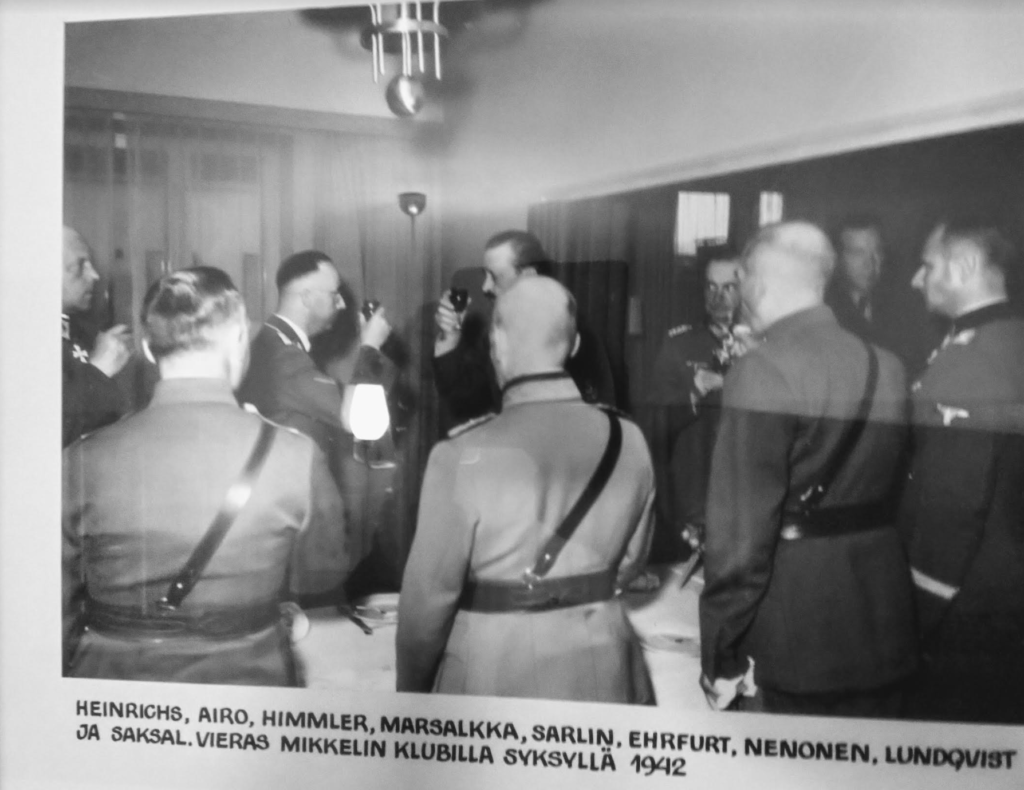
This picture below on the wall of the Mikkelin Klubi. located 230km north of the capital Helsinki, was one of the main reaons why I quit my membership. Everytime I inquired about the infamous picture of Heinrich Himmler with Carl Gustaf Mannerheim, I’d get a knee-jerk response: “it’s history (so it’s ok).”
Even if this may be the case, the picture is displayed without any context like why are Himmler and Mannerheim toasting together and what was the country’ relationship with what Nazi Germany? What about complicity in the “Final Solution,” the genocide committed against the Jews, Roma and other enemies of the Nazi regime?
Himmler is not the only war criminal on the wall of the club. You will also find Alfred Jodl, found guilty on all four counts (conspiracy, crimes against peace, war crimes, and crimes against humanity) and sentenced to death. In my opinion, the pictures on the wall of the club display history but it is done without context, which makes it problematic. If you wish, you can pay tribute to the sinister alliance between Finland and Germany and be a closet Nazi if you wish.
The text above reads: “Heinrichs, Airo, Himmler, Marshall, Ehrfurt (sic), Nenonen, Lundqvist and a German visitor at the Mikkeli Club in fall 1942.” In 1942, Operation Reinhard, which aimed to liquidate Polish Jewry, was in full swing.
Treblinka was one of the many extermination camps of Operation Reinhard, the deadliest phase of Nazi Germany’s intention to commit genocide against the Jewish people.
Those pictures and our justification for joining the Nazi cause in World War 2, could explain why Finland is incapable of tackling its growing racism problem. Hannah Arendt famously called it the banality of evil.
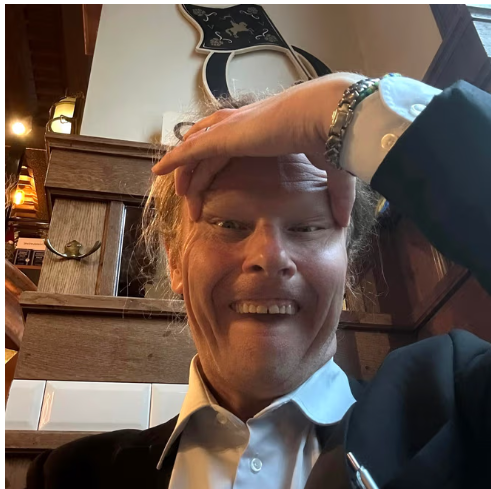
The person below is none other than Perussuomalaiset (PS)* MP Juho Eerola, who infamously said that he liked Italian fascist Benito Mussolini’s economic system because there was full employment. His list of racist rants have accompanied him through his political career. In the latest scandal (see picture below), he apologizes to Asians.
Apart from bein an MP, he used to be speaker of parliament and today chairs the legal committee. He’s even made a video where he is being shoved a dildo up his rectum.
Eerola regrets that his image has been interpreted as racist. Interpreted as racist?! It WAS and IS racist.
“In this context, I would like to say to all people of Asian descent that I apologize if this is how it came across,” he was quoted as saying in Yle. “It was by no means my intention to offend them.”
Juho Eerola didn’t mean to be racist with the picture. He is a good example of the far-right’s aim at destroying the crediblity of Finland’s institutions. Disagree? See what Donald Trump is doing n the US.Yle.
What is surprising is the reaction of the National Coalition Party like MP Pia Kauma, who has had her share of issues with racism, considered the action of MPs like Eerola as “childish and inappropriate.”
“Social media posts are childish and inappropriate,” she said in Ilta-Sanomat. “Members of Parliament are expected to behave in a dignified and respectful manner. Fooling around on social media at the expense of racism certainly does not meet these standards.”
Finland has received a lot of migration from Asia and therefore, the recent racist outburst by MPs of the Perussuomalaiset (PS)*, a member of government, could serve as a welcome ad for Asian migrants. The ad could read: Migrate to Finland. There is no racism and you’ll be treated with respect.
Sarah Dzafce lost her Miss Finland title when she was posted with a racist picture below, stating that she is eating with
Sarah Dzafce eating with a Cheinese person.
Even if the Miss Finland organizers did the right thing, MPs from the PS below started to copy Dzafce’s racist gesture.
From left to right: Juho Eerola, Kaisa Gredew ja Euroopan parlamentin jäsen Sebastian Tynkkynen. Photo: Facebook.
Also, Prime Minister Petteri Orpo welcomed Asians with his usual defeaning silence.
Lauantai-ilta Otavan ainoassa baarissa, noin 14 kilometrin päässä Mikkelistä, sai pelottavan käänteen kahdelle miehelle, jotka kertovat joutuneensa rasististen solvausten ja uhkausten kohteiksi pian kello kymmenen jälkeen.
“Mukavaksi tarkoitetusta illasta tuli vaarallinen tilanne,” sanoi toinen miehistä, joka pyysi saada pysyä nimettömänä traumansa ja jatkuvan turvallisuushuolensa vuoksi.
Hänen mukaansa kaksikko istui pöydässä nauttimassa livemusiikista, kun kaksi näkyvästi päihtynyttä miestä lähestyi ja yritti provosoida tappelun.
“Toinen miehistä löi aasialaista ystävääni päähän kulkiessaan ohi ja alkoi sen jälkeen uhkailla häntä käyttäen toistuvasti n-sanaa,” hän kertoi.
Välttääkseen ongelmia miehet siirtyivät toiseen pöytään, mutta häirintä jatkui. Miesten väitetään toistaneen rotusolvausta ja esittäneen toisen halventavan kommentin uhreille.
Järjestyksenvalvojat saapuivat paikalle ja poliisi kutsuttiin. Rasistinen häirintä jatkui ennen kuin hyökkääjät poistuivat baarista ja odottivat tietojen mukaan miehiä ulkopuolella.
“Päätimme lähteä ennen poliisin saapumista. Halusimme vain päästä takaisin Mikkeliin,” toinen miehistä sanoi.
Kaksikon mukaan tapaus sai heidät tuntemaan olonsa epävarmaksi pienempien paikkakuntien yöelämässä.
“Olin shokissa noin viikon,” toinen heistä sanoi. “Tämä on ensimmäinen kerta, kun jotain tällaista on tapahtunut minulle Suomessa.”
Mitä sinun kannattaa tehdä, jos joudut rasistisen häirinnän uhriksi?
Varmista ensiksi, ettet ole vaarassa.
Soita poliisille numeroon 112.
Ota puhelin esiin ja tallenna hyökkääjä. Tallennetta voidaan käyttää todisteena.
Jos henkilö hyökkää kimppuusi ja voit osoittaa sen johtuvan taustastasi, se voi täyttää viharikoksen tunnusmerkistön.
Tapauksen vakavuudesta riippuen poliisilta voi kestää kuukausia ennen kuin syytteet nostetaan.
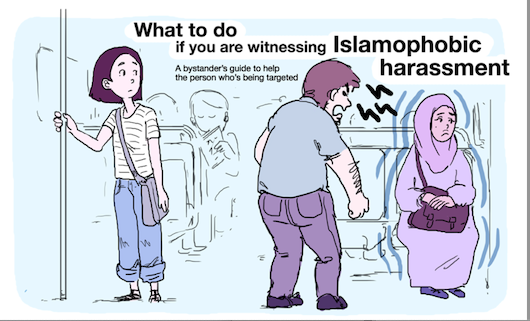
Yksi pahimmista asioista on usein sivullisten hiljaisuus. Alla on yksi tapaus, josta voi olla apua.
A Saturday night at Otava’s only bar about 14 kilometers from Mikkeli, took a frightening turn for two men who say they were targeted with racist insults and threats shortly after 10 p.m.
“What was supposed to be an enjoyable evening turned into a dangerous situation,” said one of the persons, who requested anonymity due to trauma and ongoing concerns for his safety.
According to his account, the pair were seated at a table in the bar, enjoying live music, when two visibly intoxicated men approached and attempted to provoke a fight.
“One of the men struck my Asian friend on the head as he walked past, and then began threatening him while repeatedly using the n-word,” he said.
Trying to avoid any problems, the two men moved to another table, but the harassment continued. The men allegedly repeated the racial slur and directed another derogatory comment toward the victims.
Security personnel arrived, and the police were called. The racist harassment continued before the aggressors left the premises and were reportedly waiting outside for both men.
“We decided to leave before the police arrived. We just wanted to get back to Mikkeli,” one of the men said.
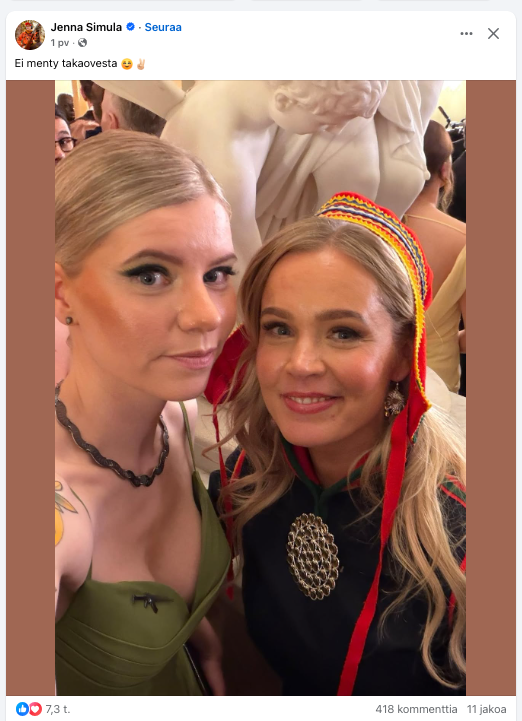
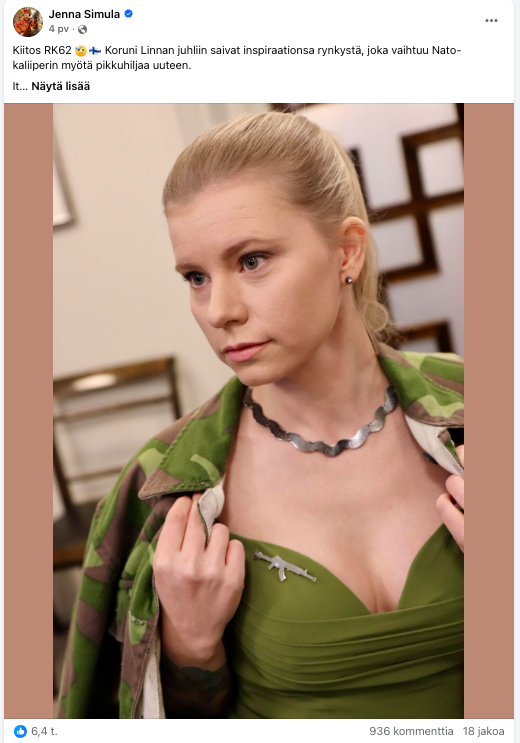
The picture uploaded on Facebook at the Independence Day gala says it all about the far-right Perussuomalaiset (PS)* party: on the left MP Jenna Simula showing off her assaut weapon pin and on the right MP Sara Seppänen doing her cultural appropriation masquerade by impersonating a Saami.
Both MPs pose shamelessly: Simula glorifying a weapon and Seppänen masquerading as a Saami.
The picture tells volumes about the fantasies of the PS.
Why President Alexander Stubb says and finds himself in funny places.
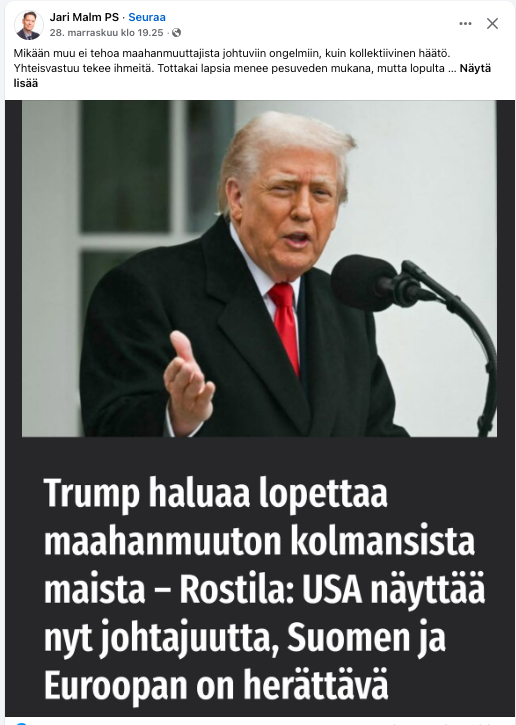
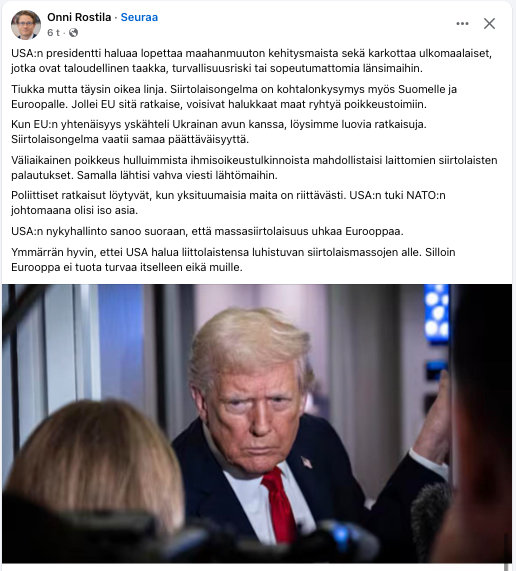
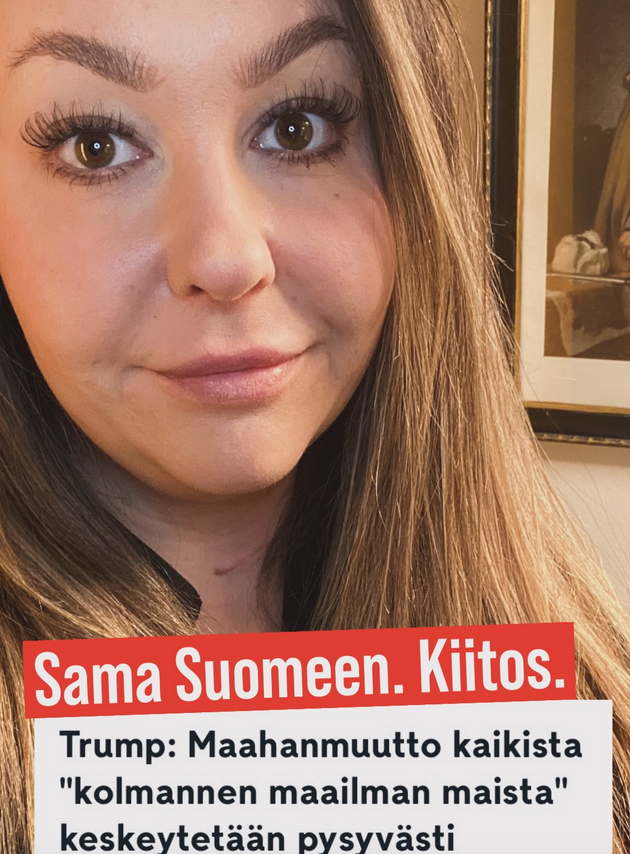
PÄIVITETTY Se ei kestänyt kauan, kun Perussuomalaiset – muun muassa kansanedustajat Onni Rostila ja Sanna Atikainen – toistivat Yhdysvaltain presidentti Donald Trumpin ilmoituksen keskeyttää maahanmuutto kolmannen maailman maista sen jälkeen, kun afganistanilainen ampui kaksi kansalliskaartin sotilasta.
On selvää, että Trumpin kansallinen turvallisuusstrategia tähtää Perussuomalaiset-puolueeseen auttaakseen sitä saavuttamaan rasistisen tavoitteensa.
Kysymys kuuluu: mitä aiot tehdä niille kolmannen maailman kansalaisille, jotka jo asuvat Euroopassa ja Suomessa? Onko vastaus ”lopullinen ratkaisu?”
Saksan ulkoministeri Johann Wadephul totesi, että Yhdysvallat on edelleen tärkeä turvallisuusalan liittolainen, mutta ”ilmaisunvapaus tai vapaiden yhteiskuntiemme organisointi” eivät kuulu tähän kategoriaan, hän sanoi Guardian-lehdelle.
Kuinka Eurooppa pitäisi herätä? Hankkia VR:n ostamaan tavaravaunuja?
Sama kysymys, mutta et vastaa: mitä aiot tehdä täällä asuville kolmannen maailman kansalaisille? Joukkokarkotukset?
Puhut turvallisuusriskeistä. Oletko koskaan ajatellut, että SINÄ ja puolueesi olette turvallisuusriski Suomelle?
US President Donald Trump’s most recent tirade against Somalis should not only be seen as hostile racism, but show once again how such a social ill us used to seek attention and power. On Thursday we heard about the US’ National Security Strategy, which warns Europe of “white civilization erasure” and throws its support to far-right parties.
The Kremlin came out and gave its full support or the strategy.
Reports the Guardian: “The Kremlin has heaped praise on Donald Trump’s latest national security strategy, calling it an encouraging change of policy that largely aligns with Russian thinking.
While the National Security Strategy offers us a glimpse of the Trump Administration’s racist and colonial mindset, I wonder if it support for nationalist far-right parties includes the Perussuomalaiset (PS)?*
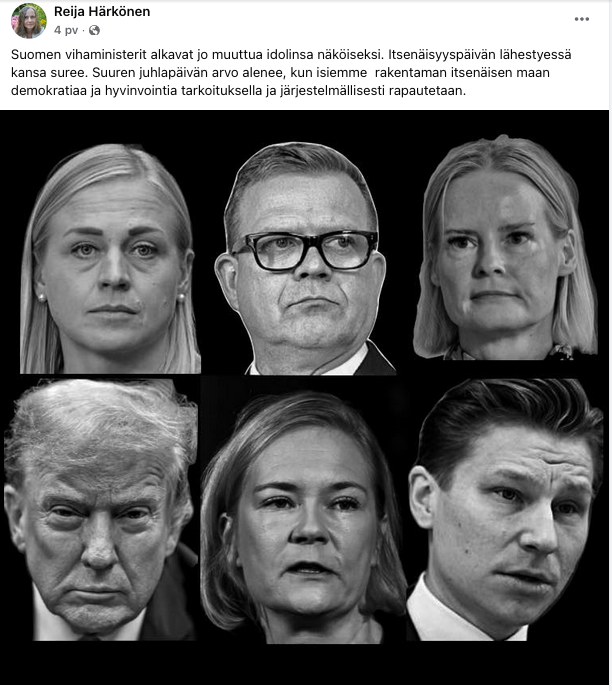
Even if Finland’s far-right party candidate in the US’ National Security Strategy would be the PS, it could also include the National Coalition Party (NCP), which is in government with the PS. Promoting anti-democratic measures would be (top left to right) NCP Foreign Minister Elina Valtonen, who is an apologist of Israel’s atrocities in Gaza, NCP Prime Minister Petteri Orpo who has helped racism grow in Finland, PS Finance Minister Riikka Purra, who impoverishes the country and puts the racism icing on it; (bottom left to right) Donald Trump, a racist felon, PS Mari Rantanen who sees migrant monsters under her bed, and NCP Defense Minister Antti Häkkänen, who fuels fear of the Russians.
Write Reija Härkonen on the Facebook posting: “Finland’s ministers of hate are already beginning to resemble their idols. As Independence Day nears, the nation mourns. The significance of this great holiday is shut when the democracy and welfare of the independent country, built by our forefathers, are deliberately and systematically eroded [by them|.“
The PS’ view of US Vice President J.D. Vance’s las year’s speech at the Munich Security Conference was more than supportive and a turning point in US-Europe relations. Vance, who gave his direct support to far-right policiatl groups like AfD of Germany, did not mention the PS. However, PS Minsiter of Finance Riikka Purra praised Vance’s speech.