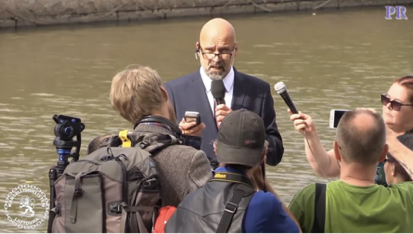
It is revealing to read comments from the Islamophobic Perussuomalaiset (PS)* party about Friday’s bombshell news: the police detained a former PS politician and a far-right Nazi-spirited activist on suspected attempted murder charges against Pakka Kataja.
Starting from PS chairperson Jussi Halla-aho, who was convicted in 2012 for ethnic agitation and breaching the sanctity of religion, was quoted as saying in tabloid Ilta-Sanomat: “It’s difficult even to believe one’s own eyes when reading this news [about the arrest of the suspects].”
In April, I had the opportunity to interview Yaron Nadbornik, the president of the Jewish Community of Helsinki. One of the matters that struck me of the interview was that in 2018-2019 the authorities started to recognize anti-Semitism as a problem.
Today the police took into custody two far-right activists charged for the attempted murder of Pekka Kataja, a Perussuomnalaiset (PS) councilor of Jämsänkoski, who was brutally attacked by two suspects.
Teemu Torssonen (left) is a municipal politician from Jyväskylä, who was sacked from the Perussuomalaiset (PS)* party last year. Tero Ala-Tuuhonen has a murkier far-right record with ties to far-right groups like Kansallismielisten liittouma,of which he is the chairperson, Soldiers of Odin, neo-Nazi Kohti vapautta!, among others. PS MP Mauri Peltokangas is one of many politicians of the same party that participates in events organized by the far right. Note the Kansallismielisten liittouma logo on the lower left of the snapshot above. The group’s chairperson Ala-Tuuhonen was detained today on suspected attempted murder charges.
Even if Kataja suspected one of these two as a “person of Arabic origin,” he later changed his story and blamed the attackers for being members of the far-right.
While it is a good matter that Kataja’s attackers were apprehended by the police, it does raise a lot of questions about the rise of the far-right, Islamophobia, and racism and what the authorities are doing to counter these types of threats to our society.
A 2020 survey showed that 91% trusted the police, down from 95% in 2018, according to the Police University College. Other studies have pointed out that trust in the police is high, even among migrants.
Despite the high amount of trust, the police service has not been immune to scandals.
The latest one involved a senior police constable, who was sentenced by the district court of the Päijät-Häme region for aggravated assault and breach of duty, according to Yle News.
The fact that this case became public is a step in the right direction that should strengthen and not erode confidence in the police.
Even so, many matters do erode confidence. One of these is an alleged case of aggressive and dehumanizing treatment of a black father and his son by the Helsinki Regional Transport Authority (HSL) and the police, according to the Helsinki Times.
Even if the passengers did not have a valid ticket, one could ask if this is how such an incident ends: humiliation, security guards, and the police.
How many white Finns end up in this situation if they don’t have a valid AB-zone ticket, which costs 2.80 euros!
Let’s assume that there is no ethnic profiling involved and that white Finns receive the same treatment as a black person.
Even so, this type of news does more to destroy the credibility of the police and the HSL ticket inspectors than anything else.
Other big trust busters are ethnic profiling and institutional racism.
“Since leaving the White House in 1981, Rosalynn and I have strived to advance human rights in countries around the world. In this quest, we have seen that silence can be as deadly as violence.”
Jimmy Carter
Some sectors of the media and other people like teachers believe that silence is the best response to racism spread by politicians.
One former journalist of the Mikkeli-based Länsi-Savo believed a few years ago that the best way to challenge racism was not to notice it.
Perussuomalaiset (PS)* chairperson Jussi Halla-aho offers us many examples of the racism spread by politicians in Finland. His comments on migrants, especially asylum seekers, reveal a pathological obsession with the topic.
A new case of aggressive and dehumanizing treatment of a black father and his son by a Helsinki Regional Transport Authority (HSL) train ticket inspector and later on by the police, according to Helsinki Times. The reason: Not having a valid train ticket.
Both the father, David Gill, and his teenage son Max were returning from a basketball tournament in Tampere.
The event, which was a traumatic incident that won’t be forgotten for a long time by the father and son, reveals a system and problem on HSL’s transport.
In the last three months, the cases of aggressive and unprofessional treatment by HSL train inspectors or security guards became public on social media in June and July. The latest incident took place on August 5.
The first incident that received wide coverage on social media involved an East African nursing student removed aggressively from the train. In contrast, the following month involved a minor, also black, who was manhandled by the security guards for not having a valid ticket.
In all three cases the victims are black and on HSL-run trains.
In one of the videos below, the father, David Gill, asks the police what they are doing as they detain him. “Why are you searching me? What did I do? I didn’t do anything! I called the police as well!”
The statement by the father that he called the police as well as a sad reminder of what happens when foreigners ask for help. You call for help, and you get detained because the police give the benefit of the doubt to the security guards.
Below is a Helsinki Times account of how the incident developed:
Perussuomalaiset MP Veikko Vallin tweeted an apology for the “mistake” of publishing pictures of children and workers at a nursery school. Even if he is sorry, he stated that his “critical opinion” of women using a chador at nursery schools has not changed.
Vallin’s action of taking pictures of children and workers at a nursing home was unbecoming of an MP. The images not only exposed his racist side, but it also showed how much some politicians, especially from the PS, do to crave their need for media attention.
The PS MP states in the original tweet that the black chador used by a Muslim woman scares him because it reminds him of Isis, which have been pictured in refugee camps in Syria wearing the niqab.
Source: eurodebates.tv
A grown man who is afraid of women wearing a chador?
Give me a break! This Trmp-imitating politician must be even afraid of mosquitos.
Vallin and the PS pulled one of the oldest tricks used by racist politicians:
Make a racist statement or claim;
Say you are sorry or remain quiet if a reporter proves what you said was a lie;
Despite all the commotion, your base will love you for what you said;
The aim is to get media attention and communicate with your base, who does not care if what you said was racist or immoral.
One of the most surprising matters about the story is not what Vallin did, but the deafening silence of other politicians and the media.
Only the tabloids, MTV and a handful of others covered the story.
Few of us will forget the 2011 parliamentary election when an Islamophobic and no-holes-barred racist party saw the number of MPs rise to 39 from 5 in 2007.
Even if the result was a wake-up call for Finland, the reaction to the rise of the Perussuomalaiset (PS) as a major political force. Some shrugged off the election as an anomaly and it would only be a matter of time when the PS would implode, like the Rural Party (SMP) in the 1970s.
It’s been near a decade since 2010 and the PS hasn’t imploded, disappeared but strengthened and influaneced its racist message on other parties like the National Coalition Party (Kokoomus).
Some analysts saw the rise of the PS as a direct answer to mounting social and economic inequality.
It could be a factor, but does growing social inequality turn you into a scapegoating racist?
Certainly not unless you had such issues before.
The most successful party of the 2011 (39 MPs), 2015 (38 MPs), and 2019 (39 MPs) parliamentary elections has been the PS. Even if suffered a hiccup in June 2017, when the party split into two factions, the PS, it has survived and lived to see another day.
When some Finns and parties talk about returning to the “good old days,” they are saying that they’d like to return to the days when foreigners had practically no rights and where racism was king.It was also a time of appeasement to the former Soviet Union, media self-censorship, impunity, and human rights abuses.
One of the most quaint matters about those who want to take Finland back to the good old days is that they weren’t even born during those troubled times.
The treatment of asylum seekers and watching over their rights brings stark memories of the good old days. Take back Finland? Source: Twitter
What kinds of laws were in force back then? The list below is by no means exhaustive:
Finland did not have any immigration act until 1983, or about 66 years after independence;
The Aliens’ Office granted residence permits on a one-by-one basis;
The Aliens’ Office under Eila Kännö functioned like a state within a state;
Even if Finnish women were the first to get the right to vote in Europe in 1906, they could not pass on Finnish citizenship to their born child until 1984;
Foreigners did not have the right to appeal if deported;
Police surveillance of foreigners by the Finnish Security and Intelligence Service (Supo) was standard;
Supo had a register of foreigners that showed which demonstrations the person had taken part in and if he or she supported human rights;
Human rights abuses of asylum seekers were the rule;
Soviet citizens were denied asylum in Finland even if they requested it;
Finland returned tens of thousands of Ingrians and Estonians at Moscow’s request;
There were so few foreigners in the 1970s (under 12,000) that the biggest national groups were Finns who were naturalized Swedes;
Racialization was the rule and carved in stone;
Foreigners could not own or publish newspapers;
The Finnish media portrayed asylum seekers from countries like Somalia in an overtly racist manner;
Journalists, except for editors, were not allowed to write about Finland’s special relationship with the former USSR;
Finland was ruled by a strongman, Urho Kekkonen, from 1955 to 1982;
Under the Restricting Act of 1939 (219/1939), which became redundant in 1992, foreigners were not allowed to acquire a majority stake in a Finnish company;
Ownership limits of Finnish firms were 20% normally and 40% under special permission;
Foreigners could not own shares in sectors such as forestry, securities trading, transportation, mining, real estate, and shipping;
Foreigners could not own land;
Most Finns never heard of pizza;
Food markets had very few if any foreign produce.
Does any democratic-loving person who respects human rights want to return to the good old days of above?
Migrant Tales insight: This story was written by a member of the Somali community and edited by Migrant Tales the following week after a young Somali Finn was knifed and killed at the Helsinki Kannelmäki train station. The letter will be published as charges against the suspect will be apparently made public by the police this week,
Many questions abound.One of the most important is if the tragic death of the young man was a hate crime and if not, why? What were the bias motivators? Was it witness perception? Intense violence? Difference between the victim and the perpetrators’ ethnic background? Or was there no other obvious motive, which is also a bias indicator. Some in the Somali community believe what happened was motivated by ethnic background. It is an important question that needs answering.
I first heard of what happened at home celebrating and breaking my fast on Sunday [April 26, 2020] night during the holy month of Ramadan. My mother knows the victim’s parents and they are devastated. Shortly before the death, the mother of the young man suffered another death when her child was born without life.
The death made me first angry, but then I told myself that this was going to happen since I live in such a racist country.
The roots of this tragedy go back to when the mayor of Helsinki [Jan Vapaavuori] labeled the Somalis [on April 14] as those spreading coronavirus. What he did was label us as part of the coronavirus problem of Finland. Anybody could see what was going to happen next. People get scared, and the racists get more aggressive and start targeting you.
Since I was a child, I have experienced racism in Finland. In the early 1990s, I was scorned at because of my skin color, but now it is also because I am a Muslim. It’s a double whammy.
Living in a racist society is scary and especially for our elders who may not speak Finnish well enough to understand or talk back to people who harass them in public.
What happened [in Kannelmäki] reinforced what many of us Somalis feel in Finland. What happened on Sunday could happen to us. And it has, before.
I don’t trust the police that they will bring justice to what happened.
Are the police going to sweep the issue of racism under the rug? Are they going to conclude that the suspects had mental issues? Were under the influence of alcohol or drugs? Are hardened criminals? Or grew up in broken homes?
Everyone should ask themselves why these two men were carrying knives.
When I go out, I have a goal: I go to work, go to the market, or some other place. What purpose did these men have by carrying knives?
For me the answer is simple. To hurt, or in this case, to kill a Somali.
If politicians like MP Ano Turtiainan lived under the Nazi regime, it pretty clear what his view of the Holocaust. The disgraced politician, who mocked George Floyd’s death, now offers his “understanding” for Greece’s decision to secretly round up over a 1,000 asylum seekers and abandoning them on the open sea.
Turtiainen tweets: “It’s a totally natural matter that this happens [Greece abandons asylum seekers on the open sea]. At some point, each country’s [tolerance] reaches a limit.”
We all are well aware of Turtiainen’s racist world view. What is especially worrying about the tweet concerning asylum seekers is the silence, which is a political statement.
In the 2019 European parliament elections, a total of 234 Euro election candidates answered Alma Media’s election compass, a total of 85 (36.3%) of them stated that they either “strongly disagree,” “disagree” or are “neutral” (have no opinion) about the following claim:
“Is it the obligation of the EU to save all those migrants who attempt to come to Europe and who are at risk of drowning in the Mediterranean?”
Not only Islamophobic PS candidates were ready to let people drown in the Mediterranean, but also from mainstream parties like the National Coalition Paty (9/45% of candidates), Center Party (7/35%), Swedish People’s Party (4/20%), Christian Democrats (4/20%) and the Social Democrats (1/6.3%).
Could a second Holocaust or systematic mass murder happen in Europe again in the face of ethnic and racial “purity?”
Turtiainan’s tweet and silence of Finland’s politicians, coupled with EU inaction on effective immigration policy, are worrying signs about our propensity for systematic mass murder.
Here is something to remember what Captain Gustave Mark Gilbert, the Army psychologist at the Nuremberg trials (1945-46), said about the Nazi war criminals on trial. All of them, according to him, could not feel with their fellow men. He said: “Evil, I think, is the absence of empathy.”