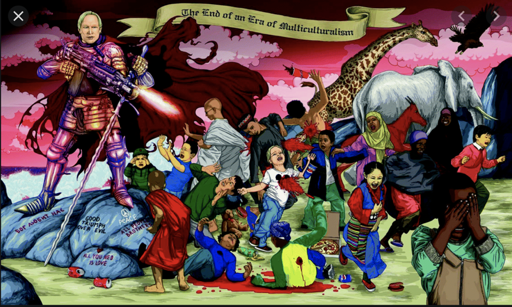
The Pekka Kataja story, the Perussuomnalaiset (PS) councilor of Jämsänkoski, is constantly changing. First, he claims that “Arab-looking” men assaulted him. That has now morphed into “possibly” it was the far right or far left.
Kataja even claimed that he was attacked due to his opinions of an asylum reception center, which he wanted to be closed.
The problem with the latter theory is that few if any at the asylum reception center has ever heard of him.
“The asylum seekers at the reception center don’t read Finnish papers so they are unaware of people like this man [Kataja], said a Jämsänkoski asylum seeker.
While we should forcefully condemn all types of violence, there is a generous dose of hypocrisy emerging from the Kataja affair. On the same day as Kataja was attacked, the family of Left Alliance Helsinki councilperson Suldaan Said Ahmed was threatened with a bb-rifle.
How many PS politicians condemed what happaned to Ahmed’s family?
Why isn’t anyone showing their repugnance for racism and hate speech perpetrated by parties like the PS?
We have recently read about two cases where security guards use force to handle a passenger that does not have a ticket. In both these cases, there is a link: both are black passengers. Both passengers were also on a transport or at a station operated by the Helsinki Regional Transport Authority (HSL).
The first case took place on June 23 in Espoo, while an East African nursing student was escorted violently out of the train. One security guard allegedly held her hand while the other had her in a chokehold.
“It was quite shocking when I saw this recent case,” said the East African nursing student. “I get nervous when I board a train because of what happened to me.”
The woman said that her lawyer has asked the police for the video footage of the incident but they have refused because the case “is still under investigation.”
The Helsinki Regional Transport Authority (HSL) announced today that the company plans to arrange “social equality” courses for ticket inspectors, according to Yle.
If the victims of both cases are correct, it exposes what we’ve known for a long time: Some have more rights in our society than others despite the social equality rhetoric we often hear and made possible by our exceptionalism.
Almost two weeks past when a 17-year-old black adolescent was allegedly violently assaulted by security guards for not having a valid ticket. The black adolescent ended up handcuffed and held on the floor while his white friend was allowed to leave.
The violent treatment of the security guards should not surprise us since a comprehensive study in 2018 on ethnic profiling by the University of Helsinki showed how ethnic profiling, especially by security staff, was a source of particular concern.
“Many said [in the study] that security guards were often rude and treated them roughly, even violently,” said the University of Helsinki Professor Suvi Keskinen of one of the ethnic profiling study’s findings.
The two cases in the story are a good opportunity to expose how systemic racism works in Finland.
How many black policemen are there in Finland? What about those that work for security firms? Too few to make a significant impact on policy.
And let’s not forget as well the racist trolling against the victim’s mother on social media.
The confidence of their impunity and ther racist arguments reveals how far some have stooped and how much work there is still to do on the anti-racism front.
Migrant Tales insight:Dr. Faith Mkwesha’s child was was held and mistreated by security guards who handcuffed him and resting his knee on her child’s back. Apart from being a traumatic experience for her child and the mother, all of this happened because he did not have a valid metro ticket, which he thought incorrectly that they were valid for two hours.
A recent column by Seida Sohrabi exposed, in my opinion, how people justify racism and social inequality. I and many others trust the law of this land while people like her have faith and trust institutional racism.
Sohrabi claims to have a master’s in political science; she is an elementary school teacher and gives talks about her views on how migrants should adapt to Finland.
If you read the column as well as her past opinions, I wonder if she understands how our Nordic society functions. She has probably read the Constitution, but like many populists, she does not take it seriously and relies more on society’s prejudices and institutional racism.
Moreover, if she has said before that schools should prohibit children from wearing the veil (hijab), does she prevent their use in her classes? Does she teach her pupils to hate their religion as she does?
Sohrabi, who is a close friend of Islamophobe pseudo authority on Islam, Atte Kaleva, is an example of how people with migrant backgrounds and minorities clamoring to create a space for themselves, will do and say anything to be accepted.
Sohrabi moved to Finland when she was six, which explains why she speaks Finnish without an accent. Is she a “foreigner” or a “Kurdish Finn?”
Atte Kaleva on the left with Seida Sohrabi promoting the politician’s book, “Jihad and Terror.” Already the title of the book should tell you that it is meant for populist and Islamophobic consumption. Helsinki University Middle East expert Hannu Juusola wasn’t too enthused by the book “Unfortunately, there are also an embarrassing amount of factual errors in the book. Read Juusola’s review (in Finnish) of Kaleva’s book here.
Just like a recent story on exploitation of migrants in the labor markets shows that many of these companies are run by migrants, many people with migrant backgrounds but who have lived most of their lives here house pretty Islamophobiv views of Muslims.
Sohrabi is not the only one in this questionable group. There are others like Morocco-born Junnes Lokka, Marco de Wit, who is of Dutch background, Miki Sileoni, whose father is Argentinean, and Gleb Simanov to name a few.
Black people who suck up to white USAmerica are called Uncle Toms. It’s a bit the same thing in Finland but in a different context. On the one side, they attack migrants and minorities who are struggling to create a space for themselves in their new or not-so-new homeland while on the other they cloy to white power.
The Urban Dictionary defines an Uncle Tom as, “a black man who will do anything to stay in good standing with the white man including betray his own people.”
It is unfortunate but true, in Finland we have migrants and minorities who will also do anything to stay in good standing to white Finns. Could we call these people “Tuomo-setä,” “setä Tuomo” or “mamu-setä?”
Moreover, I will continue to support and defend the laws of this land while others seek acceptance, encouragement, and refuge from institutional racism.
The mayor of Teuva Veli Nummela, the town’s newspaper Tejuka were straightforward about the attack against a Muslim in early June in the western Finnish town of Teuva.
Nummela wrote in a blog about the anti-racism work done at the town’s schools. “We will evaluate these practices [anti-racism] at the beginning of the new school year. We want to do our best in the fight against racism and violence and respect for human rights.”
Tejukka‘s June 17 editorial, “Measuring civility,” where it not only openly condemns what happened to the Muslim, but that “racism should not be accepted in any shape or form.”
The town newspaper published an editorial and several stories about the incident interviewing the victim, the police, and a foreigner living in Teuva.
If we look at the motive of the attack (bias indicators), there is a strong case to charge the perpetrators with a hate crime.
The police are not ruling out a hate crime but appear not to be in any rush to do so.
The police state: “For now there is no information that points to a hate crime but we are not ruling out such a possibility.” No evidence of a hate crime (bias indicator)? For one, check out the victim’s car. Source: Poliisi
So what makes what happened on June 7 to a young Muslim a hate crime?
A hate crime is a criminal offense that has a bias motivation targeting a particular group that could be based on real or perceived gender, sexual orientation, religion, ethnicity, age, or disability.
Even if crimes are serious offenses, a hate crime can have a lasting impact on the victim and the community.
https://www.youtube.com/watch?v=5PDz123cRT8
If we look at some possible bias indicators of the Muslim in Teuva in early June, they could be victim perception (white Finns versus a Muslim), intense violence (the victim ended going to the hospital), his property (a car) was damaged. Later there was graffiti written on it.
According to the Criminal Code of Finland (766/2015), Section 5, there are grounds for increasing the punishment if the crime “was based on race, skin color, birth status, national of ethnic origin, religion or belief, sexual orientation or disability of another corresponding grounds.”
I spoke with the Muslim today and he is recovering from what happened.
“I will move [from Kristiinankaupunki] to Helsinki at the end of this month,” he said. “I cannot live here because I am afraid to go outside.”
The reaction and impact of the crime have all the characteristics of how hate crimes affect the victim and community.
While hate speech is not a hate crime, in this case, it is a strong case for bias motivation. The suspects threatened to kill him, and while assaulted, an older man asked him to “ask Allah for help.”
I would be very surprised if the police do not charge the suspects for committing a hate crime. Contrarily, it would be another blow to police credibility and reinforce that the police are not interested in protecting minorities.
The bias indicators speak for themselves and suggest that what happened was no ordinary crime.
The year is 2020, and still, people of the Romany minority are refused entrance to a hotel and spa in Rantsalmi, located in the region of South Savo. Jim Crow is alive and well in some parts of Finland.
The receptionist of the Hotel & Spa Resort Järvisydän refuses entry in the video below to Roma women. When they ask if this is the hotel and spa’s policy, the receptionist says, “yes.”
It is shameful that this is still happening in a country like Finland, which claims to have one of the best education systems in the world, a comprehensive welfare state, and laws that are supposed to ensure that everyone is equal before the law.
Helsingin Sanomat published today an extensive investigative journalism story about the exploitation of foreigners by cleaning companies. Apart from Finnish (paywall), the full story is in English, Farsi, and Arabic as well.
The Helsingin Sanomat article writes about cleaning company employers’ false promises, exploitation and long working hours, underpayment of wages, human trafficking, threats, and blackmail, These sad facts are nothing new about how some cleaning companies operate in Finland.
Even so, it is a good matter that Finland’s largest daily by circulation writes about how greedy companies exploit the country’s most vulnerable groups.
Politics is another factor that distorts and undermines any meaningful steps to tackle exploitation in the Finnish labor market.
The Perussuomalaiset (PS)*, a party that bases its popularity on anti-immigrant racism and nativist nationalism, argues in parliament that foreign labor would drive down salaries.
Really? Do you mean that foreigners that enter the labor market are clamoring to be pad less than white Finns? Don’t they want to be paid the same salaries? Shouldn’t it be the job of the unions and society in general to protect the rights of migrant workers?
One factor that emerges from the exploitation stories of migrants and asylum seekers is that foreigners run many of these companies.
On SMC Cleaning’s webpage you will find only happy white people.
Here is a recent case of an asylum seeker who is a minor and worked at a car wash run by an Iraqi for 10 euros a week. Yes, you read correctly: 10 euros a week.
The owner had gone as far as to ask the minor’s father to pay him 30,000 euros so they could get a residence permit.
Bewilderment emergeswhenever Seida Sohrabi, who identifies herself as an expert on Kurdish affairs and elementary school teacher, comments on her narrow views of how migrants should adapt in Finland.
Having read her opinion pieces, I feel sorry for her Muslim students at the school she teaches. I hope their parents denounce her if she prohibits their daughters to wear the hijab or give them water-downed teachings of their religion by white Finns who are prejudiced.
Sohrabi is playing the “foreigner” and the media – and herself as well – loves it. Have you ever wondered how such eternal “foreigners” of our society speak perfect Finnish without any accent?
The reason for the latter is that they are Finns with non-white backgrounds but play the role of the “eternal foreigner” because it suits them, the media, and their peers.
They claim to represent other migrants but in fact, all they represent is their own unique group.
There are many others in the same league as her. Some of these are Morocco-born Junnes Lokka, Marco de Wit, who is of Dutch background, Miki Sileoni, whose father is Argentinean, and Gleb Simanov.
While Sohrabi and the people above come from different backgrounds, all of them hate one religious group: Muslims.
In the United States and according to the Urban Dictionary definition, an Uncle Tom “is a black man who will do anything to stay in good standing with the white man including betray his own people.”
In Migrant Tales, we have translated Uncle Tom to “Tuomo-setä,” “setä Tuomo” and “mamu-setä.”
Like in the United States, an Uncle Tom in Finland is a non-white Finn who will do anything to suck up to white Finnish culture even if it means sticking a knife in the back of his or her own people.
In the simplest terms, intersectional feminism is a tool to gain a broader view of how gender discrimination works. When studying gender discrimination, intersectionality enables us to take other factors as opposed to just one into consideration, like ethnic background, sex, disability, and sexual orientation.
One of the most preposterous affirmations Sohrabi makes is that new terms like intersectional feminism are not needed because social equality, gender equality, and fairness have characterized Finnish culture.
Really?!
How do you then explain high unemployment among some ethnic groups in Finland? Remember in October when they published a study by Akhlaq Ahmad about labor market discrimination in Finland? The study reinforced what we’ve known all along: ethnic discrimination is commonplace in Finland’s labor markets.
How come people of color or non-white Finns are underrepresented in almost in the media, politics, and policymakers? How come do people with foreign-sounding names earn smaller salaries and get less social security than white Finns?
Migrant Tales insight: When I published this story about four years ago, I imagined was certain that his presidency would be a fiasco. It was the same hunch I had in 2011 when the Perussuomalaiset scored their historic parliamentary victory. I wrote: “Far-right populism is an illness inflicting Europe at present and it now has a beachhead in Finland.”
It looks like Donald Trump is heading for an upset victory over Hillary Clinton in the US presidential elections, according to the New York Times.
A friend in California asked me a few weeks ago what would happen if Trump was elected US president. I told him that the demise of the United States as a world power would speed up. We are living in difficult times.
When will Trump build his infamous wall with Mexico? What about banning Muslims from the US? How many women will he grab by the genitals? How much racism and bigotry will he unleash in Europe on top of the racism and bigotry that we’ve seen already?
What are we to make of Perussuomalaiset (PS)* MP Sebastian Tynkkynen’s hate speech convictions? An Oulu appeals court upheld the PS MP’s second conviction for ethnic agitation. The first one was handed in 2017.
Two convictions are a pretty dark stain in an ordinary party, but for the PS, it may be a feather in one’s cap.
Tynkkynen may face further charges in a third hate speech case.
Is he planning to be the top MP with the most hate speech convictions?
It sure looks that way.
One of the most distasteful matters to read about ethnic agitation convictions are the excuses.
Writes Yle News: “He had argued that the post was political expression that was protected by freedom of speech. Tynkkynen also claimed that the text only referred to certain individuals, and did not imply that terrorism is unique to Islam.”
Tynkkynen plans to appeal the ruling to the supreme court and to the European Court of Human Rights.
The announcement by the PS MP clearly shows how little he understands what freedom of speech is. They act in such a hostile way for two reasons: they are bullies and political opportunists.
If politicians like Tynkkynen had their way, vulnerable minorities like Muslims would be put in a shooting gallery and attacked in the most hostile way possible.
It would be naive to think that words don’t have consequences.
The appearance of an Islamophobic party during this decade that spreads white supremacy and hate speech wholesale should concern us all.