An Espoo District Court sentenced Monday an eighteen-year-old man for six years in jail for the manslaughter of Abdisalam Mohamed Abulah, 18. The father of the victim, Mursal Abdulah, told Migrant Tales that he will appeal the decision.
Abdulah is one of three victims who lost his life in a span of about three weeks in January-February. Related to one of the killings in Finland’s “black February” was a suicide and a Perussuomalaiset (PS) councilor, who offered to give a medal to a white Finn for killing one of the Muslims in Oulu.
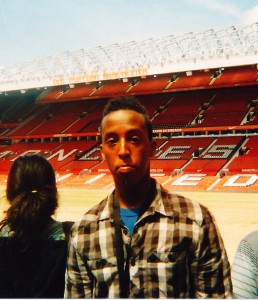
Abdisalam Mohamed Abdulah had plans to study medicine. He was a Manchester United fan.
Helsingin Sanomat reports that the victim, who attended the same high school as the sentenced young man, went to sleep at his home because he had lost the keys to his home.
Migrant Tales understands that the young man sentenced for manslaughter admitted consuming 16 bottles of beer and drugs when he killed Abdulah.
The fight erupted at the parent’s home of the young man, who slept in a room in the basement. He asked Abdulah if he was a Muslim, who responded that he was. He then asked Abdulah what he thought about Jesus.
Abdulah didn’t answer the question and told him that he did not want to talk about religion. There was silence between the two and soon a fight erupted, according to the sentenced man, who claimed that he feared Abdulah.
Abdulah lost his life when the assailant assaulted him on the head with a metal bar for weights.
The White Anti-Racist is an Oxymoron” (2003) by Kil Ja Kim argues that you cannot be white and against racism at the same time.
By “white” she does not mean having white skin. She means thinking of yourself as white and enjoying the benefits that come with it in America:
white people need to be willing to have their very social position, their very relationship of domination, their very authority, their very being…let go, perhaps even destroyed. I know this might sound scary, but that is really not my concern. I am not interested in making white people, even those so-called good-hearted anti-racist whites, comfortable about their position in struggles that shape my life in ways that it will never shape theirs.
Being white creates a conflict of interest that leads to white paternalism: whites who think they know what is best for people of colour.
Kim has seen it. So has bell hooks. So has Malcolm X:
So if we need white allies in this country, we don’t need those kind who compromise. We don’t need those kind who encourage us to be polite, responsible, you know. We don’t need those kind who give us that kind of advice. We don’t need those kind who tell us how to be patient. No, if we want some white allies, we need the kind that John Brown was, or we don’t need you.
John Brown led a slave uprising on the eve of the civil war: he died fighting for the freedom of black people.
Becoming anti-racist means giving up a white identity and standing with people of colour, not with white people. Come what may. It means not to lead people of colour but to follow. It means leaving the white club for good.
Kim breaks it down like this:
Don’t call us, we’ll call you. If we need your resources, we will contact you. But don’t show up, flaunt your power in our faces and then get angry when we resent the fact that you have so many resources we don’t and that we are not grateful for this arrangement. And don’t get mad because you can’t make decisions in the process. Why do you need to?
Stop speaking for us. We can talk for ourselves.
Stop trying to point out internal contradictions in our communities, we know what they are, we are struggling around them, and I really don’t know how white people can be helpful to non-whites to clear these up.
Don’t ever say some shit to me about how you feel silenced, marginalized, discriminated against, or put in your place as a white person. Period.
Stop calling me sister. I will tell you when you are family.
Start thinking of what it would mean, in terms of actual structured social arrangements, for whiteness and white identity – even the white anti-racist kind (because there really is no redeemable or reformed white identity) – to be destroyed.
Exactly a year ago Anders Breivik carried out his mass killings, which ended up causing the death of 77 innocent victims. Have we learned anything from that tragic Saturday that shook the Nordic region and changed it permanently?
In order to answer that question, we’d have to travel back in time to see how things were prior to that day.
In Finland, the right-wing populist Perussuomalaiset (PS) had just won a historic election victory that enabled the party to increase the number of its MPs to 39 from 5 in 2007. While party leader Timo Soini played down anti-immigration sentiment as one important factor behind the PS’ election victory, others disagreed.
Before Breivik erupted on the stage, anti-immigration parties like the PS were the new political force to contend with in Finland. It seemed that nothing could stop them from adding new election victories in the future. The louder and cruder their anti-immigration and anti-EU stances were, the more supporters they’d rally to their cause.
http://www.youtube.com/watch?v=xjVD0ztWaKA
In Norway, Denmark and Sweden, far-right populist anti-immigration parties had grown as well and were openly challenging traditional parties.
Everything changed, however, after July 22.
The first blow came in Norway to the Progress Party (FrP), which saw its support in the September municipal election plummet by 6.1 percentage points to 11.5%. In the same month, another anti-immigration party, the Danish People’s Party (DPP), suffered an election setback.
Since 2001, the Islamophobic DPP had supported minority right-wing government in exchange for tighter immigration policy.
In many respect, Breivik was a wake-up call that woke up for Finland and the Nordic region to the threat of intolerance and hate speech.
A recent supreme court ruling against Jussi Hall-aho is a case in point. The PS MP was not only fined for defaming a religion but for inciting ethnic hatred as well. The ruling wasn’t only a big blow to the PS but to the far-right Suomen Sisu wing of the party. Halla-aho was forced to resign as chairman of the administration committee, which, among other matters, sets immigration policy.
The presidential election was another important example of how Finland is distancing itself after 22/7 from the anti-immigration and populist rhetoric of parties like the PS.
Two conservative anti-EU candidates, Timo Soini of the PS and Paavo Väyrynen of the Center Party, lost to Green Party hopeful Pekka Haavisto in the first round of voting. Haavisto is openly gay and pro-EU.
The next test for the PS will come in the October municipal elections. If polls are anything to go by, the party will suffer another election setback.
In light of the above, can we claim that Breivik had had a direct impact on the popularity of the PS and other parties in the Nordic region that are anti-EU, anti-immigration and anti-Islam?
Your answer to that questions will probably reveal more than anything else your political views on immigration, Islam and cultural diversity.
But if we ask Norwegian Prime Minister Jens Stoltenberg, Norway had become after July 22 “more tolerant, [and] more careful not to judge people” by ethnic origin.
Even if Stoltenberg has shown leadership on how a wounded society should react to intolerance, it’s still unclear what impact Breivik will have on our societies. We are still healing from the wound and can matters return back to “normal” in Norway after Breivik?
If we set aside politics and try to understand the impact Breivik had on the region, one matter is certain: We are outraged by what happened but dread even more the possibility that it could happen again.
Competing for the anti-immigration thunder and rhetoric of parties like the PS, DPP, FrP and Sweden Democrats are far-right groups like the Finnish Defense League, which are copy-and-paste clones of the English Defense League.
Breivk scared the wits out of some of us and proved that anti-immigration and Counter-Jihad rhetoric can convert itself into a monster that has the ability to wreak terror and change our societies for good.
That I believe is the real message and threat of 22/7.
It is ironic that those right-wing populist and far-right parties that have gone out of their way to warn us about the threat of multiculturalism and religions like Islam have become the threat and Trojan Horses in our societies. In one horrific blow, Anders Behring Breivik did not only strike at Norway’s liberal democracy, but tore a hole in the argument of the anti-immigrant populists and fanatics.
In the Nordic region, living in a post-22/7 Europe and Nordic region means a serious loss of public face for those groups that have been the breeding ground for hatred towards immigrants and minorities. We know as well that Islamists are not the only ones who commit acts of terrorism, as the Guardian of London pointed out.
When these groups warn us today of the “threat of multiculturalism” and how it is acceptable to treat minorities with contempt, a killer called Anders Behring Breivik will haunt us in the back of our minds.
Every time these individuals and groups spread their usual rhetoric of hatred, we will stop to think and see Breivik’s eerie arguments and logic that drove him to become a mass killer.
When people go to the polls the next time in this part of Europe, some will see gruesome images of Breivik shooting down young members of the Labor Party. People will think twice whether to cast their vote for the Progress Party of Norway, Finland’s PS, Danish People’s Party and Sweden Democrats.
They will ask if supporting a party that bases its popularity on anti-immigration rhetoric is feeding future homegrown terrorism.
Possibly what happened on 22/7 will be a wake-up call for these parties to think about the impact their provocative claims not only have on immigrants but on deranged people like Breivik.
When Abdulah*, 30, talks to you about his twenty-two years in Finland, one of the first questions that arises is how has so much suffering escaped our attention. For Abdulah, acceptance isn’t only virtually impossible from white Finns, but can be just as hard to get from the Somali community.
“I have decided to live outside this society,” he says. “I have learned that there is no place here. Even my people have turned their backs on me.”
Abdulah says that there are two matters you must never lose if you don’t want to be abandoned by the Somali community.
“Language and religion are crucial,” he explains. “I don’t speak Somali that well anymore since I grew up in this country. I became an atheist two years ago and left the Muslim faith.”
How long will it take for minorities like the Somalis to be treated as equals in Finland?
Abdulah admits that he no longer believes in god.
“How can there be a god if people are constantly killing each other in Somalia?” he continues. “How can there be a god if there’s so much hatred and racism towards you in this country? How can god exist in such hells?”
There are many young men like Abdulah in Finland, who grew up the greater part of their lives in this country. He says that some have problems with the law.
“I don’t identify with such people anymore because I used to be one of them,” he says. “If you start drinking and taking drugs, your situation will only get worse. That’s the reason why I changed my life.”
Abdulah hasn’t forsaken hope despite the difficulties he’s faced. Two factors give him strength: his family and plans to be a gardener.
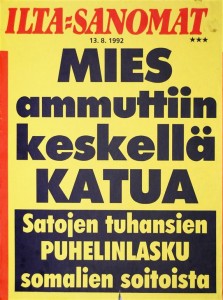
Billboards like these in the early 1990s spread prejudice about Somalis in Finland. The tabloid ad claims that Somalis had made phone calls to the tune of hundreds of thousands of marks and supposedly passed the bill to the social authorities.
“But living in Finland still feels like being in a trap,” he adds. “I want to free myself but I don’t know how.”
Abdulah discovered Migrant Tales by chance when he was searching for an alternative forum that spoke up for immigrants and visible minorities like him.
“I used to visit Suomi24, Hommaforum and even took part in Iltalehti chat forums,” he says.“They always said the same negative things about immigrants and Somalis. I felt relieved when I found Migrant Tales. It was like a light at the end of a dark tunnel that gave me hope.”
Abdulah is a very sensitive and respectful person. Despite the difficulties he’s encountered, he believes that one must be outspoken if he’s going to challenge a social ill like racism.
“We have to fight back,” he concludes. “Silence hasn’t changed my life for the better. That’s why I’m active in forums like Migrant Tales.”
*Abdulah’s name has been changed to protect his identity.
Even if I have never met Abdulah* in person but only by phone and through his comments on Migrant Tales, it’s as if we’ve known each other for a long time. Abdulah moved to Finland from Somalia in 1990 with his parents and six sisters. He was eight at the time.
When Abdulah came to Finland, there were only 21,174 immigrants living in the country, accounting for a mere 0.4% of total population, versus 183,133 (3.4%) today, according to the Population Registration Center.
“For a child from Somalia, moving to Finland was at first exciting,” he says. “We were starting a new life in a new country. I was fascinated by the snow.”
Abdulah says that his brief honeymoon with Finland ended abruptly when he started elementary school. He was the school’s first and only black student.
“That’s when the bullying started; I was even attacked physically by my classmates,” he continues. “Something bad happened to me almost every day at school.”
Being black in an all-white crowd can be sometimes dangerous in Finland.
Abdulah says that once all of his classmates, which numbered about 20, waited to attack him after school. Even a school “friend” assaulted him once with a knife.
“I’ve been bullied, called names like the n-word, insulted, kicked and hit hard at school,” he says. “The only way to survive was to be quiet and roll with the punches. There was nothing else I could do because the teachers never believed me. They were always on the side of the white students.”
“I’ve been bullied, called names like the n-word, insulted, kicked and hit hard at school,” he says. “The only way to survive was to be quiet and roll with the punches. There was nothing else I could do because the teachers never believed me. They were always on the side of the white students.”
Abdulah says that he’s tried to make friends with Finns but it has been virtually impossible. He did make some friends at school but their friendship never lasted long.
This type of tabloid ads were common in the early 1990s. It reads: “Armed refugee hater chased after blacks.”
“First they’re your friend and then they abandon you,” he says. “I was nine when I met a very nice boy at school. On the way to his home a friend of his meets us and asks him why he’s with me. He then told me right their on the spot that he could no longer be my friend.”
Even if the bullying has left deep scars on Abdulah, one of the worst memories he recalls was when he was nine and walking with his mother to the market.
“A drunk man attacked me on the street and started insulting me,” he says. “My mother called out for help but nobody came. That incident really traumatized me. I was only a child.”
Abdulah admits that growing up and living in Finland has made him paranoid. The election of an anti-immigration party like the Perussuomalaiset didn’t help dispel his fears about racism against Somalis in Finland.
The matter that concerns Abdulah the most about the Perussuomalaiet is their belief that Finns should not have children with blacks.
“With the election victory of the Perussuomalaiset that brought to parliament some fascist [anti-immigration] politicians like Jussi Halla-aho, James Hirvisaari and others, things started to turn ugly in this country from an already very bad situation for Somalis and blacks.”
Part 2 will be published Saturday.
*Abdulah’s name has been changed to protect his identity.
Such, that how I am missing myself.
I know a man who is an addict, addicted to beer. He drinks so much beer, he is always drunk.He is dizzy, dizzy like social welfare service offices( no doubt) He comes and sits on a bench in front of our building, in the coldness and warm, in the middle of snow, wind and sleet, in the darkness of winter and lighting of summer, he is here all the time.
It looks like he is a lover of this region Kallio. Perhaps he thinks our building is the best building in this world. Unlike me because I think this is the worst house in this world.
My heart burns very much for him. His looks harp on my liver and says, “Help me, help me”.
I don’t know if I should cry and beat the breast for myself or for him
Human beings are members of a whole
In creation of one essence and soul
If one member is afflicted with pain
Other members uneasy will remain
If you have no sympathy for human pain
The name of human you cannot retain
Its a poem by Saadi Shirazi, my darling Saadi
The children of Adam are limbs to each other, having created of one essence and soul
So I can’t look at him and be relaxed. He is a member of my world, of my earth.
We are friends with each other, a bit. I say ” hi” to him when I see him around. We talked a lot for almost one year and a half ago. He talked about his life. He has not any place for sleep, even in winter time he sleeps in the parks.
Freedom is good but not like this. People are so free to go and buy poison, alcohol, and punish themselves with it.
Sleeping Parliament * HELSINKI * should drink one pool of coffee, wake up and listen to these people, before our next generation becomes poisoned.
Why is that beer trade free?
Here in Finland???
Why does government abuse the LAW in the name of freedom???
Which law in Finland says that it is right to sale boxes of beer to these poor people????To youngsters and to our next generation?
People have problems. When a mountain of problems attack them, they feel fear and confusion. They lose themselves and in that time they find themselves in S market, K market, Siwa, etc. and alcohol will be their nerve and blood. It will destroy their lives, but this beer and alcohol will make some people rich. Those who this law and government support them. That is a bitter fact, but true.
They put salt on what is rotten.
But what about a day that salt is rotten???
You use salt to salt your food. You have government to keep people and society safe.
But when salt means government is rotten, how can you have a healthy society?
People complain about their problems to the law, but to who should they complain if the law itself is the problem?
What kind of worlds live inside the heads of people who make political statements by attacking an event like North Pride, a sexual-diversity festival organized through Sunday in the northern Finnish city of Oulu?
Writes YLE in English: “A discussion event in Oulu on the situation of gay asylum seekers was the target of a pepper spray attack that led one speaker to be hospitalized on Thursday evening.”
The hospitalized speaker was Left Alliance blogger and city councillor hopeful Dan Koviulaakso, who was rushed to hospital after an attacker pepper sprayed his face.
“It was no doubt a strategic attack against us as we oppose the persecution of gay, bi and transgender people. We’re against far-right extremists and racists,” said Left Alliance Oulu city councillor Juha Tapio, adding that security would need to be stepped up in the coming days.
Apart from condemning such an attack, it is a sad example of how intolerance roams freely our streets and mocks at our civil liberties and democratic institutions. The consequences of the attack become more ominous if we consider that on Sunday it’ll be a year after Anders Breivik killed 77 people in Norway.
Far-right anti-immigration/anti-minority groups should know that intolerance has no master. Nobody can control it if you let it out of the cage. It can bite back hard as we saw happen in Norway on July 22.
Finnish MPs, Jani Toivola (Green Party) and Silvia Modig (Left Alliance), are the official patrons of the event.
Hyvä Jussi Ahonen (ilmeisesti FDL:stä), kiitos seuraavasta viestistäsi:
“Jokaikinen muslimi ulos maastamme niin pian kuin mahdollista. Husein ensimmäisenä.” ([email protected] > [email protected], viime yönä noin klo 2)
Olen kuitannut viestisi. Harmiksesi joudun toteamaan, että toiveesi ovat hankalahkoja toteuttaa.
Ensimmäisen toiveesi suhteen: minä en ole millään tavalla kaikkien muslimien edustaja, joten en voi päättää, mitä he tekevät. Enkä liiemmin haluaisikaan.
Toinenkaan toiveesi ei ole kovin helppo: minulla kun ei ole kesälomaa, enkä siksi voi lähiaikoina lähteä Suomesta.
Ja toisaalta minähän nautin Suomen suvesta, toisin kuin näemmä Sinä, joka ilmeisesti kärsit univaikeuksista, kun pähkäilet maailmanmenoa hiki kaljullasi kello kaksi yöllä. Silloin katsos kunnon kansalaiset lepäävät voidakseen aamulla pyörittää yhteiskuntaa.
Mutta älä ole huolissasi. Syksyllä tulen olemaan pariin otteeseen poissa Suomesta. Silloin voinet hengittää. Muuten en ole vastuussa Sinulle siitä, jos tämän maan nykyinen ilmanlaatu ja ilmapiiri aiheuttavat Sinulle peruuttamattomia vaurioita.
Tiedän, että monet tulevat lukemaan tämän ja ihmettelevät, kuka ihmeessä oikein olen kun kirjoitan tänne näitä juttuja. Haluan kuitenkin olla rehellinen ja kertoa, keitä me olemme ja mitä mieltä me olemme asioista. En ole edustamassa ketään yksittäistä henkilöä, mutta tiedän tuovani esille monen ihmisen mielipiteen. Yritän parhaani mukaan olla suorapuheinen ja rehellinen – juuri sellainen, jona ystäväni minut tuntevat.
Tämän blogin ajatuksena on, että jokaisella olisi mahdollisuus tutustua Suomen somaleiden ajatuksiin ja mielipiteisiin koskien yhteiskuntaamme. Yritän tulevaisuudessa käydä keskustelua kanssanne mahdollisimman monista ajankohtaisista asioista. Minulle saa antaa myös rakentavaa palautetta, ehdotuksia ja kysymyksiä – yritän parhaani mukaan vastata niihin. En aio kuitenkaan haaskata aikaani turhiin kommentteihin, ja toivonkin, että asioista puhutaan reilussa fair play-hengessä.
Virtuaali- ja blogimaailmassa surffaillessani olen ikäväkseni joutunut huomaamaan, että somalialaisilla ei ole aiheen suhteen kovinkaan kehuttava maine. Ei ole harvinaista, että törmään kirjoituksiin, joissa meitä pidetään järjestäytyneinä ja paatuneina rikollisina. Useissa lähteissä viitataan myös siihen, että suojelisimme rikollisia. En todellakaan tiedä, mistä nämä ajatukset ja kirjoitukset ovat peräisin, mutta haluan nyt tehdä muutaman asian selväksi.
En missään nimessä vähättele Suomen lakia, vaikka se ei mielestäni täysin toimiva olekaan. Jos saisin tehdä siihen jotain muutoksia, voisin vakuuttaa, että rangaistukset tulisivat olemaan kovempia kuin nykypäivänä. Niin tai näin, meille somalialaisille rikoksen tekeminen merkitsee suurta häpeää ja sen tekijä tuomitaan aina ankarasti. Jos joku meikäläisistä syyllistyy rikokseen, hänet suljetaan pois yhteisöstämme. Uskokaa tai älkää, mutta yhteisön antama rangaistus ja häpeän leima tuntuvat paljon ja pitkään! Kun oma yhteisö sulkee jäsenensä ulkopuolelle, tapahtuma vaikuttaa sen kohteeseen henkisellä ja sosiaalisella tasolla merkittävän paljon.
Somalikulttuurissa yhteisöllisyydellä on pitkä perinne ja pakolaisuudesta riippumatta sitä on vaalittu uskollisesti myös kotimaan ulkopuolella. Perhettä ja sukua arvostetaan sekä kunnioitetaan, ja yhteisön merkitys koetaan erittäin tärkeänä. Somalialainen kulttuuri poikkeaa suomalaisesta myös siinä, että yhteisöön kuuluminen ja sen hyvinvointi nähdään usein yksilön hyvinvointia tärkeämpänä. Samalla kun meikäläiset opettavat ja korostavat omilleen yhteisöllisyyttä, suomalainen yhteiskunta kannustaa ihmisiä yksilöllisyyteen ja siihen, että ihmisen tulisi pärjätä omillaan. Eri viranomaisten, erityisesti lastensuojelu- ja nuorisotyössä, tulisi huomioida nämä kulttuurierot entistä paremmin.
Meillä somalialaisilla, kuten monilla muillakin kansallisuuksilla, on aina ollut oma tapamme kurittaa lapsiamme sekä yhteisömme jäseniä. Itse henkilökohtaisesti en kannata fyysistä rangaistusta missään muodossa, joten edes lapselle annettava ”tukkapölly” ei mielestäni ole hyväksyttävää. On kuitenkin muistettava, että useissa Suomeen muualta tulleissa perheissä heidän aiemmin tuntemansa rangaistuskeino (joka usein saattaa sisältää myös lievää fyysistä väkivaltaa) on otettu pois. Uusien kurittamiskeinojen opettelu vie oman aikansa ja suomalaisten suosimat ”Mene omaan huoneeseesi ja pysy siellä” tai ”Pestään suu saippualla” saattavatkin aiheuttaa hieman ongelmia suurissa somaliperheissä. Omalta osaltani olen pystynyt pitämään neljä lastani kurissa muun muassa yllä olevien lauseiden avulla – toivottavasti viesti menee perille myös tulevaisuuden lastenhuoneessa, joka muuttuu vuosi vuodelta villimmäksi. Uskon kuitenkin, että tavoistaan riippumatta jokainen vanhempi pyrkii antamaan lapselleen parhaan mahdollisen kasvatuksen, koska lapsethan ovat meidän tulevaisuutemme.
En voi vastustaa kiusausta lopettaa kirjoitustani muutamaan kuuluisaan lauseeseen: ”Viet meidän naiset!”, ”Syöt meidän verot!”, ”Viet meidän työpaikat” ja viimeisten vuosien aikana myös ”Terroristi!”. Näitä lauseita kuulen missä ikinä kuljenkin. Sisimmässäni kuitenkin tiedän, että näiden ennakkoluulojen täyttämien lauseiden takaa löytyvät vielä joku päivä ne ystävälliset suomalaiset, joita olen onnekseni tavannut jo runsaan määrän.
Päätin kirjoittaa tätä blogia siksi, että rakentaessamme siltaa kohti hyvinvoivaa Helsinkiä ja Suomea, kaikkien sillan käyttäjien tulisi olla varmoja ja tietoisia toisistaan. Yhteisymmärryksellä ja luottamuksella sillan tukipilareista rakennetaan niin kestävät, ettei niitä voi kaataa yksikään myrsky. Se on silta, jonka minä haluan rakentaa.