An immigration policy founded on racism and suspicion is bound to fail.
Prime Minister Petteri Orpo’s government has gotten off to a disastrous start that exposes how much out of touch it is with our Nordic values. Thanks to the radical-right Perussuomalaiset (PS) and their ties to neo-Nazi and far-right groups, Prime Minister Orpo is desperately trying to heal the government’s wounds with denials and political fairy tales.
The government is mortally wounded. It will only be a matter of time when the government will collapse.
PS MP Jani Mäkelä (left) and my badge of honor (right). Mäkelä claims that he wants to talk about the problems that migration brings. Sources: Yle and Twitter.
When listening to the PS and the National Coalition Party, one wonders if politicians like Orpo believe that people can’t see through their lies. How can you promise to uphold human rights, press freedom, and the rule of law if your policies expose the opposite?
In Finland, you can publish racist blogs, ask MPs to be raped, shoot gays, downplayed the Holocaust and end up as speaker of parliament, like Jussi Halla-aho.
It’s amazing, if not magical, how quickly far-right politicians of the Perussumalaiset (PS)* party can whitewash and deny their far-right and neo-Nazi sympathies. I am not talking about fringe politicians, but ministers in Prime Minister Petteri Orpo’s government.
You may ask how it’s possible to joke constantly, and for years, about the Holocaust, spread freely the great replacement theories and other ugly far-right things, and expect that everything is ok?
It may work most of the time, but it can backfire as happened with PS Minister of Economic Affairs Vilhelm Jussila, who resigned after eleven days of being minister.
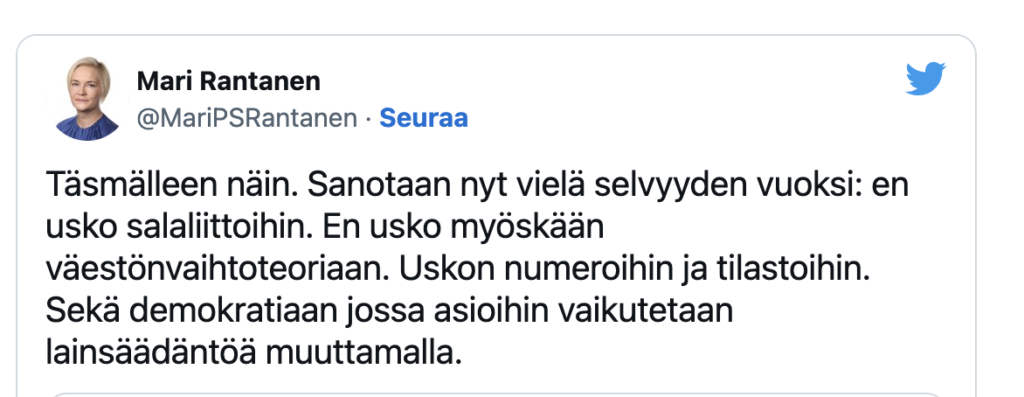
The latest scandal to hit the PS only two days after Junnila resigned, are three PS ministers, party chair Riikka Purra (Finance Minister), Mari Rantanen, (Interior Minister), and Leena Meri (Justice Minister). All three tweeted that they do not believe in the great replacement theory.
Halla-aho, who has never apologized for his racist writings, is also in hot water.
If Rantanen, Purra and Meri don’t believe in the far-right conspiracy theory that led to the death of 77 people in Norway in 2011 and the Christchurch massacre, among others, why are they now denying it?
Interior Minister Rantanen, who is a nurse and has had police training, is one of the most active Islamophobes in the government. She has relied on the great replacement theory to attract voters. Before the April election, she infamously stated on her webpage that, “We mustn’t be so naive [naive in Finnish means being blue-eyed] that soon we won’t be blue-eyed.”
The original post by Rantanen can no longer be read on her Facebook and webpage.
Why can’t we read Rantanen’s posting anymore on Facebook?
“Exactly as you said. Let me be clear: I do not believe in conspiracy theories. Nor do I believe in the great replacement of the population. I believe in numbers and statistics. And I believe in democracy, where you influence things by changing laws.“
If Rantanen didn’t say what she said, why does she so strongly deny the far-right conspiracy theory? Why does she even go as far as to point out that she believes change can only happen through democratic institutions?
If you read her tweet carefully, she does not renounce the great replacement theory but now talks about “numbers and statistics,” which back her original replacement theory.
Moreover, Rantanen does not offer us any statistical information, never mind any links, to back up her ludicrous and racist claim.
Rantanen, like Purra and Meri, crapped in her pants after what happened to Junnila. Their about-turn and new denials are a sign of cowardice.
Historian Jussi Jalonen summarizes in a tweet the three ministers’ change of heart.
What a show we saw in parliament Wednesday when radical-right Perussuomalaiset (PS)* Minister of Economic Affairs Vilhelm Junnila survived a no-confidence vote! The first visible cracks in National Coalition Party (Kokoomus) Prime Minister Petteri Orpo’s government became evident.
One of the questions that some may be asking is why does Kokoomus want to do business with a party that it turned down in 2017. The PS had imploded into two factions after the party elected Jussi Halla-aho as its new leader.
“Halla-aho’s Perussuomalaiset… their base values are so drastically different from ours,” he said. “They go against our most sacred values, human dignity, human rights, the concept of humanity, openness, and internationalism.”
Helsingin Sanomat asked Orpo five years after why the party had now qualms about sharing power in government with the PS. “The current Perussuomalaiset party, as it has evolved under Halla-aho and [Riikka] Purra, is such that I see no reason why we cannot negotiate a government program [with them],” he was quoted as saying.
Orpo’s assurances do nothing more than fuel mistrust because they are based on lies like what he said about Junnila. “Of course we do not accept any type of extremism, Nazism, Stalinism, or other ideologies that are dangerous to society or people,” he said in Helsingin Sanomat. “This is quite obvious. Everyone in Finland must be able to live a good life in safety.”
I wonder what minorities, migrants and asylum seekers think about Orpo’s statement.
Finland’s most right-wing government since the 1930s was hit by controversy on its first day Tuesday due to its links with neo-Nazis, the far-right, and unapologetic racist blog posts.
One of the epicenters of the scandal is Minister of Economic Affairs Vilhelm Junnila, whose neo-Nazi and white supremacist sympathies are readily seen through a trail of evidence.
Apart from taking part in a rally organized by far-right groups, Junnila congratulated in 2019 a Peerussuomalaiset (PS)* candidate for receiving the 88 election number. “First of all, congratulations on an excellent election number,” he was quoted as saying by The Times of Israel. “I know it’s a winning card.”
As everyone knows, 88 is code used by neo-Nazis to mean “Heil Hitler,” or “HH.”
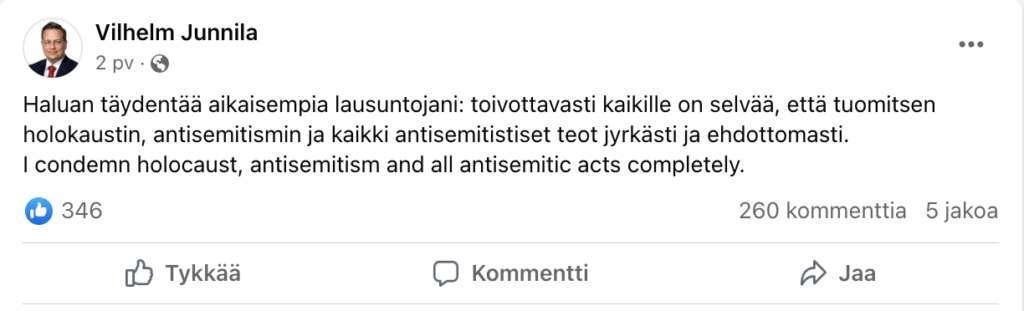
It is odd why Junnila now apologizes for such inappropriate behavior by stating on Twitter that “I condemn holocaust, antisemitism and all anti-Semitic acts completely.”
Sorry, but Junnila’s about-face apology is BS served on a platter.
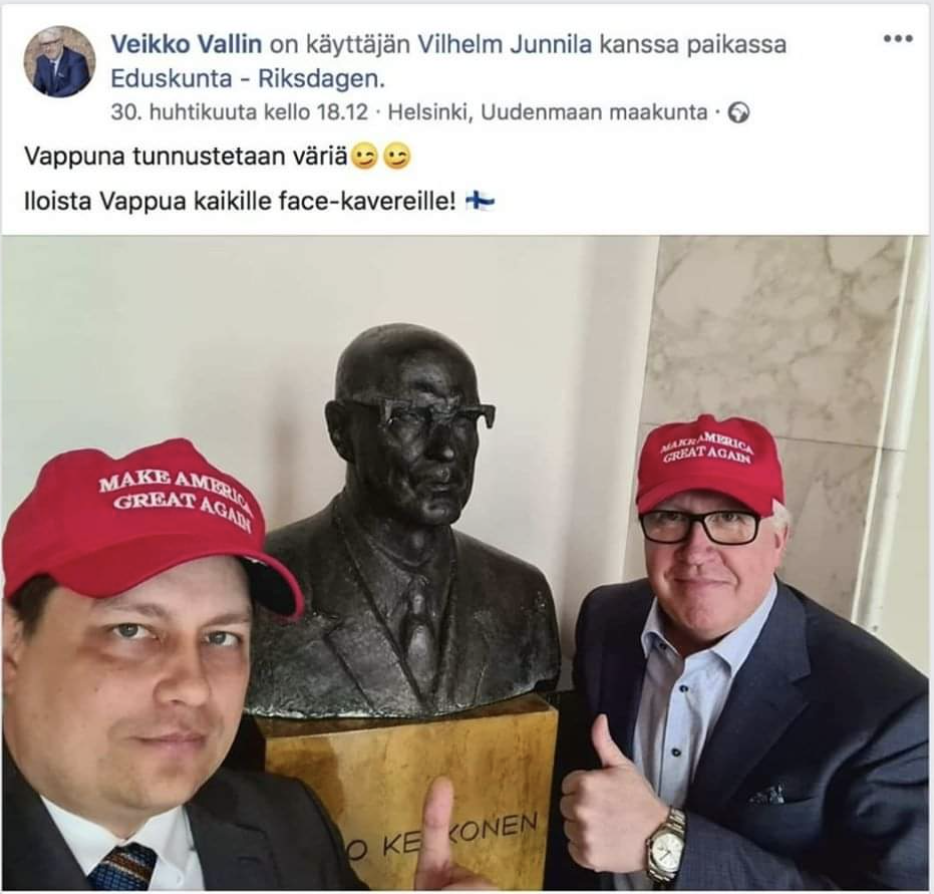
(From top left to right) Junnila visiting the United States and posing with Confederate General Robert E. Lee suggesting white supremacist sympathies. Wearing a Donald Trump MAGA (Make America Great Again) cap with former PS MP Veikko Vallin. Junnila giving a speech at a far-right rally in Turku in 2019.
The government fuels two matters: loss of credibility and polarization of society.
Prime Minister Petteri Orpo’s government, considered the most right wing since the 1930s, faced a storm of controversy on its first day not because of its austerity program, which will hit the most vulnerable sectors of society, but because of its embarrassing links to neo-Nazis and racism.
Headlined Euronews: “Racism and rape fantasies: The PR headache facing Finland’s new right-wing government.” Madrid-based El País writes: “The far-right will control seven key ministries in the Finnish government.”
The Times of Israel doesn’t beat round the bush either: “[Minister of Economic Affairs] Vilhelm Junnila says previous [neo-Nazi] behavior was ‘foolish and immature’; another key figure in new government, House Speaker Jussi Halla-aho, also has history of racist remarks.”
Apart from taking part in a rally organized by far-right groups, Junnila congratulated in 2019 a PS candidate for receiving the 88 election number. “First of all, congratulations on an excellent election number,” he was quoted as saying in The Times of Israel. “I know it’s a winning card.”
As everyone knows, 88 is code used by neo-Nazis to mean “Heil Hitler,” or “HH.”
It is odd why Junnila now apologizes for such inappropriate behavior.
Minister Junnila, who claims to not house any extremist views, now apologizes for his “88” comment: “Those who know me, know that I am a moderate. I do not belong to any nationalist organisations [sic], nor do I plan joining any.”Source: Twitter
Junnila and former MP Veikko Vallin, givng the thumbs up with their MAGA caps. Source: Facebook
Denmark is a good example of how radical-right parties like the Danish People’s Party (DPP) grow and eventually die off. In the 2022 election, the DPP saw its support plummet to an all-time low of 2.63%, losing 11 MPs to end up with a total of 5 MPs. In the 2015 election, the DPP had their best election result ever, winning 37 seats.
It should not come as any surprise that the radical right Perussuomalaiset (PS)* are close ideological allies of the DPP. It should not also come as a surprise that the catastrophic election result of the DPP last year sent shivers up the PS’ spine.
From left to right, three Nordic Region parties have captured the racist imagination of their voters: The Danish People’s Party, Sweden Democrats, and Perussuomalaiset.
The spectacular fall from the political grace of the DPP to the rapid rise of the Sweden Democrats and PS in the last decade rings a similar bell: rapid growth with the help of a hostile anti-immigration campaign message is easy but does not mean that voters will continue to support such parties forever.
Support for the Danish People’s Party plunged by 87.4% from 2015 to the 2022 general election. Source: Statistics Denmark
Even if anti-immigration parties may grow rapidly, Denmark proved that the most effective way of destroying them is by adopting the same radical policies as these parties. The key is to become more radical because voters will not vote for “light” xenophobic versions of a radical right party.
It’s clear that the Moderate Party in Sweden and the National Coalition Party of Finland are taking a big risk in cooperating with the Sweden Democrats and PS. For one, such support could enable their radical-right partners to eat them up unless they react.
In 2020, foreigners made nationally 11,465 euros less annually than Finns.
While negotiations in process on forming a new government in Finland, it’s clear from the talks led by National Coalition Party (NCP) Prime Minister-designate Petteri Orpo that labor discrimination ranks low on their list of priorities.
The negotiators have the misguided expectation that non-EU migrants: will come here in droves and work for peanuts.
And migrants do work for much less than Finns. In 2020, the average taxable income nationally was 38,111 euros for Finns and 26,646 euros for migrants, an 11,465 euro difference,, according to a report by Pasi Saukkonen. For Helsinki and Greater Helsinki, the corresponding figures are 46,701 and 28,279, respectively.
Issues facing the labor market:
Foreigners in Finland made in 2020 nationally 11,465 euros less annually than Finns.
Discrimination in the labor market has been cited by a number of studies. Having a foreign-sounding name could be an obstacle to landing a job interview.
Finnish labor markets are highly racialized and segregated.
Having a university degree is in many cases not enough to get a better-paying job.
Discrimination in the housing market is another problem facing migrants and minorities.
The situation will get worse for migrants and minorities with the new government, which has a radical-right party that is openly xenophobic agenda supported by the National Coalition Party and Christian Democrats.
In the logic of the far-right Perussuomalaiset (PS)* party, the new youth leader of the party is genetically suspect with one of his parents being from the Philippines. Certainly, his name, Lauri Laitinen, has helped, but it proves a point: cultural and ethnic diversity does not pave the way for greater understanding.
While my point is not to mock Laitinen’s background, it does raise some questions about hypocrisy. Ethnic background does not ensure a greater “understanding” of diversity but can have the opposite effect.
Disagree? Look at the Tory government in the UK and the hardline immigration policies of Suella Braverman.
Considering that the PS is a party that believes in ethnonationalism, so does Laitinen. It’s odd, that Helsingin Sanomat did not mention anything about this far-right conspiracy theory.
Laitinen defended in aHelsingin Sanomat letter to the editor why linguistic and ethnic homogeneity is a good matter. Laitinen likes to talk about “harmful” migration as a motive for why he got into politics.
It is interesting that Helsingin Sanomat gives so much space to the new youth leader of the PS and forgets to mention his problematic views about migrants, which are clearly against our laws.
The far-right Perussuomalaiset (PS) party has gained significant traction by capitalizing on anti-immigrant sentiment, particularly targeting vulnerable groups such as Muslims.
In addition to their hostility towards migrants and minorities, many PS supporters and politicians hold admiration for autocratic leaders like Donald Trump and view Viktor Orbán’s Hungary as an ideal country to emulate.
However, it would be overly simplistic to solely attribute Finland’s racism and animosity to the PS. Other parties such as the National Coalition Party, Christian Democrats, Center Party, and even the Social Democrats also face challenges regarding racism.
For migrants contemplating joining a political party, the common concern revolves around identifying the one with the least amount of racism.
When examining the PS, it becomes evident that all of them have built their political careers on propagating racism and fostering animosity towards migrants and minorities.
One example of this is MP Sebastian Tynkkynen, whose notoriety stems from promoting false information, engaging in hate speech, and receiving three ethnic agitation convictions.
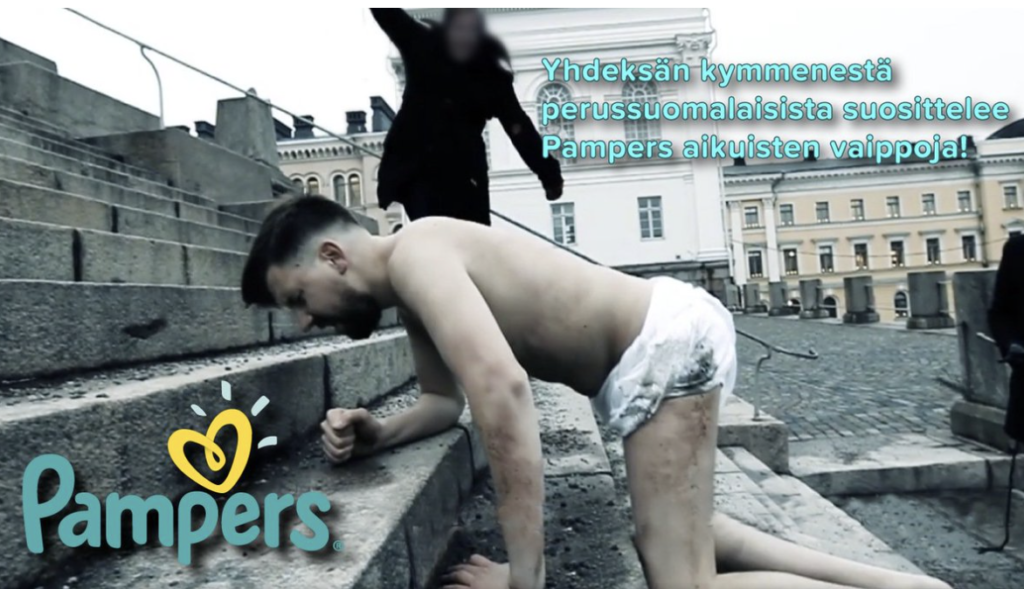
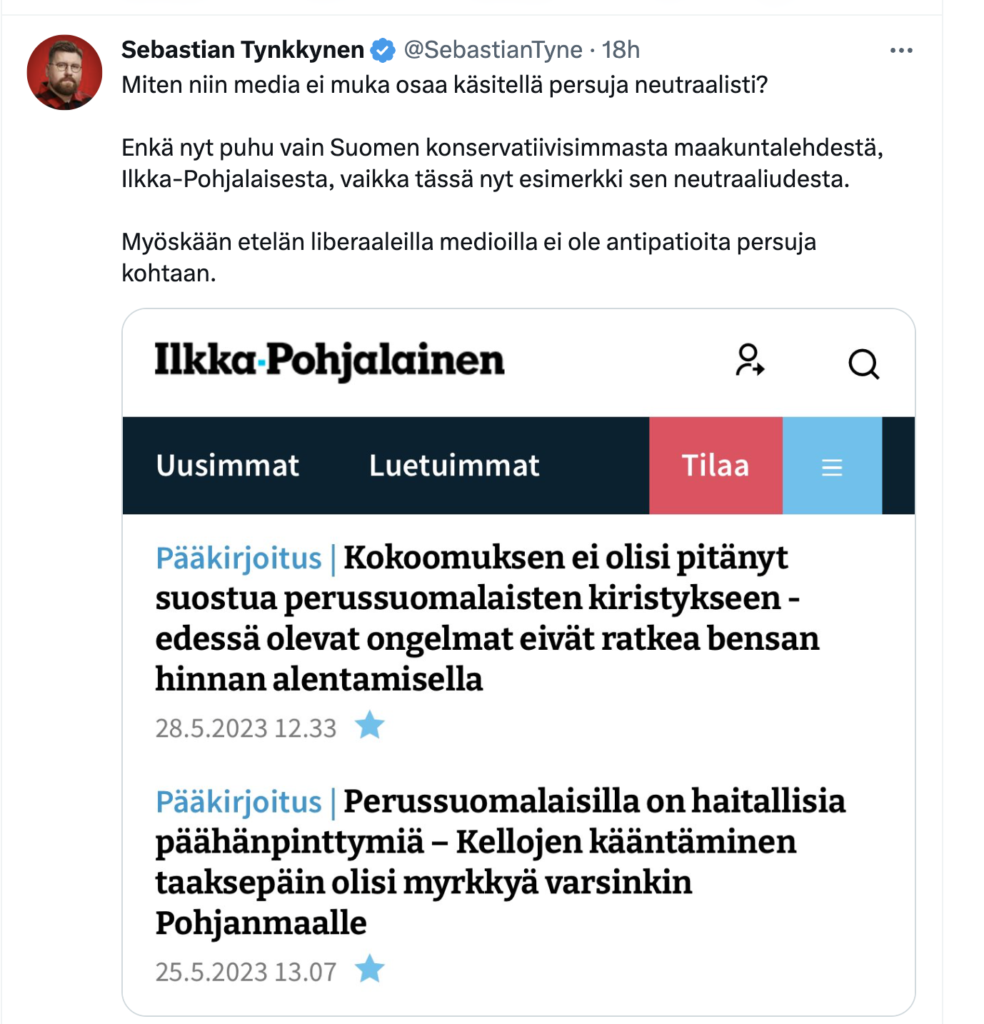
(Left) Sebastian Tynkkynen trying to make a point by wearing diapers. He voices his displeasure at an editorial that criticizes his party and asks why the media is unable to remain impartial. Answer: Why should a newspaper stay impartial in an editorial? Tynkkynen’s post shows his ignorance of the media.
A recent row erupted earlier this month in government talks when Tynkkynen asked his followers which YLE content is unnecessary.
if Tynkkynen had his way, like many other PS politicians, they’d tell the media what they can write.
Sounds like a party with a “Hungarian” heart, right?
Watching the ongoing negotiations between the National Coalition Party, Perussuomalaiset (PS)*, Swedish People’s Party, and Christian Democrats to form Finland’s most right-wing and anti-immigration government is concerning. For one, PS head Riikka Purra’s usual vitriolic anti-immigration rhetoric reminds me of a Brexit minime bully.
Purra warned on Thursday that without “migration policy tightened significantly,” they will abandon talks.
Purra’s warnings sound like a Brexit minimi bully whom others, like National Coalition Party’s prime minister-designate Petteri Orpo, back down.
If you want to see the harm that Brexit has caused to the United Kingdom, the PS is a “mini” Brexit that will cause damage to the Finnish economy because of its hardline stance on labor migration and asylum seekers.
Xenophobic stances are costly to any society because they encourage unemployment, marginalization and crime.
The fact that Orpo, the Swedish People’s Party, and Christian Democrats are negotiating to form a government with the PS is an extraordinary example of cowardice.
Helsingin Sanomat published a story revealing how a new government could tighten migration policy. There’s not much apart from worsening the already-low financial help to asylum seekers, tightening again family reunification, more effective deportations, and limiting the number of times an asylum seeker can appeal, among others.