One of the facts about the government’s anti-racism statement is that it has more to do with injecting trust in a government after it was hit by a string of racism and far-right scandals in the summer. At least for the time being, the statement succeeded at keeping the government from dissolving after the Swedish People’s Party gave it the thumbs up.
The statement also exposes the magic abilities and wishful thinking of the government: the Perussuomalaiset (PS)* isn’t a far-right party; politicians with problematic racist backgrounds are appointed ministers and with the wave of a wand, their racism instantly white-cleaned.
Read the full government anti-racism statement here.
While there was nothing new in the statement except for criminalizing Holocaust denial, Nazi and Communist flags, it was a rehashing of what the government is obliged to do to protect the rights of all people in Finland irrespective of their background.
The statement would have never been drafted if it weren’t for the scandals that the government underwent.
The statement highlights, however, the ongoing problem of racism in Finland: We acknowledge the social ill’s existence but are not willing to challenge it head on.
“The government must unequivocally distance itself from racism,” emphasizes Anna-Maja Henriksson, Swedish People’s Party chairperson and minister of education. National Coalition Party Prime Minister Petteri Orpo, declares, “As a government, we maintain a policy of zero tolerance for racism.”
Upon hearing the above-mentioned statements, one should not be surprised why some are in a state of doubt and shock, especially when people are told that they should forget and forgive the racist statements of some MPs who were appointed as ministers in June.
For example, Perussuomalaiset (PS)* MP Vilhelm Junnila resigned in disgrace after about 10 days as trade minister but was recently elected as the first vice chairperson of the PS parliamentary group.
Junnila’s successor, Wille Rydman, assumed the role of trade minister but faced a scandal due to his racist, anti-Semitic, and dehumanizing private messages, which were made public by Helsingin Sanomat. These messages also exposed Rydman’s disturbing Nazi views and ideologies. Surprisingly, the minister did not offer a public apology for the offensive messages.
The series of scandals involving the PS this summer prompts us to question whether these so-called self-proclaimed saviors of Finland understand the term “racism.” It’s important to note that Finland is bound by various international agreements aimed at addressing the social ill:
· Finland has ratified the International Convention on the Elimination of All Forms of Racial Discrimination, which places significant obligations on the government to dismantle racially discriminatory structures in society. Additionally, freedom from discrimination is enshrined in several UN treaties and the Universal Declaration of Human Rights.
· The Durban Declaration and Program of Action, adopted in the World Conference against Racism in 2001, commit states to anti-racist efforts and addressing the consequences of colonialism.
An article in Mikkeli-based daily Länsi-Savo (10 August) interviewed three members of the Finns Party (PS) from the South Savo region who claimed that racism has no place in the party. If this is true, it is significant and welcome news.
In the face of the numerous racism scandals that have overshadowed the activities of the PS over the years and, at the latest, in July, the claim by the members of the party is fantastical. We believe that racism has historically been as important to the PS as the Swedish language is to the Swedish People’s Party.
But in the name of fairness, I (Tessieri) would like to thank the PS who, in the meetings of the Mikkeli City Council that I have attended, do not speak of immigrants in a demeaning way like their fellow MPs in parliament.
However, the PS is historically the first major contemporary Finnish party to have benefited from the polarization between different groups and to have attacked other ones, such as Muslims, Africans, and other non-EU nationals, as unequals.
Racism is a serious social illness in which groups of people are treated as inferior due to their ethnic origin, skin color, nationality, culture, or religion.
While the party may not necessarily recognize its immigration policy as racist, it is highly discriminatory. The changes proposed by the government, especially the PS, in the new policy promote inequality and make it more difficult for migrants to participate in our society as equals.
We also disagree with Jani Sension that this summer’s numerous racism scandals is something made up by the media.
If the racism scandals have highlighted an important point, it is the Finnish media’s important role in defending the rule of law and the fundamental rights of all people, regardless of background.
PS Minister of the Interior Mari Rantanen, who has also published racist and far-right posts and removed them from her social media sites, has said that the government’s immigration policy will undergo a paradigm shift.
We hope that in light of these racism scandals, the media will experience its own paradigm shift in its role as the nation’s watchdog and not leave a stone unturned in its important work.
Enrique Tessieri, Yahya Roussi
The authors are members of the board of Kansainvälinen Mikkeli, a registered associationpromoting diversity. Tessieri is also a deputy city councilperson of the Mikkeli City Council.
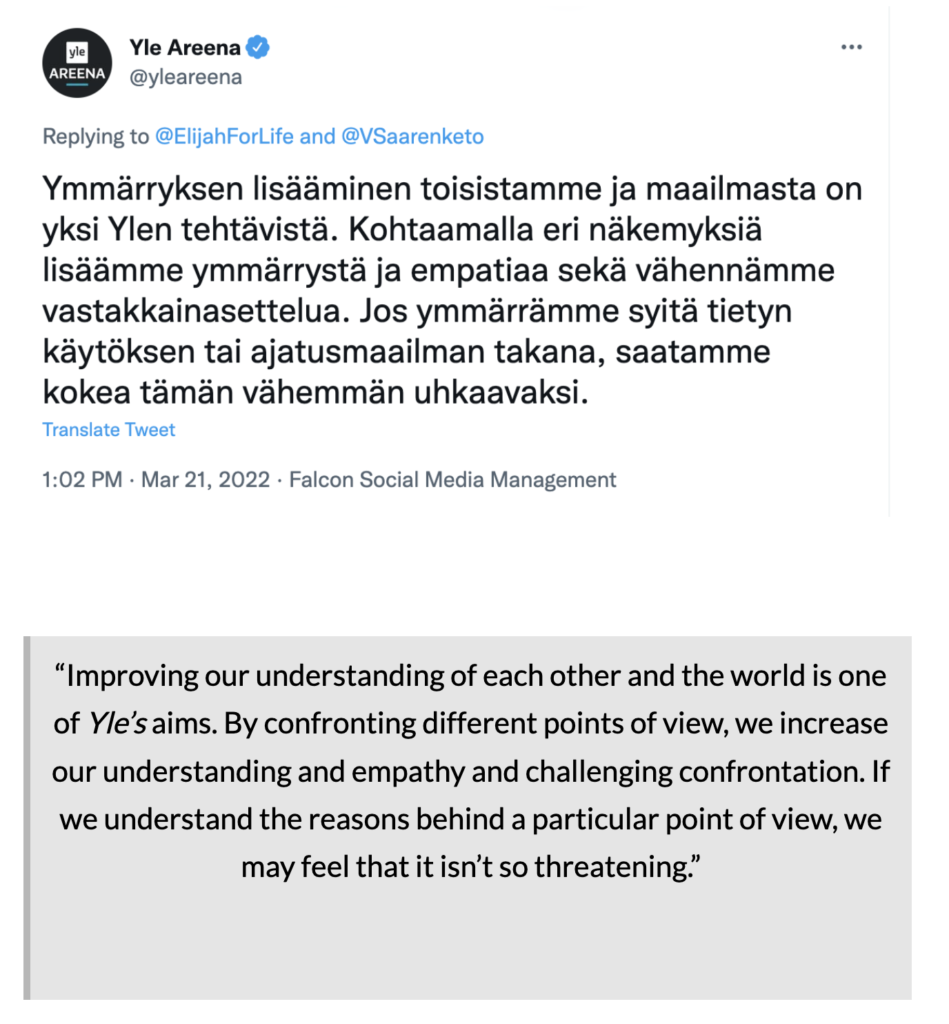
After many years of writing about racism and discrimination in Migrant Tales, I am always disappointed by Finland’s and Europe’s blind spot of racism. A good example of the latter was a feature by Yle of far-right youths whose only contribution, in my opinion, in the story was their suspicion and loathing of migrants and minorities.
It is sad that the media continues not to see its blind spot of racism but perpetuates and spreads hatred and stereotypes about migrants.
Even if such a toxic narrative may bring you fame and power as a politician, even a ministerial position, it is a perilous path that can lead us to the slippery slope of the pyramid of hate.
The Holocaust and other genocides offer red-flag warnings.
Historian Stefan Lehnstaedt hit the nail on the head about our blind spot of racism through his analysis of the Holocaust.
Finnish Broadcasting Company (Yle) published Saturday a story about two far-right youths belonging to the openly fascist and racist Blue-and-Black Movement (Sinimusta liike), and one to Suomen Sisu, which the authorities named in 2011 as “a Nazi-spirited association.” Thanks to the Yle article, the reader can read how much these so-called “radical nationalists” hate migrants.
Pyry-Lii Soinio is a twenty-two-year member of the Blue-and-Black Movement. He does not hide his loathing for outsiders. “I don’t think immigration should be restricted,” he said, “but [foreign] people should be deported altogether. I don’t care whether immigrants are good citizens or taxpayers. What matters to me is whether they are Finns.”
This is the third article that Yle has published on far-right members in the last three years. The first one was in 2019 by TV host Sean Ricks on far-right youths, followed by Suomineito in 2022.
Both stories received their fair share of criticism.
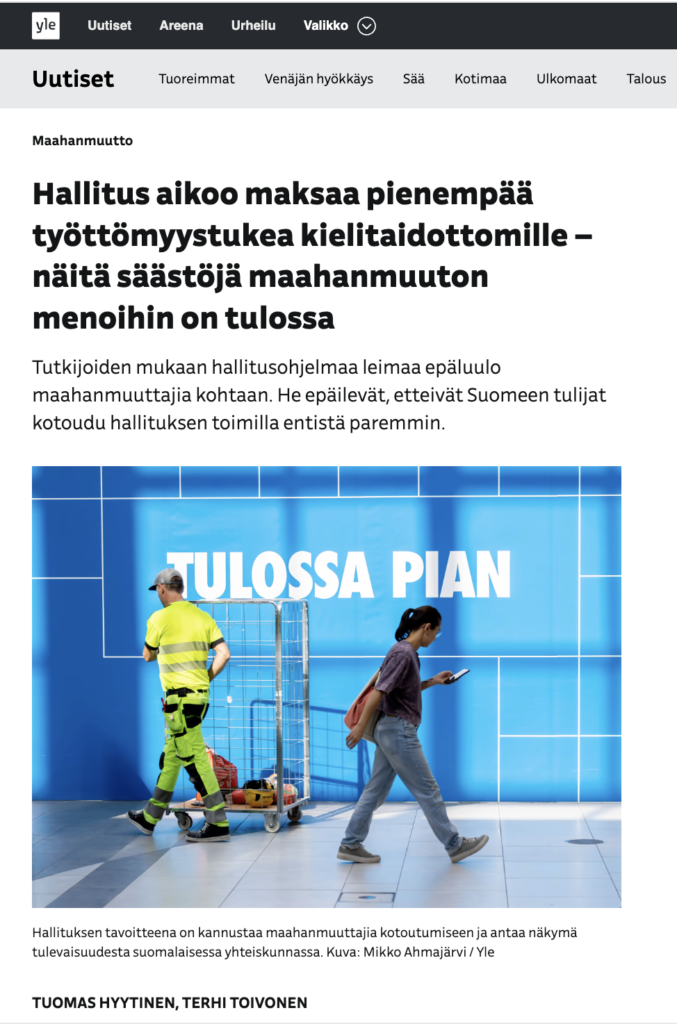
Plans to pay migrants less social welfare planned by Prime Minister Petteri Orpo’s government are a wet dream that spans back to 2016, when then Social and Health Minister Hanna Mantylä aimed to pass legislation that would grant migrants less social welfare than native Finns. Fortunately, such a law did not see the light of day since it was unconstitutional.
The unconstitutionality of such a law rests on Section 6 of the Constitution: “Everyone is equal before the law. No one shall, without an acceptable reason, be treated differently from other persons on the ground of sex, age, origin, language, religion, conviction, opinion, health, disability or other reason that concerns his or her person.”
Thus, if you are going to pay less social welfare to a group, the measure must apply to everyone in order for it to be constitutional.
Efforts to get foreigners to get less social welfare than native Finns, was brought up again in 2018 by Finland’s Nobel Prize in economics, Bengt Holmström. He said that white Finns must not share power and privileges with migrants and their children. In other words, they should get lower salaries and social security benefits so that it does not irritate Finns.
According to Statistics Finland’s Working Paper series published in 2014, Finland is no land of opportunity for migrants, according to Pekka Myrskylä. He claims that the employment level of Estonians and Thai citizens matches that of white Finns. The majority of migrants, however, live in poverty in Finland because they make less money, according to him.
I have tweeted to Riikka Purra about her suggestion not to pay social welfare to foreigners. My question to her was: If social welfare is left to a minunum, does it mean that foreigners have to pay taxes?
Surprisngly, she did not respond to my tweet.
National Coalition Party MP Pia Kauma is another politician who has been hellbent that migrants should be paid less social welfare.
One clear aspect of Finland’s heated debate about racism is how politicians, especially from the Perussuoomalaiset (PS) party, claim ignorance about what racism is. PS MP Joakim Vigelius went as far as to claim that the term “racism” has suffered from inflation.
I wonder if victims of racism and microaggression feel the same way.
As can be seen with Vigelius’ view of racism, it is always a white person setting the narrative and definitions about such a social ill.
Another politician, MP Jani Mäkelä, the head of the PS parliamentary group, said in Helsingin Sanomat that other groups define the term to fit their political needs.
“They take this term, arbitrarily define its content according to their own definition,” he said.
One of the most unusual comments that Mäkelä made to Helsingin Sanomat was his definition of racism. According to him, the law protects the individual from discrimination but this cannot apply to immigration policy, cultural and national groups.
He said that cultures, where women and sexual minorities are treated badly, cannot be considered equal to Finnish culture.
“Such a culture should be seen as inferior if it treats people like that,” added Mäkelä.
In other words, Finnish law protects individual rights against discrimination but it isn’t racist to speak demeaningly of groups like Muslims.
As one navigates through the denials and smoke screens from politicians about racism, it’s easy to understand that such tactics aim to deceive.
Some friendly advice: If you have difficulty figuring out what is racism, ask and do some research. That is how we did it in California: one can achieve a lot with the help of cultural sensitivity and the willingness to learn.
Unless you have lived isolated from people, there is no reason why you should blame ignorance on your racism.
Another piece of advice: if you want people to treat you with respect, then you should treat them with respect, too.
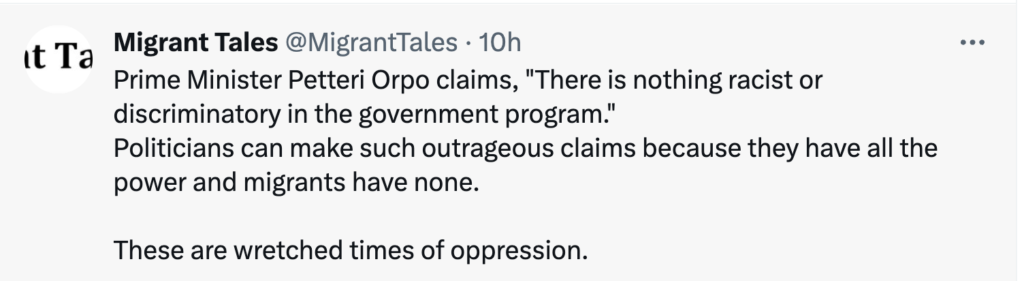
And that is not all that Orpo said in Helsingin Sanomat: “We are doing everything in our power to eradicate racism and discrimination,” he continued, “We are doing more [on this front] than any government before us.”
In light of the scandals that have rocked Orpo’s government from the start, there appear to be an endless amount of denial in the face of a chronic loss of credibility of the government.
Source: Twitter
Fomer Prime Minister Sanna Marin warned that Orpo’s government is ready to “erode the fundamental values of a democratic society.”
The Perussuomalaiset (PS)* congress over the weekend raised some questions and new perspectives about the PS’ alternate reality. The hostile attacks by PS chairperson Riikka Purra and speaker of parliament, Jussi Halla-aho, Matti Putkonen, and others as “spineless liars” are a warning of the perilous direction that the party wants to steer Finland.
Apart from the numerous scandals this summer due to the PS’ history with racism, attacks by the party on our media are equally concerning.
Prime Minister Petteri Orpo’s leadership is another problem. Very few members of his party, the conservative National Coalition Party, have voiced concern about the siatuion and its hardright political direction.
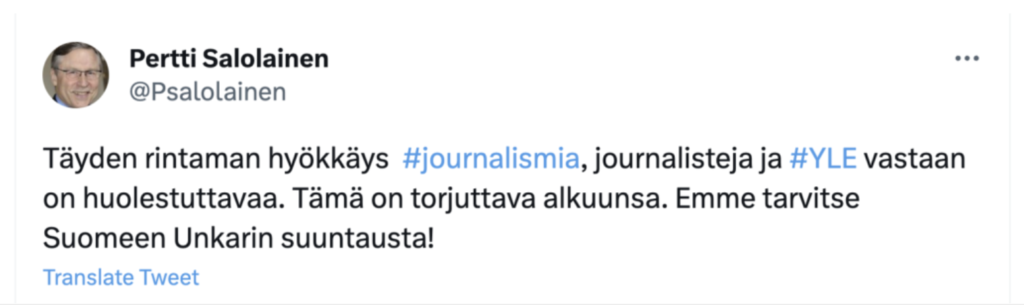
Pertti Salolainen is a veteran former NCP MP and minister who is one of the few dissenting voices of the party. Another one is former NCP member and MP Kirsi Piha.
Tweets Salolainen: “The full-frontal attack on #journalism, journalists and #YLE is worrying. It must be rejected out of hand. We don’t need to be on the path of Hungary in Finland!”
If I am honest with you, I tried to stay as far away as possible from the toxic speeches at the Perussuomalaiset (PS)* Congress. In those speeches, like the one by the party’s leader Riikka Purra, you wondered in what alternate reality the radical-right party lives.
Those speeches by Purra, Matti Purkonen, who slammed the media as “spineless liars,” and others are tragic because for those of us who have lived many years in Finland, have seen a complete about-turn in politics and society. What was considered unthinkable before, like racism, is now normalized. It’s all about hate of difference with a huge “H.”
Contrary to what people wanted to believe, the threat does not come from abroad but is homegrown and sits and grows right under our noses.
Take for instance Purra’s speech Saturday, when she concentrated on attacking the media for doing their job and publishing her racist posts from 2008 and 2019.
Iltalehti published (in Finish) all of “riikka’s” 185 posts. In them, she threatens to shoot migrant youths on a commuter train, her posts are homophobic, Islamophobic, sexist, and outright racist.
Upper left: “The problem isn’t that WE speak like racists or that we are racists.“
Upper right: “The problem is that you call us racists.“
Lower left: “The problem ends when you stop [calling us racists].“
Lower right: “YOU are the culprits.” Source: X (formerly Twitter)
Imagine, she was a 31-year-old adult PhD student who, I imagine, should have known better.
Even if one of here defense arguments is that the posts were written before her political career began, how many of us would write such racist and violent posts?