In a lengthy article on the Perussuomalaiset (PS),* Helsingin Sanomat reporter tells us we should not consider the PS a far-right party. The article offers a lot of sources to look at the question but the writer, Markko Jukkari, trips and falls on his face when he starts to editorialize the story.
He writes:
The Perussuomalaiset is not a revolutionary far-right party. It is the second largest party in Finland, with 620,981 people voting for it in a free and democratic election. It has also demonstrated a commitment to advancing its agenda through parliamentary means. Therefore, one should not call the party far-right.
Finland’s Perussuomalaiset (PS)* is a far-right whose loudest message are foreigners and minorities threaten the country.
It’s been a while since the PS won its historic election in 2011. While downplaying their victory and rise to the major Finnish political league, people like me knew that this spelled trouble for our democracy.
The PS’ is very good at ethnic- and migration-bating through far-right conspiracy theories like the great replacement. Riikka Purra and the PS want their followers to be constantly angry even if matters are not as bad as they claim.
A new row has erupted in government talks with the PS after Sebastian Tynkkynen asked his followers which YLE content is unnecessary. Mauri Peltokangas, a cantankerous politician who named the government “pitiful a**holes,” lashed out at the Swedish People’s Party.
“I want your opinion,” he wrote on Facebook. “is it really the will of the people that a minority party with a few percent of support should be allowed to fuck around and stir the pot in government negotiations when forming a government n Finland? Och samma på svenska (the same in Swedish).”
There are two opinions about the far-right Perussuomalaiset (PS)* membership in a future coalition government led by the National Coalition Party (Kokoomus): Let them join so the public will see who they are – a cantankerous and messy jumble of bitter hot air; and others point to giving former President Donald Trump the benefit of the doubt, which gave us his toxic polarizing legacy.
We are going through the same arguments about the PS as after the 2011 election when the party scored a historic victory when the party got 39 MPs elected from 5 MPs previously.
“Don’t worry,” some pointed out back then. “It will only be a matter of time before the PS will implode like what happened with the Rural Party (SMP) in the 1970s,”
In 2017, the election of Jussi Halla-aho as the leader of the PS resulted in a small implosion that divided the party into two factions. This event marked the downfall of former PS chief Timo Soini and serves as a prime example of karma. Politically exploiting racism is akin to handling a rabid dog that may bite back with force beyond your control.
Soini is today a wounded politician with his credibility in tatters.
The same fate that Soini suffered threatens Petteri Orpo and the National Coalition Party (Kokoomus).
We should not be surprised that the PS’ second chairperson after Soini, Riikka Purra, considers our constitutional and human rights obstacles to her political ambitions and goals. Her political ideology like that of the party, is based on Finnish white supremacy.
Riikka Purra tweets: “The Finnish government has little chance of influencing anything if you ask the left. The obstacles are at least human rights, the constitution, the EU, international treaties, morality, empathy, [international] image, press freedom, and of course, the correct conclusion[s] of botched investigation[s].”
It would be simplistic to blame only Soini for the rise of a far-right party in Finland. The list includes the whole political spectrum, the media, the education sector, institutions like the police, and denial with a towering D.
In Finland’s parliamentary election in April, the country shifted abruptly from a left-wing government led by the charismatic Social Democratic Prime Minister Sanna Marin to a possible right-wing government. Some see the good result of the conservative National Coalition Party, and especially the far-right Perussuomalaiset (PS),* as a threat to those values, social welfare, and solidarity held dear to the welfare state.
Like in neighboring Sweden, the far-right Sweden Democrats did well in the election and helped boost the right-wing bloc to victory through cooperation with the Moderate Party. In Finland, the National Coalition Party is ready to give the PS a ticket to become a government coalition member.
Following the PS’ election victory of 2011, which saw their MPs increase from 5 to 39, the far-right party has done exceptionally well in parliamentary elections. In the last election, the PS saw its MPs rise to 46, a record.
The PS’ claim of success lies in spreading news stories about migrant crime to lure voters with the help of the media and police.
With some PS politicians openly supporting Viktor Orbán of Hungary, former President Donald Trump, and even violent far-right groups, do populism and polarization threaten Finland’s democracy?
In an interview with the Finnish League of Human Rights, Eliza Ruynowski, a human rights lawyer from Poland, cautioned Finns to avoid accepting simplistic solutions to complex issues. She advised them to be cautious of individuals who blame specific groups of people, whether they belong to a minority or hold differing political views, as a means of resolving problems.
But let’s go back in time to uncover the dangerous political path Finland, and the rest of Europe, are on.
In reporting about Adolph Eichmann’s trial in Israel in 1961, philosopher Hannah Arendt described the war criminal responsible for transporting millions of Jews to their deaths as an ordinary bureaucrat who, in her own words, was “neither perverted nor sadistic, but “terrifyingly normal.”
Arendt called this disposition the banality of evil or the state where Eichmann performed evil deeds without evil intentions. Thus he could fulfill his tasks diligently irrespective of their horrific crimes by the inability to think from the victim’s standpoint.
At the Nuremberg trials (1945-46), US Army psychologist Captain Gustave Mark Gilbert stated that the Nazi war criminals on the dock had one matter in common: Their incapacity to feel with their fellow men and women.
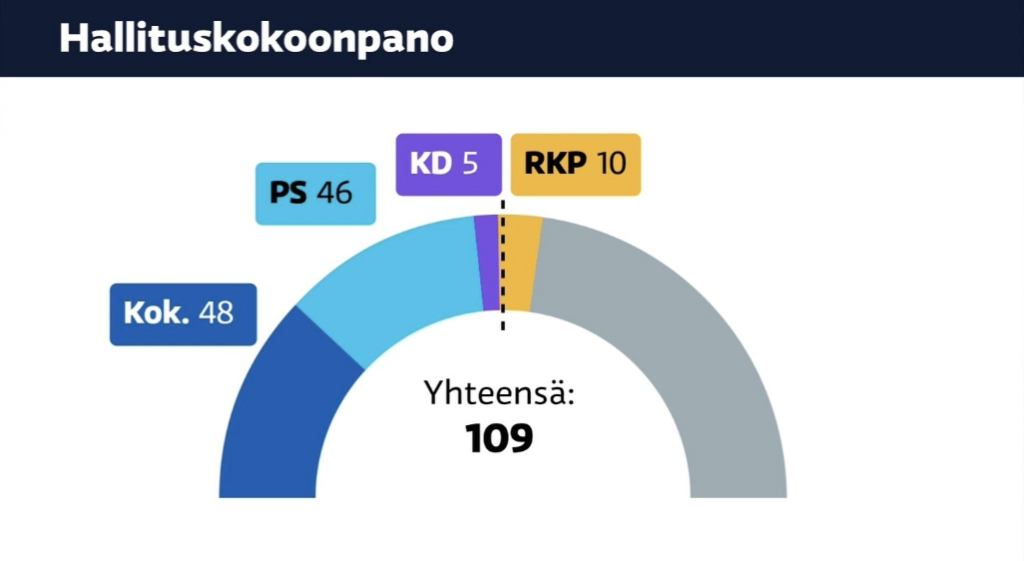
Finland’s next government will likely comprise of four parties: National Coalition Party (Kokoomus), Perussuomalaiset (PS)*, Swedish People’s Party, and Christian Democrats, according to Helsingin Sanomat. Even if the makeup of the government was pretty clear at the onset, many questions remain.
One is Finland’s chronic labor shortage and PS opposition to asylum seekers and labor migrants. Despite differences with the PS on labor migrants, Prime Minister-elect Petteri Orpo is more focused on having a right-wing government than sharing power with the Social Democrats.
The new government will have a majority (109 seats) in the 200-seat parliament. Source: Yle.
While we can criticize Kokoomus for giving a political platform for the PS to spread its populist rhetoric, one shameful member of the new government is the Swedish People’s Party.
While it is fair to say that the Swedish People’s Party is divided about joining the new government with the PS, it’s clear that the new coalition will be highly flammable and unpredictable.
Those that stand to lose the most with the new government’s austerity policies are the most vulnerable sectors of society: the unemployed, low-wage workers, and minorities like people of color. Even so, the biggest losers will be asylum seekers from outside the EU knocking at our door for shelter.
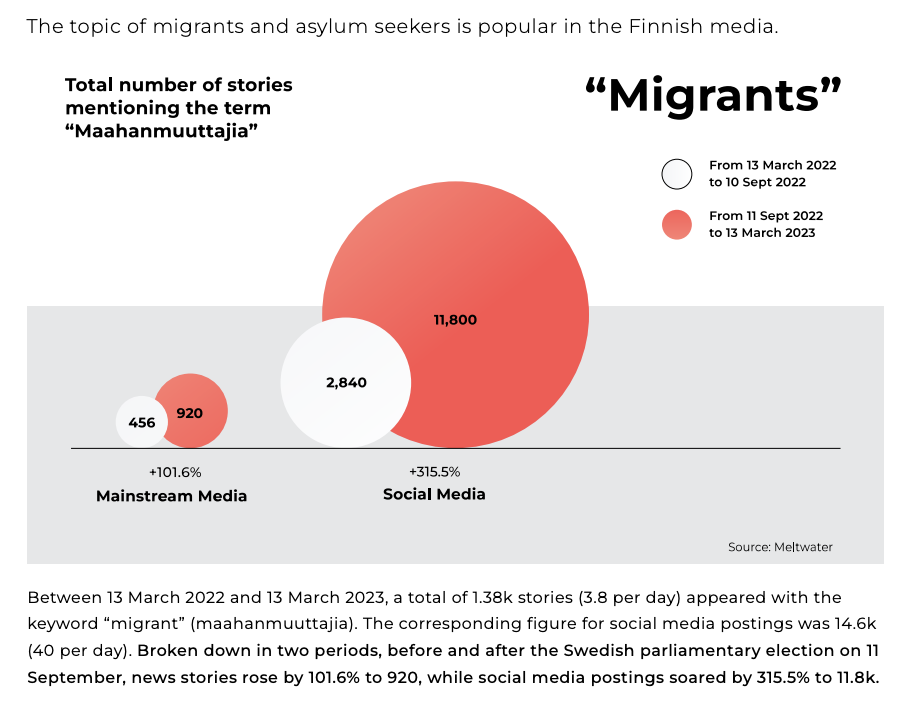
As Migrant Tales correctly predicted, interest in the so-called “youth gang” problem has tanked in the media and social media after the parliamentary election. Twenty-threedays after and before the April 2 election, news on the topic by five media outlets (Helsingin Sanomat, Yle, MTV, Iltalehti, and Ilta-Sanomat) plummeted by 54.5% to five stories from 11, according to a Meltwater search. The most significant drop was seen on social media, diving by 87.4% to 314 posts from 2.56k.
The fall was even more pronounced for all media, sinking by 70.5% to 13 stories from 44 stories.
What do these figures tell us about the fake and exaggerated “youth gang” topic spread by the Islamophobic Perussuomalaiset and its National Coalition Party ally? That was a political stunt to attract voters with the help of fear-mongering. The media (more traffic), the police (more funds to fight crime), and politicians (get voters) all profited from the topic.
According to Helsingin Sanomat, the Helsinki city council voted to build a Ghusi facility for Muslims at the Malmi cemetery. In the same way, the Finns washed their dead in saunas before burial, and Muslims in Finland will have the same opportunity to show their respect for their deceased. Even if sensible people would have no qualms about such a matter, there was one person and party that did.
Yes, you guessed correctly. The party is the Perussuomalaiset (PS)*, and the politician, city councilor Laura Korpinen, an MEP candidate on the shameful “let them drown” list.
In 2019, an Alma Median EU election compassasked if it is “the obligation of the EU to save all those migrants who attempt to come to Europe and who are at risk of drowning in the Mediterranean?”
MEP candidates of the PS and National Coalition Party as the most eager to allow migrants to drown in the Mediterranean.
In an earlier tweet, Korpinen claimed that the PS and Christian Democrats voted against the additional facility at the Malmi cemetery. She corrected her Tweet by stating that only the PS voted against such a facility for Muslims. Source: Twitter
Korpinen Tweets: “The Helsinki city council approved a project at the Malmi cemetery to build an [additional] facility for the deceased, which will be pinned on tax-payers for ritual cleansing of Muslims.”
Even if the vote passed in the city council, it showed that the PS lives on a different planet when it comes to cultural diversity and respect for other cultures and religions.
City councilor Björn Månsson of the Swedish People’s Party hit it on the dot: “This is a record new low for the Perussuomalaiset. Now even the deceased are discriminated.”
Finland’s anti-immigration and far-right atmosphere tightened another notch.
I don’t read Finnish newspapers and none in particular. I find them very taxing to read. Constantly, people who look like me are vilified, branded as the devil himself and the root cause of all problems. I have always known the correct term for an event that bothers me, and when I learned it, I sighed with relief. I no longer had to doubt myself and had facts to back up my feelings. It is dog-whistle politics, and even though I am a “Finn” on paper, the media reminds me that I am not wanted here. If I didn’t feel under constant attack, I could read papers.
– Asmaa
“Minä en lue suomenkielisiä sanomalehtiä enkä erityisesti mitään Suomalaisia lehtiä. Koen, että ne kuormittavat erittäin paljon, kun niitä lukee. Jatkuvasti ihmiset jotka näyttävät minulta mustamaalataan, leimataan itse piruksi ja kaikkien ongelmien juuri syyksi. Olen aina tiennyt, että tapahtumalle, joka häiritsee minua on oikea termi ja kun opin sen huokaisin helpotuksesta. Enää ei tarvinnut epäillä itseäni ja sain faktoja tukemaan minun tunteitani. Se on koirapilli politiikkaa (eng. dog whistle politics) Vaikka olen paperilla “suomalainen” niin lehdistö muistuttaa minua, etten ole haluttu tänne. Mikäli en kokisi olevani jatkuvan hyökkäyksen alaisena niin voisin lukea lehtiä.”
Veteran National Coalition Party (Kokoomus) MP Ben Zyskowicz was attacked a second time Saturday in Eastern Helsinki by a man who threatened to kill him, according to Helsingin Sanomat. While waiting for the metro, a man approached the MP, started to yell, and punched him in the face.
The police apprehended the suspect.
In 2011, A middle-aged man stepped in front of Zyskowicz and tried to attack him, according to the tabloid Iltalehti.
The chairperson of the Finns Party, Riikka Purra, has said on several occasions that her party’s long-term goal is that only Finnish citizens have the right to social welfare.
While such a plan is highly discriminatory, even racist, it is unfortunate that journalists don’t ask Purra what she means and what challenges would arise if they ban social welfare for foreigners. Apart from requiring a change in the constitution, which would have to get a two-thirds majority, is such a plan only a campaign stand and a pipe dream?
Apart from breaching EU law and human rights and being discriminatory, should foreigners in Finland pay less taxes since they will not be eligible for social welfare? Are there other hidden charges like tuition for children attending comprehensive school and health care?
According to some estimates, Finland needs about 40,000 labor migrants a year to plug its chronic labor shortage.
Such measures by the PS will certainly make Finland unattractive to labor migrants.
Why would you want to move to a country that treats you like a second-class member of society?
*Media Monitoring Group of Finland aims to promote fair and accurate reporting by the Finnish media of underrepresented cultural, racial, ethnic, and religious groups. As Finland’s cultural diversity continues to grow, the role of the media in forming public opinion and attitudes about minorities becomes even more relevant.