Read original tweet here.
Julie Pascoe is senior advocacy officer at the European Network Against Racism (ENAR), Europe’s largest anti-racism NGO.

Julie Pascoe is senior advocacy officer at the European Network Against Racism (ENAR), Europe’s largest anti-racism NGO.
Monday’s A-studio talk show debated Finland’s low birthrate and what the country could do to challenge the threats of an ageing and shrinking population as well as how migration could ease such woes. Present at the talk show were Left Alliance chairwoman Li Andersson, Justice Minister (National Coalition Party) Antti Häkkänen, and Nordea bank economist Olli Kärkkäinen.
While there was nothing new that said at the talk show, there was one question and one image that summed it up.
Kärkkäinen asked a very important question: “Even if politicians are so much in agreement that we need migrants, especially labor migrants, why has so little been done?”
The host asks the Nordea economist to answer his question.
“It’s easy to speak here [in these talk shows] about students staying to live in Finland and get a residence permit if they search for work,” he continued. “We can slash red tape, give out residence permit faster, but for some reason, there is little progress [in changing the present situation]. Let’s hope that demographic pressures will bring changes [faster] when the next government takes power.”
One reason why the present government has done so little is the Perussuomalaisiet*, and Blue Reform, which are populist anti-immigration parties. The former was in government but after it split into two factions in 2017, the Blue Reform is in government even if it popularity in opinion polls hovers around 2%.
Finland will hold parliamentary elections in April 2019.
Another striking feature of the talk show was the background picture of a migrant working as a cleaner.
Is this how YLE and Finland see migrants? Are they just cheap labor to do menial work that Finns don’t want to do?

Considering Finland’s ineffective and inhumane immigration policy, and if the migrant gets a residence permit, his or her rights at the workplace are far from satisfactory.

* The Perussuomalaiset (PS) party imploded on June 13, 2017, into two factions, the PS and New Alternative, which is now called Blue Reform. Despite the name changes, we believe that it is the same party in different clothing. Both factions are hostile to cultural diversity never mind Muslims and other visible minorities. One is more open about it while the other says it in a different way.
A direct translation of Perussuomalaiset in English would be something like “basic” or “fundamental Finn.” Official translations of the Finnish name of the party, such as Finns Party or True Finns, promote in our opinion nativist nationalism and racism. We, therefore, at Migrant Tales prefer to use in our postings the Finnish name of the party once and after that the acronym PS.
Kun pakolainen on Suomessa vastaanottokeskuksessa, hän on vielä tavallinen pakolainen muiden pakolaisten joukossa. Häntä pidetään pelossa ja epävarmuudessa, monesti vuosia, mutta hän saa sen verran ruokaa ja avustusta, että pysyy fyysisesti kohtuukunnossa.
Kun pakolainen on saanut kielteisen päätöksen turvapaikkahakemukseen, eikä häntä voida jostain syystä poistaa maasta, hänestä tulee laiton. Hänet potkaistaan kadulle kyselemättä, onko hänelle vokissa muiden hädänalaisten joukossa syntynyt turvaverkko, joka auttaisi häntä eteenpäin. 
Jos pakolainen järjestää kohtelustaan mielenilmauksen, hänestä tulee anarkisti ja yhteiskunnan vihollinen. Samoin käy suomalaisille vapaaehtoisille, joilla vielä on rakkautta ja myötätuntoa. Hekoittavat auttaa kunnon ihmisiä, joilla ei näytä olevan tulevaisuutta tai edes elämää. Ministerit ehdottavat lakia, jonka nojalla auttaminen kielletään.

Inhimillisyytensä säilyttäneiden ihmisten avulla pakolainen kuitenkin saa joskus jonkinlaisen otteen elämään: saa ystäviä, pääsee töihin, suomen kielen taito lisääntyy. He ovat ahkeria ja tekevät kaikkensa, siksi he edistyvät nopeasti. Heillä on vielä hiukan toivoa ihan tavallisesta elämästä.
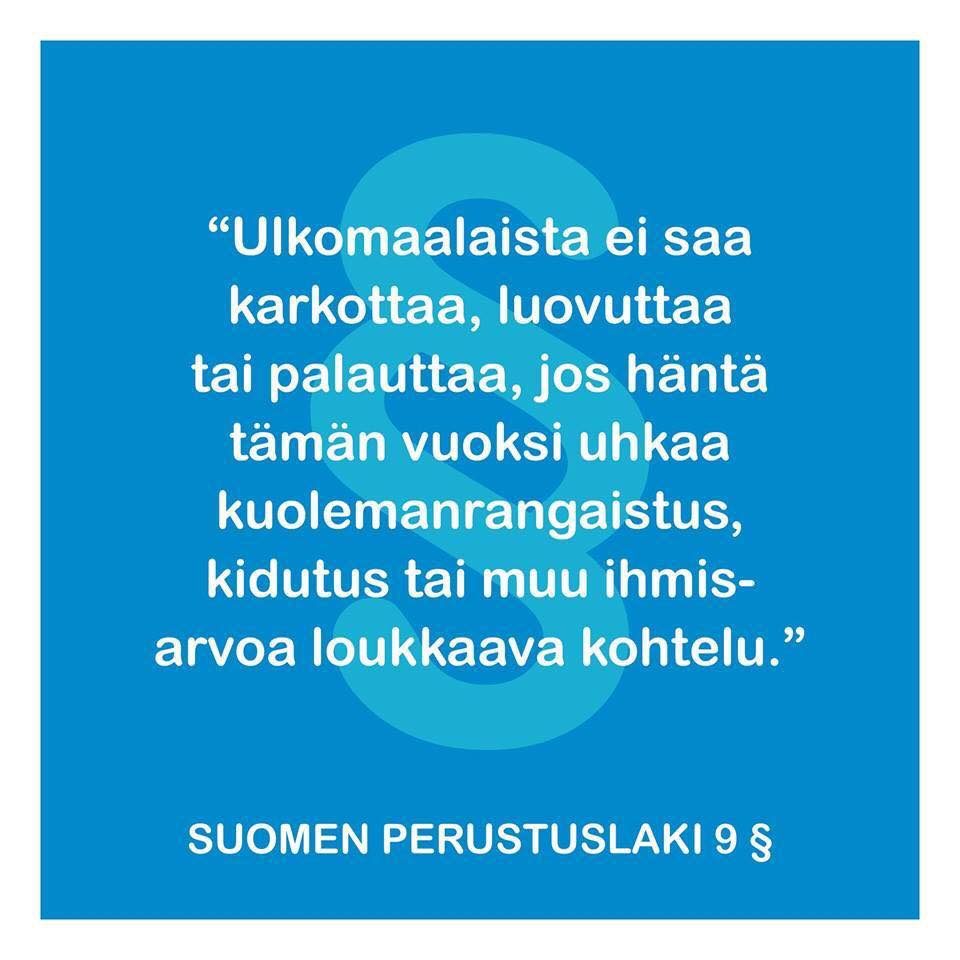
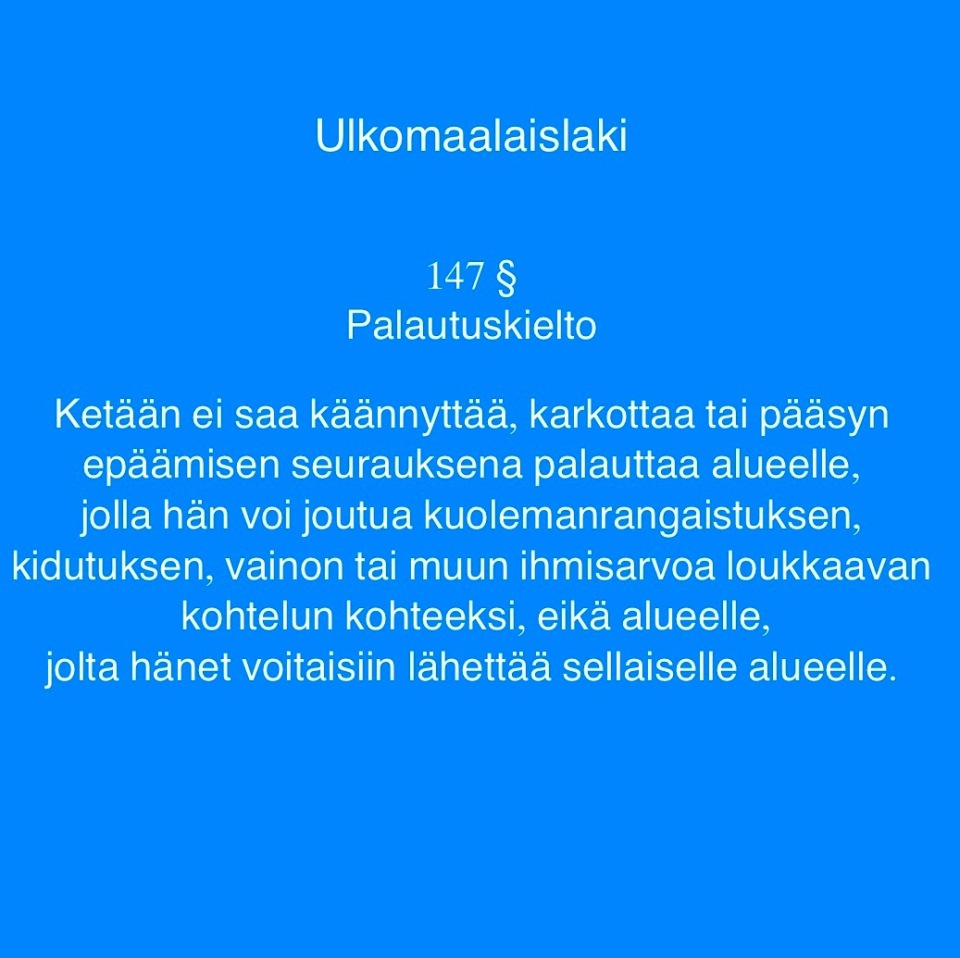
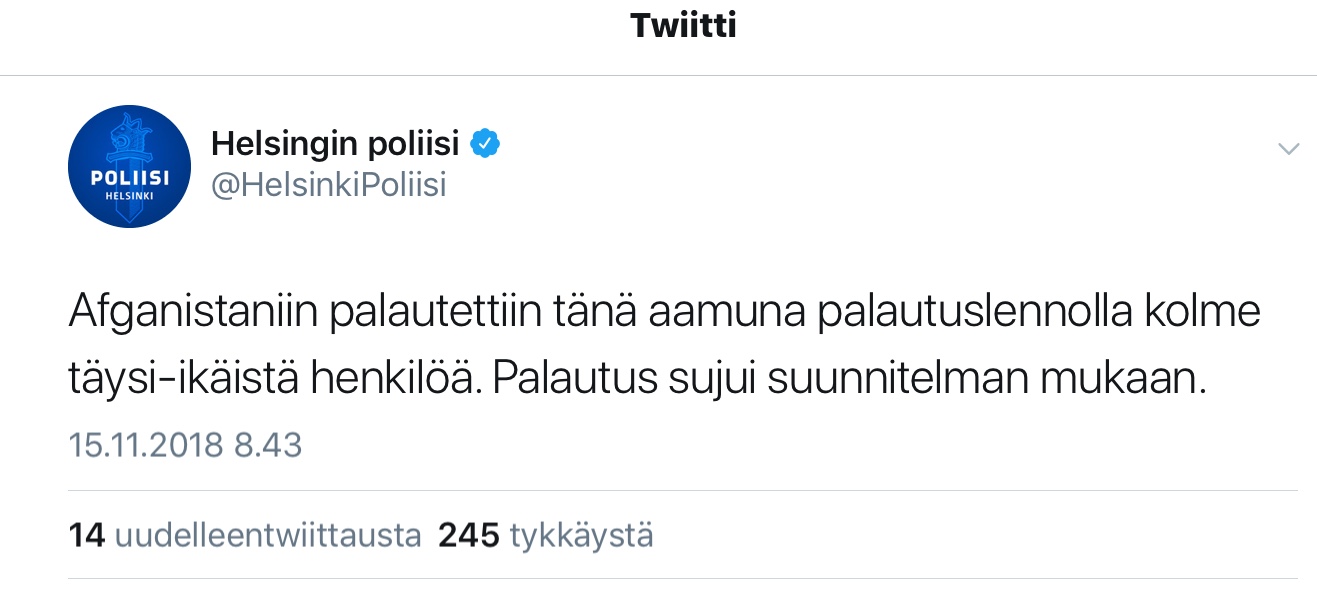
Kun pakolainen sitten päätetään pakkopalauttaa, vokista tai yksityismajoituksesta, töistä tai koulusta, hänestä tulee vaarallinen rikollinen. Kolmea tavallista nuorta miestä palauttamaan tarvitaan yksityislentokone ja viisitoista poliisia. Viimeksi tällä viikolla tehtiin yksi sellainen lento. Kabuliin, Afganistaniin, jonne ei nyt pitäisi palauttaa ketään, ei etenkään hazara-vähemmistön jäseniä, joita Taleban vainoaa systemaattisesti.

Saatuaan tällaisen urhoollisen sankarimatkan suoritettua Suomen poliisi laittaa aina voitonmerkin Twitteriin. “Tolkun ihmiset” ja rasistit käyvät kiittämässä. Pahoja tekoja on aina eräs osa kansasta puolustelemassa lailla, järjestyksellä ja turvallisuudella. Niin taas tässäkin maassa, vaikka kovin kauhistelemme rautasaappaiden kopinaa muissa maissa.

Continue reading “Pakolaisista tulee Suomessa rikollisia ilman tehtyä rikosta”
Migrant Tales has written about this before:

A new forecast by Statistics Finland tells us what we’ve known for a long time: We are in demographic hot water and our population will start to shrink and get older, according to YLE News. Net immigration will keep up present population levels at 5.6 million until 2035, but will decline to 5.5 million in the 2050s.
YLE News writes: “In 2010, the average number of births per woman in Finland was 1.87, compared to an average of 1.49 children per woman in 2017 — the lowest level in Finnish history. The overall fertility rate in 2018 is expected to decline to 1.43 and the last time that the birth rate declined as much in consecutive years was in the 1960s.”
As population forecasts show, Finland needs to take steps to increase its low birthrate and lure migrants to the country.
Using the roughly 35,000 asylum seekers that moved to Finland in 2015-2016 as an example, it’s clear that Finland and the Finnish Immigration Service (Migri) have shown their usual hostile face to migration.

Even if common sense tells us that Finland needs more migrants, luring newcomers to the country is easier said than done.


At a European Network Against Racism (ENAR) general assembly in Brussels in 2014, I met an activist from Austria who runs Radio and TV Afrika in Vienna. Alexis Neuberg said something at the meeting that I have always kept close to my heart:
“If you have the opportunity to be near power don’t censor yourself. Use that opportunity to drive home your point.”
Go to the website here.
Today people of all backgrounds celebrated Father’s Day in Finland. A Johannes Sipola, who is the chairperson for Lapland of the anti-immigration Perussuomalaiset (PS)* Youth, had another opinion and tweeted: “A happy Father’s day to all white fathers.”
It’s incredible to what lengths and ignorance some will dive in order get attention.
Sipola is a good example of the racism that inflicts Finland today.


* The Perussuomalaiset (PS) party imploded on June 13, 2017, into two factions, the PS and New Alternative, which is now called Blue Reform. Despite the name changes, we believe that it is the same party in different clothing. Both factions are hostile to cultural diversity never mind Muslims and other visible minorities. One is more open about it while the other says it in a different way. .
A direct translation of Perussuomalaiset in English would be something like “basic” or “fundamental Finn.” Official translations of the Finnish name of the party, such as Finns Party or True Finns, promote in our opinion nativist nationalism and racism. We, therefore, at Migrant Tales prefer to use in our postings the Finnish name of the party once and after that the acronym PS.
I have never believed or trusted the Perussuomalaiset (PS),* even if some were willing to give them the benefit of the doubt after their historic win in the 2011 parliamentary elections. Some claimed that it would only be a matter of time when they imploded.
The implosion of the party happened in June 2017, or six years later.
Finland holds parliamentary elections in April 2019. This may mean the near-end of two parties that have only sowed divisions and hatred of migrants and minorities. They may become a taxi or mini-taxi party (all of its MPs can fit in the back seat).
Migrant Tales has always been highly critical of the PS because it is an anomaly in Finnish politics.
Blue Reform, the faction that split from the PS in 2017, is just as bad, if not worse because they are in government.
The former party likes to let racism hang out while the latter coats it with sugar.
Both are disgraceful examples of Finland’s political system.
We have said tirelessly since 2011: The PS, and after 2017 Blue Reform, are chronically xenophobic and Islamophobic parties openly hostile to those who are different from them.

* The Perussuomalaiset (PS) party imploded on June 13, 2017, into two factions, the PS and New Alternative, which is now called Blue Reform. Despite the name changes, we believe that it is the same party in different clothing. Both factions are hostile to cultural diversity never mind Muslims and other visible minorities. One is more open about it while the other says it in a different way. .
A direct translation of Perussuomalaiset in English would be something like “basic” or “fundamental Finn.” Official translations of the Finnish name of the party, such as Finns Party or True Finns, promote in our opinion nativist nationalism and racism. We, therefore, at Migrant Tales prefer to use in our postings the Finnish name of the party once and after that the acronym PS.