Migrant tales
Menu
  • #MakeRacismHistory “In Your Eyes”
  • About Migrant Tales
  • It’s all about Human Rights
  • Literary
  • Migrant Tales Media Monitoring
  • NoHateFinland.org
  • Tales from Europe
Menu

Exposing Finnish white privilege #66: Abdirahim Husu Hussein and dealing with racist passengers in a racist environment

Posted on November 13, 2019 by Migrant Tales

THIS STORY WAS UPDATED

Helsinki City Councilperson Abdirahim Husu Hussein has been in the eye of a storm over a passenger who harassed him in a racist manner and who he was planning to leave the car at a bus stop but took the person to his final destination.

Hussein posted on Facebook on Sunday that he left the passenger by a bus stop in the freeway but all of this didn’t happen on the day he claimed.

“Only last week,” he said, “a passenger insulted me in a racist manner. I should have asked him to get out of the car, but I didn’t.”

Hussein has filed charges against the passenger who insulted him in a racist manner a week ago.

Even so, and for this mistake, the Helsinki city councilperson has been lynched by social media and print media, which has branded him “a liar.”

That’s not all. The media has put Hussein under scrutiny. One article questioned the veracity of a story that happened a long time ago to him when he woke up in a hospital after being hit with a baseball bat.

The media is not only attempting to take away his credibility but to break and destroy him as a person. The Finnish media uses a bazooka to kill an ant.

Finnish white privilege #66

Racist attacks and near-constant microaggressions and racist remarks against migrant and especially black taxi drivers are a sad fact. Hussein knows this too well.

A Helsingin Sanomat article wrote about the near-constant racist abuse suffered by a Ghanian taxi driver, and most recently, about a Somali taxi driver. There is also the case of a Somali driver who was assaulted. Etonians, who are white, suffer racist abuse from some passengers, too.

But what does Taksi Helsinki say about these cases and the fact that their visible migrant drivers get harassed in a racist manner by passengers?

No media has yet asked the company’s CEO, Jari Kantonen, if it has guidelines for those that drive for them in case a passenger starts to insult them in a racist manner.

Since Friday, I have without luck attempted to get in touch with the Taksi Helsinki CEO. He has not returned my calls.

“There are no such guidelines or training [how to deal with a racist passenger] offered by the [Taksi Helsinki] company,” said Hussein.

Gathering by the reaction of the media, members of his Social Democratic Party (SDP), and public opinion, there is one matter that stands out: The hatred of some white Finns of black people, especially outspoken ones like Hussein.

While I am certain that foreign taxi drivers, especially black drivers, are targets of racist abuse, there is no discussion going on in the media now about such a problem and how taxi companies guarantee their employees safe working spaces.

Even parties like the Social Democrats, of which Hussein is a member, appear to worry more about their poll standings than the rise of racism in Finland and of a racist party like the Perussuomalaiset (PS).* The party’s image is paramount now for the SDP.

The latest opinion poll published by Yle last week showed that support for the SDP had sunk by 1.7 percentage points to 13.9%, with the PS gaining 2.1 percentage points to lead the polls with 23%.

I wrote in May about the hypocrisy and double standards of the Finnish media when it came to another SDP politician, MP Hussein al-Taee. The SDP MP’s and Hussein’s cases expose the dark side, a blind spot of our collective denial of racism in our society and how we treat people of color.

While Hussein has apologized for what happened, it seems that many want blood since he has been outspoken against racism in Finnish society and in parties like the PS.

Many may see this as an opportunity to climb back into their shells and reassure themselves that racism is not a problem in Finland.

Believe me, it is. And Hussein’s case proves it beyond any doubt.

Ali Jahangiri, Hussein’s radio host partner, puts what happened into perspective by tweeting: “#husugate is a good example of the power structures [in our society]. When a member of the minority makes a mistake, he ends up losing all his credibility. Then again, a person [Jussi Halla-aho] in power who dreams of killing homosexuals ends up becoming the head of his party.”

Despite what happened, anti-racism activism will not disappear in Finland but get stronger.

See also:

  • Defining white Finnish privilege #1: I have it and you don’t
  • Defining white Finnish privilege #2: Third culture children versus “pupil with immigrant background” 
  • Defining white Finnish privilege #3 No history, no doctrine, no heroes and no martyrs
  • Defining white Finnish privilege #4 Holding the short end of the stick
  • Defining white Finnish privilege #5 It’s ok to be a racist
  • Defining white Finnish privilege #6 Not having a voice and the media
  • Defining white Finnish privilege #7 A definitive guide
  • Defining white Finnish privilege #8 Underrated and less intelligent
  • Defining white Finnish privilege #9 Mohammad Ali’s insight
  • Defining white Finnish privilege #10 I can victimize and make up any story I like about migrants because I’m white
  • Defining white Finnish privilege #11: Case Teuvo Hakkarainen
  • Defining white Finnish privilege #12: Case Tom Packalén
  • Defining white Finnish privilege #13: Case Matti Putkonen
  • Defining white Finnish privilege #14: Losing sight of the real issue
  • Defining white Finnish privilege #15: Case Halla-ago on the PS
  • Defining white Finnish privilege #16: Rosa Emilia Clay and my history versus yours
  • Defining white Finnish privilege #17: The Perussuomalaiset and our civil rights
  • Defining white Finnish privilege #18: Labeling others according to your prejudice
  • Defining white Finnish privilege #19: My rape statistics about your group
  • Defining white Finnish privilege #20: Labeling Others to strengthen “us” and “them.”
  • Defining white Finnish privilege #21: Who can be a Finn?
  • Defining white Finnish privilege #22: From racist, fascist to a politician without memory
  • Defining white Finnish privilege #23: Greater police powers to monitor migrants and minorities
  • Defining white Finnish privilege #24: Becoming a heartless accomplice in wars and people’s suffering
  • Defining white Finnish privilege #25: This land is my land, this isn’t your land
  • Defining white Finnish privilege #26: Are you an ethnic Finn?
  • Defining white Finnish privilege #27: White versus Other media
  • Defining white Finnish privilege #28: Are you an ethnic Finn (Part 2)?
  • Defining white Finnish privilege #29: Your family is worth less than mine
  • White Finnish privilege #30: Whitewashing and racializing the news
  • White Finnish privilege #31: The Soldiers of Odin and the Finnish media
  • White Finnish privilege #32: The white Finnish police and “them” 
  • White Finnish privilege #33: Appropriating our narrative to maintain the status quo, amass more power and privilege
  • White Finnish privilege #34: Building a political career on privilege and nativist nationalism   
  • White Finnish privilege #35: Case Sampo Terho and the ministry of (dis)culture
  • White Finnish privilege #36: Hate speech and censorship
  • White Finnish privilege #37: The master of near-everything
  • Defining white Finnish privilege #38: Cultural appropriation and racism are quaint discussion topics between white Finns
  • Exposing white Finnish privilege #39: The Hollywood ending of racism that will never happen in Finland
  • Exposing white Finnish privilege #40: To whitewash or to disenfranchise
  • Exposing white Finnish privilege #41: An Islamophobic politician and gender equality 
  • Exposing white Finnish privilege #42: Labeling and shaming
  • Exposing white Finnish privilege #43: White versus dark skin
  • Exposing white Finnish privilege #44: Defending Nazis’ rights to march is ok as long we agree on the common enemy
  • Exposing white Finnish privilege #45: Do blondes have more fun? 
  • Exposing white Finnish privilege #46: Teuvo Hakkarainen = white racism and sexism 
  • Exposing white Finnish privilege #47: President Sauli Niinistö’s “culture inside four walls”
  • Exposing white Finnish privilege #48: Allow me to smear your religion so mine can shine
  • Exposing white Finnish privilege #49: When white privilege backfires 
  • Exposing white Finnish privilege #50: Caving in to white narratives
  • Exposing white Finnish privilege #51: The police are the defenders of white power and privilege
  • Exposing white Finnish privilege #52: Having no privilege is dangerous
  • White Finnish privilege #53: Plan Finland’s unplanned pregnancy campaign #ProtectBlackGirlsToo #Whatofme
  • White Finnish privilege #54: Disguising your racism, bigotry, and prejudices effectively
  • White Finnish privilege #55: It’s that time of the year – Christmas! 
  • White Finnish privilege #56: How Islamophobic is Finland?
  • White Finnish privilege #57: Finland’s “hostile environment” against migrants
  • White Finnish privilege #58: How the police, media and politicians fuel Finland’s hostile environment against Muslims and migrants
  • White Finnish privilege #59: In this country, you are guilty before proven innocent
  • White Finnish privilege #60: Oulu, OULU! Awaken and sniff the racist coffee.
  • Exposing Finnish white privilege #61: #NoRacismInUniversity #WeAreNotSkinColour
  • Exposing Finnish white privilege #62: On free speech and scared white men
  • Exposing Finnish white privilege #63: Silence and acting dumb are the swords of institutional racism
  • Exposing Finnish white privilege #64: The cancer of institutional racism in Finland
  • Exposing Finnish white privilege #65: Racism exists because our society profits from it

*A direct translation of Perussuomalaiset in English would be something like “basic” or “fundamental Finn.” Official translations of the Finnish name of the party, such as Finns Party or True Finns, promote in our opinion nativist nationalism and racism. We, therefore, at Migrant Tales prefer to use in our postings the Finnish name of the party once and after that the acronym PS.

Kirje sometuomioistuimelle

Posted on November 13, 2019 by Reija Härkönen
Husun kirja

Kunnioitetut somekeskustelijat, poliitikot ja tavallinen kansa, totuuden ystävät.

Jos vaikkapa joku nyt oikeutta käyvistä toimittajista olisi kertonut samanlaisen valkoisen valheen, kuin tuttu taksikuski, ja jäänyt kiinni, olisitteko käyneet samalla tavalla hänen kimppuunsa?

Ette ehkä olisi.

Olisitte ajatelleet, että tuo toimittaja on hyvän asian puolella ja joutunut jo tähän mennessä kestämään valtavasti häirintää. Suvaitsevainen, hyvä ihminen, joka on aina uutterasti tehnyt hyvää työtä tasa-arvon ja oikeudenmukaisuuden eteen. Se hyökkäys, mikä häneen somessa kohdistuu, on hirvittävä ja kenelle tahansa täysin kestämätön.

Taksikuskista ette ajattele samoin. Hän on teille vain mamu, joka nyt on pettänyt teistä jokaisen henkilökohtaisesti, kun ei ole pysynyt lestissään teidän mallimamunanne ja toiminut niin, kuin te itse aina toimitte: rehellisesti, ilman minkäänlaista tarinoiden värittelyä. Perheenne, sukunne, ystävienne, koulutovereidenne, työnantajienne ja äänestäjienne tukemana. Taksikuski on teidän lisäksenne pettänyt puolueensa, äänestäjänsä, muut taksikuskit ja kaikki maahanmuuttajat.

Toimittajan kohdalla te olisitte ymmärtäneet, millainen hullunmylly siitä seuraisi ja kuinka paljon apua tämä oman somepiirinne ihminen nyt tarvitsee. Ura, työpaikka, perheen elanto, jopa mielenterveys olisivat voineet olla vaakalaudalla. Olisitte ehkä ymmärtäneet senkin, että hän valtavan paineen alla olisi yrittänyt puolustautua ja pysyä tarinassaan. Olisitte tukeneet häntä kaikkialla, missä häntä solvataan ja lähetelleet tuen ilmauksia ympäriinsä.

Abdirahimin jätitte korppien nokittavaksi. Te kirjoititte vain Facebookiin ja Twitteriin: ”Sehän valehteli, ja rasismista kerrottaessa ei saa valehdella.”

Fiktiivistä tämä mietintä tietysti on, eiväthän nuo tuntemanne ihmiset olisi missään tilanteessa liioitelleet tarinaansa tai käyttäneet valkoistakaan valhetta. Suomalainen ei valehtele.

Husun kirja

Jos olet jonkun puolella, puolustat häntä myös vaikeina hetkinä

Posted on November 11, 2019 by Reija Härkönen

Matkustimme 2000-luvun alkupuolella Espoon rannoilta bussilla Helsingin keskustaan. Oli kesä, ilta vielä nuori ja bussi puolillaan noin 14 – 15-vuotiaita ”hyvien perheiden tyttäriä”, jotka joivat näyttävästi keskiolutta ja pitivät ilmatilaa hallussa. Muutama matkustaja yritti heitä toppuutella, mutta sai vain röyhkeää sadattelua vastaukseksi. Matkan lopuksi menin kysymään kuljettajalta, miksi hän ei puuttunut tilanteeseen ja poistanut tyttöjä bussista. Maahanmuuttajakuski kertoi, ettei se ollut mahdollista, sillä jos hän tekisi jotain sellaista, vanhemmat nostaisivat metelin, soittaisivat joukolla bussifirmaan ja haukkuisivat kuljettajan, ja hänelle tulisi vaikeuksia.

Tilanne ei näköjään ole tuosta muuttunut. Nyt kuljettajien rasistinen kohtelu nousi esille Abdirahim Husu Husseinin julkaistua somessa kertomuksen kohtaamastaan rasismista taksikuskin työssä. Husu teki virheen ja kehuskeli poistaneensa rasistisen solvaajan kyydistä, vaikka olikin sitten heltynyt tai nöyrtynyt ja vienyt rasistin pyydettyyn osoitteeseen. Huomionarvoista oli kuitenkin, että hän uskaltautui kertomaan asiasta, harvoin näistä kukaan uskaltaa julkisesti kertoa. Tällä kertaa Husu oli niin ärtynyt ja väsynyt, että lähti taistelemaan tuulimyllyjä vastaan. Eipä siitä hänellekään mitään hyvää seurannut.

Olisi voinut luulla, että Husun kertomus olisi johdatellut yleisön keskustelemaan siitä, kuinka kuljettajille turvattaisiin mahdollisuus työskennellä ilman rasistista häirintää. Sen sijaan persukerho johdatteli aihetta siihen suuntaan, että Husulla olisi jotain tekemistä raiskaajataksin kanssa. Toisaalla alettiin tehdä salapoliisityötä ja etsiä aukkoa Husun hiukan epäloogisessa tarinassa. TaksiHelsinki läksi mukaan ja alkoi keskustella taksinkuljettajan työsuorituksista suuren yleisön ja skandaalimedian kanssa. Lopuksi myös maamme tunnetuin juorulehti, Helsingin Sanomat, liittyi rasistikuoroon ja vahvisti näyttävästi Husun valehtelijaksi.

Aiemmin mainitut asiat eivät ole kovin yllättäviä, media lähtee helposti rasistikelkkaan ja Helsingin Sanomillakin näyttäisi olevan erityisiä toimittajia tämän kaltaisten hykerryttävien tapausten varalle. Hyvin erikoinen oli kuitenkin älämölö, joka nousi Twitterissä poliitikkojen ja puolueaktiivien ja tavallisten kommentoijien taholta. Hyvin monella oli tarve tehdä päivitys, jossa tuomittiin jyrkästi Husun valehtelu ja katsottiin hänen vaikeuttaneen rasisminvastaista työtä ja pilanneen somaliyhteisön maineen. Ja nyt eivät olleet liikkeellä pelkästään rasistit, vaan vasemmistoliittolaiset, vihreät ja tunnetut rasismin vastustajat. Brigita Krasniqi oli yksi harvoista, joka toi selkeästi esille, mistä oli kysymys:

Kun vähemmistön edustaja on pahassa pinteessä, luulisi, että hän saisi edes hiukan tukea. Yllättävän monilla oli tarve edistää omaa poliittista uraansa tuomalla julki paheksuntansa ja ikään kuin poliittista tasapuolisuuttaan: nyt pitää joukolla tuomita, kun kerran valehteli, vaikka on mamu. Harva otti huomioon törkeän rasismin kohteeksi joutuneen piinaavaa tilannetta ja jatkuvaa varpaillaan oloa. Harva käy tuollaisella henkilökohtaisella tavalla Halla-ahon tai kenenkään rasistin kimppuun, vaikka heidän poliittinen nousunsa perustuu lähes pelkästään valehteluun ja rasistiseen kansanryhmää vastaan kiihottamiseen. Vähemmistön edustajaan on helppo iskeä, hänen on nöyrryttävä ja tunnustettava alamaisuutensa. Pieni liioittelu tarinassa ja heti olet petturi ja valehtelija. Valtuustoryhmä kokoontuu ja langettaa tuomionsa luopiolle.

Vieläkään kukaan näistä puhtoisista, valheettomista poliitikoista ei ole nostanut keskustelua jostakin näistä seikoista:

Kuinka saadaan maahanmuuttajakuskien työoloja parannettua? Kenenkään ei pidä noin raskaassa työssä sietää epäasiallista kohtelua.

Miten kuskin kuuluu toimia, jos joutuu rasistisen hyökkäyksen kohteeksi?

Onko asiallista, että työnantajan edustaja levittelee kuskin ajotietoja rasistimedialle?

Tekeekö liioittelu omasta käyttäytymisestä tukalassa tilanteessa ihmisestä huijarin, kun kertomus rasistisesta hyökkäyksestä on muilta osin totta?

Jos suomalainen poliitikko lisää pienen valheen narratiiviinsa, oletko yhtä lailla hänen niskassaan?

Millaiset ovat maahanmuuttajakuskin mahdollisuudet puolustautua, jos koko nettiyhteisö käy joukolla kimppuun?

Olisiko ollut mitenkään mahdollista, että valtuustotoverit olisivat keskustelleet aiheesta Husun kanssa ennen julkista sometuomioistuinkäsittelyä? Olisiko jopa tuomion voinut kertoa hänelle itselleen, eikä julistaa sitä somessa?

Onko SDP:llä mitään intressiä pitää huolta oman puolueen rasismin uhreista?

IMG_0030
Poliitikkoja olohuonetentissä vaalien alla v. 2015

Kotoutuminen* #4: Amalgamate, assimilate is the rule, two-way adaption is a pipedream

Posted on November 11, 2019 by Migrant Tales

In the ever exposed hypocrisy of Finland’s migrant integration program, it’s clear that two-way adaption is for the gullible. Do you believe in social fairy tales?

I don’t.

It is surprising why the Finnish school system has apparently done too little to look after children who are not white. As some studies reveal, schools are not safe places for non-white Finnish children but hostile and dangerous spaces.

For some, Finland is a very hostile country to children of color and other visible minorities. An Iraqi child looks out of the window from her detention cell in Joutseno. Source: Iltalehti.

With the hostile environment gaining pace in Finland, it’s clear that these spaces in school, which should be safe, will become ever-hostile.

The fact that the school system treats non-white Finns as second-class pupils, reveals a deep misunderstanding and ignorance of third-culture children and cultural diversity. Even if your child was born in Finland, has never visited his or her parents’ home country, and speaks Finnish better than their home language, the school system regards such pupils as of “foreign origin.”

Aminkeng A. Alemanji, a Cameroonian researcher who defended successfully in October 2016 his doctoral dissertation on anti-racism education, offers a solution.

“The issue in Finland is that we’re officially told that we are all [irrespective of our background] equal members of society but unofficially it is another story,” he continues. “If we claim that we are all equal, issues like racism cannot be tackled.”

According to Alemanji, a good example of the latter is the “appalling” treatment of minorities like the Somalis, who were born in Finland and are Finnish citizens and other non-white children who are often asked to go back home – when paradoxically their only home they know is Finland.

An Iraqi friend told me that at an elementary school in Mikkeli where both of his children are enrolled, the teacher recommended that he place “Finnish” as their mother tongue to avoid being in a special class with “foreigners.”

While this may be a pragmatic way to ensure that your children are put in the same class as white children, it is a step in the amalgamation-assimilation process. Speaking two languages or more at school is seen as a disadvantage that impairs your knowledge of Finnish.

The present system of classifying children at schools as “pupils with migrant origin” versus”natives” is outright discriminatory. It only serves to turn out second-class citizens with second-class rights.

See also:

  • Kotoutuminen #1: A good synonym for kotoutuminen is too many times the reinforcement of structural racism
  • Kotoutuminen #2: A tool of white fragility to rule you
  • Kotoutuminen #3: To touch or not to touch

*Kotoutiminen is the Finnish term for integration.

Kuka ohjaa suomalaisia rasisteiksi?

Posted on November 6, 2019 by Reija Härkönen
Hannele Luhtasela-el Showk

Viime aikoina on paljon keskusteltu niin sanotuista mikroaggressioista. Ne ovat vähemmistöryhmien edustajiin kohdistuvia, joskus tahattomia, usein opittuja loukkaavia kommentteja tai tekoja, joista paistavat stereotypiat ja ennakkoluulot. Monella ne ovat aivan tavallinen tapa puhua esimerkiksi muualta muuttaneista ihmisistä.

Suomessa tällaiset tyhmät tai tuhmat tavat ovat varsin yleisiä, eikä pelkästään mikroaggressioiden tasolla. Suomi nousi viime vuoden tilastoissa Euroopan unionin rasistisimmaksi maaksi. Tummaihoisten tölviminen on yleistä ja vihapuhe jyllää sosiaalisessa mediassa. Suomen poliittisella johdolla on kuitenkin tapana mennä puheenparressaan vähän mikroaggressioita ja kadun rasismia pitemmälle. Usein luikautetaan ihan normaalinkin puheen keskelle piilorasistisia lauseita, jotka johdattavat kansalaisia uskomaan, että uhka piilee ulkomaalaisessa.

Myös toimissa on eroja riippuen siitä, puututaanko suomalaisen vai muunmaalaisen tekemisiin. Kun Turussa tapahtui tuhoisa puukkoisku, kaksi ihmistä kuoli ja kahdeksan haavoittui, ja murhaaja oli vierasmaalainen, presidentti matkusti heti Turkuun laskemaan kukkia tapahtumapaikalle ja lausui julkisuuteen mm. näin:

”Samalla meidän on nyt kansakuntana mietittävä, miten käsittelemme tämän julman teon. Keskustelumme maahanmuutosta on ollut vaikeaa, melkeinpä mahdotonta jo ennen tätä. Maahanmuutto herättää vahvoja tunteita – puolesta ja vastaan. Asiallista keskustelua on vaikea käydä tunteisiin menevästä aiheesta, mutta meidän on kansana siihen kyettävä.”

Niinistö ja Turun murhat

Kun Kuopiossa vastikään tapahtui suomalaisen nuoren miehen tekemä raaka miekkamurha ja yhdeksän muun henkilön haavoittaminen – enimmäkseen naisten, kuten Turussakin – presidenttiä ei paikalla näkynyt ja hän tyytyi vain esittämään osanottonsa uhrien omaisille. Maamme ei nyt ollut uhattuna, maahanmuutto ei ollut hirmutekoihin syyllinen eikä keskustelun paikkaa ollut. Suomalaisen murhaajan mietteistä emme vielä tarkkaan tiedä, mutta Turun osalta tavan tallaajasta näytti siltä, että tolaltaan mennyt, syrjäytynyt, surkea taparikollinen eteni murhaajaksi, eikä lähellä olevien ihmisten useista huoli-ilmoituksista ollut mitään seurauksia. Presidentti sanoi iskun kohdistuneen hyvyyttä ja inhimillisyyttä vastaan – suomalaisen iskulla ei kai sitten ollut tällaisia tarkoitusperiä.

Jo vuoden 2015 syksyllä, kun Suomeen tuli paljon pakolaisia ja vähän maailmaa nähneillä, nurkkakuntaisilla ja moukkamaisilla suomalaisilla oli pelkojensa kanssa tekemistä, Niinistö meni suurlähettiläiskokouksessa mainitsemaan, että ”Eurooppaan tulijoiden joukossa on valitettavasti joitain niitäkin, joilla on pahat mielessä.” Eipä ollut se kovin rakentava ja kansakuntaa kokoava lausahdus hetkellä, jolloin maan isän olisi pitänyt kehottaa ihmisiä pitämään hyvää huolta maahan saapuneista, kaiken, paitsi elämänsä menettäneistä pakolaisista.

Samaan aikaan, kun presidentti ja ministerit taivastelevat ulukomaalaisten kammottavuutta, suomalaiset miehet hakkaavat surutta vaimojaan ja Suomi pysyy kenenkään asiaan puuttumatta yhtenä eukontapon kärkimaista maailmassa.

Vuoden 2015 lopulla taparikollisten ja väkivaltaisten rasistien muodostamat ”partiot” alkoivat naisten suojelun nimissä kierrellä Suomen kaupunkien kaduilla. Poliittiselta johdolta ei saatu yhdenmukaista, rasistista joukkotoimintaa tuomitsevaa kannanottoa. Oikeusministeri Lindström tokaisi, että ”jokaisella on ihan vapaa oikeus liikkua tuolla ulkona, eihän siinä ole mitään” ja pääministeri Sipilä: ”Kyllähän jokainen arjessa ymmärtää sen, että jos lapsia kuljetetaan harrastuksiin tai kouluun tai niin edespäin”. Molemmat antoivat hiljaisesti ymmärtää, että suomalaisten pelot ovat oikeutettuja ja katupartiointi ulkomaalaisia vastaan luonnollista. Vaikka Sipilä myöhemmin korjaili sanojaan, vahinko oli jo tapahtunut.

Yksi laajempi asia, joka Suomessa luo epäluuloja ja vihaa ulkomaalaisia kohtaan, on ulkomaalaispoliisin toiminta. Onko pakolaisten palautuksissa kotimaihinsa koskaan kokeiltu, toimisiko asia esim. lapsiperheiden kohdalla niin, että kerrotaan palautuspäivä ja määrätään perhe saapumaan paikalle lentokenttäkyyditystä varten tai sovitaan, milloin taksi noutaa? Onko poliisin aivan pakko mennä noutamaan lapsia vanhempineen gestapo-tyyliin yöllä, kommandovarusteissa ja susikoirien kanssa? Onko ulkomaalaispoliisiin juurtunut pelko ulkomaalaisia kohtaan? Joka tapauksessa tällaisilla manöövereillä luodaan kansalaisten keskuuteen sellainen käsitys, että pakolaisina maahan saapuneet perheet ovat terroristeja.

Yleensäkin poliisin toiminta näyttää usein siltä, että marsilaisia vaanitaan. Jos olet muualta tullut, olet epäilyttävä. Aivan äskettäin tuttava kertoi ystävälleen tapahtuneesta: moottoripyöräpoliisi pysäytti miehen tylysti jalkakäytävällä, vaati papereita nähtäväksi ja KAHLITSI miehen moottoripyöräänsä mennessään paikalle hälytettyyn poliisiautoon selvittämään henkilöllisyyttä. Päästivät kuitenkin mustan miehen menemään, kun ihonvärin lisäksi mitään epäilyttävää ei ollut. Arvatkaapa vain, vahvistuivatko jälleen silminnäkijöiden ennakkoluulot.

Eräs silmiinpistävä piirre suomalaisissa on omien vähemmistöjen syrjintä, josta jälleen selkeä esimerkki oli viime viikolla esiin noussut romanien erittely henkirikostilastoissa. Viisisataa vuotta maassa ei riitä tekemään ihmisestä suomalaista, vaan pelottava ulkomaalaisuus on otsaan tatuoitu.

Jos yritetään aina olla kaikkien kavereita ja sen varjolla käytetään ilmaisuja, jotka eivät rasistejakaan loukkaisi, tullaan hyväksyneeksi rasistinen toiminta ja edistäneeksi syrjivää ilmaisutapaa. Jos tunnettu henkilö puhuu maahanmuutosta rasitteena, se on sitten rasite, vaikka ihmisten saapumisen kylmään, umpimieliseen maahamme voisi vallan hyvin nähdä olevan myös virkiste, voimavara ja iloinen yllätys.

Yhdysvalloissa presidentti Trump puhui siirtolaisten torjuntaan tarvittavan vallihautoja, jotka kuhisevat käärmeitä ja alligaattoreita. Voi olla, että monien mielessä Suomea sellaiset jo ympäröivät. Houkuttele siinä sitten lisää kipeästi kaivattuja maahanmuuttajia.

Mika Koskinen: How much does your racist journalism cost Finnish tax payers?

Posted on November 6, 2019 by Migrant Tales

Mika Koskinen is an Iltalehti reporter for a tabloid that likes to write sensationalist stories about migrants, especially asylum seekers.

Usually citing himself and other unreliable sources, Koskinen was at it again when he tried to figure out in a column how much do asylum seekers cost Finland.

Mika Koskinen of Iltalehi asks the Finnish state, municipalities and Kela (The Social Insurance Institution) how much do asylum seekers cost Finland.

In a video interview in mid-January, he falsely claimed that Finland was naive in allowing over 30,000 asylum seekers in 2015 because there is “evidence” that suggests that such people are prone to committing sexual assault crimes.

Of all the hysteria that his writing caused and which played right in to the Islamophobic rhetoric of far-right parties like the Perussuomalaiset*, only eight people of color were sentenced to prison terms in light of the sexual assault cases in Oulu.

Koskinen’s brand of journalism is shameful and racist. It resembles the clarion call of a social media lynch mob.

In the same way like Koskinen, we could ask how much does racism cost tax payers? If you spread lies and suspicion about asylum seekers and migrants, there chances of finding employment is hindered. Unemployment means social benefits.

The paper that was used to print this column could be used as toilet paper.

*A direct translation of Perussuomalaiset in English would be something like “basic” or “fundamental Finn.” Official translations of the Finnish name of the party, such as Finns Party or True Finns, promote in our opinion nativist nationalism and racism. We, therefore, at Migrant Tales prefer to use in our postings the Finnish name of the party once and after that the acronym PS.

Police University College: Hate crimes in Finland in 2018 were down 21.9%. Is it a good sign?

Posted on November 4, 2019 by Migrant Tales

THIS STORY WAS UPDATED

Suspected hate crimes reported to the police in Finland during 2018 totaled 910 cases, which is a 21.9% fall from 1,165 hate crimes in the previous year, according to the Police University College.

As in previous years, the lion’s share (86.8% versus 89% in 2017) of all hate crimes were motivated by national-ethnic origin (635 cases) and religion (155). That was followed by sexual orientation (73) and disability (48).

The only group that saw a rise in hate crime compared with 2017 was sexual orientation, which rose by 21.7%.

Suspected hate crimes during 2011-2018: Ethnic or national background (etninen tai kansallinen tausta); religion or belief (uskonto tai vakamus); sexual orientatation (seksuaalinen suuntatuminen); disability (vammaisuus); total (yhteensä). Souce: Police University College.

Of all national groups, the Iraqis faced the highest frequency of hate crime due to national and ethnic origin. The majority of hate crimes due to religious backgrounds were against Muslims.

“One of the biggest reasons why Iraqis saw the highest frequency of hate crime [in 2018] was because they were in 2015 the majroity of newcomers,” said W. Che, a Migrant Tales associate editor. “Vigilante groups like the Soldiers of Odin justified hate crimes with the support of a hostile environment against Muslims supported indirectly or directly by the police, politicians and the media.”

Twelve percent of all hate crimes reported were directed towards a member of the Roma minority. in Finland.

Jenita Ranta, a researcher at the Police University College, believed that a number of factors caused the fall in reported hate crime cases.

“The first [reason] is that hate crimes went down and that there were less of them,” she was quoted as saying in Yle. “One reason could be that people don’t report them to the police. I believe that the biggest reason is that in 2015, there came a lot of migrants and asylum seekers, which after that we saw a rise in hate crimes. Now there haven’t been so many immigrants [coming to Finland], and it could explain the fall [in hate crimes].”

According to some estimates, only one in five hate crimes is reported to the police in Finland.

Sometimes hate crimes aren’t treated as such as was the case of a Pakistani who was attacked by three Finnish youths in February 2018, who still believes that he was a victim of a hate crime.

A salient question that can be asked in light of the Pakistani case is how the Finnish police treat hate crimes.

The European Network Against Racism (ENAR) highlighted the case in its 2014-2018 shadow report on Racist Crime & Institutional Racism in Europe:

Case Abdirahim Husu Hussein (again) and the racism of the Perussuomalaiset party

Posted on November 4, 2019 by Migrant Tales

Helsinki City Councilperson Abdirahim Husu Hussein has a lot of grit against racist parties like the Perussuomalaiset (PS)* and its band of followers. The latest incident proves beyond any shadow of a doubt that the PS is a racist party.

Hussein is a courageous politician who gets stronger with every racist death threat and harassment hurled at him. In July, the white fragility of the party suffered a blow in summer when Hussein tweeted that the PS, those who voted and supported the party, are racists.

In their misguided and blind racism, politicians like PS leader Jussi Halla-aho, who was convicted of ethnic agitation and breaching the sanctity of religion in 2012, take constant snipes at Hussein. They ask themselves in anger how a black Finn can question their white supremacy and racism?

Hussein tweeted Monday that while he was driving his taxi, a passenger started to insult him in a racist manner. The councilperson decided that he had heard enough and told the passenger to get out of the car.

“He [the passenger] was quite surprised that I did not accept his money [for part of the ride]. I told him that I do not accept money from racists.”

Hussein asked in the tweet why the passenger thought he had the right to insult him in such a racist manner. “I would not go to your work an start to tell you off,” he ended the tweet.

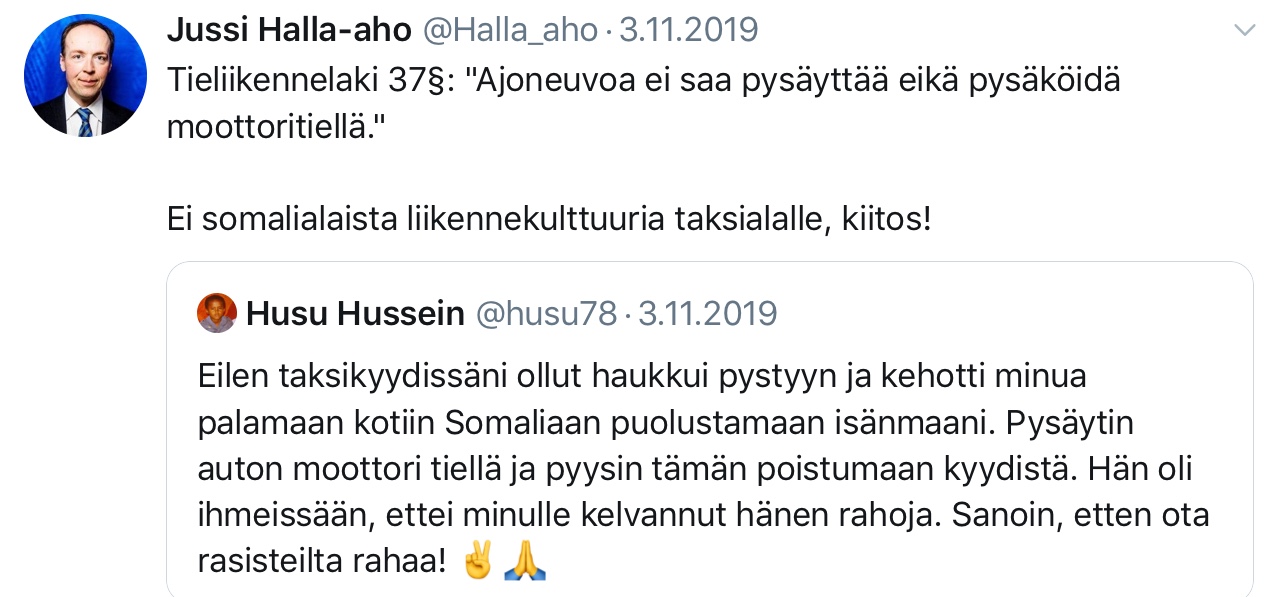
Traffic law section 37: “A motor vehicle cannot stop on the motorway. We don’t want Somali taxi culture [in Finland], thank you!

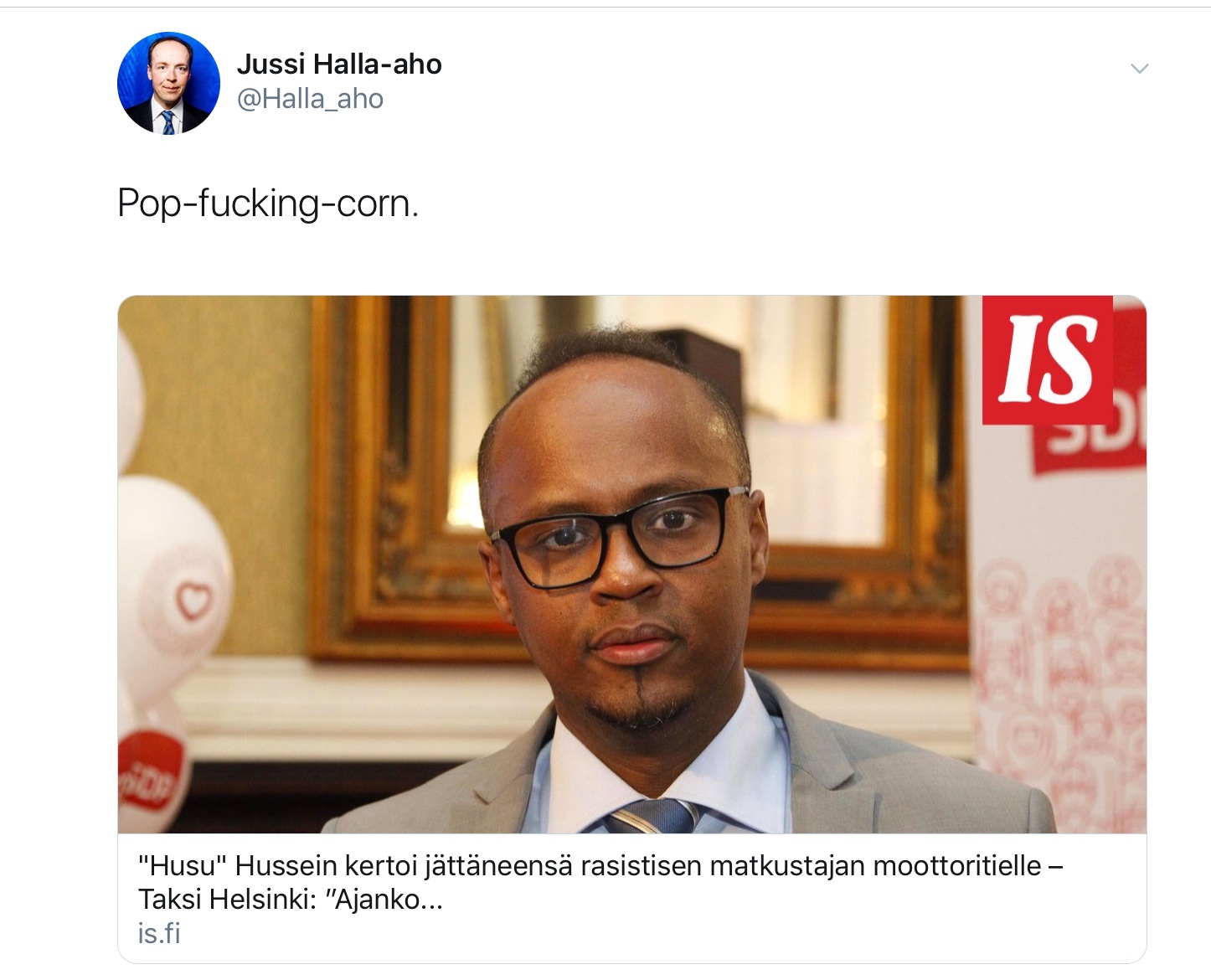
Attempting to score political points and to satisfy his hatred of the Somalis, Halla-aho tweets that what Hussein did was wrong and that you cannot ask a passenger to get off a vehicle on a motorway.

Halla-aho even gives us that the section of the law that incorrectly prohibits motor vehicles from stopping on the freeway. Indeed, people on buses or in a taxi can get off on the motorway if there is a bus stop.

The PS under Halla-aho has shown clearly its far-right racist colors. Robin DiAngelo gives an excellent definition of racism that sits perfectly with the PS leader and his followers.

A racist is an individual, always an individual, who does not like people based on race – must be conscious – and who intentionally seems to be mean to them.

Blogger Saku Timonen offers some advice to Hussein.

“He [the passenger] could have been taken to the nearest police station [and charged with racist harassment and hate speech].”

*A direct translation of Perussuomalaiset in English would be something like “basic” or “fundamental Finn.” Official translations of the Finnish name of the party, such as Finns Party or True Finns, promote in our opinion nativist nationalism and racism. We, therefore, at Migrant Tales prefer to use in our postings the Finnish name of the party once and after that the acronym PS.

Huhtasaari, Sarvamaa ja Virkkunen: Saavatko ihmiset hukkua Välimerellä?

Posted on November 2, 2019 by Migrant Tales

TÄMÄ KIRJOITUS ON PÄIVITETTY

Kolme suomalaista MEPejä, perussuomalainen Laura Huhtasaari, kokoomuslais Petri Sarvamaa ja Henna Virkkunen äänestivät 24.10. vastaan EU:n pelastus operaation puolesta Välimerelle. Europarlamentin äänestyksessä ehdotus hävisi niukasti, 290 vastaan 288 puolesta.

Huhtasaaren, Sarvamaan ja Virkkusen kanta on valitettava ja on osoitus kuinka EU on valinut kuoleman elämän puolesta. Missä on näiden poliiikkojen ihmisyys?

Kiitos Sirpla Pietikäinen, Eero Heinaluoma ja Mauri Pekkarinen kun äänestitte pelastus operataation puolesta. Seuraavat MEPit eivät äännestäneet: Ville Niinisto, Heidi Hautala, Miapetra Kumpula-Natri, Silvia Modig, Elsi Katainen, Nils Tovalds ja Teuvo Hakkarainen .

Vain 3 ääntä olisi tarvittu lisää.

Nämä MEPit äännistivät vastaan EU:n pelastus operaation puolesta Välimerelle. Kuva: European Parliament.

Keskustelin lyhesti MEP Virkkusen kanssa toukokussa miksi hän oli “erimieltä” Alma Median vaalikonen seuraavan väitteen kanssa: “EU:n velvollisuus on pelastaa kaikki hukkumisriskillä Välimeren ylittävät Eurooppaan pyrkivät siirtolaiset.”

Hän ei vastanut seuraavan kysymksen:

Virkkunen on näyttää oleva sitä mieltä, että ihmiset on aina autettava mutta pitää rangaistaa salakuljettajat, eli ihmisiä saa kuollaa prosessissa.

Kuinka monta ihmiset pitää kuola Välimerellä ennen kun EU pystyy tekemään salakuljetus kannatamaton? Kuukausia? Vuosia? Tai ei koskaan?

See the original post here.

Tänä vuonna on hukkunut yli 1000 ihmistä Välimerellä. United for Intercultural Action on vuodesta 1993 dokumentoinu “yli 36 570” kuolematapauksia kun ihmiset ovat pyrkineet Eurooppaan.

Nordic Council Literature winner Jonas Eika: In Denmark, “racism is both cultural and legal. We have state racism.”

Posted on November 2, 2019 by Migrant Tales

The 2019 recipient of the Nordic Council Literature Prize, Jonas Eika of Denmark, took the opportunity to expose generally the racism and social inequality in the Nordic region and in particular, in his home country of Denmark.

Eika, speaking at the Stockholm Concert Hall, blamed Danish Social Democrat Prime Minister Mette Fredriksen for perpetrating state-sponsored racism.

“I’m speaking to the Danish prime minister who’s also sitting somewhere in the audience, Mette Fredriksen, who’s at the head of the Social Democratic Party which has come to power by taking over the previous government’s racist language and politics,” said Eika. “Metter Fredriksen, who calls herself “the children’s PM,” but pursues an immigration policy that splits families apart, impoverishes them, and subjects a slow, destructive violence in the country’s so-called departure centers [immigration removal centers].”

Frederiksen failed to applaud after Eika’s speech and told the media at a press conference with other Nordic prime ministers the following day that she disagreed with what the writer said, according to vaaju.com.

Hear Eika’s speech below in full with English subtitles.

Eika also talked about racism and the rise of populist anti-immigration parties that promote social exclusion in the Nordic region and elsewhere.

“I’m also speaking to the other Nordic ministers in your countries,” he said, “refugees are also placed in closed prisons or remote camps, and they are broken down and made ill, some attempt o take their lives.”

“[a]nd I think that the racist nationalism, which is their years, is winning ground in the Nordic nation-states,” he continues, “[it] is dependent on whiteness, on an idea of the white majority’s exclusive right to national welfare and safety and I see whiteness as [a] heritage of the colonial past,” he said, “which also exists in the Nordic countries, and which none of the powers who previously colonized and oppressed original peoples have shown any real commitment to confronting. Quite the opposite.”‘

Thank you Bashy Qurashy for the heads-up.

  • Previous
  • 1
  • …
  • 130
  • 131
  • 132
  • 133
  • 134
  • 135
  • 136
  • …
  • 535
  • Next
Read more about documentary film
Read more

Recent Posts

  • Finland’s tabloids Iltalehti and Ilta-Sanomat are the pits
  • Riikka Purra’s Dr Jekyll and Mr Hyde mask
  • Double standards
  • Perussuomalaiset: Uusi logo, sama vanha juttu
  • Taco Trump

Recent Comments

  1. Absolutely Socking: Racist Finnish Facebook group against human rights gets flooded with socks on Musta Barbaari’s mother and sister charged by the police in “ethnic profiling” case
  2. Ilkka Nuotio on Pekka Myrskylä: “Tilastot kertovat toista kuin poliittinen keskustelu”
  3. Genrih Soinkara on The war in Ukraine and the Russian-Finnish border crisis are showing Finland’s ugly side
  4. Ahti Tolvanen on Comment by Ahti Tolvanen on the Helsinki +50 conference
  5. Angel Barrientos on Angel Barrientos is one of the kind beacons of Finland’s Chilean community

Archives

  • June 2026
  • May 2026
  • April 2026
  • March 2026
  • February 2026
  • January 2026
  • December 2025
  • November 2025
  • October 2025
  • September 2025
  • August 2025
  • July 2025
  • June 2025
  • May 2025
  • April 2025
  • March 2025
  • February 2025
  • January 2025
  • December 2024
  • November 2024
  • October 2024
  • September 2024
  • August 2024
  • July 2024
  • June 2024
  • May 2024
  • April 2024
  • March 2024
  • February 2024
  • January 2024
  • December 2023
  • November 2023
  • October 2023
  • September 2023
  • August 2023
  • July 2023
  • June 2023
  • May 2023
  • April 2023
  • March 2023
  • February 2023
  • January 2023
  • December 2022
  • November 2022
  • October 2022
  • September 2022
  • August 2022
  • July 2022
  • June 2022
  • May 2022
  • April 2022
  • March 2022
  • February 2022
  • January 2022
  • December 2021
  • November 2021
  • October 2021
  • September 2021
  • August 2021
  • July 2021
  • June 2021
  • May 2021
  • April 2021
  • March 2021
  • February 2021
  • January 2021
  • December 2020
  • November 2020
  • October 2020
  • September 2020
  • August 2020
  • July 2020
  • June 2020
  • May 2020
  • April 2020
  • March 2020
  • February 2020
  • January 2020
  • December 2019
  • November 2019
  • October 2019
  • September 2019
  • August 2019
  • July 2019
  • June 2019
  • May 2019
  • April 2019
  • March 2019
  • February 2019
  • January 2019
  • December 2018
  • November 2018
  • October 2018
  • September 2018
  • August 2018
  • July 2018
  • June 2018
  • May 2018
  • April 2018
  • March 2018
  • February 2018
  • January 2018
  • December 2017
  • November 2017
  • October 2017
  • September 2017
  • August 2017
  • July 2017
  • June 2017
  • May 2017
  • April 2017
  • March 2017
  • February 2017
  • January 2017
  • December 2016
  • November 2016
  • October 2016
  • September 2016
  • August 2016
  • July 2016
  • June 2016
  • May 2016
  • April 2016
  • March 2016
  • February 2016
  • January 2016
  • December 2015
  • November 2015
  • October 2015
  • September 2015
  • August 2015
  • July 2015
  • June 2015
  • May 2015
  • April 2015
  • March 2015
  • February 2015
  • January 2015
  • December 2014
  • November 2014
  • October 2014
  • September 2014
  • August 2014
  • July 2014
  • June 2014
  • May 2014
  • April 2014
  • March 2014
  • February 2014
  • January 2014
  • December 2013
  • November 2013
  • October 2013
  • September 2013
  • August 2013
  • July 2013
  • June 2013
  • May 2013
  • April 2013
  • March 2013
  • February 2013
  • January 2013
  • December 2012
  • November 2012
  • October 2012
  • September 2012
  • August 2012
  • July 2012
  • June 2012
  • May 2012
  • April 2012
  • March 2012
  • February 2012
  • January 2012
  • December 2011
  • November 2011
  • October 2011
  • September 2011
  • August 2011
  • July 2011
  • June 2011
  • May 2011
  • April 2011
  • March 2011
  • February 2011
  • January 2011
  • December 2010
  • November 2010
  • October 2010
  • September 2010
  • August 2010
  • July 2010
  • June 2010
  • May 2010
  • April 2010
  • March 2010
  • February 2010
  • January 2010
  • December 2009
  • November 2009
  • October 2009
  • September 2009
  • August 2009
  • July 2009
  • December 2008
  • November 2008
  • October 2008
  • September 2008
  • August 2008
  • July 2008
  • June 2008
  • May 2008
  • April 2008
  • March 2008
  • February 2008
  • January 2008
  • November 2007
  • October 2007
  • September 2007
  • August 2007
  • July 2007
  • June 2007
  • May 2007

Categories

  • ?? Gia L?c
  • ????? ?????? ????? ???????? ?? ??????
  • ???????
  • @HerraAhmed
  • @mondepasrond
  • @nohatefinland
  • @oula_silver
  • @Varathas
  • A Pakistani family
  • äärioikeisto
  • Abbas Bahmanpour
  • Abdi Muhis
  • Abdirahim Hussein Mohamed
  • Abdirahim Husu Hussein
  • Abdirisak Mahamed
  • About Migrant Tales
  • activism
  • Adam Al-Sawad
  • Adel Abidin
  • Afrofinland
  • Ahmed IJ
  • Ahti Tolvanen
  • Aino Pennanen
  • Aisha Maniar
  • Alan Ali
  • Alan Anstead
  • Alejandro Díaz Ortiz
  • Alekey Bulavsev
  • Aleksander Hemon
  • Aleksanterinliitto
  • Aleksanterinliitto ry
  • Aleksanterinliitto ry:n hallitus
  • Alex Alex
  • Alex Mckie
  • Alexander Nix
  • Alexandra Ayse Albayrak
  • Alexis Neuberg
  • Ali Asaad Hasan Alzuhairi
  • Ali Hossein Mir Ali
  • Ali Rashid
  • Ali Sagal Abdikarim
  • Alina Tsui
  • Aline Müller
  • All categories
  • Aman Heidari
  • Amiirah Salleh-Hoddin & Jana Turk
  • Amin A. Alem
  • Amir Zuhairi
  • Amkelwa Mbekeni
  • Ana María Gutiérrez Sorainen
  • Anachoma
  • Anders Adlecreutz
  • Angeliina Koskinen
  • Anna De Mutiis
  • Anna María Gutiérrez Sorainen
  • Anna-Kaisa Kuusisto ja Jaakko Tuominen
  • Annastiina Kallius
  • Anneli Juise Friman Lindeman
  • Announcement
  • Anonymous
  • Antero Leitzinger
  • anti-black racism
  • Anti-Hate Crime Organisation Finland
  • Anudari Boldbaatar
  • Arshiya Nasser
  • Aspergers Syndrome
  • Asylum Corner
  • Asylum seeker 406
  • Athena Griffin and Joe Feagin
  • Autism
  • Avaaz.org
  • Awale Olad
  • Ayan Said Mohamed
  • AYY
  • Barachiel
  • Bashy Quraishy
  • Beatrice Kabutakapua
  • Beri Jamal
  • Beri Jamal and Enrique Tessieri
  • Bertolt Brecht
  • Boiata
  • Boodi Kabbani
  • Bruno Gronow
  • Carmen Pekkarinen
  • Çelen Oben and Sheila Riikonen
  • Chiara Costa-Virtanen
  • Chiara Costa-Virtanen
  • Chiara Sorbello
  • Christian Thibault
  • Christopher Wylie
  • Clara Dublanc
  • Dana
  • Daniel Malpica
  • Danilo Canguçu
  • David Papineau
  • David Schneider
  • Dexter He
  • Don Flynn
  • Dr Masoud Kamali
  • Dr. Faith Mkwesha
  • Dr. Theodoros Fouskas
  • Edna Chun
  • Eeva Kilpi
  • Emanuela Susheela
  • En castellano
  • ENAR
  • Enrique
  • Enrique Tessieri
  • Enrique Tessieri & Raghad Mchawh
  • Enrique Tessieri & Yahya Rouissi
  • Enrique Tessieri and Muhammed Shire
  • Enrique Tessieri and Sira Moksi
  • Enrique Tessieri and Tom Vandenbosch
  • Enrique Tessieri and Wael Che
  • Enrique Tessieri and Yahya Rouissi
  • Enrique Tessieri and Zimema Mhone
  • Epäluottamusmies
  • EU
  • Europe
  • European Islamophobia Report
  • European Islamophobia Report 2019,
  • European Union
  • Eve Kyntäjä
  • Ezequiel Caldeiro
  • Facebook
  • Fadumo Dayib
  • Faisa Kahiye
  • Farhad Manjoo
  • Fasismi
  • Finland
  • Fizza Qureshi
  • Flyktingar och asyl
  • Foreign Student
  • Fozia Mir-Ali
  • Frances Webber
  • Frida Selim
  • Gareth Rice
  • Ghyslain Vedeaux
  • Global Art Point
  • Great Replacement
  • Habiba Ali
  • Hami Bahadori
  • Hami Bahdori
  • Hamid
  • Hamid Alsaameere
  • Hamid Bahdori
  • Handshake
  • Harmit Athwal
  • Hassan Abdi Ali
  • Hassan Muhumud
  • Heikki Huttunen
  • Heikki Wilenius
  • Helsingin Sanomat
  • Henning van der Hoeven
  • Henrika Mälmsröm
  • Hser Hser
  • Hser Hser ja Mustafa Isman
  • Husein Muhammed
  • Hussain Kazemian
  • Hussain Kazmenian
  • Ibrahim Khan
  • Ida
  • Ignacio Pérez Pérez
  • Iise Ali Hassan
  • Ilari Kaila & Tuomas Kaila
  • Imam Ka
  • inside-an-airport
  • Institute of Race Relations
  • Iraqi asylum seeker
  • IRR European News Team
  • IRR News Team
  • Islamic Society of Norhern FInland
  • Islamic Society of Northern Finland
  • Islamophobia
  • Jacobinmag.com
  • Jallow Momodou
  • Jan Holmberg
  • Jane Elliott
  • Jani Mäkelä
  • Jari Luoto
  • Jari Taponen
  • Jegor Nazarov
  • Jenni Stammeier
  • Jenny Bourne
  • Jessie Daniels
  • Joe Davidow
  • Johannes Koski
  • John D. Foster
  • John Grayson
  • John Marriott
  • Jon Burnett
  • Jorma Härkönen
  • Jos Schuurmans
  • José León Toro Mejías
  • Josue Tumayine
  • Jouni Karnasaari
  • Juan Camilo
  • Jukka Eräkare
  • Julian Abagond
  • Julie Pascoet
  • Jussi Halla-aho
  • Jussi Hallla-aho
  • Jussi Jalonen
  • JusticeDemon
  • Kadar Gelle
  • Kaksoiskansalaisuus
  • Kansainvälinen Mikkeli
  • Kansainvälinen Mikkeli ry
  • Katherine Tonkiss
  • Kati Lepistö
  • Kati van der Hoeven-Lepistö
  • Katie Bell
  • Kättely
  • Kerstin Ögård
  • Keshia Fredua-Mensah & Jamie Schearer
  • Khadidiatou Sylla
  • Khadra Abdirazak Sugulle
  • Kiihotus kansanryhmää vastaan
  • Kirsi Crowley
  • Koko Hubara
  • Kristiina Toivikko
  • Kubra Amini
  • KuRI
  • La Colectiva
  • La incitación al odio
  • Laura Huhtasaari
  • Lauri Finér
  • Leif Hagert
  • Léo Custódio
  • Leo Honka
  • Leontios Christodoulou
  • Lessie Branch
  • Lex Gaudius
  • Leyes de Finlandia
  • Liikkukaa!
  • Linda Hyökki
  • Liz Fekete
  • M. Blanc
  • Maarit Snellman
  • Mahad Sheikh Musse
  • Maija Vilkkumaa
  • Malmin Kebab Pizzeria Port Arthur
  • Marcell Lorincz
  • Mari Aaltola
  • María Paz López
  • Maria Rittis Ikola
  • Maria Tjader
  • Marja-Liisa Tolvanen
  • Mark
  • Markku Heikkinen
  • Marshall Niles
  • Martin Al-Laji
  • Maryan Siyad
  • Matt Carr
  • Mauricio Farah Gebara
  • Media Monitoring Group of Finland
  • Micah J. Christian
  • Michael McEachrane
  • Michele Levoy
  • Michelle Kaila
  • Migrant Tales
  • Migrant Tales Literary
  • Migrantes News
  • Migrants' Rights Network
  • MigriLeaks
  • Mikko Kapanen
  • Miriam Attias and Camila Haavisto
  • Mohamed Adan
  • Mohammad Javid
  • Mohammad M.
  • Monikulttuurisuus
  • Monisha Bhatia and Victoria Canning
  • Mor Ndiaye
  • Muh'ed
  • Muhamed Abdimajed Murshid
  • Muhammed Shire
  • Muhammed Shire and Enrique Tessieri
  • Muhis Azizi
  • Musimenta Dansila
  • Muslimiviha
  • Musulmanes
  • Namir al-Azzawi
  • Natsismi
  • Neurodiversity
  • New Women Connectors
  • Nils Muižnieks
  • No Labels No Walls
  • Noel Dandes
  • Nuor Dawood
  • Omar Khan
  • Otavanmedia
  • Oula Silvennoinen
  • Paco Diop
  • Pakistani family
  • Pentti Stranius
  • Perussuomalaiset
  • perustuslaki
  • Petra Laiti
  • Petri Cederlöf
  • Pia Grochowski
  • Podcast-lukija Bea Bergholm
  • Pohjois – Suomen Islamilainen Yhdyskunta
  • Pohjois Suomen Islamilainen Yhyskunta
  • Polina Kopylova
  • Race Files
  • racism
  • Racism Review
  • Raghad Mchawh
  • Ranska
  • Rashid H. and Migrant Tales
  • Rasismi
  • Raul Perez
  • Rebecka Holm
  • Reem Abu-Hayyeh
  • Refugees
  • Reija Härkönen
  • Remiel
  • Reza Nasri
  • Richard Gresswell
  • Riikka Purra
  • Risto Laakkonen
  • Rita Chahda
  • Ritva Kondi
  • Robito Ibrahim
  • Roble Bashir
  • Rockhaya Sylla
  • Rodolfo Walsh
  • Roger Casale
  • Rostam Atai
  • Roxana Crisólogo Correa
  • Ruth Grove-White
  • Ruth Waweru-Folabit
  • S-worldview
  • Sadio Ali Nuur
  • Sami Rusanen
  • Sandhu Bhamra
  • Sara de Jong
  • Sarah Crowther
  • Sari Alhariri
  • Sarkawt Khalil
  • Sasu
  • Scot Nakagawa
  • Shabana Ahmadzai
  • Shada Islam
  • Sharon Chang blogs
  • Shenita Ann McLean
  • Shirlene Green Newball
  • Sini Savolainen
  • Sira Moksi
  • Sonia K.
  • Sonia Maria Koo
  • Steverp
  • Stop Deportations
  • Suldaan Said Ahmed
  • Suomen mediaseurantakollektiivi
  • Suomen Muslimifoorumi ry
  • Suomen viharikosvastainen yhdistys
  • Suomen viharikosvastainen yhdistys ry
  • Suomi
  • Supermen
  • Susannah
  • Suva
  • Syrjintä
  • Talous
  • Tapio Tuomala
  • Taw Reh
  • Teivo Teivainen
  • The Daily Show
  • The Heino
  • The Supermen
  • Thomas Elfgren
  • Thulfiqar Abdulkarim
  • Tim McGettigan
  • Tino Singh
  • Tito Moustafa Sliem
  • Tobias Hübinette and L. Janelle Dance
  • Transport
  • Trica Danielle Keaton
  • Trilce Garcia
  • Trish Pääkkönen
  • Trish Pääkkönen and Enrique Tessieri
  • Tuulia Reponen
  • Uncategorized
  • UNITED
  • University of Eastern Finland
  • Uyi Osazee
  • Väkivalta
  • Vapaa Liikkuvuus
  • Venla-Sofia Saariaho
  • Vieraskynä
  • W. Che
  • W. Che an Enrique Tessieri
  • Wael Ch.
  • Wan Wei
  • Women for Refugee Women
  • Xaan Kaafi Maxamed Xalane
  • Xassan Kaafi Maxamed Xalane
  • Xassan-Kaafi Mohamed Halane & Enrique Tessieri
  • Yahya Rouissi
  • Yasmin Yusuf
  • Yassen Ghaleb
  • Yle Puhe
  • Yuliet Tresa
  • Yve Shepherd
  • Zahra Khavari
  • Zaker
  • Zalina Ametova
  • Zamzam Ahmed Ali
  • Zeinab Amini ja Soheila Khavari
  • Zimema Mahone and Enrique Tessieri
  • Zimema Mhone
  • Zoila Forss Crespo Moreyra
  • ZT
  • Zulma Sierra
  • Zuzeeko Tegha Abeng
© 2026 Migrant tales | Powered by Minimalist Blog WordPress Theme