“Mielestäni kahta asiaa. Ensinnäkin sitä, että kokoomuksen puheenjohtaja Petteri Orpo on sanonut, että näitä (al-Holin suomalaisia) lapsia ei pidä auttaa, jos se tarkoittaa näiden äitien auttamista. Hallituksen linja lähtee siitä, että nämä lapset, joista monet ovat alle viisivuotiaita, taaperoita, päiväkoti-ikäisiä lapsia, heitä pitää auttaa, lapsen etu pitää olla ensisijainen. Tämä ei ole kokoomuksen linja, ja minun mielestäni kokoomuksen linja on tässä suhteessa väärä.
Toinen asia. jota olen peräänkuuluttanut ja josta meidän hallituksemme tulee kyllä pitämään kiinni on se että kunnioitetaan meidän oikeusvaltiotamme, sitä että meillä on vallan kolmijako-oppi. Hallitus, eduskunta, poliitikot tekevät poliittisia linjauksia, poliittisia päätöksiä, mutta me emme tee päätöksiä yksilöiden hengestä ja elämästä, me emme tee päätöksiä yksilötasolla. Se on sitten viranomaisten tehtävä, joilla se toimivaltuus on. Mielestäni tästä pitää pitää kiinni. Olin aika ihmeissäni siitä, että kokoomuksen suunnalta tämä erittäin voimakkaasti kyseenalaistettiin ja sanottiin, että hallitus piilottelee virkamiesten selän takana. Näinhän ei ole. Meillä on oikeusvaltiorakenteet ja niistä kaikissa tilanteissa pitää kiinni.”
Helsingin Sanomat carried out a survey asking if Pirkka-Pekka Petelius did the right thing to apologize to the Saami for mocking them in a racist manner in the Hymyhuulet show (1987-88). The survey showed that 57% thought that Petelius was wrong to apologize, while only 29% said that he did the right thing; 14% had no opinion.
The most vigorous opposition to the apology came from the 50-69-year age group. Two-thirds of them considered the apology wrong. Those who were under 30 years had higher education and voted for the Left Alliance, and Green League party were the most favorable.
Petelius, who is a Green League MP, said that he was surprised by the reaction his apology produced.
“I’ve experienced quite heinous accusations, threats, and hate speech for apologizing to an indigenous group [like the Saami],” he was quoted as saying in Helsingin Sanomat. “Incomprehensible. It is my business to convene the Saami and apologize to them for the impact that my sketches have had. ”
Finnish white privilege #67
The Helsingin Sanomat survey is not only an indication of the deep roots of Finnish white privilege but of white fragility as well.
Robin Diangelo describes as white fragility in her best-selling book, “White Fragility.” She states that most white people “are absolutely not receptive to finding out their impact on other people.” She also mentions that the reaction caused by white fragility is nothing fragile but hostile.
If Petelius’ apology can create such a knee-jerk reaction of hate and hostility, ask yourself how many Finns would be ok with living with people of color and treating them as equals.
The reaction to Petelius’ apology also shows the ethnic and racist bubble the country continues to live in and who calls the ethnic-racial shots. Hint: It isn’t the minorities.
Migrant Tales has written numerous stories about how the Finnish media frames minorities and people of color. What is most incredible about his fact is that it continues in the Finnish media and even by Helsingin Sanomat, the county’s most important daily.
If there is one criticism of Finland’s media, it is, in many cases, its lack of fairness and overkill when it writes about migrants and minorities. In many cases, the scene appears like a person (the media) trying to kill an ant (Muslims) with a bazooka.
Apart from unfairness, the Finnish media is biased and unbalanced when it writes about minorities like Muslims.
Yle’s coverage of the Oulu sexual assault cases from November 27 to February 13 is a case in point. Back then, the state-owned broadcaster published a whopping 77 stories on the topic. On January 14, Yle published 13 stories about the topic.
How many people have been tried and convicted in the Oulu sexual assault cases? Only eight, but some believe that the hysteria generated by the media and politicians gave the Islamophobic Perussuomalaiset (PS)* party a significant boost in the recent parliamentary elections.
Another example of media hysteria is the hype about the fate of a handful of Finnish women and children in the al-Hol refugee camp in Syria.
Finland’s media needs to get real and to come to terms with its past and present racism, which is strongly denied. An apology and hiring minorities to the newsroom would be an essential first step.
The Finnish media could also start taking a clearer stand on racism and discrimination in our society by writing editorials. One of these topics could be on populism and how it is hreatening our Nordic way of life.
Finnish magazines like Hymy in the 1990s did not hide their racism. In this story about Lola Odusaga, elected Miss Finland in 1996, offers readers answers to the following questions: Does a black person get a tan, bruise and do teeth shine at night? See the original blog post (in Finnish) here.
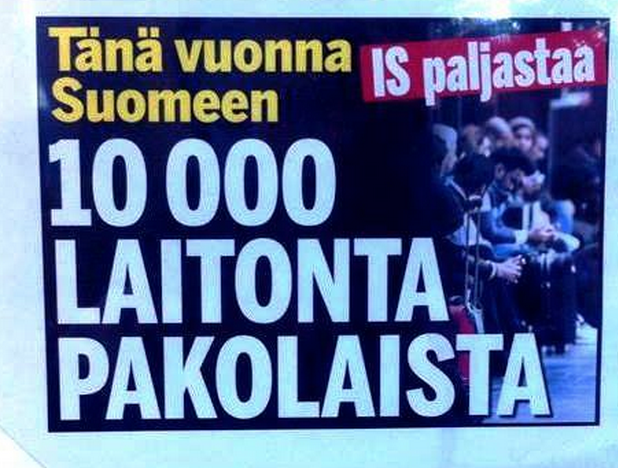
Tabloids like Ilta-Sanomat and Iltalehti have a questionable record when it comes to coverage of minorities like Muslims in Finland. This billboard of 2015 claims that this year Finland will get 10,000 “illegal” refugees. What is an “illegal” refugee? There is no such thing. Source: Ilta-Sanomat.An Ilta-Sanomat billboard that claims that the Somalis in the early 1990s swindled the authorities n getting refugee status. Source: Ilta-Sanomat.Believe it or not, but in the 1990s, Somalis who would not go back to thir former homeland was big “news.” it was news to publish that the Somalis were not going back to their homeland but planned to make Finland their home. Source: llta-Sanomat.
A 10-year-old child in a department store in Tampere was attacked by a man with a knife. The suspect took two swings at the child but his father was able to stop the attack. Even if the suspect was a white Finn, and fearing a social media storm on social media, the police announced that the suspect “does not have a foreign origin.”
“A person with foreign origin” is code for a non-EU citizen or a person of color.
To put it simply, and if this happened in the UK, the police would write in the statement that the suspect isn’t a person of color, Muslim, Jew or any other minority.
These types of statements by the police racialize crime and cave in to the anti-immigration populism of parties like the Perussuomalaiset.*
Finland’s biggest daily Helsingin Sanomat published a story about a Finnish woman who impersonated a Japanese tourist asking dumb questions to Finns. The show was so popular that it even won a Venla award, a Finnish version of the USAmerican Emmy Award.
That was in 2014.
Why would Helsingin Sanomat, a newspaper with vast resources and power, like to commemorate a Finn that impersonates a Japanese tourist? What’s the joke, and isn’t this racist and embarrassing that a daily wouldn’t even ask if this show is offensive to the Asian community in Finland?
Is this racist? Sure it is because it spreads stereotypes of the Japanese. It is also shameful considering that Finland’s most prominent daily still publishes these types of stories in 2019 uncritically.
In the Helsingin Sanomat story, there is no mention if this is racist and if it insults Asian communities of Finland. Read the full story (in Finnish) here.
One may ask why such stories ever get past the copy editors and why no one at the daily asked if these types of stories were ever ok?
Helsingin Sanomat recently celebrated its 130h anniversary. See any people of color or minorities, even if about 16% of Helsinki’s population are not white Finns? Source: Helsingin Sanomat.
The answer to that question could probably be found in the picture above, where there isn’t a single visible minority on the Helsingin Sanomat staff, even if about 16% of Helsinki’s population comprises of migrants and non-white Finns.
Prime Minister Sanna Marin announced today that Finland would assist in the repatriation of some 30 Finnish children in the al-Hol camp in Syria, according to Yle.She said that Finland had no obligation to help the mothers.
While the announcement was expected after President Sauli Niinistö stated his view on the matter Sunday, it’s clear that the decision by the government is political.
University of Helsinki family law researcher, Sanna Mustasaari, warned about the danger of mixing politics with the al-Hol children’s welfare.
“The mothers weren’t helped because it was [a] political [decision],” she said on Yle’s A-Studio, adding that “under no circumstances” should the child welfare authorities, in searching for legal reasons to help the child, allow politics to influence their decision.
University of Helsinki family law researcher Sanna Mustasaari. Source: Yle.
President Sauli Niinistö announced Sunday that Finland must help the Finnish children in the al-Hol camp in Syria but not the mothers.
What does this mean in practice? It suggests that Prime Minister Sanna Marin’s government will take the same line as Niinistö.
One of the interesting matters to ask about the whole affair is why it is such a hot issue? What roles do prejudice and anti-Muslim sentiment play in the debate?
If the president and the government see eye to eye on the matter, what does it imply for the mothers? What about those who don’t want to be separated from their children? Does it mean that both mother and child will remain in Syria in squalid conditions?
The handling of the whole al-Hol matter by the government will weaken its credibility further. A president and a government that is ready to throw its citizens to the dogs cannot command a lot of respect from people who take human rights seriously.
If the government is having such a difficult time agreeing on how to help some 10 women and 30 children, what does it mean to government plans to strengthen human rights and improve the legal situation of asylum seekers?
A while back, President Niinistö suggested that Finland’s policy concerning the women and children in al-Hol should be similar to the other Nordic nations, which only grant assistance to children, not their mothers.
Even if Niinistö turns to the other Nordic nations for policy guidance, he forgets to tell us about the anti-Muslim sentiment in Norway and that the country is ruled by the Conservative Party and Islmophobic Progress Party. Even in Denmark, where the Social Democrats won the elections, Islamophobic sentiment is the highest of all the Nordic countries.
In Sweden, which has always been an example of a welcoming nation to migrants and refugees, is having second thoughts as the shadow of the Sweden Democrats grows.
I am certain that if President Tarja Halonen (2000-2012) were in office, the government’s response to the al-Hol Finns would be different and more in line with these people’s human rights.
President Niinistö’s announcement concerning the Finns in al-Hol should not come to any surprise. His past comments and views about migration and cultural diversity are in line with what he said.
The National Coalition Party (Kokoomus) claims to champion liberal Western values and entrepreneurship, right? Is this true if the party succumbs to cheap anti-immigration populism?
Kokoomus MP Wille Rydman likes spewing copy-and-paste soundbites of the Islamophobic Perussuomalaiset (PS)* party.
Apart from his staunch Islamophobic views, he also takes up pseudo-scientific eugenicist views as in this recent news story.
Jussi Halla-aho, convicted for ethnic agitation in 2012, heads the PS. Under his leadership, the party has steered further to the far right.
Rydman is no exception when it comes to lawmakers attempting to capitalize politically of the fate of about 40 women and children at the al-Hol camp of northeast Syria.
The tweet below is an example of how far Kokoomus continues to stoop and how willing it is to forfeit the rule of law for personal gain.
One of the cheapest tweets by a Finnish lawmaker.
“Instead of offering state aid for repatriation, if an adult Finnish citizen has turned his [or her] back on this country to serve a brutal terrorist organization, the correct thing to do is to revoke that person’s nationality and place a permanent bar from entering the country. A 17-year-old Islamist extremist is no safer from one who is 18 years old.
If these people bore a child when living in “a caliphate,” what kinds of bond does such a child have in practice with Finland? If he has never been to Finland and was brought up under an Islamist system, there is no point in repatriating the child nor is it legally possible without the whole family. [So be it] if this cannot be done legally without retrieving the rest of the family at the same time.”
One of the suggestions made by Rydman is that Finnish citizenship should be revoked with permanent bans to enter the country.
If Rydman’s opportunistic populism does not make you reach for the collective barf bag, Kokoomus Helsinki City Councillor Atte Kaleva is another one throwing Islamophobic tantrums. He tweets below that a person is guilty before he is proven innocent.
Atte Kaleva’s tweet reveals his disdain for the rule of law.
Both Rydman, Kaleva, and Kokoomus are examples of cheap populism and, most worrying, how fast they’d be ready to ditch the rule of law and our Nordic way of life for a handful of votes.
One of the most significant political debates going on in Finland now is the fate of about 40 Finnish women and children at the al-Hol camp in northeastern Syria. The debate has taken such shameful turns that even ministers have tuned to their followers on social media to ask whether these women and children should be repatriated.
It is clear that prejudices and hardcore racism against Muslims, especially women who ditch their white Finnish majority culture for another religion, is one driving force in the ongoing debate.
The saddest matters about the ongoing debate is the near-constant Islamophobic disinformation and wishy-washy politicians scoring brownie points with voters. The discussion exposes pretty well our racism towards Muslims.
Helsingin Sanomat, Finland’s biggest daily and which should know better, is also responsible for spreading stereotypes and racism against Muslims.
Other mainstream media in Finland like Yle commonly spread stereotypes about Muslims like in this story published in 2018.
Since the repatriation debate of the Finnish women and children at al-Hol is an ongoing story, Helsingin Sanomat has an illustration of five women and four children to highlight the topic. Even if the women at al-Hol wear niqabs, the drawing suggests they us burkas (sic).
The difference between the hijab (or veil), niqab, and burka is pretty clear as the picture below shows. Muslims are common in our society, and we should learn to know the difference between the three.
From left to right: the hijab, niqab, and burka. Source: Sunday Times.
If papers like Helsingin Sanomat want to stop spreading stereotypes and disinformation about vulnerable groups like Muslims in Finland, they should get their facts right and take the time to research their stories better.
They should, at the minimum, know the difference between a niqab and burka.
The Center Party of Finland is a liability to the future of Prime Minister Sanna Marin’s government. We already saw how they forced former Prime Minister Antti Rinne to resign. And then, we witnessed Finance Minister Katri Kulmuni’s Instagram poll.
Kulmuni’s post not only exposed her total disregard for human lives and the country’s international obligations but was a warning that some politicians, even ministers, are ready to leave the fate of their citizens to public opinion and chance.
She asked in the Instagram poll whether it would be ok repatriating “[Finnish] children only” or “children and [Finnish] mothers” from the al-Hol camp in Syria.
Andrew Stroehlein of Human Rights Watch was one of many who were awestruck what Kulmuni’s post. “Seriously, Finland? This is awful, if true,” he tweeted Thursday.
Finland has always been good at getting the maximum mileage from its international image by hiding its problematic social sore spots.
One of these is women’s rights and equality. Women still make about 20% less than men and a recent survey found Finland to be the second-most violent country for women.
Even if some brag about how Finland became the first to grant women the right to vote in 1906, it was not until 1984 when women were able to grant citizenship to their children through jus sanguinis.
Finland also had draconian laws against foreigners and foreign investment thanks to the Restricting Act of 1939 (Law 219/1939), which was made redundant in 1992.
Moreover, Finland got its first Aliens Act in 1983, or about 66 years after independence in 1917. Finland had total disregard for human rights when in the Cold War it returned Soviet citizens back to the USSR without granting asylum. Finland has serious issues with racism, hate crime and asylum policy.
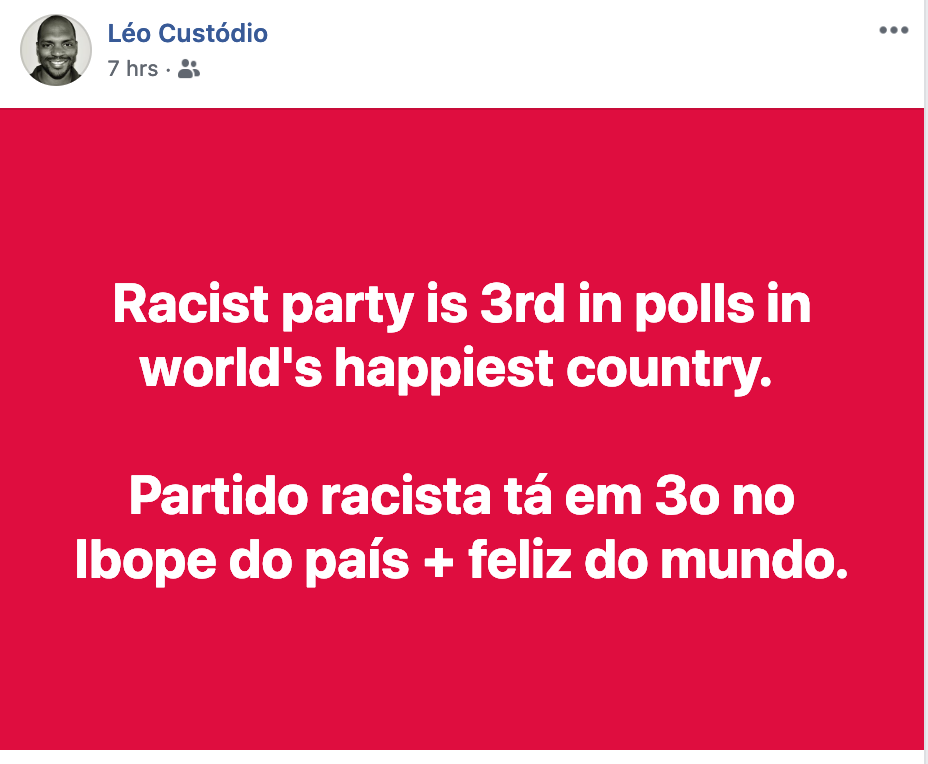
And here lay the question of questions that reveal how deep our collective heads are stuck in the mud: How can such a perfect society, which is supposed to be the happiest in the world, have an openly racist and misogynist party like the Perussuomalaiset (PS)* leading in the polls?
Even if our media scores high on the World Press Freedom Index, why is much of the reporting uncritical when it comes to serious social issues like migrant and minority discrimination and rights? The fact far-right populism is breathing down the necks of mainstream parties is a good indication of the failure of the media to challenge such social ills.
Let’s get real. What Finance Minister Kulmuni posted is a symptom of our denial in confronting those sore spots that only help cover and play down our more serious social problems.
The sooner we understand this, the sooner we can begin to start making Finland a good country to live in for all of its inhabitants irrespective of their backgrounds.