Migrant tales
Menu
  • #MakeRacismHistory “In Your Eyes”
  • About Migrant Tales
  • It’s all about Human Rights
  • Literary
  • Migrant Tales Media Monitoring
  • NoHateFinland.org
  • Tales from Europe
Menu

Category: All categories

UPDATE (Mar. 30): Migrant Tales’ 2015 Hall of Poor and Sloppy Journalism

Posted on March 30, 2015 by Migrant Tales

Migrant Tales’ 2015 Hall of Poor and Sloppy Journalism will be updated separately. To see other examples of opinionated journalism in Finland about cultural diversity, please go to this link.

Mar. 30

Ilkan kysely: Lukijoista suurin osa ei halua pakolaisperhettä naapuriinsa  (Ilkka)

What’s wrong with this story and how does it reinforce prejudices about refugees? Ilkka of Seinäjoki, probably the most anti-immigration daily in Finland, published the results of a survey it conducted with its readers and asked what they think about refugees. Eighty percent that responded said that South Ostrobothnia shouldn’t accept anymore refugees while 60% said they would not want to have a refugee as their neighbor. Should we be surprised by the results of the survey? Not really due to the xenophobic climate in Finland. So why did Ilkka carry out this survey in the first place if it knew what the answer would be? Hiding one’s shame or that intolerance works in many strange ways? Was one reason Seinäjoki’s decision not to accept any refugees this year? Either way shameful and opinionated journalism at its worst.

Näyttökuva 2015-3-30 kello 14.25.41


UPDATE (Mar. 19): Migrant Tales’ 2015 Hall of Poor and Sloppy Journalism

Posted on March 21, 2015 by Migrant Tales

Migrant Tales’ 2015 Hall of Poor and Sloppy Journalism will be updated separately. To see other examples of opinionated journalism in Finland about cultural diversity, please go to this link.

Mar. 19

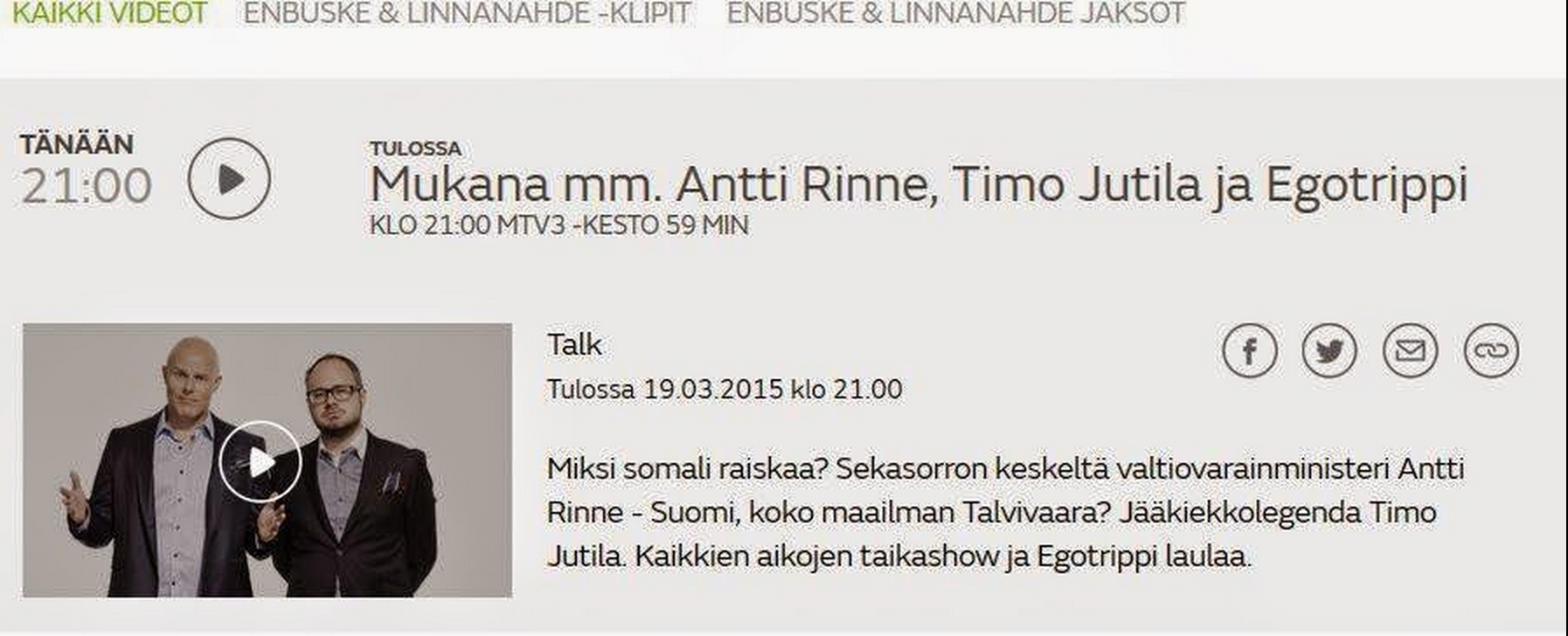
Enbuske & Linnanahde: Miksi “kansalaisryhmä x” raiskaa?  (MTV3)

What’s wrong with this ad promoting a TV talk show? Racism in Finnish journalism is more common than one thinks. One of the problems is that the so-called migrant narrative is dominated and played out by white Finns who feel self-righteous are blinded by their own prejudices and political correctness. Their intolerance could be pictured as a jack-in-the-box that pops up when the lid is open and exposes an ogre. Imagine a popular talk show watched by Finns that asks why a certain national group rapes? What Enbuske & Linnanahde forget to mention is that white Finns commit the most rapes in this country so we could perfectly well ask the same questions of white Finns. Enbuske & Linnanahde have always had issues with their prejudices. This ad below, which was later changed, exposes it perfectly.


Näyttökuva 2015-3-21 kello 10.30.28


Now you see it…

Näyttökuva 2015-3-22 kello 16.40.42

…now you don’t.

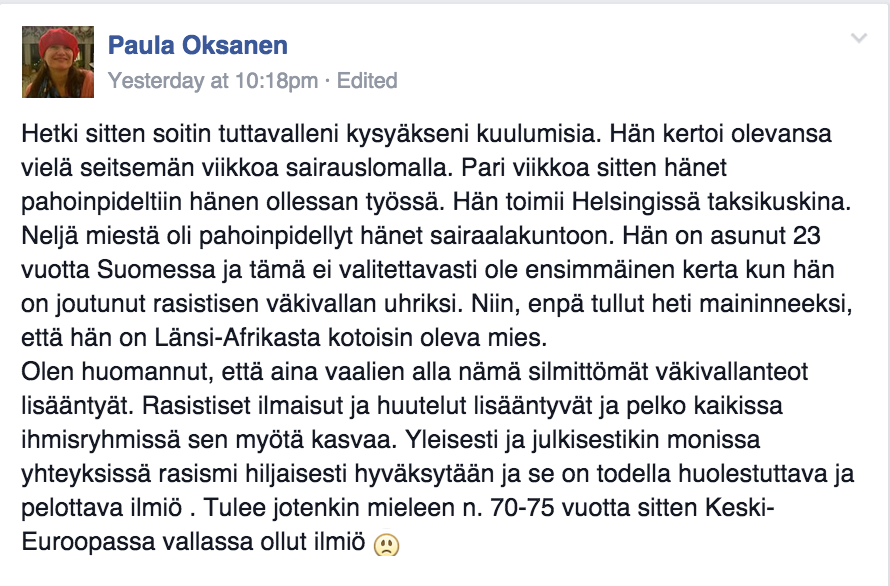
Musta taksikuski, joka on asunut 23 vuotta Suomessa joutui viharikoksen uhriksi

Posted on March 18, 2015 by Migrant Tales

Tässä ikävä uutinen…

Näyttökuva 2015-3-16 kello 23.07.28


UPDATE (Mar. 11): Migrant Tales’ 2015 Hall of Poor and Sloppy Journalism

Posted on March 12, 2015 by Migrant Tales

Migrant Tales’ 2015 Hall of Poor and Sloppy Journalism will be updated separately. To see other examples of opinionated journalism in Finland about cultural diversity, please go to this link.

Mar. 11

Tapanilan raiskaus ja HS:n uutisointi – Mitä kertoa, kun epäillyt ovat jo kiini? (Helsingin Sanomat)

Some bad and some good journalism. The police said in a statement that a group of 15-18-year-olds who raped a woman on Monday in Tapanila, a neighborhood of northern Helsinki, had “immigrant backgrounds.” A few minutes later after publishing the story Helsingin Sanomat, which relied on the police statement, took out the word since the suspects were in police custody. Stating a person’s ethnic identity can be helpful if the suspect is still at large. This may be problematic, however, since a person with “immigrant background” encompasses a very large group. In practice it is anyone who isn’t a white Finn. In the present xenophobic climate and with parliamentary elections only a month away, some anti-immigration sites are pointing the accusing finger at Helsingin Sanomat for removing the word “immigrant background” in the story as a clear example that Finland’s largest daily favors “foreigners.” A question that should always be asked when mentioning a suspect’s ethnic background is if the person is under custody or is still at large?

Na?ytto?kuva 2015-3-12 kello 0.45.01


European racism is like a Cadillac but has the ability to appear and vanish

Posted on March 8, 2015 by Migrant Tales

Racism is like a Cadillac, they bring out a new model every year.

Malcolm X (1925-65)

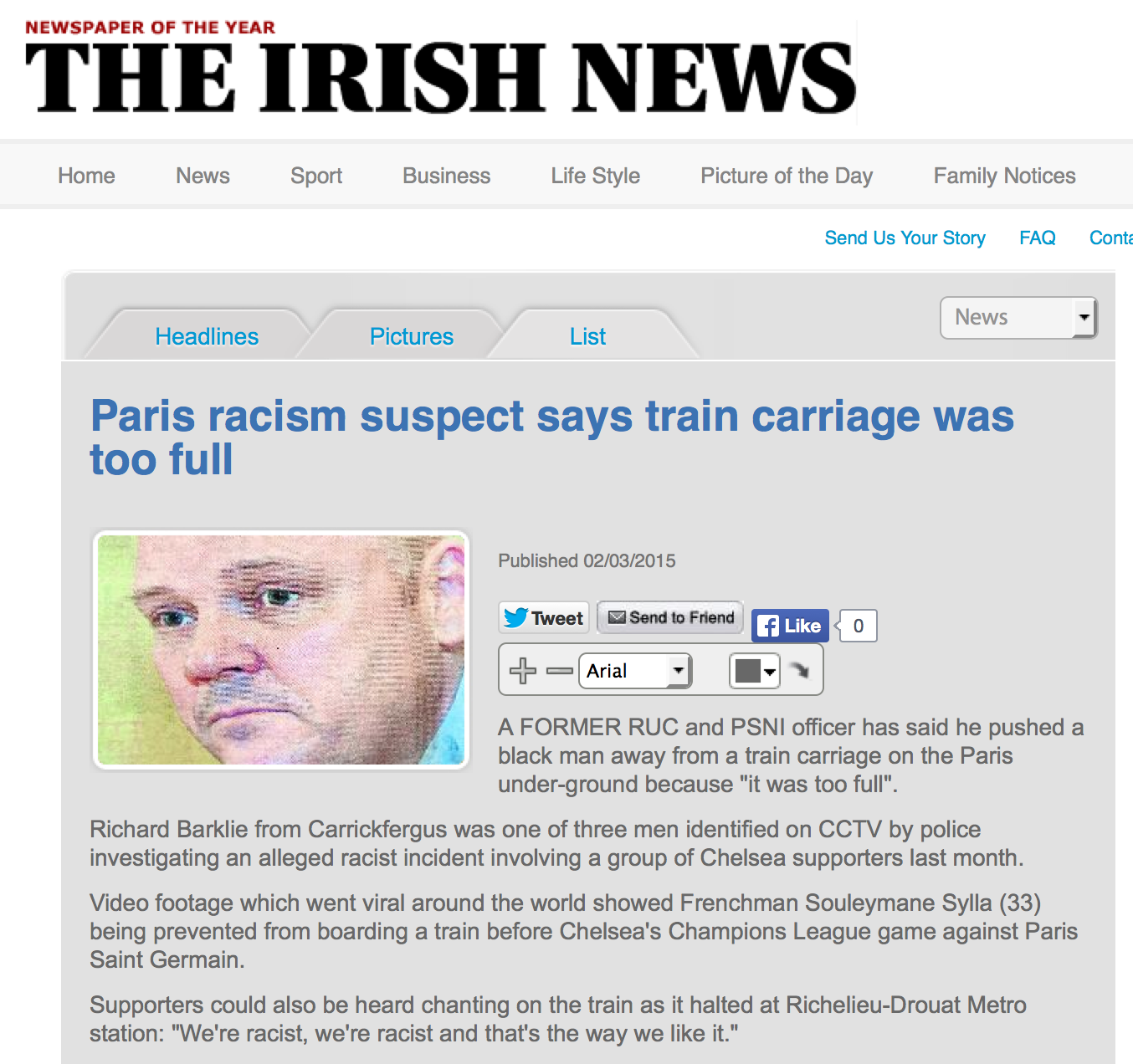
The story of the three Chelsea fans who are suspected of turning away a black person from entering a train on the Paris subway station of Richelieu-Drovat highlights the many “Cadillacs” and shades of racism in today’s Europe as well as its ability to appear and vanish.  

One of the suspects in the Paris metro affair is Richard Barklie, 50, when a black man, Souleymane Sylla, was shoved from entering a carriage. While this was happening, supporters were heard chanting: “We’re racist, we’re racist and that’s the way we like it.”

Barklie claims that the black man was shoved away because the carriage was full and had nothing to do with racism.

Näyttökuva 2015-3-6 kello 8.22.21

Read full story here.

Continue reading “European racism is like a Cadillac but has the ability to appear and vanish”

Contemporary Immigration in Greece: A sourcebook

Posted on March 6, 2015 by Migrant Tales

Dr. Theodoros Fouskas, a lecturer at the New York College, Greece, is editor together with Dr. Vassileios Tsevrenis of a comprehensive book on immigration in Greece. As some are already aware, Greece has seen a surge in xenophobia due to the great number of refugees that enter the country from outside Europe.  

Dr. Tsevrenis is a lawyer, special scientific collaborator at Marangopoulos Foundation for Human Rights (MFHR), and member of the Scientific Committee of the Foundation of Greek Parliament.

Continue reading “Contemporary Immigration in Greece: A sourcebook”

UPDATE (Feb. 26): Migrant Tales’ 2015 Hall of Poor and Sloppy Journalism

Posted on February 26, 2015 by Migrant Tales

Migrant Tales’2015 Hall of Poor and Sloppy Journalism will be updated separately. To see other examples of opinionated journalism in Finland about cultural diversity, please go to this link. 

Feb. 26

Rasismi motiivina somalitaksikuskin pahoinpitelyyn Lieksassa? (Karjalainen)

Why such an odd question in the headline? Migrant Tales has published, like the national media, a number of stories on racism in Lieksa, a town located in Eastern Finland. Karjalainen, a Joensuu daily, has played an important role in tackling racism in this part of the country. The headline of the story, Racism could be a motive in the attack against a Somali taxi driver of Lieksa, is an odd headline. The story states that not only was the taxi driver attacked by the white Finnish male client, but was that the driver was also a victim of his racist language and harassment. While everyone is innocent before proven guilty, why are we questioning if this was a hate crime? Are we playing down what happened by asking if it was a hate crime? The headline should have been bolder like, White Finn attacks and hurls racist language against Somali taxi driver.

Näyttökuva 2015-2-26 kello 13.23.18

Anonymous: Humanity ushers

Posted on February 25, 2015 by Migrant Tales
 
By Anonymous

Humanity humanity

we speak of issues of humanity

can`t stay tight-lipped against brutality

spur reactions toward our predicament

deliberate on issues of humanity

humanity………………….……. humanity

IMG_8502

you are a fresh breath against worlds insanity

enlightens on pervading concerns against humanity

draw boundary between humanity and inhumanity

you spell genuine surface of humanity

quell wrath against inhumanity

yell globally, you crusade for humanity

like a mirror vanity

reflect not distorted image but world insanity

but also reality and spearhead true values of humanity

you lift a lid for those who suffer from inhumanity

speak for them in language of humanity

for the voiceless give a voice of humanity

shed light on their predicament and inhumanity

call attention for cause of humanity

for those without supper and in adversity

you nourish them with hope for humanity

those in danger buffer against inhumanity

their distress calls crave for humanity

touch their lives and save them from inhumanity

for those tortured revive their trust in humanity

recognize their fate and call for a cause for humanity

feed our soul with a cold breeze of humanity

against harsh reality

and everyday life attrocity

humanity………………….……… humanity

IMG_8610

the common spirit that binds us all in uniformity

human rights as our watchdog speak-up for humanity

humanity………………….………………. humanity

not an entity but multiplicity and diversity

against man-made and natural calamities calls for humanity

modern world crisis and turmoil

calls for a shield of humanity

for our every day life in disarray seeks you humanity

lets walk and talk humanity

in unisom embrace humanity

to usher us to the next millinieum with faith in humanity

Racism Review: Islamophobia is a form of Racism

Posted on February 12, 2015 by Migrant Tales

Jessie Daniels

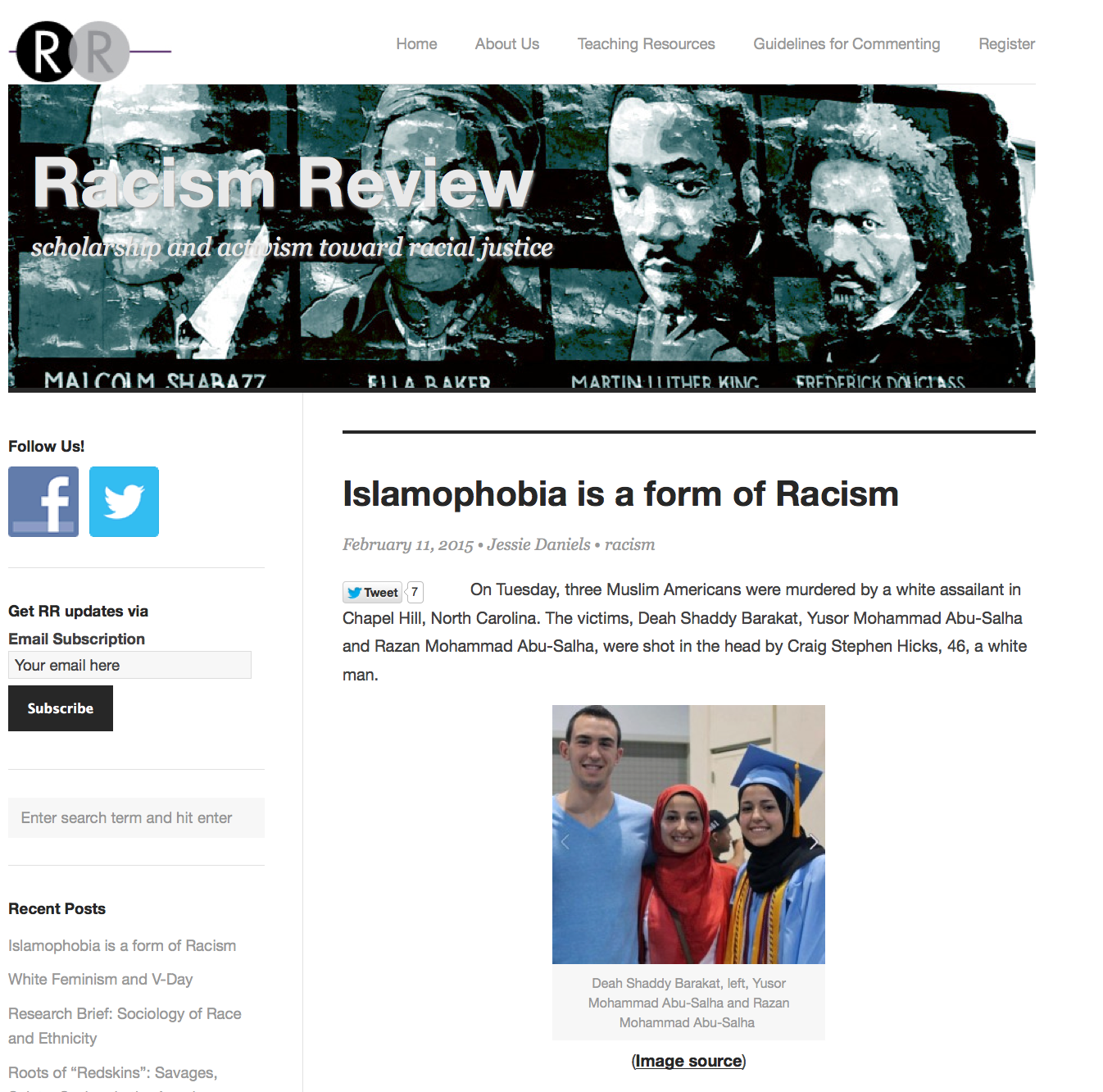
On Tuesday, three Muslim Americans were murdered by a white assailant in Chapel Hill, North Carolina. The victims, Deah Shaddy Barakat, Yusor Mohammad Abu-Salha and Razan Mohammad Abu-Salha, were shot in the head by Craig Stephen Hicks, 46, a white man.


Näyttökuva 2015-2-12 kello 15.30.17


Read original blog entry here.


A “dispute over parking,” was what led to the shooting according to some of the initial news reports. Ripley Rand, U.S. attorney for the Middle District of North Carolina, said at a news conference about the shootings: “We don’t have any evidence that this was part of an organized effort against Muslims. This appears, at this point, to have been an isolated incident.” What the dominant news stories and Rand’s comments miss, are the connection between Islamophobia and systematic racism. As Professor Mohamad Elmasry points out, Muslims are consistently portrayed as “inherently dangerous” in western media.

As a response to what many saw as a denial of role of Islamophobia and racism in the murder, people took to Twitter to express their outrage, using the hashtag #MuslimLivesMatter, which was soon trending.

There is a fairly well-established, and yet still growing, body of research which documents the racialization of Muslim people and the rise of Islamophobia in the West as forms of racism. Just some of this research includes the following:

  • Dunn, Kevin M., Natascha Klocker, and Tanya Salabay. “Contemporary racism and Islamaphobia in Australia Racializing religion.” Ethnicities 7, no. 4 (2007): 564-589. Abstract: Contemporary anti-Muslim sentiment in Australia is reproduced through a racialization that includes well rehearsed stereotypes of Islam, perceptions of threat and inferiority, as well as fantasies that the Other (in this case Australian Muslims) do not belong, or are absent. These are not old or colour-based racisms, but they do manifest certain characteristics that allow us to conceive a racialization process in relation to Muslims. Three sets of findings show how constructions of Islam are important means through which racism is reproduced. First, public opinion surveys reveal the extent of Islamaphobia in Australia and the links between threat perception and constructions of alien-ness and Otherness. The second data set is from a content analysis of the racialized pathologies of Muslims and their spaces. The third is from an examination of the undercurrents of Islamaphobia and national cultural selectivity in the politics of responding to asylum seekers. Negative media treatment is strongly linked to antipathetic government dispositions. This negativity has material impacts upon Australian Muslims. It sponsors a more widespread Islamaphobia, (mis)informs opposition to mosque development and ever more restrictive asylum seeker policies, and lies behind arson attacks and racist violence. Ultimately, the racialization of Islam corrupts belonging and citizenship for Muslim Australians. (locked)
  • Gottschalk, Peter, and Gabriel Greenberg. Islamophobia: making Muslims the enemy. Rowman & Littlefield, 2008. Book description: The term “Islamophobia” reflects the largely unexamined and deeply ingrained anxiety many Americans experience when considering Islam and Muslim cultures. Until recently, America has had only a small domestic Muslim minority and few connections to Muslim cultures with whom to build familiarity. In times of crisis, the long-simmering resentments, suspicions and fears manifest themselves. This book graphically shows how political cartoons–the print medium with the most immediate impact–dramatically reveal Americans demonizing and demeaning Muslims and Islam. It also reveals a fundamental misunderstanding of the Muslim world in general and issues a wake-up call to the American people. (available at libraries)
  • Hussain, Yasmin, and Paul Bagguley. “Securitized citizens: Islamophobia, racism and the 7/7 London bombings.” The Sociological Review 60, no. 4 (2012): 715-734. Abstract: The London bombings of 7 July 2005 were a major event shaping the relationship between Muslims and non-Muslims in Britain. In this paper we introduce the idea of ‘securitized citizens’ to analyse the changing relationship between British Muslims and wider British society in response to this and similar events. Through an analysis of qualitative interviews with Muslims and non-Muslims of a variety of ethnic backgrounds in the areas where the London bombers lived in West Yorkshire we examine the popular perceptions of non-Muslims and Muslims’ experiences. We show how processes of securitization and racialization have interacted with Islamophobic discourses and identifications, as well as the experiences of Muslims in West Yorkshire after the attacks. (locked)
  • Poynting, Scott, and Victoria Mason. “The resistible rise of Islamophobia Anti-Muslim racism in the UK and Australia before 11 September 2001.” Journal of Sociology 43, no. 1 (2007): 61-86. Abstract: This article compares the rise of anti-Muslim racism in Britain and Australia, from 1989 to 2001, as a foundation for assessing the extent to which the upsurge of Islamophobia after 11 September was a development of existing patterns of racism in these two countries. The respective histories of immigration and settlement by Muslim populations are outlined, along with the relevant immigration and ‘ethnic affairs’ policies and the resulting demographics. The article traces the ideologies of xenophobia that developed in Britain and Australia over this period. It records a transition from anti-Asian and anti-Arab racism to anti-Muslim racism, reflected in and responding to changes in the identities and cultural politics of the minority communities. It outlines instances of the racial and ethnic targeting by the state of the ethnic and religious minorities concerned, and postulates a causal relationship between this and the shifting patterns of acts of racial hatred, vilification and discrimination. (locked)
  • Saeed, Amir. “Media, racism and Islamophobia: The representation of Islam and Muslims in the media.” Sociology Compass 1, no. 2 (2007): 443-462. Abstract: This article examines the representation of Islam and Muslims in the British press. It suggests that British Muslims are portrayed as an ‘alien other’ within the media. It suggests that this misrepresenatation can be linked to the development of a ‘racism’, namely, Islamphobia that has its roots in cultural representations of the ‘other’. In order to develop this arguement, the article provies a summary/overview of how ethnic minorities have been represented in the British press and argues that the treatment of British Muslims and Islam follows these themes of ‘deviance’ and ‘un-Britishness’. (locked)
  • Sheridan, Lorraine P. “Islamophobia pre–and post–September 11th, 2001.”Journal of Interpersonal Violence 21, no. 3 (2006): 317-336. Abstract: Although much academic research has addressed racism, religious discrimination has been largely ignored. The current study investigates levels of selfreported racial and religious discrimination in a sample of 222 British Muslims. Respondents indicate that following September 11th, 2001, levels of implicit or indirect discrimination rose by 82.6% and experiences of overt discrimination by 76.3%. Thus, the current work demonstrates that major world events may affect not only stereotypes of minority groups but also prejudice toward minorities. Results suggest that religious affiliation may be a more meaningful predictor of prejudice than race or ethnicity. General Health Questionnaire scores indicate that 35.6% of participants likely suffered mental health problems, with significant associations between problem-indicative scores and reports of experiencing a specific abusive incident of September 11th–related abuse by respondents. The dearth of empirical work pertaining to religious discrimination and its effects is a cause for concern. (locked)

Denying the link between Islamophobia and racism both discounts the weight of evidence and compounds the pain of those who have lost friends and loved ones to hate-motivated violence.

Read original blog entry here.

This piece was reprinted by Migrant Tales with permission.

Nuori musta nainen pienessä suomalaisissa kaupungissa

Posted on February 12, 2015 by Migrant Tales

Suomalaiset ovat sitä mieltä, ettei rotusortoa heidän keskuudessa ilmene. 

Joseph Wandera Owindi*

Joidenkin ns. kantasuomalaisten on vaikea tajuta kuinka musta nainen voi tulla kohdelluksi pienessä kaupungissa kuten Mikkelissä. Mustat naiset eivät ole ainoat uhrit, koska samat ennakkoluulot pätevät myös venäläisiä naisia kohtaan.

Näyttökuva 2015-2-12 kello 0.30.25

”Olen asunut Mikkelissä muutamia vuosia ja joka kerta kun lähden kodista usein keski-ikäiset miehet lähestyvät minua julkisella paikalla,” hän sanoo. ”Jotkut ajattelevat, että olen prostituoitu kun taas toiset syyttelevät minun elävän sosiaaliturvalla. He kysyvät englannin kiellellä miksi en puhu Suomea, jota kyllä puhun, tai sanovat minulle että pitäisi palata sinne mistä tulin.”

Musta nainen on oppinut olemaan varovainen kuinka hän pukeutuu.

“Jos käytän lyhyttä hametta tai minulla on meikkiä sitten miehet lähestyvät ja alkavat tekemään epämiellyttäviä kysymyksiä,” hän jatkaa. “En tykkää olla ulkona yksin mutta jos olen aina jonkun ystävän kanssa. Kuten sanoin, jotkut miehet ovat erittäin röyhkeitä eivätkä he välittä jos he loukkaavat minua.”

“Joskus vastaan takaisin,” hän sanoo. “Kerron että en elä sosiaaliturvasta, koska opiskelen ja olen työssä. Eivät he silti usko.”

Nuori musta nainen uskoo että Eteläsudanilaiset, Turkkilaiset ja Romanit ovat vähemmistöjä jotka kärsivät kaikista eniten Mikkelissä taustansa takia.

Mustalla naisella on lapsi joka ei ole vielä koulussa. Hän uskoo että hänen lapsensa tulee kärsimään koulussa etnisen taustan takia. Kerran kun hän oli vauva mukanaan hampurilaisravintolassa noin 15-vuotiaat teinit kommentoivat äänen kun näkivät lapseni vaunuissa, että “katso siellä on apina.”

“Kun olen lapsen kanssa saan vihaiset katseet jotka kysyvät minulta miksi tein tuo lapsen valkoisten suomalaisen kanssa,” hän sanoo. “Kuinka minä elän tämänkaltaisen kohtelun kohteena joka päivä? Yritän unohtaa mitä tapahtuu vaikka se on vaikeaa. Tämä on hyvin kiusallinen tilanne.”

Nainen sanoo, että jotkut ihmisten Suomessa pitäisi kouluttaa että he oppisivat kohtelemaan toisia samalla kunnioitusta mitä he vaativat itselleen.

*Kato, kato nekru. WSOY. Porvoo 1972. s. 47. 


  • Previous
  • 1
  • …
  • 23
  • 24
  • 25
  • 26
  • 27
  • 28
  • 29
  • …
  • 119
  • Next
Read more about documentary film
Read more

Recent Posts

  • Finland’s tabloids Iltalehti and Ilta-Sanomat are the pits
  • Riikka Purra’s Dr Jekyll and Mr Hyde mask
  • Double standards
  • Perussuomalaiset: Uusi logo, sama vanha juttu
  • Taco Trump

Recent Comments

  1. Absolutely Socking: Racist Finnish Facebook group against human rights gets flooded with socks on Musta Barbaari’s mother and sister charged by the police in “ethnic profiling” case
  2. Ilkka Nuotio on Pekka Myrskylä: “Tilastot kertovat toista kuin poliittinen keskustelu”
  3. Genrih Soinkara on The war in Ukraine and the Russian-Finnish border crisis are showing Finland’s ugly side
  4. Ahti Tolvanen on Comment by Ahti Tolvanen on the Helsinki +50 conference
  5. Angel Barrientos on Angel Barrientos is one of the kind beacons of Finland’s Chilean community

Archives

  • June 2026
  • May 2026
  • April 2026
  • March 2026
  • February 2026
  • January 2026
  • December 2025
  • November 2025
  • October 2025
  • September 2025
  • August 2025
  • July 2025
  • June 2025
  • May 2025
  • April 2025
  • March 2025
  • February 2025
  • January 2025
  • December 2024
  • November 2024
  • October 2024
  • September 2024
  • August 2024
  • July 2024
  • June 2024
  • May 2024
  • April 2024
  • March 2024
  • February 2024
  • January 2024
  • December 2023
  • November 2023
  • October 2023
  • September 2023
  • August 2023
  • July 2023
  • June 2023
  • May 2023
  • April 2023
  • March 2023
  • February 2023
  • January 2023
  • December 2022
  • November 2022
  • October 2022
  • September 2022
  • August 2022
  • July 2022
  • June 2022
  • May 2022
  • April 2022
  • March 2022
  • February 2022
  • January 2022
  • December 2021
  • November 2021
  • October 2021
  • September 2021
  • August 2021
  • July 2021
  • June 2021
  • May 2021
  • April 2021
  • March 2021
  • February 2021
  • January 2021
  • December 2020
  • November 2020
  • October 2020
  • September 2020
  • August 2020
  • July 2020
  • June 2020
  • May 2020
  • April 2020
  • March 2020
  • February 2020
  • January 2020
  • December 2019
  • November 2019
  • October 2019
  • September 2019
  • August 2019
  • July 2019
  • June 2019
  • May 2019
  • April 2019
  • March 2019
  • February 2019
  • January 2019
  • December 2018
  • November 2018
  • October 2018
  • September 2018
  • August 2018
  • July 2018
  • June 2018
  • May 2018
  • April 2018
  • March 2018
  • February 2018
  • January 2018
  • December 2017
  • November 2017
  • October 2017
  • September 2017
  • August 2017
  • July 2017
  • June 2017
  • May 2017
  • April 2017
  • March 2017
  • February 2017
  • January 2017
  • December 2016
  • November 2016
  • October 2016
  • September 2016
  • August 2016
  • July 2016
  • June 2016
  • May 2016
  • April 2016
  • March 2016
  • February 2016
  • January 2016
  • December 2015
  • November 2015
  • October 2015
  • September 2015
  • August 2015
  • July 2015
  • June 2015
  • May 2015
  • April 2015
  • March 2015
  • February 2015
  • January 2015
  • December 2014
  • November 2014
  • October 2014
  • September 2014
  • August 2014
  • July 2014
  • June 2014
  • May 2014
  • April 2014
  • March 2014
  • February 2014
  • January 2014
  • December 2013
  • November 2013
  • October 2013
  • September 2013
  • August 2013
  • July 2013
  • June 2013
  • May 2013
  • April 2013
  • March 2013
  • February 2013
  • January 2013
  • December 2012
  • November 2012
  • October 2012
  • September 2012
  • August 2012
  • July 2012
  • June 2012
  • May 2012
  • April 2012
  • March 2012
  • February 2012
  • January 2012
  • December 2011
  • November 2011
  • October 2011
  • September 2011
  • August 2011
  • July 2011
  • June 2011
  • May 2011
  • April 2011
  • March 2011
  • February 2011
  • January 2011
  • December 2010
  • November 2010
  • October 2010
  • September 2010
  • August 2010
  • July 2010
  • June 2010
  • May 2010
  • April 2010
  • March 2010
  • February 2010
  • January 2010
  • December 2009
  • November 2009
  • October 2009
  • September 2009
  • August 2009
  • July 2009
  • December 2008
  • November 2008
  • October 2008
  • September 2008
  • August 2008
  • July 2008
  • June 2008
  • May 2008
  • April 2008
  • March 2008
  • February 2008
  • January 2008
  • November 2007
  • October 2007
  • September 2007
  • August 2007
  • July 2007
  • June 2007
  • May 2007

Categories

  • ?? Gia L?c
  • ????? ?????? ????? ???????? ?? ??????
  • ???????
  • @HerraAhmed
  • @mondepasrond
  • @nohatefinland
  • @oula_silver
  • @Varathas
  • A Pakistani family
  • äärioikeisto
  • Abbas Bahmanpour
  • Abdi Muhis
  • Abdirahim Hussein Mohamed
  • Abdirahim Husu Hussein
  • Abdirisak Mahamed
  • About Migrant Tales
  • activism
  • Adam Al-Sawad
  • Adel Abidin
  • Afrofinland
  • Ahmed IJ
  • Ahti Tolvanen
  • Aino Pennanen
  • Aisha Maniar
  • Alan Ali
  • Alan Anstead
  • Alejandro Díaz Ortiz
  • Alekey Bulavsev
  • Aleksander Hemon
  • Aleksanterinliitto
  • Aleksanterinliitto ry
  • Aleksanterinliitto ry:n hallitus
  • Alex Alex
  • Alex Mckie
  • Alexander Nix
  • Alexandra Ayse Albayrak
  • Alexis Neuberg
  • Ali Asaad Hasan Alzuhairi
  • Ali Hossein Mir Ali
  • Ali Rashid
  • Ali Sagal Abdikarim
  • Alina Tsui
  • Aline Müller
  • All categories
  • Aman Heidari
  • Amiirah Salleh-Hoddin & Jana Turk
  • Amin A. Alem
  • Amir Zuhairi
  • Amkelwa Mbekeni
  • Ana María Gutiérrez Sorainen
  • Anachoma
  • Anders Adlecreutz
  • Angeliina Koskinen
  • Anna De Mutiis
  • Anna María Gutiérrez Sorainen
  • Anna-Kaisa Kuusisto ja Jaakko Tuominen
  • Annastiina Kallius
  • Anneli Juise Friman Lindeman
  • Announcement
  • Anonymous
  • Antero Leitzinger
  • anti-black racism
  • Anti-Hate Crime Organisation Finland
  • Anudari Boldbaatar
  • Arshiya Nasser
  • Aspergers Syndrome
  • Asylum Corner
  • Asylum seeker 406
  • Athena Griffin and Joe Feagin
  • Autism
  • Avaaz.org
  • Awale Olad
  • Ayan Said Mohamed
  • AYY
  • Barachiel
  • Bashy Quraishy
  • Beatrice Kabutakapua
  • Beri Jamal
  • Beri Jamal and Enrique Tessieri
  • Bertolt Brecht
  • Boiata
  • Boodi Kabbani
  • Bruno Gronow
  • Carmen Pekkarinen
  • Çelen Oben and Sheila Riikonen
  • Chiara Costa-Virtanen
  • Chiara Costa-Virtanen
  • Chiara Sorbello
  • Christian Thibault
  • Christopher Wylie
  • Clara Dublanc
  • Dana
  • Daniel Malpica
  • Danilo Canguçu
  • David Papineau
  • David Schneider
  • Dexter He
  • Don Flynn
  • Dr Masoud Kamali
  • Dr. Faith Mkwesha
  • Dr. Theodoros Fouskas
  • Edna Chun
  • Eeva Kilpi
  • Emanuela Susheela
  • En castellano
  • ENAR
  • Enrique
  • Enrique Tessieri
  • Enrique Tessieri & Raghad Mchawh
  • Enrique Tessieri & Yahya Rouissi
  • Enrique Tessieri and Muhammed Shire
  • Enrique Tessieri and Sira Moksi
  • Enrique Tessieri and Tom Vandenbosch
  • Enrique Tessieri and Wael Che
  • Enrique Tessieri and Yahya Rouissi
  • Enrique Tessieri and Zimema Mhone
  • Epäluottamusmies
  • EU
  • Europe
  • European Islamophobia Report
  • European Islamophobia Report 2019,
  • European Union
  • Eve Kyntäjä
  • Ezequiel Caldeiro
  • Facebook
  • Fadumo Dayib
  • Faisa Kahiye
  • Farhad Manjoo
  • Fasismi
  • Finland
  • Fizza Qureshi
  • Flyktingar och asyl
  • Foreign Student
  • Fozia Mir-Ali
  • Frances Webber
  • Frida Selim
  • Gareth Rice
  • Ghyslain Vedeaux
  • Global Art Point
  • Great Replacement
  • Habiba Ali
  • Hami Bahadori
  • Hami Bahdori
  • Hamid
  • Hamid Alsaameere
  • Hamid Bahdori
  • Handshake
  • Harmit Athwal
  • Hassan Abdi Ali
  • Hassan Muhumud
  • Heikki Huttunen
  • Heikki Wilenius
  • Helsingin Sanomat
  • Henning van der Hoeven
  • Henrika Mälmsröm
  • Hser Hser
  • Hser Hser ja Mustafa Isman
  • Husein Muhammed
  • Hussain Kazemian
  • Hussain Kazmenian
  • Ibrahim Khan
  • Ida
  • Ignacio Pérez Pérez
  • Iise Ali Hassan
  • Ilari Kaila & Tuomas Kaila
  • Imam Ka
  • inside-an-airport
  • Institute of Race Relations
  • Iraqi asylum seeker
  • IRR European News Team
  • IRR News Team
  • Islamic Society of Norhern FInland
  • Islamic Society of Northern Finland
  • Islamophobia
  • Jacobinmag.com
  • Jallow Momodou
  • Jan Holmberg
  • Jane Elliott
  • Jani Mäkelä
  • Jari Luoto
  • Jari Taponen
  • Jegor Nazarov
  • Jenni Stammeier
  • Jenny Bourne
  • Jessie Daniels
  • Joe Davidow
  • Johannes Koski
  • John D. Foster
  • John Grayson
  • John Marriott
  • Jon Burnett
  • Jorma Härkönen
  • Jos Schuurmans
  • José León Toro Mejías
  • Josue Tumayine
  • Jouni Karnasaari
  • Juan Camilo
  • Jukka Eräkare
  • Julian Abagond
  • Julie Pascoet
  • Jussi Halla-aho
  • Jussi Hallla-aho
  • Jussi Jalonen
  • JusticeDemon
  • Kadar Gelle
  • Kaksoiskansalaisuus
  • Kansainvälinen Mikkeli
  • Kansainvälinen Mikkeli ry
  • Katherine Tonkiss
  • Kati Lepistö
  • Kati van der Hoeven-Lepistö
  • Katie Bell
  • Kättely
  • Kerstin Ögård
  • Keshia Fredua-Mensah & Jamie Schearer
  • Khadidiatou Sylla
  • Khadra Abdirazak Sugulle
  • Kiihotus kansanryhmää vastaan
  • Kirsi Crowley
  • Koko Hubara
  • Kristiina Toivikko
  • Kubra Amini
  • KuRI
  • La Colectiva
  • La incitación al odio
  • Laura Huhtasaari
  • Lauri Finér
  • Leif Hagert
  • Léo Custódio
  • Leo Honka
  • Leontios Christodoulou
  • Lessie Branch
  • Lex Gaudius
  • Leyes de Finlandia
  • Liikkukaa!
  • Linda Hyökki
  • Liz Fekete
  • M. Blanc
  • Maarit Snellman
  • Mahad Sheikh Musse
  • Maija Vilkkumaa
  • Malmin Kebab Pizzeria Port Arthur
  • Marcell Lorincz
  • Mari Aaltola
  • María Paz López
  • Maria Rittis Ikola
  • Maria Tjader
  • Marja-Liisa Tolvanen
  • Mark
  • Markku Heikkinen
  • Marshall Niles
  • Martin Al-Laji
  • Maryan Siyad
  • Matt Carr
  • Mauricio Farah Gebara
  • Media Monitoring Group of Finland
  • Micah J. Christian
  • Michael McEachrane
  • Michele Levoy
  • Michelle Kaila
  • Migrant Tales
  • Migrant Tales Literary
  • Migrantes News
  • Migrants' Rights Network
  • MigriLeaks
  • Mikko Kapanen
  • Miriam Attias and Camila Haavisto
  • Mohamed Adan
  • Mohammad Javid
  • Mohammad M.
  • Monikulttuurisuus
  • Monisha Bhatia and Victoria Canning
  • Mor Ndiaye
  • Muh'ed
  • Muhamed Abdimajed Murshid
  • Muhammed Shire
  • Muhammed Shire and Enrique Tessieri
  • Muhis Azizi
  • Musimenta Dansila
  • Muslimiviha
  • Musulmanes
  • Namir al-Azzawi
  • Natsismi
  • Neurodiversity
  • New Women Connectors
  • Nils Muižnieks
  • No Labels No Walls
  • Noel Dandes
  • Nuor Dawood
  • Omar Khan
  • Otavanmedia
  • Oula Silvennoinen
  • Paco Diop
  • Pakistani family
  • Pentti Stranius
  • Perussuomalaiset
  • perustuslaki
  • Petra Laiti
  • Petri Cederlöf
  • Pia Grochowski
  • Podcast-lukija Bea Bergholm
  • Pohjois – Suomen Islamilainen Yhdyskunta
  • Pohjois Suomen Islamilainen Yhyskunta
  • Polina Kopylova
  • Race Files
  • racism
  • Racism Review
  • Raghad Mchawh
  • Ranska
  • Rashid H. and Migrant Tales
  • Rasismi
  • Raul Perez
  • Rebecka Holm
  • Reem Abu-Hayyeh
  • Refugees
  • Reija Härkönen
  • Remiel
  • Reza Nasri
  • Richard Gresswell
  • Riikka Purra
  • Risto Laakkonen
  • Rita Chahda
  • Ritva Kondi
  • Robito Ibrahim
  • Roble Bashir
  • Rockhaya Sylla
  • Rodolfo Walsh
  • Roger Casale
  • Rostam Atai
  • Roxana Crisólogo Correa
  • Ruth Grove-White
  • Ruth Waweru-Folabit
  • S-worldview
  • Sadio Ali Nuur
  • Sami Rusanen
  • Sandhu Bhamra
  • Sara de Jong
  • Sarah Crowther
  • Sari Alhariri
  • Sarkawt Khalil
  • Sasu
  • Scot Nakagawa
  • Shabana Ahmadzai
  • Shada Islam
  • Sharon Chang blogs
  • Shenita Ann McLean
  • Shirlene Green Newball
  • Sini Savolainen
  • Sira Moksi
  • Sonia K.
  • Sonia Maria Koo
  • Steverp
  • Stop Deportations
  • Suldaan Said Ahmed
  • Suomen mediaseurantakollektiivi
  • Suomen Muslimifoorumi ry
  • Suomen viharikosvastainen yhdistys
  • Suomen viharikosvastainen yhdistys ry
  • Suomi
  • Supermen
  • Susannah
  • Suva
  • Syrjintä
  • Talous
  • Tapio Tuomala
  • Taw Reh
  • Teivo Teivainen
  • The Daily Show
  • The Heino
  • The Supermen
  • Thomas Elfgren
  • Thulfiqar Abdulkarim
  • Tim McGettigan
  • Tino Singh
  • Tito Moustafa Sliem
  • Tobias Hübinette and L. Janelle Dance
  • Transport
  • Trica Danielle Keaton
  • Trilce Garcia
  • Trish Pääkkönen
  • Trish Pääkkönen and Enrique Tessieri
  • Tuulia Reponen
  • Uncategorized
  • UNITED
  • University of Eastern Finland
  • Uyi Osazee
  • Väkivalta
  • Vapaa Liikkuvuus
  • Venla-Sofia Saariaho
  • Vieraskynä
  • W. Che
  • W. Che an Enrique Tessieri
  • Wael Ch.
  • Wan Wei
  • Women for Refugee Women
  • Xaan Kaafi Maxamed Xalane
  • Xassan Kaafi Maxamed Xalane
  • Xassan-Kaafi Mohamed Halane & Enrique Tessieri
  • Yahya Rouissi
  • Yasmin Yusuf
  • Yassen Ghaleb
  • Yle Puhe
  • Yuliet Tresa
  • Yve Shepherd
  • Zahra Khavari
  • Zaker
  • Zalina Ametova
  • Zamzam Ahmed Ali
  • Zeinab Amini ja Soheila Khavari
  • Zimema Mahone and Enrique Tessieri
  • Zimema Mhone
  • Zoila Forss Crespo Moreyra
  • ZT
  • Zulma Sierra
  • Zuzeeko Tegha Abeng
© 2026 Migrant tales | Powered by Minimalist Blog WordPress Theme