One of the facts about the government’s anti-racism statement is that it has more to do with injecting trust in a government after it was hit by a string of racism and far-right scandals in the summer. At least for the time being, the statement succeeded at keeping the government from dissolving after the Swedish People’s Party gave it the thumbs up.
The statement also exposes the magic abilities and wishful thinking of the government: the Perussuomalaiset (PS)* isn’t a far-right party; politicians with problematic racist backgrounds are appointed ministers and with the wave of a wand, their racism instantly white-cleaned.
Read the full government anti-racism statement here.
While there was nothing new in the statement except for criminalizing Holocaust denial, Nazi and Communist flags, it was a rehashing of what the government is obliged to do to protect the rights of all people in Finland irrespective of their background.
The statement would have never been drafted if it weren’t for the scandals that the government underwent.
The statement highlights, however, the ongoing problem of racism in Finland: We acknowledge the social ill’s existence but are not willing to challenge it head on.
After many years of writing about racism and discrimination in Migrant Tales, I am always disappointed by Finland’s and Europe’s blind spot of racism. A good example of the latter was a feature by Yle of far-right youths whose only contribution, in my opinion, in the story was their suspicion and loathing of migrants and minorities.
It is sad that the media continues not to see its blind spot of racism but perpetuates and spreads hatred and stereotypes about migrants.
Even if such a toxic narrative may bring you fame and power as a politician, even a ministerial position, it is a perilous path that can lead us to the slippery slope of the pyramid of hate.
The Holocaust and other genocides offer red-flag warnings.
Historian Stefan Lehnstaedt hit the nail on the head about our blind spot of racism through his analysis of the Holocaust.
Finnish Broadcasting Company (Yle) published Saturday a story about two far-right youths belonging to the openly fascist and racist Blue-and-Black Movement (Sinimusta liike), and one to Suomen Sisu, which the authorities named in 2011 as “a Nazi-spirited association.” Thanks to the Yle article, the reader can read how much these so-called “radical nationalists” hate migrants.
Pyry-Lii Soinio is a twenty-two-year member of the Blue-and-Black Movement. He does not hide his loathing for outsiders. “I don’t think immigration should be restricted,” he said, “but [foreign] people should be deported altogether. I don’t care whether immigrants are good citizens or taxpayers. What matters to me is whether they are Finns.”
This is the third article that Yle has published on far-right members in the last three years. The first one was in 2019 by TV host Sean Ricks on far-right youths, followed by Suomineito in 2022.
Both stories received their fair share of criticism.
Plans to pay migrants less social welfare planned by Prime Minister Petteri Orpo’s government are a wet dream that spans back to 2016, when then Social and Health Minister Hanna Mantylä aimed to pass legislation that would grant migrants less social welfare than native Finns. Fortunately, such a law did not see the light of day since it was unconstitutional.
The unconstitutionality of such a law rests on Section 6 of the Constitution: “Everyone is equal before the law. No one shall, without an acceptable reason, be treated differently from other persons on the ground of sex, age, origin, language, religion, conviction, opinion, health, disability or other reason that concerns his or her person.”
Thus, if you are going to pay less social welfare to a group, the measure must apply to everyone in order for it to be constitutional.
Efforts to get foreigners to get less social welfare than native Finns, was brought up again in 2018 by Finland’s Nobel Prize in economics, Bengt Holmström. He said that white Finns must not share power and privileges with migrants and their children. In other words, they should get lower salaries and social security benefits so that it does not irritate Finns.
According to Statistics Finland’s Working Paper series published in 2014, Finland is no land of opportunity for migrants, according to Pekka Myrskylä. He claims that the employment level of Estonians and Thai citizens matches that of white Finns. The majority of migrants, however, live in poverty in Finland because they make less money, according to him.
I have tweeted to Riikka Purra about her suggestion not to pay social welfare to foreigners. My question to her was: If social welfare is left to a minunum, does it mean that foreigners have to pay taxes?
Surprisngly, she did not respond to my tweet.
National Coalition Party MP Pia Kauma is another politician who has been hellbent that migrants should be paid less social welfare.
Perussuomalaiset on villi kortti, joka on valmis tuhoamaan Suomen hyvinvointivaltion ja demokratian. Hyökkäykset mediaa vastaan ovat tuttu strategia Donald Trumpin pelikirjasta.
Liikenne- ja viestintäministeri Lulu Ranne (ps) sanoi Helsingin Sanomissa tänään ”jotain rajaa” uutisointiin perussuomalaisista.
”Minä olen sitä mieltä, että tämä on mennyt aivan överiksi,” hän varoitti.
Kuvittele, että ministeri kertoo tiedotusvälineille, miten ne voivat tehdä työnsä. Mistä he saavat kirjoittaa.
Jos Suomi ei varo, PS ei miettisi kahdesti Kokoomuksen kanssa kansalaisoikeuksien ja demokratian heikentämistä.
Krooninen rasismi ja valheet sivuutetaan, mutta suurin niistä on Riikka Purran lupaus siitä, että pienituloiset eivät kärsisi leikkauksista.
Takinkäännös ennätys!
Suosittelen, että jokainen katsoo tämän videon ja jakaa sen eteenpäin vaikka omille persu tutuille. Tämä on takinkäännön SM-ennätys. Saat mitä tilaa? pic.twitter.com/xaZm8EN0nh
PS ei ainoastaan hyökkää tiedotusvälineitä vastaan vaan kieltäytyy puhumasta toimittajille. Tämä on vaarallinen strategia, ja sen pitäisi olla punainen vaate.
Purra ei ole vielä antanut medialle haastattelua rasistisista kirjoituksistaan huolimatta Helsingin Sanomien kaltaisten tahojen vivahteikkaista pyynnöistä.
One clear aspect of Finland’s heated debate about racism is how politicians, especially from the Perussuoomalaiset (PS) party, claim ignorance about what racism is. PS MP Joakim Vigelius went as far as to claim that the term “racism” has suffered from inflation.
I wonder if victims of racism and microaggression feel the same way.
As can be seen with Vigelius’ view of racism, it is always a white person setting the narrative and definitions about such a social ill.
Another politician, MP Jani Mäkelä, the head of the PS parliamentary group, said in Helsingin Sanomat that other groups define the term to fit their political needs.
“They take this term, arbitrarily define its content according to their own definition,” he said.
One of the most unusual comments that Mäkelä made to Helsingin Sanomat was his definition of racism. According to him, the law protects the individual from discrimination but this cannot apply to immigration policy, cultural and national groups.
He said that cultures, where women and sexual minorities are treated badly, cannot be considered equal to Finnish culture.
“Such a culture should be seen as inferior if it treats people like that,” added Mäkelä.
In other words, Finnish law protects individual rights against discrimination but it isn’t racist to speak demeaningly of groups like Muslims.
As one navigates through the denials and smoke screens from politicians about racism, it’s easy to understand that such tactics aim to deceive.
Some friendly advice: If you have difficulty figuring out what is racism, ask and do some research. That is how we did it in California: one can achieve a lot with the help of cultural sensitivity and the willingness to learn.
Unless you have lived isolated from people, there is no reason why you should blame ignorance on your racism.
Another piece of advice: if you want people to treat you with respect, then you should treat them with respect, too.
The big question is what impact will the racism scandals that have rocked Prime Minister Petteri Orpo’s government. For one, they reveal an era when politicians can say anything they want and face little to no accountability.
Perussuomalaiset (PS)* Finance Minister Riikka Purra’s racist and violent comments of 2008 have put her in a difficult bind. She has tried to mitigate the damage by stating that the posts are old and she wrote them before entering politics.
Sure, Purra, you were a 31-year-old adult doing Ph.D. research at the time.
Writes Politico: “Purra — from the right-wing populist Finns Party [PS] — has been accused of writing: “Is anyone up for spitting on beggars … ?” as well as using racist slurs historically used to demean Black people. The racist comments were published under the acronym “riikka” in the guestbook of former Finns Party leader Jussi Halla-aho’s online blog Scripta.”
A good example of how an Islamophobic party like the PS covers its hatred for Muslims. In the top picture, the PS claims that Muslim women are oppressed because they wear certain Muslim attire. In the second cartoon below, the PS gives its real opinion: “Why don’t you go back to where you came from? That dress has no place in Finland.”Purra made a comment in 2019 of a woman with a “black sack” which she hasn’t apologized.
Purra also threatened in her posts to kill migrant youths on a commuter train and called Turks “monkeys.”
How many of us would think of joining a racist site like Purra did and writing racist comments to our heart’s content?
I wouldn’t.
In a normal world, any politician, never mind a minster, would be forced to resign after writing such racist things. The fact that the Purra and other ministers like Wille Rydman don’t want to resign, shows how politics in Finland want to defy the law of political gravity.
And that is not all that Orpo said in Helsingin Sanomat: “We are doing everything in our power to eradicate racism and discrimination,” he continued, “We are doing more [on this front] than any government before us.”
In light of the scandals that have rocked Orpo’s government from the start, there appear to be an endless amount of denial in the face of a chronic loss of credibility of the government.
Source: Twitter
Fomer Prime Minister Sanna Marin warned that Orpo’s government is ready to “erode the fundamental values of a democratic society.”
It is a bit disingenuous that after ten years of the historic Perussuomaiset (PS)* victory in the 2011 election, when the party saw the number of MPs soared to 39 from five previously, some of us still appear startled about the racism of the radical right party and how they aim to destroy the credibility of the Finnish media and our democratic institution. There is an answer as to why: The challenge of seeing the dark side of ourselves.
After the hostile attacks against the Finnish media at the PS congress over the weekend and editorials and analysis by Finland’s biggest daily, Helsingin Sanomat, it appears that everyone is still surprised.
Just for the record, I never underestimated the profound impact and threat of the PS to our democratic institutions. The quote by Time Magazine in 2011 expressed my concern in the face of how too many played down the election result. Source Time Magazine.
But it would be unfair to place all the blame on the PS. Today, traditional parties like the conservative National Coalition Party (Kokoomus) have become ideologically closer to the PS. Even a traditional liberal party like the Swedish People’s Party, agreed to form part of a coalition government with the PS.
Kun tarkastellaan rasismiskandaaleja, jotka ovat varjostaneet perussuomalaisten toimintaa vuosien varrella ja viimeistään heinäkuussa, on tämä väite erikoinen. Uskomme, että rasismi on ollut historiallisesti yhtä tärkeä asia perussuomalaisille kuin ruotsin kieli on ruotsalaiselle kansanpuolueelle.
Mutta oikeudenmukaisuuden nimissä, minä (Tessieri) haluan kiittää perussuomalaisia, jotka Mikkelin kaupunginvaltuuston kokouksissa, joihin olen osallistunut, eivät puhu maahanmuuttajista alentavalla tavalla kuin heidän kansanedustajat eduskunnassa.
Perussuomalaiset on kuitenkin historiallisesti ensimmäinen suuri nykysuomalainen puolue, joka on hyötynyt eri ryhmien vastakkainasettelusta ja leimannut muita ryhmiä, kuten muslimeja, afrikkalaisia ja muita EU:n ulkopuolisia ihmisiä, vähemmän arvokkaiksi.
Rasismi on vakava yhteiskunnallinen sairaus, jossa ihmisryhmät määritellään alempiarvoisiksi etnisen alkuperän, ihonvärin, kansallisuuden, kulttuurin tai uskonnon vuoksi.
Vaikka puolue ei välttämättä tunnusta maahanmuuttopolitiikkaansa rasistiseksi, sillä on kuitenkin hyvin syrjiviä piirteitä. Parannuksia ei juurikaan ole toteutettu, ja muutokset vaikeuttavat maahanmuuttajien tasavertaista kohtelua ja mahdollisuutta osallistumiseen yhteiskuntaamme.
Olemme myös eri mieltä Jani Sension kanssa siitä, että tämän kesän rasismikohu on lähinnä median luoma ilmiö.
Jos tämä rasismikeskustelu on tuonut yhden tärkeän asian esille, niin sen, että suomalaisella lehdistöllä on tärkeä rooli oikeusvaltioperiaatteen ja kaikkien ihmisten perusoikeuksien puolustamisessa riippumatta taustoista.
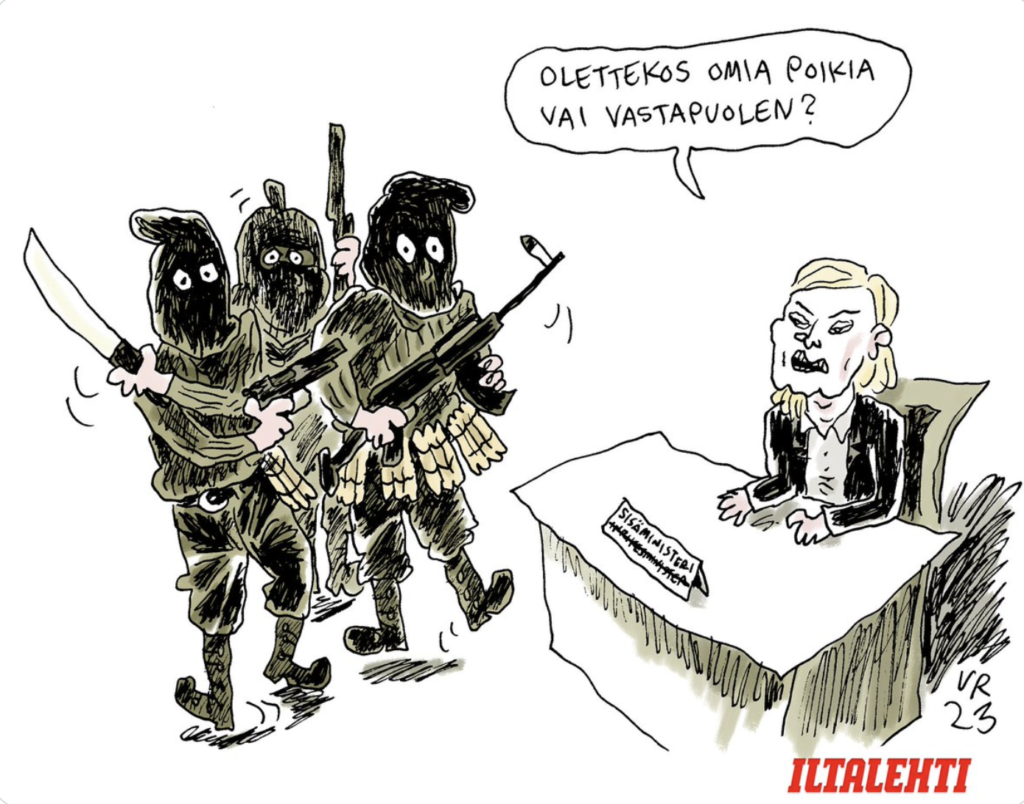
Sisäministeri Mari Rantanen (ps.), joka on myös julkaissut ongelmallisia postauksia ja poistanut niitä rankalla kädellä sosiaalisessa mediassa, on sanonut, että hallituksen maahanmuuttopolitiikka tule kokemaan paradigman muutoksen eli hyvin perustavaa laatua olevia muutoksia.
Toivomme, että näiden rasismikohujen valossa lehdistö kokee oman paradigman muutoksensa roolissaan kansakunnan vahtikoirana eikä jätä kiveäkään kääntämättä tehdessään työtään.
Enrique Tessieri, Yahya Roussi
Kirjoittajat ovat Kansainvälinen Mikkeli ry:n hallituksen jäseniä ja Tessieri puheenjohtaja. Tessieri on myös Mikkelin kaupunginvaltuuston varajäsen (sd.).