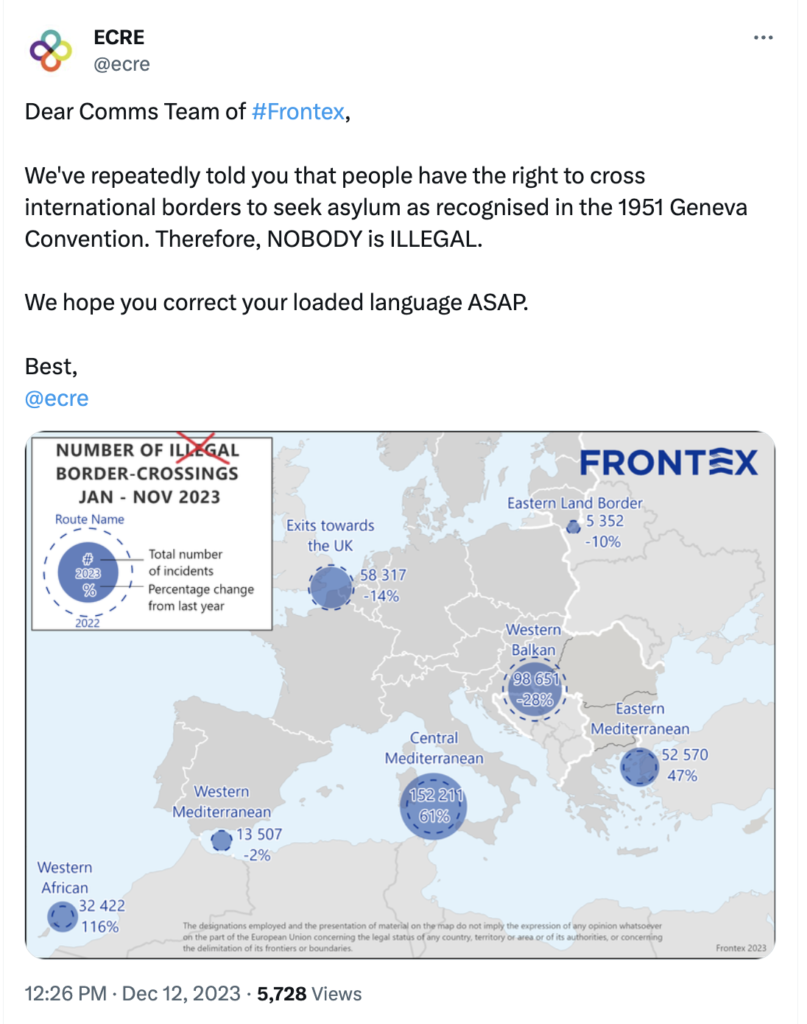
As the xenophobic government of Prime Minister Petteri Orpo aims to open some border crossings on the Finnish-Russian border on 14 January, the big question will the government revert to illegal pushbacks?
Why is there concern?
Orpo has gone as far as to suggest earlier that asylum seekers should be sent directly back to Russia supposedly because it is a safe country.
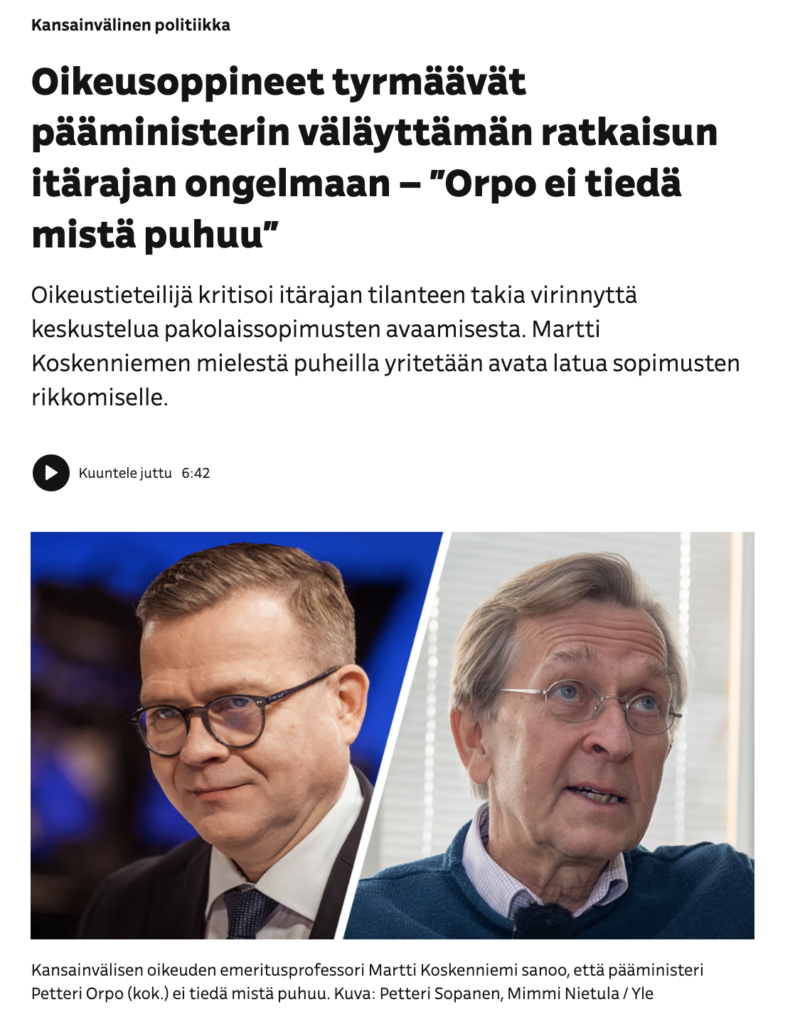
Such a suggestion, denying people the right to asylum, has received strong criticism from international law professor Martti Koskenniemi.
Even if some news outlets like Yle claim that parties belonging to the government “have increased” their support, according to the latest opinion poll published by Yle, another fact is left out of the story.
Is this the case? The full story? The total support given to the parties in the government stood at 48.5%, which is up a tad from 47.9% in ther previous opinion poll.
Moreover, the Finnish-Russian border crisis, which the Perussuomalaiset (PS)* have hoped to increase support, was not a boost for the PS.
The government of Prime Minister Petteri Orpo is anticipating with some dread the opening of the Finnish-Russian border on 14 January. In order to deny people the right to asylum, Orpo has gone as far as to suggest that asylum seekers should be sent directly back to Russia supposedly because it is a safe country.
Such a suggestion, denying people the right to asylum, has received strong criticism from international law professor Martti Koskenniemi.
“I can only conclude that Orpo does not know what he is talking about,” Koskenniemi was quoted as saying in Yle. “Surely the prime minister is not proposing such a thing [like denying asylum with illegal pushbacks]. There is no need to use the English term. The proposal [by Orpo] is an excuse to breach international agreements.”
As Koskenniemi correctly asks, why haven’t politicians suggested any credible changes to international agreements on asylum?
The answer is a no-brainer: They don’t have any answers except for weakening human rights and trashing international agreements governing refugee and asylum rights.
Another important question that should concern us is what is the government’s new steps to further undermine human rights and civil rights? They are already doing this on a massive scale by weakening social, labor and migrant rights.
As far as Orpo’s government is concerned, its record on racism and human rights reveal an incompetence rarely seen in Finnish politics.
There only argument for breaching human rights is fear.
The only route of the government is to exit from power.
Russia is not unpredictable. In its operations against Finland, it exploits racism because Finland is a racist country.
The observation by writer Sofi Oksnanen is the only one I have read that reveals the government’s pushbacks and their draconian immigration and asylum policy. The government’s knee-jerk reaction to closing the Finnish-Russian border shows how Finnish politicians and the media have jumped on the populist-racist bandwagon.
Oksanen is a sharp writer and observer, especially of governments with autocratic intentions. It is surprising that the Finnish media, never mind politicians, have not dared to question the government’s policies but bowed instead to them.
Prime Minister Petteri Orpo can claim with a poker face its immigration policy isn’t racist because it is a copy of what is being done in other Nordic countries. Would it be fair to say that the immigration policy of all Nordic countries is then racist?
Thanks to a talk hosted by the European Network on Religion and Belief (ENORB) this week, we were able to witness once again the violent pushbacks occurring on EU borders, Migrant Tales recently published a story about this pushback on the Turkish-Greek Evros River border.
The pushbacks, which go largely unnoticed by the European media, are happening right now and are the region’s blind spot and shame.
Writes Mireia Rimbau Vilà of ENORB: “As negotiations for the New EU Pact on Migration and Asylum are finalized, the future is bleak. For this, we need to stand together in solidarity. At the European Network on Religion and Belief, we want to build bridges between different groups to strengthen community cohesion.”
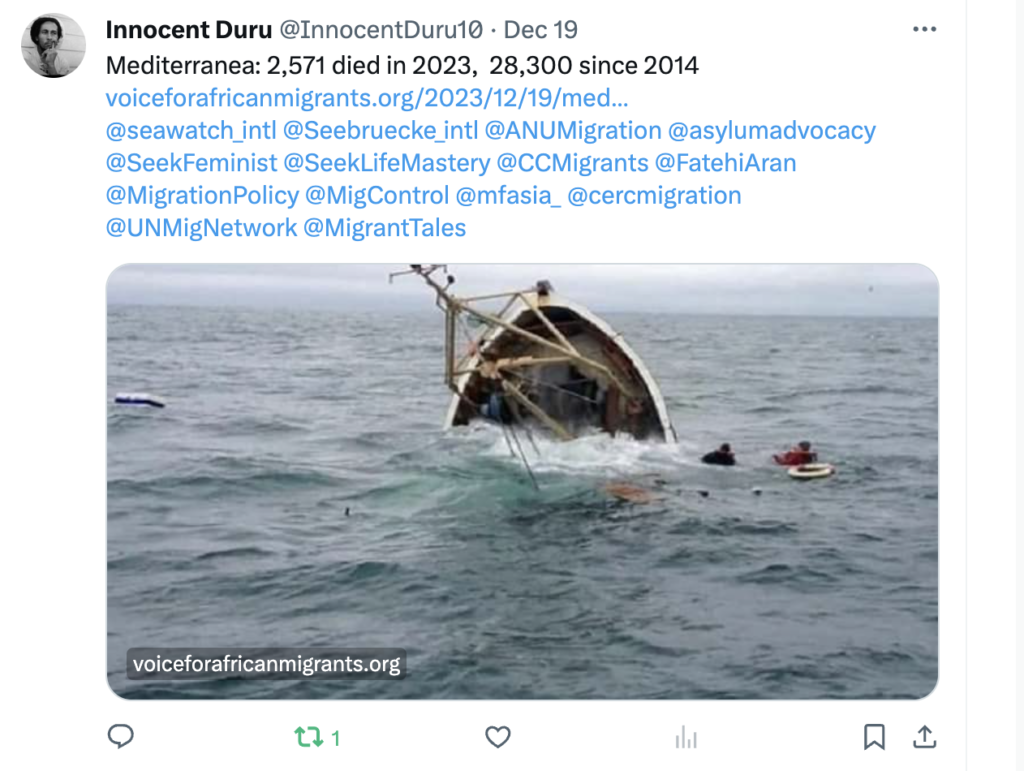
Pushbacks are a reality that asylum seekers and migrants are facing in many parts of the EU.
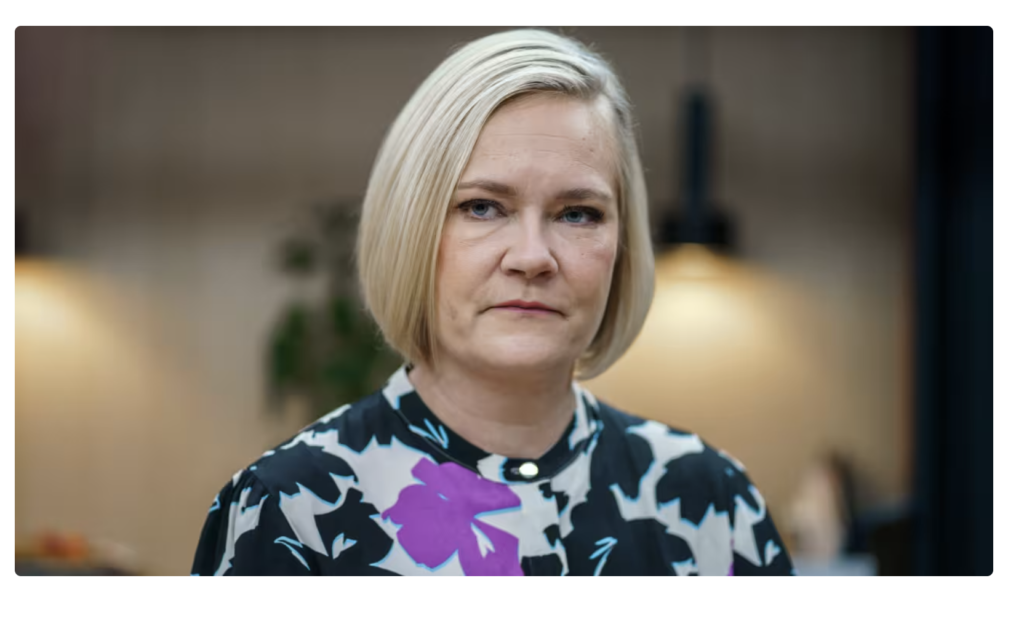
As Finland plans to open two of its eight bordercrossing points Thursday, Interior Minister Mari Rantanen was busy on A-studio spreading her usual bravado and get-tough-on-migrant soundbites earmarked principally for the Perussuomalaiset (PS)* party’s supporters.
Rantanen has a funny habit of smiling after a difficult comment. According to her, some 900 asylum seekers were a threat to national security and therefore Finland had to close the border with Russia.
It’s pretty clear that after breaking its campaign, like promising lower fuel prices at the pumps and food prices, coupled with massive cutbacks in social welfare spending, the PS is in deep trouble with its supporters.
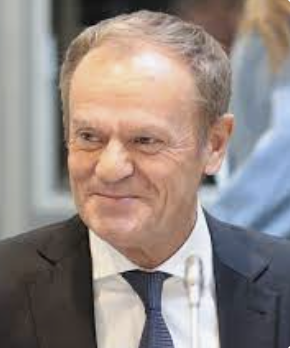
After the European Council’s Commissioner for Human Rights, Dunja Mijatovic, rebuked Rantanen for the closure of the border, Poland’s new Prime Minister Donald Tusk gave a strong speech at the Sejm, the lower house of parliament, that gave hope against the toxic tide of anti-immigration rhetoric, which runs also high in Finland. as well.
“The criticism [by EU Commissioner Miatovic] doesn’t have any bearing on our decision [to open up two border crossings] since the government has been guided by national security, which has been the main factor for closing the [Finnish-Russian] border,” said Rantanen.
Interior Minister Mari Rantanen (left) and Prime Minister Donald Tusk are two very different politicians. Sources: Yle and Wikipedia
In many respects, Tusk’s speech was not only directed at the outgoing ruling party, Law and Justice (PiS), but against xenophobic politicians like Rantanen and other ones in other European countries.
When I first went to the [Evros River] border, my first priority was to uncover what was happening and not to get arrested.
Philip Pollák, directorof the Anachoma documentary project
The 480-kilometer-long Evros River, which divides Greece and Turkey in an uneasy truce, is just one of many places where EU policy on pushbacks goes largely unchecked. The pushbacks we are witnessing on the Evros River are not only against international and EU law but also a weaponized region against migrants where death has sometimes the final say.
“In an ideal world, I hope our documentary Anachoma, which means embankment in Greek, will see its first screening in May, a month before the European Parliament election in June. I hope it will raise awareness and encourage people not to look the other way,” said Pollák. “The documentary, which exposes pushbacks with the help of investigative journalism, research and experts, aims not only to show that what is happening is illegal but barbaric and wrong. It also undermines and chips away at our democracy and European values.”
Philip Pollák, director o the Anachoma project.
The Anachoma project has during three years interviewed over 30 people in 20 locations from Istanbul to Brussels. Some of these include Green MEP Tineke Strik, Stefanos Levidis, a forensic architecture researcher, Panayote Dimitras, founder of the Greek Helsinki Monitor.
Note from Philip Pollák: “ANACHOMA is a project that came very far with immense commitment from the team and investment of our own resources. However, to make this hard work see the light of day, we need the support of a broader community, of people who care. That’s why we started our crowdfunding campaign through our website and social media handles.
If you are interested in collaborating to make the world know about these stories, and to hold the bright light of a projector to the injustice witnessed for decades, please consider visiting our website and contributing to ANACHOMA.“
The Evros River region is located in the northeastern and western parts of Greece and Turkey, respectively. Source: Wikipedia.
“The entire military strip [between both countries] is off limits,” Pollák continued. “There Is a buffer zone, but there are no maps that show the exact geographic location because it is a secret. You do see the checkpoints and how the border is guarded.”
Pollák said that one can be arrested if you are caught in the buffer zone. “You can face espionage charges, if you are a Greek you can even face treason charges,” he explained.
Interest grew in Greece
Pollák got interested in the Evros River pushbacks when he moved to Greece in 2020 and started to hear stories from that region. He did his Master’s thesis on the topic.
“Our documentary is all about pushbacks in their crudest form,” Pollák continues. “The action and treatment of migrants at the border by the Greek authorities breach the 1951 Convention on Refugees, the 1967 Protocol of that treaty, the European Charter of Fundamental Rights, European Convention on Human Rights, UN Declaration of Human Rights, and many other laws concerning the treatment of migrants.”
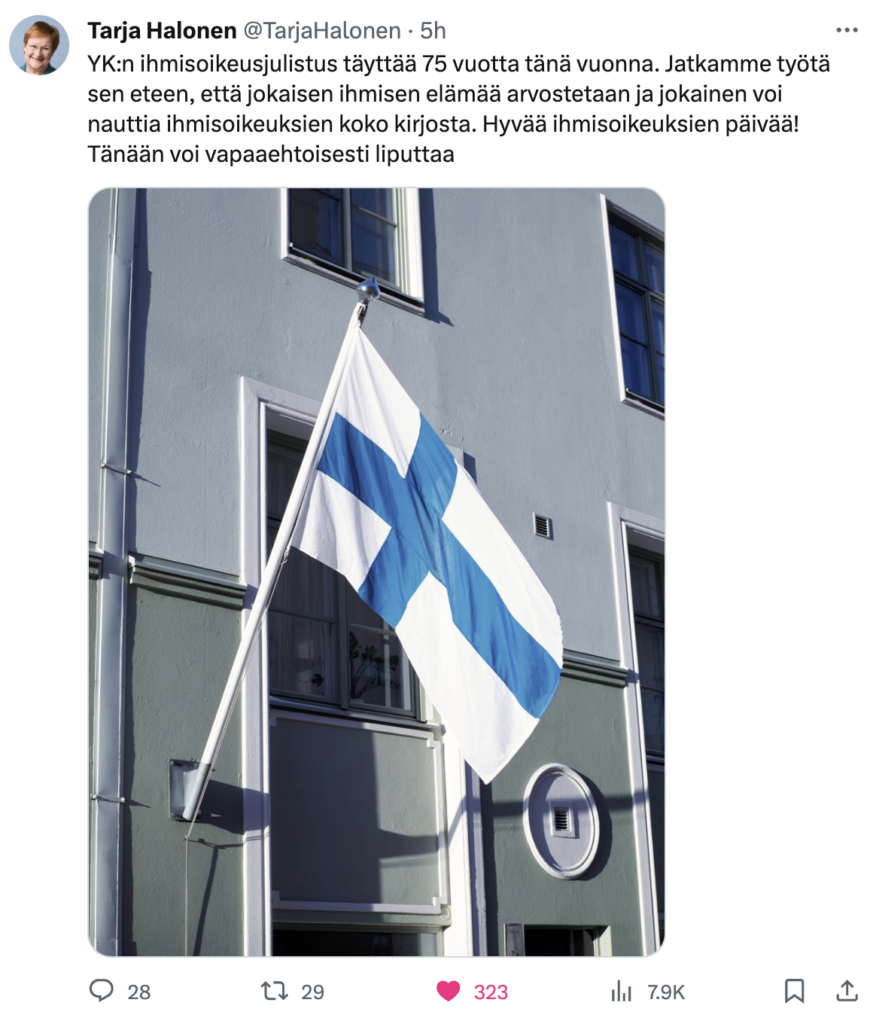
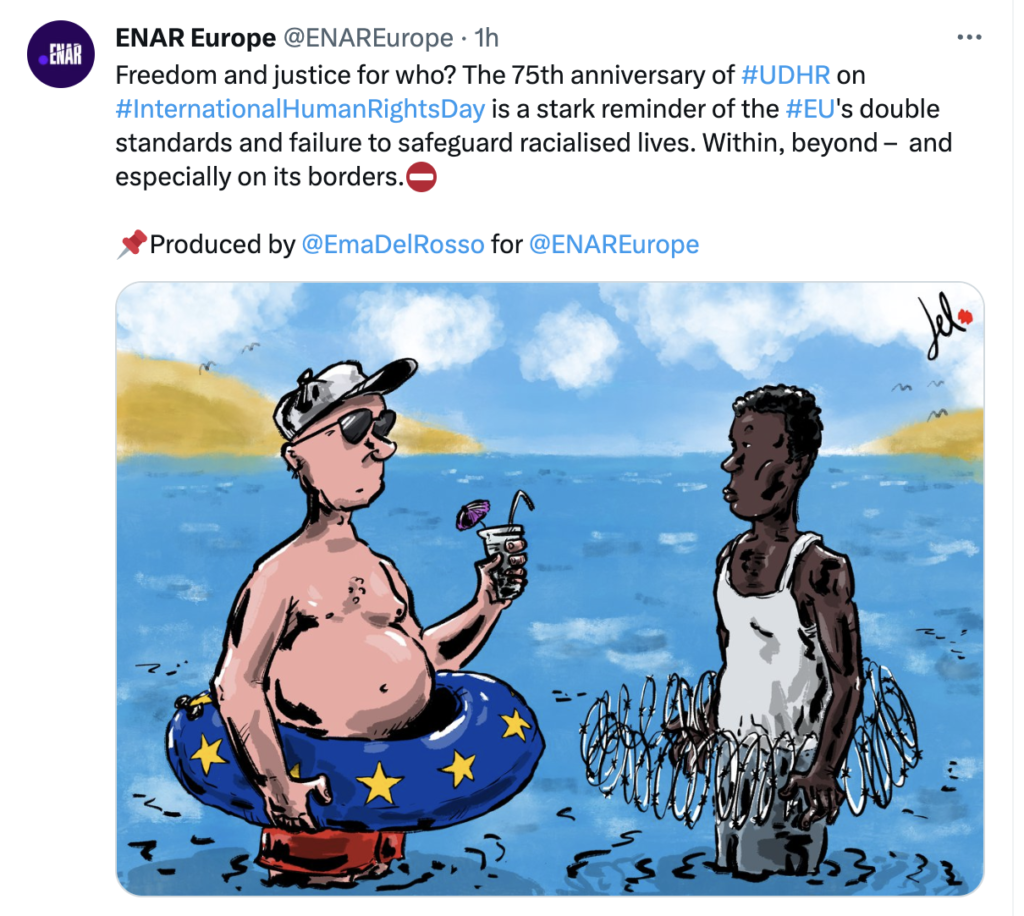
It is shameful, but obvious, why Prime Minister Petteri Orpo’s government, not one minister of the National Coalition Party and Perussuomalaiset,* mentions International Human Rights Day. Being white, driven by xenophobia and having a privileged life in Finland, it is understandable why such politicians see Human Rightsas a threat.
Former President Tarja Halonen (2000-2012) commemorated in a Tween below International Human Rights Day.
During the Cold War, Human Rights was a no-no in Finland because it questioned Finnish-Soviet relations. Finland joined the Council of Europe in 1989, 39 years after its founding in 1950, which held the banner of Human Rights high.
As an Argentinean who lived under a dictatorship in 1976-83, Human Rights have a special place in my heart. Thanks to such rights, Argentineans had a voice in the face of violent oppression.
In April 1978, I was stopped by the police at gunpoint in the street, detained and thrown in a police cell without the right to habeas corpus, a Human Right.
I still remember that autumn Saturday as if it were yesterday.
Is it a coincidence that Perussuomalaiset (PS)* Interior Minister Mari Rantanen’s letter Tuesday to the EU Commission on scraping asylum rights temporarily is an accidental coincidence? News of Rantanen’s letter, which has received harsh criticism from Professor of International Law Matti Koskenniemi, was published after a story byThe Guardian claiming global inaction on human rights could fuel “mass atrocities” and over 1,000 unmarked graves were discovered on EU migration routes.
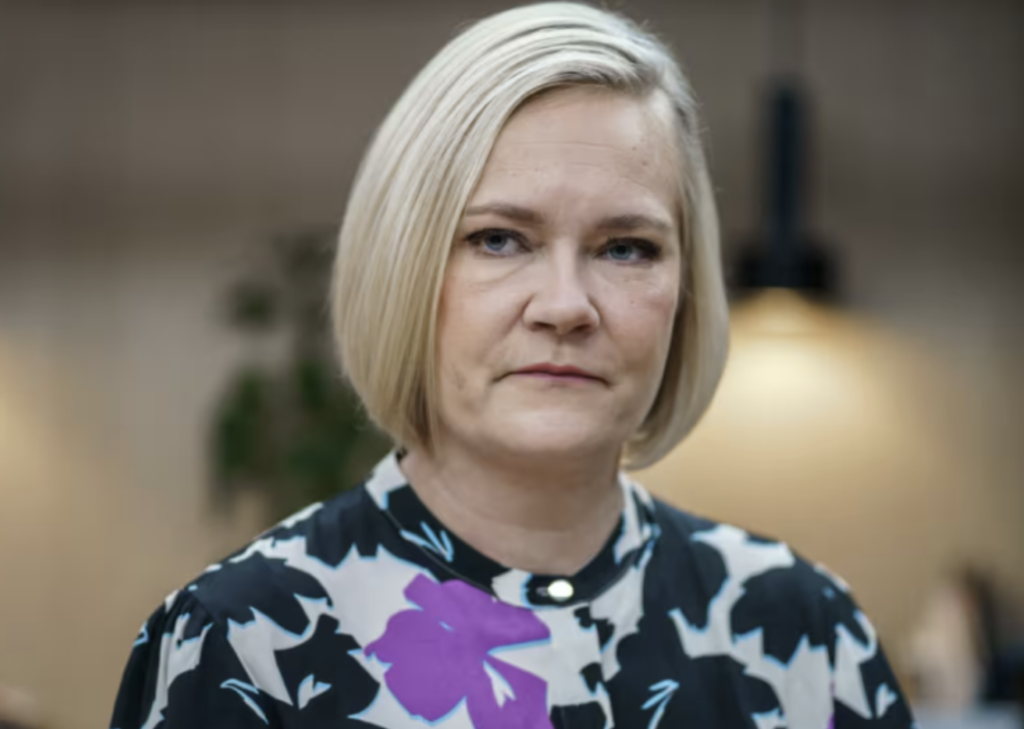
Interioir Minister Mari Rantanen is the dark face of Finland’s immigration policy who wants to put on ice human rights for asylum seekers. Some consider her an incompetent minister driven by Islamophobia and xenophobia. Source: Yle
While Professor Koksenniemi slammed Rantanen’s letter to the EU Commission as “unbelievable and incomprehensible,” not one minister, never mind Prime Minister Petteri Orpo, has questioned or commented on Rantanen’s letter to overhaul the asylum system.
Even President Sauli Niinistö, whose job is to oversee Finland’s foreign policy, has not uttered a word.
Rantanen’s letter to the EU Commission is another black stain on how the present government is undermining systematically human and civil rights in Finland.
“The whole purpose of this [refugee] system is to protect people in need,” Koskenniemi was quoted as saying in Demokraatti. “And the minister wants to attack this system without saying anything about what the purpose of this system is.”
Rantanen does not mention the word “refugee” once in the letter to the EU Commission.
Much of Finland’s hostility towards asylum seekers and visible minorities lies on President Sauli Niinistö, who hosts today his last Independence Day gala. For some, like me, this is good news. Hopefully, Finland’s next president will have a greater understanding of migrants, cultural diversity and peace-building.
Ahti Tolvanen, who is a member of the Migrant Tales board, believes that President Niinistö failed in his job number one.
“One of the areas that President Niinist failed was maintaining Finland as a peacekeeping nation,” he said. “He just walked away from decades of a tradition in The Helsinki Spirit.”
The Helsinki Spirit was the basis of Finland’s foreign policy grounded on détente and non-involvement and not taking sides in conflicts.
President Niinistö dancing with his wife Jenni Haukio at the Independence Day gala.
During the past eight years of his mandate, President Niinistö has shown his hostility towards asylum seekers, especially Muslims, and other people of color. He was never a friend of such communities.
President Niinistö’s prejudices and apparent ignorance about racism are one source that feeds Finland’s hostile environment against migrants and minorities. Some of his comments and stances (see below) leave some scratching their heads.