Migrant tales
Menu
  • #MakeRacismHistory “In Your Eyes”
  • About Migrant Tales
  • It’s all about Human Rights
  • Literary
  • Migrant Tales Media Monitoring
  • NoHateFinland.org
  • Tales from Europe
Menu

Category: Enrique Tessieri

To all the Other Finns like me: Nobody can deny who you are

Posted on January 15, 2014 by Migrant Tales

After spending a brief moment of my childhood in Finland, and growing roots in other lands, I longed to move back to the country I was once from.  I was fortunate and able to visit Finland every summer.

Those days I spent as a child and adolescent in the company of my grandparents in the Finnish countryside changed my life. If a person changes after a long journey, every journey to Finland changed me.   

Visiting Finland in the summer didn’t only give me an opportunity to relearn the Finnish language and strengthen my bonds with this land, it recharged my soul and gave me strength to face life of a huge city like Los Angeles.

Image1-34_edited-1

My Finnish roots are as deep as my roots in Argentina and Southern California. As Finland continues to deny its cultural diversity, it continues to deny others their right to their identity. The Perussuomalaiset is one party that has openly declared war on people like us.

I’m grateful for my Finnish roots and for those summers I spent with my grandparents. I am who I am today because of them and those summers.

But with the rise of intolerance in this country, and political parties that have declared war on Finland’s ever-growing cultural diversity, I have one important message for them: Nothing, absolutely nothing, can erase who we are.

Today there are tens of thousands of us. We come from diverse backgrounds but one matter unites us: Finland is our home. Some of us have appeared on Migrant Tales: Joseph, Ida, Abdulah, Ariela and other multicultural Finns like Aune and Anna.

Don’t allow those that take their prejudice and intolerance seriously erase who you are. No ethnic group in Finland can claim this land as their own. This land belongs to all those who live here irrespective of their background.

I fear that I will not live long enough to see that day when most of us in this land, irrespective of his or her background, will be accepted and respected as equals.  Maybe it’ll be you or your children or grandchildren that will witness that day.

Those who want to exclude us aim to erase and deny our history.

Rodolfo Walsh, an Argentinean journalist and writer, said something that we should never forget when we write our history. Even if it was written in the 1970s, it still applies to immigrants and multicultural Finns:

Our dominant classes have made sure that the worker has no history, doesn’t have a doctrine, any heroes or any martyrs. Every struggle has to be started from scratch, separated from previous struggles; the collective history is lost, their lessons are forgotten. History appears as it if were private property, whose owners are the owners of everything.

When someone tells you that you’re a “half-Finn,” answer them back kindly that you’re not “half” of anything but a full human being. Remind them of the 1.2 million Finns that emigrated abroad between 1860 and 1999.

Ask them why they have conveniently forgotten these Finns and how they integrated and become a part of a greater world family.

Image1-35_edited-1(1)This picture is of one of the saddest moments in my life. It’s a day before we moved from Finland to Argentina. I made a vow to return back to Finland one day and I did about sixteen years later, in 1978.

Joseph, Ida, Abdulah, Ariel, Aune, Anna and many Other Finns like me, don’t forget who you are and remember above everything else, nobody can deny who you are.

As Nelson Mandela said, you are the captain of your destiny, or in our case, the captain of your identity, the master of your narrative.

Nobody can erase who you are because you have memory.

Draft law that aims to prohibit Russians from purchasing land is a sad sign of the times

Posted on January 14, 2014 by Migrant Tales

In a country like Finland, which has a small migrant population compared with other European countries, intolerance and xenophobia usually reveal themselves as déjà vu. One of these real illusions came in the form of a draft bill in parliament that aims to prohibit real estate purchases by Russians, according to Joensuu-based daily Karjalainen.

The same fear-mongering to incite nationalism is by some Finnish MP during an election year is no different from what we saw recently in the United Kingdom, when Prime Minister David Cameron warned that 250,000 Romanians and Bulgarians were going to swarm to the country.

Home Secretary Theresa May added fire to Cameron’s warnings by claiming that Britain was powerless to stop tens of thousands of Bulgarians and Romanians from moving to the UK in 2014.

When January 1 came, only a few dozen arrived, according to Al Jazeera.

Kuvankaappaus 2014-1-14 kello 9.04.41

Read full story (in Finnish) here.

The draft bill already has the backing of 101 of 200 MPs.

According to Karjalainen, 400-500 real estate purchases are made annually by Russians in Finland, 20-30 in Eastern Finland alone.

One of the arguments used by those in favor of the draft bill is that it would curtail money laundering and is justifiable since Finns cannot buy land in Russia.

While they have a good point, the bill would hurt us since it would keep alive old suspicions about our eastern neighbor.

If the draft bill gets approval and becomes law, non-European Economic Area (EEA) citizens would have to be residents of Finland for five years in order to purchase real estate.

If we look at some of the MPs that are in favor of such a bill, we’ll quickly notice that they are the same politicians that are against refugees, cultural diversity and like to use the word “fatherland” in every other sentence.

Some of these MPs are the ones that want to demote the Swedish language to elective status at schools arguing that it would pave the way for more Finns to study the Russian langauge.

If these politicians are fueling our age-old suspicion of Russians with such a bill, why would more people be inclined to study such a language? Certainly favorable attitudes of a country play an important role.

For some, who have lived in this country for a long time, understand that present plans to curtail real estate purchases by Russians is a flashback to the days of the Restricting Act of 1939 (law 219/1939), which prohibited foreigners from owning real estate and acquiring a majority stake in Finnish companies.

The Act, which was in force until 1992, prohibited foreigners from owning shares in key sectors of the economy such as forestry, securities trading, transportation, mining, real estate and shipping.

Suspicion and xenophobia of the outside world was and still is very real. In the early 1980s I was handing a petition with a group of non-Finnish citizens to some MPs in parliament. The petition demanded greater rights for migrants in Finland. A common guest at such an event with foreigners was Police Chief Olli Urponen (1983-97). I once asked him why Finland had such a restrictive policy towards foreigners.

He responded: “To keep criminals out of Finland.”

This was the response of the police chief of a country that saw over 1.2 million of its countrymen emigrate between 1860 and 1999.

The very attitude, that the outside world is a dangerous place full of suspicious people, is how Finland saw the world during most of the last century.

Apart from having a law that curtailed foreign investment to the country up to the mid-1990s, official Finland did everything possible to hinder as much as possible foreigners from moving to the country.

The fact that it took Finland 65 years after independence to have in force in 1983 its first aliens act reveals how the country saw migrants and cultural diversity.

That same attitude persists today in too many circles and we have no-one else to blame than ourselves. We should teach more tolerance and less hatred of people who are different from us at schools and our homes.

If parliament passes a law that prohibits Russians from buying land in Finland, it won’t be a coincidence.

October 19, 1982: A day we should never forget in Finland

Posted on January 13, 2014 by Migrant Tales

The first large demonstration ever held in Finland by migrants was on October 19, 1982. Before that historic march, some 100 Pakistanis marched from Helsinki to Turku in the early 1970s to protest that they didn’t get work in Finland. The second march in 1982, began in front of Porthania and ended at the doorsteps of Parliament. 

A day before the 1982 march, the then Aliens’ Office head, Eila Kännö, was reported to have threatened on Ilta-Sanomat that those migrants that took part in the march would be arrested. Back then, foreigners had few rights in Finland.

Among the things we were marching for back then was passage of Finland’s first Aliens Act, which came into force in 1984, or 65 years after independence.


I’m proud that we did organize the march. I found a rare poster in my files of that day we should never forget. 

IMG_2981The official poster that was used for the march on October 19, 1982.

If you asked over thirty years ago the police why Finland had such a restrictive policy against foreigners, their response was a common one: To keep criminals from moving to Finland.

How do you explain labor shortage and high unemployment?

Posted on January 12, 2014 by Migrant Tales

Sometimes Migrant Tales gets it right and many times we do. Our sharp associate editor, JusticeDemon, raised and shed light on a very topical issue that is constantly poisoning the debate about our ever-growing cultural diversity in Finland.

In Mikkeli, which is located about 230km north of Helsinki, a Perussuomalaiset (PS) politician, who equates immigrants with white European colonizers that colonized The Americas, and who believes that the region of South Savo doesn’t need any immigrants, claimed recently on Länsi-Savo that there is no labor shortage in Finland.

While there’s nothing surprising that a councilman of an anti-immigration party like the PS can make such a claim, it is odd that the chairwoman of the Social Democratic Party of Southeastern Finland, Satu Taavitsainen, agreed with the PS politician.

The PS councilman, Jukka Pöyry, is so much against immigration that if he’d live in the nineteenth century, he would be against foreign industrial leaders like Finnlayson, Paulig, Sinebrychoff, Rettig, Fazer and other household names today from moving to Finland because “there’s poverty and unemployment.”

Thus the argument made often by anti-immigration politicians is that we don’t need labor immigrants because there’s no labor shortage.

These politicians forget as well that in the EU there’s freedom of movement.

Kuvankaappaus 2014-1-12 kello 21.49.33

Read original posting here.

JusticeDemon raises an good point on a comment to ohdake on Migrant Tales. If you want to know if there is a labor shortage in Finland, all you have to do is visit the national job search engine, which reveals 10,639 job vacancies today. Since there’s no obligation to notify job vacancies – writes JusticeDemon – the true number of job openings is probably twice the number of notices.

He continues: “Many of these notices concern more than one vacancy, and many have been open for several weeks if not months. These are also only the vacancies that have been notified to employment authorities. There is no enforceable obligation to notify vacancies, and the true number of jobs available is probably around twice the number of notices.”

At the same time, Finland had in November an official unemployment rate of 7.9%.

JusticeDemon know throws the knockout punch:

Naive perceptions are easily manipulated by forces seeking political power. For example the most natural naive perception from the foregoing fact of 20,000 vacant jobs and 8 per cent unemployment is that the Finnish unemployed are work shy, and that they blame working immigrants for their unemployment in order to distract public attention from their own failings. This particular naive perception appeals to certain types of selfish Conservative mentality, but remains otherwise fairly rare in Finland.

JusticeDemon considers a “naive perception” the assumption that the number of jobs in an economy is constant. This assumes that any newcomer to the job market is somehow taking a job away from incumbent job-seekers.

“This naive perception appeals to authoritarian mentalities with limited cognitive and conceptual flexibility,” continues JusticeDemon. “There are various other naive perceptions that can be and are woven into the public consciousness to serve political ends. For example the view that everything comes down to labour costs, or that everything is the outcome of some massive conspiracy.”

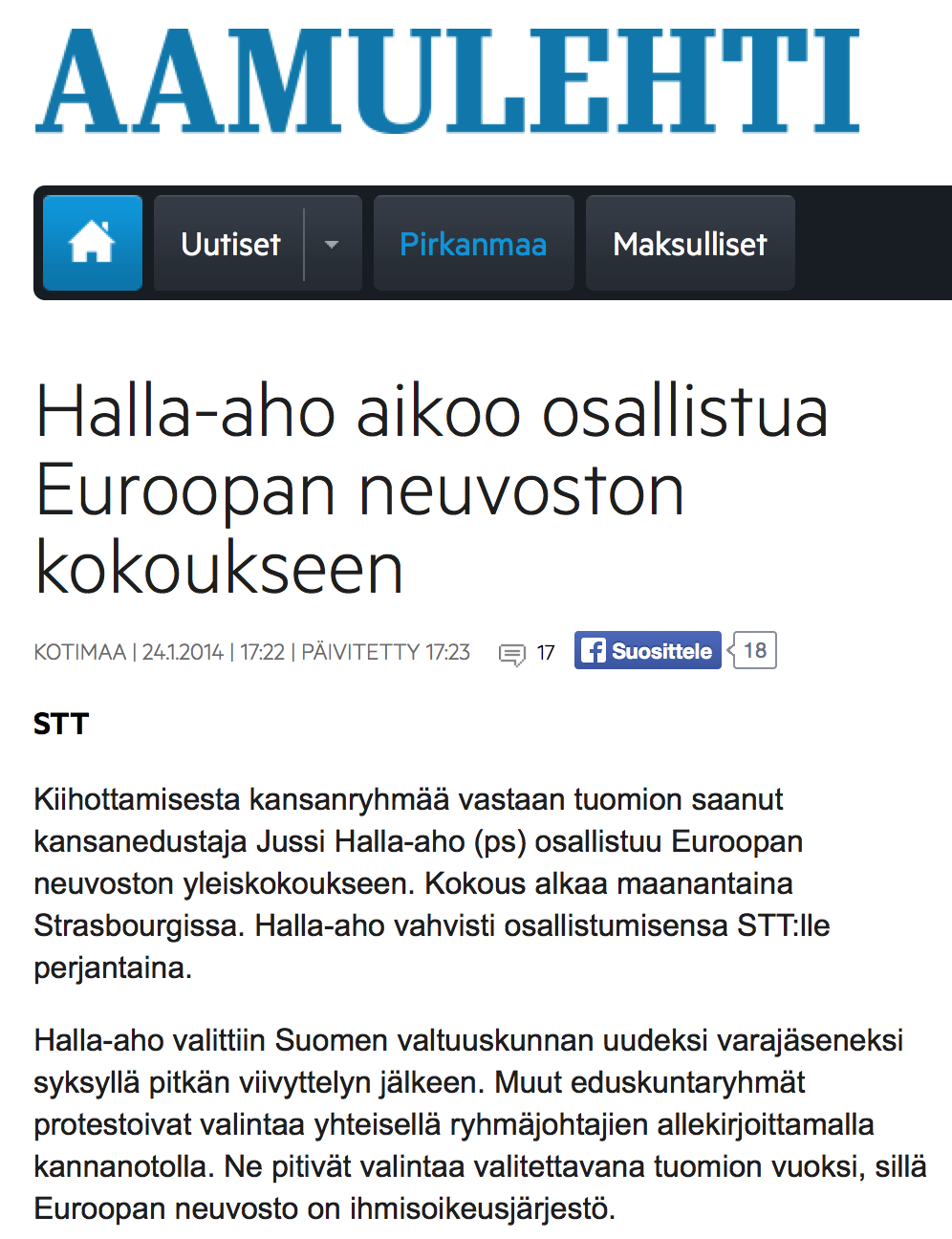
Two anti-immigration politicians “doing their hate thing” in Finland: One former, one present PS MP

Posted on January 10, 2014 by Migrant Tales

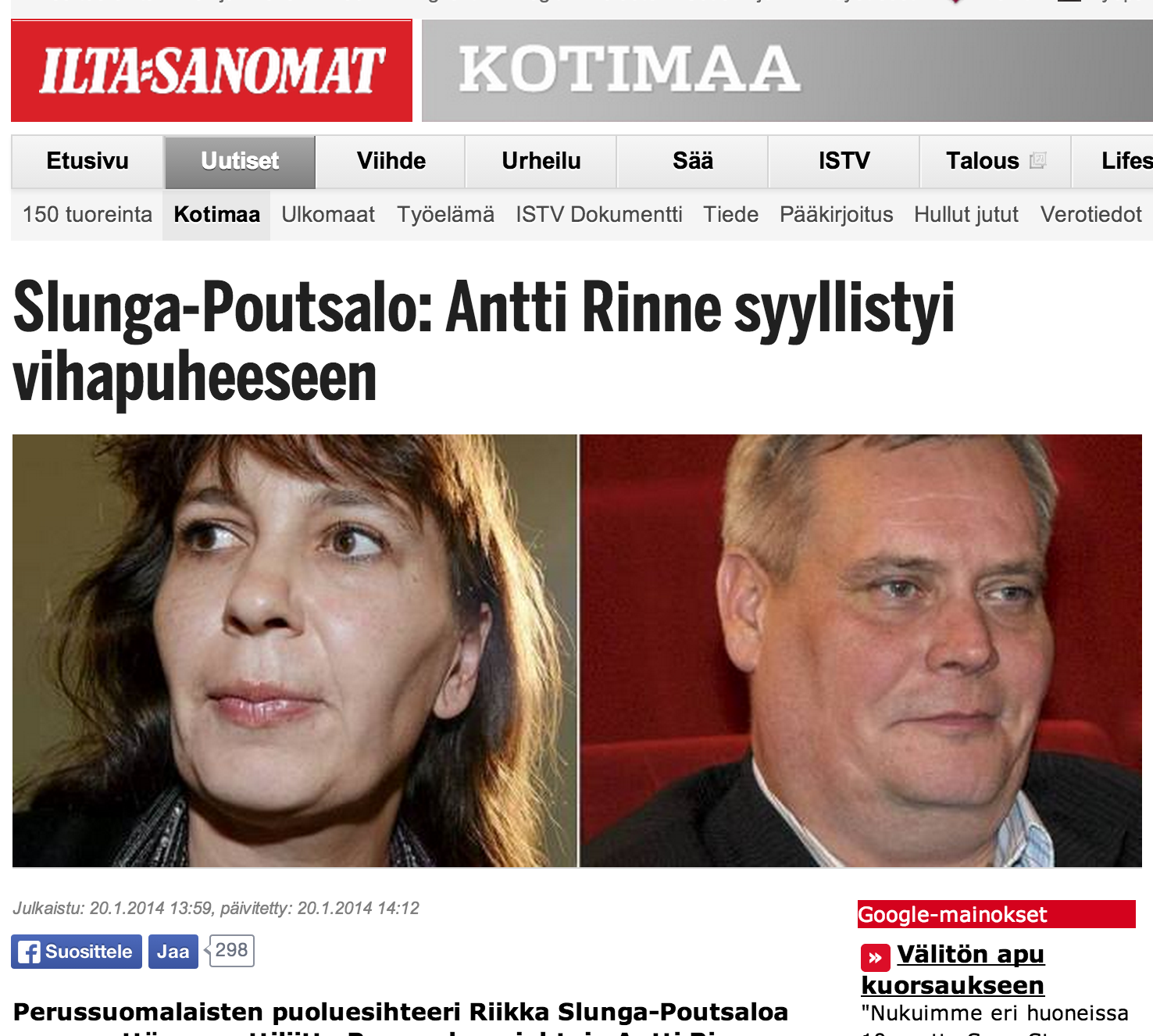
Has anyone asked what the election in 2011 of 39 MPs of the anti-immigration Perussuomalaiset (PS) party has done to poison the political atmosphere for immigrants and visible minorities in Finland? To show how much in denial we still are in a country, take a closer look at some former and present PS MPs.

Where’s the denial?

In the fact that the media and public sees individuals – not the PS never mind its good-cop leader Timo Soini – responsible for the party’s racist and Islamophobic remarks.

One former member of the PS, MP James Hirvisaari, who is now a member of the far-right Muutos 2011 party, and one present member, MP Olli Immonen, are making headlines again.

MP Hirvisaari, who has already been sentenced for ethnic agitation, writes on his blog that the state prosecutor is carrying out a preliminary investigation on charging the MP for the same crime.

Hirvisaari, who commented on a blog entry by PS politician Kai Haavisto, wrote that rape was a “national pastime” of countries like South Africa. The Muutos 2011 MP wrote as well that the genetic makeup of certain ethnic groups, like black Africans, encouraged a culture of rape.

Hirvisaari made the comment on a blog written by Haavisto where he suggested that those groups that are prone to commit rape should be chemically castrated before being allowed to live in Finland.

Kuvankaappaus 2014-1-10 kello 10.10.24

Not only does PS MP Immonen’s blog entry is close to 3,000 words long! The length and the topic show clearly the MP’s hatred for Muslims and cultural diversity.

MP Immonen, who is the chairman of the far-right association Suomen Sisu, which discourages white Finns from marrying foreigners, claims in his latest blog entry that gays, green-left groups, and the Finnish Lutheran Church are helping Islam to spread in Finland.

Immonen sent in December a written question to parliament that Finland should start classifying people according to their ethnic background.

As in previous cases, the PS and Soini haven’t said a word about Immonen’s racist views. The PS leader said that Immonen’s suggestion to classify people according to their ethnic background “doesn’t concern him.”

One matter that baffles me about the PS is that they are usually ready to label whole groups as rapists and criminals, but when some Finns look at the anti-immigration party, they are seen individuals.

This reveals, I believe, that deep state of denial that Finland is in concerning intolerance.


Finland’s ombudsman for minorities says Helsinki social services and health care employees practice ethnic profiling

Posted on January 9, 2014 by Migrant Tales

Finland’s ombudsman for minorities, Eva Biaudet, accused the Helsinki department of social services and health care of ethnic profiling because it requires its employees to check if “a foreign-looking” person has a residence permit, reports Helsingin Sanomat. 

The city of Helsinki said in a statement in June that its social services and health care employees will begin to ask foreign-looking people to prove they are legal residents of the country.

Read the statement (in Finnish) by the ombudsman for minorities here.

Kuvankaappaus 2014-1-9 kello 7.16.02

Read full story here.

The present requirement on social services and health care employees, encourages them to place “unnecessary” attention on a person’s ethnicity, according to Biaudet. In the worst of cases, people like undocumented migrants, may be discouraged from seeking medical attention due to the requirement.

Migrant Tales agrees fully with the ombudsman for minority’s concern over ethnic profiling by Helsinki city employees. The sooner this stops the better.

Taking into account the negative political climate in Finland for migrants and visible minorities after the the 2011 elections, it’s unclear whether the ruling by Helsinki was motivated by a a genuine concern that non-residents such as tourists were abusing the system or simply because of ever-growing anti-immigration sentiment.

Does intolerance fuel racist harassment and abuse?

Posted on January 8, 2014 by Migrant Tales

We’ve written quite a few stories about racist bullying and the rise of an anti-immigration party, the Perussuomalaiset (PS), after the April 2011 elections. The Independent reports that the number of children seeking help in England for racist bullying “increased sharply” in 2013.

One of the reasons for the sharp rise in children seeking help for racist bullying is the heated public debate concerning immigration, which is impacting ethnic relations in the classroom, according to the daily.

Kuvankaappaus 2014-1-8 kello 23.34.09

Read full story here.

Writes The Independent: “More than 1,400 children and young people contacted ChildLine for counseling about racist bullying in 2013, up 69 per cent on the previous 12 months. Islamophobia is a particular issue in schools, according to the charity, with young Muslims reporting that they are being called ‘terrorists’ and ‘bombers’ by classmates.”

The last story that Migrant Tales published on racist bullying was in April, when a black elementary school student was bullied so much at a Mikkeli school that his single mother was forced to move to Helsinki.

The mother of the bullied child wrote: “Soon the majority of his classmates started bullying him. They named him a black monkey and told him to go to the toilet bowl because the color of his skin was like the color of feces. (Sara stops for a moment to contain her tears. She succeeds).”

Many of the short accounts told by racist bullying victims on The Independent are sadly similar to what some children are experiencing in Finland.

Here’s one by “boy, age unknown:” “I’m getting fed up. People at school keep calling me racist names but the teachers aren’t doing anything. It’s really upsetting and I feel unsupported. I don’t know what to do.”

According to the story, one of the reasons why racist bullying continues at British school is because the teachers don’t do anything to address the problem.

A story on Kajaani-based Kainuun Sanomat reported in February 2012 that that some members of the Somali community of Finland experienced a rise in racist abuse after the PS election victory two and a half years ago.

While it’s difficult to prove a connection exists between the PS victory and greater racist abuse in Finland, any sensible person can surmise that greater intolerance and hatred is a poor way to challenge such social ills.

Somali Finn Abdulah: Living in a land between Nowhere and Somewhere

Posted on January 6, 2014 by Migrant Tales

Abdulah, whose life as a Somali Finn has appeared in previous stories on Migrant Tales, was especially troubled by a news story published this month about the sharp rise in deportations of convicted and undocumented immigrants. According to YLE, the number of deportations from Finland have risen sharply after the Sello Mall killings of December 31, 2009. 

Last year alone, the Finnish Immigration Service (FIS) deported over 270 people. That’s about 50 more, or a 22% rise, from 220 deportation in 2011.

Kuvankaappaus 2014-1-6 kello 11.24.46

The Sello Mall killings, which took place at a crowded mall in the Espoo suburb of Leppävaara, was carried out by Ibrahim Shkupolli, who murdered five people before taking his life. Read full story here.

FIS denies that there is a connection between the rise in deportations and the killings that took place at Leppävaara about four years ago.

For Abdulah, who has applied since 1999 five times without luck for Finnish citizenship, the news about the rise in deportations was a source of concern for a number of reasons. Apart from reinforcing his view that Finland has become an ever-intolerant and xenophobic country to live in, it apparently worsened his chances of getting citizenship.

“I moved to this country when I was seven years old and have lived here for over twenty years,” he said. “Finland is my home country. I speak Finnish better than the language of my parents.”

Abdulah, who says Finland became a more racist country especially after the Perussuomalaiset (PS) party won the 2011 elections, claims that his human rights are being violated because he’s denied citizenship. He’s gets the following standard explanation every time his citizenship application is turned down: “Your behavior [in this country] hasn’t been above reproach.”*

The Somali Finn, who is presently unemployed, said that applying for citizenship is expensive costing 450 euros.

IMG_8648


“Is my destiny in Finland to live as a permanent outsider?” asked Abdulah.

“That’s a lot of money for me,” he continued. “I saved up the money for a whole year. I ate cheap food like macaroni, spaghetti, tuna fish flakes, ground meat that was on sale and two slices of bread before going to bed. Your body suffers because it doesn’t get enough protein.”

Breakfast was never a problem for Abdulah since you can buy porridge at the market for less than a euro.

Abdulah said that in a six-year period he was sentenced five times by a court. Four times for fighting in public and once for attempted robbery.

He claims that he was sentenced unjustly.

“Back then, I was young, naive and lacked a father figure since my dad died just before 1999,” he said. “I should have just stayed at home and not hang out with the wrong people. I should have understood that Finland is a very racist country and that the system, the police and the courts are stacked against you.”

Abdulah said that in one case where he took part in a fight, a group of skinheads attacked him and his friends. The police came and he was arrested even if it the skinheads started the fight.

“Once I was accused of being in another fight,” he continued. “The white Finn claimed that we started it but the police believed his word against ours even if he didn’t have any witnesses. The police treated me with disrespect. Once they locked me up at a police station and addressed me all the time with the n-word.”

Abdulah admits that one can make mistakes when you’re young. But he’s today a changed man.

“Back when I was young, I looked for acceptance,” he said. “I couldn’t find it in society, which was hostile to me, or among my family.”

“As I mentioned, I lost my father and lacked a father figure as well,” he continued. “If I could, I would challenge those cases against me. I was sentenced unjustly. Sometimes I didn’t have access to a lawyer. Being black and a Somali in this society meant that you were already guilty before the trial began.”

Another part of Abdulah’s dilemma in Finland hinges on what so many children of immigrants experience, living in between two cultures. For those who have experienced it, it’s like living in a land between Nowhere and Somewhere for some.

“Being from a culture that you used to identity with and from another one that doesn’t accept you really mixes up your sense of who you are and it’s depressing,” he said. “Not being able to get citizenship only reinforces that feeling of estrangement.”

See also:

  • Abdulah: Healing the wounds inflicted by intolerance and regaining balance (April 21, 2013)
  • Cultural diversity in Finland: A letter from Ida, Abdulah and Micah (January 11, 2013)
  • Somali-Finn Abdulah: Living in no-man’s land (Part 2) (June 21, 2012)
  • Somali-Finn Abdulah: Living in no-man’s land (Part I) (June 20, 2012)

* Et ole ollut nuhteeton.

Finland is a highly racialized country

Posted on January 5, 2014 by Migrant Tales

Racialization, or ethnicization, is a sociological concept that ascribes racial or ethnic identities to a relationship. In simple terms it is the way that a dominant group ascribes an identity on minorities in order to dominate them. In Finland this is so common that our nationality is mentioned on our drivers license even if we’re Finnish citizens. 

Image1-42_edited-2(4)

On the third line of my drivers license after name and surname, there’s my date of birth and place of birth. In my case it’s ARG, or Argentina.

I was born in Argentina but grew up in California and lived in cities like London and Helsinki when I was a minor. Why aren’t these reflected on my drivers license?

This practice smells of Helena Eronen’s suggestion that immigrants should start wearing sleeve badges and what the Nazis did when they obliged Jews to sew the Star of David on their clothing.

The question is why do we have to have this information on our drivers license?

Does the information give the police who stop you more information about your background? Does it encourage ethnic profiling and make the difference whether you’ll get off with a warning or a ticket?

Why is it anyone’s business to know where I’m from? What about if I show my drivers license to a shop keeper as ID? Why should he or she know where I was born?

The Finnish state and its employees like the police, who are paid to serve us, appear to be obsessed by race and blood as well as ethnicity. Since this information appears to be crucial to them, why not include sexual preference? Why not classify Finns according to the region they were born or which ethnic group they belong to?

Instead of encouraging inclusiveness, these types of practices are one of many ways that the Finnish state continues to remind you that you aren’t an equal member of this society.


Finland’s distorted immigration debate is damaging our country

Posted on January 3, 2014 by Migrant Tales

My son asked me Friday an interesting question that revealed what is wrong concerning the present debate on immigration and immigrants in Finland. He asked me to show how does immigration fuel economic growth. His question, which is a valid one, reveals some of the perceptions that some have about immigration. 

Due to the attention that anti-immigration politicians have received in the media, coupled by the silence and lack of leadership from the majority of politicians, many actually believe that the majority of foreigners in this country are refugees, Muslims, from Africa and here only to live off welfare.

Some, like MPs of the Perussuomalaiset (PS) party, play on our worst prejudices and fears by claiming that Muslims are invading Finland and Europe in Trojan horses. It’s only a question of time when ghettos will be set alight by ethnic strife, according to them.

L_0995-Medium-223x300

Tabloids like Ilta-Sanomat continue to spread racism in Finland. This billboard of 1992 claimed that Somalis “tricked” authorities to pay phone bills costing hundreds of thousands of Finnish marks. In that period, you could buy a row house in Helsinki for 500,000 marks. Billboard source: Institute of Migration

Facts reveal a very different picture, however. Finland has today fewer refugees than in the 1920s, when some 35,000 refugees from Russia lived in our country. In 2012, a mere 3,219 refugees applied for asylum but only 1,601 were accepted versus 43,900 in Sweden, according to the Finnish Immigration Service.

Moreover, 9.1% of all people who were born abroad and are residents of Finland are from Africa (25,895). The majority, or 64% (182,696), are from a European country.

A news story by Helsingin Sanomat on Friday showed how lopsided the present debate on immigration and immigrants is in Finland. The story revealed that our country accepted 149 Syrian refugees last year compared with 14,600 in Sweden.

There is nothing wrong with immigration from Africa as there is nothing wrong with immigration from Latin America, Asia, North America or from other European countries. What is wrong and unacceptable, however, is how such a distorted picture of immigration continues to be maintained.

This proves, in my opinion, that the media has been led more by its prejudices than its journalistic standards, politicians by their opportunism than leadership, and the general public by their apathy on the topic. The most shameful matter is that few are doing anything to bust such myths.

It’s possible to understand this situation from a historic perspective since Finland did everything possible up to 1995, when we became an EU member, to hinder as much as possible immigration and foreign investment to this country.

This suspicion of the outside world can be explained in part by our difficult relations with the former Soviet Union. Even so, it can’t suffice as the whole answer. How can a nation that lost over 1.2 million of its countrymen to emigration during 1860-1999 house such suspicious attitudes towards immigrants?

Going back to the question that my son asked Friday, I told him that it’s highly doubtful that his father, grandfather, great grandfather and great great grandfather, who were all immigrants, ever discussed how negative or harmful immigration is to society. On the contrary. Immigration is a positive phenomenon that brings new blood, new ideas and new strength to a country.

“The fact is simple,” I continued, “the whole idea of migrating from one country to another is opportunity and the search for a better life. This is the case irrespective if you migrate for political or economic reasons.”

Recent calls by the head of the Government Institute for Economic Research (VATT), Juhanna Vartiainen, and the Confederation of Finnish Industries (EK), that Finland needs more labor immigrants, has been met with skepticism by SAK, the central organization of Finnish trade unions.

According to SAK, immigration isn’t a solution to labor shortages because it would lead to two labor markets, according to YLE in English.

Any sensible person understands that the aim of immigration shouldn’t be to drive down salaries and rollback  important gains and rights achieved for employees by our labor market. If Finland’s immigrant population grows in the future, as it will, it should be the job of the labor unions and authorities to ensure that the rights of every employee, including immigrants, aren’t compromised by abusive employers.

A recent article published by Forbes magazine, offers us sobering advice on what to avoid in Finland and Europe on the immigration front.

“Attempting to fence off the country is no answer to anything.  It would be difficult for a generally free society with extensive borders to close out the rest of the world.  Worse, to be effective such controls as ID cards, citizenship checks, workplace raids, employer sanctions, and more would undermine domestic liberties.”

Kuvankaappaus 2014-1-4 kello 1.08.18

Read full story here.

One important step that we must take in order to debate fairly and in a proactive manner about our ever-growing cultural diversity, is bust those terrible and destructive myths that distort the debate on immigration and immigrants.

Maintaining alive such myths is damaging to our country economically, politically and socially. We will end up paying a hefty price if we don’t in the form of lower living standards and loss of competitiveness.

  • Previous
  • 1
  • …
  • 239
  • 240
  • 241
  • 242
  • 243
  • 244
  • 245
  • Next
Read more about documentary film
Read more

Recent Posts

  • Finland’s tabloids Iltalehti and Ilta-Sanomat are the pits
  • Riikka Purra’s Dr Jekyll and Mr Hyde mask
  • Double standards
  • Perussuomalaiset: Uusi logo, sama vanha juttu
  • Taco Trump

Recent Comments

  1. Absolutely Socking: Racist Finnish Facebook group against human rights gets flooded with socks on Musta Barbaari’s mother and sister charged by the police in “ethnic profiling” case
  2. Ilkka Nuotio on Pekka Myrskylä: “Tilastot kertovat toista kuin poliittinen keskustelu”
  3. Genrih Soinkara on The war in Ukraine and the Russian-Finnish border crisis are showing Finland’s ugly side
  4. Ahti Tolvanen on Comment by Ahti Tolvanen on the Helsinki +50 conference
  5. Angel Barrientos on Angel Barrientos is one of the kind beacons of Finland’s Chilean community

Archives

  • June 2026
  • May 2026
  • April 2026
  • March 2026
  • February 2026
  • January 2026
  • December 2025
  • November 2025
  • October 2025
  • September 2025
  • August 2025
  • July 2025
  • June 2025
  • May 2025
  • April 2025
  • March 2025
  • February 2025
  • January 2025
  • December 2024
  • November 2024
  • October 2024
  • September 2024
  • August 2024
  • July 2024
  • June 2024
  • May 2024
  • April 2024
  • March 2024
  • February 2024
  • January 2024
  • December 2023
  • November 2023
  • October 2023
  • September 2023
  • August 2023
  • July 2023
  • June 2023
  • May 2023
  • April 2023
  • March 2023
  • February 2023
  • January 2023
  • December 2022
  • November 2022
  • October 2022
  • September 2022
  • August 2022
  • July 2022
  • June 2022
  • May 2022
  • April 2022
  • March 2022
  • February 2022
  • January 2022
  • December 2021
  • November 2021
  • October 2021
  • September 2021
  • August 2021
  • July 2021
  • June 2021
  • May 2021
  • April 2021
  • March 2021
  • February 2021
  • January 2021
  • December 2020
  • November 2020
  • October 2020
  • September 2020
  • August 2020
  • July 2020
  • June 2020
  • May 2020
  • April 2020
  • March 2020
  • February 2020
  • January 2020
  • December 2019
  • November 2019
  • October 2019
  • September 2019
  • August 2019
  • July 2019
  • June 2019
  • May 2019
  • April 2019
  • March 2019
  • February 2019
  • January 2019
  • December 2018
  • November 2018
  • October 2018
  • September 2018
  • August 2018
  • July 2018
  • June 2018
  • May 2018
  • April 2018
  • March 2018
  • February 2018
  • January 2018
  • December 2017
  • November 2017
  • October 2017
  • September 2017
  • August 2017
  • July 2017
  • June 2017
  • May 2017
  • April 2017
  • March 2017
  • February 2017
  • January 2017
  • December 2016
  • November 2016
  • October 2016
  • September 2016
  • August 2016
  • July 2016
  • June 2016
  • May 2016
  • April 2016
  • March 2016
  • February 2016
  • January 2016
  • December 2015
  • November 2015
  • October 2015
  • September 2015
  • August 2015
  • July 2015
  • June 2015
  • May 2015
  • April 2015
  • March 2015
  • February 2015
  • January 2015
  • December 2014
  • November 2014
  • October 2014
  • September 2014
  • August 2014
  • July 2014
  • June 2014
  • May 2014
  • April 2014
  • March 2014
  • February 2014
  • January 2014
  • December 2013
  • November 2013
  • October 2013
  • September 2013
  • August 2013
  • July 2013
  • June 2013
  • May 2013
  • April 2013
  • March 2013
  • February 2013
  • January 2013
  • December 2012
  • November 2012
  • October 2012
  • September 2012
  • August 2012
  • July 2012
  • June 2012
  • May 2012
  • April 2012
  • March 2012
  • February 2012
  • January 2012
  • December 2011
  • November 2011
  • October 2011
  • September 2011
  • August 2011
  • July 2011
  • June 2011
  • May 2011
  • April 2011
  • March 2011
  • February 2011
  • January 2011
  • December 2010
  • November 2010
  • October 2010
  • September 2010
  • August 2010
  • July 2010
  • June 2010
  • May 2010
  • April 2010
  • March 2010
  • February 2010
  • January 2010
  • December 2009
  • November 2009
  • October 2009
  • September 2009
  • August 2009
  • July 2009
  • December 2008
  • November 2008
  • October 2008
  • September 2008
  • August 2008
  • July 2008
  • June 2008
  • May 2008
  • April 2008
  • March 2008
  • February 2008
  • January 2008
  • November 2007
  • October 2007
  • September 2007
  • August 2007
  • July 2007
  • June 2007
  • May 2007

Categories

  • ?? Gia L?c
  • ????? ?????? ????? ???????? ?? ??????
  • ???????
  • @HerraAhmed
  • @mondepasrond
  • @nohatefinland
  • @oula_silver
  • @Varathas
  • A Pakistani family
  • äärioikeisto
  • Abbas Bahmanpour
  • Abdi Muhis
  • Abdirahim Hussein Mohamed
  • Abdirahim Husu Hussein
  • Abdirisak Mahamed
  • About Migrant Tales
  • activism
  • Adam Al-Sawad
  • Adel Abidin
  • Afrofinland
  • Ahmed IJ
  • Ahti Tolvanen
  • Aino Pennanen
  • Aisha Maniar
  • Alan Ali
  • Alan Anstead
  • Alejandro Díaz Ortiz
  • Alekey Bulavsev
  • Aleksander Hemon
  • Aleksanterinliitto
  • Aleksanterinliitto ry
  • Aleksanterinliitto ry:n hallitus
  • Alex Alex
  • Alex Mckie
  • Alexander Nix
  • Alexandra Ayse Albayrak
  • Alexis Neuberg
  • Ali Asaad Hasan Alzuhairi
  • Ali Hossein Mir Ali
  • Ali Rashid
  • Ali Sagal Abdikarim
  • Alina Tsui
  • Aline Müller
  • All categories
  • Aman Heidari
  • Amiirah Salleh-Hoddin & Jana Turk
  • Amin A. Alem
  • Amir Zuhairi
  • Amkelwa Mbekeni
  • Ana María Gutiérrez Sorainen
  • Anachoma
  • Anders Adlecreutz
  • Angeliina Koskinen
  • Anna De Mutiis
  • Anna María Gutiérrez Sorainen
  • Anna-Kaisa Kuusisto ja Jaakko Tuominen
  • Annastiina Kallius
  • Anneli Juise Friman Lindeman
  • Announcement
  • Anonymous
  • Antero Leitzinger
  • anti-black racism
  • Anti-Hate Crime Organisation Finland
  • Anudari Boldbaatar
  • Arshiya Nasser
  • Aspergers Syndrome
  • Asylum Corner
  • Asylum seeker 406
  • Athena Griffin and Joe Feagin
  • Autism
  • Avaaz.org
  • Awale Olad
  • Ayan Said Mohamed
  • AYY
  • Barachiel
  • Bashy Quraishy
  • Beatrice Kabutakapua
  • Beri Jamal
  • Beri Jamal and Enrique Tessieri
  • Bertolt Brecht
  • Boiata
  • Boodi Kabbani
  • Bruno Gronow
  • Carmen Pekkarinen
  • Çelen Oben and Sheila Riikonen
  • Chiara Costa-Virtanen
  • Chiara Costa-Virtanen
  • Chiara Sorbello
  • Christian Thibault
  • Christopher Wylie
  • Clara Dublanc
  • Dana
  • Daniel Malpica
  • Danilo Canguçu
  • David Papineau
  • David Schneider
  • Dexter He
  • Don Flynn
  • Dr Masoud Kamali
  • Dr. Faith Mkwesha
  • Dr. Theodoros Fouskas
  • Edna Chun
  • Eeva Kilpi
  • Emanuela Susheela
  • En castellano
  • ENAR
  • Enrique
  • Enrique Tessieri
  • Enrique Tessieri & Raghad Mchawh
  • Enrique Tessieri & Yahya Rouissi
  • Enrique Tessieri and Muhammed Shire
  • Enrique Tessieri and Sira Moksi
  • Enrique Tessieri and Tom Vandenbosch
  • Enrique Tessieri and Wael Che
  • Enrique Tessieri and Yahya Rouissi
  • Enrique Tessieri and Zimema Mhone
  • Epäluottamusmies
  • EU
  • Europe
  • European Islamophobia Report
  • European Islamophobia Report 2019,
  • European Union
  • Eve Kyntäjä
  • Ezequiel Caldeiro
  • Facebook
  • Fadumo Dayib
  • Faisa Kahiye
  • Farhad Manjoo
  • Fasismi
  • Finland
  • Fizza Qureshi
  • Flyktingar och asyl
  • Foreign Student
  • Fozia Mir-Ali
  • Frances Webber
  • Frida Selim
  • Gareth Rice
  • Ghyslain Vedeaux
  • Global Art Point
  • Great Replacement
  • Habiba Ali
  • Hami Bahadori
  • Hami Bahdori
  • Hamid
  • Hamid Alsaameere
  • Hamid Bahdori
  • Handshake
  • Harmit Athwal
  • Hassan Abdi Ali
  • Hassan Muhumud
  • Heikki Huttunen
  • Heikki Wilenius
  • Helsingin Sanomat
  • Henning van der Hoeven
  • Henrika Mälmsröm
  • Hser Hser
  • Hser Hser ja Mustafa Isman
  • Husein Muhammed
  • Hussain Kazemian
  • Hussain Kazmenian
  • Ibrahim Khan
  • Ida
  • Ignacio Pérez Pérez
  • Iise Ali Hassan
  • Ilari Kaila & Tuomas Kaila
  • Imam Ka
  • inside-an-airport
  • Institute of Race Relations
  • Iraqi asylum seeker
  • IRR European News Team
  • IRR News Team
  • Islamic Society of Norhern FInland
  • Islamic Society of Northern Finland
  • Islamophobia
  • Jacobinmag.com
  • Jallow Momodou
  • Jan Holmberg
  • Jane Elliott
  • Jani Mäkelä
  • Jari Luoto
  • Jari Taponen
  • Jegor Nazarov
  • Jenni Stammeier
  • Jenny Bourne
  • Jessie Daniels
  • Joe Davidow
  • Johannes Koski
  • John D. Foster
  • John Grayson
  • John Marriott
  • Jon Burnett
  • Jorma Härkönen
  • Jos Schuurmans
  • José León Toro Mejías
  • Josue Tumayine
  • Jouni Karnasaari
  • Juan Camilo
  • Jukka Eräkare
  • Julian Abagond
  • Julie Pascoet
  • Jussi Halla-aho
  • Jussi Hallla-aho
  • Jussi Jalonen
  • JusticeDemon
  • Kadar Gelle
  • Kaksoiskansalaisuus
  • Kansainvälinen Mikkeli
  • Kansainvälinen Mikkeli ry
  • Katherine Tonkiss
  • Kati Lepistö
  • Kati van der Hoeven-Lepistö
  • Katie Bell
  • Kättely
  • Kerstin Ögård
  • Keshia Fredua-Mensah & Jamie Schearer
  • Khadidiatou Sylla
  • Khadra Abdirazak Sugulle
  • Kiihotus kansanryhmää vastaan
  • Kirsi Crowley
  • Koko Hubara
  • Kristiina Toivikko
  • Kubra Amini
  • KuRI
  • La Colectiva
  • La incitación al odio
  • Laura Huhtasaari
  • Lauri Finér
  • Leif Hagert
  • Léo Custódio
  • Leo Honka
  • Leontios Christodoulou
  • Lessie Branch
  • Lex Gaudius
  • Leyes de Finlandia
  • Liikkukaa!
  • Linda Hyökki
  • Liz Fekete
  • M. Blanc
  • Maarit Snellman
  • Mahad Sheikh Musse
  • Maija Vilkkumaa
  • Malmin Kebab Pizzeria Port Arthur
  • Marcell Lorincz
  • Mari Aaltola
  • María Paz López
  • Maria Rittis Ikola
  • Maria Tjader
  • Marja-Liisa Tolvanen
  • Mark
  • Markku Heikkinen
  • Marshall Niles
  • Martin Al-Laji
  • Maryan Siyad
  • Matt Carr
  • Mauricio Farah Gebara
  • Media Monitoring Group of Finland
  • Micah J. Christian
  • Michael McEachrane
  • Michele Levoy
  • Michelle Kaila
  • Migrant Tales
  • Migrant Tales Literary
  • Migrantes News
  • Migrants' Rights Network
  • MigriLeaks
  • Mikko Kapanen
  • Miriam Attias and Camila Haavisto
  • Mohamed Adan
  • Mohammad Javid
  • Mohammad M.
  • Monikulttuurisuus
  • Monisha Bhatia and Victoria Canning
  • Mor Ndiaye
  • Muh'ed
  • Muhamed Abdimajed Murshid
  • Muhammed Shire
  • Muhammed Shire and Enrique Tessieri
  • Muhis Azizi
  • Musimenta Dansila
  • Muslimiviha
  • Musulmanes
  • Namir al-Azzawi
  • Natsismi
  • Neurodiversity
  • New Women Connectors
  • Nils Muižnieks
  • No Labels No Walls
  • Noel Dandes
  • Nuor Dawood
  • Omar Khan
  • Otavanmedia
  • Oula Silvennoinen
  • Paco Diop
  • Pakistani family
  • Pentti Stranius
  • Perussuomalaiset
  • perustuslaki
  • Petra Laiti
  • Petri Cederlöf
  • Pia Grochowski
  • Podcast-lukija Bea Bergholm
  • Pohjois – Suomen Islamilainen Yhdyskunta
  • Pohjois Suomen Islamilainen Yhyskunta
  • Polina Kopylova
  • Race Files
  • racism
  • Racism Review
  • Raghad Mchawh
  • Ranska
  • Rashid H. and Migrant Tales
  • Rasismi
  • Raul Perez
  • Rebecka Holm
  • Reem Abu-Hayyeh
  • Refugees
  • Reija Härkönen
  • Remiel
  • Reza Nasri
  • Richard Gresswell
  • Riikka Purra
  • Risto Laakkonen
  • Rita Chahda
  • Ritva Kondi
  • Robito Ibrahim
  • Roble Bashir
  • Rockhaya Sylla
  • Rodolfo Walsh
  • Roger Casale
  • Rostam Atai
  • Roxana Crisólogo Correa
  • Ruth Grove-White
  • Ruth Waweru-Folabit
  • S-worldview
  • Sadio Ali Nuur
  • Sami Rusanen
  • Sandhu Bhamra
  • Sara de Jong
  • Sarah Crowther
  • Sari Alhariri
  • Sarkawt Khalil
  • Sasu
  • Scot Nakagawa
  • Shabana Ahmadzai
  • Shada Islam
  • Sharon Chang blogs
  • Shenita Ann McLean
  • Shirlene Green Newball
  • Sini Savolainen
  • Sira Moksi
  • Sonia K.
  • Sonia Maria Koo
  • Steverp
  • Stop Deportations
  • Suldaan Said Ahmed
  • Suomen mediaseurantakollektiivi
  • Suomen Muslimifoorumi ry
  • Suomen viharikosvastainen yhdistys
  • Suomen viharikosvastainen yhdistys ry
  • Suomi
  • Supermen
  • Susannah
  • Suva
  • Syrjintä
  • Talous
  • Tapio Tuomala
  • Taw Reh
  • Teivo Teivainen
  • The Daily Show
  • The Heino
  • The Supermen
  • Thomas Elfgren
  • Thulfiqar Abdulkarim
  • Tim McGettigan
  • Tino Singh
  • Tito Moustafa Sliem
  • Tobias Hübinette and L. Janelle Dance
  • Transport
  • Trica Danielle Keaton
  • Trilce Garcia
  • Trish Pääkkönen
  • Trish Pääkkönen and Enrique Tessieri
  • Tuulia Reponen
  • Uncategorized
  • UNITED
  • University of Eastern Finland
  • Uyi Osazee
  • Väkivalta
  • Vapaa Liikkuvuus
  • Venla-Sofia Saariaho
  • Vieraskynä
  • W. Che
  • W. Che an Enrique Tessieri
  • Wael Ch.
  • Wan Wei
  • Women for Refugee Women
  • Xaan Kaafi Maxamed Xalane
  • Xassan Kaafi Maxamed Xalane
  • Xassan-Kaafi Mohamed Halane & Enrique Tessieri
  • Yahya Rouissi
  • Yasmin Yusuf
  • Yassen Ghaleb
  • Yle Puhe
  • Yuliet Tresa
  • Yve Shepherd
  • Zahra Khavari
  • Zaker
  • Zalina Ametova
  • Zamzam Ahmed Ali
  • Zeinab Amini ja Soheila Khavari
  • Zimema Mahone and Enrique Tessieri
  • Zimema Mhone
  • Zoila Forss Crespo Moreyra
  • ZT
  • Zulma Sierra
  • Zuzeeko Tegha Abeng
© 2026 Migrant tales | Powered by Minimalist Blog WordPress Theme