The United States has bombed Iran dragging the US into a new war in the Middle East. Even if Donald Trump said that the bombing on Iran’s nuclear sites were a “resounding success,” how many wars were won by simply bombing a country? None?
Trump is Benjamin Netanyahu’s humble servant. Both need a new war to help them improve their standings in opinion polls.
If you ask me, what happened will not weaken Iran’s nuclear program but will envigor it.
Like in the rest of the troubled region, wars and strife will cause millions to leave and knock on Europe’s high walls.
A shameful day of our hypocrisy.
What has Finland’s response been to the aggression or is it ok because Israel has the right to defend itself?
The misfortunes of the Perussuomalaiset (PS)* have been a source of concern from some and happiness for others. After the 2011 general election, when the PS won 39 seats versus five previously, some of us have had to put up with the party’s racism and Finland’s inability and normalization of anti-immigration populism.
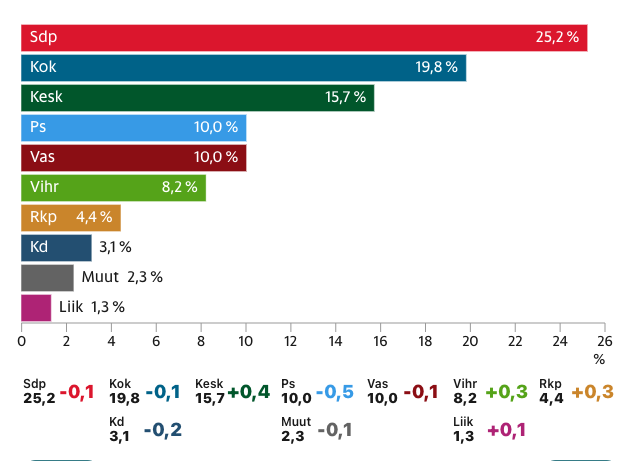
The dire situation of the PS was highlighted again in Helsingin Sanomat’sopinion poll, which showed the party tied with the Left Alliance with 10% and just a heartbeat from entering the single-digit league.
In the 2007 general election, the PS received 4.05% of the votes granting it five MPs compared with three (1.57%) in 2003.
Some of the biggest excuses justifying and normalizing the PS’s entry into the political “big leagues” after 2011 are:
The party will implode like the Rural Party did in the 1970s;
Timo Soini is not a racist;
The PS is not an anti-Muslim party but one against the EU;
Jussi Halla-aho is the “bad” PS and Soini the “good” one;
There are many other excuses to justify the PS ideology and toxic politics.
Do you believe that the PS rating will dip into the single-digit leagues soon? Do you believe that the party’s situation will lead to early elections in the fall?
The Perussuomalaiset (PS)* party congress at Lahti exposed to the tee the far-right and racist beast that has always lurked inside the party. Riikka Purra, who won easy reelection as chairperson, rambled on with typical far-right talking points.
Claiming that white Finnish culture was under attack, she placed the blame on so-called mass immigration from developing countries that places strains on public services and will force the welfare state to collapse.
Purra equating Islam with “cultural intrusion” and how this is destroying the white social fabric of Finland. Oddly, she used the annual World Village Festival in Helsinki as an example of the cultural intrusion, which includes Islamization.
Without mentioning anyone specific, Purra states that “some decision-makers have themselves allowed, themselves demanded, and themselves promoted” the disintegration of Finnish culture.
If there are still any doubts that the PS isn’t a far-right and racist party, Purra’s speech leaves no room for doubt. Not only are her words offensive to migrants and minorities in Finland, but they are also a warning that matters could evolve like in the United States under Donald Trump.
The newly elected leadership of the PS. From left to right: Party secretary Harri Vuorenpää, Simo Grönroos, Teemu Keskisarja, Riikka Purra, and Joakim VIgelius. Source: Suomen Uutiset.
The Finnish parliament passed Wednesday the extension of the pushback law until the end of 2026. The final vote was 168 in favor, 29 against and two absent, according to the Helsinki Times. The passage of the bill means that Finland will continue to flout internationtal law and its commitment to human rights. It will effectively mean that the Finnish-Russian border will remain closed.
Fool me once, shame on you. Fool me twice, shame on me. Fool me three times, shame on both of us.
Stephen King
One matter is a near-sure way of getting support in Finland, and it is the threat of migration. Keijo Korhonen, a Center Party politician, made a name for himself in the 1980s by instilling fear that the fall of the USSR would force thousands of Russians to cross our border en masse.
Xenophobia and racism are potent components of the undercurrent of Finnish politics that has been recently exploited by the far-right Perussuomalaiset (PS)* party. Anti-immigration was such a powerful topic that it handed the PS its historic win in 2011, when it saw the number of MPs rise to 39 from 5 previously.
In every general election after 2011, the PS has capitalized and done well thanks to their pet theme and message: the threat of migration.
On Wednesday, Parliament will vote for a continuation of the pushback law until the end of 2026, which effectively suspends the human right of seeking asylum.
The fear of migration, especially Muslims, is the fuel that the PS and government are using to get the extension of the pushback law across the finish line.
PS Interior Minister Mari Rantanen and the government have defended the law, citing “national security.” They claim that our national security is under threat, but they have not brought any evidence because it is a secret. But here is the question: How can you trust a xenophobic government and politicians who capitalize on racism? It’s like trusting the pyromaniac to put out a fire.
I have called the pushback law a farce and a lie to satisfy the political wet dreams of the PS.
It is shameful that parties like the Social Democrats, who should know better, with the majority supporting the bill that has caused damage to Finland’s international image and made us less secure.
With the next general election on 18 April 2027, some eyes are pointing towards the Perussuomalaiset (PS)*, which suffered a catastrophic municipal and county election. If such misfortunes aren’t enough, recent opinion polls have put the far-right party in fourth place behind the Center Party.
The PS’ fall is significant. The last time the party was at 10% levels in the polls was in January 2019, when it was 9.7%. It is a far cry from its peak of 22.8% in January 2020.
Almost everyone knows that when the PS is facing problems, it turns to its immigration rhetoric. One reason the party has fared so well in the general elections after 2011 is that it has skillfully brought the “migrant threat” to the attention of voters.
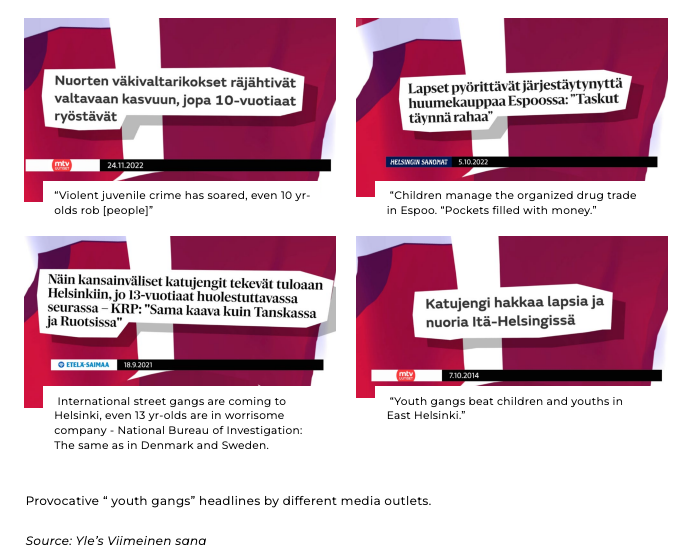
Migrant Tales published in Reilumedia in 2023, highlighted the use of migrant crime by the PS as a ploy to attract voters. We wrote: As the past has demonstrated, the radical-right PS had lured voters through news stories involving migrants and asylum seekers committing crimes in the 2011, 2015, and 2019 parliamentary elections. One of the many big ‘migrant scandals’, the PS wants to exploit for the April election is the threat of ‘youth gangs.'”
Below are some of the lessons learned from the potential youth gang problem that the media, the PS and police exploited for their own aims.
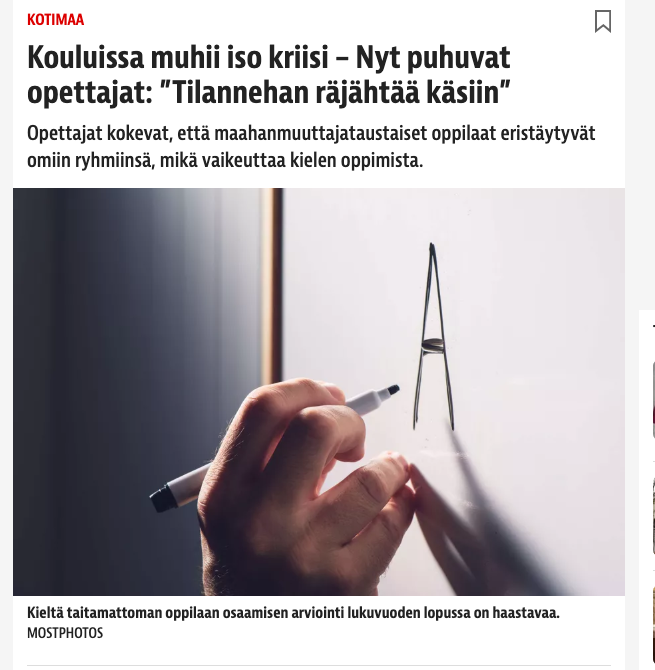
An article in tabloid Iltalehti aims to reinforce readers about why “kids with migrant backgrounds” are a problem, but instead reveals the racist attitudes of the tabloid and of some comprehensive school teachers. I suspect that one of the reasons why Iltalehti uses anonymous sources is because no respecting teacher would go on the record with such claims.
Let’s dissect the article’s most outrageous claims:
The article concerned why brown and black children, specifically Muslims, are marginalized and don’t want to be Finns, which affects their Finnish language-learning abilities. One good start would be to stop labeling them “children with migrant backgrounds.” The label alone excludes.
One reason why kids don’t want to identify as Finns is that they are not even accepted as Finns. As mentioned above, why would some of these kids want to identify with white Finns, which the article labels “ethnic” Finns (kantasuomalainen), if their backgrounds are not taken into account?
What about institutional racism and the xenophobic and bigoted comments by politicians in particular, like the Perussuomalaiset (PS)*, who have made their political message by spreading racism and lies about migrants? Would you want to be part of a society that holds you in contempt?
I have said it before and will say it again: I never want to be a white Finn but a Finn on my terms. The article does not mention how these children could be seen and taught to be Finns on their terms.
The article claims: “Some children with an immigrant background who were born in Finland do not speak Finnish well enough to attend school.” If this is the case, it reveals the failure of the school system and ineffective social policy. Nowhere is it mentioned in the article how we tackle this problem.
Why do three teachers cited in the story speak anonymously? “Paula,” who teaches the Islman religion, claims that some of her students don’t want to be Finns. If “Paula” is a teacher, she should know better the importance of retaining your culture instead of erasing it. Over 1.2 million Finns emigrated from Finland between 1860 and 1999. Even the children of the first generation, still in their fifth generation, continue to see themselves as Finns. Is this strange? No.
“Karla” is another consultant teacher who speaks anonymously in the article. She believes that the best way to solve Finnish-language learning issues is to send such families to the countryside. Apart from being illegal, I’m certain that some teachers feel this is an effective way to teach Finnish.
“Helena” is a Finnish-language teacher who also appears anonymously in the story. She is in favor of limiting the number of non-Finnish-speaking students. There was a big discussion in 2011 about limiting the number of “students with foreign backgrounds” in classes. One of the questions that these polls asked over ten years ago is if public servants like teachers can limit or choose who they’ll teach. Can the police do the same? Is segregating schools by placing caps constitutional?
The Iltalehti article leads: “Kouluissa on suuri kriisi – opettajat puhuvat ääneen: Opettajien mielestä maahanmuuttajataustaiset oppilaat eristäytyvät ryhmiinsä, mikä vaikeuttaa kielen oppimista.”
These types of stories in the Finnish media only serve to reinforce stereotypes and suspicion about migrants.
The Trump administration is one of the best examples of the violent knee-jerk reaction of how white privilege reacts when threatened. As Nazi Germany proved, government’s will go to any lengths to defend their privileges, even if it is a fabricated threat.
No country is immune to such a situation. The rise of far-right parties in Europe is an example of the latter. All of them have one factor in common: outsiders are threatening to take away our privileges.
Fortunately, Finland is bucking the trend for now. The anti-immigration and far-right Perussuomalaiset (PS)* party, which is in government, has seen its poll numbers nosedive, as a recent Helsingin Sanomat opinion poll showed.
According to Helsingin Sanomat, the last time the PS’ share of the vote was at the 10% level was in January 2019, when it was 9.7%. It is today a far cry from its peak of 22.8% in January 2020.
The PS’ lack of support is linked to white privilege, which the party is attacking through its austerity measures that target vulnerable groups like single mothers and the unemployed.
The worst enemy of the Perussuomalaiset is the Perussuomalaiset.
The recent opinion poll published by Yle is a source of hope that Finland is finally awakening from its 2011 general election nightmare, when the Perussuomalaiset (PS)* saw its MPs in parliament soar to 39 from five previously.
The latest poll shows that the PS’ support plummeted by four percentage points to 11.4% relegating the anti-immigration far-right party to fourth place after the Social Democrats (25.3%), National Coalition Party (20.2%), and Center Party (15.6%).
The PS saw its support dive in April’s municipal and county elections and this is a bad omen for the party in the 2027 general election.
Even if the PS leadership blames their poor election misfortunes on “a red wave” and “poor communication,” the party’s membership in government has exposed its far-right neoliberal policies and agenda.
Many, like myself who have followed the PS closely since the early 2010s, are hoping that the PS will return permanently to the single-digit political leagues characterized by internal fighting.
In the face of what is happening in the United States under President Donald Trump and the rise of far-right parties in Europe like the AfD of Germany, one may ask if we have crossed the point of no return. Finland’s municipal and county elections of April offer us a clear no to that question.
In the municipal and county elections, the Perussuomalaiset (PS)* saw its results plummet raising speculation that it may be even a death blow to the party with parliamentary elections due in April 2027.
The worst enemy of far-right and autocratic parties and rulers is none other than themselves. Autocratic rulers and parties become success or speed blind until they smash against a wall.
In a watershed announcement by Germany’s domestic intelligence service it slammed AdF as a “right-wing extremist group.” This could allow the government to ban the far-right party. As guessed, the Trump administration has expressed its displeasure.
One of the lessons that I learned from my native Argentina, is that political turmoil caused by autocrats like military rulers have their days counted when they believe they are invincible. Today, we are witnessing it in the United States under the Trump regime.
As he promised, Trump is an autocrat from day one challenging the very institutional fabric of the country.
It would be naive and careless to believe that the US is now under attack from an autocrat. It has been under attack from within ever since it institutionalized slavery, injustice and runaway capitalism.
And what is even greater and offers a ray of hope, is that fact that you do not need an army to defeat the most well-equipped regime. All you need is a few good people at the right historical place and time.
An example of how the mainstream media spreads racism and frames migrants. MTV is supposed to be a “serious” source but last year it invited Interioir Minister Mari Rantanen to talk about the governments anti-immigration policy with a provocative picture on the right. You can read the lastest European Islamophobia Report 2023 here.
Opulence and inustice are a deadly mix that can destroy an autocrat like cyanide and it will end up killing and impoverishing it.
The recent municipal and county elections in Finland also are a cyaide pill for the xenophobic Perussuomalaiset (PS)*, whch saw its election result plunge to by 6.8% to 7.6% and by 3.3% ti 7.8%, respectively.
Few are shedding a tear about the dismal result of the PS in the election after it has spread in Finland xenophobia and attacked migrants and minorities. It is a party that appeals and spreads racism that are masters at playing the victim. The PS is a constant threat to our democracy and the rule of law.
Parliamentary election in Finland take place in 2027 and we’ll see then whether the PS will be relegated to the minor political leagues and was a brief political nightmare.