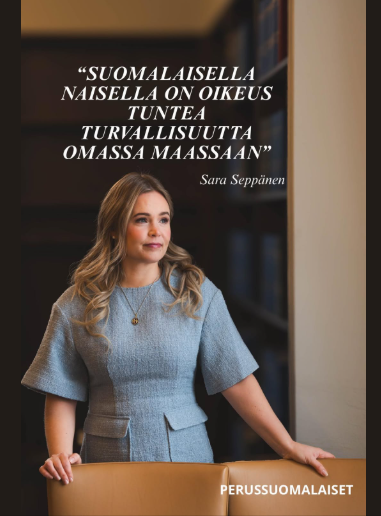
Perussuomalaiset (PS)* Minister for Foreign Trade and Development Ville Tavio is one of the most Islamophobic members of the government. He recently praised US President Donald Trump’s speech at Davos.
Trump’s speech, which received a lot of pushback from European representatives, was good in Tavio’s opinion because a strong America first policy was good for Finland because it aims to do good things like lowering migration.
“I would like Finland to be a strong and united nation,” he was quoted as saying in Yle. “I would like that more than anything else. In my opinion, the direction Finland has been taking for many decades has been quite divisive. Continuing mass immigration and failing to create cultural unity does not help the situation.”
Tavio, who commonly cites the great replacement theory and has no qualms about expressing his hatred for minorities like Muslims, talks about “mass immigration” to Finland even if the country has one of the smallest foreign populations in Europe.
Migrant Tales wrote a rebuttal to a Tavio column in Helsinki Times, but he never cared to reply.
Tavio, and many members of his far-right party, are a warning of where Finland could become and use the same tactics that ICE is using to terrorize migrants. For this reason we must remain vigilant and united.
Finland, the happiest country in the world—so sings the choir of statistics, gently accompanied by the pleasant rustling of freshly increased government salaries and bonuses. What an excellent job they must be doing! Their rising compensation stands as living proof of national happiness. Meanwhile, the healthcare system is invited to explore the art of efficiency without resources, social welfare practices the virtue of austerity, and housing benefits master the elegant trick of disappearing without farewell. Unemployment benefits, too, grow philosophical: they still exist, but mainly as an idea. Mass layoffs? Naturally—a small and necessary sacrifice at the altar of “labor-market flexibility.” Trade unions are carefully weakened, no doubt to spare them the exhausting burden of influence. Progress, after all, must hurt—preferably someone else. But let us not despair. Finland remains the happiest country in the world. One merely has to ask, in the true spirit of the Enlightenment:happy for whom, exactly.
*Sami Rusanen is “an international lawyer, legal counsel, critical analyst, executive consultant, project & HR Manager, Investment” (Linkedin)
Saara-Sofia Sirénin lähtö kokoomuksen ryhmästä kesken kansanedustajakauden herättää huomiota. Helsingin Sanomien mukaan Sirén kiistää, että kokoomuksen konservatiivisuus olisi saanut hänet hylkäämään eduskuntatyön. Harmi, että kiistää, sillä sitä olisi voinut pitää kunniallisena syynä lähteä kesken kaiken tehtävästä, johon äänestäjät ovat hänet valtuuttaneet.
Sirén on ollut niitä kokoomuksen ryhmän harvinaisia toimijoita, joita on vielä saattanut pitää arvostettavina kansanedustajan tehtävän hoitajina. Se, että hän ei edelleenkään tunne halua arvostella selvästi äärioikealle kallistunutta, raakaa ääripolitiikka harjoittavaa nykykokoomusta, on huolestuttava asia. Mikä kokoomuksen toiminnassa mahtaa olla sellaista, jota Sirénin tapainen henkilö pitää niin arvostettavana, että vaikenee törkeyksistäkin?
Moni ei tiedä, mitä kokoomuslaiset nykyään puuhailevat ja ajattelevat. Ministereiden ja kansanedustajien Facebook-seinät täyttyvät tapaamisista, itsenäisyyspäivän juhla-asuista, jouluaterioista, matkoista ja äveriäästä elämästä. Ei siellä paljon politikoida.
Mutta katsotaanpa vähän, millaisilla foorumeilla kokoomuslaiset ovat jäseninä. Selailin joulukuun lopulla sivustoja, joissa kokoomuslaiset kokoontuvat joukolla.
Oikeistofoorumilla on 18.000 jäsentä. Ministereistä ja kansanedustajista heihin kuuluvat ainakin Elina Valtonen, ulkoministeri (peräti kahdella eri profiililla), Matias Marttinen, työministeri, Jukka Kopra, eduskuntaryhmän puheenjohtaja, Pia Kauma, Arto Satonen, Aleksi Jäntti, Janne Jukkola, Juha Hänninen, Heikki Vestman, Milla Lahdenperä, Karoliina Partanen, kokoomuksen varapuheenjohtaja, Ville Valkonen, Tere Sammallahti ja Atte Kaleva. Perussuomalaisiakin ryhmässä on useita. Lista ei ole täydellinen, mutta kansanedustajien sille tuoma arvovalta antanee osviittaa siitä, että ryhmä on äärioikeiston omanaan pitämä ja seuraamisen väärti.
Tässä kuvia jouluisten postausten sisällöstä. Näin sitä kokoomuslaista yhteishenkeä rakennetaan.
Yksi ryhmän ylläpitäjistä joutui 13 vuotta sitten eroamaan kokoomusnuorten varapuheenjohtajan tehtävistä, koska meni sanomaan julkisesti sen, mitä monet kokoomuslaiset ajattelevat vielä tänäänkin: ”On järjenvastaista, että tuemme heikoimman aineksen lisääntymistä ja sitten ihmettelemme, miksi täällä on huumeriippuvaisina syntyviä lapsia ja huostaanottoja alkoholistivanhemmilta”. Vähävaraisen väestön ja maahanmuuttajien halveksunta näkyvät nyt hallituksenkin toiminnassa.
Päivän Byrokraatti on 29.000 seuraajan äärioikeistolainen blogi
Facebookissa ja Twitterissä (X). Se on trumpilainen öyhötysryhmä, jolla on merkittävä asema äärioikeiston vaalityössä. Tässä pari kuvaa tuonkin joukkion isänmaallisista joulutunnelmista.
Näin esiintyy tämän päivän kokoomus. ”Se on vain se netti”, sanoo konservatiivinen äänestäjäkunta. Mutta siellä se tämän päivän politiikka ja etenkin äänestäjien houkuttelu tapahtuu. Kokoomuksen konstit eivät ole kunniallisia.
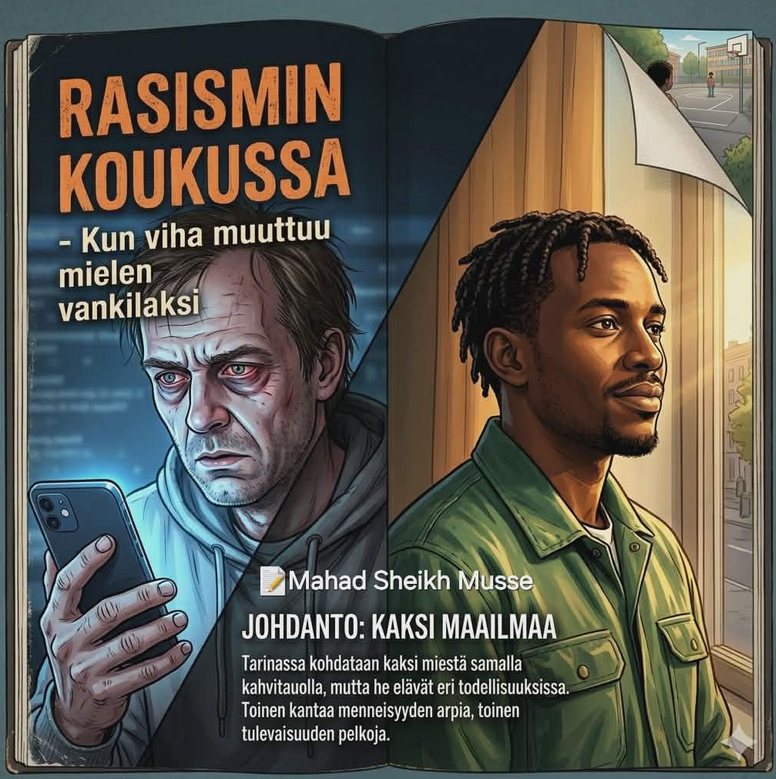
#KuiskaustenKaupunki kertoo Farahista ja Osmanista, kahdesta nuoresta miehestä, jotka ovat kasvaneet Suomessa Somaliasta tulleina.
Harmaassa lähiössä heidän arkeaan varjostavat menneisyyden menetykset ja nykyhetken paineet.
Harmaassa lähiössä heidän arkeaan varjostavat menneisyyden menetykset ja nykyhetken paineet. Farah on hiljainen ja vastuuta kantava esikoinen, joka tukee äitiään isän kuoleman jälkeen.
Osman on eloisampi, mutta levoton ja haavoittuva.
Kodin rauhan taustalla kytee uhka: kaduilta leviävä uusi ja vaarallinen huume alkaa vetää yhteisön nuoria puoleensa.
Farah tuntee kuiskauksen, joka enteilee vaikeaa valintaa – miten suojella perhettä ja yhteisöä maailmassa, jossa menneisyys, suru ja ympäristön houkutukset törmäävät.
We have all witnessed how Donald Trump’s administration, the self-proclaimed authoritarian unleashing violence, racism, abuse and imperialism, has gone berserk. Even if it is clear what type of an accused convict president we are dealing with, the saddest matter to watch is how EU politicians are bending the knee to Trump.
One of the first leaders I would purchase kneepads is French President Emmanuel Macron. After criticizing Trump about tariffs, the US president leaked a letter by him where he wrote that he agrees with what he is doing in Syria and “we can do great things in Iran.”
Let’s not forget kneepads for NATO chief Mark Rutte, EU Commission President Ursula von der Leyen, her vice president, Kaja Kallas, and a long list of other EU leaders who have turned a blind eye on the atrocities and war crimes in Gaza. Since I live in Finland, I would purchase kneepads for President Alexander Stubb and Foreign Minister Elina Valtonen.
The most Trumpian party in Finland is the Perussuomalaiset (PS)*. PS MP Laura Huhtasaari, who has openly supported Hungarian strongman Viktor Orbán, openly said that the US is the only country that can guarantee Greenland’s security.
Apart from the PS, the National Coalition Party led by Stubb, Valtonen and Prime Minister Petteri Orpo are the most subervient to Trump, who could slap them in the face and then Stubb would ask if he wants to play golf.
Good advice for the EU: The best way to deal with the Russian threat is to negotiate directly with Moscow. Sabre-rattling and threatening with a crumbling NATO will not do it. Where is Finland’s foreign policy heading after NATO?
California Governor Gavin Newsom is one of Donald Trump’s biggest critics. “He is a T.rex. If you don’t mate with him you’ll be devoured.”
Now Trump is telling the Norwegian government he has lost interest in peace because he did not receive the Nobel Peace Prize!
This should be a signal, even to those slow to catch on, to get off his team.
He just invaded Venezuela, may bomb Iran again soon, possibly even Mexico in addition to annexing Canada. Now, which one of these is Finland as eager NATO newcomer, keen to go to war with if called upon under the alliance’s charter by its most powerful member, the USA? I don’t have to ask around much to know the average Finn’s answer in “none of the above” and many will add “are you crazy?”
Then there is the matter of Trump’s threat to annex Greenland which is most of the territory of our Nordic ally and friend, Denmark, by military force if necessary. In this case Finland would have to choose between its most powerful ally, the USA or it’s neighbour, Denmark- if push came to shove. If it came to a conflict it would be almost impossible for us to keep out of it the way things stand now.
The chaos in world politics created by Trump’s tariff-wielding in magnified manifold in the crises NATO is now in.
But as the Chinese proverb said, crises also creates opportunity. The opportunity provided for us by Trump’s bluster is to get out of a sinking NATO before all hell breaks loose. We could also still cancel the F 35 fighters like Spain, Portugal and possibly Canada and save ourselves millions. Does anybody in the Finnish leadership still believe Trump will be generous enough to supply spare parts to keep those F 35s flying if there is the slightest disagreement with him when we may be defending ourselves? After this Greenland spat it’s hard to believe such gullibility still survives in any serious degree. There is every reason to believe that even now Trump is installing secret incapacitating technology in the planes yet to be delivered. It is hard to imagine he is not capable of just that after inserting his egotistical whine about not getting the Prize into his military strategy. He has show his cards, we just need to read them.
It is time for us, I mean Finland, to get out while the getting is good. While at it we also need to cancel the Defence Cooperation Agreement which would make it easy for Trump to occupy Finland if he gets it into his head to do so. A likely scenario for that is not hard to imagine in this conflicted state of the world.
Getting out would take us back to 2022 when we in Finland were living in a peaceful and non-aligned country refusing to get mixed up in wars or sending weapons to anyone fighting them.
We could also eventually rearrange peaceful trading relations with and through Russia and using the Saimaa canal to help pull ourselves out of a recession. The rest of the EU and Europe would soon learn to accept this as they did before in other troubled times. Even if returning to the old status quo took awhile, we would still be in a better position than the mess we are now heading for.
As US President Donald Trump continues to go off the rails acting like a USAmerican Kim Jong Un, it’s clear that we must not only do everything to stop him but prevent Europe from taking the same route.
It’s sad but a reality that many people will die as a result of his power-starving appetite, which may instil fear in some but in others embolden.
With the recent attack and kidnapping of Venezuelan President Nicolas Maduro and the saber-rattling at Iran, it’s clear that these acts of aggression, or imperialaims, will embolden people to fight back.
We have many examples that show that we don’t need a modern army to beat an oppressor.
The list below is not complete of some who challenged a system and won with their bravery and suffering.
On the first of December 1955 Rosa Parks refused to give her seat on a bus to a white passenger. That moment of defiance was one of the sparks of the Civil Rights Movement.
Dedication and a love for freedom turned Harriet Tubman into ray of hope for many black slaves.
The Cuban Revolution is one of the best examples of being at the right place at the right time. It proved that you don’t need an army to defeat a large organized and corrupt army.
Even if Sacco and Vanzetti were falsely executed by the electric chair in 1927, they are still fondly rememberd. Their only crime was that they were anarchists. Their death led to protests around the world.
The October 17, 1945 demonstration, which freed Juan Domingo Perón from detention, showed a remarkable event where his charistmatic wife, Evita Perón, rallied the masses and changed history.
The White Rose movement did not end with the death the death of Sophie Scholl, Hans Scholl and Christoph Probst on the 22 February 1943, shortly after Hitler’s 6th Army had suffered a decisive defeat in Stalingrad. These brave activists dared to challenge the power of an autocratic regime by distributing anti-Nazi messages.
The Russian Revolution of 1917 was one of the most important historic events in the last century. What would the world be if Bolsheviks would have not succeeded? What would the world be like without Karl Marx?
“El derecho de vivir en paz,” the right to live in peace, is one of folk singer’s Victor Jara’s most famous songs. He was brutally murdered by the military dictatorship and his songs censored. After the uprising against the Chilean government in 2019 when they raised the price of subway tickets, people started to sing Jara’s songs as a rallying cry for freedom and democracy.
Upton Sinclair impacted the US through his writing in books like The Jungle.
There are many, many more examples when the underdog beat the oppressor.
Migrant Tales context:In 2016, we reported about the terrible treatment of asylum seekers in the northern town of Kolari. Lapin Kansa, a Rovaniemi-based daily, got intereted in the story and helped the demontration to get national attention. One of the reasons why the demonstration was organized was against the asylum center’s deputy manager Jari Sillantie. One editor spoke to me later angered and questioned if Sillantie was a racist. The story below should answer that question. I believe that this demonstration was the first that caused the sacking of a manager.
I do, and very vividly. Jari Sillantie was the deputy manager of the northern Finland Kolari asylum reception center that sacked him after some 140 asylum seekers protested his management style.
Even if his management style and Facebook “likes” did not reveal his attraction to the Islamophobic Perussuomalaiset (PS)* party, they did speak volumes about his anti-immigration views (see picture below).
After all of the asylum seekers at the reception center demonstrated on May 4 and forced the Red Cross, which managed the reception center, Sillantie was sacked and deemed “unsuitable for the job.”
We learned more things about Sillantie: His heart is with the Islamophobic PS party, and he was convicted for tax fraud in 2018. He owes 666,000 euros in back taxes to the state.
Jari Sillantie, who was sacked as deputy manager of the Kolari asylum reception center in 2016, was not suited for the job. His “likes” on Facebook, which have now been deleted, are an assortment of far-right associations and politicianslike Laura Huhtasaari.
Sillanpää is a good example of the hypocrisy of the PS. He states in his campaign message all the racist talking points of the party. Migrants should follow the law but Sillantie and the PS have special privileges.
Sillantie’s message comes in loud and clear in his campaign poster: Vote for Finns first!
Thanks to the asylum seekers of the former Kolari asylum reception center, the media, and our work, we were able to expose Sillantie for what he was: a questionable person who wanted to make the lives of asylum seekers as difficult as possible.
Since the 1970s, Finnish identity has undergone a profound transformation, closely tied to Finland’s shift from a largely homogeneous country of emigration to an increasingly diverse society shaped by immigration. What was once a marginal issue has become central to political debate and everyday conversations about belonging. Migration has not only changed who lives in Finland, but also how Finnishness itself is understood, questioned, and redefined.
In the 1970s, Finland was primarily a country people left rather than moved to. Tens of thousands of Finns migrated abroad, especially to Sweden, in search of work and better economic opportunities. Migration at the time was seen mainly as a practical response to labor demand, not as something that challenged national identity. Finnish society was widely perceived as culturally and ethnically homogeneous. Being Finnish was closely associated with speaking Finnish, sharing a common historical narrative, and fitting into a relatively uniform cultural framework. Apart from the Swedish-speaking minority and the Sámi—whose voices were often sidelined—internal diversity received little public attention.
This began to change slowly in the 1980s. Finland started to receive small numbers of refugees, including people fleeing war and political repression in Vietnam and parts of Latin America. There were also labor migrants and Finns returning from Sweden. Yet immigration remained limited in scale and visibility, and it rarely sparked broader political debate. Finnish identity was still largely seen as stable and clearly bounded. Integration, where it was discussed at all, was understood as a one-way process: newcomers were expected to adapt to Finnish society, rather than society adapting in response.
The 1990s marked a turning point. The collapse of the Soviet Union reshaped migration patterns across Northern Europe, and Finland was no exception. Ingrian Finns arrived from Russia under policies that framed them as ethnic “return migrants.” At the same time, Finland began to receive more asylum seekers, notably from Somalia and the Balkan region. Finland’s accession to the European Union in 1995 further embedded the country in European migration and asylum frameworks. Migration became more visible, and with visibility came debate—about citizenship, integration, and who could truly belong. Finnishness started to shift, slowly, from a narrowly ethnic concept toward a more civic one, based on citizenship, language skills, and participation in society. Still, anxieties about cultural difference and social cohesion were never far from the surface.
Vaikka Migrant Tales ei vaivaudu kiinnittämään huomiota pikkurasisisteihin, Suomi olisi hieno maa ilman heitä.
Perussuomalaiset-nuorten mainokset ovat häpeällisiä. He uskovat, että heidän muukalaisvihansa on nykyään ”siistiä”, mutta katsotaanpa heidän lausuntojaan tulevaisuudessa, kun heidän sanoja a aatuksia on aikaa mädäntyä.
Jos Suomen tulevaisuus on heidän käsissään, olemme pulassa. Uskon kuitenkin, että on tarpeeksi järkeviä suomalaisia, jotka osaavat erottaa halvat rasistiset iskulauseet ja totuuden.
He tarkoittavat todellisuudessa, että kaikki työttömät ulkomaalaiset tulisi lähettää keskitysleireille tavaravaunuissa.
Ei koskaan ota vastuuta. Syytetään muita!
Jos noudatamme koskaan politiikkaanne, Suomi kuolee, koska sen väestö ikääntyy. Sillä välin imetään maahanmuuttajilta kaikki veri.