
A new population forecast from the Itla Children’s Foundation delivers a stark warning: by 2035, the number of children in Finland will fall by nearly 20 percent. In some regions, the decline will be catastrophic. Kymenlaakso is expected to lose more than a third of its child population, while even growth regions such as Pirkanmaa will see stagnation rather than renewal.
Finland is hardly alone in facing falling birth rates. Across the EU, ageing populations and declining fertility are reshaping societies. What sets Finland apart, however, is not the problem itself—but the political refusal to confront it.
Instead of embracing immigration as part of the solution, Finland has spent the past decades moving in the opposite direction. Since its electoral breakthrough in 2011, the Perussuomalaiset (PS)* has built its success on anti-immigration rhetoric, transforming hostility toward migrants into a central political theme. That message has paid off at the ballot box, but it has done nothing to prepare the country for its bleak demographic future.
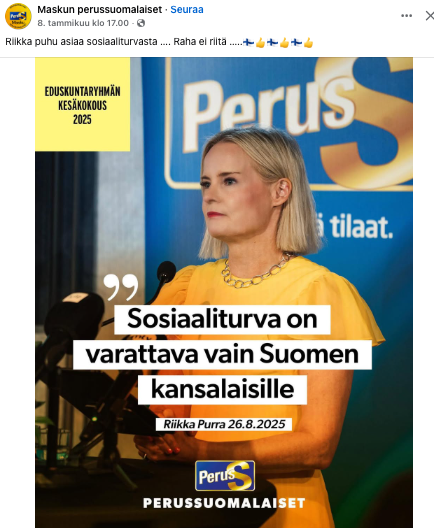
Today, the party’s chairperson and minister of finance, Riikka Purra, regularly amplifies messages that frame immigration as a threat rather than a necessity. Statements suggesting that only Finnish citizens should be entitled to social welfare are not only morally troubling but also constitutionally questionable. More importantly, they signal to the outside world that Finland is closed, suspicious, and unwelcoming.Facebook
This is a dangerous signal to send at a time when Finland desperately needs workers, taxpayers, and young families.
Unlike parties that speak—however imperfectly—about growth, openness, and long-term competitiveness, the PS offer a vision of Finland that simply shrinks. Restrictive immigration policies combined with declining birth rates do not preserve the welfare state; they hollow it out. A smaller workforce cannot sustain an ageing population, no matter how high the fences are built.
The choice facing Finland is not between immigration and social cohesion. It is between adaptation and decline.
If Finland wants a future with functioning schools, staffed hospitals, and a viable welfare system, it must abandon the illusion that demographic collapse can be reversed through nationalism and xenophobia alone. The country needs an about-turn in policy—one that replaces fear with pragmatism and inclusion.
Instead of inventing new obstacles for people who want to live here, work, and contribute here, Finland should be actively lowering them. Demography is not ideology. The numbers do not care about slogans.
