Come an watch today at 7 pm a wonderful play reflecting these troubled times at Botta, Museokatu 10, Helsinki.
Below is a review that Migrant Taleswrote about Helsinki Noir at the end of December.
“Writer and director Ahti Tolvanen, who is a member of the Migrant Tales board, has written a play that reflects hard and uncertain times for Finland. When Ahti came to Finland in the 1970s, it was a very different country. For one, its foreign policy, which some criticized as Finlandization, attempted to coexist with its giant eastern neighbor.
But matters have chaned from those cold war years. Some Finnish politicians regularly beat their chests at Russia and believe that NATO will save the day if Finland is ever invaded by Russia.
“Before, Finland’s foreign policy was dictated by the Soviet Union and now we are prostrate towards the United States,” said Tolvanen. “Finland seems to be adrift and nobody can see where it is heading.”
The play offers a different narrative and take on things. Geopolitics, politics, immigration policy and other factors come to light and offer the viewer a chance to reflect where the country is heading.”
Helsinki Noir, which has showed in Helsinki and London, has received some rave reviews:
“Satirizing ultra-conservative politicians…raising public awareness, and empowering the disempowered” – Yuko Kurahashi, a vising reviewer and professor of drama, Kent State University.
“A wonderful show” said Laura Killeen, director of Rosemary Branch, London
Watching political events in the United States and the Donald Trump’s inauguration as the US’ 47th president, brought despair and forced me to dig deep for hopeand consolation. One of the matters that I will never forget is the last military dictatorship (1976-83) of Rafael Videla in Argentina.
His stranglehold over the country was near-complete. But then the years revealed his weakness: the first indication of his decline and loss of power when he believed he was invincible.
You don’t need an army are weapons of mass destruction to defeat your foe. There are many, many example below of people that ignited a spike at the right place and right time to begin a social movement. Trump, therefore, looks like a president in decline.
The list below is not complete of some who challenged a system and won with their bravery and suffering.
On the first of December 1955 Rosa Parks refused to give her seat on a bus to a white passenger. That moment of defiance was one of the sparks of the Civil Rights Movement.
Dedication and a love for freedom turned Harriet Tubman into ray of hope for many black slaves.
The Cuban Revolution is one of the best examples of being at the right place at the right time. It proved that you don’t need an army to defeat a large organized and corrupt army.
Even if Sacco and Vanzetti were falsely executed by the electric chair in 1927, they are still fondly rememberd. Their only crime was that they were anarchists. Their death led to protests around the world.
The October 17, 1945 demonstration, which freed Juan Domingo Perón from detention, showed a remarkable event where his charistmatic wife, Evita Perón, rallied the masses and changed history.
Rakenteellinen syrjintä ja rasismi heikentävät yhdenvertaisuutta viranomaistyössä, ja pahimmillaan ne toimijat, joiden tulisi tukea nuoria, sulkevat heidät ulos tärkeistä palveluista ja mahdollisuuksista.
Tämä epäoikeudenmukaisuus ei koske kaikkia nuoria samalla tavalla, vaan kohtelu riippuu usein heidän taustastaan.
Kantaväestöön kuuluvat nuoret ja maahanmuuttajataustaiset nuoret kohdataan eri tavoin – eikä tämä ero synny heidän käyttäytymisestään, vaan rakenteiden ja asenteiden vinoumista.
Viranomaisten ja toimijoiden epätasa-arvoiset kohtaamiset.
Monet viranomaiset ja toimijat lähestyvät nuoria valmiiden ennakkoluulojen ja oletusten kautta.
Kantaväestöön kuuluvat nuoret nähdään useammin yksilöinä, joilla on henkilökohtaisia tarpeita ja haasteita, kun taas maahanmuuttajataustaisia nuoria kohdellaan usein taustansa edustajina.
Heidän käytöstään, tarpeitaan ja jopa virheitään arvioidaan ryhmäidentiteetin kautta, mikä johtaa kollektiiviseen vastuuttamiseen.
Esimerkiksi kantaväestöön kuuluvan nuoren huono käytös voidaan selittää “kasvuvaiheena” tai “yksilöllisenä ongelmana”, kun taas maahanmuuttajataustaisen nuoren kohdalla se nähdään helposti merkkinä laajemmasta kulttuurisesta tai “heimoon” liittyvästä ongelmasta.
Tämä näkyy esimerkiksi viranomaisten ja poliitikkojen retoriikassa, jossa maahanmuuttajataustaisten perheiden odotetaan “ottavan lapsensa kuriin” tavalla, jota kantaväestöön kuuluvilta ei vaadita.
Palveluista ulossulkeminen ja leimaaminen
Maahanmuuttajataustaiset nuoret ja perheet kohtaavat useammin epäluottamusta ja syrjintää myös palveluissa, joiden tehtävänä olisi tukea heitä.
Heitä voidaan epäillä jo lähtökohtaisesti enemmän, ja heidän tarpeitaan vähätellään.
Tämä näkyy esimerkiksi koulujen kurinpitokäytännöissä, sosiaalipalveluissa tai viranomaisten toimissa, joissa maahanmuuttajataustaiset nuoret kohtaavat kovempia seuraamuksia tai tiukempia rajoituksia kuin kantaväestöön kuuluvat ikätoverinsa.
Samalla heidän saavutuksiaan vähätellään, ja he joutuvat todistamaan arvonsa jatkuvasti enemmän kuin muut.
Nuorten taustat eivät saisi määrittää heidän tulevaisuuttaan
Viranomaisten ja päättäjien on ymmärrettävä, että tämä eriarvoinen kohtelu ei synny tyhjästä – se on seurausta rakenteellisesta rasismista, joka ylläpitää epätasa-arvoa.
Jos nuoret, joilla on maahanmuuttajatausta, nähdään lähtökohtaisesti ongelmina, heidän mahdollisuutensa onnistua ja tuntea kuuluvansa yhteiskuntaan heikkenevät merkittävästi.
Kaikkien nuorten – taustastaan riippumatta – on saatava kokea olevansa yksilöitä, joilla on oikeus tehdä virheitä, kasvaa ja kehittyä. Heidän kohtelunsa ei saa riippua siitä, missä heidän vanhempansa ovat syntyneet tai minkä näköisiä he ovat. Yhteiskunnan on purettava rakenteita, jotka ylläpitävät tätä eriarvoisuutta.
Vastuu jakautuu kaikille tasapuolisesti
– Nuorten vastuu:
Nuoret vastaavat omista teoistaan ja valinnoistaan, mutta heillä on oltava tuki ja mahdollisuudet onnistua. Ilman tasa-arvoista kohtelua ei voi syntyä vastuuntuntoista yksilöä.
– Vanhempien vastuu: Vanhemmat voivat ohjata lapsiaan, mutta he tarvitsevat siihen yhteiskunnan tukea. Perheitä ei saa asettaa eri asemaan heidän taustansa perusteella.
– Viranomaisten ja päättäjien vastuu:
Viranomaisilla ja päättäjillä on erityinen vastuu varmistaa, että kaikki nuoret kohdataan yhdenvertaisesti. Heidän tulee tunnistaa omat ennakkoluulonsa ja purkaa rakenteellista rasismia aktiivisesti.
On aika siirtyä sanoista tekoihin.
Rakenteellisen syrjinnän purkaminen on välttämätöntä, jotta voimme luoda yhteiskunnan, jossa jokainen nuori riippumatta taustastaan, voi kasvaa yksilönä ja kokea olevansa arvokas osa yhteisöä.
*Mahad Sheikh Musse on monikulttuurisen nuorisotyön ammattilainen, joka omaa vuosien kokemus viranomaisten ja eri yhteisöjen kanssa työskentelmisestä.
Deportation is one of the cruelest matters about migration.
Another deportation ruling hangs over an Iraqi family of five who has lived in Finland for ten years. Tragic is the fate of the children, aged 16, 14 and 7 years, who don’t read and write in Arabic and remember their parents’ former home country through tales and online meetings with their grandmother.
The deportation order was given on 7 January and can happen at any moment.
“We came in 2015 to Finland and our journey lasted 13 days from Iraq,” said the father with evident concern about their future. “My wife is sick and needs to be operated.”
Their eldest daughter, who is 16 years old and is a ninth grader, speaks perfect Finnish and saw the deportation order of her family as “an injustice.”
The family has received 10 rejections for asylum from the Finnish Immigration Service.
She does not remember the long trip from Iraq to Finland but remembered that Turkey was a beautiful country and that she slept a lot during the journey. “The four-hour trip on a [rubber] dinghy from Izmir [Turkey] to the [Greek] island of Lesvos was scary,” she continued. “We the children sat in the middle and the men on the side so nobody would fall overboard.”
The family’s future looks uncertain in Iraq.
“I don’t believe that Iraq is a good country,” the daughter continued. “Iraq has suffered from wars, people are mean and life is difficult. I will not be able to succeed at school because I do not know how to read or write in Arabic even if I speak the language.”
Despite all the uncertainty and hardship that the family has endured in Finland, the father said that he did not hold any grudges on Finland.
“We are still hopeful that we may stay in Finland,” he concluded.
Twenty-eight years ago I wrote in a Finland Bridge column about the greying of Finland. Even if Finland has the third-oldest population in the world after Japan and Italy. Has anything changed since 1997 and what are the solutions to our demographic woes?
Some far-fetched solutions I suggested back then was to raise the retirement age to over seventy and to cut pension benefits to near-starvation levels.
Isn’t that were we are heading?
The fact that Finland has opposed migration and cultural diversity tooth and nail, means that today we have one of the smallest migrant populations in the world, according to MoveHub. It’s clear that we are paying a high price economically and socially for doing nothing, or very little, to invite migrants to the country.
I wrote in the column that “turning Finland into a gerontrocracy will not benefit anyone. It will signify the demise of this nation.”
Setting aside our propensity to scapegoat migrants, especially Muslims and those from outside the EU, we have to rethink who we are and foster a new sense of citizenship and inclusion.
Here are my suggestions for an about-turn in citizenship and inclusion:
“Being” Finnish means being from a multitude of ethnic and cultural backgrounds.
Since all ethnic groups in Finland have a history, we must remove the whitewash they have undergone.
Teach anti-racism from comprehensive school.
Teach children not to hate and that difference is normal.
Draft new laws recommended by the European Commission Against Racism and Intolerance (ECRI) to tackle social ills like racism and hate speech.
More studies are needed on racism and Islamophobia in particular.
Mainstream media should use minorities in stories about them.
Promote cultural and ethnic diversity in civil servant jobs, like the police, in a concerted effort to dismantle institutional racism.
Racism is a crime that and is punishabe by law. It is a shameful act.
Parties that promote racism, like the Perussuomalaiset,* and whose members have ethnic agitation convictions should be prohibited from holding office.
Do you like to sare some suggestions to the above?
Former Perussuomalaiset* and today Center Party councilperson Tanja Hartonen’s attack on me is a good example of political revenge aimed at silencing me and Migrant Tales. I am sure that all these made-up stories about what I said at city committee meeting will not stand the light of day.
The truth is that Hartonen became furious with me at the meeting and raised her voice and would not let me say a word. As she has fabricated with the blessings of the local newspaper Länsi-Savo, I never called her a racist. Länsi-Savo’s reporter Elina Partio, has shown her worst and most biased side in her reporting. Shame on her and the newspaper.
My mistake, of course, was to remind Hartonen that she once wrote some pretty offensive articles.
I founded Migrant Tales in 2007 and you can find a lot of writing there, over 5 000 posts. An important reminder to Länsi-Savo: when you leave out the context of news stories, you leave the door open to bias.
In a world where migration constantly weaves new identities and is even seen as a threat to national identities, countries in Europe are throwing all their political weight to slow such a natural process. Being from a multicultural and multinational background can be a problem in a world that sees new identities as a threat.
On my life’s journey, I made over four decades ago one of the greatest discoveries and found peace with my multicultural self in my native Buenos Aires, Argentina, at the Finnish Seaman’s Church. Even if such pleasant landscapes no longer witness my patient silence and stance, they are now memories that have turned into imaginary cities of the mind, where every building stands out eager to tell you a story.
Even though I have visited the Finnish Seaman’s Church on many occasions, the days I spent there as a brief tenant in 1999 brought me back to the beginning of a long journey I began in the 1990s.
The Finnish Seaman’s Church at aт San Juan 234, Buenos Aires. Photo by Enrique Tessieri.
For months, I kept the secret to myself. I didn’t even dare reveal it to my wife. Living a few years later in the northern part of South America, in the twilight quagmire of the violence and strife that has gripped Colombia for decades, I have decided to share the secret with you.
Dante and Jacob
William Blake (1757-1827) once said that improvements make straight roads but the crooked ones without improvement are roads of genius. Was my multicultural background my crooked road?
Both of my great-grandparents had migrant migrant backgrounds. One of them, Dante, was an anarchist sent to a prison on the island of Pantelleria, located between Sicily and Tunisia. Jacob’s great-grandfather, Jacob Weikain, a tinsmith, had emigrated to Finland from Latvia in 1799.
My family has been on the move for generations. A journey may take generations to complete, if ever. Is this the reason why in my deepest thoughts I am always traveling somewhere else, searching elsewhere? Does it reveal why I feel many times like standing alone in a railway station waiting for the last train home, feeling like being in the land of nowhere with a sense of being somewhere else?
At the end of the last century, the Finns were sowing the seeds of their independence from the Russian Empire. Italy comprising several kingdoms, duchies, and city-states, became a unified country in 1861.
Even if Dante and Jacob are talks of the past, and when they were alive I was talk of the future, I can say confidently that the yearning and restlessness that I feel is because of them or possibly it has to do with the fact that I was born in an enormous transit lounge called Argentina. I am like many that were born in that land: my great-grandparents arrived as migrants and after three generations, their great-grandchildren became migrants again.
Due to my multinational background, I used to feel out of place but understand such feelings were nothing more than my prejudices. Thanks to the Finnish Seamen’s Church of Buenos Aires, I don’t feel out of place at all no matter where I am.
The world is becoming a very small place as time races ahead. For this reason, I believe that my children and grandchildren will be luckier than I am. In the millennium we’ll be able to enter and leave cultures and lifestyles and be if I wish – from many places and will not be judged as a result.
As long as we are not overcome by racial hatred, greed, and power, life in the millennium will be like being in a vast city like Buenos Aires, London, or New York, where everyone is from somewhere but where no one is a real or imagined native.
If we all learned to understand that we are nothing more than temporary beings on Earth searching endlessly for that hill where the grass is greener on the other side where we can be from nowhere to be from everywhere.
The 5 November US presidential election will be remembered as the alarm that signifies the end of USAmerica and when all of its contradictions caught up with it and destroyed it. Nothing good can come out of a second Trump term except for more global and national chaos.
The US poet Allan Ginsberg (1926-1997) put it in the following words in his book The Fall of America: “In a thousand years, if there is history, America’ll will be remembered as a Nasty little country full of Pricks…”
Only the system is to blame for the downfall of the United States, a history of the unfree. The United States’ predicament has come to fruition thanks to runaway capitalism and the lack of guardrails.
Power blinds, but also destroys.
Whenever a country believes it is invinsible, that is when ita downfall spiral begins.
Right behind the United States is Europe.
Our downfall tells us that we’ll be treated the same way as we treat others from developed countries – with contempt.
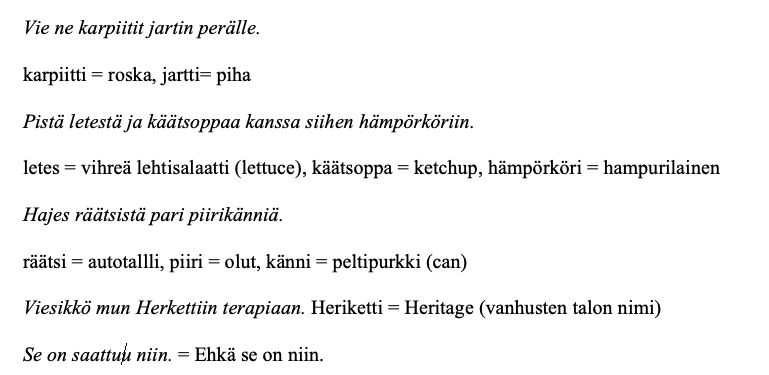
Tapasin Mara-Liisa Tolvasen Thunder Bayssä Kanadassa vuonna 2006. Thunder Bay (Tunterpei) on kaupunki, jossa on paljon suomalaistaustaisia. Marja-Liisa oli niin ystävällinen, että hän antoi minulle sanakirjan, jossa on joitakin Fingliska-sanoja.
Sanoja
Saulstemarie tai Suustemarie = Sault St. Marie Supperi = Sudbury Tunterpei = Thunder Bay Vankkuuveri = Vancouver Vinnipekki = Winnipeg Rutto = Trudeau (ent. pääministeri)
mauri = pormestari (mayor) lojiari = lakimies (lawyer) nörsä = sairaanhoitaja mainari = kaivosmies kuvermentti = valtio laisi = lupa (licence) ajolaisi = ajokortti roki =avolavapikup tai kuoma-auto pootti = vene kämppä = kesämökki haussi = talo kaara = auto haiskoulu = high school maali = ostokeskus (mall) haali = seurojentalo (hall) hospitaali = sairaala