Migrant tales
Menu
  • #MakeRacismHistory “In Your Eyes”
  • About Migrant Tales
  • It’s all about Human Rights
  • Literary
  • Migrant Tales Media Monitoring
  • NoHateFinland.org
  • Tales from Europe
Menu

Month: November 2014

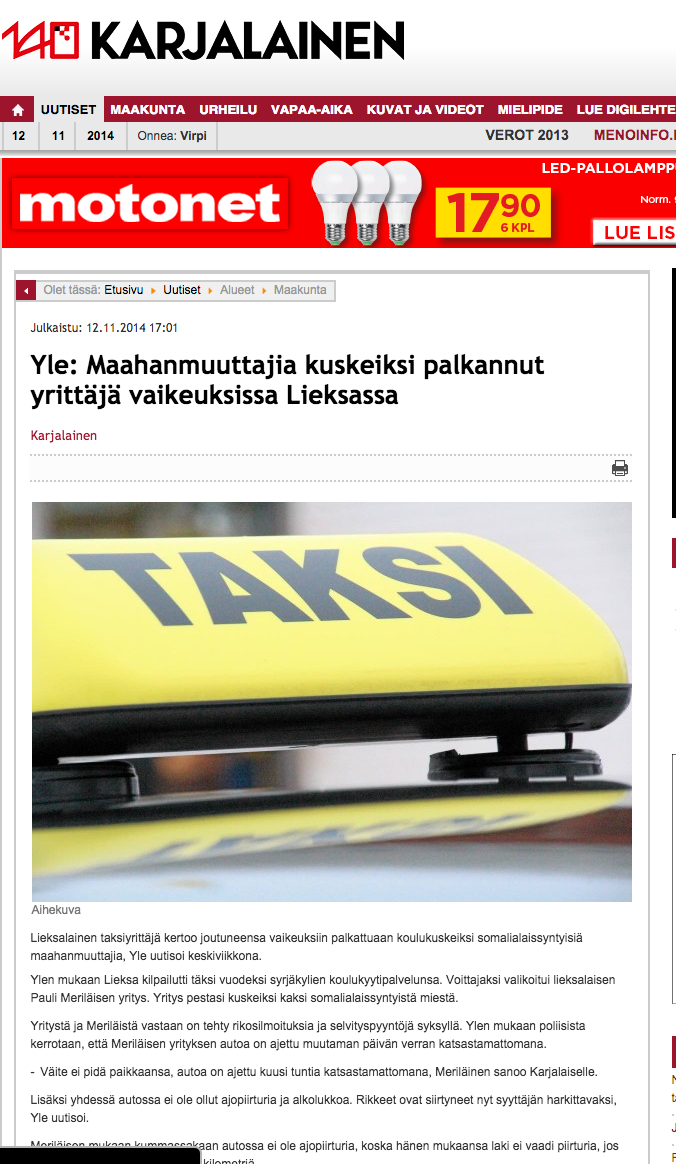
Lieksa, Finland: Parents don’t want their children to be driven to school by Somali taxi drivers

Posted on November 12, 2014 by Migrant Tales

Leiksa, a far-flung town in eastern Finland, has attracted a lot of bad publicity in recent years from Perussuomalaiset (PS)* councilmen who demanded a ‘Somali-free’ meeting room to a migrant taxi driver that was assaulted recently,  is once again in the news for all the wrong reasons. A group of parents from the town of 12,000 inhabitants don’t want their children to be driven to and from school by Somali taxi drivers. 

The parents claim that the taxis that the children are taken to school haven’t passed the annual vehicle safety and roadworthiness test or have alcohol ignition locks required by law.

Some parents have filed complaints to the police and threatened to boycott the taxis if the drivers aren’t changed and that the cars have passed the annual vehicle safety test.

Pauli Meriläinen, the owner who hired the Somali taxi drivers, denies the accusations made against him.

‘The whole fuss started when I hired by mistake migrant taxi drivers,” he was quoted as saying on Joensuu-based Karjalainen. ‘Right after that the problems began. Parents started to made up these accusations.’

Näyttökuva 2014-11-12 kello 21.06.30


Read full story (in Finnish) here.


One of the parents told YLE Pohjois-Karjala that the parents don’t feel comfortable with the Somali drivers because they don’t speak sufficient Finnish.

‘This has nothing to do with the color of their skin or their nationality,’ the person said. ‘In the agreement it states that [Finnish] language proficiency must be sufficient but in this case it isn’t.’

The parents of the children accuse Meriläinen of using the ‘racism card’ to not resolve their two demands: change the drivers and the roadworthiness of the taxis.

‘I wonder what the union thinks if parents demand that I change the drivers?’ Meriläinen said. ‘Is that a reason to layoff [these drivers]? The [taxi] drivers [are qualified and] have driven buses in Helsinki.’

* The Finnish name for the Finns Party is the Perussuomalaiset (PS). The English names of the party adopted by the PS, like True Finns or Finns Party, promote in our opinion nativist nationalism and xenophobia. We therefore prefer to use the Finnish name of the party on our postings.

Anonymous migrant: Known – unknown

Posted on November 12, 2014 by Migrant Tales

Migrant Tales’ insight: Anonymous is one of the many readers that not only visit our blog but contribute their stories and poems. I’m not at liberty to disclose her identity but can vouch for her story. We have been in touch countless of times on the phone and she has told me her six-year ordeal in Finland many, many times. 

I am honored to publish her poems and insights of life in Finland. Having power over others gives you certain privileges like not questioning yourself. But being marginal opens up a different world that Anonymous’ poems bring.

One of my favorite writings by Anonymous is Against all odds human spirit cannot be crushed. 

IMG_4585

__________________

By Anonymous

KNOWN-UNKNOWN

A fate of life hanged in the balance. Nothing to ease the suffering. Devoid of any means of sustainance. Left to ponder on unknown fate rest on the assumption that nobody will be aware nor figure out her plight as she is kept under surveillance 24/7. In the event becomes an invisible victim. She exists… known but her plight unknown…


WOUND-UNWOUND

incident ripped open healing wound

past suffering sutured by mound

re-opens and gushes blood without a sound

where does it end…

but leaves a trail a around

to where the acts of revenge surround

to the heart of discord- pattern -bound

where does it end…

destroy every ounce of effort with pound

slash existing roots of hope without sound

and any progress made and found

where does it end…

induce a fall down against enemy with hound

not to be able to pick herself from ground

for it will take a miracle this time around

where does it end….

Reija Härkönen: Mitä pitää tapahtua, että kansa herää?

Posted on November 11, 2014 by Migrant Tales

Reija Härkönen

Hämärässä tilassa on piikkilanka-aitojen välinen kuja. Kuja on kokonaan lusikoitten ja haarukoitten peitossa. Historiaa vähänkin tunteva näkee heti, mistä on kysymys: keskitysleireille viedyiltä juutalaisilta riistettiin kaikki omaisuus, monilla perheillä mukaan haalittu arvotavara olivat hopeiset aterimet. Tästä mennään keskitysleirille. Teos sijaitsee saksalaisen Dortmundin kaupungin modernin taiteen museossa, Ostwallissa.

MO_Vostell_Thermoelektrisches_Kaugummi_1970

Vanhempi rouva, joka istuu ovensuussa valvomassa näyttelyesineitä, huomaa, että pysähdyn vähän pitemmäksi aikaa katselemaan näkymää. Hän tulee vierelleni, ja kertoo, että jos haluan, voin kävellä kujalle. Ei saa koskea -kasvatus on lujassa, ja varmistan vielä, että olen ymmärtänyt oikein. Kun sitten lähden muutaman metrin taipaleelle, rouva työntää vanhanaikaisen pahvisen matkalaukun käteeni. Hitaasti astelen kalisevien lusikoitten päällä piikkilangan viertä pitkin. Matkalaukustani alkaa kuulua ääniä, kuin vaikeaa hengitystä. Minunko?

Palattuani oppaani kertoo, että Wolf Vostell on tehnyt teoksen vuonna 1970. Hän oli ollut huolissaan siitä, kuinka natsi-Saksan aikaiset aatteet jälleen olivat nostaneet päätään sen aikaisessa Saksassa. Puhuimme siitä, kuinka taiteilijat ovat herkkiä vaistoamaan, mitä yhteiskunnassa on tapahtumassa ja myös reagoivat herkästi ikäviä asioita esiin nostamalla.

Saksan kielen taitoni on melko vaatimaton, mutta jostakin sanat nyt löytyivät. Huoli oli yhteinen ja kauhulla puhuimme siitä, mitä on jo tapahtunut vaikkapa Unkarissa ja Kreikassa ja mitä on meneillään itse asiassa koko Euroopassa.

Dortmund on tänään vireä monikulttuurinen kaupunki. Sodan aikana kaupunki oli mm. Puolan Zamoscin ja Belzecin keskitysleireille kuljetettavien ihmisten kokoamiskeskus, yli 40.000 ihmistä kuljetettiin tätä kautta. Myös kaupungin oma, vähän yli 4100 hengen juutalaisyhteisö katosi sodan aikana lähes täysin, osa keskitysleireille, jotkut pääsivät pakenemaan muihin maihin.

Olimme tietysti täsmälleen samaa mieltä, kuin lähes kuka tahansa aikalaisemme: ihmisen ihonvärillä, etnisyydellä, kielellä ja kulttuurilla ei kerta kaikkiaan ole väliä, eikä niistä voi normaali ihminen mitenkään löytää oikeutusta toisen ihmisen vihaamiseen ja tappamiseen. Mutta miksi sitten menneisyyden kaiut ovat niin selvät?

Pala nousi kurkkuun meillä molemmilla, kyynel silmänurkassa läksin kulkemaan museon muille osastoille. Rouva toivotti minulle kaikesta huolimatta mukavaa tutustumista näyttelyyn. Vähän ajan kuluttua hän etsi minut uudelleen käsiinsä. Hän tahtoi antaa minulle pienen lahjan, kauniisti kuvitetun museo-ohjelman. Sielumme olivat kohdanneet. Yhteinen huoli oli yhdistänyt meidät.

Meillä kaikki eivät vielä ole tiedostaneet, mitä Suomessa ja muualla Euroopassa on meneillään. Jotkut vähättelevät asian tärkeyttä, toiset vetoavat siihen, että Suomessa suojelupoliisi sanoo, että äärioikeistolainen liikehdintä on meillä vähäistä. Onko se vähäistä silloin, kun se on jo niin pitkällä, että sitä ohjataan eduskunnasta?

Eikö pitäisi huolestua toden teolla viimeistään nyt, kun syrjäytyneiden lasten katuväkivallan herättäessä huolta suomalainen kansanedustaja ehdottaa suojeluskuntamallista katupartiointia etnisen väkivallan kitkemiseksi ja ilmoittaa tehtävään vapaaehtoiseksi natsimielisen järjestönsä? Tai kun toinen kansanedustaja, itsekin poliisi, ilmoittaa, että poliisi on voimaton ja lasten harjoittama katuväkivalta on rasistista rikollisuutta etnisiä suomalaisia kohtaan? Huomasiko kukaan sitäkään, kuinka äärioikeistolaisen falangin kiihottaminen on tehonnut Lieksassa? Puheet alkavat realisoitua väkivallaksi.

Onhan niin, että tällä kertaa ihan tavallinen, keskiluokkainen kansa ei vaikenemalla mahdollista pahuuden etenemistä? Unkarista on jo osa sivistyneistöä ja taiteilijoita joutunut pakenemaan ja erilaiset vähemmistöt ovat ahdingossa. Onko meillä mahdollista toimia niin, etteivät uusfasistisen populismin harjoittajat saa vapaasti, ilman minkäänlaista vastustusta, ajaa ihmisvastaista agendaansa?

Vai annetaanko meillä asioiden edetä niin pitkälle, että jälkeenpäin sanomme vain: “Me emme tienneet”?

Alkuperäisen blogikirjoituksen voi lukea tästä.

Tämä blogikirjoitus julkaistiin Migrant Talesissä luvalla.


http://www.verkkouutiset.fi/politiikka/Suomen_Sisu_monikultturismi-26763

http://www.helsinginuutiset.fi/artikkeli/242894-poliisikansanedustaja-jengihyokkaykset-ovat-rasistisia

http://www.iltasanomat.fi/kotimaa/art-1288761380421.html


Migrant Tales (July 3, 2014): Is ‘Heikki the drunk’ Finnish or Swedish?

Posted on November 11, 2014 by Migrant Tales

Migrants’ Tales insight: This story is interesting when looking at the Fazer gigolo tv commercial in Finland, which reinforces stereotypes about certain migrants and minorities in this country. An all-white board of the Council of Ethics in Advertising, which gets all of its funding from the private sector, will have a difficult time understanding what some minorities may feel about such commercials. 

Check out the story below about ‘Heikki the drunk’ and how it offended some Swedish Finns. 

Are the two related? Certainly they are. 

____________________

Some Swedish Finns are up in arms about a children’s book published in Sweden that pictures a wino called Heikki, according to YLE in English.  The character in the book, who is lying in a bush next to a plastic bag full of beer, was too much for Swedish Finn Sirpa Lamminpää, who filed a complaint to the Discrimination Ombudsman.  

YLE in English reports that the Discrimination Ombudsman will not take the case since “perceived prejudice” in printed books is falls under the jurisdiction of Swedish Chancellor of Justice.

Illustrator Gunna Grähs defends the character by stating that Heikki is a Swede.

“Perhaps she [Lamminpää]  is simply upset about the character being an alcoholic,” Grähs was quoted as saying. “Only one thing links him to Finland, and that is his name. In my opinion Heikki’s is a case of social class, not nationality.”

Grähs has a good point. Sweden is culturally diverse and a person with a name like Heikki can be a Swede.

Even so, the commotion about Heikki shows that Sweden is still a far ways off from being a post-racial society.

Risto Laakkonen, who is outspoken on migrant rights in Finland, said that any type of stereotyping is wrong and shouldn’t be tolerated.


Näyttökuva 2014-7-3 kello 11.42.19


Read full story here.


Laakkonen was active in a campaign in the 1970s to change the way that the Swedish media pictured Finns. Whenever a crime was reported by the media the first national group that came to mind as the culprits were Finns.

“With [then] Ambassador Max Jakobson we got in touch with all the editor-in-chiefs and managing editors of all the newspapers and television channels and told them that this type of stereotyping isn’t good since you’re labeling people who are working in this country,” he said. “The portrayal of Finns as the culprits ended pretty rapidly.”

Laakkonen said that in Finland it was impossible for the media to be racist towards migrants since there were so few back in the 1970s. He said that Finland’s media caught up to the Swedes in the 1990s.

“Things were actually much worse than today before when you had openly [fascist] groups [like the IKL 1932-44] that talked about Finns as a tribe and influenced this type of thinking to be taught at schools,” he said. “The Perussuomalaiset* are small fry when compared to the past.”

Laakkonen said that human rights and tolerance are like a tree that must be watered.

“The tree will die if you don’t water it,” he said. “All you need is 10% of the population to be awake and active [for human rights] for things to change.”


* The Finnish name for the Finns Party is the Perussuomalaiset (PS). The names adopted by the PS, like True Finns or Finns Party, promote in our opinion nativist nationalism and xenophobia. We therefore prefer to use the Finnish name of the party on our postings. 


Migrants’ Rights Network: Yes, migrants are net contributors, but they are also our partners in challenging inequality and injustice

Posted on November 10, 2014 by Migrant Tales

Migrant Tales’ insight: Another fine essay by Don Flynn, which brings to mind recent claims by the Perussuomalaiset (PS)* party that migration costs the country up to 2 billion euros. The estimation is only a guess by the PS and which forget to calculate that the majority of migrants in Finland work, pay taxes and consume. They conveniently forgot to mention as well a recent OECD report that migration had boosted Finland’s economic growth in 2011 by 0.16%, including pensions. 

_____________

Don Flynn*

Don_web_0

We heard last week that recent migrants have contributed £20 billion to UK revenues. But the real gains from migration will come when newcomers can take their place in the fight against inequality and xenophobia.

Näyttökuva 2014-11-10 kello 18.03.41

Read full blog entry here. 


Last week’s report from academics at University College London on the fiscal impacts of migration to the UK is just the latest in a whole sequence which has made the case that, far from being a charge on the tax payer, the migration that developed over the course of the 2000s, has brought in a cohort of net contributors.

We can expect that this steady accumulation of evidence supporting the view that migration does generate positive effects is to open up space in the political mainstream for the argument that immigration policy should incline towards openness rather than closure. Advocacy in support of groups like international students and skilled migrants has already advanced to the point where it has the ear of leading ministers with Vince Cable at BIS being particularly outspoken.

Arguments in favour of more openness on immigration policy represent both opportunities and challenges for groups working to support the rights of migrants. Opportunities in the sense that they undermine the ‘commonsense’ presumption that society is better protected when it imposes strict control over the movement of non-nationals; challenged because so much of the discussion revolves around the election of the types of migrant for whom borders will be relatively open.

MRN has always resisted the idea that a simple formula is available which will assist state functionaries in a decision-making process about who is the ‘good’ immigrant, as opposed to the undesirable. The slogan which the Home Office has raised to official status, branding its policies as aiming to select ‘the brightest and the best’ seems especially inane as the evidence accumulates that the gains for the welfare of the population are just as likely to come from any newcomer who aims to fill whatever niche if offered up and to meet the demands for taxes that will inevitably come their way.

This week we will be launching the ‘Migrant Manifesto’ which we think is really needed if we are going to build the communities in the UK which can really meet all the challenges of living in our modern globalised world and at the same tackle all the growing problems that come from inequality and social exclusion.

This means going beyond the simple celebration of the fact that migrants contribute more in taxes than they take out in services. Our Manifesto will call for acknowledgment of the fact that the immigration policies of recent years have created a hugely uneven playing field for newcomers, with rights to secure residence status, to challenge the unfair decisions of the authorities, to sponsor the admission of family members, to access the public services which they pay for from their tax contributions, to escape from the dangers of exploitation in the workplace, and generally to live without the fear of the constant demand to produce papers that ‘prove’ identity and legal status, all being badly eroded.

Our view is that policies on the way migration is managed should be as much about basic human values and they are about extracting economic advantages over people deliberately made vulnerable because of their status as non-nationals. If we thing that it is permissible to squeeze more out of migrants than it is out of citizens then we will be held back from challenging inequality and the gross injustices that emerge from racism and xenophobia.

Our ‘Migrant Manifesto’ campaign will go live after its launch this coming Wednesday.

What it calls for has been outlined in a series of blogs on this website over the past six weeks. The full text will be public after the launch and we are offering it up as an opportunity for discussion and, hopefully, a spur to campaigning activity during the next six months.  A special website will be launched very soon to help sustain the momentum of this work.

To recap on what we are calling for, check these blogs from the last few weeks

  • End the ‘hostile environment’
  • Protect a right to family life
  • Give European migrants a fair deal
  • Improve the immigration system for all
  • End the exploitation of migrant workers
  • Protect the interests of international students 

We hope that these calls for action will resonate with groups working with migrant communities right the way across the country.  The Migrant Manifesto will make progress only if it is taken up and developed by people who can affirm its basic propositions, but also add and take them further forward.

We welcome your comments about this campaign and will look forward to hearing from you all.

Read original story here.

This piece was reprinted by Migrant Tales with permission.

* Don Flynn, the MRN director, leads the ogranization’s strategic development and coordinates MRN’s policy and project work. He is a regular and sought-after speaker at conferences, seminars and lectures on behalf of MRN.

* The Finnish name for the Finns Party is the Perussuomalaiset (PS). The English names of the party adopted by the PS, like True Finns or Finns Party, promote in our opinion nativist nationalism and xenophobia. We therefore prefer to use the Finnish name of the party on our postings.

Response to Fazer’s gigolo says a lot about Finland today

Posted on November 10, 2014 by Migrant Tales

The decision by the Council of Ethics in Advertising of Finland that there was nothing wrong with Fazer’s gigolo television commercial says a lot about why there is so little respect towards minorities in this country. For those who lived in Finland in the 1970s, Fazer’s gigolo was the typical stereotype of the southern European man, who spoke broken Finnish, was useless but was a good lover. 

Irwin Goodman even wrote a racist song about the ‘gigolo’ called Marcello Magaoni, or Marcello Macaroni.  There a similar song in the 1970s by Esa Pakainen, who masqueraded in a 1960 Finnish movie as a blackface with his partner Pätkä.

In a similar story in Sweden in July, some members of the Finnish community in Sweden were outraged about a Heikki the drunk character in a book that they claimed reinforced stereotypes about Finns in Sweden.

Why does a large sweets company like Fazer of Finland think that it’s perfectly acceptable to reinforce stereotypes about minorities in order to boost sales? Are they saying that ‘humorous’ racist stereotypes hit the spot with Finnish consumers?

The response of the Council of Ethic in Advertising is one matter but the comments from readers on different newspapers are just as revealing.

The lion’s share of those responses about the Fazer gigolo didn’t see anything racist or wrong with the commercial and agreed with the Council of Ethics in Advertising that it was humorous.

Writes Pantterit on parhaita: ‘That was a really funny commercial.’

Funny? Certainly if you are white.

Read more comments (in Finnish) on Lappeenranta-based daily Etelä-Saimaa.Näyttökuva 2014-11-10 kello 12.38.31

Why does Fazer think that the way to Finnish consumers’ heart is with the help of ethnicity and race? In 2007, after mounting pressure from the EU, it stopped using its infamous golliwog on its licorice brand and in it stopped using a Chinese man or women in one of its products in 2011.

Migrant Tales filed a complaint to the Council of Ethic in Advertising because the commercial promoted stereotypes of southern European men. Stereotypes are the breeding ground from with the fruits of intolerance feed off.

The decision by the Council and the reaction of many readers clearly shows how little weight migrants and minorities continue to have in Finland.

I for one will be one person who will boycott Fazer products and I hope that many more will do the same.


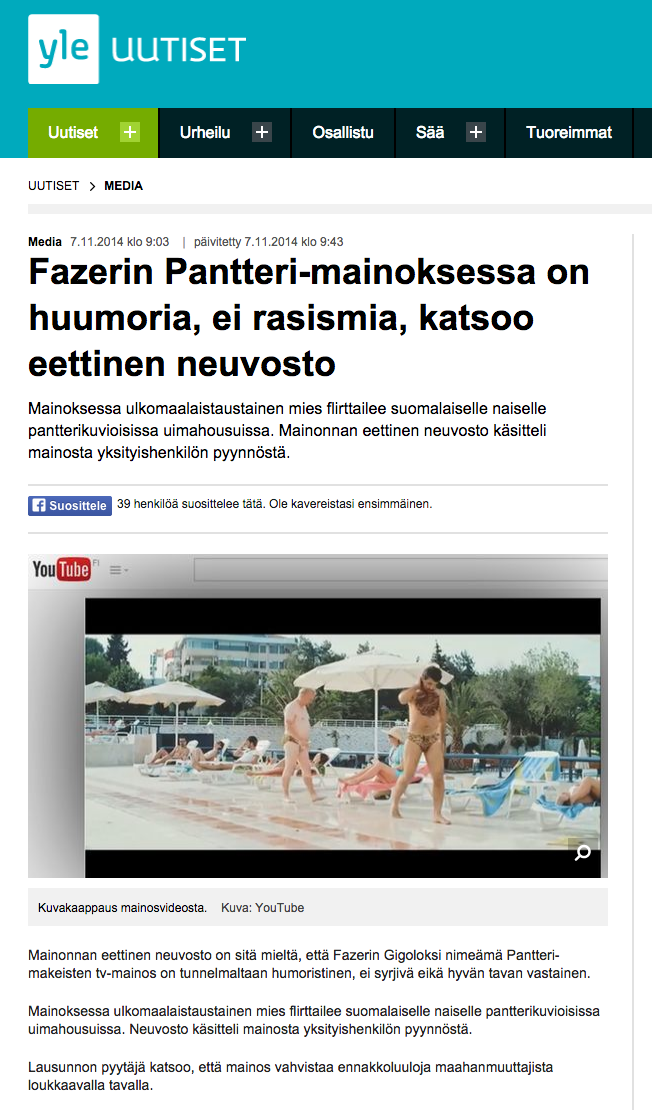
The Council of Ethics in Advertising of Finland finds nothing wrong with Fazer’s ‘gigolo’

Posted on November 7, 2014 by Migrant Tales

The Council of Ethics in Advertising has found nothing wrong with a Fazer advertisement, which depicting a stereotypical Southern European gigolo in a salt licorice television commercial. The seven-member board of the council, which are all white Finns, considered the commercial to be done in good taste and with humor.

Migrant Tales filed a complaint to the Council of Ethics in Advertising citing that the Fazer television commercial reinforced racist stereotypes about men from Southern Europe. Aren’t stereotypes the breeding ground of racism and discrimination?

The council receives all of its financing from the private sector.

For those of us who have lived in Finland in the 1980s, the “mud-faced gigolo speaking broken Finnish” was a common racist stereotype of some foreign men that still exists.

An important question we should ask Fazer is why it persists in using such marketing strategies after racist mascots like its infamous Golliwog on its licorice brand, which was banned in 2007 thanks to EU pressure, and the racist image  of a Chinese man or woman in one of its products in 2011? Why does the company think that race and ethnicity are the way to the Finnish consumer’s heart?

Adding salt to injury, tabloid Ilta-Sanomat headlines that the commercial doesn’t insult migrants.

Right on, Ilta-Sanomat. Here’s a white tabloid giving its “expert view” on what is and isn’t offensive to migrants.

Tabloids like Ilta-Sanomat played an important role in reinforcing intolerance and hostility towards migrants from the 1990s.

Näyttökuva 2014-11-7 kello 10.28.54


Read full story here.


Even if The Council of Ethics in Advertising sees nothing wrong with the television commercial, many minorities in Finland consider it offensive.

 What is your opinion of this tv commercial?

See also:

  • Time warp Fazer of Finland: Stereotyping Mediterranean “gigolos” to sell salt licorice

November 6, 1981: Address to the international seminar (on the plight of foreign students in Finland)

Posted on November 7, 2014 by Migrant Tales

Enrique Tessieri

Finally the consciousness of the Finnish government and the Finnish public via the press have come to the point where the status of foreigners has been recognized as a problem. The simple fact that this issue has found its way into the public consciousness shows that we’ve come a long way. We’ve made our needs known and more than anything the purpose of the seminar* is to find out and get general agreement upon where do we go from here?
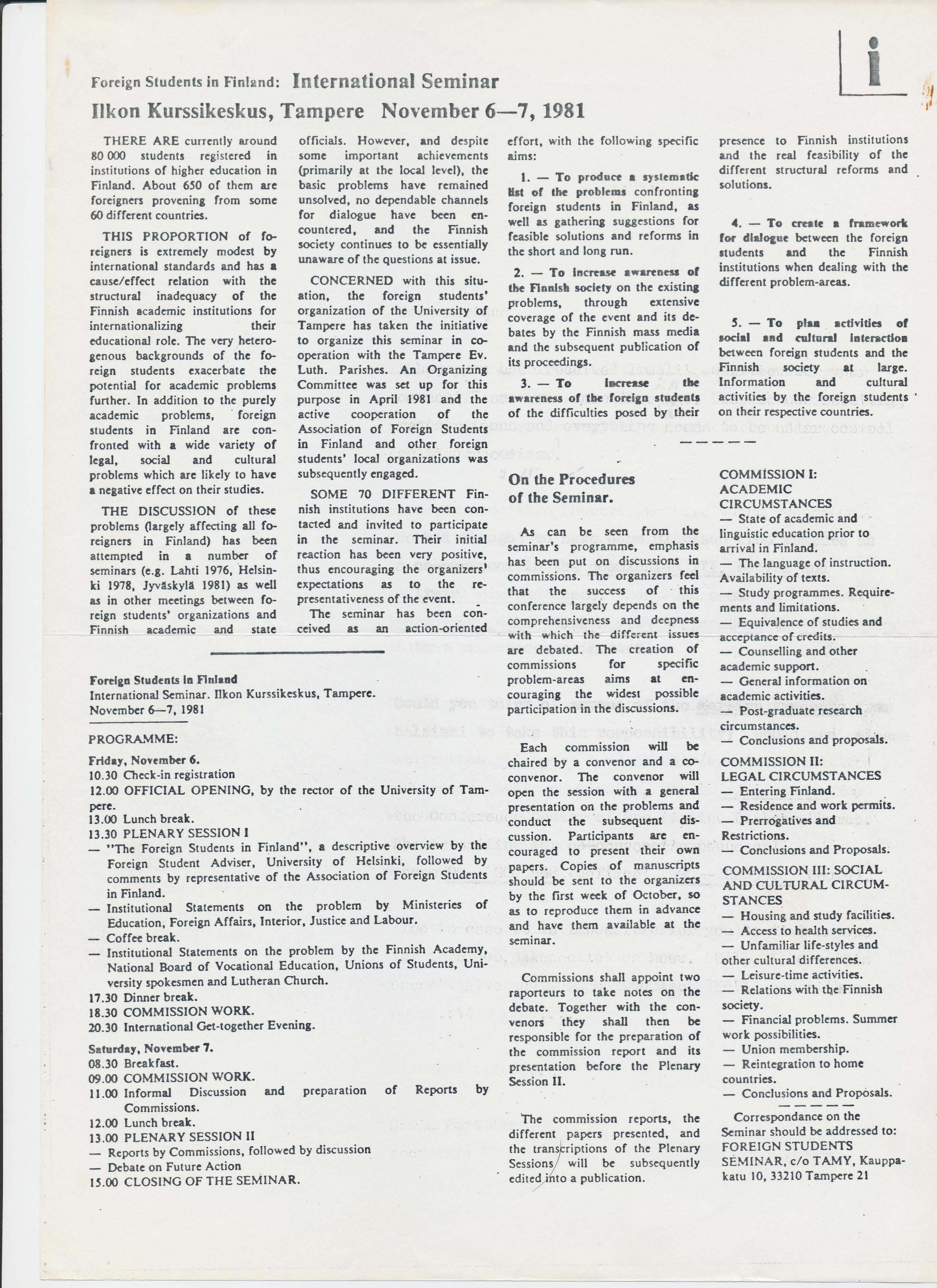
Image1-105_edited-1

Irmeli’s* presentation has given us a good basis for discussion both regarding the statistical realities of our predicament and as a first hand report from a person who has spent a good deal of time dealing with these matters over the years.

What I would like to do today is to lay some philosophical ground work for the hopefully productive discussions to follow in the course of this conference. To do this, we should start by distinguishing the kinds of foreign students in Finland. The first group are the ones with means. These are the scholarship holders, or from well-to-do families, whose intentions and aspirations as to what they shall achieve during their relatively short stay in Finland are specific. Their personal investments in university life and Finnish society at large is limited. Upon finishing their year of study or in some cases a degree program, they return to their country. This groups i the least affected by what Irmeli calls “the uncertainty factor.”

The second category includes the rest of us. The unifying feature of this group is that for some reason, no matter how tenuous that reasoning is, they continue to hang on to the notion that they’ll end up living and working here. When they start to make plans they soon realize the magnitude of “the uncertainty factor.” Money, has to be gotten by the expenditure of large amounts of energy which usually has nothing to do with their course of study.

The effort to keep family, studies, and household together should be described in terms no less than heroic. I think I don’t have to describe this subject any further since all of use here know exactly what I am talking about.

Why does all this uncertainty exist? For the second groups clearly it cannot be confined to academic categories – if you cant’ eat you can’t study. The American poet Gertrud Stein once explained that public opinion was what it was because people “love what they know,” and by large, foreign people are seen by the police, by the Office of Alien Affairs, and by that part of the population who lack the opportunity or the ability  to communicate with us, as unknowns. In short we are not loved. No matter how much we bitch or kick our heels it won’t change the situation and thus lay a foundation for the reforms we seek.

We have not come to this conference to complain to each other; we know the score. If there is an abuse of our rights or deficiency in our legal status, let’s ask ourselves what we can do about it here and what the Finnish authorities can themselves do about it.

Let’s focus our energies on the three areas we have come to discuss: our legal status, the academic set up, and our integration into this society.

LEGAL STATUS

Finland’s xenophobia is clearly reflected in her laws concerning foreigners. Proper manipulation of these laws by the authorities no doubt is connected to the underwhelming size of the foreign population of this country and probably exerts and effect on keeping the number of foreign students down. Remember Irmeli’s observation that healthy student bodies contain as much as 10% foreign population? Our population is 1/12 of that!

The first and foremost factor is the distinctly negative approach the laws has taken towards foreigners. Much of our rights are defined in terms of what we may not do. We cannot vote, we cannot participate in demonstrations, we cannot buy land, we cannot edit newspapers, we don’t even have the right to appeal upon deportation. Obviously these laws have been made to protect the citizenry of this country, but in all fairness, do foreign students represent the kind of threat to property, to national security, or the ideology of the official representatives of this country to justify blanket condemnation under the law? By and large, the foreign student population has very little influence on the financial and political fate of this nation and the laws were made with other interests in mind. The other Scandinavian countries have realized the discrepancy and have gone far to ameliorate it. This has been done by the reaction of an immigrant or permanent resident status. Uncertainly is removed because the foreigner has limited power in controlling his destiny and this is what it’s all about. Under this status a foreigner takes on the responsibilities of what could be called a quasi-citizenship; he votes locally, pays taxes, and participates in the construction of society. As far as foreign students are concerned, most of us end up being qualified for such status after a couple of years. So why doesn’t this status exist?

The second undesirable factor concerning legal status is the tremendous waste of personal talents and time. Constant reapplication for work and residence permits, as well as the limits placed on the kinds of labor we are permitted to do (generally language teaching or menial labor) prevents Finland from realizing the benefit of a fully actualized foreign population. This is based in some part on the unfair perception that without limits foreigners would deny citizens of employment but in practice it means any new avenues of creative endeavor, or said the other way, “the benefits of new blood in the system” are very effectively thwarted. Who gains by all this? As a final note, I would like to ask those preparing  proposals on changing legal status to keep those proposals positively worded.

THE ACADEMIC SET UP

Not too long ago I was told by a Finnish leader of a certain immigration organization that I could not aspire to ever hold a university post. He pointed out that since my Finnish would never be at the same level as that of a native I could never have a chance. He told me that my best bet would be to get into the restaurant hotel business since I was kind mannered and spoke languages. If this is true we might all as well switch over to the “ravintola ja hotelli opistot.” Certainly my experience with foreign teachers in the University of California leads me to believe this need not be the case. The bad news is that any foreigner who aspires to academic success must be able to communicate fluently even gracefully in Finnish and as long as a foreign student fails to rationalize this he will always remain among the academically disadvantaged.

But even assuming the foreign student makes a serious effort to learn Finnish he must still confront completely unjustified academic pretense of the educational system here. The “osta kotimaista” mentality is well rooted in Finnish academic tradition and often results in the foreign scholar’s sad realization that his is having to cope with nothing more than simple provinciality cloaked in a dress of bureaucratic paper and regulations. Against we might ask: Who is anybody gains from such attitudes?

INTEGRATION INTO FINNISH SOCIETY

What I am discussing here are really nothing more than aspects of barriers to comfortable integration into this society and perhaps we can do greatest justice to foreign students by taking a holistic approach to their problems. When foreign students can eat properly, house themselves, and possess greater power in determining their academic and economic futures, they can solve their other problems by themselves. In return for greater freedoms within this culture, foreign students should be made aware that they will also have to shoulder greater social responsibilities. Joining a club is never grounds for sustained membership, we will always have to be proving ourselves.

The foreign students who stay on, most likely will be the future leaders of the foreign community. Presently, that community numbers 10,000 (not counting our children) larger than the Lapp and gypsy minorities put together. We could say we constitute a pretty sizable minority, albeit fragmented. This minority speaks many languages, and follows many customs. But we are all unified in the extent of our exclusion from the majority culture. Until we begin to speak for ourselves, until we begin to document our history and until we assess our efforts to integrate with this society, our improved status will never be justified in the minds of the authorities or the Finnish public. This is a long-range project, but hopefully we can plant some seeds of understanding in the course of these seminars whose growth will have meaningful benefit for all of us.

Have a good conference.


*International Seminar, Ilkon Kurssikeskus (Nov. 6-7, 1981), Tampere, Finland.

* Irmeli Tammivaara-Balaam, Helsinki University foreign student advisor.
Journalismi ja blogikirjoittaminen uusille suomalaisille (Helsinki)

Posted on November 6, 2014 by Migrant Tales

4.-5.12.2014 Otavan Opiston Osuuskunta, Annankatu 9 a 11, Helsinki

Haluatko julkaista uutisia suomalaisissa tai ulkomaalaisessa mediassa? Kiinnostaako blogikirjoittajan ura? Haluatko tietää mitä on tiedottaminen? Löytääksesi paikan kirjoituksellesi, sinun tulee tuntea lehdistö ja markkinointi Suomessa kuten myös ulkomailla.

Näyttökuva 2014-11-6 kello 23.16.18

Kurssin sisältö

Koulutuksen päätavoite on yksikertainen: antaa keinoja julkaista valmista kirjoitustyötä. Lisäksi tavoitteena on lisätä Suomessa asuvien maahanmuuttajien osaamista asia- ja mielipidetekstien kirjoittamisessa sekä parantaa heidän valmiuksiaan osallistua yhteiskunnalliseen keskusteluun ja näin saada julki maahanmuuttajien omaa näkökulmaa.

Koulutuksessa saat tietoa esimerkiksi seuraavista asioista:

– uutisjuttu, kolumnin ja pääkirjoituksen kirjoittaminen
– haastattelutekniikka (diskurssi- sekä narratiivianalyysi)
– ulkomaankirjeenvaihtaja tai freelancer-toimittaja Suomessa
– referenssilähteet, joita voit käyttää tarjotessasi tekstejä suomalaiselle tai ulkomaalaisille medioille
– toimittajien tyylikirjat
– katsaus Suomen median historiaan
– sensuuri, itsesensuuri ja median rooli länsimaisessa demokratiassa
– eettiset kysymykset, jotka koskevat toimittajia
– julkisen sanan neuvoston rooli
– blogin perustaminen

Kurssi pidetään suomeksi ja tuoetaan tarvittaessa englanniksi. In Finnish, but support in English translations provided.

Hinta

Kurssihinta 30 eur (sis. kahvit, ei lounasta). Laskutetaan jälkikäteen.

Ilmoittautuminen

Ilmoittautumislomakkeeseen pääsee täältä. Ilmoittautuminen 27.11.2014 asti.

Kouluttajana toimii Enrique Tessieri. Hänellä on noin 25 vuoden kokemus ulkomaankirjeenvaihtajana Suomessa, Argentiinassa, Espanjassa, Kolumbiassa ja Italiassa. Hän on Migrant Tales -blogin päätoimittaja. Lue lisää Enriquen ajatuksia kurssista täältä!

Palautetta edelliseltä kurssilta

“The teacher, Enrique Tessieri, connected well with the participants and shared his knowledge effectively.”

“Kolme kieltä ja opettaja huomioi kaikki meitä. Pohdimme yhdessä ja vaikka teimme työryhmä! Uutta ideoita tuli runsaasti.”

Lisätietoja: [email protected]

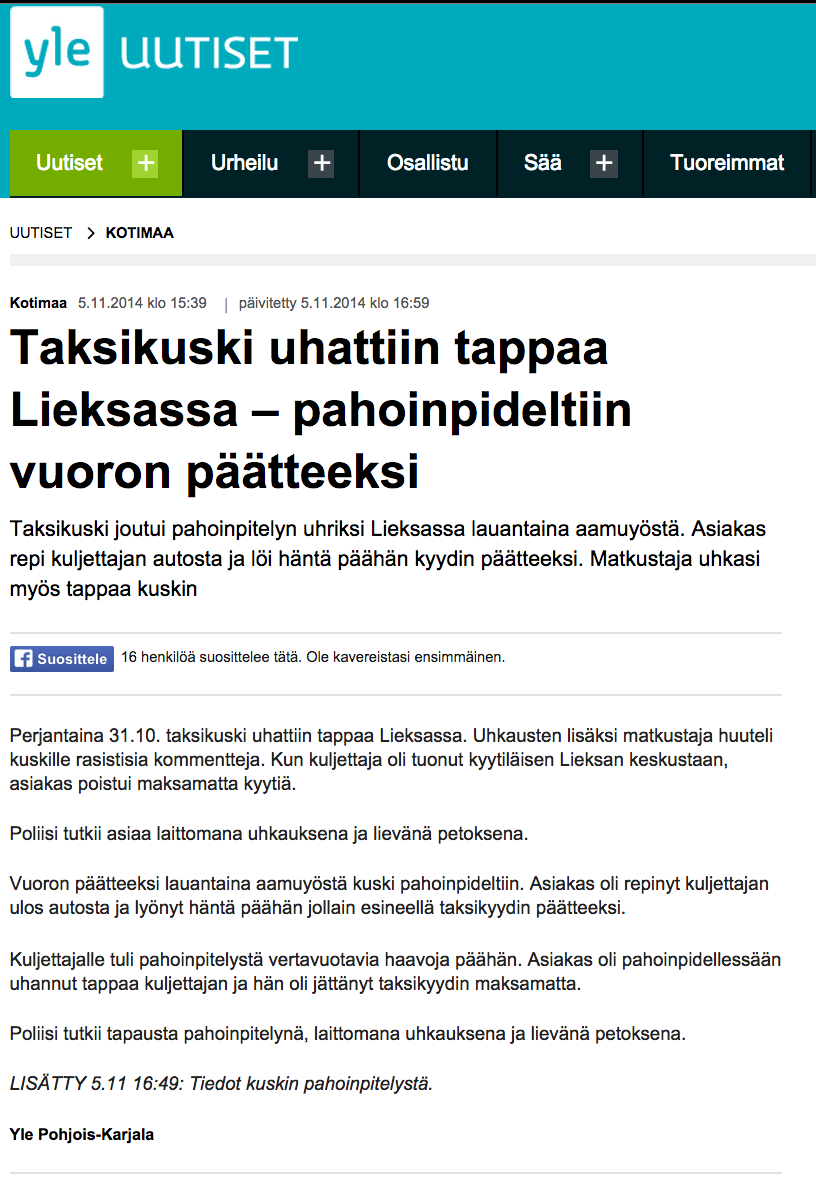
Lieksa, Finland: Migrant taxi driver assaulted by client

Posted on November 6, 2014 by Migrant Tales

The North Karelian town of Lieksa is once again in the media after a migrant taxi driver was assaulted physically Friday by a client who also threatened to kill him, according to YLE Pohjois-Karjala. The suspect left the scene without paying the fare. 

The police are investigating the case as an assault case and for leaving the scene without paying the fare. There is no mention that racism may have had anything to do with the suspect’s hostile behavior.

Näyttökuva 2014-11-6 kello 0.01.19

Read full story here.

Leiska has been in the news a number of years for problems with its migrant community.

  • Previous
  • 1
  • 2
  • 3
  • Next
Read more about documentary film
Read more

Recent Posts

  • Finland’s tabloids Iltalehti and Ilta-Sanomat are the pits
  • Riikka Purra’s Dr Jekyll and Mr Hyde mask
  • Double standards
  • Perussuomalaiset: Uusi logo, sama vanha juttu
  • Taco Trump

Recent Comments

  1. Absolutely Socking: Racist Finnish Facebook group against human rights gets flooded with socks on Musta Barbaari’s mother and sister charged by the police in “ethnic profiling” case
  2. Ilkka Nuotio on Pekka Myrskylä: “Tilastot kertovat toista kuin poliittinen keskustelu”
  3. Genrih Soinkara on The war in Ukraine and the Russian-Finnish border crisis are showing Finland’s ugly side
  4. Ahti Tolvanen on Comment by Ahti Tolvanen on the Helsinki +50 conference
  5. Angel Barrientos on Angel Barrientos is one of the kind beacons of Finland’s Chilean community

Archives

  • June 2026
  • May 2026
  • April 2026
  • March 2026
  • February 2026
  • January 2026
  • December 2025
  • November 2025
  • October 2025
  • September 2025
  • August 2025
  • July 2025
  • June 2025
  • May 2025
  • April 2025
  • March 2025
  • February 2025
  • January 2025
  • December 2024
  • November 2024
  • October 2024
  • September 2024
  • August 2024
  • July 2024
  • June 2024
  • May 2024
  • April 2024
  • March 2024
  • February 2024
  • January 2024
  • December 2023
  • November 2023
  • October 2023
  • September 2023
  • August 2023
  • July 2023
  • June 2023
  • May 2023
  • April 2023
  • March 2023
  • February 2023
  • January 2023
  • December 2022
  • November 2022
  • October 2022
  • September 2022
  • August 2022
  • July 2022
  • June 2022
  • May 2022
  • April 2022
  • March 2022
  • February 2022
  • January 2022
  • December 2021
  • November 2021
  • October 2021
  • September 2021
  • August 2021
  • July 2021
  • June 2021
  • May 2021
  • April 2021
  • March 2021
  • February 2021
  • January 2021
  • December 2020
  • November 2020
  • October 2020
  • September 2020
  • August 2020
  • July 2020
  • June 2020
  • May 2020
  • April 2020
  • March 2020
  • February 2020
  • January 2020
  • December 2019
  • November 2019
  • October 2019
  • September 2019
  • August 2019
  • July 2019
  • June 2019
  • May 2019
  • April 2019
  • March 2019
  • February 2019
  • January 2019
  • December 2018
  • November 2018
  • October 2018
  • September 2018
  • August 2018
  • July 2018
  • June 2018
  • May 2018
  • April 2018
  • March 2018
  • February 2018
  • January 2018
  • December 2017
  • November 2017
  • October 2017
  • September 2017
  • August 2017
  • July 2017
  • June 2017
  • May 2017
  • April 2017
  • March 2017
  • February 2017
  • January 2017
  • December 2016
  • November 2016
  • October 2016
  • September 2016
  • August 2016
  • July 2016
  • June 2016
  • May 2016
  • April 2016
  • March 2016
  • February 2016
  • January 2016
  • December 2015
  • November 2015
  • October 2015
  • September 2015
  • August 2015
  • July 2015
  • June 2015
  • May 2015
  • April 2015
  • March 2015
  • February 2015
  • January 2015
  • December 2014
  • November 2014
  • October 2014
  • September 2014
  • August 2014
  • July 2014
  • June 2014
  • May 2014
  • April 2014
  • March 2014
  • February 2014
  • January 2014
  • December 2013
  • November 2013
  • October 2013
  • September 2013
  • August 2013
  • July 2013
  • June 2013
  • May 2013
  • April 2013
  • March 2013
  • February 2013
  • January 2013
  • December 2012
  • November 2012
  • October 2012
  • September 2012
  • August 2012
  • July 2012
  • June 2012
  • May 2012
  • April 2012
  • March 2012
  • February 2012
  • January 2012
  • December 2011
  • November 2011
  • October 2011
  • September 2011
  • August 2011
  • July 2011
  • June 2011
  • May 2011
  • April 2011
  • March 2011
  • February 2011
  • January 2011
  • December 2010
  • November 2010
  • October 2010
  • September 2010
  • August 2010
  • July 2010
  • June 2010
  • May 2010
  • April 2010
  • March 2010
  • February 2010
  • January 2010
  • December 2009
  • November 2009
  • October 2009
  • September 2009
  • August 2009
  • July 2009
  • December 2008
  • November 2008
  • October 2008
  • September 2008
  • August 2008
  • July 2008
  • June 2008
  • May 2008
  • April 2008
  • March 2008
  • February 2008
  • January 2008
  • November 2007
  • October 2007
  • September 2007
  • August 2007
  • July 2007
  • June 2007
  • May 2007

Categories

  • ?? Gia L?c
  • ????? ?????? ????? ???????? ?? ??????
  • ???????
  • @HerraAhmed
  • @mondepasrond
  • @nohatefinland
  • @oula_silver
  • @Varathas
  • A Pakistani family
  • äärioikeisto
  • Abbas Bahmanpour
  • Abdi Muhis
  • Abdirahim Hussein Mohamed
  • Abdirahim Husu Hussein
  • Abdirisak Mahamed
  • About Migrant Tales
  • activism
  • Adam Al-Sawad
  • Adel Abidin
  • Afrofinland
  • Ahmed IJ
  • Ahti Tolvanen
  • Aino Pennanen
  • Aisha Maniar
  • Alan Ali
  • Alan Anstead
  • Alejandro Díaz Ortiz
  • Alekey Bulavsev
  • Aleksander Hemon
  • Aleksanterinliitto
  • Aleksanterinliitto ry
  • Aleksanterinliitto ry:n hallitus
  • Alex Alex
  • Alex Mckie
  • Alexander Nix
  • Alexandra Ayse Albayrak
  • Alexis Neuberg
  • Ali Asaad Hasan Alzuhairi
  • Ali Hossein Mir Ali
  • Ali Rashid
  • Ali Sagal Abdikarim
  • Alina Tsui
  • Aline Müller
  • All categories
  • Aman Heidari
  • Amiirah Salleh-Hoddin & Jana Turk
  • Amin A. Alem
  • Amir Zuhairi
  • Amkelwa Mbekeni
  • Ana María Gutiérrez Sorainen
  • Anachoma
  • Anders Adlecreutz
  • Angeliina Koskinen
  • Anna De Mutiis
  • Anna María Gutiérrez Sorainen
  • Anna-Kaisa Kuusisto ja Jaakko Tuominen
  • Annastiina Kallius
  • Anneli Juise Friman Lindeman
  • Announcement
  • Anonymous
  • Antero Leitzinger
  • anti-black racism
  • Anti-Hate Crime Organisation Finland
  • Anudari Boldbaatar
  • Arshiya Nasser
  • Aspergers Syndrome
  • Asylum Corner
  • Asylum seeker 406
  • Athena Griffin and Joe Feagin
  • Autism
  • Avaaz.org
  • Awale Olad
  • Ayan Said Mohamed
  • AYY
  • Barachiel
  • Bashy Quraishy
  • Beatrice Kabutakapua
  • Beri Jamal
  • Beri Jamal and Enrique Tessieri
  • Bertolt Brecht
  • Boiata
  • Boodi Kabbani
  • Bruno Gronow
  • Carmen Pekkarinen
  • Çelen Oben and Sheila Riikonen
  • Chiara Costa-Virtanen
  • Chiara Costa-Virtanen
  • Chiara Sorbello
  • Christian Thibault
  • Christopher Wylie
  • Clara Dublanc
  • Dana
  • Daniel Malpica
  • Danilo Canguçu
  • David Papineau
  • David Schneider
  • Dexter He
  • Don Flynn
  • Dr Masoud Kamali
  • Dr. Faith Mkwesha
  • Dr. Theodoros Fouskas
  • Edna Chun
  • Eeva Kilpi
  • Emanuela Susheela
  • En castellano
  • ENAR
  • Enrique
  • Enrique Tessieri
  • Enrique Tessieri & Raghad Mchawh
  • Enrique Tessieri & Yahya Rouissi
  • Enrique Tessieri and Muhammed Shire
  • Enrique Tessieri and Sira Moksi
  • Enrique Tessieri and Tom Vandenbosch
  • Enrique Tessieri and Wael Che
  • Enrique Tessieri and Yahya Rouissi
  • Enrique Tessieri and Zimema Mhone
  • Epäluottamusmies
  • EU
  • Europe
  • European Islamophobia Report
  • European Islamophobia Report 2019,
  • European Union
  • Eve Kyntäjä
  • Ezequiel Caldeiro
  • Facebook
  • Fadumo Dayib
  • Faisa Kahiye
  • Farhad Manjoo
  • Fasismi
  • Finland
  • Fizza Qureshi
  • Flyktingar och asyl
  • Foreign Student
  • Fozia Mir-Ali
  • Frances Webber
  • Frida Selim
  • Gareth Rice
  • Ghyslain Vedeaux
  • Global Art Point
  • Great Replacement
  • Habiba Ali
  • Hami Bahadori
  • Hami Bahdori
  • Hamid
  • Hamid Alsaameere
  • Hamid Bahdori
  • Handshake
  • Harmit Athwal
  • Hassan Abdi Ali
  • Hassan Muhumud
  • Heikki Huttunen
  • Heikki Wilenius
  • Helsingin Sanomat
  • Henning van der Hoeven
  • Henrika Mälmsröm
  • Hser Hser
  • Hser Hser ja Mustafa Isman
  • Husein Muhammed
  • Hussain Kazemian
  • Hussain Kazmenian
  • Ibrahim Khan
  • Ida
  • Ignacio Pérez Pérez
  • Iise Ali Hassan
  • Ilari Kaila & Tuomas Kaila
  • Imam Ka
  • inside-an-airport
  • Institute of Race Relations
  • Iraqi asylum seeker
  • IRR European News Team
  • IRR News Team
  • Islamic Society of Norhern FInland
  • Islamic Society of Northern Finland
  • Islamophobia
  • Jacobinmag.com
  • Jallow Momodou
  • Jan Holmberg
  • Jane Elliott
  • Jani Mäkelä
  • Jari Luoto
  • Jari Taponen
  • Jegor Nazarov
  • Jenni Stammeier
  • Jenny Bourne
  • Jessie Daniels
  • Joe Davidow
  • Johannes Koski
  • John D. Foster
  • John Grayson
  • John Marriott
  • Jon Burnett
  • Jorma Härkönen
  • Jos Schuurmans
  • José León Toro Mejías
  • Josue Tumayine
  • Jouni Karnasaari
  • Juan Camilo
  • Jukka Eräkare
  • Julian Abagond
  • Julie Pascoet
  • Jussi Halla-aho
  • Jussi Hallla-aho
  • Jussi Jalonen
  • JusticeDemon
  • Kadar Gelle
  • Kaksoiskansalaisuus
  • Kansainvälinen Mikkeli
  • Kansainvälinen Mikkeli ry
  • Katherine Tonkiss
  • Kati Lepistö
  • Kati van der Hoeven-Lepistö
  • Katie Bell
  • Kättely
  • Kerstin Ögård
  • Keshia Fredua-Mensah & Jamie Schearer
  • Khadidiatou Sylla
  • Khadra Abdirazak Sugulle
  • Kiihotus kansanryhmää vastaan
  • Kirsi Crowley
  • Koko Hubara
  • Kristiina Toivikko
  • Kubra Amini
  • KuRI
  • La Colectiva
  • La incitación al odio
  • Laura Huhtasaari
  • Lauri Finér
  • Leif Hagert
  • Léo Custódio
  • Leo Honka
  • Leontios Christodoulou
  • Lessie Branch
  • Lex Gaudius
  • Leyes de Finlandia
  • Liikkukaa!
  • Linda Hyökki
  • Liz Fekete
  • M. Blanc
  • Maarit Snellman
  • Mahad Sheikh Musse
  • Maija Vilkkumaa
  • Malmin Kebab Pizzeria Port Arthur
  • Marcell Lorincz
  • Mari Aaltola
  • María Paz López
  • Maria Rittis Ikola
  • Maria Tjader
  • Marja-Liisa Tolvanen
  • Mark
  • Markku Heikkinen
  • Marshall Niles
  • Martin Al-Laji
  • Maryan Siyad
  • Matt Carr
  • Mauricio Farah Gebara
  • Media Monitoring Group of Finland
  • Micah J. Christian
  • Michael McEachrane
  • Michele Levoy
  • Michelle Kaila
  • Migrant Tales
  • Migrant Tales Literary
  • Migrantes News
  • Migrants' Rights Network
  • MigriLeaks
  • Mikko Kapanen
  • Miriam Attias and Camila Haavisto
  • Mohamed Adan
  • Mohammad Javid
  • Mohammad M.
  • Monikulttuurisuus
  • Monisha Bhatia and Victoria Canning
  • Mor Ndiaye
  • Muh'ed
  • Muhamed Abdimajed Murshid
  • Muhammed Shire
  • Muhammed Shire and Enrique Tessieri
  • Muhis Azizi
  • Musimenta Dansila
  • Muslimiviha
  • Musulmanes
  • Namir al-Azzawi
  • Natsismi
  • Neurodiversity
  • New Women Connectors
  • Nils Muižnieks
  • No Labels No Walls
  • Noel Dandes
  • Nuor Dawood
  • Omar Khan
  • Otavanmedia
  • Oula Silvennoinen
  • Paco Diop
  • Pakistani family
  • Pentti Stranius
  • Perussuomalaiset
  • perustuslaki
  • Petra Laiti
  • Petri Cederlöf
  • Pia Grochowski
  • Podcast-lukija Bea Bergholm
  • Pohjois – Suomen Islamilainen Yhdyskunta
  • Pohjois Suomen Islamilainen Yhyskunta
  • Polina Kopylova
  • Race Files
  • racism
  • Racism Review
  • Raghad Mchawh
  • Ranska
  • Rashid H. and Migrant Tales
  • Rasismi
  • Raul Perez
  • Rebecka Holm
  • Reem Abu-Hayyeh
  • Refugees
  • Reija Härkönen
  • Remiel
  • Reza Nasri
  • Richard Gresswell
  • Riikka Purra
  • Risto Laakkonen
  • Rita Chahda
  • Ritva Kondi
  • Robito Ibrahim
  • Roble Bashir
  • Rockhaya Sylla
  • Rodolfo Walsh
  • Roger Casale
  • Rostam Atai
  • Roxana Crisólogo Correa
  • Ruth Grove-White
  • Ruth Waweru-Folabit
  • S-worldview
  • Sadio Ali Nuur
  • Sami Rusanen
  • Sandhu Bhamra
  • Sara de Jong
  • Sarah Crowther
  • Sari Alhariri
  • Sarkawt Khalil
  • Sasu
  • Scot Nakagawa
  • Shabana Ahmadzai
  • Shada Islam
  • Sharon Chang blogs
  • Shenita Ann McLean
  • Shirlene Green Newball
  • Sini Savolainen
  • Sira Moksi
  • Sonia K.
  • Sonia Maria Koo
  • Steverp
  • Stop Deportations
  • Suldaan Said Ahmed
  • Suomen mediaseurantakollektiivi
  • Suomen Muslimifoorumi ry
  • Suomen viharikosvastainen yhdistys
  • Suomen viharikosvastainen yhdistys ry
  • Suomi
  • Supermen
  • Susannah
  • Suva
  • Syrjintä
  • Talous
  • Tapio Tuomala
  • Taw Reh
  • Teivo Teivainen
  • The Daily Show
  • The Heino
  • The Supermen
  • Thomas Elfgren
  • Thulfiqar Abdulkarim
  • Tim McGettigan
  • Tino Singh
  • Tito Moustafa Sliem
  • Tobias Hübinette and L. Janelle Dance
  • Transport
  • Trica Danielle Keaton
  • Trilce Garcia
  • Trish Pääkkönen
  • Trish Pääkkönen and Enrique Tessieri
  • Tuulia Reponen
  • Uncategorized
  • UNITED
  • University of Eastern Finland
  • Uyi Osazee
  • Väkivalta
  • Vapaa Liikkuvuus
  • Venla-Sofia Saariaho
  • Vieraskynä
  • W. Che
  • W. Che an Enrique Tessieri
  • Wael Ch.
  • Wan Wei
  • Women for Refugee Women
  • Xaan Kaafi Maxamed Xalane
  • Xassan Kaafi Maxamed Xalane
  • Xassan-Kaafi Mohamed Halane & Enrique Tessieri
  • Yahya Rouissi
  • Yasmin Yusuf
  • Yassen Ghaleb
  • Yle Puhe
  • Yuliet Tresa
  • Yve Shepherd
  • Zahra Khavari
  • Zaker
  • Zalina Ametova
  • Zamzam Ahmed Ali
  • Zeinab Amini ja Soheila Khavari
  • Zimema Mahone and Enrique Tessieri
  • Zimema Mhone
  • Zoila Forss Crespo Moreyra
  • ZT
  • Zulma Sierra
  • Zuzeeko Tegha Abeng
© 2026 Migrant tales | Powered by Minimalist Blog WordPress Theme