Migrant tales
Menu
  • #MakeRacismHistory “In Your Eyes”
  • About Migrant Tales
  • It’s all about Human Rights
  • Literary
  • Migrant Tales Media Monitoring
  • NoHateFinland.org
  • Tales from Europe
Menu

Month: November 2014

Same-sex marriage bill approved by Finnish parliament

Posted on November 28, 2014 by Migrant Tales

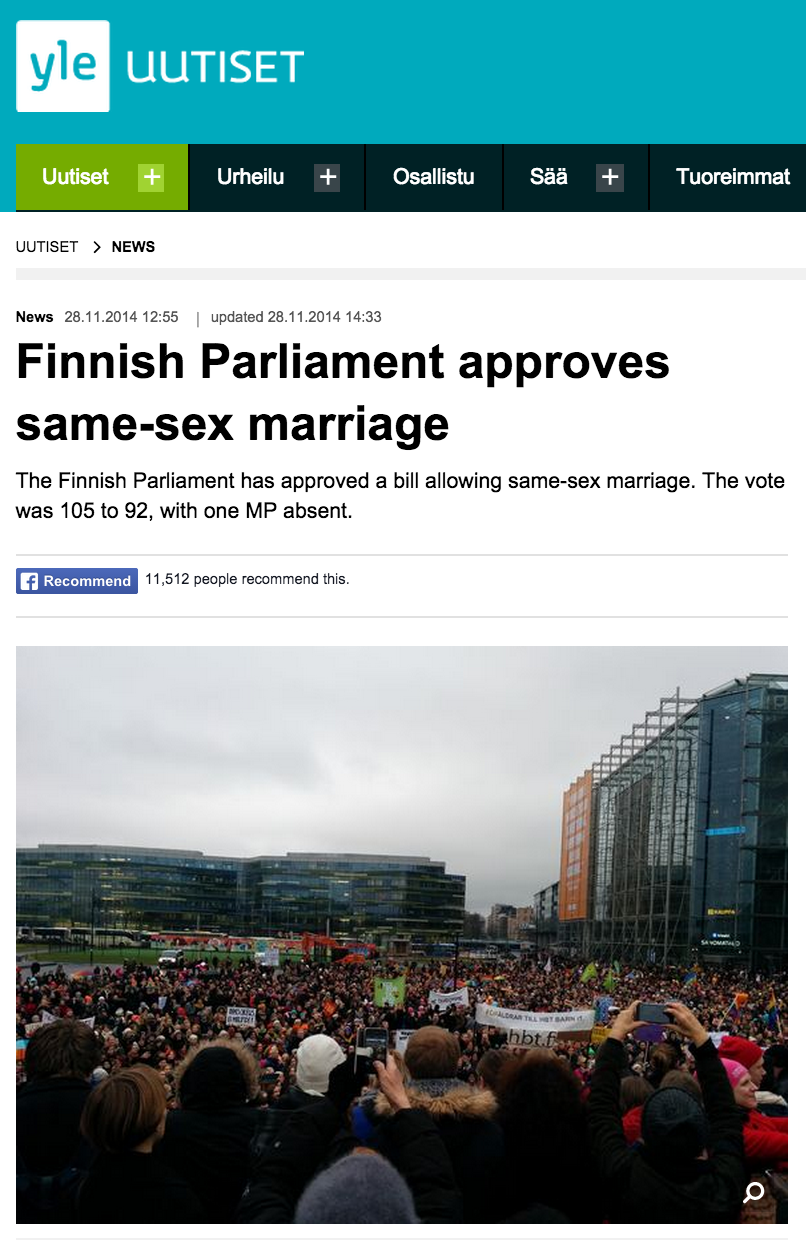
Parliament has approved 105-92 a bill that will pave the way for same-sex marriage, according to YLE in English. The vote in favor of same-sex marriage is the first-ever citizens’ initiative that has been approved by the Eduskunta, or parliament.

The vote was a big setback for Timo Soini and the Perussuomalasiet (PS)* party, which had spent a lot of political capital against the bill.

Other losers were Päivi Räsänen and the Christian Democrats.

The biggest winners were parties like the Greens, Social Democrats, Left Alliance and Swedish People’s Party, which voted in majority for same-sex marriage.

Migrant Tales believes that the passage of the bill will be a big boost for gay rights but for our ever-growing culturally and ethnically diverse society.

Näyttökuva 2014-11-28 kello 15.13.34

Read full story here.


With the passage of the bill, Finland finally joins the other Nordic nations that have approved same sex marriage.

Writes YLE in English: ”The reform will force wide-ranging changes in other legislation, which will take well over a year to finalize. The law will therefore not take effect until 2016 at the earliest.”

Gays and lesbians have been allowed to have registered partnerships since 2002.


* The Finnish name for the Finns Party is the Perussuomalaiset (PS). The names adopted by the PS, like True Finns or Finns Party, promote in our opinion nativist nationalism and xenophobia. We therefore prefer to use the Finnish name of the party on our postings.


Same-sex marriage bill vote Friday will be a cliff hanger

Posted on November 27, 2014 by Migrant Tales

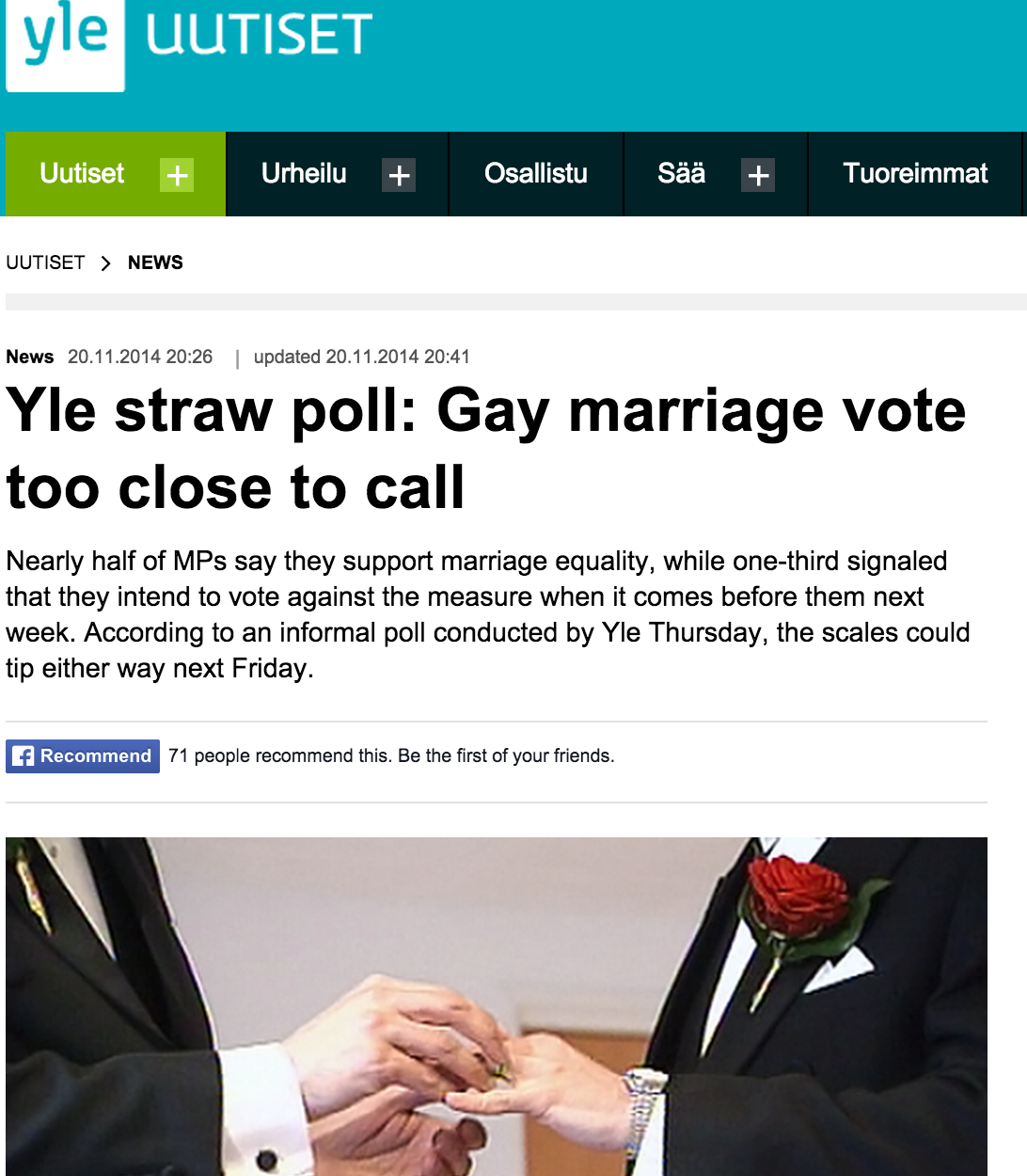
Finland will vote Friday on the long-overdue bill that would make marriage legal between same-sex couples. A lot rides on tomorrow’s vote. In many respects, the outcome of Friday’s vote shows Finland to be at an important crossroads.

Some analysts see the passage of the same-sex marriage bill not only as a victory for gays but for all minorities in Finland.

At present, the social construct of the so-called white, heterosexual Finn is being seriously challenged by tomorrow’s vote as well as by our ever-growing cultural diversity.

According to political observers, the vote is still too close to call.

Näyttökuva 2014-11-27 kello 6.59.26

Read full story here.


The debate on same-sex marriage has divided Finland. Even so, Evangelical Church of Finland Archbishop Kari Mäkinen said this week he supports granting homosexual couples the right to marriage.

It’s highly probable that the historic vote Friday would not be a cliff hanger if it weren’t for the Perussuomalaiset (PS),* which are betting much of their political capital against the bill.

In 2011 the PS won their historic parliamentary election victory by gaining 39 seats in parliament from 5 previously. Their election victory was based on hostility and mistrust of the EU, immigrants, refugees, cultural diversity and homosexuals.

Friday’s vote will reveal a lot of things. One is whether we are a closed or open-minded society.

The closed society, supported by the PS, is outright hostile to minorities and keeps such groups excluded by building fences of mistrust with the help of myths.

The open-minded society is the new face of Finland in this century that cannot be stopped. That face and landscape comprises of minorities with equal rights.


* The Finnish name for the Finns Party is the Perussuomalaiset (PS). The names adopted by the PS, like True Finns or Finns Party, promote in our opinion nativist nationalism and xenophobia. We therefore prefer to use the Finnish name of the party on our postings.

Finland: A nation of emigrants

Posted on November 26, 2014 by Migrant Tales

While some heads of state like Barack Obama speak of the United States as a nation of immigrants, Finland has historically been a nation of emigrants. How does being a nation of emigrants differ from being a nation of immigrants? There is a big difference and reveals in part why some Finns are so hostile to immigration. 

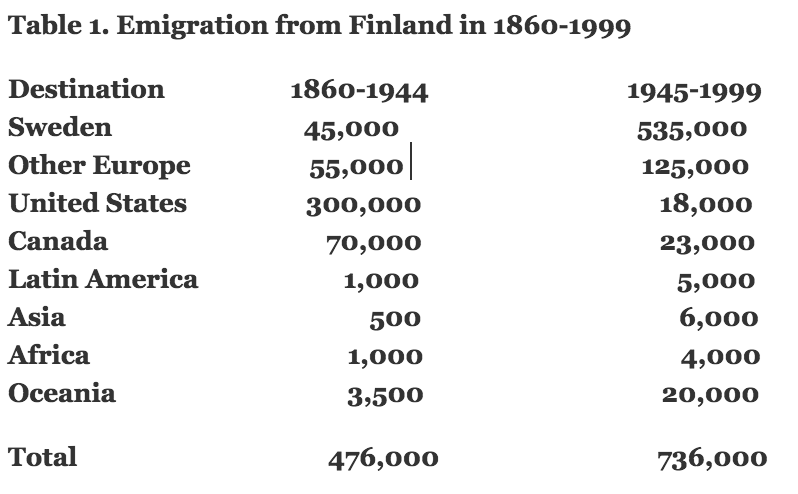
Finland is a good example of a country made up of emigrants. During 1860-1999, over 1.2 million emigrated, with the majority moving to Sweden (580,000) and North America (411,000).

If all of these emigrants would have stayed put in Finland, our population would be today about 7 million instead of 5.470 million.

Emigration has had a big demographic never mind social impact on Finland.

Näyttökuva 2014-11-26 kello 12.49.51

Source: Jouni Korkiasaari and Ismo Söderling: Finnish emigration and immigration after World War II. Migration Institute 2003.    Source: http://www.migrationinstitute.fi/articles/011_Korkiasaari_Soderling.pdf

Since we are a nation of emigrants, it explains in part why some of our politicians and society don’t see immigration as a positive matter.

Being a land of emigration has distorted our view of things. Instead of seeing the world as an opportunity, it’s seen by too many as a threat. This is understandable considering our difficult history with the former Soviet Union. Even so, wars and conflicts end and we must learn to move on, even if the Ukraine crisis has reinforced our worst prejudices.

Finland is slowly learning to become a nation of immigrants. When we’ll be able to call ourselves a nation of immigrants, that’s when our perceptions of foreigners and newcomers will change, hopefully for the better.

This will take time. But we’re already on that road no matter how some resist this fact tooth and nail and throw everything they have against our ever-growing culturally and ethnically diverse nation.

Julian Abagond: nation of immigrants

Posted on November 25, 2014 by Migrant Tales

Migrant Tales insight: Finland is a nation of emigrants, not of immigrants. Even so, the same structures that have kept intact the structures and systemic exploitation of minorities, slavery and Jim Crow are still alive and kicking despite the fact that we try to convince ourselves that the United States is a nation of immigrants. 

___________________

Julian Abagond

The phrase “nation of immigrants” (1883) is often applied to the United States, especially by its scholars, journalists, presidents and schoolteachers.

Näyttökuva 2014-11-25 kello 21.14.36

Last week, President Obama put it like this (on November 20th 2014):

“My fellow Americans, we are and always will be a nation of immigrants. We were strangers once, too. And whether our forebearers were strangers who crossed the Atlantic, or the Pacific or the Rio Grande, we are here only because this country welcomed them in and taught them that to be an American is about something more than what we look like or what our last names are, or how we worship.”

His words do not apply to about 40% of the nation:

  • Not to Native Americans who were wiped out or driven west.
  • Nor to Black Americans who were brought in chains.
  • Nor to Chinese Americans who were killed or driven out of the western US in the late 1800s.
  • Nor to Mexican Americans deported in the 1930s.
  • Nor to the people whose lands the US took over: Native Americans,Northern Mexicans, Alaska Natives, Native Hawaiians, Puerto Ricans, Guamanians, Palauans, Eastern Samoans, Northern Mariana Islanders or Virgin Islanders.
  • Nor, given the perpetual foreigner stereotype, to Asian Americans.
  • Nor to most British or Dutch Americans, who were not immigrants (people who move to a foreign country) but colonists (people who create an offshoot of their mother country). Calling them “immigrants” would mean they joined Native American societies. They were conquerors and invaders, not “immigrants”.

In English the word “immigrant” only goes back to 1792. The phrase “nation of immigrants” does not appear in print till 1883, not in the New York Times till 1923. It was still a surprising idea at Harvard University in 1945, even for historian Oscar Handlin, who grew up in New York City as the son of Russian Jewish immigrants. It did not take off till the 1960s, when President Kennedy wrote a book for the Jewish Anti-Defamation League called “A Nation of Immigrants” (1964).

Näyttökuva 2014-11-25 kello 21.12.53

So when Obama says, as he did in 2010, 2013 and 2014:

“We’ve always defined ourselves as a nation of immigrants.”

He is reading history backwards. It is an idea that did not catch on till the Third Enlargement of Whiteness, which took in southern and eastern Europeans.

Obama on Independence Day, 2012:

“We say it so often, we sometimes forget what it means – we are a nation of immigrants. Unless you are one of the first Americans, a Native American, we are all descended from folks who came from someplace else – whether they arrived on the Mayflower or on a slave ship, whether they came through Ellis Island or crossed the Rio Grande.”

The “nation of immigrants” thing colour-blinds US history as if it were not much affected by racism – genocide, slavery, settler colonialism, imperialism, etc – as if Italian and Jamaican immigrants are pretty much the same, or English colonists and African slaves, as if US institutions protect everyone’s rights regardless of race and the Bootstrap Myth is true.

Thanks to Kyle for suggesting this post.

See also:

  • The three pillars of American white supremacy
  • The Third Enlargement of American Whiteness
  • white racial frame
    • colour-blind racism: the four frames
    • Bootstrap Myth
    • perpetual foreigner stereotype
  • genocide
  • The Cherokee Trail of Tears
  • Kingdom of Hawaii

Read original posting here.

This piece was reprinted by Migrant Tales with permission.


Migrants’ Rights Network: “How to talk about immigration?”

Posted on November 24, 2014 by Migrant Tales
Don Flynn*
Don_web_0
The thinktank British Future created a stir last week with the publication of its new book, How to talk about immigration.

It is clear that, given the current febrile state of the public mood, a lot of damage can be done by talking about immigration in ways that are insensitive to many people’s anxieties. Times are exceptionally hard for so many people – wage earners in particular are feeling the squeeze of an economy which has blocked off any rise in their living standards for most of a decade. Commonsense, that age-old foe of critical thinking, tells citizens that immigration must have something to do with this unhappy state of affairs. If there is good evidence which shows that this is not the case then we have to find the best way to get this across to the people who would benefit from knowing the true facts.

Na?ytto?kuva 2014-11-24 kello 17.22.28Read full story here.


The British Future manual provides a good checklist, based on three years of public opinion research, for the obvious things that should not be done in communicating about migration: Don’t make out that people are stupid because they are showing resistance to the idea that migrants pay more in taxes than they receive in services. Take seriously the concerns they have that changes brought about by migration might be happening too quickly.  Think about the reasons why new arrivals might not be welcome in communities which feel that the public services which are so important to their lives are already under too great a stress.

British Future also puts forward a compelling argument for the view that the majority of the population occupies a ‘persuadable middle ground’ position in immigration which would shift in the direction of moderately pro-immigration arguments, providing these were put well by people they trust.

It seems almost rude to stir up disagreements with a set of ideas and proposals which have the best intentions, but a few red flags need to be posted about British Future’s policy conclusions, which merit further discussion.

Theorists of this sort of thing tell us that there are broadly two ways of doing politics in liberal democratic societies.  One of these is the technocratic approach favoured by expert elites.  It tells us that modern society is tremendously complex and capable of generating problems and tensions at any point across its extended field of operation.  Each has the potential to be dealt with in isolation from the others, with the need to fight foreign wars having no necessary relation to heath care policies or the cost of housing.

In this way of looking at things immigration policy throws up a set of issues that ought to be isolated from the ability of politicians to deal with the budget deficit, improve the standard of primary school education, or provide adequate pensions for the retired.  Government needs to draw on the expertise of policy wizards who know how to fix things under each of these individual headings and let them get on with the job.

Against this there is the populist tide in democratic politics which resists the idea that the problems of contemporary life are fragmented and separate.  It answers the charge that we should leave it to the experts to get the system to work again with the accusation that the apparently separate problems are actually subsets of the one big problem which is breaking the back of the whole of society.  The experts have failed and it is now down to ordinary citizens to work out what needs to be done to come up with solutions – and these will inevitably be far reaching and radical.

The British Future approach strongly skews the direction of the discussion towards technocratic responses. Following a detailed analysis of public opinion research, the book concludes by putting forward an immigration management package which it proposes is plausible according to the requirements of the ‘persuadable majority’, and that would generate a set of ‘realistic targets’ that a majority would be prepared to back.  How to talk about immigration ends by pitching a deal that would allow universities to recruit international students, employers to bring in skilled workers, and shepherd all newcomers to a safe haven as integrated residents of British society.

It sounds so elegantly simple as to make you wonder why no one has come up with it before.  But hang on a minute – that is exactly what the all the parties in government have thought they were doing at virtually every moment for close on the past two decades.  New Labour promised to be ‘as tough as old boots’ on unwanted asylum seekers and labour migrants who failed to produce value for the UK economy.  They offered a ‘realistic’ package of ultra-surveillance that would have enhanced the power of state agencies to enforce the immigration rules through biometric identity cards and total overview of migrant movements through society.

The quid pro quo for this assurance that everyone moving into the country was subject to thoroughgoing control was acceptance of migration at the higher levels needed to maintain growth amongst the economic sectors producing employment growth – primarily the small and medium sized business hungry for a workforce with the sort of soft skills to be found most readily amongst migrants.

The coalition government subsequently promoted its own version of realistic targets – in broad terms similar to the set New Labour had been running when they were evicted from office but with the added oomph of a promise to reduce net migration to the tens of thousands. Ironically, whilst this might have had a higher approval rating amongst public opinion as to what people really wanted, the conjunction of a whole range of factors running from the obligations that ensued from the EU Treaties, the persistence of high levels of demand for migrants amongst British employers, and the chronic ineptitude of a Home Office which exemplifies everything we know about that dead end, sclerotic structure which is the Westminster state today, was always certain to confound and destroy all the hopes for the ‘no ifs, no buts’ solution the coalition was aiming for.

The danger for British Future in this context is the risk of association with the claims of technocratic currents in mainstream politics that an unreformed, over-centralised, elitist bureaucratic state is capable of delivering the goods. The guiding framework for the paper is the issues that would be acceptable to the public and the political elite at this moment in time, and some of the most difficult but salient human rights issues relating to migration – for example the impacts of immigration enforcement, the position of undocumented migrants, the need for reform of the detention estate, the shape of future asylum policy and so on – are not tackled.

So if the door is slammed shut against the prospect of progress through this style of political management, what about its more unashamedly populist and democratic alternative? What would advocacy of immigration policies look like if it was bold enough to share the widely held view that mainstream politics does have to carry a large share of the blame for the mess that so many people are in today?

We have the examples of the public conversation in Scotland to know that framing the issue of migration according to the needs of 5 million people has brought a very different shape to the politics of that country. Last week’s news of Obama’s executive order offering temporary legal status to approximately five million undocumented immigrants is another good example of how politicans can push for a real change beyond the established middle ground.

There are good grounds for believing that the task of winning the debate on immigration will require a great deal more than finessing the language aimed at the mainstream majority. The populist moods sweeping liberal democracies all over the world require conviction and a robust determination to take on and defeat a resurgent right wing which is working to rally opinion around the pole of traditional authority and the Thatcherite values of middle England. The language and advocacy we most need is that which is most capable of taking this on and beating it, and finding our way to that approach ought to be our highest authority.

Read original posting here.

This piece was reprinted by Migrant Tales with permission.

*Don Flynn, the MRN Director, leads the organisation’s strategic development and coordinates MRN’s policy and project work. He is a regular and sought-after speaker at conferences, seminars and lectures on behalf of MRN.

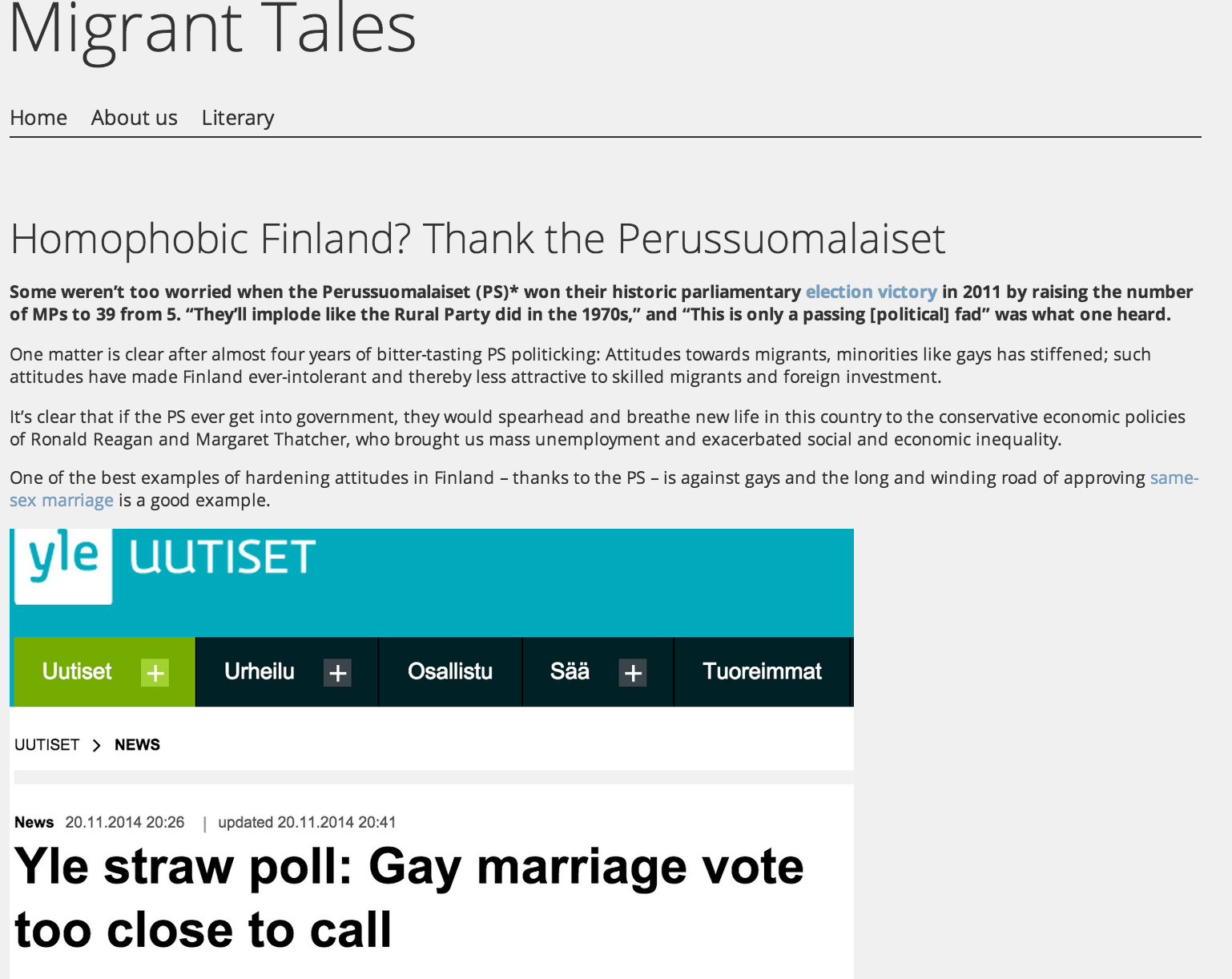
Homophobic Finland? Thank the Perussuomalaiset

Posted on November 23, 2014 by Migrant Tales

Some weren’t too worried when the Perussuomalaiset (PS)* won their historic parliamentary election victory in 2011 by raising the number of MPs to 39 from 5. “They’ll implode like the Rural Party did in the 1970s,” and “This is only a passing [political] fad” was what one heard. 

One matter is clear after almost four years of bitter-tasting PS politicking: Attitudes towards migrants, minorities like gays has stiffened; such attitudes have made Finland ever-intolerant and thereby less attractive to skilled migrants and foreign investment.

It’s clear that if the PS ever get into government, they would spearhead and breathe new life in this country to the conservative economic policies of Ronald Reagan and Margaret Thatcher, who brought us mass unemployment and exacerbated social and economic inequality.

One of the best examples of hardening attitudes in Finland – thanks to the PS – is against gays and the long and winding road of approving same-sex marriage is a good example.

Näyttökuva 2014-11-23 kello 10.07.13

One of the most outspoken voices against same-sex marriage is the Perussuomalaiset party. Read full story here.


It’s clear that if the PS wouldn’t have won in 2011, same-sex marriage would have already been legal in this country.

Taking into account that recent polls show the Center Party to be the clear favorite to win the next parliamentary elections in April and the party’s voting record, Friday’s parliamentary vote for or against same-sex marriage will be the last for a very long time.

The PS has tried to pull many fast ones on the public. One of these was a recent claim that migration costs Finland near-2 billion euros. While such claims were conjured by the PS for obvious reasons, has anyone asked how much the populist party has cost Finland in the way of lost skilled migrants, jobs, opportunities and investment?

Finland has a problem: It’s population is aging and we need skilled migrants to fill the gap as well as new jobs. Why would any person in his right mind move to a country that is suspicious of migrants and foreign investment?

One problem with racism and ethnocentrism is that it distorts reality.

* The Finnish name for the Finns Party is the Perussuomalaiset (PS). The names adopted by the PS, like True Finns or Finns Party, promote in our opinion nativist nationalism and xenophobia. We therefore prefer to use the Finnish name of the party on our postings.

Systemic disenfranchisement of migrants and minorities in Europe

Posted on November 21, 2014 by Migrant Tales

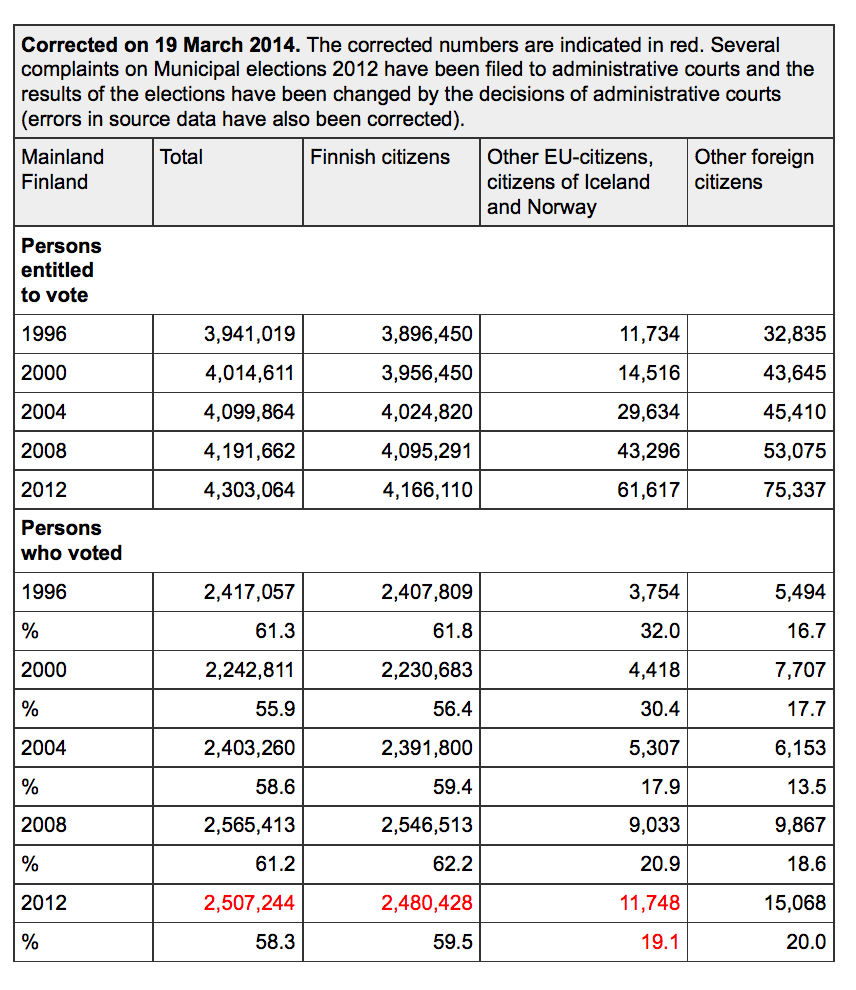
One important question that doesn’t appear to bother too many politicians is why migrant voter turnout in Europe is so low. In the 2012 municipal elections of Finland, 20% of eligible migrants voted compared with 18.6% in 2008. This is a far cry from 59.5% and 62.2% of Finnish citizens that voted in such elections, respectively. 

As we saw in the EU elections of May, the far right made important gains especially in countries like France, United Kingdom, Denmark Austria, Sweden and Greece. The low voter turnout coupled with the disenfranchisement of migrants from the political system and society in general has benefited the far right.

According to  an opinion piece on euobserver by Thomas Huddleston, the low levels of voter participation and naturalization of Europe’s ever-growing immigrant population have become “the major disenfranchisement cause of our time.”

Table 1: Persons entitled to vote and those who voted by nationality in municipal elections during 1996-2012.

Näyttökuva 2014-11-21 kello 17.54.58

Source: Statistics Finland.

Some of the key issues that Huddleston points out are the following:

  • There are 51 million migrants aged 15-74 in the EU, or 14% of the adult population;
  • 32 million migrants are first- and 18 million are second-generation migrants;
  • Two thirds of the first first-generation are not citizens of their country of residence;
  • A large number of young second generation adults are not citizens in around half of the EU member states;
  • Among non-EU citizens, 10 million live in EU countries (Germany, Italy, France, Greece and Austria) denying them even the right to vote in local elections;
  • Far right parties in countries like Austria, Belgium, Denmark, France and the UK are benefiting the most from this democratic deficit.

It’s clear why the far right and anti-immigration groups do not want to give migrants greater voting rights since such a move would undermine their power. But if we want to make the EU more inclusive, it’s clear that we are going to have to make an about-turn in voting rights to migrants.

Writes Huddleston:

Research finds that the electoral power of the far-right is the most important factor explaining the restrictiveness of European countries’ citizenship policies, which then has major effects on immigrants’ naturalization rates, even for high-educated and developed-world immigrants.

For those who still believe that parties like the Perussuomalaiset (PS), which has far right roots, haven’t poisoned the air for migrants and polarized society should think twice. A good example is the ongoing debate on same-sex marriage in Finland. If the PS wouldn’t have won the 2011 elections and become the third-largest party in parliament, same-sex marriage would most likely have been approved a long time ago.


* The Finnish name for the Finns Party is the Perussuomalaiset (PS). The names adopted by the PS, like True Finns or Finns Party, promote in our opinion nativist nationalism and xenophobia. We therefore prefer to use the Finnish name of the party on our postings. 

Institute of Race Relations: Roma – fascism’s first victims, again

Posted on November 15, 2014 by Migrant Tales

Liz Fekete

Anti-Roma violence draws strength from fascist ideas that linger on in mainstream European thought.

On 15 September, a Roma man from Romania, homeless in Sweden, died of injuries sustained on 31 August, when a fire broke out at a Roma temporary tent camp in Högdalen, southern Stockholm. We will probably never know whether the man, who has not been named, was the victim of a tragic accident, or whether his tent was deliberately set on fire by racists who, in months previous, had been very vocal on social media disseminating information on the location of Sweden’s temporary Roma encampments. The reason why the truth may prove elusive rests with police officers who, on arriving at the scene of the fire, assumed that it had been caused by the carelessness of the Roma themselves. The Roma had other views, but by the time they persuaded the police to act like investigators and keep an open mind, the damage had been done. As it took the police several hours to cordon off the charred campsite for a forensic examination, what might have been a murder scene was compromised, and vital forensic evidence lost.

lady-in-front-of-burnt-traveller-trailer-300x154

Irish Traveller in front of a trailer destroyed in an arson attack.

THE LEGACY OF FASCIST IDEAS

Given all we know about far-right hated of the Roma, current and historical, why would the police be so quick to rule out a racial motive?

In order to understand the unexceptional tunnel-vision of the Swedish police, it is perhaps necessary to turn to mainstream culture, to consider the ways that Roma, Gypsies and Travellers are discussed on social media, in newspapers, TV, in educational materials and textbooks. (Consider the current protests in Madrid over the twenty-third edition of the dictionary of the Royal Spanish Academy which defined a ‘gypsy’ as ‘one who lies and cheats’.)[1] Not only is there widespread cultural ignorance of the lasting impact of the Holocaust on Roma communities, but also a lack of insight into the ways in which mainstream discourses today replicate, albeit (in most, but by no means all, cases) in muted form, the fascist thinking of the 1930s. At least half a million and perhaps as many as 1.5 million Roma died in the Porajmos, or the Great Devouring, as the Holocaust is known amongst the Roma. While the Nuremburg Laws of 1935 marked the Roma out, alongside the Jews, for the Final Solution, the Roma and Sinti had already been decimated through the Nazi’s social hygiene programmes. At the centre of Nazi ideology was eugenics (improvement of the genetic stock), the ideas surrounding which were not unique to fascism but grew out of Social Darwinism, a mainstream ‘science’ in Europe and the United States in the nineteenth and twentieth centuries. The Nazis were to drive the logic of eugenics forwards to its ultimate barbaric limits. Certain categories of people – the criminal, degenerate, homosexual, idle, feeble-minded, disabled and insane – were selected for forced labour or concentration camps. For the Nazis, they were ‘deviant’, ‘asocial’ and ‘workshy’, summed up in Hitler’s phrase ‘life unworthy of life’ (Lebensunwertes Leben). Under the 1933 Law for the Prevention of Hereditarily Diseased Offspring, Roma and Sinti were selected for compulsory sterilisation and, later, in 1939, for extermination under the Action T-4 forced euthanasia programme. In this way, Roma were treated by the Nazis, as both a social and genetic threat to the ‘master race’, and then, after the Nuremberg Laws, as a ‘racial threat’ . But given that in today’s post-Holocaust Europe, scientific racism is no longer acceptable, it is the social hygiene component of fascism that lingers in modern attitudes towards the Roma. The legacy of fascism is evidenced in our failure to hold to account those who, directly or indirectly, refer to the criminal culture and deviant lifestyle of the Roma.

It should also be remembered that sterilisation programmes persisted in many European countries, long after the end of the second world war. Even in the so-called egalitarian paradise of Sweden, from 1935-1976 the state forcibly sterilised some 60,000 women under a eugenics programme designed to rid the country of inferior racial stock. Meanwhile, the universal failure of European societies to recognise Roma suffering during the Holocaust, meant that textbooks and education materials were not readily scrutinised for anti-Roma content (witness the Spanish dictionary scandal, mentioned above). In fact, in Germany the Porajmos was only officially acknowledged in 1982 and only in 2011 was a Roma representative officially asked to speak at the German Holocaust Memorial Day.[2]

SOCIAL FASCISM IN EASTERN EUROPE

All these failures ensured that hostility and violence against the Roma continued in the post-war period, with barely a ripple of mainstream protest. There were pogroms against the Roma in Hungary and Romania in the 1990s, with the Romanian police actively participating in the most infamous of the attacks in Hãdãreni in 1993, during which three Romani men were killed and eighteen Romani houses were destroyed.[3] During a 14-month period in 2009-10, Hungarian neo-Nazi serial killers murdered six Roma and engaged in countless other attacks, including arson, in nine small towns and villages in central and eastern Hungary.[4] The social hygiene ideas of the Nazis, the equation of Roma lifestyles with social degeneracy, as well as the over-breeding that threatens the ‘racial stock’, linger on across much of eastern Europe, painfully affecting the marginalised and impoverished Roma. In the Slovakian town of Kosice, the Magnificent Seven Party (7 Stato?ných, and, yes, they actually wear cowboy hats), are calling for ‘gypsies’ to be rounded up and put on flights to Europe, and for sterilisation programmes (albeit voluntary, whatever that means in this context) for any Roma women who remain.[5] Between 1971 and 1991, the sterilisation of Roma woman, often during a Caesarean section or an abortion, and without their knowledge, was state practice across Czechoslovakia.[6]

Out of the mouths of respectable politicians, as well as judges, come the same social stereotypes, the same discriminatory words . In April 2014, a judge in a court in Gyula in Békés county, Southeast Hungary, rejecting a bid to dissolve the paramilitaries of the Szebb Jövõt Vigilante Association (closely linked to Jobbik and the previously dissolved Hungarian Guard), summed up by declaring that ‘Being a Roma should not be primarily interpreted as a racial category, rather as a way of life led by a group of people who stand apart from the traditional values of majority society, and whose lifestyle is characterized by the avoidance of work and the disrespect of private property and the norms of living together.’ Meanwhile, on 2 August in the Czech Republic , Tomio Okamura, previously an independent senator loosely aligned with Christian Democrats, but now leader of the breakaway far-right Dawn of Direct Democracy, chose the occasion of Roma Holocaust Day to describe the Lety concentration camp (where Roma were interned during the Nazi occupation, with many sent on to Auschwitz) as a ‘labour camp for persons who were avoiding proper work’, and where people died of old age and ‘diseases they brought with them as a result of their previous travelling lifestyle’. Now, Facebook pages are spring up across the Czech Republic with names and slogans such as ‘We demand impunity for shooting gypsies’, ‘We don’t want to feed the Romani population’ and ‘We Demand the Public Execution of the Executive Director of Romea’.

WESTERN AND NORTHERN EUROPE – IT’S NO JOKE

Anti-Roma hatred is reaching vile levels. But the most shocking aspect of the hate is the tacit support given by respectable politicians – across Europe, from South to North, from East to West – for views that may fall short of denouncing the Roma as a ‘racial threat’, but replicate the Nazi view of Roma as delinquent and workshy and a social threat to Europe.

It’s far too simplistic to label this an eastern European post-Communist problem, (with the snide undercurrent that you can’t expect more from the economically and socially backward East). Vile comments, most often passed off as humour, emanate from the mouths of our supposedly more enlightened western and northern European politicians on a daily basis. Witness the UK’s Maidenhead Conservative councillor’s recent comment (a misplaced joke he claims), at a council meeting, that one way to speed up the council’s evictions of Travellers, would be to ‘Execute them’.[7] Or the comments of Gilles Bourdouleix, the deputy mayor of a constituency in the French Maine-et-Loire region, who remarked, during a confrontation with Roma at a camp in Cholet, that ‘maybe Hitler did not kill enough Gypsies’. (A misunderstanding, his comments aimed at no one in particular, he protests!)[8]

It is in France, where Facebook pages call for the elimination of the Roma, that violence has, according to the League of Human Rights, reached ‘pathological’ levels.[9] The League blames government policies and high-profile eviction programmes. One particularly horrendous incident occurred in June 2014, when a 16-year-old teenager from Romania, known as Gheorghe C, only narrowly escaped death after suffering life-threatening injuries, including a fractured skull, following an ‘attempted lynching’. The teenager was kidnapped from a Roma encampment in the Pierrefitte-sur-Seine area, north of Paris by a gang of hooded men and tortured in the basement of a housing estate in the Seine Sans Denis area, north of Paris. Finally, unconscious, his body was discovered dumped in a shopping trolley left on the side of the national motorway. His violent treatment was greeted with expressions of support on many online portals.

But this is only one in a catalogue of violent attacks across northern and western Europe which, like in Sweden, have centred on Roma living in tent-encampments and other easily-identifiable living spaces. Not a week goes by without the reporting of another disturbing incident. To take just a few of the most recent: in September 2014, in Germany, in the Silberhöhe neighbourhood of Halle, neo-Nazis took over an online rant against the Roma. It started out on Facebook but fascists upped the ante, infiltrating protests, and spraying swastikas and racist comments on buildings, roads and sidewalks.[10] In October, in Ireland, multiple Facebook campaigns appeared around the theme of ‘Get Roma criminal gypsies out’, (Roma were described on posts as ‘cockroaches’ and ‘c***s’). Shortly after, Roma families had to be evacuated from their Waterford home, after around sixty people gathered outside their house, chanting ‘Roma, out, out, out’ and other obscenities.[11] The Pavee Point Traveller and Roma centre is mobilising support for the families.

It’s the same story in France and the UK, where the National Federation of Gypsy Liaison Groups’ most recent report, on Gypsy, Traveller and Roma integration, highlights abusive media coverage and overtly racist statements from local and national politicians as cause for concern. The report carries a photo of the burnt out caravan of a Traveller family forced out of their home.

‘THE HOMELESS DEAD’[12]

But to return to Sweden, and the death of the Romanian Roma man in Högdalen. The police, reporting themselves to their own ethics committee for their handling of the fire,[13] have now admitted that they were unaware of the social media campaign to identify Roma encampments, as well as previous incidents, when Roma had had their tents cut with knives, for instance, or a caravan was set on fire. As one solidarity campaigner I spoke to said, ‘The Roma witnesses believe that the fire was an act of arson, though no one had seen the attacker or attackers, and we now find ourselves in the unfortunate situation that total clarity will probably never be reached on this.’ Meanwhile, the name of the Romanian Roma man who died has not been reported. This will most likely go down in the records as just another death amongst the ranks of the European homeless, a growing proportion of whom, according to the European Federation of National Associations Working with the Homeless, are migrants, and an unknown number Roma.[14]

Read original story here.

This piece was reprinted by Migrant Tales with permission.

RELATED LINKS

IRR Briefing Paper: From pillar to post: pan-European racism and the Roma

European Roma Rights Centre

Pavee Point Roma and Traveller Centre

National Federation of Gypsy and Traveller Liaison Groups

Roma Feminist Association for Diversity (AGFD)

FEANTSA

Europe Roma

References: [1] The protests are being organised by the Association of Feminist Gypsies for Diversity. See ‘Gypsies protest over dictionary definition’, Guardian (30 October 2014). [2] See Ian Hancock, The Pariah Syndrome (Karoma, 1987). [3] The 21-year search for justice for the victims is ongoing. In July 2014, following a case brought by the ERRC and Romani Crises, the Cluj Napoca Court of Appeal found the government had failed to honour previous commitments made to the victims and the community of Hãdãreni. See a European Roma Rights Centre press release (29 July 2014). [4] No government official visited any of the victims’ families or offered an apology. Finally, in the autumn of 2014, the government agreed compensation for those who suffered bodily injuries, or lived in a common household with either the victim or with the person injured during the attacks, or was a close relative. Many of the victims were left disabled for life and with psychological problems, forced to live in the most desperate conditions, without money for medication or food. See Deutsche Welle (2 August 2014). [5] ‘Slovak plan to give Gypsies free flights to the UK’, Croatian Times (16 October 2014). [6] See ‘Forced sterilisation of Romani women – a persisting human rights violation’, Romedia Foundation (7 February 2013). [7] Maidenhead Advertiser (22 October 2014). [8] He was subsequently convicted of hate speech and expelled from the French Union of Democrats and Independents. See ‘French mayor who claimed Hitler “did not kill enough” Roma gypsies avoids jail’, Telegraph (12 August 2014). [9] ‘Forced Evictions in France: absurdly stubborn, stubbornly absurd’, European Roma Rights Centre (7 April 2014). [10]  ‘Hetze gegen Roma. Polizei verstärkt Präsenz in Silberhöhe’, Mitteldeutsche Zeitung (20 July 2014). [11] ‘Ireland: Waterford anti-Roma protests criticised as “cowardly and racist”’, Irish Times (27 October 2014). [12] For an excellent discussion about the problems of trying to account for the homeless who are dying in their droves, see Lise Grout, Cécile Rocca and Christophe Louis, ‘Counting and Describing “The Homeless Dead” – a vital activity to better understand the dead and better help the living’, in Homeless in Europe (magazine of FEANTSA, Winter 2012/2013). [13] ‘Police report themselves over fatal fire at Roma camp’, Radio Sweden (22 September 2014). [14] See ‘Homelessness amongst Immigrants in the EU – a service provider’s perspective’, FEANTSA (June 2013).

The Institute of Race Relations is precluded from expressing a corporate view: any opinions expressed are therefore those of the authors.
Do you think David Cameron should be given ‘a medal’ for immigration?

Posted on November 15, 2014 by Migrant Tales

Finnish Prime Minister Alexsander Stubb continues to surprise us. This time he proposed giving the UK, or Prime Minister David Cameron, ‘a medal’ for immigration. Taking into account how Cameron sees himself threatened by the UKIP and how he’s caved in to anti-immigration and anti-EU rhetoric, the distinction proposed by Stubb is odd to say the least. 

Cameron’s anti-immigration rhetoric is nothing new.

One of the matters that becomes clear in Martin Barker’s The New Racism (1981) is that the same anti-immigration sound bites are used today. Prime Minister Margaret Thatcher claimed before the 1979 general election on BBC Radio 4 that Britain was being ‘swamped’ by immigrants and alien cultures.

Remember when Cameron warned how Britain was going to be swamped by Bulgarians and Romanians that on January 1, 2014? Such claims were totally false.

Why do politicians make such irresponsible statements that victimize whole groups? Is it because they lack backbone and seek political gains at any cost? Is it because immigrants and minorities are easy targets to bully publicly?

Näyttökuva 2014-11-15 kello 1.10.07


Read full story here.


I never could understand how a country that was a colonial and imperialist power like the UK is so touchy about immigration. Since Cameron is into populist anti-immigration rhetoric, certainly we can make a case for the abuse of hundreds of millions of people under colonialism. What about its complicity in the slave trade?

Whatever happened to that Subb before the 2011 parliamentary elections, when he took a strong stand against the xenophobia, racism and ignorance gripping the debate on immigration and immigrants in Finland?

Should we give the Finnish prime minister ‘a medal’ for forgetting that intolerance and populist anti-immigration rhetoric, parroted by Cameron, have little to do with our Nordic values?


Defining white Finnish privilege #14: Losing sight of the real issue

Posted on November 13, 2014 by Migrant Tales

One of the matters that has always surprised me in Finland is that if you speak out against intolerance and racism, you are sometimes seen as the rude one, not the one making the inappropriate comment. Apart from playing down a social ill like intolerance, we too often lose sight of the real issue: the victim. 

There are many factors that make us play down racism. One could be that we don’t want to rock the boat and get involved because intolerance doesn’t affect us directly. The issue is too complicated and hairy.

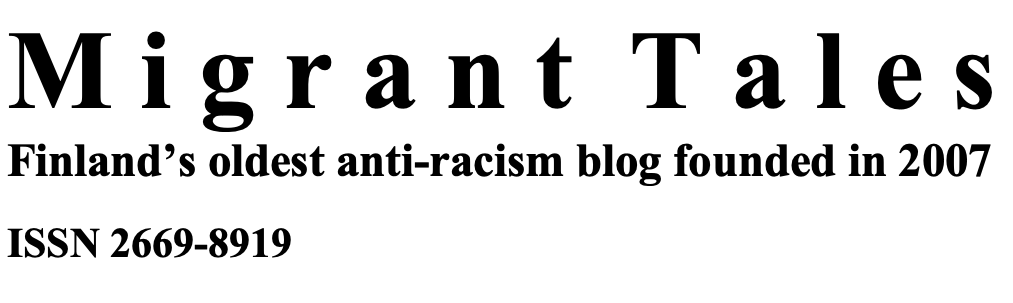
Take for example a recent case in Lieksa where parents don’t want their children to be taken to and from school by Somali drivers because they ‘don’t speak Finnish well enough.’

Näyttökuva 2014-11-12 kello 21.06.30

Read full story here.


The taxi owner, who hired the Somali drivers, claims that the parents’ motives are racist. The parents deny that their actions have anything to do with the drivers’ skin color or nationality.

But what about if both have some complicity in the matter and that we’re losing focus on the real problem?

‘I highly doubt that the man who hired the [Somali] drivers did so because he’s a good Samaritan,’ a Joensuu source told Migrant Tales. ‘Certainly there are racists among the parents but then again has anyone asked if the man who hired the drivers pays them less money [than white Finn driver] in order to maximize profit?’  

Definition #14

While we still don’t know all the facts, white privilege appears to be written all over the most recent case in Lieksa: Parents can demand one thing and the owner of the taxis can say another. Nobody asks the Somali drivers their opinion.

Thus white privilege permits us to miss the real issue at play: suspicion, prejudice and exploitation of migrants.

It’s not always an open-and-shut matter. White privilege permits you to lose sight of the real issue because it is convenient. It allows you to forget the victim, or the taxi drivers, as is the case in Lieksa.

See also:

  • Defining white Finnish privilege #1: I have it and you don’t
  • Defining white Finnish privilege #2: Third culture children versus “pupil with immigrant background” 
  • Defining white Finnish privilege #3 No history, no doctrine, no heroes and no martyrs
  • Defining white Finnish privilege #4 Holding the short end of the stick
  • Defining white Finnish privilege #5 It’s ok to be a racist
  • Defining white Finnish privilege #6 Not having a voice and the media
  • Defining white Finnish privilege #7 A definitive guide
  • Defining white Finnish privilege #8 Underrated and less intelligent
  • Defining white Finnish privilege #9 Mohammad Ali’s insight
  • Defining white Finnish privilege #10 I can victimize and make up any story I like about migrants because I’m white
  • Defining white Finnish privilege #11: Case Teuvo Hakkarainen
  • Defining white Finnish privilege #12: Case Tom Packalén
  • Defining white Finnish privilege #13: Case Matti Putkonen

* The Finnish name for the Finns Party is the Perussuomalaiset (PS). The English names of the party adopted by the PS, like True Finns or Finns Party, promote in our opinion nativist nationalism and xenophobia. We therefore prefer to use the Finnish name of the party on our postings.

  • 1
  • 2
  • 3
  • Next
Read more about documentary film
Read more

Recent Posts

  • Finland’s tabloids Iltalehti and Ilta-Sanomat are the pits
  • Riikka Purra’s Dr Jekyll and Mr Hyde mask
  • Double standards
  • Perussuomalaiset: Uusi logo, sama vanha juttu
  • Taco Trump

Recent Comments

  1. Absolutely Socking: Racist Finnish Facebook group against human rights gets flooded with socks on Musta Barbaari’s mother and sister charged by the police in “ethnic profiling” case
  2. Ilkka Nuotio on Pekka Myrskylä: “Tilastot kertovat toista kuin poliittinen keskustelu”
  3. Genrih Soinkara on The war in Ukraine and the Russian-Finnish border crisis are showing Finland’s ugly side
  4. Ahti Tolvanen on Comment by Ahti Tolvanen on the Helsinki +50 conference
  5. Angel Barrientos on Angel Barrientos is one of the kind beacons of Finland’s Chilean community

Archives

  • June 2026
  • May 2026
  • April 2026
  • March 2026
  • February 2026
  • January 2026
  • December 2025
  • November 2025
  • October 2025
  • September 2025
  • August 2025
  • July 2025
  • June 2025
  • May 2025
  • April 2025
  • March 2025
  • February 2025
  • January 2025
  • December 2024
  • November 2024
  • October 2024
  • September 2024
  • August 2024
  • July 2024
  • June 2024
  • May 2024
  • April 2024
  • March 2024
  • February 2024
  • January 2024
  • December 2023
  • November 2023
  • October 2023
  • September 2023
  • August 2023
  • July 2023
  • June 2023
  • May 2023
  • April 2023
  • March 2023
  • February 2023
  • January 2023
  • December 2022
  • November 2022
  • October 2022
  • September 2022
  • August 2022
  • July 2022
  • June 2022
  • May 2022
  • April 2022
  • March 2022
  • February 2022
  • January 2022
  • December 2021
  • November 2021
  • October 2021
  • September 2021
  • August 2021
  • July 2021
  • June 2021
  • May 2021
  • April 2021
  • March 2021
  • February 2021
  • January 2021
  • December 2020
  • November 2020
  • October 2020
  • September 2020
  • August 2020
  • July 2020
  • June 2020
  • May 2020
  • April 2020
  • March 2020
  • February 2020
  • January 2020
  • December 2019
  • November 2019
  • October 2019
  • September 2019
  • August 2019
  • July 2019
  • June 2019
  • May 2019
  • April 2019
  • March 2019
  • February 2019
  • January 2019
  • December 2018
  • November 2018
  • October 2018
  • September 2018
  • August 2018
  • July 2018
  • June 2018
  • May 2018
  • April 2018
  • March 2018
  • February 2018
  • January 2018
  • December 2017
  • November 2017
  • October 2017
  • September 2017
  • August 2017
  • July 2017
  • June 2017
  • May 2017
  • April 2017
  • March 2017
  • February 2017
  • January 2017
  • December 2016
  • November 2016
  • October 2016
  • September 2016
  • August 2016
  • July 2016
  • June 2016
  • May 2016
  • April 2016
  • March 2016
  • February 2016
  • January 2016
  • December 2015
  • November 2015
  • October 2015
  • September 2015
  • August 2015
  • July 2015
  • June 2015
  • May 2015
  • April 2015
  • March 2015
  • February 2015
  • January 2015
  • December 2014
  • November 2014
  • October 2014
  • September 2014
  • August 2014
  • July 2014
  • June 2014
  • May 2014
  • April 2014
  • March 2014
  • February 2014
  • January 2014
  • December 2013
  • November 2013
  • October 2013
  • September 2013
  • August 2013
  • July 2013
  • June 2013
  • May 2013
  • April 2013
  • March 2013
  • February 2013
  • January 2013
  • December 2012
  • November 2012
  • October 2012
  • September 2012
  • August 2012
  • July 2012
  • June 2012
  • May 2012
  • April 2012
  • March 2012
  • February 2012
  • January 2012
  • December 2011
  • November 2011
  • October 2011
  • September 2011
  • August 2011
  • July 2011
  • June 2011
  • May 2011
  • April 2011
  • March 2011
  • February 2011
  • January 2011
  • December 2010
  • November 2010
  • October 2010
  • September 2010
  • August 2010
  • July 2010
  • June 2010
  • May 2010
  • April 2010
  • March 2010
  • February 2010
  • January 2010
  • December 2009
  • November 2009
  • October 2009
  • September 2009
  • August 2009
  • July 2009
  • December 2008
  • November 2008
  • October 2008
  • September 2008
  • August 2008
  • July 2008
  • June 2008
  • May 2008
  • April 2008
  • March 2008
  • February 2008
  • January 2008
  • November 2007
  • October 2007
  • September 2007
  • August 2007
  • July 2007
  • June 2007
  • May 2007

Categories

  • ?? Gia L?c
  • ????? ?????? ????? ???????? ?? ??????
  • ???????
  • @HerraAhmed
  • @mondepasrond
  • @nohatefinland
  • @oula_silver
  • @Varathas
  • A Pakistani family
  • äärioikeisto
  • Abbas Bahmanpour
  • Abdi Muhis
  • Abdirahim Hussein Mohamed
  • Abdirahim Husu Hussein
  • Abdirisak Mahamed
  • About Migrant Tales
  • activism
  • Adam Al-Sawad
  • Adel Abidin
  • Afrofinland
  • Ahmed IJ
  • Ahti Tolvanen
  • Aino Pennanen
  • Aisha Maniar
  • Alan Ali
  • Alan Anstead
  • Alejandro Díaz Ortiz
  • Alekey Bulavsev
  • Aleksander Hemon
  • Aleksanterinliitto
  • Aleksanterinliitto ry
  • Aleksanterinliitto ry:n hallitus
  • Alex Alex
  • Alex Mckie
  • Alexander Nix
  • Alexandra Ayse Albayrak
  • Alexis Neuberg
  • Ali Asaad Hasan Alzuhairi
  • Ali Hossein Mir Ali
  • Ali Rashid
  • Ali Sagal Abdikarim
  • Alina Tsui
  • Aline Müller
  • All categories
  • Aman Heidari
  • Amiirah Salleh-Hoddin & Jana Turk
  • Amin A. Alem
  • Amir Zuhairi
  • Amkelwa Mbekeni
  • Ana María Gutiérrez Sorainen
  • Anachoma
  • Anders Adlecreutz
  • Angeliina Koskinen
  • Anna De Mutiis
  • Anna María Gutiérrez Sorainen
  • Anna-Kaisa Kuusisto ja Jaakko Tuominen
  • Annastiina Kallius
  • Anneli Juise Friman Lindeman
  • Announcement
  • Anonymous
  • Antero Leitzinger
  • anti-black racism
  • Anti-Hate Crime Organisation Finland
  • Anudari Boldbaatar
  • Arshiya Nasser
  • Aspergers Syndrome
  • Asylum Corner
  • Asylum seeker 406
  • Athena Griffin and Joe Feagin
  • Autism
  • Avaaz.org
  • Awale Olad
  • Ayan Said Mohamed
  • AYY
  • Barachiel
  • Bashy Quraishy
  • Beatrice Kabutakapua
  • Beri Jamal
  • Beri Jamal and Enrique Tessieri
  • Bertolt Brecht
  • Boiata
  • Boodi Kabbani
  • Bruno Gronow
  • Carmen Pekkarinen
  • Çelen Oben and Sheila Riikonen
  • Chiara Costa-Virtanen
  • Chiara Costa-Virtanen
  • Chiara Sorbello
  • Christian Thibault
  • Christopher Wylie
  • Clara Dublanc
  • Dana
  • Daniel Malpica
  • Danilo Canguçu
  • David Papineau
  • David Schneider
  • Dexter He
  • Don Flynn
  • Dr Masoud Kamali
  • Dr. Faith Mkwesha
  • Dr. Theodoros Fouskas
  • Edna Chun
  • Eeva Kilpi
  • Emanuela Susheela
  • En castellano
  • ENAR
  • Enrique
  • Enrique Tessieri
  • Enrique Tessieri & Raghad Mchawh
  • Enrique Tessieri & Yahya Rouissi
  • Enrique Tessieri and Muhammed Shire
  • Enrique Tessieri and Sira Moksi
  • Enrique Tessieri and Tom Vandenbosch
  • Enrique Tessieri and Wael Che
  • Enrique Tessieri and Yahya Rouissi
  • Enrique Tessieri and Zimema Mhone
  • Epäluottamusmies
  • EU
  • Europe
  • European Islamophobia Report
  • European Islamophobia Report 2019,
  • European Union
  • Eve Kyntäjä
  • Ezequiel Caldeiro
  • Facebook
  • Fadumo Dayib
  • Faisa Kahiye
  • Farhad Manjoo
  • Fasismi
  • Finland
  • Fizza Qureshi
  • Flyktingar och asyl
  • Foreign Student
  • Fozia Mir-Ali
  • Frances Webber
  • Frida Selim
  • Gareth Rice
  • Ghyslain Vedeaux
  • Global Art Point
  • Great Replacement
  • Habiba Ali
  • Hami Bahadori
  • Hami Bahdori
  • Hamid
  • Hamid Alsaameere
  • Hamid Bahdori
  • Handshake
  • Harmit Athwal
  • Hassan Abdi Ali
  • Hassan Muhumud
  • Heikki Huttunen
  • Heikki Wilenius
  • Helsingin Sanomat
  • Henning van der Hoeven
  • Henrika Mälmsröm
  • Hser Hser
  • Hser Hser ja Mustafa Isman
  • Husein Muhammed
  • Hussain Kazemian
  • Hussain Kazmenian
  • Ibrahim Khan
  • Ida
  • Ignacio Pérez Pérez
  • Iise Ali Hassan
  • Ilari Kaila & Tuomas Kaila
  • Imam Ka
  • inside-an-airport
  • Institute of Race Relations
  • Iraqi asylum seeker
  • IRR European News Team
  • IRR News Team
  • Islamic Society of Norhern FInland
  • Islamic Society of Northern Finland
  • Islamophobia
  • Jacobinmag.com
  • Jallow Momodou
  • Jan Holmberg
  • Jane Elliott
  • Jani Mäkelä
  • Jari Luoto
  • Jari Taponen
  • Jegor Nazarov
  • Jenni Stammeier
  • Jenny Bourne
  • Jessie Daniels
  • Joe Davidow
  • Johannes Koski
  • John D. Foster
  • John Grayson
  • John Marriott
  • Jon Burnett
  • Jorma Härkönen
  • Jos Schuurmans
  • José León Toro Mejías
  • Josue Tumayine
  • Jouni Karnasaari
  • Juan Camilo
  • Jukka Eräkare
  • Julian Abagond
  • Julie Pascoet
  • Jussi Halla-aho
  • Jussi Hallla-aho
  • Jussi Jalonen
  • JusticeDemon
  • Kadar Gelle
  • Kaksoiskansalaisuus
  • Kansainvälinen Mikkeli
  • Kansainvälinen Mikkeli ry
  • Katherine Tonkiss
  • Kati Lepistö
  • Kati van der Hoeven-Lepistö
  • Katie Bell
  • Kättely
  • Kerstin Ögård
  • Keshia Fredua-Mensah & Jamie Schearer
  • Khadidiatou Sylla
  • Khadra Abdirazak Sugulle
  • Kiihotus kansanryhmää vastaan
  • Kirsi Crowley
  • Koko Hubara
  • Kristiina Toivikko
  • Kubra Amini
  • KuRI
  • La Colectiva
  • La incitación al odio
  • Laura Huhtasaari
  • Lauri Finér
  • Leif Hagert
  • Léo Custódio
  • Leo Honka
  • Leontios Christodoulou
  • Lessie Branch
  • Lex Gaudius
  • Leyes de Finlandia
  • Liikkukaa!
  • Linda Hyökki
  • Liz Fekete
  • M. Blanc
  • Maarit Snellman
  • Mahad Sheikh Musse
  • Maija Vilkkumaa
  • Malmin Kebab Pizzeria Port Arthur
  • Marcell Lorincz
  • Mari Aaltola
  • María Paz López
  • Maria Rittis Ikola
  • Maria Tjader
  • Marja-Liisa Tolvanen
  • Mark
  • Markku Heikkinen
  • Marshall Niles
  • Martin Al-Laji
  • Maryan Siyad
  • Matt Carr
  • Mauricio Farah Gebara
  • Media Monitoring Group of Finland
  • Micah J. Christian
  • Michael McEachrane
  • Michele Levoy
  • Michelle Kaila
  • Migrant Tales
  • Migrant Tales Literary
  • Migrantes News
  • Migrants' Rights Network
  • MigriLeaks
  • Mikko Kapanen
  • Miriam Attias and Camila Haavisto
  • Mohamed Adan
  • Mohammad Javid
  • Mohammad M.
  • Monikulttuurisuus
  • Monisha Bhatia and Victoria Canning
  • Mor Ndiaye
  • Muh'ed
  • Muhamed Abdimajed Murshid
  • Muhammed Shire
  • Muhammed Shire and Enrique Tessieri
  • Muhis Azizi
  • Musimenta Dansila
  • Muslimiviha
  • Musulmanes
  • Namir al-Azzawi
  • Natsismi
  • Neurodiversity
  • New Women Connectors
  • Nils Muižnieks
  • No Labels No Walls
  • Noel Dandes
  • Nuor Dawood
  • Omar Khan
  • Otavanmedia
  • Oula Silvennoinen
  • Paco Diop
  • Pakistani family
  • Pentti Stranius
  • Perussuomalaiset
  • perustuslaki
  • Petra Laiti
  • Petri Cederlöf
  • Pia Grochowski
  • Podcast-lukija Bea Bergholm
  • Pohjois – Suomen Islamilainen Yhdyskunta
  • Pohjois Suomen Islamilainen Yhyskunta
  • Polina Kopylova
  • Race Files
  • racism
  • Racism Review
  • Raghad Mchawh
  • Ranska
  • Rashid H. and Migrant Tales
  • Rasismi
  • Raul Perez
  • Rebecka Holm
  • Reem Abu-Hayyeh
  • Refugees
  • Reija Härkönen
  • Remiel
  • Reza Nasri
  • Richard Gresswell
  • Riikka Purra
  • Risto Laakkonen
  • Rita Chahda
  • Ritva Kondi
  • Robito Ibrahim
  • Roble Bashir
  • Rockhaya Sylla
  • Rodolfo Walsh
  • Roger Casale
  • Rostam Atai
  • Roxana Crisólogo Correa
  • Ruth Grove-White
  • Ruth Waweru-Folabit
  • S-worldview
  • Sadio Ali Nuur
  • Sami Rusanen
  • Sandhu Bhamra
  • Sara de Jong
  • Sarah Crowther
  • Sari Alhariri
  • Sarkawt Khalil
  • Sasu
  • Scot Nakagawa
  • Shabana Ahmadzai
  • Shada Islam
  • Sharon Chang blogs
  • Shenita Ann McLean
  • Shirlene Green Newball
  • Sini Savolainen
  • Sira Moksi
  • Sonia K.
  • Sonia Maria Koo
  • Steverp
  • Stop Deportations
  • Suldaan Said Ahmed
  • Suomen mediaseurantakollektiivi
  • Suomen Muslimifoorumi ry
  • Suomen viharikosvastainen yhdistys
  • Suomen viharikosvastainen yhdistys ry
  • Suomi
  • Supermen
  • Susannah
  • Suva
  • Syrjintä
  • Talous
  • Tapio Tuomala
  • Taw Reh
  • Teivo Teivainen
  • The Daily Show
  • The Heino
  • The Supermen
  • Thomas Elfgren
  • Thulfiqar Abdulkarim
  • Tim McGettigan
  • Tino Singh
  • Tito Moustafa Sliem
  • Tobias Hübinette and L. Janelle Dance
  • Transport
  • Trica Danielle Keaton
  • Trilce Garcia
  • Trish Pääkkönen
  • Trish Pääkkönen and Enrique Tessieri
  • Tuulia Reponen
  • Uncategorized
  • UNITED
  • University of Eastern Finland
  • Uyi Osazee
  • Väkivalta
  • Vapaa Liikkuvuus
  • Venla-Sofia Saariaho
  • Vieraskynä
  • W. Che
  • W. Che an Enrique Tessieri
  • Wael Ch.
  • Wan Wei
  • Women for Refugee Women
  • Xaan Kaafi Maxamed Xalane
  • Xassan Kaafi Maxamed Xalane
  • Xassan-Kaafi Mohamed Halane & Enrique Tessieri
  • Yahya Rouissi
  • Yasmin Yusuf
  • Yassen Ghaleb
  • Yle Puhe
  • Yuliet Tresa
  • Yve Shepherd
  • Zahra Khavari
  • Zaker
  • Zalina Ametova
  • Zamzam Ahmed Ali
  • Zeinab Amini ja Soheila Khavari
  • Zimema Mahone and Enrique Tessieri
  • Zimema Mhone
  • Zoila Forss Crespo Moreyra
  • ZT
  • Zulma Sierra
  • Zuzeeko Tegha Abeng
© 2026 Migrant tales | Powered by Minimalist Blog WordPress Theme