Migrant tales
Menu
  • #MakeRacismHistory “In Your Eyes”
  • About Migrant Tales
  • It’s all about Human Rights
  • Literary
  • Migrant Tales Media Monitoring
  • NoHateFinland.org
  • Tales from Europe
Menu

Month: February 2014

Language plays an important role in migrant adaption but so do acceptance, respect and equal opportunities

Posted on February 28, 2014 by Migrant Tales

With the help of migrants, YLE Uutiset Suoralinja television program Monday at 7.20 pm wants to find out how much do Finnish and Swedish language skills help you integrate and find employment. When teaching migrants one of Finland’s two official languages, what works and what doesn’t?

One interesting question that we could ask is why are we asking this important question today? When speaking of migrant adaption, is the emphasis only language without looking at other important issues as acceptance, respect and equal opportunities?

The answer to that question could reveal a lot about how we integrate and accept newcomers to our society.

Even if we speak of two-way adaption, or integration in the integration act, the expectation and aim appears to be assimilation, or one-way adaption. This means that the migrant does all the adapting while we are not required to change at all.

This, I believe, integration in theory but assimilation is usually the rule, is the crux of the issue. Migrants, and especially Finns who control political and economic power in this country, must do much more to fuel two-way integration.

You can read more about Monday’s program here. What are your thoughts on the topic. You can send your answers to yjr Suora linja team directly at [email protected]  or [email protected].

Kuvankaappaus 2014-2-28 kello 11.02.23
There’s nothing wrong with this, but why does the Finnish media many times picture immigrants as blacks or if they are women with head covering?

Here’s what I wrote to YLE Uutiset Suora linja:

Learning Finnish or Swedish is crucial and helps in the integration process of the newcomer. However, language is used in Finland to discriminate people and seen as a panacea on how to integrate successfully into Finnish society. Language is part of your “ethnicity” in Finnish society. Russians are white but still they suffer from discrimination.

The question we should ask as well is why aren’t there enough Finnish-language classes offered to migrants? Is this a way to “control” migrants and keep some groups on short leashes?

There are many countries like Spain that show us that language is only one important factor in the migrant’s adaption process. Why aren’t Latin Americans from Peru, Ecuador and other countries, who speak Spanish as their native language, are Catholics and live in former Spanish colonies, accepted and suffer from discrimination in Spain?

Let’s bring the issue closer to home and look at the history of the Romany minority and Saami in this country. They’ve lived here for centuries and still suffer from discrimination and social exclusion.

So, when you speak of just language as the key to Finnish integration to society and believe that this will help a migrant or a visible minority get employed, you should give that thought a major rethink.

Best wishes,

Another red herring about gays and Jews by Finnish PS MP Juho Eerola

Posted on February 26, 2014 by Migrant Tales

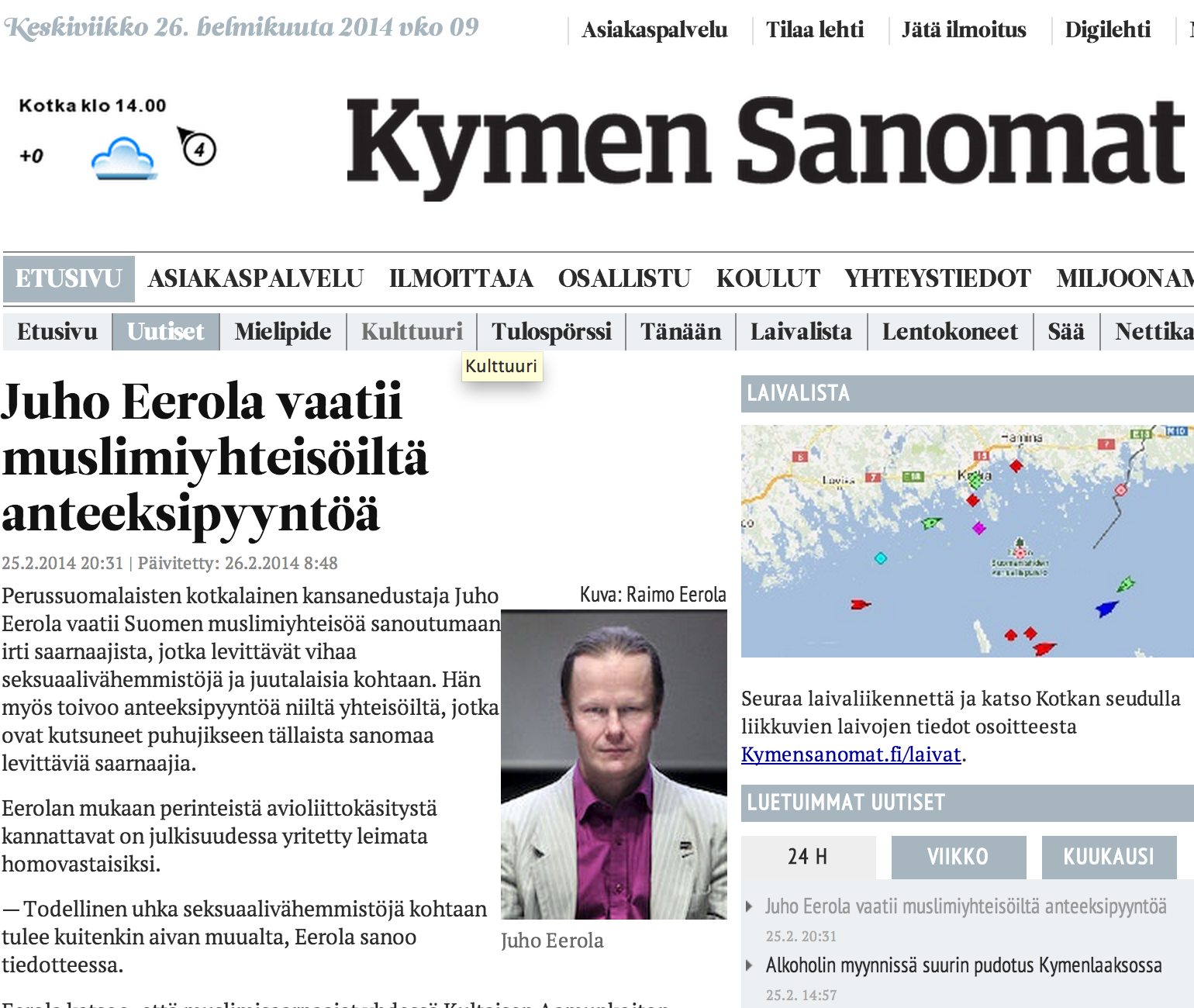
I’m always amazed by these anti-immigration and especially anti-Islam Perussuomalaiset MPs like Juho Eerola, sent a written question to parliament demanding that Muslims in Finland renounce publicly their anti-gay and anti-Semitic stances, according to Kotka-based Kymen Sanomat.

Here’s a very good opinion piece (in Finnish) by Sakari Timonen that exposes Eerola for what he is: A politician without scruples.

The question that Eerola’s statement raises is why is he offering us this red herring now.

Those that have read Eerola throughout the years, know perfectly well that he’s no friend of gays. We could even put to question his pro-Jewish stance. Is he pro-Jewish because he supports how Israel treats Palestinians, who are Muslims?

The answer why the PS MP expresses concern now for gays and Jews is clear: European MEP elections are coming up in May and there is apparently concern in the PS that the party’s negative stand against same sex-marriages may cost it dearly.

 Kuvankaappaus 2014-2-26 kello 11.40.31

Read full story here.  

Eerola’s victimization of Muslims is done the same old way: He groups all Muslims in the same bag.

Reaction to Eerola’s stunt has been widely commented and condemned on social media.

PS MP Eerola is that type of far-right politicians who would care less for gays never mind cultural diversity in Finland and religious freedom.

His most recent outburst and red herring is ample proof of that.

Landmark decision in Finland: Sikh busman said “it was a nice feeling” to wear a turban at work

Posted on February 25, 2014 by Migrant Tales

The long ordeal over whether Sikh bus driver Gill Sukhdarshan Singh could wear a turban to work ended on February 21. “I got a call from the AKT (Transport Workers’ Union) on Friday and they said that it’s been resolved,” he told Migrant Tales. “I have the right to wear a turban at work.”   

Kuvankaappaus 2014-2-25 kello 0.44.39

Read full story here.

“It was a nice feeling to go to work [and wear a turban],” he continued. “Everybody was happy: my coworkers and the passengers. They said it was a good thing that I could use a turban at work.”

Sukhdarshan Singh said that he went to work on that historic Friday at 10am. Even so, he had been struggling with his employer for about a year to have the right to wear a turban at work.

“[The long struggle] wasn’t nice but it’s now over,” he admitted.

The Sikh busman, who has lived in Finland for 28 years, said that it’s a good matter that Finland starts to accept people from other cultures.

“This is a very positive matter,” he said. “Finland is part of a wider world.”

Helsingin Sanomat  reported  Monday that a decision was reached last week between the Finnish Employers’ Federation of Road Transport (ALT) and Transport Workers’ Union AKT over the interpretation of the bus driver’s employment contract.

According to ALT and AKT, Sukhdarshan Singh has the right to wear a turban at work if he wants.

Sukhdashan Singh’s employer Veolia has promised to abide by ALT’s and AKT’s interpretation as well as Helsingin Bussiliikkene, Helsinki’s municipal bus company.

The right to wear a turban at work is a historical decision that Sikh bus drivers got in England in the 1969.


A must-see video about who we Finns are

Posted on February 25, 2014 by Migrant Tales

If there is one matter where Finland’s ever-growing culturally diverse society must still work on, it’s instilling greater acceptance and respect for those who are different from white Finns. For me, this is central in our struggle to live in a country that is acceptant and respects others irrespective of their backgrounds. 

After moving over thirty years to this country, there’s finally a video below that reflects and promotes this important fact.

I dedicate it to all those who still believe that Finnish identity is monolithic, or, as Heikki Waris claimed in the 1960s on page two of “An introduction to Finnish history,” the following (note how he forgets to mention the 10,000-strong Romany minority):  

A fourth aspect is the high degree of homogeneity of Finnish society. Racial homogeneity particularly characterizes the Finnish people who have practically no racial minorities, the less than three thousand Lapps in the northernmost arctic communities making up the largest racial minority group. Consequently, racial prejudice and discrimination are nonexistent.

Waris is very selective when he writes about so-called racial homogeneity. He simply forgets that 1.2 million Finns emigrated and mixed with people and cultures in other lands. He denies and plays down who we’ve always been and will be.

To all those Finns who still believe that this country only belongs to them, I have some news for you. This land belongs to all of us.

We won’t wait for generations for acceptance.

Acceptance begins with us.

Landmark decision in Finland: Sikh bus driver may wear turban at work

Posted on February 25, 2014 by Migrant Tales

The long ordeal over whether Sikh bus driver Gill Sukhdarshan Singh could wear a turban to work has been decided in his favor, reports Helsingin Sanomat. A decision was reached last week between the Finnish Employers’ Federation of Road Transport (ALT) and Transport Workers’ Union AKT over the interpretation of the bus driver’s employment contract. 

According to ALT and AKT, Sukhdarshan Singh has the right to wear a turban at work if he wants.

Kuvankaappaus 2014-2-25 kello 0.44.39

Read full story here.

Sukhdashan Singh’s employer Veolia has promised to abide by ALT’s and AKT’s interpretation as well as Helsingin Bussiliikkene, Helsinki’s municipal bus company.

The right to wear a turban at work is a historical decision that Sikh bus drivers got in England in the 1969.

Migrant Tales will publish more Tuesday on this landmark decision.

Read update here.

Four refugees to move to the Finnish municipality of Kauniainen

Posted on February 24, 2014 by Migrant Tales

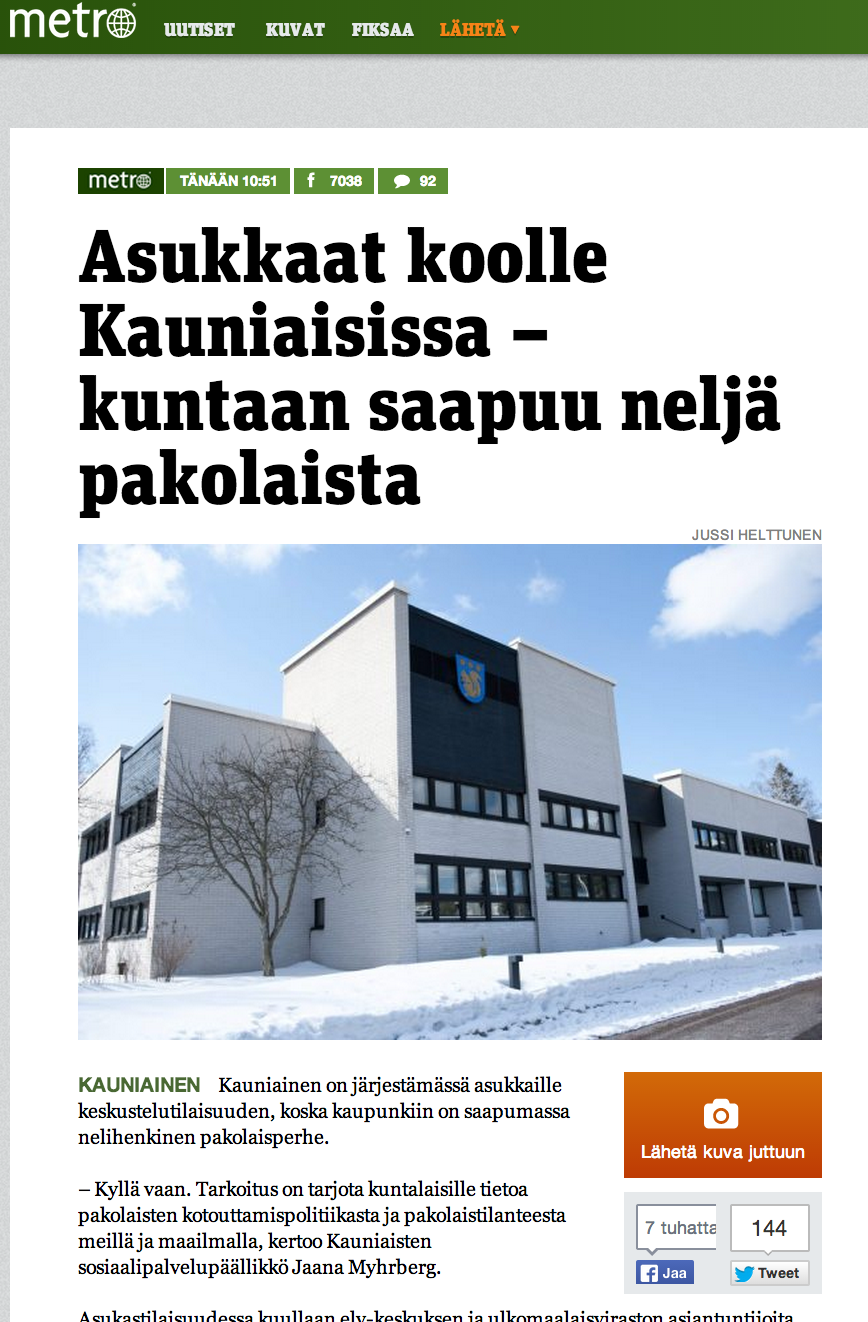
I couldn’t believe my eyes when I read the headline of this story that reads that a refugee family of four from Congo will move to Kaunianen, Finland’s richest municipality, located 18 kilometers west of Helsinki, according to Metro.

 Kuvankaappaus 2014-2-24 kello 21.43.13

Read full story here.

If you think that such news warrants media attention, the story got 7,000 “likes” and 144 tweets on Monday evening.

Jaana Myhrberg, who works for the municipality social services, says that Kaunianen residents will meet with municipal authorities to learn about the integration program and the plight of refugees in Finland and elsewhere.

Kaunianen, which has about 9,000 inhabitants, accepts ten quota refugees annually.

Myhrberg said that she hoped that the event will not generate anti-refugee sentiment and label the municipality’s new inhabitants.

Fadumo Dayib: To research, or not to research Somalis, is the question

Posted on February 24, 2014 by Migrant Tales

I am here today to reflect on being the other, on othering. I am not here as a PhD student from this University but as an activist, a blogger and as your research object.

Kuvankaappaus 2014-2-24 kello 10.10.30

Read full essay here.

The previous presenter raised a very important point that activism does not put bread on your table. I concur with her.

In fact, I want to expound further on that point by arguing that one cannot be paid and be an activist at the same time. By that I mean, if I was receiving funding from an entity that is unethical, could I be an activist? Would I have the freedom, the backbone to question their unethical practices knowing the repercussions? What if they claimed to work on equality but never hired minorities? If they claimed to fight racism while having a white board? Could I be involved in these institutions and claim to be an activist? Can a colonialist be an anti-colonialist while still in the colonialist establishment? My answer is no.

I came to Finland, as a fleeing refugee, with a battered suitcase and a chunk of halwa in my kiondo in 1990. While I slept soundlessly in a motel called Matkakoti in Helsinki, dreaming of cardamom tea in Xamar, the Finnish press was busy selling mass hysteria. A man saw the opportunities the newcomers brought with them and quickly sat down to write. As a result, the first descriptive text on Somalis, or rather their invasion of Finland, was penned. That text was aptly titled “Somali Shock”. I stumbled upon it years after I’d arrived, dazed from all the racist slurs but still desperate to belong. I sought answers, comprehension but never got any.

Somalis became an interesting phenomenon to study. Why would all these young, mostly good looking young men want to come to Finland? Why were they all coming through Russia? Why were they not malnourished, with flies buzzing over their runny noses? Why Finland when thousands are migrating elsewhere? These questions woke a few hibernating researchers who then devoted their time to their new pets. After all, the Somalis looked, smelled and acted differently. They mistreated their women, neglected their children, ran away from fighting in Somali, were loud and had a fetish for Finnish women. In addition, they also had a liking for extravagance, shiny stuff, perky breasts, driving in BMWs, and at the cost of the generous welfare system. This was a phenomenon worthy of a study. I never had the pleasure of meeting these researchers personally but followed their activities through the grapevine.

Fast forward to 1995, a Finnish woman married to a Somali man is in our house, asking questions about death and studying how we deal with grief. She is doing a PhD on Somalis, is dressed as a Somali, henna on her hands, gold bangles jiggling. She is more Somali than I am. You see, this is very important. A researcher must resemble the natives, must eat as they do, must be part of them and must behave like them. After all, this is an ethnographic research. But does that mean she knows what I am feeling? What it is to be me? What it is to be a Somali woman, a Muslim from Africa? No. She is a privileged white woman. The power dynamics are skewed in her favor. No amount of dressing, mannerisms, is going to change that reality.

She shoots her Finnish questions relentlessly, her tongue darting in and out of her mouth. I don’t hear her, my mind is on my mother, the only solid foundation in my life, crumpling under my feet. My mother who is slowly dying in her sterile hospital room. My mother who has always been by my side, is going on a long journey, alone. The persistent chatter from the researcher never ceases. It floats above the community din, overwhelming my dulled senses.

As death went about his business, I tried to negotiate for a few days, hours, minutes. He shook his head, stood above her, and coaxed her soul to depart. I kissed her face, wiping away her sweat and my tears. Death, the only certainty in life, had accomplished his mission. The researcher hovered about, notebook in hand. She asked me something, pink mouth moving silently. I looked away, ear cocked, head turned to the side, listening for any sounds from my mother. I heard someone explaining something to her. No, you cannot take pictures. No, you cannot go to the grave. No, because women are not allowed to.

The next day, she stayed with us at home, observing our grief. As my brother was putting my mother’s head in the grave, kilometers away, her husband came out with his camera and started snapping away. The camera was wrestled from his grip and taken away.

Years later, I read her PhD research and could not place myself in her writings. That is not what happened on that day, at that hour, I fumed. I should know, that is when my mother died. We were never presented with the findings and were never involved with her research in any way. However, her research, her participatory research, claims otherwise.

Now fast forward to 1999, the start of the research avalanche. The Somali communities had researcher commandos coming through their front doors, back doors, windows and even through their roofs. You could hire a Somali to open their community for you, rush in and pick your research objects. If you were a feminist, you’d pick the Somali woman with her pregnant forehead. If you were a youth activist, you’d pick her adolescents with their protruding teeth. If you were a social worker, you’d pick her children with their swollen bellies. For some strange reason, the Somali man, lucky bastard, was never picked on as a study subject. As a researcher, you’d work your way up from a novice researcher to an expert, to a specialist on Somalis. This was the golden era in Somali research.

Now fast forward to 2002, the research specialists linked up with associations/NGOs and put their drinking straws into the blood of the Somalis. The trend was to publish your research, then set up an EU-funded project and call it a name like “half-an ass”, your momma”, “save a skinny Somali” or something like that. To gain legitimacy, you’d scrawl Somalis on your cover page and disregard any ethical considerations. It did not matter that you did not interview all the Somalis; that you only interviewed a handful. It did not matter whether you consulted your target group, what they thought of the labels attached to them, of your findings. All that mattered was gaining recognition and making a livelihood. Once you had that project which allowed you to overnight in Mogadishu, dine in Nairobi and drink in New York, you were set for at least four years or more.

Now fast forward to 2006, I am a development expert and planning a project for a certain country. I fled Finland as a refugee, fled from xenophobia, to faraway sunny places. Obsessed with doing good deeds, I spent endless hours working on plans, calling meetings the next day and getting signatures from the parties involved by that evening. The plan was given to them for implementation, along with funding. When the reporting time neared, the implementing party sat and churned out a report to my liking. Instead of teaching them how to fish, I taught them how to relay on donors. I bought the ingredients, cooked the food, invited them over, offered it to them and even told them how to eat it. And so life went on. My point here is that I know what it feels like to plan for people, to take away their agency instead of planning with them.

Now fast forward to 2014, I am a PhD researcher. As I embark on my research, I am mindful of my two roles, of being a researcher as well as the researched. I sit with you, not as an object but as an equal being and challenge you to think outside of the box. As I stand here, I know that there are some here who think that I don’t belong. You’d rather exclude me. Perhaps you believe that exclusion and inclusion are only concepts? You would rather continue seeing me as the other, the exotic, the victim. You want to silence me so that you can continue to speak for me, speak over me. Do you think you can tell my story better than me?

I also know that there are some here who are offended by what I am saying. But as you’re stewing in your indignation, please remember that it is not about you. It isn’t and has never been about you. It is about the other, the communities that have been researched to death. It is about producing the same bull year in and year out.

Then there are those from these communities who cry wolf, who blame others for entering and researching these communities. I understand their views. Like them, I want the researchers to stop focusing on producing disempowering narratives on Somalis. I want them to stop generalizing their findings to all the Somalis: to the Farah and Farhiyo eating peanuts peacefully in Puijonlaakso. However, my response to them has been that as long as there are people among us who let in these researchers, then they should also be blamed. It takes two to tango. The reasons for letting in these researchers are various. Some of us let in these researchers, hoping to get something out of it. But when that does not materialize beyond consultancy fees, salary,  acknowledgement or a career as a used fiddle in the hands of your fiddler, what then?

If your research has nothing new to add, then please don’t do it. It does not help that you recruit assistants from these communities, that the gates have been opened to you, that your team has people from these communities. If the end result is the same as your findings in 2001, then it is time to call it quits. Or is it?

Thank you.

Read original column here.

This piece was reprinted by Migrant Tales with permission.

Violent language

Posted on February 23, 2014 by Migrant Tales

Some Finns don’t grasp how violent anti-immigration groups are and the role of institutional racism, which serves and supports such groups. Every lie, distorted and exaggerated fact concocted against migrants and visible minorities is a bullet.

These anti-immigration groups and their supporters are, however, big cowards. They often threaten, slander and distort facts anonymously. Some may even write to your employer – anonymously of course – and chastise you in the hope that you’ll get fired from your job.

Even though I got my first death threats in Finland in the early 1990s after I wrote about Somali and African asylum seekers in Mikkeli for Finland’s largest magazine, Apu, matters have gotten worse since those days.

That’s why I believe that the Perussuomalaiset, especially their far-right and anti-immigration wing, are a big threat to the security of migrants and visible minorities. The Perussuomalaiset aren’t the only political party in Finland that has racists. You can find them in all parties.

Violence doesn’t always have to be physical and can be found in the form of institutional racism. It lives at elementary schools where children of migrant parents are openly labeled as “them,” or “other.”

Inequality is violence with a capital “V” especially in a noble country like Finland.

It’s high time that we recognize and challenge violent language against migrants and all minorities.

Being “critical of migrants” is only a code word for racism and hostility.

Read posting in Finnish here.

Väkivallan kielellä

Posted on February 23, 2014 by Migrant Tales

Jotkut eivät ymmärrä kuinka väkivaltaisia ovat maahanmuuttovastustajat ja niitä rasismin yhteiskunnallisia rakenteita joita he palvelevat ja joihin saavat tukea. Jokainen valhe, vääristetty ja liioiteltu tieto on kuin luoti.

Nämä maahanmuuttovastaiset ovat kuitenkin suuria pelkureita. He monesti uhkaavat, solvaavat toisia ei omalla nimellä mutta nimettömänä. He kirjoittavat jopa työantajalle – tietysti nimettömänä – ja haukkuvat sinua siinä toivossa, että saisit potkut työpaikkaistasi.

Vaikka sain ensimmäiset tappouhkaukset toimittajana Suomessa 1990-luvun alussa, koska kirjoitin jutun Apu-lehteen somalialaisista ja afrikkalaisista pakolaisista Mikkelissä, sama meno on vain kiihtynyt tänään.

Siksi uskon, että perussuomalaiset ja erityisesti sen äärioikeisto ja maahanmuuttovastainen siipi ovat suuri vaara ja turvallisuusriski meille, eli maahanmuuttajille ja näkyville vähemmistöille. Perussuomalaiset eivät ole ainoa puolue jossa on rasisteja. Niitä on valitettavasti jokaisessa suomalaisissa puolueessa.

Väkivallan ei tarvitse aina olla fyysistä, koska siitä löytyy myös valtion ja yhteiskunnanrakenteissa.  Se voi tapahtua  ala-asteen koululla kun sinut leimataan avoimesti mamu.

Epätasa-arvoa on väkivalta isolla V:llä erityisesti niin hienossa maassa kuin Suomessa.

Olisi siksi korkea aika tunnistaa ja haasta väkivallan kieli.

Se ei ole mitään “kriittisyyttä,” se on väkivalta.

___________

Nimetön kirje minulle Ylä-Savosta päivitetty 8.11.2010:

Herra Tessieri

Hyvin kylmät terveiset täältä Ylä-Savosta, kirjoittaja on alkuperäinen Suomen kansalainen, joka puolusti tätä maata, jonka sos. turvan varassa ilmeisesti sinäkin nyt nautiskelet. Haavoitun tätä maata puolustaessani talvi ja jatko sodassa itsenäisyytemme puolesta, en teikäläisten muukalaisten puolesta. Emme voi hyväksyä tätä ”luuseri”-laumaa mitä sinäkin edustat ja vielä yrität moittia ja haukkua alkuperäisiä suomalaisia, jotka ovat tämän maan rakentaneet ja verellään lunastaneet. Häpeä hyvä mies tälläistä artikkeliä minkä Savon Sanomat vielä julkaisi.

Kuvankaappaus 2014-2-23 kello 13.14.21

Sain vihaisen kirjeen tämän mielipidejutun takia.

Mene hyvä mies sinne maahan mistä olet tullut, äläkä tule koskaan takaisin. Korjaa sen valtakunnan etuja, jos sinut joku maa haluaa elätäkseen ottaa. Terve menoa vain.

Olen tilannut Savon Sanomia yli 50 vuotta, mutta nyt olen sanonut tilaukseni irti kun häpäisevät tilaajiaan tuommoisilta artikkeleilla sinun ansioistasi. Kirjoitti eräs sotimme veteraani suuren joukon puolesta jotka ovat samaa mieltä tällöisistä luusereista. Emme todella puolustanut tätä maata teikäläisiä varten. Suomi Suomalaisille.!


Passage of gay marriage law will benefit all minorities in Finland

Posted on February 22, 2014 by Migrant Tales

The ongoing passionate debate in parliament on same-sex marriage reveals, in my opinion, something we’ve known all along about Finland: How we accept and respect people who are different from us. Alongside the present debate on gay marriage is another one being contested in public about our ever-growing cultural diversity.

A draft law to legalize gay marriage in Finland was defeated in February 2013 by a vote of 9-8 by the legal committee of parliament.

Finland is still the only Nordic country that doesn’t recognize same-sex marriages.

After that dramatic vote in the legal committee last year, a lot of matters have happened. A citizen’s initiative got over 166,000 signatures. A citizen’s initiative gets 50,000 signatures in six months it must be put to a vote in parliament.

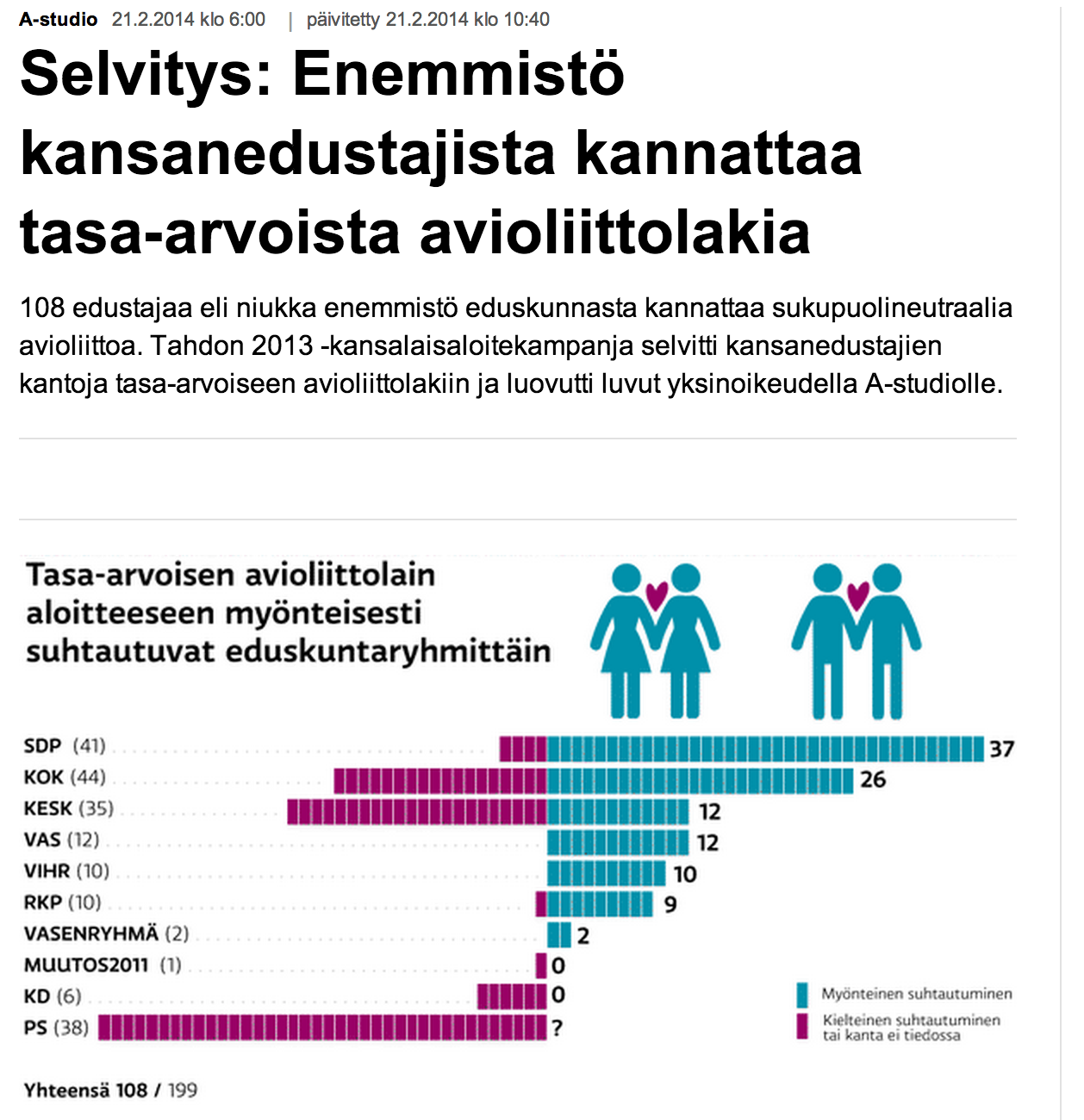
If we look at an A-Studio poll that was published Thursday, it shouldn’t surprise us that the same political parties that oppose gay marriage are against cultural diversity.

Which parties oppose gay marriage? It shouldn’t surprise us that at the head of the list is the anti-EU, anti-immigration and especially anti-Islam Perussuomalaiset (PS) party followed by smaller ones like the Christian Democrats.  The Center Party and National Coalition Party, are still split on the new law.

Kuvankaappaus 2014-2-22 kello 9.10.46

 A poll by A-Studio shows that 108 out of 199 MPs support the same-sex marriage initiative. Read full story here.

One could rightfully ask why is legalizing gay marriage important for Finland. The answer to this question is clear because there is a direct relationship with the ongoing debate on our ever-growing cultural diversity and how minorities should be accepted and respected in this country.

Finland has always been culturally diverse, according to Professor Jeremy Gould of Jyväskylä University.

“Culture is always diverse – people everywhere have different tastes, beliefs, habits, and values,” he told Migrant Tales. “This has been true of Finland for centuries. For me the so-called ‘debate about multiculturalism’ is a code word for racism in our society. Finland is already culturally diverse. The issue is that people of color don’t receive the respect and recognition they deserve as human beings.”

In the same way, the debate on granting gays the right to marriage is a code word for homophobia.

The same parties that aren’t ready to give gays the right to marriage are those that are doing everything possible to sabotage and deny our cultural diversity. Spearheading this campaign is none other than the PS.

When the new law is passed, not only will gays benefit from it but other minorities in our society. It will lead and fuel the long-overdue recognition and respect due to all minorities living in Finland.

That is why a lot rides on the passage of the gay marriage law.

  • 1
  • 2
  • 3
  • Next
Read more about documentary film
Read more

Recent Posts

  • Finland’s tabloids Iltalehti and Ilta-Sanomat are the pits
  • Riikka Purra’s Dr Jekyll and Mr Hyde mask
  • Double standards
  • Perussuomalaiset: Uusi logo, sama vanha juttu
  • Taco Trump

Recent Comments

  1. Absolutely Socking: Racist Finnish Facebook group against human rights gets flooded with socks on Musta Barbaari’s mother and sister charged by the police in “ethnic profiling” case
  2. Ilkka Nuotio on Pekka Myrskylä: “Tilastot kertovat toista kuin poliittinen keskustelu”
  3. Genrih Soinkara on The war in Ukraine and the Russian-Finnish border crisis are showing Finland’s ugly side
  4. Ahti Tolvanen on Comment by Ahti Tolvanen on the Helsinki +50 conference
  5. Angel Barrientos on Angel Barrientos is one of the kind beacons of Finland’s Chilean community

Archives

  • June 2026
  • May 2026
  • April 2026
  • March 2026
  • February 2026
  • January 2026
  • December 2025
  • November 2025
  • October 2025
  • September 2025
  • August 2025
  • July 2025
  • June 2025
  • May 2025
  • April 2025
  • March 2025
  • February 2025
  • January 2025
  • December 2024
  • November 2024
  • October 2024
  • September 2024
  • August 2024
  • July 2024
  • June 2024
  • May 2024
  • April 2024
  • March 2024
  • February 2024
  • January 2024
  • December 2023
  • November 2023
  • October 2023
  • September 2023
  • August 2023
  • July 2023
  • June 2023
  • May 2023
  • April 2023
  • March 2023
  • February 2023
  • January 2023
  • December 2022
  • November 2022
  • October 2022
  • September 2022
  • August 2022
  • July 2022
  • June 2022
  • May 2022
  • April 2022
  • March 2022
  • February 2022
  • January 2022
  • December 2021
  • November 2021
  • October 2021
  • September 2021
  • August 2021
  • July 2021
  • June 2021
  • May 2021
  • April 2021
  • March 2021
  • February 2021
  • January 2021
  • December 2020
  • November 2020
  • October 2020
  • September 2020
  • August 2020
  • July 2020
  • June 2020
  • May 2020
  • April 2020
  • March 2020
  • February 2020
  • January 2020
  • December 2019
  • November 2019
  • October 2019
  • September 2019
  • August 2019
  • July 2019
  • June 2019
  • May 2019
  • April 2019
  • March 2019
  • February 2019
  • January 2019
  • December 2018
  • November 2018
  • October 2018
  • September 2018
  • August 2018
  • July 2018
  • June 2018
  • May 2018
  • April 2018
  • March 2018
  • February 2018
  • January 2018
  • December 2017
  • November 2017
  • October 2017
  • September 2017
  • August 2017
  • July 2017
  • June 2017
  • May 2017
  • April 2017
  • March 2017
  • February 2017
  • January 2017
  • December 2016
  • November 2016
  • October 2016
  • September 2016
  • August 2016
  • July 2016
  • June 2016
  • May 2016
  • April 2016
  • March 2016
  • February 2016
  • January 2016
  • December 2015
  • November 2015
  • October 2015
  • September 2015
  • August 2015
  • July 2015
  • June 2015
  • May 2015
  • April 2015
  • March 2015
  • February 2015
  • January 2015
  • December 2014
  • November 2014
  • October 2014
  • September 2014
  • August 2014
  • July 2014
  • June 2014
  • May 2014
  • April 2014
  • March 2014
  • February 2014
  • January 2014
  • December 2013
  • November 2013
  • October 2013
  • September 2013
  • August 2013
  • July 2013
  • June 2013
  • May 2013
  • April 2013
  • March 2013
  • February 2013
  • January 2013
  • December 2012
  • November 2012
  • October 2012
  • September 2012
  • August 2012
  • July 2012
  • June 2012
  • May 2012
  • April 2012
  • March 2012
  • February 2012
  • January 2012
  • December 2011
  • November 2011
  • October 2011
  • September 2011
  • August 2011
  • July 2011
  • June 2011
  • May 2011
  • April 2011
  • March 2011
  • February 2011
  • January 2011
  • December 2010
  • November 2010
  • October 2010
  • September 2010
  • August 2010
  • July 2010
  • June 2010
  • May 2010
  • April 2010
  • March 2010
  • February 2010
  • January 2010
  • December 2009
  • November 2009
  • October 2009
  • September 2009
  • August 2009
  • July 2009
  • December 2008
  • November 2008
  • October 2008
  • September 2008
  • August 2008
  • July 2008
  • June 2008
  • May 2008
  • April 2008
  • March 2008
  • February 2008
  • January 2008
  • November 2007
  • October 2007
  • September 2007
  • August 2007
  • July 2007
  • June 2007
  • May 2007

Categories

  • ?? Gia L?c
  • ????? ?????? ????? ???????? ?? ??????
  • ???????
  • @HerraAhmed
  • @mondepasrond
  • @nohatefinland
  • @oula_silver
  • @Varathas
  • A Pakistani family
  • äärioikeisto
  • Abbas Bahmanpour
  • Abdi Muhis
  • Abdirahim Hussein Mohamed
  • Abdirahim Husu Hussein
  • Abdirisak Mahamed
  • About Migrant Tales
  • activism
  • Adam Al-Sawad
  • Adel Abidin
  • Afrofinland
  • Ahmed IJ
  • Ahti Tolvanen
  • Aino Pennanen
  • Aisha Maniar
  • Alan Ali
  • Alan Anstead
  • Alejandro Díaz Ortiz
  • Alekey Bulavsev
  • Aleksander Hemon
  • Aleksanterinliitto
  • Aleksanterinliitto ry
  • Aleksanterinliitto ry:n hallitus
  • Alex Alex
  • Alex Mckie
  • Alexander Nix
  • Alexandra Ayse Albayrak
  • Alexis Neuberg
  • Ali Asaad Hasan Alzuhairi
  • Ali Hossein Mir Ali
  • Ali Rashid
  • Ali Sagal Abdikarim
  • Alina Tsui
  • Aline Müller
  • All categories
  • Aman Heidari
  • Amiirah Salleh-Hoddin & Jana Turk
  • Amin A. Alem
  • Amir Zuhairi
  • Amkelwa Mbekeni
  • Ana María Gutiérrez Sorainen
  • Anachoma
  • Anders Adlecreutz
  • Angeliina Koskinen
  • Anna De Mutiis
  • Anna María Gutiérrez Sorainen
  • Anna-Kaisa Kuusisto ja Jaakko Tuominen
  • Annastiina Kallius
  • Anneli Juise Friman Lindeman
  • Announcement
  • Anonymous
  • Antero Leitzinger
  • anti-black racism
  • Anti-Hate Crime Organisation Finland
  • Anudari Boldbaatar
  • Arshiya Nasser
  • Aspergers Syndrome
  • Asylum Corner
  • Asylum seeker 406
  • Athena Griffin and Joe Feagin
  • Autism
  • Avaaz.org
  • Awale Olad
  • Ayan Said Mohamed
  • AYY
  • Barachiel
  • Bashy Quraishy
  • Beatrice Kabutakapua
  • Beri Jamal
  • Beri Jamal and Enrique Tessieri
  • Bertolt Brecht
  • Boiata
  • Boodi Kabbani
  • Bruno Gronow
  • Carmen Pekkarinen
  • Çelen Oben and Sheila Riikonen
  • Chiara Costa-Virtanen
  • Chiara Costa-Virtanen
  • Chiara Sorbello
  • Christian Thibault
  • Christopher Wylie
  • Clara Dublanc
  • Dana
  • Daniel Malpica
  • Danilo Canguçu
  • David Papineau
  • David Schneider
  • Dexter He
  • Don Flynn
  • Dr Masoud Kamali
  • Dr. Faith Mkwesha
  • Dr. Theodoros Fouskas
  • Edna Chun
  • Eeva Kilpi
  • Emanuela Susheela
  • En castellano
  • ENAR
  • Enrique
  • Enrique Tessieri
  • Enrique Tessieri & Raghad Mchawh
  • Enrique Tessieri & Yahya Rouissi
  • Enrique Tessieri and Muhammed Shire
  • Enrique Tessieri and Sira Moksi
  • Enrique Tessieri and Tom Vandenbosch
  • Enrique Tessieri and Wael Che
  • Enrique Tessieri and Yahya Rouissi
  • Enrique Tessieri and Zimema Mhone
  • Epäluottamusmies
  • EU
  • Europe
  • European Islamophobia Report
  • European Islamophobia Report 2019,
  • European Union
  • Eve Kyntäjä
  • Ezequiel Caldeiro
  • Facebook
  • Fadumo Dayib
  • Faisa Kahiye
  • Farhad Manjoo
  • Fasismi
  • Finland
  • Fizza Qureshi
  • Flyktingar och asyl
  • Foreign Student
  • Fozia Mir-Ali
  • Frances Webber
  • Frida Selim
  • Gareth Rice
  • Ghyslain Vedeaux
  • Global Art Point
  • Great Replacement
  • Habiba Ali
  • Hami Bahadori
  • Hami Bahdori
  • Hamid
  • Hamid Alsaameere
  • Hamid Bahdori
  • Handshake
  • Harmit Athwal
  • Hassan Abdi Ali
  • Hassan Muhumud
  • Heikki Huttunen
  • Heikki Wilenius
  • Helsingin Sanomat
  • Henning van der Hoeven
  • Henrika Mälmsröm
  • Hser Hser
  • Hser Hser ja Mustafa Isman
  • Husein Muhammed
  • Hussain Kazemian
  • Hussain Kazmenian
  • Ibrahim Khan
  • Ida
  • Ignacio Pérez Pérez
  • Iise Ali Hassan
  • Ilari Kaila & Tuomas Kaila
  • Imam Ka
  • inside-an-airport
  • Institute of Race Relations
  • Iraqi asylum seeker
  • IRR European News Team
  • IRR News Team
  • Islamic Society of Norhern FInland
  • Islamic Society of Northern Finland
  • Islamophobia
  • Jacobinmag.com
  • Jallow Momodou
  • Jan Holmberg
  • Jane Elliott
  • Jani Mäkelä
  • Jari Luoto
  • Jari Taponen
  • Jegor Nazarov
  • Jenni Stammeier
  • Jenny Bourne
  • Jessie Daniels
  • Joe Davidow
  • Johannes Koski
  • John D. Foster
  • John Grayson
  • John Marriott
  • Jon Burnett
  • Jorma Härkönen
  • Jos Schuurmans
  • José León Toro Mejías
  • Josue Tumayine
  • Jouni Karnasaari
  • Juan Camilo
  • Jukka Eräkare
  • Julian Abagond
  • Julie Pascoet
  • Jussi Halla-aho
  • Jussi Hallla-aho
  • Jussi Jalonen
  • JusticeDemon
  • Kadar Gelle
  • Kaksoiskansalaisuus
  • Kansainvälinen Mikkeli
  • Kansainvälinen Mikkeli ry
  • Katherine Tonkiss
  • Kati Lepistö
  • Kati van der Hoeven-Lepistö
  • Katie Bell
  • Kättely
  • Kerstin Ögård
  • Keshia Fredua-Mensah & Jamie Schearer
  • Khadidiatou Sylla
  • Khadra Abdirazak Sugulle
  • Kiihotus kansanryhmää vastaan
  • Kirsi Crowley
  • Koko Hubara
  • Kristiina Toivikko
  • Kubra Amini
  • KuRI
  • La Colectiva
  • La incitación al odio
  • Laura Huhtasaari
  • Lauri Finér
  • Leif Hagert
  • Léo Custódio
  • Leo Honka
  • Leontios Christodoulou
  • Lessie Branch
  • Lex Gaudius
  • Leyes de Finlandia
  • Liikkukaa!
  • Linda Hyökki
  • Liz Fekete
  • M. Blanc
  • Maarit Snellman
  • Mahad Sheikh Musse
  • Maija Vilkkumaa
  • Malmin Kebab Pizzeria Port Arthur
  • Marcell Lorincz
  • Mari Aaltola
  • María Paz López
  • Maria Rittis Ikola
  • Maria Tjader
  • Marja-Liisa Tolvanen
  • Mark
  • Markku Heikkinen
  • Marshall Niles
  • Martin Al-Laji
  • Maryan Siyad
  • Matt Carr
  • Mauricio Farah Gebara
  • Media Monitoring Group of Finland
  • Micah J. Christian
  • Michael McEachrane
  • Michele Levoy
  • Michelle Kaila
  • Migrant Tales
  • Migrant Tales Literary
  • Migrantes News
  • Migrants' Rights Network
  • MigriLeaks
  • Mikko Kapanen
  • Miriam Attias and Camila Haavisto
  • Mohamed Adan
  • Mohammad Javid
  • Mohammad M.
  • Monikulttuurisuus
  • Monisha Bhatia and Victoria Canning
  • Mor Ndiaye
  • Muh'ed
  • Muhamed Abdimajed Murshid
  • Muhammed Shire
  • Muhammed Shire and Enrique Tessieri
  • Muhis Azizi
  • Musimenta Dansila
  • Muslimiviha
  • Musulmanes
  • Namir al-Azzawi
  • Natsismi
  • Neurodiversity
  • New Women Connectors
  • Nils Muižnieks
  • No Labels No Walls
  • Noel Dandes
  • Nuor Dawood
  • Omar Khan
  • Otavanmedia
  • Oula Silvennoinen
  • Paco Diop
  • Pakistani family
  • Pentti Stranius
  • Perussuomalaiset
  • perustuslaki
  • Petra Laiti
  • Petri Cederlöf
  • Pia Grochowski
  • Podcast-lukija Bea Bergholm
  • Pohjois – Suomen Islamilainen Yhdyskunta
  • Pohjois Suomen Islamilainen Yhyskunta
  • Polina Kopylova
  • Race Files
  • racism
  • Racism Review
  • Raghad Mchawh
  • Ranska
  • Rashid H. and Migrant Tales
  • Rasismi
  • Raul Perez
  • Rebecka Holm
  • Reem Abu-Hayyeh
  • Refugees
  • Reija Härkönen
  • Remiel
  • Reza Nasri
  • Richard Gresswell
  • Riikka Purra
  • Risto Laakkonen
  • Rita Chahda
  • Ritva Kondi
  • Robito Ibrahim
  • Roble Bashir
  • Rockhaya Sylla
  • Rodolfo Walsh
  • Roger Casale
  • Rostam Atai
  • Roxana Crisólogo Correa
  • Ruth Grove-White
  • Ruth Waweru-Folabit
  • S-worldview
  • Sadio Ali Nuur
  • Sami Rusanen
  • Sandhu Bhamra
  • Sara de Jong
  • Sarah Crowther
  • Sari Alhariri
  • Sarkawt Khalil
  • Sasu
  • Scot Nakagawa
  • Shabana Ahmadzai
  • Shada Islam
  • Sharon Chang blogs
  • Shenita Ann McLean
  • Shirlene Green Newball
  • Sini Savolainen
  • Sira Moksi
  • Sonia K.
  • Sonia Maria Koo
  • Steverp
  • Stop Deportations
  • Suldaan Said Ahmed
  • Suomen mediaseurantakollektiivi
  • Suomen Muslimifoorumi ry
  • Suomen viharikosvastainen yhdistys
  • Suomen viharikosvastainen yhdistys ry
  • Suomi
  • Supermen
  • Susannah
  • Suva
  • Syrjintä
  • Talous
  • Tapio Tuomala
  • Taw Reh
  • Teivo Teivainen
  • The Daily Show
  • The Heino
  • The Supermen
  • Thomas Elfgren
  • Thulfiqar Abdulkarim
  • Tim McGettigan
  • Tino Singh
  • Tito Moustafa Sliem
  • Tobias Hübinette and L. Janelle Dance
  • Transport
  • Trica Danielle Keaton
  • Trilce Garcia
  • Trish Pääkkönen
  • Trish Pääkkönen and Enrique Tessieri
  • Tuulia Reponen
  • Uncategorized
  • UNITED
  • University of Eastern Finland
  • Uyi Osazee
  • Väkivalta
  • Vapaa Liikkuvuus
  • Venla-Sofia Saariaho
  • Vieraskynä
  • W. Che
  • W. Che an Enrique Tessieri
  • Wael Ch.
  • Wan Wei
  • Women for Refugee Women
  • Xaan Kaafi Maxamed Xalane
  • Xassan Kaafi Maxamed Xalane
  • Xassan-Kaafi Mohamed Halane & Enrique Tessieri
  • Yahya Rouissi
  • Yasmin Yusuf
  • Yassen Ghaleb
  • Yle Puhe
  • Yuliet Tresa
  • Yve Shepherd
  • Zahra Khavari
  • Zaker
  • Zalina Ametova
  • Zamzam Ahmed Ali
  • Zeinab Amini ja Soheila Khavari
  • Zimema Mahone and Enrique Tessieri
  • Zimema Mhone
  • Zoila Forss Crespo Moreyra
  • ZT
  • Zulma Sierra
  • Zuzeeko Tegha Abeng
© 2026 Migrant tales | Powered by Minimalist Blog WordPress Theme