Migrant tales
Menu
  • #MakeRacismHistory “In Your Eyes”
  • About Migrant Tales
  • It’s all about Human Rights
  • Literary
  • Migrant Tales Media Monitoring
  • NoHateFinland.org
  • Tales from Europe
Menu

Month: February 2014

Migrant high unemployment in Finland is a good way to measure discrimination and social exclusion

Posted on February 10, 2014 by Migrant Tales

Apart from Jim Crow laws and centuries of discrimination, one of the many social issues that the U.S. Civil Rights Movement of the 1950s and 1960s addressed was high unemployment among blacks. In a country like Finland, which sees work as a crucial pathway to inclusion and acceptance, it’s clear that unemployment is an effective to way to socially exclude and subjugate groups from society.

The expectations of some Finns about migrants is so low that they are willing to accept them to work in low-paying jobs that they would never take.

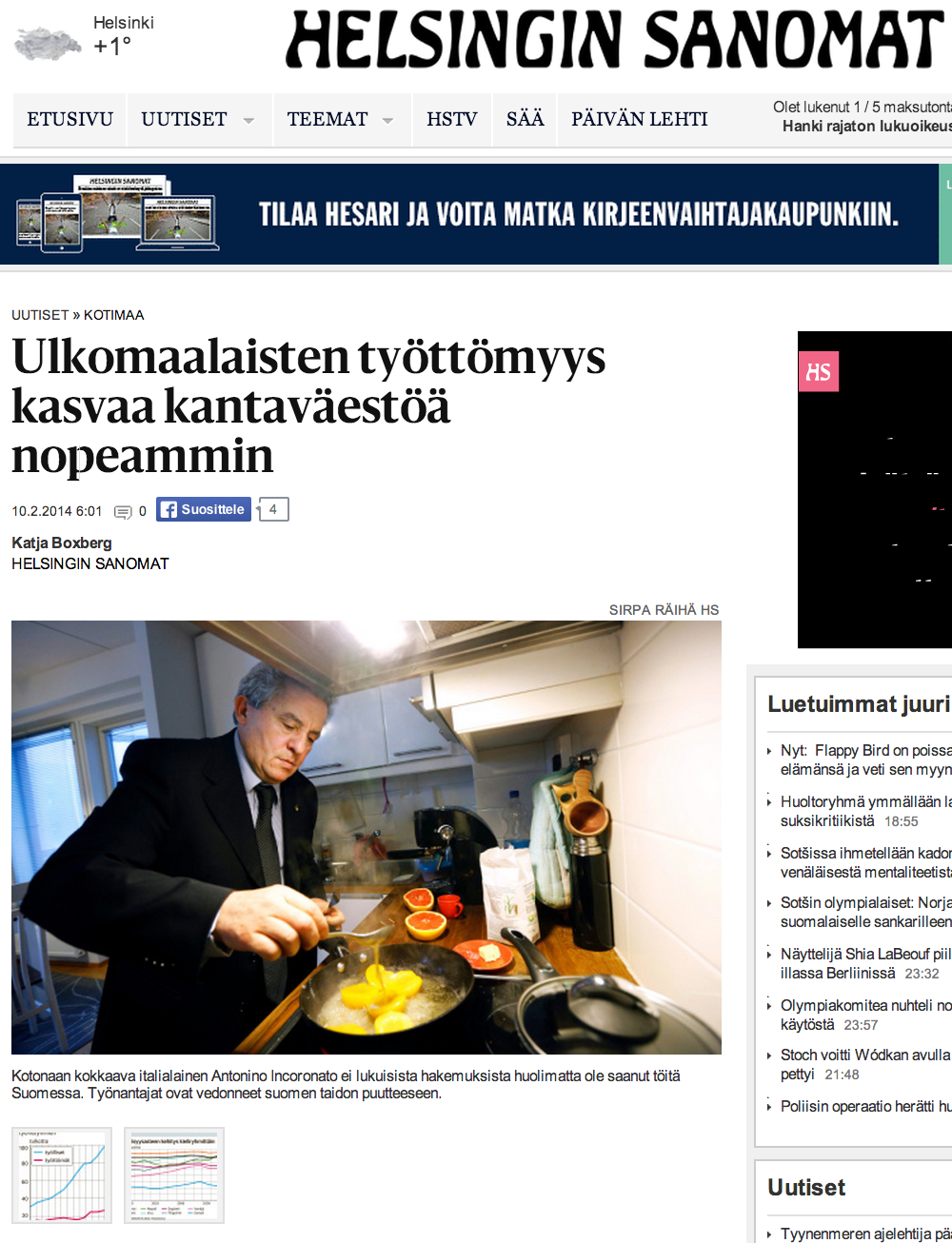
According to a Helsingin Sanomat article, the jobless rate among migrants rose by one fifth to close to 30,000 migrants compared with a year ago. Migrant unemployment in 2012 totaled over 22%.

As long as unemployment is 2-3 times higher than the national average, it means that migrants, and especially their children, will be denied a better life in Finland.

Why isn’t abysmally high unemployment among some members of the migrant community in Finland an issue? It not only shows, in my opinion, the little social consciousness of some migrants but our little interest in tackling social ills like intolerance and discrimination.

The present situation reveals as well how Finland has benefited from high unemployment among migrants. Not only does it keep certain migrant groups in check, it keeps social workers employed and anti-immigration politicians from parties like the Perussuomalaiset (PS) in the headlines.

One answer that sheds light on the above-mentioned is that racism makes people and groups invisible.

Kuvankaappaus 2014-2-10 kello 7.53.15

Read full story here.

Attempting to answer the question, why we’re not paying enough attention to an issue like high unemployment among migrants, is the problem.

Certainly I can give you a long list of excuses why a migrant is unemployed. What I’m not doing is dealing with the many causes of the problem, like structural racism, or how unemployment and social welfare are used to socially exclude migrants.

True, language and the ability of a migrant to adapt to a new country play crucial roles in that person’s adaption and integration.

An opportunist called PS MP Jussi Halla-aho of Finland

Posted on February 9, 2014 by Migrant Tales

If there’s one politician who has successfully made a career by spreading racism and victimizing a group like Somalis in Finland, that politician is Perussuomalaiset (PS) MP Jussi Halla-aho, who is running for MEP. Apart from playing on people’s fears about migration and cultural diversity, the PS MP is a very unthankful person. 

Kuvankaappaus 2014-2-9 kello 15.24.01

Read full story here.

Those people that Halla-aho commonly victimizes in Finland, like African Muslims from Somalia, are the ones who gave him for the time being a political career.

Just like many far-right anti-immigration politicians, Halla-aho actually believes that he can say anything he wishes, rewrite history and contrive arguments that are  nothing more than hearsay and storms in teacups.

While Halla-aho’s party does well in opinion polls, the presidential and municipal elections were a far cry from the historic result that the right-wing populist party gained in the 2011 parliamentary elections.

Even if Halla-aho and the PS want to show that they are unbeatable and immortal, the truth is that they are very vulnerable and know that returning back to the minor political leagues is always a scenario.

Just like when calling a pyromaniac to put out a fire, Halla-aho visited Lieksa on Saturday, which was in the national media spotlight again in December when a councilman of the same party as the PS MP said he wanted to meet in a “Somali-free” room.

One of the big lies that Halla-aho has spread in Finland is that migration is negative because those coming here are only Africans, Muslims and from Somalia.

He forgets to point out that the majority of migrants in Finland work and that the groups he victimizes are a small minority.

“Problems don’t arise from someone making imprudent statements about immigrants and speaking badly of them,” he was quoted as saying Saturday on Karjalainen. “The problem lies in some immigration groups that have given a negative picture of themselves with their own actions.”

The claim by Halla-aho is ludicrous because it is a common debating tactic used by politicians like him to shift the blame on the victim.

His statement is similar to blaming Jews in Nazi Germany for the Holocaust.

  • There was very good coverage of Halla-aho’s visit to Lieksa by MTV3. 

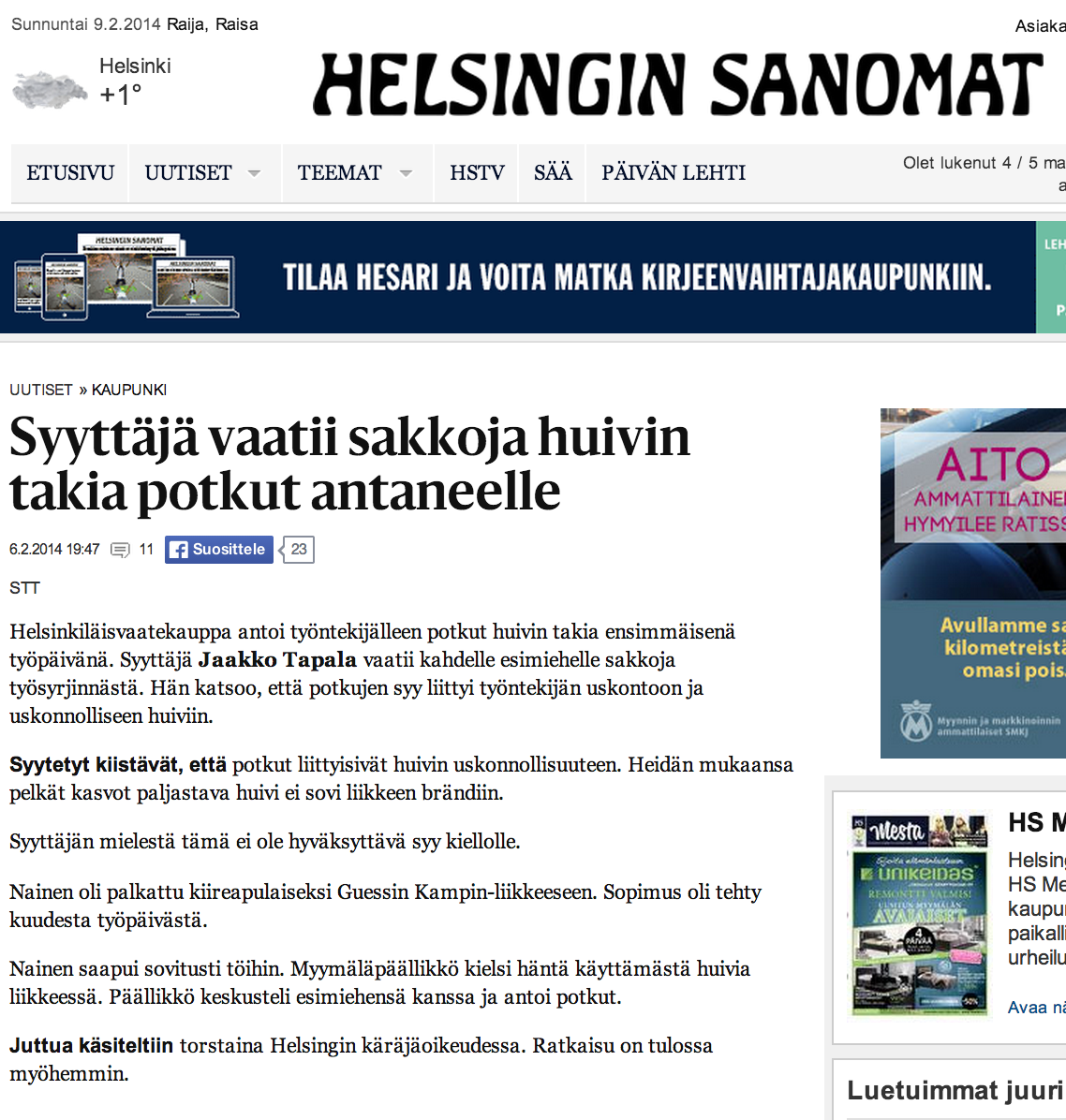
Guess Helsinki: Saleswoman gets fired for wearing headscarf to work

Posted on February 9, 2014 by Migrant Tales

A Muslim woman who wore a headscarf to work on her first day was fired, reports Helsingin Sanomat, Finland’s largest daily. Even if the managers of the Guess clothing store deny that the women was fired because she is a Muslim, prosecutor Jaakko Tapala is filing a charge for job discrimination.

The two managers said that the reason why the woman, who was hired to work as a temporary employee for six days, was fired was because the veil didn’t fit the clothing store’s brand.

The incident has received wide coverage on social media.

Michaela Moua said on Facebook below: “Shocking…’doesn’t fit the clothing store’s brand…’ should the brand be racism and discrimination? Not a good look…

Kuvankaappaus 2014-2-9 kello 0.30.55

Kuvankaappaus 2014-2-9 kello 0.24.12

Read full story here.


Finland had 3,238 asylum seekers in 2013

Posted on February 7, 2014 by Migrant Tales

A total of 3,238 people applied for asylum in Finland compared with 3,129 people in the previous year, according to the Finnish Immigration Service. The largest single group of asylum seekers was Iraqis (819) followed by Russians (226) and Somalis (217).

The number of asylum seekers coming to Finland oscillated between 1,500 and 6,000 over the 5-year period from 2006 to 2010.

Kuvankaappaus 2014-2-7 kello 21.51.37

Read full story here.

”The situation has been stable for a few years,” Esko Repo, head of the FIS refugee unit, was quoted as saying in Helsingin Sanomat.

A total of 4,055 asylum decisions were made by the authorities last year.  Forty-five percent (1,827 applicants) were given asylum while the rest were rejected.

The average processing time for asylum applications was 190 days, with 80% of  applicants processed in 156 days.

Meanwhile in neighboring Sweden, the total number of asylum seekers in 2013 was 54,259 persons, or whom 24,498 were given asylum, according to the Migration Board of Sweden. This compares with 11,983 asylum seekers in Norway in 2013 and 3,896 in Denmark during the first three quarters of the year.


We can do it and send Halla-aho and the PS to where they came from

Posted on February 5, 2014 by Migrant Tales

I still remember April 2011, when the anti-EU, anti-immigration and especially anti-Islam Perussuomalaiset (PS) party opened a gloomy chapter in Finland’s history by getting 39 MPs elected to parliament. The election was impressive to say the least considering that only 5 PS MPs got elected in 2007.

yes we can

Source: www.youthventure.org

While some were surprised by the election result, some played it down. They felt that the PS would blow over and that it’s only a question of time when the party would implode, like the Rural Party of the 1970s, due to internal differences.

While the PS does well in opinion polls, the presidential and municipal elections were a far cry from the historic result that the right-wing populist party gained in the 2011 parliamentary elections.

With two crucial make-or-break elections in May and April 2015, the million-euro question is how well will the PS fare.

Certainly a lot of things can happen from here to May and April of next year, there are signs that the public is getting tired of the PS political scandals and the racism that continues to plague the party.

While there was a definite honeymoon with the PS’ chairman, Timo Soini, the media and public have started to lose interest in the charismatic leader.

And this is quite understandable considering that the PS have not given one credible solution to put the Finnish economy back on a healthy path of growth. It’s MPs are more interested in whining and machismo, which has a heavy dose of intolerance, nationalism and bravado, instead of offering credible solutions.

One of the biggest mistakes that the PS is making at this moment is that it believes its election good fortunes of 2011 are eternal, which reveals why the party has become arrogant and power-hungry.

I believe that we’ll see big surprises in the following MEP and parliamentary elections and that the election of PS MP Jussi Halla-aho is still undecided. Certainly the misfortunes of the PS rest on themselves and how well Finland’s traditional parties can expose Soini’s political antics and double-talk.

Finland took a clear swing to the populist and far-right three years ago. Finnish voters in 2012 gave an inconclusive show of support to the PS in the presidential and municipal elections.

The next two elections will decide whether the PS will be sent or not back to the minor political leagues.


Uncle Toms, or mamus, are used to control minority groups

Posted on February 5, 2014 by Migrant Tales

It’s interesting to read how some white Finns get all jumpy when you speak about Uncle Toms, or mamus, in Finland. One such blogger, Veli-Pekka Leivo, claimed that labeling someone a traitor to his ethnic group fuels and supports victimization. 

Victimization? How much harm does an Uncle Tom do to members of his community by ensuring that a certain migrant or minority group becomes passive?

As our society in Finland become more culturally diverse and social ills like racism are exposed, the more vigilant we have to be against mamus. They, if anyone, are the ones holding their people back because their job is to keep their group passive and accept the status quo.

Malcolm X said in the 1960s that the same old slave master today has Negroes who are modern Uncle Toms, or 20th century Uncle Toms. “…to keep you and me in check, keep us under control, keep up passive and peaceful and non-violent. That’s Tom making you non-violent…”

As migrants and minorities struggle for greater rights in Finland, it is important that we have a term that can be used against those who betray the cause and their people.

http://www.youtube.com/watch?v=HDWZWSPUX1k

Migrants’ Rights Network: When single markets and the inequalities of global trade provide the basis of a ‘right to migrate’ (Part 3)

Posted on February 3, 2014 by Migrant Tales

Don Flynn*

Don_web_0


This is the final blog in a three part series which sets the reasons why we need a clearer and more precise idea of the rights which migrants need if they are to prosper in the modern world. Here we argue that the assertion of a ‘right to migrate’ is the touchstone for all the other types of security and protection which migrants should be able to rely on. 

we_are_here

The Oxford University economist, Martin Ruhs, has drawn attention to the dilemma faced by groups and networks supporting migrants, arguing that, the more rights that are claimed for people who move the less national governments appeared to be prepared to admit them into their jurisdictions in the first place. Ruhs regrets this fact, on the grounds that it undermines the role that migration plays in the global economy in promoting welfare and redistributing wealth. Because he would like to see more welfare and higher levels of wealth redistribution he calls on migrants to be less fussy in asking for rights and accept the fact that the opportunity on almost any terms to live and work for a period in jobs in the developed economies is too good to give up.

More or less the same proposition of a trade off between rights and the opportunity to migrate is accepted by others participating in this discussion, most recently another Oxford academic, Paul Collier. Colier calls for stronger rights for those migrants who have managed to establish themselves abroad, on the basis that this will have the effect of reducing the volume of migration which host countries are prepared to tolerate. Collier thinks there’s too much migration going on in the modern world and an insistence it be permitted only on the grounds that full equality of treatment with citizens was granted would be a good way to choke it off.

In practice both of these approaches, if they were ever to be applied in their pure form, would give rise to a vicious spiral that would likely result in highly levels of irregular migration and the diminution of the rights of those who had achieved a legal status. Ruhs’s proposal, which is applied  in a number of rich but labour-scarce countries, imposes high costs but limits the returns that come from decent wages for migrants using the permitted short-term labour schemes and thereby forces many towards rule-breaking activity in order to re-coup their losses. The national authorities of the host country invariably counter this by increasing their surveillance of all migrant communities and restricting the social space in which rights can be exercised to an even greater degree.

Collier’s stance is ignorant of the fact that the rights which are of most importance to migrants are those which increase their capacity to act transnationally, engaging both with matters concerning the welfare of family and compatriots in regions of origin as well as the ability to leverage an optimum earning capacity in the host country.  As anyone who works closely with migrant communities knows, what internationally mobile people want and is security in their of residence status and, at the same time, the assurance that they can respond to changing needs within their personal support networks by either travelling abroad themselves or sponsoring the admission of others.  The right that would be of most use is one which, ironically, most citizens of the charmed circle of high income countries think they already have, which is the firm assurance that their travel across borders will be subject to the very minimum of personal inconvenience.  For brevities sake, let’s call it a right to migrate.

EU free movement as a ‘right to migrate’

Could an officially acknowledged right to migrate be made to operate on a wider basis?  The important example of free movement within the EU to gives us some ideas on the principles that would be involved.

The right to migrate, which is effectively what free movement is all about, has emerged in Europe as a consequence of the efforts to create a single market covering goods, services, capital and labour.  Its unique feature, being a project undertaken during a time when recovery from the cataclysmic events of the first half of the 20th century, lay in the fact that it was fundamentally driven by the political objective of resolving the tensions which had driven the continent to devastating war twice within the space of fifty years.

The emergence of single markets gives us good idea when the time might be right to accede to a right to migrate.  There are certainly many who would criticise the NAFTA agreement, which created a single market for goods and capital between Canada, the US and Mexico in 1994.  The flood of investment into the northern region of Mexico that came about under the agreement combined with the ruinous effect on large sectors of agriculture in that country caused by the dumping of cheap US products, forced a huge wave of movement on the population of the central American country, some of which was absorbed into the low-cost manufacturing maquiladora programmes which operated close to the US border, and a large part of the rest continuing their movement as irregular, undocumented migrants in the US. A properly instituted free movement of people chapter in NAFTA would have averted what has turned into two decades of often anarchic and violent labour trafficking.

But the fact is the need for clearer and more definite rights to migrate is prompted even before fully fledged single markets come into existence.  The evidence of more mundane interpenetration of commerce between countries is often sufficient to trigger the practical need for freer movement, particular when uneven economic development leads to inequalities in trading outcomes.  As long as the much-desired ‘level playing field’ is unreached then the terms of trade favour the interests of already dominant parties, making the task of catching up much more difficult  for the less developed.

This is the reason why, unlike the case of the formation of the European single market, the issue of the free movement of labour is seldom addressed when free trade agreements are drafted at the global level.  Preventing workers from moving to places where they could get the best terms for the sale of their labour is one of the ways in which rich countries can gain even more of an advantage, by bottling up the down-side of free markets in territories where they don’t have to address its social and economic problems.

The refusal of the policy makers of the Global North to consider the implications of their commercial systems  – the wiping out of trade sectors of trade and industry, the drift of the under-employed into the urban centres which are attracting foreign direct investment, the turbulence and insecurity of the new labour markets that come into existence, the sharper polarisation of populations into the new rich and the new poor – all this sets out the moral basis for a right to migrate.

Old rallying cry

In the 1960s and 70s Commonwealth migrants arriving in the UK challenged the racism they confronted with by proclaiming “We are here because you were there.”  We are here because your country entered ours and radically altered ways of life, enriching some but also plunging others in new forms of poverty, and putting an unsustainable strain of the social structures which had provided for the security and well-being of local populations in the past.

“We are here because you were there”, applies with equal force for the people of any country which has been brought into the mainstream of market globalisation, whether they are the post-colonial nations of Africa, Asia and the Caribbean region, of the post-Soviet societies of Eastern and Central Europe.  Supporting the moral right to “be here” is the basic reason why the migrants’ rights movement is bound to support, not just equal treatment and non-discrimination for those who have managed to fit in with the rules proscribed by official migration management, but also to test and stretch these systems by pushing harder to widen and extend the channels through which people migrate.  For many this earns them the status of being ‘illegal’ migrants, but the opprobrium attached to that title carries ought to be regarded as on a par with the term ‘runaway slaves’ in the years before abolition. In both cases the breaking of the law takes place as a consequence of a class struggle between labour and capital at a global level, with labour struggling to obtain better terms for itself by changing the ways in which markets operate.

When a right to migrate is in place the ability of migrants to obtain the other rights due to them and spelt out in international conventions will be hugely enhanced.  Without the fear of arrest and deportation, migrants will have the confidence to press for better terms and conditions of employment.  As the rights gap between themselves and other tax-payers is diminished they will be able to claim a proper stake in the benefits and public services which exist to promote the welfare and security of the community.

Finally, the ultimate genius of proclaiming a right to migrate lies in the fact that it does not depend, in its early stages at least, on the action of any government to bring it into being.  The eminent historian of human rights, Lynn Hunt, has described how the struggle for change is not initiated by government authority, but ordinary people who feel a lack of something important in their lives: “You know the meaning of human rights”, she argues, “because you feel distressed when they are violated.”  It is the action which arises from this feeling of distress, the determination to obtain redress and push against all the forces that deny relief, that drives our societies towards reform.

The distress that is acute for many people across the world today comes from the fact that, whilst they are obliged to live in the world create and ordered by the rise of the global economy, the right to make at least a part of that world work better in their interests is denied to them.  The assertion of a right to migrate through the direction action of migrants, combined with solidarity action on the part of others who recognise the legitimacy of the claim for that right, is the core logic of what we mean today by “migrants’ rights”.  So, how we organise ourselves for the campaigns that will be needed to make this right a reality?

Read original story here.

This piece was reprinted by Migrant Tales with permission.

*Don Flynn, the MRN Director, leads the organisation’s strategic development and coordinates MRN’s policy and project work. He is a regular and sought-after speaker at conferences, seminars and lectures on behalf of MRN.

Interior Minister Päivi Räsänen is on the anti-immigration warpath again

Posted on February 2, 2014 by Migrant Tales

Anti-immigration and anti-gay hardliner Christian Democrat interior minister, Päivi Räsänen, said on YLE in English that she’s in favor of tightening immigration policy further by closing a “loophole” for asylum seekers. Under the present law, those asylum seekers whose application has been turned down, can get temporary residence for two years before acquiring a permanent residence permit. 

While we’re speaking of a “huge” number of asylum seekers – about 200 in all – it’s these types of laws that not only reveal our suspicion of asylum seekers and migrants in general, but ensures that skilled migrants will not move to Finland in significant numbers.

And why would they? Migrants want to move to countries where other migrants live – not some cold place that is unsure about its ever-growing cultural diversity and where too many politicians treat refugees like “welfare shoppers.”

What’s wrong if a person wants to move from a country where he has no future to one where there’s opportunity? Isn’t that what over 1.2 million Finnish emigrants did between 1860 and 1999? Can you punish somebody for seeking a better future?

In order for Finland to begin accepting its ever-growing cultural diversity, it has to revisit its history and ask why during most of the last century until 1995, when Finland became an EU member, did it do everything possible to hinder migrants and foreign investment to the country.

Kuvankaappaus 2014-2-2 kello 10.26.28

Read full story here.

Räsänen’s get-tough stand on a handful of asylum seekers isn’t surprising since it’s the same policy and attitude that many politicians have about refugees, migrants and our ever-growing cultural diversity.  It’s a good example of the usual overkill by them.

According to YLE in English, the change in the law would affect asylum seekers especially from Afghanistan, Iraq and Somalia, which are ravaged by war.

“A person that does not voluntarily leave to a country seen as safe gets a temporary residence permit, that after two years becomes a permanent residence permit,” Räsänen was quoted as saying on Yle in English. “We propose that the law is changed so that temporary residence permits are no longer granted on that basis.”

Some human rights associations believe that the new law will encourage asylum seekers to become undocumented migrants.

Fadumo Dayib: The Cannibalistic Clan Club aka CCC

Posted on February 1, 2014 by Migrant Tales

Fadumo Dayib

Caraweelo, both fists raised in defiance, body contorted in mockery and eyes wide open with belligerence, burst into this world with a single, loud, blood-curling scream. Her kin, upon seeing the jewel between her legs, drew back with disgust and disappointment, all the while murmuring verses of protection.

A few old men, scared out of their wits and way past their due date, lay comatose on the scorching ground, recovering from the chilling scream. God help their kin from this abomination, this vile curse. What a waste of space, of humanity. She was and would never be of use to their kin. Surely, the drought and this creature were Satan’s antics, his offspring. Caraweelo, who could read their minds, spread her legs wide, reached for her jewel and rained on the land. She knew she had a long journey ahead of her, a destiny to fulfill. She looked into the tired eyes of her mother, laughed and reached for sustenance.

Caraweelo was blessed with the gift of insight, reflection and observation. She watched quietly, hidden in the safe zone in her mind. Women, in colorful robes, flirted back and forth, selling their dreams. Their men, fat and belching, the leeches, sat on mats chatting and chilling. They were discussing important matters, Caraweelo was told, and should not be disturbed. But Caraweelo knew better. She chewed her lips, drawing blood. She shuddered with resentment. They were fools in skirts, cowards who never ventured into war. Instead, they sat, plotted and planned the down-fall of an unseen rival. After dark, they would jump on their bone-weary wives and gallop into the sunset, alone.

When Caraweelo was six, her grandfather came for her one dark night and took her worth away. As she lay, bleeding and petrified, he proved why blood was thicker than water. You see, charity starts at home. Yes, it is true that nobody has the power to hurt you as your kin. It did not matter that she was still in stitches, recovering from mutilation, in strict observation of culture and tradition. She was their rubbish bin, their semen cup. That was all she was good for and would ever be good for. Caraweelo’s mother told her to bite her tongue, to sit on her lips and to conform. A good girl should not be seen, should not be heard and should aim to please. Hush child. This is your destiny, your role in life. Caraweelo disagreed silently. Her day would come one day.

When Caraweelo was thirteen, her grandfather gave her to his close friend…his distant cousin. He had trained her well and knew that she would bring prestige to her family. She watched from afar as the two old men sat, whispering and giving her furtive glances. Her 50-something year old husband looked at her, smacking his wrinkled lips. With the exchange of one camel and two cows, Caraweelo moved into the camp of her kin, her grandfather. That night, Caraweelo tasted bondage, tasted fear and blood. She had flashbacks of her violent initiation, her rape, into her kin…her clan. Her 13-year old body curled into itself, begging for mercy. He was oblivion to her cries, heaving and gasping. Shush. You’re a woman amidst millions of other women with similar faiths and destinies. You’re nothing. You don’t count. You don’t belong to any clan. Caraweelo bit down, swallowing her screams, cursing and vehemently disagreeing.

Caraweelo’s husband came into some wealth and moved her to Mogadishu. She was a young mother and still proud. She was still standing…..still strong. War broke out and they had to flee their beloved country. Finland was open, welcoming….or so she thought. Her old husband found the new country tough and turned to bitterness.

As he grew old, diminishing, Caraweelo grew into a beautiful black swan. She learned the new language, the new culture and embraced the new world she’d stepped into. Hush woman. Stick to your four walls and raise your children. Enough of your madness. Shut up, Caraweelo yells. You don’t own me anymore. Shush woman. You’ll go to hell for disobeying God. Shut up, she yells back. Since when did you abide by God’s rules? Hush infidel. Her husband – a serial wife beating rapist – became a sheikh during the day. When religious blackmail failed, her husband resorted to karate chops and kicks. When the next karate chop came, her husband suddenly found himself on the floor of their flat, overpowered by emancipation and enlightenment.

Caraweelo’s kin, her clan came to reconcile the two. This was the day she had lived for all her life. They came, all men. Of course they were all men. The cannibalistic clan is an exclusive club for goat-fuckers, father-fuckers, mother-fuckers and daughter-fuckers. Caraweelo let it rip. She let the shit hit the fan. Hush woman. Blood is thicker than blood. You’re mistreating your grandfather….your next kin of blood. He has sole ownership over your body. Shut up, Caraweelo yells. Where were you when my kin was ripping me apart? Raping my innocence? Shush woman. He has rights over you, rights over your children. Please, she says and rolls her eyes. I am married to the Finnish government. It pays my bills, puts a warm roof over my head, educates my children and takes care of my worries. Hush woman. You kin, your clan are your blood and marrow. Please, she yells back. I was born into wilderness. I never belonged. I was never counted for.

Caraweelo, after getting rid of her nightmare, ended up with her son. A tyrant like his father.  When he fully slipped into his father’s shoes, she cut the umbilical cord and threw him out. She devoted her time, energy and love to raising queens, to raising warriors, to her daughters. She watches other women silently, with keen observation. She observes the clannish women. They look smart and educated on the exterior, but are rotten to their clan core. They parrot talk about emancipation, empowerment, nationalism, religion and equality during the day time and turn into clan cannibals when the sun sets. They conspire to congregate in dingy cafes, smelly alleys, forsaken homes and treacherous associations with their kin, their men, plotting and planning.

Caraweelo knows these women. After all, they are her cousins, her mother, her aunts, her grandmothers and her offspring. They are her and she is them. These are women who are more loyal to their clan than to their womanhood. Hush woman. Don’t hush me monster. You are repugnant….a traitor to womanhood……a traitor to Somalia. Instead of getting ahead based on qualifications, you resort to writing lists with your moronic kin. After all I went through, for you and for all the other women, this is what you do, she admonishes. I sold charcoal, my body and paid everything I had in my possession so that you could get to safety. Hush, I am Caraweelo. Let me speak. Let me put things into perspective for you.

You came to the Diaspora on the pretext of running from the clan militia, your cousins. What do you do upon reaching safety? You churn out lists, hate lists, of those you perceive to be better than you. Because it irks you that others are progressing, are making an honest living and getting ahead in life, you obsess over your lists. It irks you that you never managed to annihilate them from the face of the earth. You are a traitor, conspiring with men, your kin, your clan that raped you, molested you and your children. You are supporting a structure that enslaves you, dehumanizes you, denies you existence and that is uncivilized. Don’t you ever shush me! You never mattered to them and even as you conspire with them, they still despise you. Don’t you see my sister, my daughter, as long as you have a jewel between your legs, you’ll never matter to them.

Caraweelo speaks the truth. It hurts and is unpleasant. The cannibalistic clan mentality is deeply ingrained in these women. Every Friday or Saturday evening, they appear adorned in expensive robes and gold. They show up for their clans in the numerous weddings taking place almost every week. Yes, blood is thicker than water. Some of them have never worked a day in this country, can never write nor read any language. It is not uncommon to run into them at the health centers with back-aches, stomach-aches and other psychosomatic ailments. They’ll do anything to get out of going to school, work or reality. To becoming productive citizens. However, on that evening when their clan multiples, they’ll speak in languages. Hallelujah! When the lies start about her clan….how they rule the seas..even when they’ve never seen what it looks like and all of that shit….she’ll jump into the air, flick backwards, somersaulting all over the place and rolling on the carpet. Hallelujah! A miracle, she’s cured of her back-ache, her debilitating sickness. What a pity that the employment office staff, or the social worker, aren’t there to see this miracle.

Hush little girls. Give it up. Burn those lists. Desist with your malicious efforts. Your opponents still continue to exist despite your lists. Your hosts, although initially puzzled and supportive, now can see through your deception. No, she yelps, uncertainty in her eyes. I am my clan and they love me. Shush girl. That’s the devil talking in you, Caraweelo says. Desist with your poison. The CCC is not for you. It never was and it never will be. Cannibals eat each others. They’ll turn on you when all else has been eaten. Stop sponsoring your terrorist cousins. Cut their funding and put an end to their pillaging of Somalia. Somalia is one and will always be one. Put your clan flag away and unite under womanhood.

Shush little girl. You belong with the women folk, we are your womanhood, your sisterhood. You belong with me, with us. I will cure you of your disease, you’re dear to me, you’re my blood and marrow, Caraweelo says. Yes, Caraweelo, we hear you. Yes mama Caraweelo…..my queen…I hear and obey you. Yes, they are diseased and if they don’t want a cure, then they should leave. We turn, Caraweelo at the helm, both fists in the air and we scream in unison, shattering windows…eardrums. If you won’t join us, then go on and leave. You don’t belong in civilization. You are not worthy of Caraweelo. Go back to where you come from and indulge your sickness there. You’re not worthy of womanhood…of freedom. Your cage is open…yet you are still in bondage.

* Some background information on Queen Caraweelo (http://www.jaakoole.com/2010/02/queen-caraweelo/)

Read original column here.

This piece was reprinted by Migrant Tales with permission.

Should Finland’s Uncle Toms be called mamus?

Posted on February 1, 2014 by Migrant Tales

Alarm bells go off inside of me whenever I hear migrants, who should know better, claim that racism isn’t a major issue in our society many times standing next to or speaking to white Finns. There are many reasons why a migrant may play down such a social ill. These may include ignorance, prejudice, lack of courage and outright opportunism. 

Whatever the reasons may be, one matter is needed in Finland’s migrant terminology: A Finnish equivalent of Uncle Tom.

For those who are unfamiliar with the term, Uncle Tom’ Cabin debut in 1852 as a play that aimed to raise awareness against slavery in the United States.

Despite its noble beginnings, the meaning of Uncle Tom has changed to mean today a black man who will do anything to appease his white oppressors, even betray his race or ethnic group, according to Urban Dictionary.

Migrant Tales had a lively debate in 2011 about what Uncle Tom is and what it would be in Finnish. @HelsinkiObs was kind enough to offer us the following older and new versions of the term: Setä Tuomas and Tuomo Setä, respectively.

While the latter two are good terms that have been directly translated from English, Finland should have its own Setä or Täti Tuomas term. One candidate that would, in my opinion, be a perfect translation is mamu, the shortened word for maahanmuuttaja, or migrant.

Since such a label is shameful, mamu should be spelled in lower case.

The purpose of this column is not to release a social media lynch mob on anyone but to raise awareness of a serious problem that the migrant and visible minority community faces. Betraying a group for personal gain and opportunism is just as bad when a person sells secrets to a foreign country.

How do you spot a mamu?

  • Excessive subservience to white Finns
  • Some mamus claim to be migrants but in fact are Finns since they have lived most of their lives here
  • He or she is a mouthpiece of the arguments used by white Finns to maintain migrants and visible minorities as second- and third-class citizens
  • Plays down and denies, like some white Finns, racism
  • Underestimates the destructive power of racism
  • Never speaks of systemic racism
  • Claims to be against racism but has the same opinions as the worst racists in Finland about minorities in his or her own country
  • Believes that a social ill like racism can be beaten with kindness and understanding

While there are many mamus, one that readily comes to mind is Fija Saarni, MP James Hirvisaari’s aide. Nasima Razmyar’s rebuttal to Perussuomalaiset MP Teuvo Hakkarainen is a good example of mamu-spirited writing.

Razmyar wanted to have an honest discussion over coffee with Hakkarainen after he claimed that Muslims were taking over Finland and Europe.

Moroccan-born Junes Lokka, who’s lived most of his life in Finland, is another sad example of how some with migrant backgrounds become white and spread racism. He’s a member of the Muutos 2011 party with MP James Hirvisaari, one of Finland’s most notorious racists.

Glenn Robinson is editor of Community Village whom I have great respect because his postings shed strong light on how intolerance operates in our society.

A recent posting by him, Moving the Race Conversation Forward, offers us – and especially mamus – valuable food for thought about the weapons used to maintain racism in our society.

According to Moving the Race Conversation Forward, there are four levels of racism that we should keep in mind. While internalized and interpersonal racism are individual forms of racism, the one that the media, politicians and the public forgets is systemic racism.

Says Jay Smooth of Race Forward (see video clip here): “Once you get past those individual levels, first of all you have to deal with institutional racism: The racist policies and discriminatory practices in schools and world places and government agencies that routinely produce unjust outcomes for people of color. And when you step beyond that level you have structural racism: The unjust racist patterns and practices that play out across the institutions that make up our society.”

How does systemic racism work in Finland? Ask yourself how many black professors do we have at our universities. What about policemen who are visible minorities? Look at the television ads that bombard us daily and ask how many minorities are in them.

Why is it that when white Finns speak of migrants in the employment market, they usually speak of low-paying like cleaning?

Why are unemployment levels among migrants 2-3 times higher than the national average in Finland?

Why isn’t there any debate in our society about systemic racism in Finland?

Kuvankaappaus 2014-1-31 kello 21.16.11

  • Previous
  • 1
  • 2
  • 3
Read more about documentary film
Read more

Recent Posts

  • Finland’s tabloids Iltalehti and Ilta-Sanomat are the pits
  • Riikka Purra’s Dr Jekyll and Mr Hyde mask
  • Double standards
  • Perussuomalaiset: Uusi logo, sama vanha juttu
  • Taco Trump

Recent Comments

  1. Absolutely Socking: Racist Finnish Facebook group against human rights gets flooded with socks on Musta Barbaari’s mother and sister charged by the police in “ethnic profiling” case
  2. Ilkka Nuotio on Pekka Myrskylä: “Tilastot kertovat toista kuin poliittinen keskustelu”
  3. Genrih Soinkara on The war in Ukraine and the Russian-Finnish border crisis are showing Finland’s ugly side
  4. Ahti Tolvanen on Comment by Ahti Tolvanen on the Helsinki +50 conference
  5. Angel Barrientos on Angel Barrientos is one of the kind beacons of Finland’s Chilean community

Archives

  • June 2026
  • May 2026
  • April 2026
  • March 2026
  • February 2026
  • January 2026
  • December 2025
  • November 2025
  • October 2025
  • September 2025
  • August 2025
  • July 2025
  • June 2025
  • May 2025
  • April 2025
  • March 2025
  • February 2025
  • January 2025
  • December 2024
  • November 2024
  • October 2024
  • September 2024
  • August 2024
  • July 2024
  • June 2024
  • May 2024
  • April 2024
  • March 2024
  • February 2024
  • January 2024
  • December 2023
  • November 2023
  • October 2023
  • September 2023
  • August 2023
  • July 2023
  • June 2023
  • May 2023
  • April 2023
  • March 2023
  • February 2023
  • January 2023
  • December 2022
  • November 2022
  • October 2022
  • September 2022
  • August 2022
  • July 2022
  • June 2022
  • May 2022
  • April 2022
  • March 2022
  • February 2022
  • January 2022
  • December 2021
  • November 2021
  • October 2021
  • September 2021
  • August 2021
  • July 2021
  • June 2021
  • May 2021
  • April 2021
  • March 2021
  • February 2021
  • January 2021
  • December 2020
  • November 2020
  • October 2020
  • September 2020
  • August 2020
  • July 2020
  • June 2020
  • May 2020
  • April 2020
  • March 2020
  • February 2020
  • January 2020
  • December 2019
  • November 2019
  • October 2019
  • September 2019
  • August 2019
  • July 2019
  • June 2019
  • May 2019
  • April 2019
  • March 2019
  • February 2019
  • January 2019
  • December 2018
  • November 2018
  • October 2018
  • September 2018
  • August 2018
  • July 2018
  • June 2018
  • May 2018
  • April 2018
  • March 2018
  • February 2018
  • January 2018
  • December 2017
  • November 2017
  • October 2017
  • September 2017
  • August 2017
  • July 2017
  • June 2017
  • May 2017
  • April 2017
  • March 2017
  • February 2017
  • January 2017
  • December 2016
  • November 2016
  • October 2016
  • September 2016
  • August 2016
  • July 2016
  • June 2016
  • May 2016
  • April 2016
  • March 2016
  • February 2016
  • January 2016
  • December 2015
  • November 2015
  • October 2015
  • September 2015
  • August 2015
  • July 2015
  • June 2015
  • May 2015
  • April 2015
  • March 2015
  • February 2015
  • January 2015
  • December 2014
  • November 2014
  • October 2014
  • September 2014
  • August 2014
  • July 2014
  • June 2014
  • May 2014
  • April 2014
  • March 2014
  • February 2014
  • January 2014
  • December 2013
  • November 2013
  • October 2013
  • September 2013
  • August 2013
  • July 2013
  • June 2013
  • May 2013
  • April 2013
  • March 2013
  • February 2013
  • January 2013
  • December 2012
  • November 2012
  • October 2012
  • September 2012
  • August 2012
  • July 2012
  • June 2012
  • May 2012
  • April 2012
  • March 2012
  • February 2012
  • January 2012
  • December 2011
  • November 2011
  • October 2011
  • September 2011
  • August 2011
  • July 2011
  • June 2011
  • May 2011
  • April 2011
  • March 2011
  • February 2011
  • January 2011
  • December 2010
  • November 2010
  • October 2010
  • September 2010
  • August 2010
  • July 2010
  • June 2010
  • May 2010
  • April 2010
  • March 2010
  • February 2010
  • January 2010
  • December 2009
  • November 2009
  • October 2009
  • September 2009
  • August 2009
  • July 2009
  • December 2008
  • November 2008
  • October 2008
  • September 2008
  • August 2008
  • July 2008
  • June 2008
  • May 2008
  • April 2008
  • March 2008
  • February 2008
  • January 2008
  • November 2007
  • October 2007
  • September 2007
  • August 2007
  • July 2007
  • June 2007
  • May 2007

Categories

  • ?? Gia L?c
  • ????? ?????? ????? ???????? ?? ??????
  • ???????
  • @HerraAhmed
  • @mondepasrond
  • @nohatefinland
  • @oula_silver
  • @Varathas
  • A Pakistani family
  • äärioikeisto
  • Abbas Bahmanpour
  • Abdi Muhis
  • Abdirahim Hussein Mohamed
  • Abdirahim Husu Hussein
  • Abdirisak Mahamed
  • About Migrant Tales
  • activism
  • Adam Al-Sawad
  • Adel Abidin
  • Afrofinland
  • Ahmed IJ
  • Ahti Tolvanen
  • Aino Pennanen
  • Aisha Maniar
  • Alan Ali
  • Alan Anstead
  • Alejandro Díaz Ortiz
  • Alekey Bulavsev
  • Aleksander Hemon
  • Aleksanterinliitto
  • Aleksanterinliitto ry
  • Aleksanterinliitto ry:n hallitus
  • Alex Alex
  • Alex Mckie
  • Alexander Nix
  • Alexandra Ayse Albayrak
  • Alexis Neuberg
  • Ali Asaad Hasan Alzuhairi
  • Ali Hossein Mir Ali
  • Ali Rashid
  • Ali Sagal Abdikarim
  • Alina Tsui
  • Aline Müller
  • All categories
  • Aman Heidari
  • Amiirah Salleh-Hoddin & Jana Turk
  • Amin A. Alem
  • Amir Zuhairi
  • Amkelwa Mbekeni
  • Ana María Gutiérrez Sorainen
  • Anachoma
  • Anders Adlecreutz
  • Angeliina Koskinen
  • Anna De Mutiis
  • Anna María Gutiérrez Sorainen
  • Anna-Kaisa Kuusisto ja Jaakko Tuominen
  • Annastiina Kallius
  • Anneli Juise Friman Lindeman
  • Announcement
  • Anonymous
  • Antero Leitzinger
  • anti-black racism
  • Anti-Hate Crime Organisation Finland
  • Anudari Boldbaatar
  • Arshiya Nasser
  • Aspergers Syndrome
  • Asylum Corner
  • Asylum seeker 406
  • Athena Griffin and Joe Feagin
  • Autism
  • Avaaz.org
  • Awale Olad
  • Ayan Said Mohamed
  • AYY
  • Barachiel
  • Bashy Quraishy
  • Beatrice Kabutakapua
  • Beri Jamal
  • Beri Jamal and Enrique Tessieri
  • Bertolt Brecht
  • Boiata
  • Boodi Kabbani
  • Bruno Gronow
  • Carmen Pekkarinen
  • Çelen Oben and Sheila Riikonen
  • Chiara Costa-Virtanen
  • Chiara Costa-Virtanen
  • Chiara Sorbello
  • Christian Thibault
  • Christopher Wylie
  • Clara Dublanc
  • Dana
  • Daniel Malpica
  • Danilo Canguçu
  • David Papineau
  • David Schneider
  • Dexter He
  • Don Flynn
  • Dr Masoud Kamali
  • Dr. Faith Mkwesha
  • Dr. Theodoros Fouskas
  • Edna Chun
  • Eeva Kilpi
  • Emanuela Susheela
  • En castellano
  • ENAR
  • Enrique
  • Enrique Tessieri
  • Enrique Tessieri & Raghad Mchawh
  • Enrique Tessieri & Yahya Rouissi
  • Enrique Tessieri and Muhammed Shire
  • Enrique Tessieri and Sira Moksi
  • Enrique Tessieri and Tom Vandenbosch
  • Enrique Tessieri and Wael Che
  • Enrique Tessieri and Yahya Rouissi
  • Enrique Tessieri and Zimema Mhone
  • Epäluottamusmies
  • EU
  • Europe
  • European Islamophobia Report
  • European Islamophobia Report 2019,
  • European Union
  • Eve Kyntäjä
  • Ezequiel Caldeiro
  • Facebook
  • Fadumo Dayib
  • Faisa Kahiye
  • Farhad Manjoo
  • Fasismi
  • Finland
  • Fizza Qureshi
  • Flyktingar och asyl
  • Foreign Student
  • Fozia Mir-Ali
  • Frances Webber
  • Frida Selim
  • Gareth Rice
  • Ghyslain Vedeaux
  • Global Art Point
  • Great Replacement
  • Habiba Ali
  • Hami Bahadori
  • Hami Bahdori
  • Hamid
  • Hamid Alsaameere
  • Hamid Bahdori
  • Handshake
  • Harmit Athwal
  • Hassan Abdi Ali
  • Hassan Muhumud
  • Heikki Huttunen
  • Heikki Wilenius
  • Helsingin Sanomat
  • Henning van der Hoeven
  • Henrika Mälmsröm
  • Hser Hser
  • Hser Hser ja Mustafa Isman
  • Husein Muhammed
  • Hussain Kazemian
  • Hussain Kazmenian
  • Ibrahim Khan
  • Ida
  • Ignacio Pérez Pérez
  • Iise Ali Hassan
  • Ilari Kaila & Tuomas Kaila
  • Imam Ka
  • inside-an-airport
  • Institute of Race Relations
  • Iraqi asylum seeker
  • IRR European News Team
  • IRR News Team
  • Islamic Society of Norhern FInland
  • Islamic Society of Northern Finland
  • Islamophobia
  • Jacobinmag.com
  • Jallow Momodou
  • Jan Holmberg
  • Jane Elliott
  • Jani Mäkelä
  • Jari Luoto
  • Jari Taponen
  • Jegor Nazarov
  • Jenni Stammeier
  • Jenny Bourne
  • Jessie Daniels
  • Joe Davidow
  • Johannes Koski
  • John D. Foster
  • John Grayson
  • John Marriott
  • Jon Burnett
  • Jorma Härkönen
  • Jos Schuurmans
  • José León Toro Mejías
  • Josue Tumayine
  • Jouni Karnasaari
  • Juan Camilo
  • Jukka Eräkare
  • Julian Abagond
  • Julie Pascoet
  • Jussi Halla-aho
  • Jussi Hallla-aho
  • Jussi Jalonen
  • JusticeDemon
  • Kadar Gelle
  • Kaksoiskansalaisuus
  • Kansainvälinen Mikkeli
  • Kansainvälinen Mikkeli ry
  • Katherine Tonkiss
  • Kati Lepistö
  • Kati van der Hoeven-Lepistö
  • Katie Bell
  • Kättely
  • Kerstin Ögård
  • Keshia Fredua-Mensah & Jamie Schearer
  • Khadidiatou Sylla
  • Khadra Abdirazak Sugulle
  • Kiihotus kansanryhmää vastaan
  • Kirsi Crowley
  • Koko Hubara
  • Kristiina Toivikko
  • Kubra Amini
  • KuRI
  • La Colectiva
  • La incitación al odio
  • Laura Huhtasaari
  • Lauri Finér
  • Leif Hagert
  • Léo Custódio
  • Leo Honka
  • Leontios Christodoulou
  • Lessie Branch
  • Lex Gaudius
  • Leyes de Finlandia
  • Liikkukaa!
  • Linda Hyökki
  • Liz Fekete
  • M. Blanc
  • Maarit Snellman
  • Mahad Sheikh Musse
  • Maija Vilkkumaa
  • Malmin Kebab Pizzeria Port Arthur
  • Marcell Lorincz
  • Mari Aaltola
  • María Paz López
  • Maria Rittis Ikola
  • Maria Tjader
  • Marja-Liisa Tolvanen
  • Mark
  • Markku Heikkinen
  • Marshall Niles
  • Martin Al-Laji
  • Maryan Siyad
  • Matt Carr
  • Mauricio Farah Gebara
  • Media Monitoring Group of Finland
  • Micah J. Christian
  • Michael McEachrane
  • Michele Levoy
  • Michelle Kaila
  • Migrant Tales
  • Migrant Tales Literary
  • Migrantes News
  • Migrants' Rights Network
  • MigriLeaks
  • Mikko Kapanen
  • Miriam Attias and Camila Haavisto
  • Mohamed Adan
  • Mohammad Javid
  • Mohammad M.
  • Monikulttuurisuus
  • Monisha Bhatia and Victoria Canning
  • Mor Ndiaye
  • Muh'ed
  • Muhamed Abdimajed Murshid
  • Muhammed Shire
  • Muhammed Shire and Enrique Tessieri
  • Muhis Azizi
  • Musimenta Dansila
  • Muslimiviha
  • Musulmanes
  • Namir al-Azzawi
  • Natsismi
  • Neurodiversity
  • New Women Connectors
  • Nils Muižnieks
  • No Labels No Walls
  • Noel Dandes
  • Nuor Dawood
  • Omar Khan
  • Otavanmedia
  • Oula Silvennoinen
  • Paco Diop
  • Pakistani family
  • Pentti Stranius
  • Perussuomalaiset
  • perustuslaki
  • Petra Laiti
  • Petri Cederlöf
  • Pia Grochowski
  • Podcast-lukija Bea Bergholm
  • Pohjois – Suomen Islamilainen Yhdyskunta
  • Pohjois Suomen Islamilainen Yhyskunta
  • Polina Kopylova
  • Race Files
  • racism
  • Racism Review
  • Raghad Mchawh
  • Ranska
  • Rashid H. and Migrant Tales
  • Rasismi
  • Raul Perez
  • Rebecka Holm
  • Reem Abu-Hayyeh
  • Refugees
  • Reija Härkönen
  • Remiel
  • Reza Nasri
  • Richard Gresswell
  • Riikka Purra
  • Risto Laakkonen
  • Rita Chahda
  • Ritva Kondi
  • Robito Ibrahim
  • Roble Bashir
  • Rockhaya Sylla
  • Rodolfo Walsh
  • Roger Casale
  • Rostam Atai
  • Roxana Crisólogo Correa
  • Ruth Grove-White
  • Ruth Waweru-Folabit
  • S-worldview
  • Sadio Ali Nuur
  • Sami Rusanen
  • Sandhu Bhamra
  • Sara de Jong
  • Sarah Crowther
  • Sari Alhariri
  • Sarkawt Khalil
  • Sasu
  • Scot Nakagawa
  • Shabana Ahmadzai
  • Shada Islam
  • Sharon Chang blogs
  • Shenita Ann McLean
  • Shirlene Green Newball
  • Sini Savolainen
  • Sira Moksi
  • Sonia K.
  • Sonia Maria Koo
  • Steverp
  • Stop Deportations
  • Suldaan Said Ahmed
  • Suomen mediaseurantakollektiivi
  • Suomen Muslimifoorumi ry
  • Suomen viharikosvastainen yhdistys
  • Suomen viharikosvastainen yhdistys ry
  • Suomi
  • Supermen
  • Susannah
  • Suva
  • Syrjintä
  • Talous
  • Tapio Tuomala
  • Taw Reh
  • Teivo Teivainen
  • The Daily Show
  • The Heino
  • The Supermen
  • Thomas Elfgren
  • Thulfiqar Abdulkarim
  • Tim McGettigan
  • Tino Singh
  • Tito Moustafa Sliem
  • Tobias Hübinette and L. Janelle Dance
  • Transport
  • Trica Danielle Keaton
  • Trilce Garcia
  • Trish Pääkkönen
  • Trish Pääkkönen and Enrique Tessieri
  • Tuulia Reponen
  • Uncategorized
  • UNITED
  • University of Eastern Finland
  • Uyi Osazee
  • Väkivalta
  • Vapaa Liikkuvuus
  • Venla-Sofia Saariaho
  • Vieraskynä
  • W. Che
  • W. Che an Enrique Tessieri
  • Wael Ch.
  • Wan Wei
  • Women for Refugee Women
  • Xaan Kaafi Maxamed Xalane
  • Xassan Kaafi Maxamed Xalane
  • Xassan-Kaafi Mohamed Halane & Enrique Tessieri
  • Yahya Rouissi
  • Yasmin Yusuf
  • Yassen Ghaleb
  • Yle Puhe
  • Yuliet Tresa
  • Yve Shepherd
  • Zahra Khavari
  • Zaker
  • Zalina Ametova
  • Zamzam Ahmed Ali
  • Zeinab Amini ja Soheila Khavari
  • Zimema Mahone and Enrique Tessieri
  • Zimema Mhone
  • Zoila Forss Crespo Moreyra
  • ZT
  • Zulma Sierra
  • Zuzeeko Tegha Abeng
© 2026 Migrant tales | Powered by Minimalist Blog WordPress Theme