Migrant tales
Menu
  • #MakeRacismHistory “In Your Eyes”
  • About Migrant Tales
  • It’s all about Human Rights
  • Literary
  • Migrant Tales Media Monitoring
  • NoHateFinland.org
  • Tales from Europe
Menu

Month: January 2014

Extremist Suomen Sisu is extremist Suomen Sisu no matter how you word it

Posted on January 30, 2014 by Migrant Tales

One of the characteristics of extremist groups in Finland is that they want to convince you that they’re “mainstream and normal.” A good example of the latter is Suomen Sisu, a Finnish white supremacist association, which announced on Yle that it wants to sharpen its mission statement, which it claims leaves too much room for interpretation.

One of the reasons why Finland still hasn’t woken up fully to racism and fascism is because the media, politicians and public permit groups that represent intolerance to dictate the terminology. Suomen Sisu wants, for example, to be called a nationalistic association instead of far right, extremist never mind racist and Nazi-leaning.

One matter is expectations and another is reality. Certainly the far-right association would like to have a more mainstream image but such a task would be like taking Nazism and selling it as something “normal” to the Jews.

Kuvankaappaus 2014-1-30 kello 9.50.26

Read full story here.

What exactly does Suomen Sisu want to change in the mission statement? Does it believe that with the help of a few words and sentences it can erase its white supremacist and extremist label that it has rightfully won?

At the beginning of the 2000 and 2006 mission statements, Somen Sisu leaves no doubt what its aims are in the opening paragraph:

 All people, races and cultures are in themselves valuable and their natural development must be ensured. Doing away with humankind’s natural [ethnic and cultural] diversity with the help of misleading terms [like multiculturalism] must be stopped. Different [national] groups should not be mixed and thereby destroying and replacing naturally advanced cultures with an array of global subcultures.

Suomen Sisun paita
This is Suomen Sisu’s world view of cultural diversity.

No matter what Suomen Sisu does to change its mission statement, it’ll be the same association no matter how you slice it.

It’s the job of the critical press to ensure that the public is not fooled by these type of publicity stunts.

What does Mesolithic man, who had blue eyes and was dark-skinned, reveal about our European ethnicity?

Posted on January 28, 2014 by Migrant Tales

Our obsession with ethnicity or race is always exposed when our myths and cultural wise tales are exposed by science. DNA taken from a molar of a European hunter-gatherer, who lived around 7,000 years ago, showed the Mesolithic man to have blue eyes, black or brown hair and dark skin, according to the Guardian.

Kuvankaappaus 2014-1-28 kello 12.40.04

Read full story here.

Apart from supporting the theory that primates like us originated from Africa and migrated to Europe, Asia, Australia and the Americas, it reveals how much we are still bound by social constructs like ethnicity and the importance of skin color.

Arguing, like some racists do so often, that somehow ethnic groups have never mixed and that people who lived in Europe were “white” from the onset is, to put it diplomatically, pure rubbish.

Any sensible person understands that one of humankind’s secrets of survival has been migration and intermixing genetically and culturally.

Even so, you’ll find too many who argue that the later isn’t true. That somehow the Garden of Eden wasn’t in Babylonia but existed in some secret place in their own country. Those people that emerged from that fictitious Garden of Eden “just appeared” and never mixed with any outside group.

So-called interracial marriage and migration are the best examples  and living proof of what primates like us have been doing since we became bipedal. We migrated because we were curious and hopeful that the grass is always greener on the other side of the hill.

Who are those that feel threatened today by migration and cultural diversity? Aren’t they the one’s who are trying to maintain myths about our “whiteness” and “superiority” over other people?

Risto Laakonen, who have done a lot to promote greater acceptance of Finnish migrants in Sweden and of migrants in general in Finland,  said that whenever a group starts to speak of itself as a tribe, that’s when we start to flirt with racism.

593-Etela-Savon_maakuntaliitto_logo
This used to be the logo of the regional council of South Savo.

While it is perfectly fine for any group to be proud of its heritage, can anyone claim the Mesolithic man and those hunters and gatherers that lived in these parts thousands of year as their exclusive cultural property?

Not really because those that wandered so far are nobody else but us today.

Cost-cutting measures in education will hit migrant and visible minority students especially hard in Finland

Posted on January 27, 2014 by Migrant Tales

Whenever there are cost-cutting measures that target education or social welfare, you know who’s going to get hit the hardest. Some obvious groups include the socially marginalized, unemployed, some migrants and visible minorities. 

Trade Union of Education in Finland (OAJ) president Olli Luukkainen was quoted as saying on tabloid Iltalehti Monday that budget cuts on education have fueled greater social inequality at schools.Kuvankaappaus 2014-1-27 kello 10.46.10

Read full story (in Finnish) here.

Since intolerance plays a role in Finland as well, it’s clear that while cost-cutting measures are impacting our educational sector, it will be especially hard on migrant and visible minority students.

A good indicator of social inequality and intolerance in Finland is the high migrant unemployment rate, which is two- to three-times higher than the national average, which rose by one percentage point in December to 7.9% versus a year ago.

If in times of economic abundance and growth our educational system continued to treat some of their Finnish students as pupils with “migrant backgrounds,” and still don’t grasp that a Finn doesn’t have to be white to be treated as an equal member of this society, it’s clear that migrant and visible minority students are going to get hit the hardest by the budget cuts.

Disagree? Why then are students who aren’t white respected and treated at schools like white Finns who have different ethnic and national backgrounds? Why are they labelled maahanmuuttajataustainen, or student with immigrant background?

The answer is obvious. They are labelled a non-inclusive name like the above because the majority culture wants to remind that they are “Other” and aren’t white. Why? To promote social inequality, or “us” and “them.”

Why are we, Migrant Tales, the only ones writing about this very worrying situation?

Shouldn’t anti-racist groups and the parents of these migrant and visible minorities be up in arms about the impact that budget cuts will have on the lives of their children?

Why so much complacent silence?

Migrant Tales kiittää “internet netsi” ja Scripta blogia

Posted on January 26, 2014 by Migrant Tales

Syyskuu 8 päivä 2008 oli historiallinen Migrant Tales blogille. Silloin olin lähellä  lopettaa blogini. Kaikki muuttui syyskuun 8 päivänä kun Migrant Talesia vastaan  hyökättiin Scripta blogista. Eräs “internet netsi” ilmoitti meistä Scriptan seinälle: “Tuolta voitte lukea kuinka kamalan rasistinen maa suomi on, uskokaa ny!”

Kiitoksia “Internet netsi”* ja Jussi Halla-ahon Scripta blogille, että annoit minulle voimaa jatkaa. Olemme tänään yksi Suomen tärkeimmistä rasisminvastaisista äänistä.

Muutamat kommentit, joka kaappasin Scripta blogista sinä tärkeänä päivänä:

banner

Nimi: Old No. 7                                                                                                                                                       Mitä teen: Kommentoin                                                                                                                                     Viesti: Mikäs mies tuo Enriikke Tessieeri on olevinaan? En oikein tykästynyt miehen teksteihin, tuntui vähän siltä että näppäimistöön kajotessaan Enriquella on alkanut pyryttää pahemman kerran. Eipä sillä, varmasti Suomessa on syrjintää, ryssävihaa, sovinismia ynnämuuta, mutta mitä sitten? Eikö niitä voitaisi jo laskea suomalaiseen kulttuuriin, on niistä niin kauan valitettu. Ja kun ne olisivat virallisesti meidän kulttuuriamme, voisimme vedota silmät vetistäen tiedostaviin tahoihin että meidän kulttuuriamme on suojeltava maahanmuuttajien vastaavalta. Se luultavasti toimisi….Ai ei? Ainiin, unohdin ihan: Ennenkö voimme aloittaa kitisemisen, täytyy joka iikan käydä pyörimässä avotakassa tai hiilikellarissa. Jos ei sellaista ole lähellä, joku voi tulla hakemaan kauan paikallaan maanneen kahden euron kolikon sänkyni alta, ajanee saman asian. Josta tulikin mieleeni että voisinkin siivota talouteni, tämä alkaa näyttää afgaanin majalta. Jatkakaa. 12. syyskuuta 2008 16:53:35

Nimi: Martti Suni                                                                                                                                                    Mitä teen: Kommentoin                                                                                                                                    Viesti: Luin tuota blogia ja kommentteja aika pintapuolisesti mutta siitä syntyi vähän sellainen vaikutelma enemmän tai vähemmän ulkomaalaisesta joka luulee ymmärtävänsä syväluotaavan tarkasti suomalaisen yhteiskunnan ominaispiirteitä ja sitten kertoo tyhmille suomalaisille miten asiat ovat. Ihan vakavissaan selittää jostain miten Suomessakin eri alueilta tulevien välillä on ongelmia ja “rasismia” ja sitten vetää jotain karjalan evakkojuttuja esimerkiksi mistä on lukenut jostain historian kirjoista ihan niinkuin sellaisilla olisi jotain tekemistä nykypäivän kanssa. Tuli vähän Finlandforthoughtin Phil(?) mieleen. Ja ratkaisuhan kaikkeen on lisää monikulttuurisuutta ja jos olet erimieltä sinulla on joko jokin syndrooma päällä tai vähintään olet liian vanha, rasisti tai edustat pienenpientä vähemmistöä. 12. syyskuuta 2008 15:50:30

Nimi: Herja                                                                                                                                                              Mitä teen: Kommentoin                                                                                                                                    Viesti: Olipa aikamoista paskaa. Olen joskus kommentoinut tuon Enriquen blogia ja täytyy sanoa, että mieheen ei uppoa mikään argumentti ja aina löytyy se mokuttajan ABC:n vakiovastaus selitykseksi monikulttuurisuuden ongelmille. Sitten jos senkin tyrmää niin tulee uusi ad hoc-selitys joka voi olla ristiriitainen edellisen kanssa.
12. syyskuuta 2008 15:42:18

Nimi: Martti Suni                                                                                                                                                    Mitä teen: Ilmoitusasia                                                                                          Viesti: http://nemoo.wordpress.com/ Olipa aikamoista paskaa.                                                                           12. syyskuuta 2008 15:33:17

Nimi: intternet netsi                                                                                                                                        Kotisivu: http://nemoo.wordpress.com/                                                                                                         Viesti: http://nemoo.wordpress.com/ Tuolta voitte lukea kuinka kamalan rasistinen maa suomi on, uskokaa ny!
12. syyskuuta 2008 14:32:34

*Hän on Onkko Hommaforumissa.

Finland is repeating the mistakes of the past because we deny our history

Posted on January 26, 2014 by Migrant Tales

There’s an interesting question that a YLE journalist asks National Coalition Party minister for European affairs and foreign trade, Aleksander Stubb, on the Ykkösaamu talk show Saturday about why small- and medium-sized companies in Finland prefer to be acquired by foreign companies instead of continue to expand in global markets.

Kuvankaappaus 2014-1-26 kello 12.10.55

National Coalition Party Minister for European Affairs and Foreign Trade Aleksander Stubb speaking on YLE’s Ykkösaamu talk show.

It’s unfortunate that Stubb wasn’t more honest with his answer because it would have revealed, in my opinion, what’s wrong with this country today and why an anti-EU, anti-immigration and especially anti-Islam party became in 2011 the third-biggest force in parliament.

Stubb ducked the answer by stating that small- and medium-sized companies should “believe more in themselves” and continue their expansion in global market.

While it’s clear that “belief in oneself” is crucial, another important factor is how you see the outside world.

How could some Finns not see the outside world as a threat if some of these small- and medium-sized business leaders, who grew up during the cold war era, were taught to mistrust it? Finland did everything possible  during that period to hinder migration and foreign investment to Finland with the help of laws and myths of self-sufficiency that were reinforced by our hatred of the former Soviet Union.

I’m certain that the reason why some Finnish companies, and there are many, have succeeded in global markets is simply because they’ve overcome their own prejudices they learned at home and school.

We come again to the so-called dumb question why intolerance and racism are bad for a healthy country like Finland. Aren’t we our worst enemies, not those migrants and visible minorities we scapegoat and blame for our own shortcomings?

Finland must look at its intolerance in a bolder fashion. If we don’t, as the PS have shown, we are doomed to repeat the same mistakes of the past.

PS MP Halla-aho to attend first Council of Europe meeting Monday

Posted on January 24, 2014 by Migrant Tales

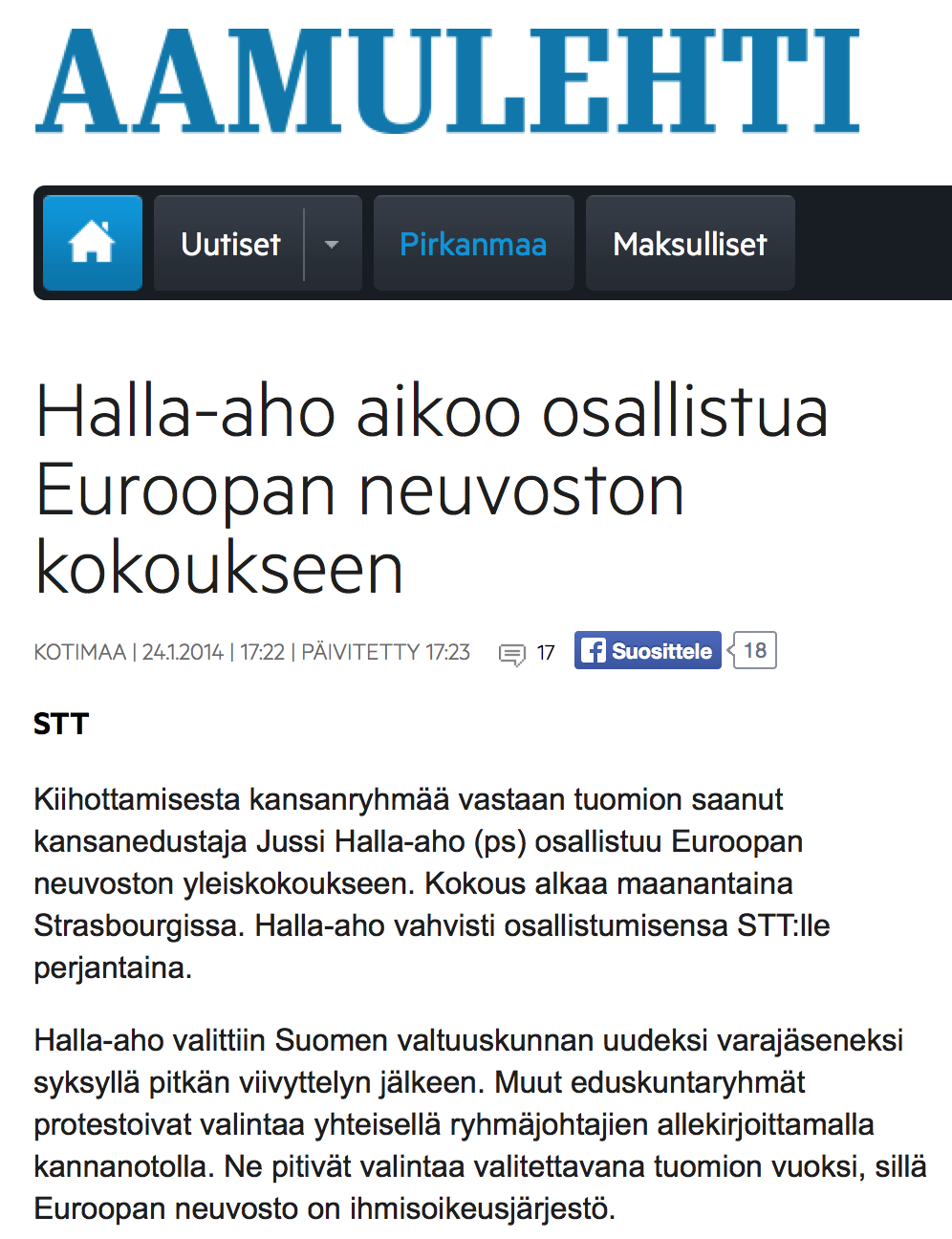
Perussuomalaiset (PS) MP Jussi Halla-aho, who was sentenced for ethnic agitation, will represent Finland at a Council of Europe meeting Monday in Strasbourg, according to Tampere-based Aamulehti, which cites STT. 

Kuvankaappaus 2014-1-24 kello 22.54.51

Read full story (in FInnish) here.

The appointment of Halla-aho to the Finnish delegation to the Council of Europe last year prompted a joint statement by the leaders of seven parliamentary parties expressing regret over this move.

One of the aims of the Council of Europe is to promote human rights.

National Coalition Party MP Kimmo Sasi, who is Vice-Chairman of the Finnish delegation to the Council of Europe, said that Halla-aho’s appointment as deputy member didn’t advance Finland’s image as a country that defends human rights.

True, but Sasi forgets that before 1995, when Finland became an EU member, the human rights of migrants were not respected. One clear indication of breaches of human rights were denying Soviet citizens the right to political asylum in Finland.

The fact that Finland’s third largest party in parliament, the PS, doesn’t have any problems with naming an MP like Halla-aho to represent this country speaks volumes about the state of intolerance in this country.

Finland was one of the last countries in Western Europe to join the Council of Europe in 1989. Finland’s special relationship with the former Soviet Union was one reason why Finland took so long to join.

Racism Review: White Sexual Violence against Enslaved Black Women

Posted on January 24, 2014 by Migrant Tales
MT comment: Understanding how why there was/is slavery enables us to understand the nature of the beast of  racism and social exclusion. 
_____________
By Rachel F

Historians have estimated that at least 58% of all enslaved women between 15 and 30 years of age were sexually assaulted by white men during the antebellum period. In addition to the white male privilege and power evident in this extensive routine rape of black female slaves, the reactions of white women to their husbands’ sexual behavior helped perpetuate racial and gender subordination as well as white privilege.

Kuvankaappaus 2014-1-24 kello 20.53.55

Read full column here.

White women reacted to sexual violence perpetrated against enslaved black women by their husbands in a variety of ways including ignoring or denying the behavior, divorcing their husbands, or punishing the enslaved black women who were sexually victimized. These reactions are repeated throughout a variety of records from slavery including Work Projects Administration slave narratives, divorce petitions, autobiographical slave narratives, and diaries.

For white women, the legal structure created some incentives to stay quiet about their husbands’ sexual violation of enslaved black women. During the 1800’s, a variety of state courts declared that a man had the right to execute “moderate chastisement” of his wife “in cases of emergency,” such as the Mississippi Supreme Court in Bradley v. State in 1824. The white male dominated structure of the legal, political, and economic system was crucial to white women’s responses to their husbands’ sexual violence against slaves. The desire to stay physically unharmed and financially secure likely encouraged many white women to remain silent about their husbands’ sexual behavior.

Mary Chesnut, an elite white woman living in the mid-1800’s described the denial of white women in her diary. She writes

every lady tells you who is the father of all the mulatto children in everybody’s household, but those in her own she seems to think drop from the clouds, or pretends so to think.

An anonymous former slave who was interviewed for the Work Projects Administration slave narratives wrote similarly,

Before my old marster died, he had a pretty gal he was goin’ with and he wouldn’t let her work nowhere but in the house, and his wife nor nobody else didn’t say nothin’ ’bout it; they knowed better. She had three chillun for him. . . .

Despite the potential consequences of speaking out against their husbands, some white women did file for divorce from their husbands often in large part because of the sexual “relationships” they had with enslaved black women. Through divorce petitions white women portrayed themselves as innocent victims of their husbands’ adultery. White women repeatedly overlooked the sexual violence and victimization of the enslaved black women coerced into their husbands’ “affairs.” Meanwhile they portrayed themselves as meeting the ideal standards of white womanhood, such as Margaret Garner from Mobile, Alabama who in 1841 petitioned for divorce explaining that she “calmly remonstrated” with her husband with regard to his affair or Mary Jackson from Georgia who treated her husband “Joseph with respect and affection and rendered due obedience to all the lawful commands.”

These women depict themselves as willfully submissive and obedient. Although the obedient, passive and loyal portrayals of themselves assisted white women in gaining divorces from their husbands as well as a portion of the economic resources in many cases; they simultaneously reinforced white gender roles and the white sexism that is associated. Moreover, when white women frame themselves as the sole victims of their husbands’ “affairs” with enslaved black women, they reinforce a narrative which focuses all attention on their own needs and the role of the court in protecting white women from men who have failed to achieve white male virtue, as opposed to acknowledging the needs of the black women who were sexually victimized and requiring of legal protection against rape.

Some white women also enacted a form of secondary abuse through physical and verbal punishment against the enslaved black women who had been sexually violated by white men. Through physical and verbal abuse, white women could transfer their feelings of humiliation, jealousy, or degradation into feelings of racial superiority over female slaves. Because white women were unable to enact any behaviors which would give them power over their white husbands this physical abuse directed at the enslaved black women simultaneously reflects the gender-subordinated and racially-privileged status that white women held. Not only did white women reinforce racial oppression through their responses, and lack of responses, to their husbands’ sexual violence, but they also reinforced their own oppression as white women by failing to resist the white male behaviors and white male dominated structures which ensure their gender subordination.

Today, although interracial rape of black women by white men has decreased significantly from the antebellum period, the intersecting institutions of oppression which shaped the identities and influenced the dynamics between white women, white men, black women, and black men persist. This raises the questions, in what ways are intersecting institutions of oppression creating incentives for some groups to partake in oppressive racial and gender performances and acts of domination today, and how does each group contribute to the overarching intersectional system of oppression?

*Rachel is a Phd student doing her dissertation work on this issue of the extensive sexual coercion and rape of Black women by white men during the slavery era.  

Read original blog entry here.

This piece was reprinted by Migrant Tales with permission.

Higher unemployment and economic woes spell big trouble for migrants and visible minorities

Posted on January 23, 2014 by Migrant Tales

Finland got shocking news Thursday when postal company Itella announced that it may shed up to 1,200 jobs, according to Yle in English. Taking into account that unemployment shot up in 2013 to 7.9% from 6.9% in the previous year, what do these two news stories mean for the migrant and visible minority community?

Those who lived through the early 1990s in Finland, when this country suffered its worst economic downturn in a century and when unemployment soared to around 18%, it’s nothing unusual that migrants were hit especially hard back then.

Since migrant unemployment is normally two to three times higher than the national average in Finland, that means the jobless rate for migrants at that time was 53% in 1994!

Kuvankaappaus 2014-1-23 kello 21.08.33

Read full story here.

While unemployment in Finland is still lower today than that 10.5% average for the European Union, migrants and visible minorities have a lot to worry about since the recession will be especially harsh with them during two consecutive election years.

Just like about twenty years ago, the dire economic situation will offer self-declared and closet racists the opportunity to layoff migrants or to make their life miserable at work. How? By letting them know that the shadow of unemployment hangs constantly over them.

Contrary to the early 1990s, when Finland didn’t have a large anti-immigration party like the Perussuomalaiset today, migrants and visible minorities will be scapegoated and victimized relentlessly by greedy and opportunistic politicians.

With the Euro MP elections in May and the parliamentary elections in April 2015, the going for migrants and visible minorities in Finland and Europe is going to get tougher.

The situation resembles a sinking ship where most of the passengers will be sacrificed to the chilling waters because there are too few lifeboats for everyone.

What will make matters worse is the dog-eat-dog climate that will discourage solidarity.


Trade Union Pro leader affair: PS leadership claims it is a victim of hate speech

Posted on January 21, 2014 by Migrant Tales

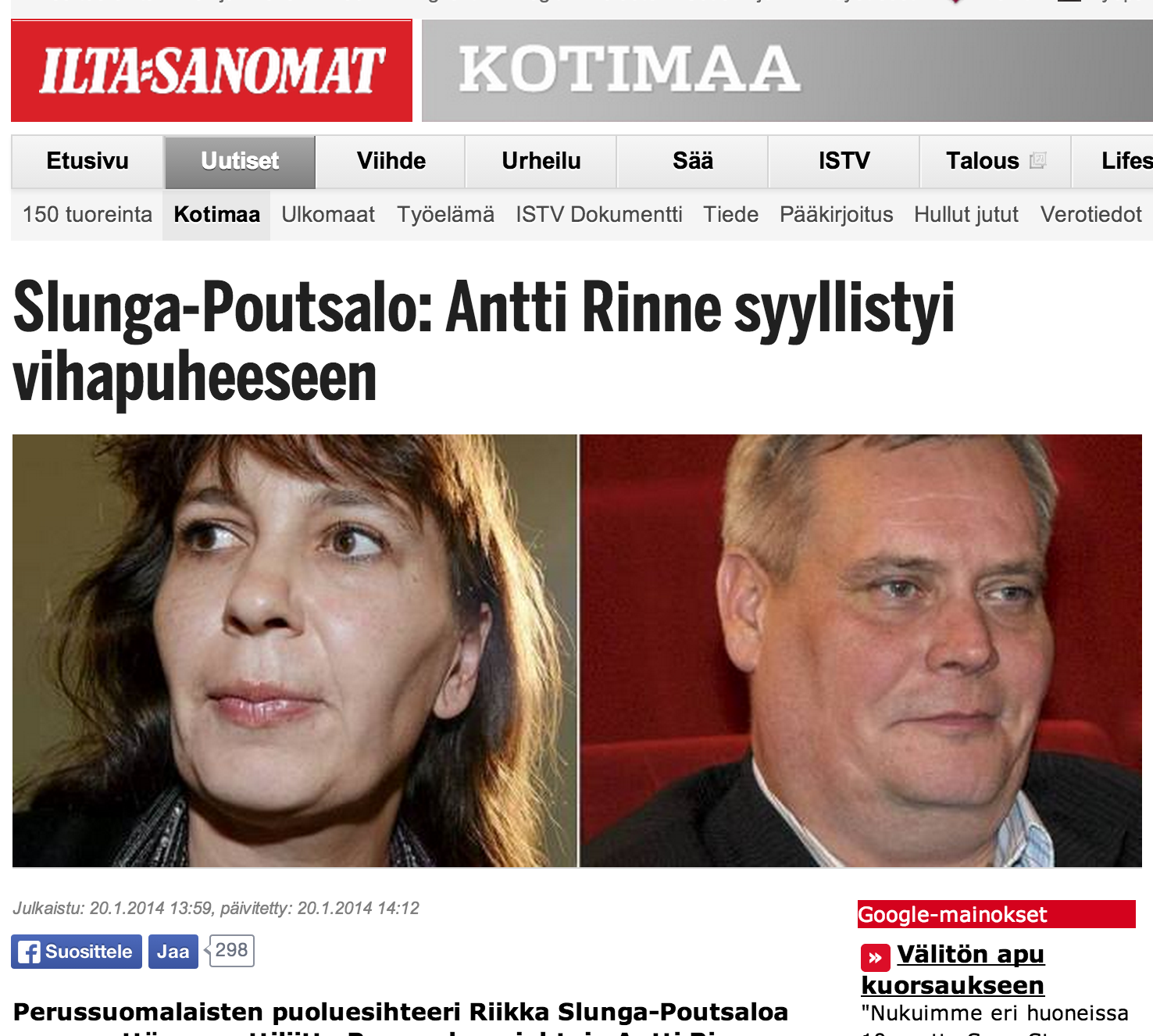
Perussuomalaiset (PS) party secretary Riikka Slunga-Poutsalo put her two cents on tabloid Ilta-Sanomat Tuesday by stating that Antti Rinne is guilty of hate speech against her party. One matter is an MP filing police charges against a person for having an opinion and the other is for the party leadership to back such action.   

Migrant Tales reported Monday that PS MP Kaj Turunen had filed charges against Rinne for ”ethnic agitation” because he had stated on a Helsingin Sanomat interviews that the right-wing populist party had no scruples and therefore was open to racism and fascism. Kuvankaappaus 2014-1-21 kello 11.27.04

Read full story (in Finnish) here.

The reaction of the PS to Rinne’s statement is one of the party’s deceptions exposed in the raw.

Since much of the party’s support comes from Finnish males who feel excluded and victims of society, Rinne’s comment sits well with the image the party wants to give voters. “The image that the party wants to reinforce is that of a socially excluded [male] victim who is misunderstood and has no voice,” a university professor told Migrant Tales.

Sensible people understand that what Turunen did and what Slunga-Poutsalo condoned is ludicrous from a legal standpoint.  We know that the PS is a political party not an ethnic group or religious minority that needs protection from hate speech.

The present incident, which will be forgotten by many but not by Migrant Tales, is another example of the tragic-comic performance by the PS. It not only shows how lost ideologically and susceptible they are to racism and fascism, but to shameless opportunism as well.

It reinforces our view that the PS are a political menace to Finland.

MP files police charges against union leader for naming the PS a party of racists and fascists

Posted on January 20, 2014 by Migrant Tales

Can you believe that an MP of the Perussuomalaiset (PS) party, Kaj Turunen, has filed charges against Trade Union Pro chairman Antti Rinne for stating on a Helsingin Sanomt interview that the right-wing populist party had no scruples and therefore open to racism and fascism, according to Uusi Suomi. 

Believe it or not, Turunen believes his party to be some kind of an ethnic group and therefore – in his opinion – Rinne is guilty (sic!) of hate speech and ethnic agitation.

This type of nonsensical behavior by the PS is nothing unusual. Remember, they love to picture themselves as the excluded victim. Turunen is exploiting this image of the anti-EU, anti-immigration and especially anti-Islam party by charging Rinne even if it sounds ludicrous.

That’s how low Finland has stooped with the PS since 2011.

Kuvankaappaus 2014-1-20 kello 15.17.58

Read full story here.

Trade Union Pro is the largest private sector union for clerical employees. Rinne is challenging Social Democrat head Jutta Urpilainen for the chairmanship of the Social Democratic Party this spring.

Turunen was quoted as saying on Uusi Suomi that he was “very offended” by Rinne’s statements, which he considered “scary.”

The PS MP from Savonlinna may claim what Rinne said to be scary, but what’s even scarier is how little an elected lawmaker like Turunen understands our right to express ourselves freely in this society.

While the PS tries countlessly to hide its racist statements under the guise of “free speech,” there’s a big difference between criticizing a party and outright racism.

Moreover, there are countless of disgraceful examples of racism in the PS and even that one of its MPs, Juho Eerola, admitted being attracted by fascism. One former and present PS MP, James Hirvisaari and Jussi Halla-aho, respectively, have been sentenced for ethnic agitation.

What does Turunen attempt to win from this?

Expose his ignorance of our civil rights and that he can’t take criticism because it offends him.


  • 1
  • 2
  • 3
  • Next
Read more about documentary film
Read more

Recent Posts

  • Finland’s tabloids Iltalehti and Ilta-Sanomat are the pits
  • Riikka Purra’s Dr Jekyll and Mr Hyde mask
  • Double standards
  • Perussuomalaiset: Uusi logo, sama vanha juttu
  • Taco Trump

Recent Comments

  1. Absolutely Socking: Racist Finnish Facebook group against human rights gets flooded with socks on Musta Barbaari’s mother and sister charged by the police in “ethnic profiling” case
  2. Ilkka Nuotio on Pekka Myrskylä: “Tilastot kertovat toista kuin poliittinen keskustelu”
  3. Genrih Soinkara on The war in Ukraine and the Russian-Finnish border crisis are showing Finland’s ugly side
  4. Ahti Tolvanen on Comment by Ahti Tolvanen on the Helsinki +50 conference
  5. Angel Barrientos on Angel Barrientos is one of the kind beacons of Finland’s Chilean community

Archives

  • June 2026
  • May 2026
  • April 2026
  • March 2026
  • February 2026
  • January 2026
  • December 2025
  • November 2025
  • October 2025
  • September 2025
  • August 2025
  • July 2025
  • June 2025
  • May 2025
  • April 2025
  • March 2025
  • February 2025
  • January 2025
  • December 2024
  • November 2024
  • October 2024
  • September 2024
  • August 2024
  • July 2024
  • June 2024
  • May 2024
  • April 2024
  • March 2024
  • February 2024
  • January 2024
  • December 2023
  • November 2023
  • October 2023
  • September 2023
  • August 2023
  • July 2023
  • June 2023
  • May 2023
  • April 2023
  • March 2023
  • February 2023
  • January 2023
  • December 2022
  • November 2022
  • October 2022
  • September 2022
  • August 2022
  • July 2022
  • June 2022
  • May 2022
  • April 2022
  • March 2022
  • February 2022
  • January 2022
  • December 2021
  • November 2021
  • October 2021
  • September 2021
  • August 2021
  • July 2021
  • June 2021
  • May 2021
  • April 2021
  • March 2021
  • February 2021
  • January 2021
  • December 2020
  • November 2020
  • October 2020
  • September 2020
  • August 2020
  • July 2020
  • June 2020
  • May 2020
  • April 2020
  • March 2020
  • February 2020
  • January 2020
  • December 2019
  • November 2019
  • October 2019
  • September 2019
  • August 2019
  • July 2019
  • June 2019
  • May 2019
  • April 2019
  • March 2019
  • February 2019
  • January 2019
  • December 2018
  • November 2018
  • October 2018
  • September 2018
  • August 2018
  • July 2018
  • June 2018
  • May 2018
  • April 2018
  • March 2018
  • February 2018
  • January 2018
  • December 2017
  • November 2017
  • October 2017
  • September 2017
  • August 2017
  • July 2017
  • June 2017
  • May 2017
  • April 2017
  • March 2017
  • February 2017
  • January 2017
  • December 2016
  • November 2016
  • October 2016
  • September 2016
  • August 2016
  • July 2016
  • June 2016
  • May 2016
  • April 2016
  • March 2016
  • February 2016
  • January 2016
  • December 2015
  • November 2015
  • October 2015
  • September 2015
  • August 2015
  • July 2015
  • June 2015
  • May 2015
  • April 2015
  • March 2015
  • February 2015
  • January 2015
  • December 2014
  • November 2014
  • October 2014
  • September 2014
  • August 2014
  • July 2014
  • June 2014
  • May 2014
  • April 2014
  • March 2014
  • February 2014
  • January 2014
  • December 2013
  • November 2013
  • October 2013
  • September 2013
  • August 2013
  • July 2013
  • June 2013
  • May 2013
  • April 2013
  • March 2013
  • February 2013
  • January 2013
  • December 2012
  • November 2012
  • October 2012
  • September 2012
  • August 2012
  • July 2012
  • June 2012
  • May 2012
  • April 2012
  • March 2012
  • February 2012
  • January 2012
  • December 2011
  • November 2011
  • October 2011
  • September 2011
  • August 2011
  • July 2011
  • June 2011
  • May 2011
  • April 2011
  • March 2011
  • February 2011
  • January 2011
  • December 2010
  • November 2010
  • October 2010
  • September 2010
  • August 2010
  • July 2010
  • June 2010
  • May 2010
  • April 2010
  • March 2010
  • February 2010
  • January 2010
  • December 2009
  • November 2009
  • October 2009
  • September 2009
  • August 2009
  • July 2009
  • December 2008
  • November 2008
  • October 2008
  • September 2008
  • August 2008
  • July 2008
  • June 2008
  • May 2008
  • April 2008
  • March 2008
  • February 2008
  • January 2008
  • November 2007
  • October 2007
  • September 2007
  • August 2007
  • July 2007
  • June 2007
  • May 2007

Categories

  • ?? Gia L?c
  • ????? ?????? ????? ???????? ?? ??????
  • ???????
  • @HerraAhmed
  • @mondepasrond
  • @nohatefinland
  • @oula_silver
  • @Varathas
  • A Pakistani family
  • äärioikeisto
  • Abbas Bahmanpour
  • Abdi Muhis
  • Abdirahim Hussein Mohamed
  • Abdirahim Husu Hussein
  • Abdirisak Mahamed
  • About Migrant Tales
  • activism
  • Adam Al-Sawad
  • Adel Abidin
  • Afrofinland
  • Ahmed IJ
  • Ahti Tolvanen
  • Aino Pennanen
  • Aisha Maniar
  • Alan Ali
  • Alan Anstead
  • Alejandro Díaz Ortiz
  • Alekey Bulavsev
  • Aleksander Hemon
  • Aleksanterinliitto
  • Aleksanterinliitto ry
  • Aleksanterinliitto ry:n hallitus
  • Alex Alex
  • Alex Mckie
  • Alexander Nix
  • Alexandra Ayse Albayrak
  • Alexis Neuberg
  • Ali Asaad Hasan Alzuhairi
  • Ali Hossein Mir Ali
  • Ali Rashid
  • Ali Sagal Abdikarim
  • Alina Tsui
  • Aline Müller
  • All categories
  • Aman Heidari
  • Amiirah Salleh-Hoddin & Jana Turk
  • Amin A. Alem
  • Amir Zuhairi
  • Amkelwa Mbekeni
  • Ana María Gutiérrez Sorainen
  • Anachoma
  • Anders Adlecreutz
  • Angeliina Koskinen
  • Anna De Mutiis
  • Anna María Gutiérrez Sorainen
  • Anna-Kaisa Kuusisto ja Jaakko Tuominen
  • Annastiina Kallius
  • Anneli Juise Friman Lindeman
  • Announcement
  • Anonymous
  • Antero Leitzinger
  • anti-black racism
  • Anti-Hate Crime Organisation Finland
  • Anudari Boldbaatar
  • Arshiya Nasser
  • Aspergers Syndrome
  • Asylum Corner
  • Asylum seeker 406
  • Athena Griffin and Joe Feagin
  • Autism
  • Avaaz.org
  • Awale Olad
  • Ayan Said Mohamed
  • AYY
  • Barachiel
  • Bashy Quraishy
  • Beatrice Kabutakapua
  • Beri Jamal
  • Beri Jamal and Enrique Tessieri
  • Bertolt Brecht
  • Boiata
  • Boodi Kabbani
  • Bruno Gronow
  • Carmen Pekkarinen
  • Çelen Oben and Sheila Riikonen
  • Chiara Costa-Virtanen
  • Chiara Costa-Virtanen
  • Chiara Sorbello
  • Christian Thibault
  • Christopher Wylie
  • Clara Dublanc
  • Dana
  • Daniel Malpica
  • Danilo Canguçu
  • David Papineau
  • David Schneider
  • Dexter He
  • Don Flynn
  • Dr Masoud Kamali
  • Dr. Faith Mkwesha
  • Dr. Theodoros Fouskas
  • Edna Chun
  • Eeva Kilpi
  • Emanuela Susheela
  • En castellano
  • ENAR
  • Enrique
  • Enrique Tessieri
  • Enrique Tessieri & Raghad Mchawh
  • Enrique Tessieri & Yahya Rouissi
  • Enrique Tessieri and Muhammed Shire
  • Enrique Tessieri and Sira Moksi
  • Enrique Tessieri and Tom Vandenbosch
  • Enrique Tessieri and Wael Che
  • Enrique Tessieri and Yahya Rouissi
  • Enrique Tessieri and Zimema Mhone
  • Epäluottamusmies
  • EU
  • Europe
  • European Islamophobia Report
  • European Islamophobia Report 2019,
  • European Union
  • Eve Kyntäjä
  • Ezequiel Caldeiro
  • Facebook
  • Fadumo Dayib
  • Faisa Kahiye
  • Farhad Manjoo
  • Fasismi
  • Finland
  • Fizza Qureshi
  • Flyktingar och asyl
  • Foreign Student
  • Fozia Mir-Ali
  • Frances Webber
  • Frida Selim
  • Gareth Rice
  • Ghyslain Vedeaux
  • Global Art Point
  • Great Replacement
  • Habiba Ali
  • Hami Bahadori
  • Hami Bahdori
  • Hamid
  • Hamid Alsaameere
  • Hamid Bahdori
  • Handshake
  • Harmit Athwal
  • Hassan Abdi Ali
  • Hassan Muhumud
  • Heikki Huttunen
  • Heikki Wilenius
  • Helsingin Sanomat
  • Henning van der Hoeven
  • Henrika Mälmsröm
  • Hser Hser
  • Hser Hser ja Mustafa Isman
  • Husein Muhammed
  • Hussain Kazemian
  • Hussain Kazmenian
  • Ibrahim Khan
  • Ida
  • Ignacio Pérez Pérez
  • Iise Ali Hassan
  • Ilari Kaila & Tuomas Kaila
  • Imam Ka
  • inside-an-airport
  • Institute of Race Relations
  • Iraqi asylum seeker
  • IRR European News Team
  • IRR News Team
  • Islamic Society of Norhern FInland
  • Islamic Society of Northern Finland
  • Islamophobia
  • Jacobinmag.com
  • Jallow Momodou
  • Jan Holmberg
  • Jane Elliott
  • Jani Mäkelä
  • Jari Luoto
  • Jari Taponen
  • Jegor Nazarov
  • Jenni Stammeier
  • Jenny Bourne
  • Jessie Daniels
  • Joe Davidow
  • Johannes Koski
  • John D. Foster
  • John Grayson
  • John Marriott
  • Jon Burnett
  • Jorma Härkönen
  • Jos Schuurmans
  • José León Toro Mejías
  • Josue Tumayine
  • Jouni Karnasaari
  • Juan Camilo
  • Jukka Eräkare
  • Julian Abagond
  • Julie Pascoet
  • Jussi Halla-aho
  • Jussi Hallla-aho
  • Jussi Jalonen
  • JusticeDemon
  • Kadar Gelle
  • Kaksoiskansalaisuus
  • Kansainvälinen Mikkeli
  • Kansainvälinen Mikkeli ry
  • Katherine Tonkiss
  • Kati Lepistö
  • Kati van der Hoeven-Lepistö
  • Katie Bell
  • Kättely
  • Kerstin Ögård
  • Keshia Fredua-Mensah & Jamie Schearer
  • Khadidiatou Sylla
  • Khadra Abdirazak Sugulle
  • Kiihotus kansanryhmää vastaan
  • Kirsi Crowley
  • Koko Hubara
  • Kristiina Toivikko
  • Kubra Amini
  • KuRI
  • La Colectiva
  • La incitación al odio
  • Laura Huhtasaari
  • Lauri Finér
  • Leif Hagert
  • Léo Custódio
  • Leo Honka
  • Leontios Christodoulou
  • Lessie Branch
  • Lex Gaudius
  • Leyes de Finlandia
  • Liikkukaa!
  • Linda Hyökki
  • Liz Fekete
  • M. Blanc
  • Maarit Snellman
  • Mahad Sheikh Musse
  • Maija Vilkkumaa
  • Malmin Kebab Pizzeria Port Arthur
  • Marcell Lorincz
  • Mari Aaltola
  • María Paz López
  • Maria Rittis Ikola
  • Maria Tjader
  • Marja-Liisa Tolvanen
  • Mark
  • Markku Heikkinen
  • Marshall Niles
  • Martin Al-Laji
  • Maryan Siyad
  • Matt Carr
  • Mauricio Farah Gebara
  • Media Monitoring Group of Finland
  • Micah J. Christian
  • Michael McEachrane
  • Michele Levoy
  • Michelle Kaila
  • Migrant Tales
  • Migrant Tales Literary
  • Migrantes News
  • Migrants' Rights Network
  • MigriLeaks
  • Mikko Kapanen
  • Miriam Attias and Camila Haavisto
  • Mohamed Adan
  • Mohammad Javid
  • Mohammad M.
  • Monikulttuurisuus
  • Monisha Bhatia and Victoria Canning
  • Mor Ndiaye
  • Muh'ed
  • Muhamed Abdimajed Murshid
  • Muhammed Shire
  • Muhammed Shire and Enrique Tessieri
  • Muhis Azizi
  • Musimenta Dansila
  • Muslimiviha
  • Musulmanes
  • Namir al-Azzawi
  • Natsismi
  • Neurodiversity
  • New Women Connectors
  • Nils Muižnieks
  • No Labels No Walls
  • Noel Dandes
  • Nuor Dawood
  • Omar Khan
  • Otavanmedia
  • Oula Silvennoinen
  • Paco Diop
  • Pakistani family
  • Pentti Stranius
  • Perussuomalaiset
  • perustuslaki
  • Petra Laiti
  • Petri Cederlöf
  • Pia Grochowski
  • Podcast-lukija Bea Bergholm
  • Pohjois – Suomen Islamilainen Yhdyskunta
  • Pohjois Suomen Islamilainen Yhyskunta
  • Polina Kopylova
  • Race Files
  • racism
  • Racism Review
  • Raghad Mchawh
  • Ranska
  • Rashid H. and Migrant Tales
  • Rasismi
  • Raul Perez
  • Rebecka Holm
  • Reem Abu-Hayyeh
  • Refugees
  • Reija Härkönen
  • Remiel
  • Reza Nasri
  • Richard Gresswell
  • Riikka Purra
  • Risto Laakkonen
  • Rita Chahda
  • Ritva Kondi
  • Robito Ibrahim
  • Roble Bashir
  • Rockhaya Sylla
  • Rodolfo Walsh
  • Roger Casale
  • Rostam Atai
  • Roxana Crisólogo Correa
  • Ruth Grove-White
  • Ruth Waweru-Folabit
  • S-worldview
  • Sadio Ali Nuur
  • Sami Rusanen
  • Sandhu Bhamra
  • Sara de Jong
  • Sarah Crowther
  • Sari Alhariri
  • Sarkawt Khalil
  • Sasu
  • Scot Nakagawa
  • Shabana Ahmadzai
  • Shada Islam
  • Sharon Chang blogs
  • Shenita Ann McLean
  • Shirlene Green Newball
  • Sini Savolainen
  • Sira Moksi
  • Sonia K.
  • Sonia Maria Koo
  • Steverp
  • Stop Deportations
  • Suldaan Said Ahmed
  • Suomen mediaseurantakollektiivi
  • Suomen Muslimifoorumi ry
  • Suomen viharikosvastainen yhdistys
  • Suomen viharikosvastainen yhdistys ry
  • Suomi
  • Supermen
  • Susannah
  • Suva
  • Syrjintä
  • Talous
  • Tapio Tuomala
  • Taw Reh
  • Teivo Teivainen
  • The Daily Show
  • The Heino
  • The Supermen
  • Thomas Elfgren
  • Thulfiqar Abdulkarim
  • Tim McGettigan
  • Tino Singh
  • Tito Moustafa Sliem
  • Tobias Hübinette and L. Janelle Dance
  • Transport
  • Trica Danielle Keaton
  • Trilce Garcia
  • Trish Pääkkönen
  • Trish Pääkkönen and Enrique Tessieri
  • Tuulia Reponen
  • Uncategorized
  • UNITED
  • University of Eastern Finland
  • Uyi Osazee
  • Väkivalta
  • Vapaa Liikkuvuus
  • Venla-Sofia Saariaho
  • Vieraskynä
  • W. Che
  • W. Che an Enrique Tessieri
  • Wael Ch.
  • Wan Wei
  • Women for Refugee Women
  • Xaan Kaafi Maxamed Xalane
  • Xassan Kaafi Maxamed Xalane
  • Xassan-Kaafi Mohamed Halane & Enrique Tessieri
  • Yahya Rouissi
  • Yasmin Yusuf
  • Yassen Ghaleb
  • Yle Puhe
  • Yuliet Tresa
  • Yve Shepherd
  • Zahra Khavari
  • Zaker
  • Zalina Ametova
  • Zamzam Ahmed Ali
  • Zeinab Amini ja Soheila Khavari
  • Zimema Mahone and Enrique Tessieri
  • Zimema Mhone
  • Zoila Forss Crespo Moreyra
  • ZT
  • Zulma Sierra
  • Zuzeeko Tegha Abeng
© 2026 Migrant tales | Powered by Minimalist Blog WordPress Theme