My son asked me Friday an interesting question that revealed what is wrong concerning the present debate on immigration and immigrants in Finland. He asked me to show how does immigration fuel economic growth. His question, which is a valid one, reveals some of the perceptions that some have about immigration.
Due to the attention that anti-immigration politicians have received in the media, coupled by the silence and lack of leadership from the majority of politicians, many actually believe that the majority of foreigners in this country are refugees, Muslims, from Africa and here only to live off welfare.
Some, like MPs of the Perussuomalaiset (PS) party, play on our worst prejudices and fears by claiming that Muslims are invading Finland and Europe in Trojan horses. It’s only a question of time when ghettos will be set alight by ethnic strife, according to them.
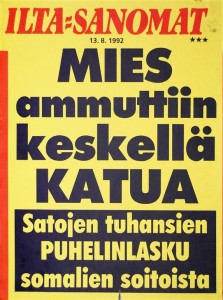
Tabloids like Ilta-Sanomat continue to spread racism in Finland. This billboard of 1992 claimed that Somalis “tricked” authorities to pay phone bills costing hundreds of thousands of Finnish marks. In that period, you could buy a row house in Helsinki for 500,000 marks. Billboard source: Institute of Migration
Facts reveal a very different picture, however. Finland has today fewer refugees than in the 1920s, when some 35,000 refugees from Russia lived in our country. In 2012, a mere 3,219 refugees applied for asylum but only 1,601 were accepted versus 43,900 in Sweden, according to the Finnish Immigration Service.
Moreover, 9.1% of all people who were born abroad and are residents of Finland are from Africa (25,895). The majority, or 64% (182,696), are from a European country.
A news story by Helsingin Sanomat on Friday showed how lopsided the present debate on immigration and immigrants is in Finland. The story revealed that our country accepted 149 Syrian refugees last year compared with 14,600 in Sweden.
There is nothing wrong with immigration from Africa as there is nothing wrong with immigration from Latin America, Asia, North America or from other European countries. What is wrong and unacceptable, however, is how such a distorted picture of immigration continues to be maintained.
This proves, in my opinion, that the media has been led more by its prejudices than its journalistic standards, politicians by their opportunism than leadership, and the general public by their apathy on the topic. The most shameful matter is that few are doing anything to bust such myths.
It’s possible to understand this situation from a historic perspective since Finland did everything possible up to 1995, when we became an EU member, to hinder as much as possible immigration and foreign investment to this country.
This suspicion of the outside world can be explained in part by our difficult relations with the former Soviet Union. Even so, it can’t suffice as the whole answer. How can a nation that lost over 1.2 million of its countrymen to emigration during 1860-1999 house such suspicious attitudes towards immigrants?
Going back to the question that my son asked Friday, I told him that it’s highly doubtful that his father, grandfather, great grandfather and great great grandfather, who were all immigrants, ever discussed how negative or harmful immigration is to society. On the contrary. Immigration is a positive phenomenon that brings new blood, new ideas and new strength to a country.
“The fact is simple,” I continued, “the whole idea of migrating from one country to another is opportunity and the search for a better life. This is the case irrespective if you migrate for political or economic reasons.”
Recent calls by the head of the Government Institute for Economic Research (VATT), Juhanna Vartiainen, and the Confederation of Finnish Industries (EK), that Finland needs more labor immigrants, has been met with skepticism by SAK, the central organization of Finnish trade unions.
According to SAK, immigration isn’t a solution to labor shortages because it would lead to two labor markets, according to YLE in English.
Any sensible person understands that the aim of immigration shouldn’t be to drive down salaries and rollback important gains and rights achieved for employees by our labor market. If Finland’s immigrant population grows in the future, as it will, it should be the job of the labor unions and authorities to ensure that the rights of every employee, including immigrants, aren’t compromised by abusive employers.
A recent article published by Forbes magazine, offers us sobering advice on what to avoid in Finland and Europe on the immigration front.
“Attempting to fence off the country is no answer to anything. It would be difficult for a generally free society with extensive borders to close out the rest of the world. Worse, to be effective such controls as ID cards, citizenship checks, workplace raids, employer sanctions, and more would undermine domestic liberties.”

Read full story here.
One important step that we must take in order to debate fairly and in a proactive manner about our ever-growing cultural diversity, is bust those terrible and destructive myths that distort the debate on immigration and immigrants.
Maintaining alive such myths is damaging to our country economically, politically and socially. We will end up paying a hefty price if we don’t in the form of lower living standards and loss of competitiveness.