Migrant tales
Menu
  • #MakeRacismHistory “In Your Eyes”
  • About Migrant Tales
  • It’s all about Human Rights
  • Literary
  • Migrant Tales Media Monitoring
  • NoHateFinland.org
  • Tales from Europe
Menu

Month: January 2014

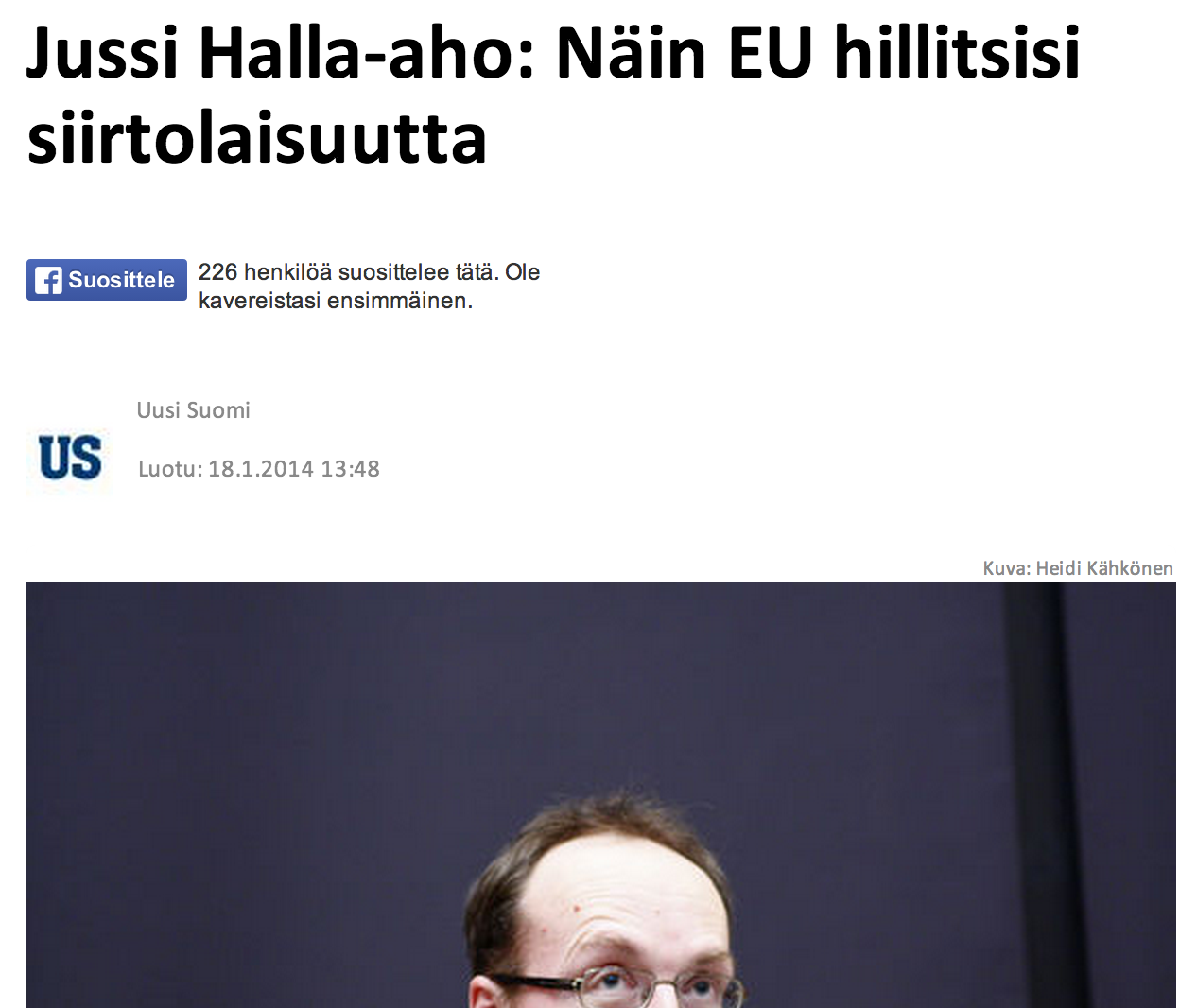
PS MP Jussi Halla-aho doesn’t like cultural diversity, never mind Africans and Muslims

Posted on January 19, 2014 by Migrant Tales

I’m not going to expend a lot of energy on analyzing what Perussuomaliset (PS) MP Jussi Halla-aho wrote in a recent blog entry. All of what he writes about migrants, especially refugees, is demeaning and negative. One sentence in particular, however, caught my attention and which exposes the anti-immigration politician to a tee. 

Kuvankaappaus 2014-1-19 kello 23.28.18

Read full story (in Finnish) here.

Halla-aho, who was sentenced for ethnic agitation, makes a special effort to stress in his blog entry that the measures he’d like to propose to control migration flows to Europe aren’t intended to keep Europe “white” but in the best interests of the countries concerned.

The PS MP’s first deception is exposed when he uses the term migration as opposed to refugee flows. He uses the former as opposed to the latter term because he believes that most Africans, Middle Easterners and Muslims aren’t real refugees but “welfare shoppers.”

If you’ve read Halla-aho and his ilk, their whole argument is based on criticizing immigration policy, which, according to them, allows too many refugees to move to Europe. Now who are those refugees? They are the Africans, Middle Easterners and Muslims that politicians like him loathe.

Rule number one of journalism: Denial is usually what a politician really thinks or feels insecure about.

A good example of the latter would be a politician like Halla-aho who goes out of his way to claim that he has nothing against cultural diversity or a homophobe who denies he’s against gays.

We’ve heard these types of statements so many times before, especially from anti-immigration politicians.

FGM or female circumcision: Traveling from culture point a to culture point b without exploding into pieces

Posted on January 19, 2014 by Migrant Tales

Fadumo Dayib, who writes a great blog called Somali Womanhood and is Migrant Tales associate editor, asked me a very good question when I spoke to her about what some call female circumcision and which the critics refer to female genital mutilation (FGM). “What new points of view can you bring to the debate,” she asked. 

A very good question indeed. I’m a man who was brought up in societies where this practice, which has been going on for centuries, doesn’t take place. In the societies that I grew up in, the norm has been to encourage greater sexual freedom and enjoyment as well as acceptance of sexual minorities like gays

What, then, can I offer to such a topic?

I will try to write about it from a journalist’s viewpoint who has a background in anthropology.

From an anthropological perspective, it’s important to point out that this practice is one of many elements of a rite of passage that prepares young girls for womanhood and marriage.

Opponents of FGM, however, emphasize that the practice is detrimental to a women’s health and well-being. Some, like Dayib, consider this practice a ritualized form of child abuse, violence against women and a violation of their human rights.

About twenty years ago, when I worked for a Finnish family magazine called Apu, Eve Hietamies asked me about doing a story on the topic. Taking into account the negative climate at the time against Somalis, I tried to explain to her the impact her story would add to the widespread prejudice people had of this group.

What kinds of passions would such a story reinforce and awaken? Would it fuel empathy for minors who may fall victim to such a practice in Finland or fuel our intolerance and prejudice of people who come from different cultures?

The same question I asked the Apu reporter a long time ago is still valid but in a different context. Am I writing about this topic because I’m genuinely interested in the welfare of these minors and that it could take place in Finland, or interested in career advancement and social pornography?

I advised the reporter not to write such a story and that is what she did.

A similar story was published by Helsingin Sanomat. It showed two 14-year-old-adolescents of the Maasai tribe in Kenya pictured by Meeri Koutaniemi. The author of the story, Anu Nousiainen, hadn’t been present while Koutaniemi took the pictures of the two adolescents.

While we can – and should – be able to speak openly about such a practice, our reporting ethics and standards must be in order. Moreover, extra care must be taken not to victimize in the process whole groups in Finland never mind globally.

As an anthropologist and migrant, I know that getting from culture point a to culture point b doesn’t look as easy as it seems. That journey between these two points can be full of minefields that won’t tear your limbs to shreds if stepped on but expose instead your ignorance, prejudices, ethnocentrism, cultural and career opportunism in the raw.

As a journalist, I understand that this is a “good” story that can win me and the publication a lot of attention and prestige. I understand as well that I can get away with murder by not adhering fully to ethical standards since the readers’ and my colleagues’ prejudices will encourage them to turn a blind eye.

This type of protection only works for a while. Time is the final judge of what you write. How would the Apu reporter’s story look today and how will the Helsingin Sanomat pictures go down with us twenty years from now? Will they have the same impact or expose our own issues with respect to the plight of billions of people who are not as fortunate as us to live a life of abundance in the developed world?

Those who have travelled successfully between culture point a to culture point b, understand that the best way to make journey in one piece is with the protective shield of respect and cultural sensitivity.

Certainly there’s a big difference if a semi-sensationalist magazine like Apu publishes a story about female circumcision versus a quality daily like Helsingin Sanomat, which is supposed to abide by the highest journalistic standards.

And here’s the crux of the matter. Dailies like Helsingin Sanomat sometimes don’t abide by such standards. How many still remember Saska Saarikoski’s defense of Perussuomalaiset MP Jussi Halla-aho, who got sentenced for ethnic agitation, and how the media gave inflated respectability and importance to people like him?

The biggest problem that Helsingin Sanomat journalists like Saarikoski had before the 2011 parliamentary elections was that they couldn’t tell the difference between outright racism and freedom of speech.

Dayib explains eloquently some of the ethical issues in a recent blog entry. She takes a stand against FGM but writes as well about the double standards and hypocrisy of “concerned” NGOs and white women.

One important question that we should be asking is how widespread this practice is in Finland? Why are white people writing about this topic? Why do Africans allow white Europeans to write their narrative?

Unicef of Finland considers the story published by Helsingin Sanomat was unethical because it exposed the minors’ faces and identity despite the fact that the children’s rights association uses pictures of minors itself on its web pages and publications.

Apart from showing what FGM or female circumcision is in the raw, why is the focus of the Helsingin Sanomat story shifting from this practice and the plight of minors in countries like Kenya to ethical issues?

The answer is self-evident: It’s a white narrative of somebody else. We’re not really interested in what happens because it doesn’t concern us directly. It’s about some group faraway whom we don’t know and don’t care enough about to make a difference in their lives. How come we except so much injustice and poverty to take place globally if we live in countries that have the means to eradicate such issues?

Saido Mohamed, who is an advisor at the Finnish League for Human Rights, travels daily from culture point a to culture point b and back.

“First and foremost matter to take into account is the child’s right to privacy and confidentiality,” she told Migrant Tales. “This is a question that any self-respecting reporter and NGO must adhere to. I believe that it is a good matter that this issue  is brought up and debated in public.”

According to Mohamed, it would be important for the media in Finland and elsewhere to set some guidelines, without watering down the issue, on how to report such cases in the future.

The Council for Mass Media (JSN) will soon make a pronouncement on the Helsingin Sanomat story.


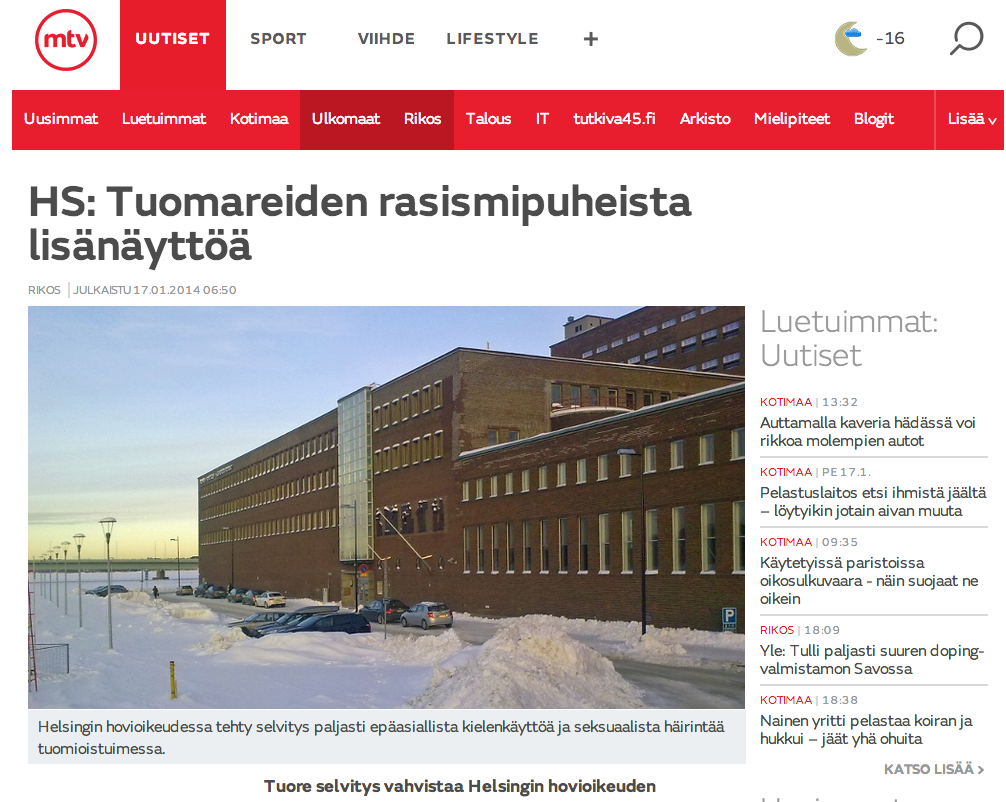
Attorney general inquiry confirms earlier internal investigation by the Helsinki Courts of Appeal

Posted on January 18, 2014 by Migrant Tales

An inquiry commissioned by the attorney general confirmed an internal investigation scooped by MTV3 in summer revealed some judges of the Helsinki Courts of Appeal harassed women sexually at parties and used racist language, according to MTV3, which cites Helsingin Sanomat.

Kuvankaappaus 2014-1-18 kello 22.45.52

Read full story (in Finnish) here.

The internal investigation, which revealed that some judges acted in a sexist manner parties, revealed as well that they used racist and derogatory labels to name blacks, Russians, Jews and gays.

One of the claims made by a story on Helsingin Sanomat is the Helsinki Courts of Appeal doesn’t believe that the racist behavior of the judges didn’t have any bearing on the sentences they pronounced.

While we don’t have enough information about this case except for an MTV3 story and another one written by Finland’s largest daily, one could rightly ask how could such racist and sexist behavior by judges not impact their impartiality especially in cases involving migrants and gays?

Even if the original investigation doesn’t mention the Romany minority, I wonder what the judges think of them.

A judge is a public figure and his credibility hinges on his or her impartiality. Making racist comments and treating women in a demeaning manner at parties destroys such credibility in one blow.

To all the Other Finns like me: Nobody can deny who you are

Posted on January 15, 2014 by Migrant Tales

After spending a brief moment of my childhood in Finland, and growing roots in other lands, I longed to move back to the country I was once from.  I was fortunate and able to visit Finland every summer.

Those days I spent as a child and adolescent in the company of my grandparents in the Finnish countryside changed my life. If a person changes after a long journey, every journey to Finland changed me.   

Visiting Finland in the summer didn’t only give me an opportunity to relearn the Finnish language and strengthen my bonds with this land, it recharged my soul and gave me strength to face life of a huge city like Los Angeles.

Image1-34_edited-1

My Finnish roots are as deep as my roots in Argentina and Southern California. As Finland continues to deny its cultural diversity, it continues to deny others their right to their identity. The Perussuomalaiset is one party that has openly declared war on people like us.

I’m grateful for my Finnish roots and for those summers I spent with my grandparents. I am who I am today because of them and those summers.

But with the rise of intolerance in this country, and political parties that have declared war on Finland’s ever-growing cultural diversity, I have one important message for them: Nothing, absolutely nothing, can erase who we are.

Today there are tens of thousands of us. We come from diverse backgrounds but one matter unites us: Finland is our home. Some of us have appeared on Migrant Tales: Joseph, Ida, Abdulah, Ariela and other multicultural Finns like Aune and Anna.

Don’t allow those that take their prejudice and intolerance seriously erase who you are. No ethnic group in Finland can claim this land as their own. This land belongs to all those who live here irrespective of their background.

I fear that I will not live long enough to see that day when most of us in this land, irrespective of his or her background, will be accepted and respected as equals.  Maybe it’ll be you or your children or grandchildren that will witness that day.

Those who want to exclude us aim to erase and deny our history.

Rodolfo Walsh, an Argentinean journalist and writer, said something that we should never forget when we write our history. Even if it was written in the 1970s, it still applies to immigrants and multicultural Finns:

Our dominant classes have made sure that the worker has no history, doesn’t have a doctrine, any heroes or any martyrs. Every struggle has to be started from scratch, separated from previous struggles; the collective history is lost, their lessons are forgotten. History appears as it if were private property, whose owners are the owners of everything.

When someone tells you that you’re a “half-Finn,” answer them back kindly that you’re not “half” of anything but a full human being. Remind them of the 1.2 million Finns that emigrated abroad between 1860 and 1999.

Ask them why they have conveniently forgotten these Finns and how they integrated and become a part of a greater world family.

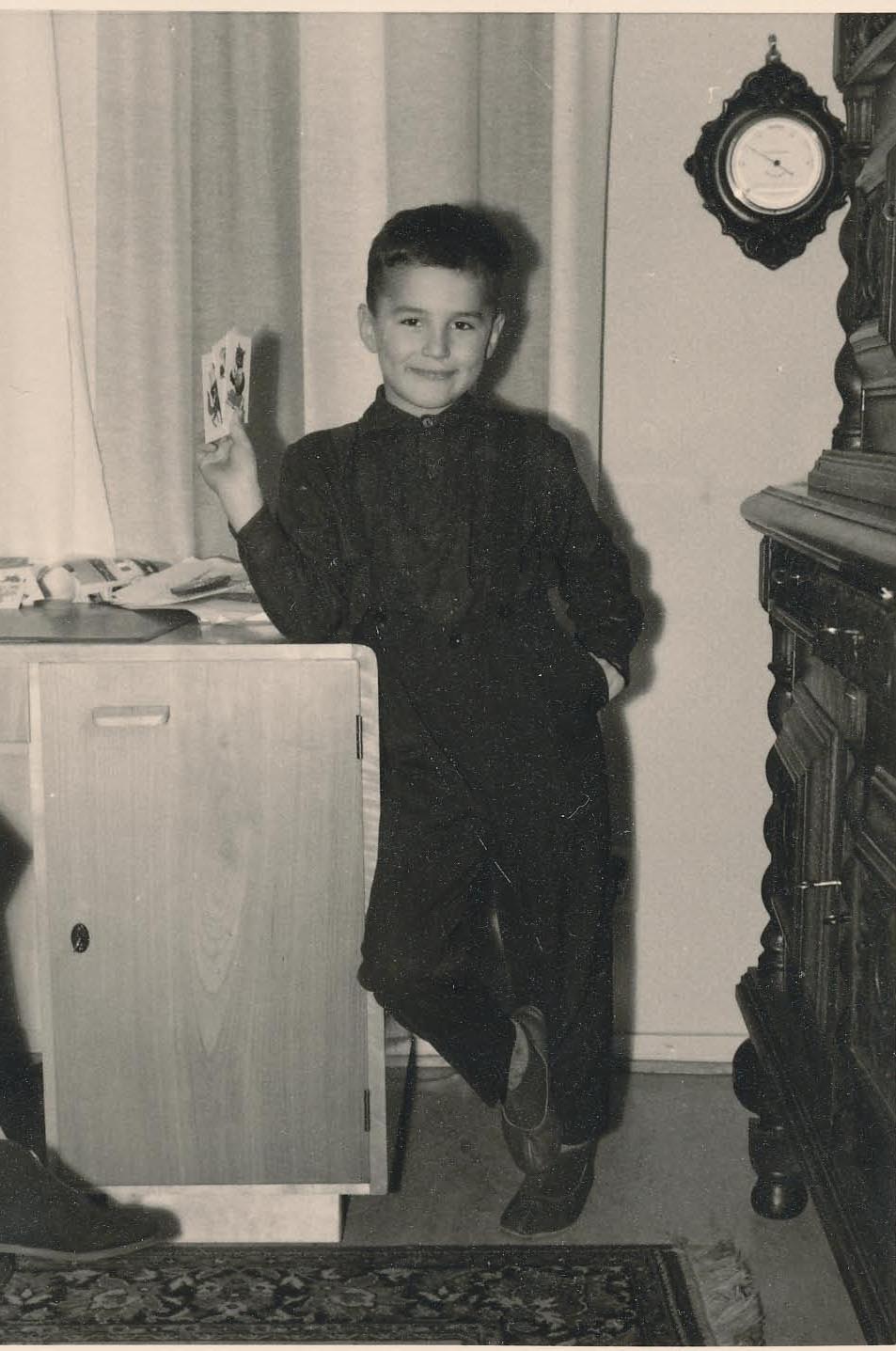
Image1-35_edited-1(1)This picture is of one of the saddest moments in my life. It’s a day before we moved from Finland to Argentina. I made a vow to return back to Finland one day and I did about sixteen years later, in 1978.

Joseph, Ida, Abdulah, Ariel, Aune, Anna and many Other Finns like me, don’t forget who you are and remember above everything else, nobody can deny who you are.

As Nelson Mandela said, you are the captain of your destiny, or in our case, the captain of your identity, the master of your narrative.

Nobody can erase who you are because you have memory.

Draft law that aims to prohibit Russians from purchasing land is a sad sign of the times

Posted on January 14, 2014 by Migrant Tales

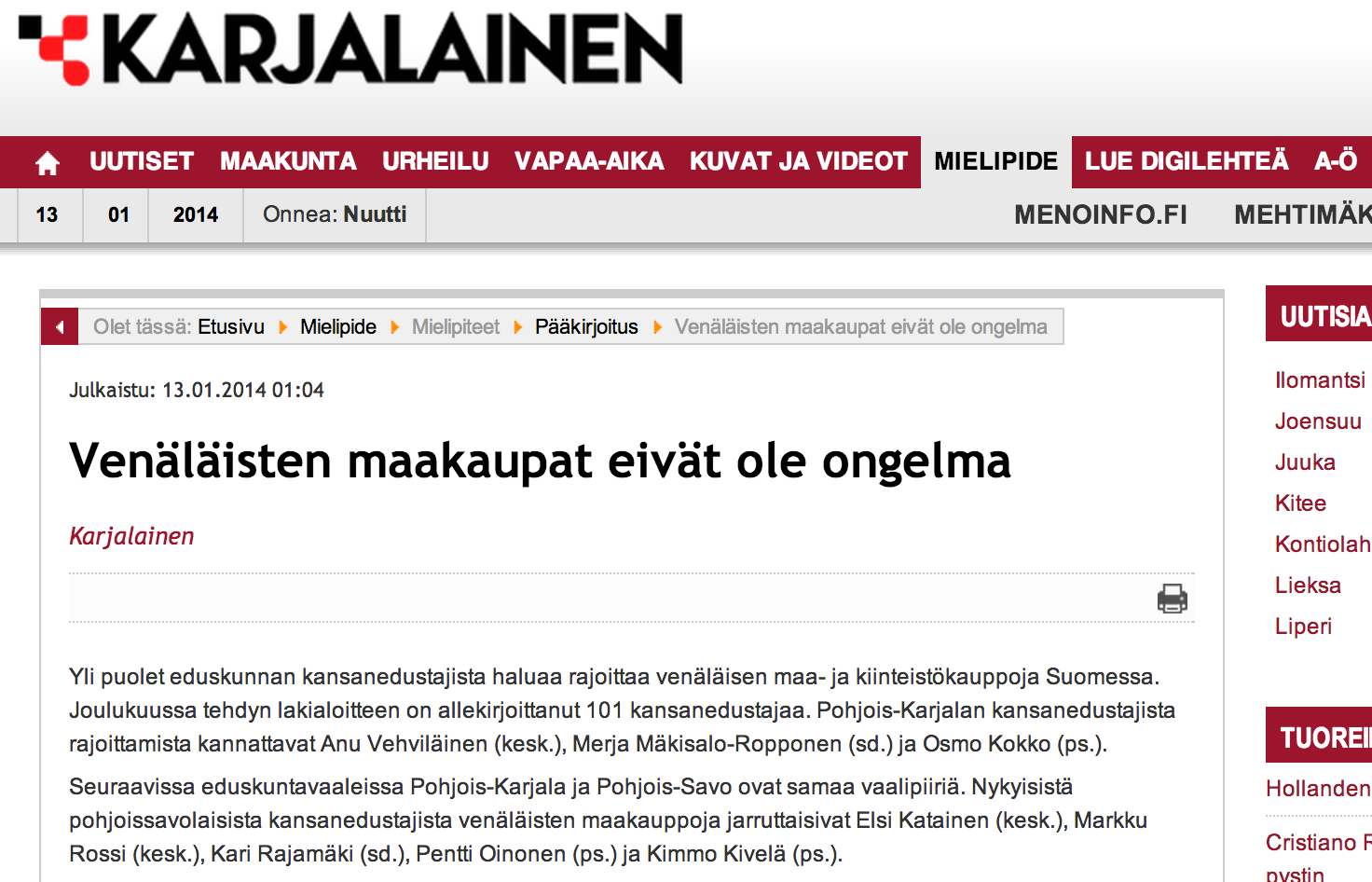
In a country like Finland, which has a small migrant population compared with other European countries, intolerance and xenophobia usually reveal themselves as déjà vu. One of these real illusions came in the form of a draft bill in parliament that aims to prohibit real estate purchases by Russians, according to Joensuu-based daily Karjalainen.

The same fear-mongering to incite nationalism is by some Finnish MP during an election year is no different from what we saw recently in the United Kingdom, when Prime Minister David Cameron warned that 250,000 Romanians and Bulgarians were going to swarm to the country.

Home Secretary Theresa May added fire to Cameron’s warnings by claiming that Britain was powerless to stop tens of thousands of Bulgarians and Romanians from moving to the UK in 2014.

When January 1 came, only a few dozen arrived, according to Al Jazeera.

Kuvankaappaus 2014-1-14 kello 9.04.41

Read full story (in Finnish) here.

The draft bill already has the backing of 101 of 200 MPs.

According to Karjalainen, 400-500 real estate purchases are made annually by Russians in Finland, 20-30 in Eastern Finland alone.

One of the arguments used by those in favor of the draft bill is that it would curtail money laundering and is justifiable since Finns cannot buy land in Russia.

While they have a good point, the bill would hurt us since it would keep alive old suspicions about our eastern neighbor.

If the draft bill gets approval and becomes law, non-European Economic Area (EEA) citizens would have to be residents of Finland for five years in order to purchase real estate.

If we look at some of the MPs that are in favor of such a bill, we’ll quickly notice that they are the same politicians that are against refugees, cultural diversity and like to use the word “fatherland” in every other sentence.

Some of these MPs are the ones that want to demote the Swedish language to elective status at schools arguing that it would pave the way for more Finns to study the Russian langauge.

If these politicians are fueling our age-old suspicion of Russians with such a bill, why would more people be inclined to study such a language? Certainly favorable attitudes of a country play an important role.

For some, who have lived in this country for a long time, understand that present plans to curtail real estate purchases by Russians is a flashback to the days of the Restricting Act of 1939 (law 219/1939), which prohibited foreigners from owning real estate and acquiring a majority stake in Finnish companies.

The Act, which was in force until 1992, prohibited foreigners from owning shares in key sectors of the economy such as forestry, securities trading, transportation, mining, real estate and shipping.

Suspicion and xenophobia of the outside world was and still is very real. In the early 1980s I was handing a petition with a group of non-Finnish citizens to some MPs in parliament. The petition demanded greater rights for migrants in Finland. A common guest at such an event with foreigners was Police Chief Olli Urponen (1983-97). I once asked him why Finland had such a restrictive policy towards foreigners.

He responded: “To keep criminals out of Finland.”

This was the response of the police chief of a country that saw over 1.2 million of its countrymen emigrate between 1860 and 1999.

The very attitude, that the outside world is a dangerous place full of suspicious people, is how Finland saw the world during most of the last century.

Apart from having a law that curtailed foreign investment to the country up to the mid-1990s, official Finland did everything possible to hinder as much as possible foreigners from moving to the country.

The fact that it took Finland 65 years after independence to have in force in 1983 its first aliens act reveals how the country saw migrants and cultural diversity.

That same attitude persists today in too many circles and we have no-one else to blame than ourselves. We should teach more tolerance and less hatred of people who are different from us at schools and our homes.

If parliament passes a law that prohibits Russians from buying land in Finland, it won’t be a coincidence.

Migrants’ Rights Network: Wanted: Truth and clarity about migration to the UK today

Posted on January 14, 2014 by Migrant Tales

MT comment: Is it a coincidence that the same issues but in a different context are taking place in Finland and elsewhere in Europe? Even if elections are supposed to be a time when we celebrate our democratic rights, for some, like migrants and minorities, it has come to represent a day of uncertainty, even fear.   

___________________ 

Don Flynn* 

Don_web_0

The opening weeks of 2014 have been marred by inept contributions to the conversation about immigration made by politicians from all parts of the mainstream parties. Given the febrile moods of the public on this issue, and the fact that elections are looming across the next 18 months, this is an irresponsible way to discuss these matters. Here are the reasons why we need to agree some basic truths about immigration today. 

Just two weeks into the New Year and it is already clear that the public conversation about immigration policy is picking up exactly where it left off before the holidays.

There seems to be an agreement that the Bulgarian and Romanian people who, we were assured by the tabloids, would be sweeping into the UK like a veritable tsunami have been a bit of a disappointment to date.  Those who arrived on the famous flights into Luton airport were the ones who had been living and working in the UK for some years and who had merely nipped back home for a week or so over the Christmas break.  Never mind – there are still over 340 days left in the year for them to come into the country in their tens of thousands, so may be the scaremongers will get the raw numbers they claim.

Misleading on benefits

Disappointed might not be the right word, since it implies that you once hoped for better, but the fact that the politicians have returned so quickly to worry the bone of migrants being drawn by generous benefits is something we could be doing without.  Migration Watch UK seems to have at least conceded the evidence that out of work benefits –Job Seekers Allowance, etc  – are not the principal draw, but they have switched to an argument about the pulling power of in-work benefits,  like tax credit, housing benefit, council tax benefit, and the like.  It appears they think EU migrants will be drawn in unfeasibly large numbers because of the expectation that these will be available on tap.

It is true that the average family in the UK takes home a bigger share in benefits which essentially top up low earnings than those in any comparable country in the EU. Workers in top of the league Denmark have a gross monthly wage of €4800, lower-down Germany €3400 and mid-range Austria and France around €2800.  Us Brits, in contrast, facing similar costs of living, have to bump along on the equivalent of €2200.*

That is why in-work benefits are so much higher in the UK.  But in terms of a straightforward labour market deal, isn’t it obvious that the bigger draw will be towards countries that offer higher wages rather than towards those who expect their workers to go through all the rigmarole of form filling and income assessment before they obtain a living income?

MRN takes the view that we simply don’t know who many Bulgarians or Romanians will be coming to the UK this year – or Spaniards or Italians for that matter.  What we are confident of is that they will be net contributors to the UK economy, and this fact should be more centrally acknowledged in the public policy discussion.

For this reason it is particularly disappointing that the Labour oppositions seems to be so incoherent at a time where clarity and principles are so obviously needed.  Business spokesperson Chuka Umunna gave a floundering performance on this point during the BBC television Question Time last week when he appeared to be suggesting that consideration ought to be given to preventing EU citizens coming to the UK to work unless they had a definite job offer in the skill range they operated in.

This is an idea that needs to be scotched immediately.  It amounts to nothing less than a call for a visa system to be reintroduced which would require EU citizens to submit evidence of an appropriate job offer before arriving here.  Even worse, compulsory visa systems for workers skew the whole immigration system towards a need for visas for other reasons, such as to study or to joining family settled here. Unless Labour is seriously considering a radical, full reversal of the entire system of free movement then its senior spokespeople should be told to steer well clear of such inept speculation.

End migrant scapegoating

We expect that one of the things that will emerge over the next six months is the fact that our benefits system is not a significant draw factor for EU migrants and it is high time to make the evidence on this the central part of the policy discussion. Unless politicians are clear on the point it will serve to poison the tone of policy discussion not just about immigration, but the whole programme of welfare reform itself.  Our system of supporting hard pressed wage earners has become overly dependent on state subsidies of the tax credit and housing benefit variety no doubt, but the solution is not to pull the rug out from under the feet of those people who need this extra income to afford a basic standard of life, but to mend the labour market and the way it comes up with the sums that it is prepared to allocate to remuneration.

Migrants are not to blame for the fact that average wages have stagnated since 2008, and for so many this has meant being worse off than they had previously been.  The election campaign that will be kicking off in the next few weeks, firstly for the European Parliament and local government in May of this year, and the then the general election in May 2015, will see many politicians seeking to capitalise on the insecurity and anxiety that ordinary people now feel about their lives.

They must be answered with the bold and clear proclamation that migrants are not to blame for the predicament we are now in.  Further, if we are ever to find a way of our this hole, it will because we have risen to the task of building solidarity between citizens and migrants across Europe, and have moved public policy onto a bold and radical agenda which aims to secure social justice for all.

Read original story here.

This piece was reprinted by Migrant Tales with permission.

*Don Flynn, the MRN Director, leads the organisation’s strategic development and coordinates MRN’s policy and project work. He is a regular and sought-after speaker at conferences, seminars and lectures on behalf of MRN.

Migrant Tales Literary: When Finland kicked the shit out of tolerance

Posted on January 13, 2014 by Migrant Tales

Dedicated to Eila Kännö (1921-2009)*

By Leo Honka

I lived in this land of Finland

from a long, long time ago

before it heard your steps

when it could kick the shit out of tolerance

and walk away with impunity with intolerance

in the streets

as soverign master

Over anything that moved.

You’d be shocked by the things I’ve consumed

with my eyes and ears

and devoured in one gulp

by a thrusted spear through the heart:

The fight to maintain Finland white back then

was pretty easy

all you needed were two sentences:

To keep criminals

and the human trash away.

* Head of the Aliens Office of Finland during 1970-84.  Finland got its first aliens act in 1984, or 66 years after independence. Before this the authorities could detain and deport a migrant with no right of appeal. Some claim that Kännö ran the Aliens Office like a state within a state. 

Image1-44_edited-1

This book, Naisena miesten maailmassa, was published by Kännö in 1990.

October 19, 1982: A day we should never forget in Finland

Posted on January 13, 2014 by Migrant Tales

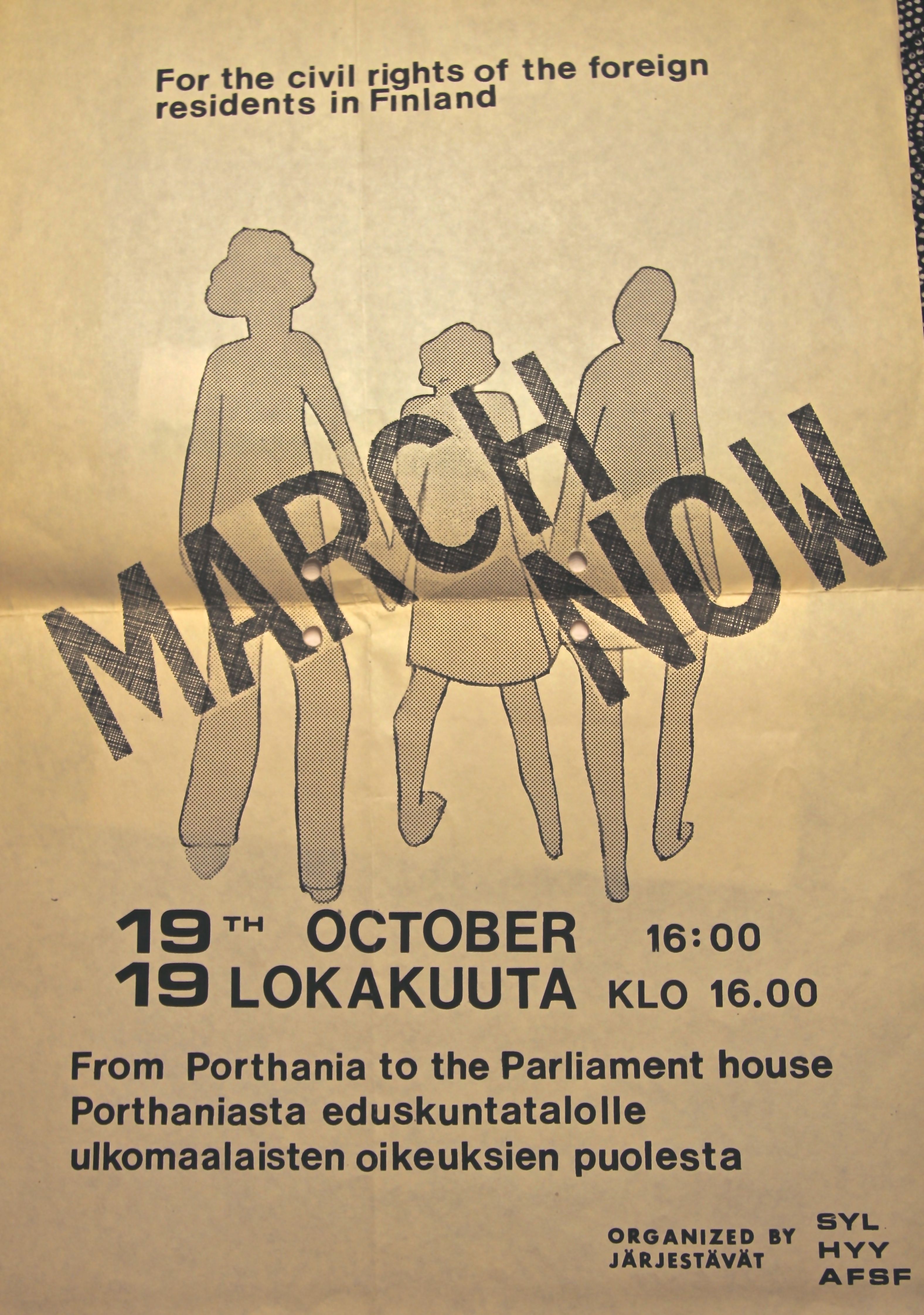
The first large demonstration ever held in Finland by migrants was on October 19, 1982. Before that historic march, some 100 Pakistanis marched from Helsinki to Turku in the early 1970s to protest that they didn’t get work in Finland. The second march in 1982, began in front of Porthania and ended at the doorsteps of Parliament. 

A day before the 1982 march, the then Aliens’ Office head, Eila Kännö, was reported to have threatened on Ilta-Sanomat that those migrants that took part in the march would be arrested. Back then, foreigners had few rights in Finland.

Among the things we were marching for back then was passage of Finland’s first Aliens Act, which came into force in 1984, or 65 years after independence.


I’m proud that we did organize the march. I found a rare poster in my files of that day we should never forget. 

IMG_2981The official poster that was used for the march on October 19, 1982.

If you asked over thirty years ago the police why Finland had such a restrictive policy against foreigners, their response was a common one: To keep criminals from moving to Finland.

How do you explain labor shortage and high unemployment?

Posted on January 12, 2014 by Migrant Tales

Sometimes Migrant Tales gets it right and many times we do. Our sharp associate editor, JusticeDemon, raised and shed light on a very topical issue that is constantly poisoning the debate about our ever-growing cultural diversity in Finland.

In Mikkeli, which is located about 230km north of Helsinki, a Perussuomalaiset (PS) politician, who equates immigrants with white European colonizers that colonized The Americas, and who believes that the region of South Savo doesn’t need any immigrants, claimed recently on Länsi-Savo that there is no labor shortage in Finland.

While there’s nothing surprising that a councilman of an anti-immigration party like the PS can make such a claim, it is odd that the chairwoman of the Social Democratic Party of Southeastern Finland, Satu Taavitsainen, agreed with the PS politician.

The PS councilman, Jukka Pöyry, is so much against immigration that if he’d live in the nineteenth century, he would be against foreign industrial leaders like Finnlayson, Paulig, Sinebrychoff, Rettig, Fazer and other household names today from moving to Finland because “there’s poverty and unemployment.”

Thus the argument made often by anti-immigration politicians is that we don’t need labor immigrants because there’s no labor shortage.

These politicians forget as well that in the EU there’s freedom of movement.

Kuvankaappaus 2014-1-12 kello 21.49.33

Read original posting here.

JusticeDemon raises an good point on a comment to ohdake on Migrant Tales. If you want to know if there is a labor shortage in Finland, all you have to do is visit the national job search engine, which reveals 10,639 job vacancies today. Since there’s no obligation to notify job vacancies – writes JusticeDemon – the true number of job openings is probably twice the number of notices.

He continues: “Many of these notices concern more than one vacancy, and many have been open for several weeks if not months. These are also only the vacancies that have been notified to employment authorities. There is no enforceable obligation to notify vacancies, and the true number of jobs available is probably around twice the number of notices.”

At the same time, Finland had in November an official unemployment rate of 7.9%.

JusticeDemon know throws the knockout punch:

Naive perceptions are easily manipulated by forces seeking political power. For example the most natural naive perception from the foregoing fact of 20,000 vacant jobs and 8 per cent unemployment is that the Finnish unemployed are work shy, and that they blame working immigrants for their unemployment in order to distract public attention from their own failings. This particular naive perception appeals to certain types of selfish Conservative mentality, but remains otherwise fairly rare in Finland.

JusticeDemon considers a “naive perception” the assumption that the number of jobs in an economy is constant. This assumes that any newcomer to the job market is somehow taking a job away from incumbent job-seekers.

“This naive perception appeals to authoritarian mentalities with limited cognitive and conceptual flexibility,” continues JusticeDemon. “There are various other naive perceptions that can be and are woven into the public consciousness to serve political ends. For example the view that everything comes down to labour costs, or that everything is the outcome of some massive conspiracy.”

Fadumo Dayib: Don’t worship my hurt feelings for the road to FGM is paved with good intentions

Posted on January 12, 2014 by Migrant Tales

Fadumo Dayib

There is an angry mob ready to lynch. They’re gathering force, leaping over barriers, ululating, and blindly bulldozing civility in their wake. The drummers, hunched over the “SOS” drum, thumps out an angry condescending rhythm, rivers of sweat and recriminations running down their livid face. The steady drumming picks up pace, urging the mob to free themselves from inhibitions, to discard any rules of engagement, gradually ignites the mob in an incensed dance. The dance of hurt feelings, of good attentions, manifested in chest beating, raised fists, and swathed in the bright colors of morality, swells to a frenzy, and abruptly ends in an ecstatic orgasmic crescendo that is feverish. The mob, oiled and utterly convinced out their righteousness, is ready. Suddenly, it turns in unison, their gaze locking on two young women tending to their media business. Lurching, heaving, the mob manages to corner the two petrified young women, strips them naked of their humanity and drags them on the street for an all-night mob mania. There’s nothing like a mob action, especially when it is out to save the black woman, or more specifically in this case, her black ass.

Kuvankaappaus 2014-1-12 kello 12.56.44

Read full posting here.

Sorry guys, please give me a minute while I rein in my over-active imagination. Let me get a steaming mug of chamomile tea to sooth my frayed nerves before continuing this writing. What a beautiful Sunday morning it is. Yes sire. We finally have snow, finally.

Hmmm, where was I. Right, I remember now. There is a mob, ready for lynching and all because of our juicy, fat, and black as the night asses. They’re on a “Save the Clitless Clique” campaign and my endangered ass is on the line here. We’re talking about the ass population of millions of women. I should be happy right. I should be honored. I should be flattered. I should be grateful for being the victim. I should be quiet, ashamed of what has been done to me. But I am not. Instead, I am confused, bewildered.

This mob is offended on my behalf because of an article and photos on FGM published by Helsinki Sanomat, the biggest media outlet in Finland, over a week ago. The anger is not wholly targeted at the media outlet as such, but at two specific women, namely Anu Nouisianen and Meeri Koutaniemi, who both provided the narrative. The writing and the photos were, I must say, fantastic. The photos, though shocking and terrifying, appealed to my humanity. FGM is not beautiful. It is gruesome, chillingly terrifying and deadly. Men, glance down, look at your little brother in your pants, sit back comfortably and imagine the whole tip of your penises, without anesthesia, being slowly, excruciatingly, sliced away. That is mutilation and not circumcision. You must be out of your mind to even have the audacity to even insist that mutilation is the same as male circumcision.

Why are some people reacting so strongly to the HS piece, you ask? Beats me too but I’ll hazard a guess based on my observations. You see, Anu and Meeri were invited and given access to one of the remote Masai villages in Kenya, where preparations were underway for an upcoming FGM procedure. Their visit eventually culminated in the inhumane mutilation of two under-aged Masai girls. Mind you, these villages are not strange to Meeri because of her self-funded, decade-long anti-FGM work. That is a side dish and not to be mixed with the main course. Anyway, the discussions’ escalated from insidious insinuations to downright accusations of racism, colonialism, exploitation, opportunism, incompetence and arrogance etc. As a result, a lot of negative energy is invested in shifting the focus from this abhorrent practice, in diluting its importance and in silencing others.

There is no doubt that some of the ethical concerns raised about the piece are valid. Yes, exploitation is wrong. Yes, racism is wrong. Yes, children have rights and their privacy should be protected. Yes, we should not make a living out of the misery of others. These are rules of engagement that should apply to ALL, regardless of the context, color and creed. But is it fair, just, and ethical to accuse Anu and Meeri of these things? Why is there a need to question their intentions and in this very disrespectful manner? Why take things so personally?

This discussion minefield is shrouded in double standards. The loaded language of politics, of disempowerment, of patronization involved here is disturbing. If we are going to bring up the issue of exploitation, of making a living out of the misery out of others, how about the migrants here? How about tackling the million dollar integration business that we have going on here? How about broaching the disempowerment of the black migrant communities by the integration business people? How about questioning the over-representation of the indigenous Finns in the integration and development NGOs? How about their exclusive right to leadership and management positions in these initiatives? How about their over-representation in development projects? We have highly qualified and competent people that could be doing these jobs. But no, we have to relegate them to their position, their dirty territory, to deal with their kind. As if that is all they are capable of! The context of exploitation and by whom, is purely subjective and steeped in self-interest.

The black woman’s body, the bodies of her children, has been divided up for exploitation. We have experts on her madness, on her anger, on her ugliness, on her religious fanaticisms, her inability to care for her children. We have experts on her sexuality, experts on her lack of sexuality, experts on her hyper-sexuality, experts on her womanhood, on her femininity. She needs saving from herself, from her husband, her son. Never mind about engaging her as an equal. Hell, fuck that intersectionality shit, right? Continue to speak over her and for her in your researches, in your projects, in your documentaries and in your writings. And if she continues to insist on speaking for herself, label her as unreasonable, as lazy, as a mindless child producing factory, and if all fails, label her as nut case and put her on your blacklist. After all, she is half a woman, right? She is not the whole woman that you are, right? Isn’t that exploitation, modern day slavery, colonialism, racism, opportunism? If that isn’t exploitation, then what is?  How about tackling that? Why the selectivity? Is it because Meeri mentioned the P and the C word? Could that be it? She has a campaign and a project in the pipeline. What? How dare she encroach on a stamped body, the black woman’s body, on a stacked territory, whether here or elsewhere? How about not speaking for me at all? How about that?

I, as an FGM survivor, don’t see the burning need in whipping this horse to kingdom come. It is distasteful when some people choose to be selective in their lynching. I am not the victim portrayed in these discussions nor will I ever be. I am a survivor. I have survived this long and will continue to do so long after this debate is over. I dream, yearn and pray for the day when this level of organized interest, this level of passion, this level of energy and this level of commitment is dedicated to the fight against racism, is dedicated to the fight for equity, for equal representation of migrants in decision-making structures, institutions and matters that affect their well-being in Finland.

Read original column here.

This piece was reprinted by Migrant Tales with permission.

  • Previous
  • 1
  • 2
  • 3
  • Next
Read more about documentary film
Read more

Recent Posts

  • Finland’s tabloids Iltalehti and Ilta-Sanomat are the pits
  • Riikka Purra’s Dr Jekyll and Mr Hyde mask
  • Double standards
  • Perussuomalaiset: Uusi logo, sama vanha juttu
  • Taco Trump

Recent Comments

  1. Absolutely Socking: Racist Finnish Facebook group against human rights gets flooded with socks on Musta Barbaari’s mother and sister charged by the police in “ethnic profiling” case
  2. Ilkka Nuotio on Pekka Myrskylä: “Tilastot kertovat toista kuin poliittinen keskustelu”
  3. Genrih Soinkara on The war in Ukraine and the Russian-Finnish border crisis are showing Finland’s ugly side
  4. Ahti Tolvanen on Comment by Ahti Tolvanen on the Helsinki +50 conference
  5. Angel Barrientos on Angel Barrientos is one of the kind beacons of Finland’s Chilean community

Archives

  • June 2026
  • May 2026
  • April 2026
  • March 2026
  • February 2026
  • January 2026
  • December 2025
  • November 2025
  • October 2025
  • September 2025
  • August 2025
  • July 2025
  • June 2025
  • May 2025
  • April 2025
  • March 2025
  • February 2025
  • January 2025
  • December 2024
  • November 2024
  • October 2024
  • September 2024
  • August 2024
  • July 2024
  • June 2024
  • May 2024
  • April 2024
  • March 2024
  • February 2024
  • January 2024
  • December 2023
  • November 2023
  • October 2023
  • September 2023
  • August 2023
  • July 2023
  • June 2023
  • May 2023
  • April 2023
  • March 2023
  • February 2023
  • January 2023
  • December 2022
  • November 2022
  • October 2022
  • September 2022
  • August 2022
  • July 2022
  • June 2022
  • May 2022
  • April 2022
  • March 2022
  • February 2022
  • January 2022
  • December 2021
  • November 2021
  • October 2021
  • September 2021
  • August 2021
  • July 2021
  • June 2021
  • May 2021
  • April 2021
  • March 2021
  • February 2021
  • January 2021
  • December 2020
  • November 2020
  • October 2020
  • September 2020
  • August 2020
  • July 2020
  • June 2020
  • May 2020
  • April 2020
  • March 2020
  • February 2020
  • January 2020
  • December 2019
  • November 2019
  • October 2019
  • September 2019
  • August 2019
  • July 2019
  • June 2019
  • May 2019
  • April 2019
  • March 2019
  • February 2019
  • January 2019
  • December 2018
  • November 2018
  • October 2018
  • September 2018
  • August 2018
  • July 2018
  • June 2018
  • May 2018
  • April 2018
  • March 2018
  • February 2018
  • January 2018
  • December 2017
  • November 2017
  • October 2017
  • September 2017
  • August 2017
  • July 2017
  • June 2017
  • May 2017
  • April 2017
  • March 2017
  • February 2017
  • January 2017
  • December 2016
  • November 2016
  • October 2016
  • September 2016
  • August 2016
  • July 2016
  • June 2016
  • May 2016
  • April 2016
  • March 2016
  • February 2016
  • January 2016
  • December 2015
  • November 2015
  • October 2015
  • September 2015
  • August 2015
  • July 2015
  • June 2015
  • May 2015
  • April 2015
  • March 2015
  • February 2015
  • January 2015
  • December 2014
  • November 2014
  • October 2014
  • September 2014
  • August 2014
  • July 2014
  • June 2014
  • May 2014
  • April 2014
  • March 2014
  • February 2014
  • January 2014
  • December 2013
  • November 2013
  • October 2013
  • September 2013
  • August 2013
  • July 2013
  • June 2013
  • May 2013
  • April 2013
  • March 2013
  • February 2013
  • January 2013
  • December 2012
  • November 2012
  • October 2012
  • September 2012
  • August 2012
  • July 2012
  • June 2012
  • May 2012
  • April 2012
  • March 2012
  • February 2012
  • January 2012
  • December 2011
  • November 2011
  • October 2011
  • September 2011
  • August 2011
  • July 2011
  • June 2011
  • May 2011
  • April 2011
  • March 2011
  • February 2011
  • January 2011
  • December 2010
  • November 2010
  • October 2010
  • September 2010
  • August 2010
  • July 2010
  • June 2010
  • May 2010
  • April 2010
  • March 2010
  • February 2010
  • January 2010
  • December 2009
  • November 2009
  • October 2009
  • September 2009
  • August 2009
  • July 2009
  • December 2008
  • November 2008
  • October 2008
  • September 2008
  • August 2008
  • July 2008
  • June 2008
  • May 2008
  • April 2008
  • March 2008
  • February 2008
  • January 2008
  • November 2007
  • October 2007
  • September 2007
  • August 2007
  • July 2007
  • June 2007
  • May 2007

Categories

  • ?? Gia L?c
  • ????? ?????? ????? ???????? ?? ??????
  • ???????
  • @HerraAhmed
  • @mondepasrond
  • @nohatefinland
  • @oula_silver
  • @Varathas
  • A Pakistani family
  • äärioikeisto
  • Abbas Bahmanpour
  • Abdi Muhis
  • Abdirahim Hussein Mohamed
  • Abdirahim Husu Hussein
  • Abdirisak Mahamed
  • About Migrant Tales
  • activism
  • Adam Al-Sawad
  • Adel Abidin
  • Afrofinland
  • Ahmed IJ
  • Ahti Tolvanen
  • Aino Pennanen
  • Aisha Maniar
  • Alan Ali
  • Alan Anstead
  • Alejandro Díaz Ortiz
  • Alekey Bulavsev
  • Aleksander Hemon
  • Aleksanterinliitto
  • Aleksanterinliitto ry
  • Aleksanterinliitto ry:n hallitus
  • Alex Alex
  • Alex Mckie
  • Alexander Nix
  • Alexandra Ayse Albayrak
  • Alexis Neuberg
  • Ali Asaad Hasan Alzuhairi
  • Ali Hossein Mir Ali
  • Ali Rashid
  • Ali Sagal Abdikarim
  • Alina Tsui
  • Aline Müller
  • All categories
  • Aman Heidari
  • Amiirah Salleh-Hoddin & Jana Turk
  • Amin A. Alem
  • Amir Zuhairi
  • Amkelwa Mbekeni
  • Ana María Gutiérrez Sorainen
  • Anachoma
  • Anders Adlecreutz
  • Angeliina Koskinen
  • Anna De Mutiis
  • Anna María Gutiérrez Sorainen
  • Anna-Kaisa Kuusisto ja Jaakko Tuominen
  • Annastiina Kallius
  • Anneli Juise Friman Lindeman
  • Announcement
  • Anonymous
  • Antero Leitzinger
  • anti-black racism
  • Anti-Hate Crime Organisation Finland
  • Anudari Boldbaatar
  • Arshiya Nasser
  • Aspergers Syndrome
  • Asylum Corner
  • Asylum seeker 406
  • Athena Griffin and Joe Feagin
  • Autism
  • Avaaz.org
  • Awale Olad
  • Ayan Said Mohamed
  • AYY
  • Barachiel
  • Bashy Quraishy
  • Beatrice Kabutakapua
  • Beri Jamal
  • Beri Jamal and Enrique Tessieri
  • Bertolt Brecht
  • Boiata
  • Boodi Kabbani
  • Bruno Gronow
  • Carmen Pekkarinen
  • Çelen Oben and Sheila Riikonen
  • Chiara Costa-Virtanen
  • Chiara Costa-Virtanen
  • Chiara Sorbello
  • Christian Thibault
  • Christopher Wylie
  • Clara Dublanc
  • Dana
  • Daniel Malpica
  • Danilo Canguçu
  • David Papineau
  • David Schneider
  • Dexter He
  • Don Flynn
  • Dr Masoud Kamali
  • Dr. Faith Mkwesha
  • Dr. Theodoros Fouskas
  • Edna Chun
  • Eeva Kilpi
  • Emanuela Susheela
  • En castellano
  • ENAR
  • Enrique
  • Enrique Tessieri
  • Enrique Tessieri & Raghad Mchawh
  • Enrique Tessieri & Yahya Rouissi
  • Enrique Tessieri and Muhammed Shire
  • Enrique Tessieri and Sira Moksi
  • Enrique Tessieri and Tom Vandenbosch
  • Enrique Tessieri and Wael Che
  • Enrique Tessieri and Yahya Rouissi
  • Enrique Tessieri and Zimema Mhone
  • Epäluottamusmies
  • EU
  • Europe
  • European Islamophobia Report
  • European Islamophobia Report 2019,
  • European Union
  • Eve Kyntäjä
  • Ezequiel Caldeiro
  • Facebook
  • Fadumo Dayib
  • Faisa Kahiye
  • Farhad Manjoo
  • Fasismi
  • Finland
  • Fizza Qureshi
  • Flyktingar och asyl
  • Foreign Student
  • Fozia Mir-Ali
  • Frances Webber
  • Frida Selim
  • Gareth Rice
  • Ghyslain Vedeaux
  • Global Art Point
  • Great Replacement
  • Habiba Ali
  • Hami Bahadori
  • Hami Bahdori
  • Hamid
  • Hamid Alsaameere
  • Hamid Bahdori
  • Handshake
  • Harmit Athwal
  • Hassan Abdi Ali
  • Hassan Muhumud
  • Heikki Huttunen
  • Heikki Wilenius
  • Helsingin Sanomat
  • Henning van der Hoeven
  • Henrika Mälmsröm
  • Hser Hser
  • Hser Hser ja Mustafa Isman
  • Husein Muhammed
  • Hussain Kazemian
  • Hussain Kazmenian
  • Ibrahim Khan
  • Ida
  • Ignacio Pérez Pérez
  • Iise Ali Hassan
  • Ilari Kaila & Tuomas Kaila
  • Imam Ka
  • inside-an-airport
  • Institute of Race Relations
  • Iraqi asylum seeker
  • IRR European News Team
  • IRR News Team
  • Islamic Society of Norhern FInland
  • Islamic Society of Northern Finland
  • Islamophobia
  • Jacobinmag.com
  • Jallow Momodou
  • Jan Holmberg
  • Jane Elliott
  • Jani Mäkelä
  • Jari Luoto
  • Jari Taponen
  • Jegor Nazarov
  • Jenni Stammeier
  • Jenny Bourne
  • Jessie Daniels
  • Joe Davidow
  • Johannes Koski
  • John D. Foster
  • John Grayson
  • John Marriott
  • Jon Burnett
  • Jorma Härkönen
  • Jos Schuurmans
  • José León Toro Mejías
  • Josue Tumayine
  • Jouni Karnasaari
  • Juan Camilo
  • Jukka Eräkare
  • Julian Abagond
  • Julie Pascoet
  • Jussi Halla-aho
  • Jussi Hallla-aho
  • Jussi Jalonen
  • JusticeDemon
  • Kadar Gelle
  • Kaksoiskansalaisuus
  • Kansainvälinen Mikkeli
  • Kansainvälinen Mikkeli ry
  • Katherine Tonkiss
  • Kati Lepistö
  • Kati van der Hoeven-Lepistö
  • Katie Bell
  • Kättely
  • Kerstin Ögård
  • Keshia Fredua-Mensah & Jamie Schearer
  • Khadidiatou Sylla
  • Khadra Abdirazak Sugulle
  • Kiihotus kansanryhmää vastaan
  • Kirsi Crowley
  • Koko Hubara
  • Kristiina Toivikko
  • Kubra Amini
  • KuRI
  • La Colectiva
  • La incitación al odio
  • Laura Huhtasaari
  • Lauri Finér
  • Leif Hagert
  • Léo Custódio
  • Leo Honka
  • Leontios Christodoulou
  • Lessie Branch
  • Lex Gaudius
  • Leyes de Finlandia
  • Liikkukaa!
  • Linda Hyökki
  • Liz Fekete
  • M. Blanc
  • Maarit Snellman
  • Mahad Sheikh Musse
  • Maija Vilkkumaa
  • Malmin Kebab Pizzeria Port Arthur
  • Marcell Lorincz
  • Mari Aaltola
  • María Paz López
  • Maria Rittis Ikola
  • Maria Tjader
  • Marja-Liisa Tolvanen
  • Mark
  • Markku Heikkinen
  • Marshall Niles
  • Martin Al-Laji
  • Maryan Siyad
  • Matt Carr
  • Mauricio Farah Gebara
  • Media Monitoring Group of Finland
  • Micah J. Christian
  • Michael McEachrane
  • Michele Levoy
  • Michelle Kaila
  • Migrant Tales
  • Migrant Tales Literary
  • Migrantes News
  • Migrants' Rights Network
  • MigriLeaks
  • Mikko Kapanen
  • Miriam Attias and Camila Haavisto
  • Mohamed Adan
  • Mohammad Javid
  • Mohammad M.
  • Monikulttuurisuus
  • Monisha Bhatia and Victoria Canning
  • Mor Ndiaye
  • Muh'ed
  • Muhamed Abdimajed Murshid
  • Muhammed Shire
  • Muhammed Shire and Enrique Tessieri
  • Muhis Azizi
  • Musimenta Dansila
  • Muslimiviha
  • Musulmanes
  • Namir al-Azzawi
  • Natsismi
  • Neurodiversity
  • New Women Connectors
  • Nils Muižnieks
  • No Labels No Walls
  • Noel Dandes
  • Nuor Dawood
  • Omar Khan
  • Otavanmedia
  • Oula Silvennoinen
  • Paco Diop
  • Pakistani family
  • Pentti Stranius
  • Perussuomalaiset
  • perustuslaki
  • Petra Laiti
  • Petri Cederlöf
  • Pia Grochowski
  • Podcast-lukija Bea Bergholm
  • Pohjois – Suomen Islamilainen Yhdyskunta
  • Pohjois Suomen Islamilainen Yhyskunta
  • Polina Kopylova
  • Race Files
  • racism
  • Racism Review
  • Raghad Mchawh
  • Ranska
  • Rashid H. and Migrant Tales
  • Rasismi
  • Raul Perez
  • Rebecka Holm
  • Reem Abu-Hayyeh
  • Refugees
  • Reija Härkönen
  • Remiel
  • Reza Nasri
  • Richard Gresswell
  • Riikka Purra
  • Risto Laakkonen
  • Rita Chahda
  • Ritva Kondi
  • Robito Ibrahim
  • Roble Bashir
  • Rockhaya Sylla
  • Rodolfo Walsh
  • Roger Casale
  • Rostam Atai
  • Roxana Crisólogo Correa
  • Ruth Grove-White
  • Ruth Waweru-Folabit
  • S-worldview
  • Sadio Ali Nuur
  • Sami Rusanen
  • Sandhu Bhamra
  • Sara de Jong
  • Sarah Crowther
  • Sari Alhariri
  • Sarkawt Khalil
  • Sasu
  • Scot Nakagawa
  • Shabana Ahmadzai
  • Shada Islam
  • Sharon Chang blogs
  • Shenita Ann McLean
  • Shirlene Green Newball
  • Sini Savolainen
  • Sira Moksi
  • Sonia K.
  • Sonia Maria Koo
  • Steverp
  • Stop Deportations
  • Suldaan Said Ahmed
  • Suomen mediaseurantakollektiivi
  • Suomen Muslimifoorumi ry
  • Suomen viharikosvastainen yhdistys
  • Suomen viharikosvastainen yhdistys ry
  • Suomi
  • Supermen
  • Susannah
  • Suva
  • Syrjintä
  • Talous
  • Tapio Tuomala
  • Taw Reh
  • Teivo Teivainen
  • The Daily Show
  • The Heino
  • The Supermen
  • Thomas Elfgren
  • Thulfiqar Abdulkarim
  • Tim McGettigan
  • Tino Singh
  • Tito Moustafa Sliem
  • Tobias Hübinette and L. Janelle Dance
  • Transport
  • Trica Danielle Keaton
  • Trilce Garcia
  • Trish Pääkkönen
  • Trish Pääkkönen and Enrique Tessieri
  • Tuulia Reponen
  • Uncategorized
  • UNITED
  • University of Eastern Finland
  • Uyi Osazee
  • Väkivalta
  • Vapaa Liikkuvuus
  • Venla-Sofia Saariaho
  • Vieraskynä
  • W. Che
  • W. Che an Enrique Tessieri
  • Wael Ch.
  • Wan Wei
  • Women for Refugee Women
  • Xaan Kaafi Maxamed Xalane
  • Xassan Kaafi Maxamed Xalane
  • Xassan-Kaafi Mohamed Halane & Enrique Tessieri
  • Yahya Rouissi
  • Yasmin Yusuf
  • Yassen Ghaleb
  • Yle Puhe
  • Yuliet Tresa
  • Yve Shepherd
  • Zahra Khavari
  • Zaker
  • Zalina Ametova
  • Zamzam Ahmed Ali
  • Zeinab Amini ja Soheila Khavari
  • Zimema Mahone and Enrique Tessieri
  • Zimema Mhone
  • Zoila Forss Crespo Moreyra
  • ZT
  • Zulma Sierra
  • Zuzeeko Tegha Abeng
© 2026 Migrant tales | Powered by Minimalist Blog WordPress Theme