Migrant tales
Menu
  • #MakeRacismHistory “In Your Eyes”
  • About Migrant Tales
  • It’s all about Human Rights
  • Literary
  • Migrant Tales Media Monitoring
  • NoHateFinland.org
  • Tales from Europe
Menu

Month: May 2013

Do mobile phone companies and insurers discriminate against immigrants living in Finland?

Posted on May 8, 2013 by Migrant Tales

Migrant Tales published Monday a story about how mobile phone operators in Finland require immigrants to make at least a 300-euro deposit and be a resident of this country for two years to get a mobile phone line.  
Kuvankaappaus 2013-5-8 kello 0.47.20

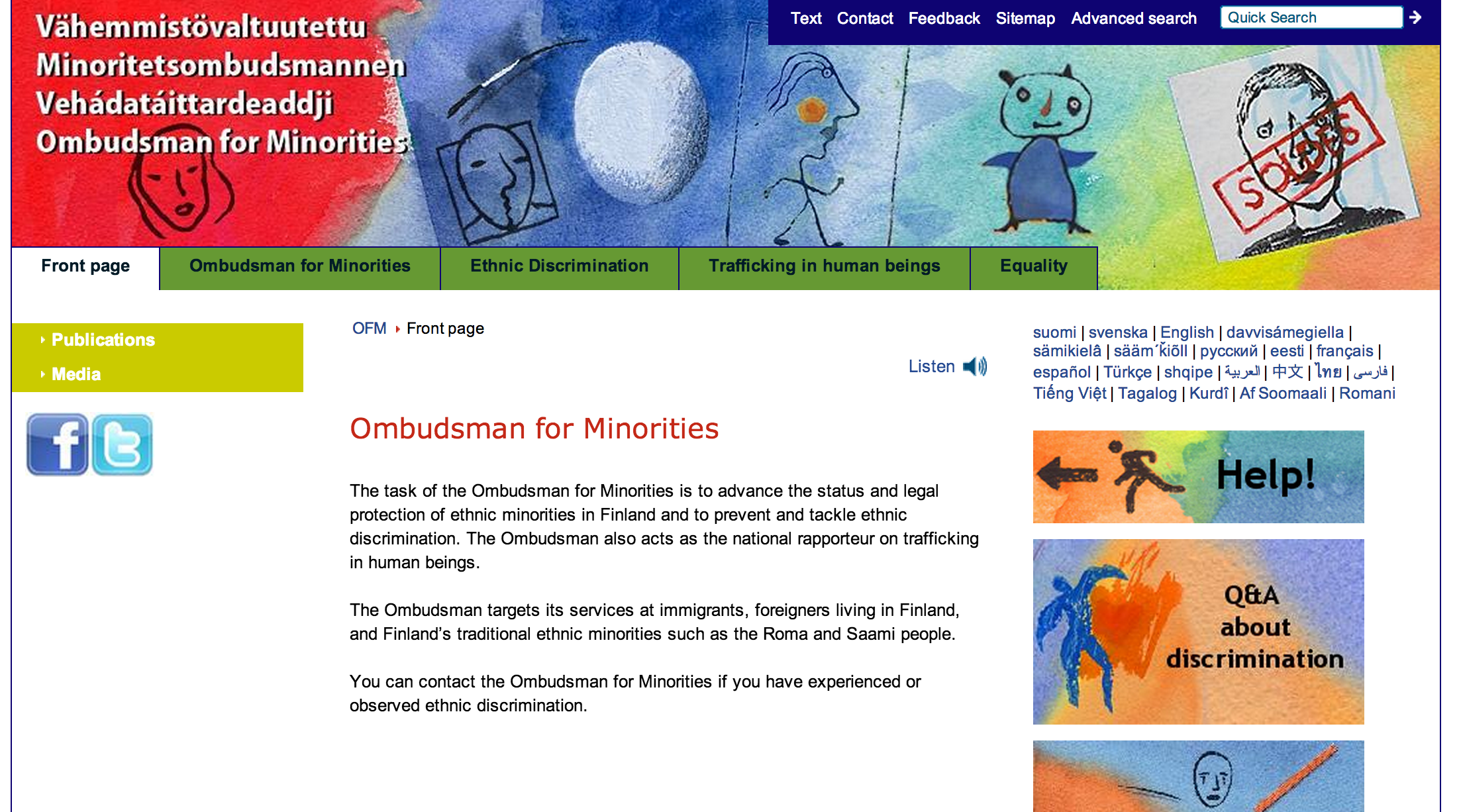
The Ombudsman for Minorities is a good place to inquire about your rights. They have a customer service line that one can call on weekdays 10-12  at +358 (0)71 878 8666

Thanks to Stephen Penny, whose blog entries have been published previously on Migrant Tales, wrote to us about the problems he’s been having in getting a mobile phone line in Helsinki. “Nightmare!” he tweeted. “I went to get a pre-paid SIM at the weekend, & was told 5 years for a mobile contract or EUR300-500 up front deposit!”

Penny said that one operator, Elisa, told him that it would take as long as five years before he could get a contract.  He said that the 300-500-euro deposit would only be refunded when the contract ended, normally after 24 months.

Asking a potential customer to pay a 300-500-euro deposit can be a tall order if you are a refugee and living off social assistance, which amounts to a few hundred euros a month.

An official at the Ombudsman for Minorities told Migrant Tales that the only reason why a phone operator can ask a potential client to meet the two-year residence requirement is if the person doesn’t have a credit history.

Another official at the National Discrimination Tribunal of Finland (Syrjintälautakunta) said that there was no cases brought to the tribunal’s attention concerning the two-year-or-more residence requirement by Finnish mobile phone operators.

Another interesting story that was brought to our attention Tuesday was how some Finnish insurance companies like IF require immigrants to have a social security institution Kela card for two years to get life insurance.

Writes Joe: ”I had a similar experience when I tried to get a life insurance policy here and was told that, even though I’m an EU citizen, I would have to live in Finland for between 2 and 5 years before any insurance company would consider me.”

Carlos Loarca confirmed in an email what Joe said: ”My experience about the insurance company IF [one of the biggest or the biggest in Scandinavia] told me that I can not apply for a personal insurance after I have my Kela card for longer than 2 years.”

The official from the Ombudsman for Minorities office was unaware that insurance companies like IF require immigrants to have a Kela card for two years to get life insurance.

One way of moving ahead would be to complain to the Ombudsman for Minorities with some concrete cases and/or bring it to the attention of the National Discrimination Tribunal of Finland as well.

If you want your case to be heard by the Ombudsman for Minorities, write to [email protected] .
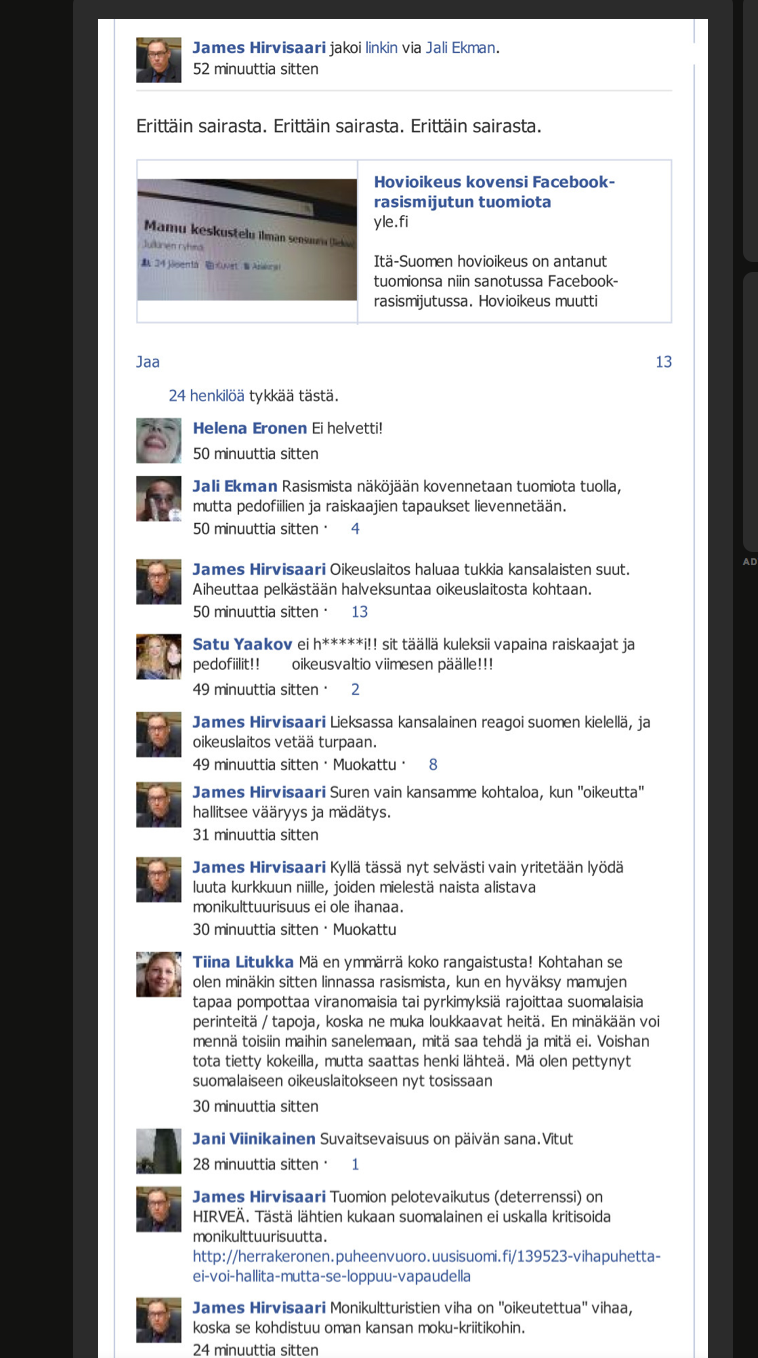
 

Kansanedustaja James Hirvisaari ja hänen mielikuvituksellinen Suomi

Posted on May 7, 2013 by Migrant Tales

Perussuomalainen kansanedustaja James Hirvisaaren Facebook sivun kommentit Itä-Suomen hovioikeus tuomiosta niin sanotussa Lieksan Facebook-rasismijutussa, ovat  hyvä esimerkki siitä kuinka suvaitsemattomuus on saanut jalansijan Suomessa. Riippumatta kuinka paljon perussuomalaisten puheenjohtaja Timo Soini haluaa antaa maltillisen kuvan puolueesta, siinä aina nousee samat tekijät ja viha pintaan. 

Suomessa vihataan paljon tänä päivänä. Vihataan maahanmuuttajat, homot, feministejä, suomen ruotsalaisia, vihervasemmistolaisia ja vaikka mitä.

Kuvankaappaus 2013-5-7 kello 19.42.02

Kun asuin Argentiinassa sotilasjuntan aikana 1977-1978, jossa katosi yli 30 000 ihmisiä, kenraalit puhuivat samalla tavalla vihollisista kuin nyt jotkut perussuomalaiset kansanedustajat puhuvat monikulttuurisuudesta.

Jos muuttaisin sanan “kommunismi,” joka antoi juntalle vapakädet terrorisoida koko kansaa ja maan oikeilla tai kuvitteellisilla vihollisilla ja laittaisit tilalle sanan “monikulttuurisuus,” yhtäläisyys  on pelottava. 

Hirvisaari ja hänen aatetoverinsa ovat valitettava ilmiö yhteiskunnassa. Heidän ristiretki monikulttuurisuutta vastaan muistuttaa Don Quijoten taistelu tuulimyllyjä vastaan.

He eivät vain halua kieltä, että olemme kasvava kulttuurisesti moninainen yhteiskunta, mutta taistelevat sen vastaan.

Olen varma, että he tulevat epäonnistumaan pahasti tavoitesaan.


Otavan Sanomat: Miksi musliminaiset ovat yliedustettuina yksinhuoltajaäitien ryhmässä?

Posted on May 7, 2013 by Migrant Tales

Maryan Siyad ja Zamzam Ahmed Ali

Miksi Suomessa ovat musliminaiset yliedustettuina yksinhuoltajaäitien ryhmässä? Esimerkiksi, Suomessa asuvien Somaliassa syntyneiden naisten perheistä liki 44% oli ilman miestä tai isää vuonna 2011, MTV3:n 45 minuuttia -ohjelman mukaan, kun vastaava luku suomalaisten naisten keskuudessa on 20,2%. Miten tähän on päädytty?

Kaikki tietävät, että lapsen kasvattaminen ei ole helppoa, erityisesti jos olet yksinhuoltaja sekä asut vieraassa maassa. Nuoret äidit ja lapset tarvitsevat tukea. Enemmän tukea sitä parempi.

Kulttuuriset paineet saattavat olla yksi syy miksi niin monia somali naisia on yksinhuoltajina. Kuten muualla, Somaliassakin naiset perinteisesti hoitavat lapset ja kodin. Miehen rooli on olla työssä kodin ulkopuolella. Nämä roolit muuttuvat paljon kun tähän perinteeseen tule muutoksia yhteiskunnan muutosten myötä.

Kaikki tietävät, että perhe on taloudellinen yksiö. Jollakin perheillä vähäinen raha ja mahdollisuudet voi kärjistää ongelmat sekä muuttaa naisten ja miesten perinteiset roolit.

Saamalla tavalla kun suomalaiset yksinhuoltajat tekevät urheasti työtä lastensa hyväksi, sama asia koske maahanmuuttaja naisia. Äitiys ei tunne kansalaisuutta tai rajoja.

Mikä sitten on ratkaisu? Kuinka voisimme vähentää yksinhuoltajien paineita?

Helppoa ratkaisua korkeaan yksihuoltajien määrään ongelmaan ei löydy. Yksi tärkeä askel oikeaan suuntaan olisi kuitenkin se että viranomaiset tunnistavat ongelmat ja että niin pitää tarttua.

Kenties yksi lääke voisi olla enemmän koulutusta ja työtä tarjoilla yksinhuoltajille, että heidän elämä näin helpottuisi Suomessa. Enemmän rahaa ja mahdollisuuksia parempaan tulevaisuus varmasti auttaisi yksinhuoltajien ja heidän tilannetta.

Tämä juttu julkaistiin Otavan Sanomissa (toukokuu 2013). Maryan Siyad ja Zamzam Ahmed Ali opiskelevat Otavan Opiston monikulttuurisella peruskoululinjalla. 

Why do immigrants have to wait two years to get a mobile phone line in Finland?

Posted on May 6, 2013 by Migrant Tales

We have read in the past how difficult it is for some immigrants in Finland to open a bank account never mind get access to online banking. All of Finland’s phone operators require immigrants to be residents for two years and a deposit of 300-500 euros in order to get a mobile phone line. 

A Saunalahti customer service employee said that the two-year requirement was made by all phone companies operating in the country.

How do they know how long a person has lived in Finland?

“We find out the person’s creditworthiness,” the Saunalahti employee said. “That’s how we know how long he’s lived in the country.”

An immigrant who has resided in Finland for a year and a half said that getting credit for buying a cell phone was out of the question if you don’t meet the two-year minimum residence requirement.

“Having a mobile phone line is complicated and costly if you pay the deposit,” the immigrant said. “If you are a refugee who gets a few hundred euros in assistance monthly from the state, 300 euros is a lot of money.”

@SR_Penny tweeted shortly after the story was published: “Nightmare! I went to get a pre-paid SIM at the weekend, & was told 5 years for a mobile contract or EUR300-500 up front deposit!”

@SR_Penny said that one operator, Elisa, told him that it would take as long as five years until he can get a contract.  He said that the 300-500 euro deposit would only be refunded when the contract ended, normally after 24 months.

One way that immigrants get around this problem is by asking their friends and relatives to open a mobile phone line for them.

Getting a mobile phone line isn’t the only headache immigrants face. Opening a bank account can be equally trying and varies from bank to bank and city branch office to city branch office. In some cases it’s possible to open a bank account but not have access to online banking.

Some banks even require immigrants to be Finnish citizenship in order to have access to online banking, while others require a valid Finnish driver’s license.

While stateless persons may have a difficult time opening a bank account in Finland, some have gotten around this obstacle by using a driver’s license.


Sini Savolainen: Nainen, tuo keppihevosista paras!

Posted on May 6, 2013 by Migrant Tales

Sini Savolainen

Voisivatko oikeistolaiset siis kiivetä pois selästäni!
Jälkijytkyläisessä politiikassa yhdeksi maahanmuuton ja toisten kulttuurien vastustamisen suurimmaksi syyksi on nostettu naisten ihmisoikeudet. Niiden kannattaminen kun näyttää tosi hyvältä ulospäin.Valitettavasti homma ei toimi ihan niin, että huudetaan “Mutta entäs naisten oikeudet!” ihan joka ikiseen väliin, jos “ihmisoikeustaistelulla” ei ole mitään loogista linjaa.

Erityisen suosittu keppihevonen tuntuu olevan musliminainen. Musliminainen kun on vielä suomalaisia lähilajejaan, kapista mokuttajanaista ja tavallista ihanan valkoista suomalaisnaista enemmän hukassa.

Hyvä esimerkki tästä on perjantaina uutisoitu kansanedustaja Saarakkalan ehdottama burkha- ja niqabkielto. Saarakkala on sitä mieltä, että muutaman kymmenen naisen (mitä todennäköisimmin vapaaehtoinen) verhoutuminen on suuri loukkaus heidän oikeuksiaan kohtaan.

Naisten oikeuksien punainen lanka ei kuitenkaan ole kovin yhtenäinen. Saarakkala vastustaa yhtä naisten lisääntymisterveyden kulmakivistä, oikeutta aborttiin. Hänen mielestään lääkärin pitäisi saada kieltäytyä abortista vakaumuksensa pohjalta.

Burkhakieltoa ajetaan sinisilmäisesti sillä perusteella, että verhotut naiset ovat jotenkin totaalisen alistettuja tahdottomia raukkoja, jotka oma mies huputtaa ennen kotoa poistumista.

Kuinka montaa musliminaista vaikkapa Saarakkala on konsultoinut asiasta ennen kiellon puuhaamisen aloittamista?

Saarakkalalla tuskin valkoisena (oletettavasti) kristittynä miehenä on pahemmin kokemusta elämästä muslimina, saati musliminaisena.

Jo aiemmin keväällä FEMENin tempauksen myötä musliminaiset ympäri maailmaa ilmaisivat, etteivät he tahdo olla länsimaisten feministien keppihevosia. En usko heidän tahtovan sen suuremmin olla islamofobisten, maahanmuuttajavihamielisten oikeistolaisten miesten keppihevosia.

Ei toisten oikeuksia voi ajaa omista lähtökohdista, kuuntelematta ja ymmärtämättä toisten ajatuksia ja asemaa.

Luovuttamattomat ihmisoikeudet kuuluvat kaikille ja kiinnostus niiden edistämiseen on tärkeää. Tavassa, jolla näitä oikeuksia ajetaan, on kuitenkin vielä oikeistolla ja myös lännen liberaaleilla oppimisen varaa.

Alkuperäisen blogikirjoituksen voi lukea tästä.

Tämä blogikirjoitus julkaistiin Migrant Talesissä luvalla.

Husein Muhammed: Nälkä ei tunne kela-korttia

Posted on May 5, 2013 by Migrant Tales

Husein Muhammed

Husein Muhammed 

“Leipäjonoissa kela-korttipakko – tuhat asiakasta hävisi. Vain henkilöllisyytensä todistaneet pääsevät sisään hakemaan ilmaista ruokaa. Toiminnanjohtaja Heikki Hursti kertoo, että auttamisjärjestö sai tarpeekseen ruoka-avun väärinkäyttäjistä.”

Näin uutisoi MTV3 tunnetuimman suomalaisen ruoka-apua tarjoavan järjestön, Hurstin suvun Laupeudentyö ry:n, uudesta käytännöstä.

Hursti kertoo uutisessa kuulleensa huhuja, että avustusjärjestöjen jakamaa ruokaa käytettäisiin väärin, myytäisiin eteenpäin. Lisäksi hänen mukaan “vaatejakeluihin tuli porukka, joka ei edes katsellut vaatteiden kokoa, vaan mätti tavaraa suoraan säkkeihin”.

Ruokajonojen pituutta on viime aikoina pidetty – jos ei suoranaisena tilastona – ainakin jonkinlaisena oireena huono-osaisuuden lisääntymisestä yhteiskunnassa. Juuri Laupeudentyö ry sai kansan liikkeelle turvaamaan sille jakelupisteitä, kun se joutui asukkaiden valitusten johdosta lähtemään Helsingin Kallion eräästä kerrostalosta.

On toki tärkeää, että ruoka-apu päätyy niille, jotka sitä eniten tarvitsevat. Myönnän olleeni niin onnekas, ettei minun ole tarvinnut mennä leipäjonoihin. Leipäjonoissa on varmasti varattomia tai vähävaraisia ihmisiä, joille ruokakassi tai käytetyt vaatteet tulevat tarpeeseen.

Toisaalta en lähde myöskään kiistämään, etteikö minkäänlaisia väärinkäytöksiä voisi ruoka- ja vaatejonoihin liittyä. Lähdetään siis siitä olettamuksesta, että Hurstin kuulemat huhut olisivat todellisia: ruokaa ja vaatteita hakisivat muutkin kuin niitä kipeästi tarvitsevat. Olettakaamme lisäksi, että myös Hurstin epäilys ruoan ja vaatteiden ottamista myyntiä varten pitäisi paikkaansa.

Hurstin tarjoama apu on vapaaehtoista. Kukaan ei voi määrätä, kenelle Hursti saa tarjota apuaan ja kenelle ei. Hursti järjestöineen julistaa kuitenkin tarjoavansa apuaan kaikille sitä aidosti tarvitseville. Hursti kertoo pyrkivänsä torjumaan väärinkäytökset, mikä on tietysti myös hänen järjestönsä apua aidosti tarvitsevien kannalta hyvä asia.

Hurstilla on siis oikeus valita avun kohteet sekä estää väärinkäytökset. Hurstin esittämä uusi keino väärinkäytösten estämiseksi on kuitenkin täysi huti. Kela-kortista ei voi päätellä kenenkään avuntarvetta: sellaisen omistanee paitsi asunnoton Anssi myös Björn Wahlroos.

Kela-kortin hallussapito ei millään tavalla ole todiste henkilön tarpeesta saada ruoka-apua leipäjonoista. Ehkä pikemminkin juuri päinvastoin: Kela-kortin haltijat ovat Suomen sosiaaliturvan piirissä. Heillä voi olla työpaikka tai ainakin oikeus työmarkkinatukeen tai toimeentulotukeen tai muunlaiseen yhteiskunnan tarjoamaan turvaan.

Toki osa kela-kortin haltijoistakin voi aidosti olla hätäavun tarpeessa. Mutta paljon todennäköisemmin sellaisen tarpeessa ovat kela-kortittomat ulkomaalaiset, jotka eivät ole Suomen sosiaaliturvan piirissä. Esimerkiksi turvapaikanhakijat, kerjäläiset tai matalapalkka-aloilla työskentelevät virolaiset. Tai niin sanotut paperittomat henkilöt, jotka maastakarkotuksen pelossa eivät uskalla ollenkaan ottaa yhteyttä viranomaisiin tai asettua asumaan virallisesti mihinkään Suomessa.

Väitänkö siis, etteivät ulkomaalaiset voi syyllistyä väärinkäytöksiin leipä- tai vaatejonoissa? Toki voivat. Eikö Hursti saa sitten estää ulkomaalaisten väärinkäytöksiä? Toki saa.

Hursti hehkuttaa leipäjonojen lyhentyneen heti tuhannella asiakkaalla. Mutta onko se jokin saavutus? Jonoista tuskin jäivät pois apua tarvitsemattomat, sillä avuntarvetta ei millään tavalla tutkita. Jonoista jäivät pois kela-korttia vailla olevat asiakkaat, joiden joukosta löytyvät kaiken todennäköisy
yden mukaan eniten vapaaehtoista apua tarvitsevat, koska viranomaisilta ei apua heru.

Kela-korttipakkoa voisi jossain määrin ymmärtää, jos sillä voitaisiin selvittää avuntarvetta ja/tai mikäli korttipakko olisi ainoa mahdollisuus puuttua väärinkäytöksiin. Korttipakko ei kuitenkaan täytä kumpaakaan ehtoa.

Mahdollisten väärinkäytösten torjumisen voisi varsin vaivattomasti hoitaa rajoittamalla käytettyjen vaatekappaleiden ottamista esimerkiksi vain pariin vaatekappaleeseen per henkilö. Väärinkäytösten torjumiseen on niin yksinkertaisia keinoja, ettei Hursti järjestöineen liene edes tullut niitä ajatelleeksi.


* Kirjoittaja on lakimies ja tietokirjailija sekä Etelä-Suomen etnisten suhteiden neuvottelukunnan puheenjohtaja (2011 – 2015)

Alkuperäisen blogikirjoituksen voi lukea tästä.

Tämä blogikirjoitus julkaistiin Migrant Talesissä luvalla.

Enough is enough! I’ve had it with you Finns!

Posted on May 5, 2013 by Dana

By Dana

Yesterday was a dark black day but a blessed one even if it brought so much sadness. A racist couldn’t kill who I am and yet again, like so many times before in my life, God helped me to overcome a very difficult situation. For you racists out there, and those who support you, even those who are racist but yet don’t know it, even those of you who are racist but are still in denial, let me tell you the following: I can hear your thoughts and hate.

Here’s what happened to me at work a day before Vappu, or Labor Day:

I began work on Tuesday in the morning and I knew that the following day would be Vappu. I don’t need to prove to anyone how good of a worker I am. I’m just as good as any of my Finnish coworkers.  Even so, I still don’t understand how people can be so cruel and rude to anyone before a day like Vappu.

My coworkers were in a festive mood and already partying in the kitchen and I heard their laughs all the way from there. Their joy brought me to them. It was wonderful to see my people in such a happy mood. There was food on the kitchen table: cakes, sweets and fruits.

To my surprise, the Vappu they were celebrating a day before was not for me because I was not like them. I’m a foreigner. It was hard blow being excluded. Oh my God, I said to myself, how could they hurt me in such a way?

It was clear that they didn’t want to be with me. Their clear  “you’re not one of us” look and their laughs told me that loud and clearly.

When I returned to the kitchen a little later for my lunch break, I saw them eating ice cream on the other side of the room.  It was the same message over again: This ice cream is for us and not for you.

How did I know?

Because nobody in the room was considerate enough to ask me to join them.

It’s not the first time I’ve been in these types of situations. Only 1% of all the Finns I have met have accepted me and been kind to me.

Sitting as I usually do in the kitchen and eating my lunch by myself, I was careful not place my food on the table because I didn’t want their food to touch mine. Everybody could see I was in the room but no one cared to notice.

I finished eating lunch and went back to work.

Even while I was working, nobody called me to join my fellow coworkers in the kitchen. I felt that I had turned into a ghost before them and Vappu. I didn’t exist.

When I left work I wanted to scream at the top of my voice but where and to whom? In the market? On the street? In shops? At Lidl?

I’ve had it with you Finns! I’ve lived here for five years and I give up!

Believe it or not, I’m actually happy that I gave up on the Finns because I won’t waste my time anymore on false expectations.

Enough is enough!

_______________

More blog entries by Dana: 

A warning: Finland

Don’t leave me

Poetic essay for tomatoes and cucumbers

An immigrant’s life in Finland: Dana misses her family


Landmark busman turban case will be another watershed in Finland’s acceptance of cultural diversity

Posted on May 4, 2013 by Migrant Tales

Finland is about to cross another watershed in cultural diversity, when busman Gill Sukhdarshan Singh of Vantaa was prohibited from using a turban at work, reports Helsingin Sanomat. Some legal experts see it an open-and-shut legal case.

The excuses for a turban ban by bus company Veolia highlight, however, a wider challenge facing our ever-growing cultural diversity.

Kuvankaappaus 2013-5-4 kello 9.52.00

That “challenge” is nothing more than acknowledgement by Finland that we live in a culturally diverse society today. Other ethnic groups and cultures have just as much right to feel at home in Finland.

The whole turban case is as well an example how far behind we lag with other European countries concerning cultural diversity. Sikh bus drivers in England won such rights over forty years ago in 1969.

Despite the arguments used by the bus company to justify the ban, one of the most absurd reasons stated is that waring a tuban is a security risk.

How does wearing a turban cause a security risk?

Singh’s attitutde and approach to the ban by his employer is the correct one that other immigrants and minorities should take when challenging intlerance.  “I’m doing this for my children’s sake so they won’t have to [fight for such a right],” he said.

The case should be seen not only as important to Sikhs living in Finland, but to all immigrants and visible minorities living in this country. Greater acceptance of a group’s rights will have a positive effect on promote greater acceptance of other groups in this country.

On an editorial in Saturday’s Helsingin Sanomat, the daily writes about the turban ban. It hopes that the case is won by Singh.

Meanwhile, retailer HOK-Elanto announced that its employees can wear veils at work, reports Helsingin Sanomat. One of the reasons why their is a policy change in the dress code is because many Muslim women work for the company.

Analysts believe that this practice will become common in other Finnish companies.

While Finland takes proactive steps to accept other groups in this country, parties like the Perussuomalaisiet (PS) are fighting tooth and nail against cultural diversity.

PS MP Vesa-Matti Saarakkala, a well-known anti-immigration lobbyist who is anti-Muslim, has introduced a law initiative in parliament that aims to ban the burqa and nijab in public places. Despite the fact that we’re speaking of a minute minority of women in Finland (I have never seen a woman wearing such clothes in this country), he considers the law important because it is “a preventive measure.”

The law is not expected to pass in parliament.


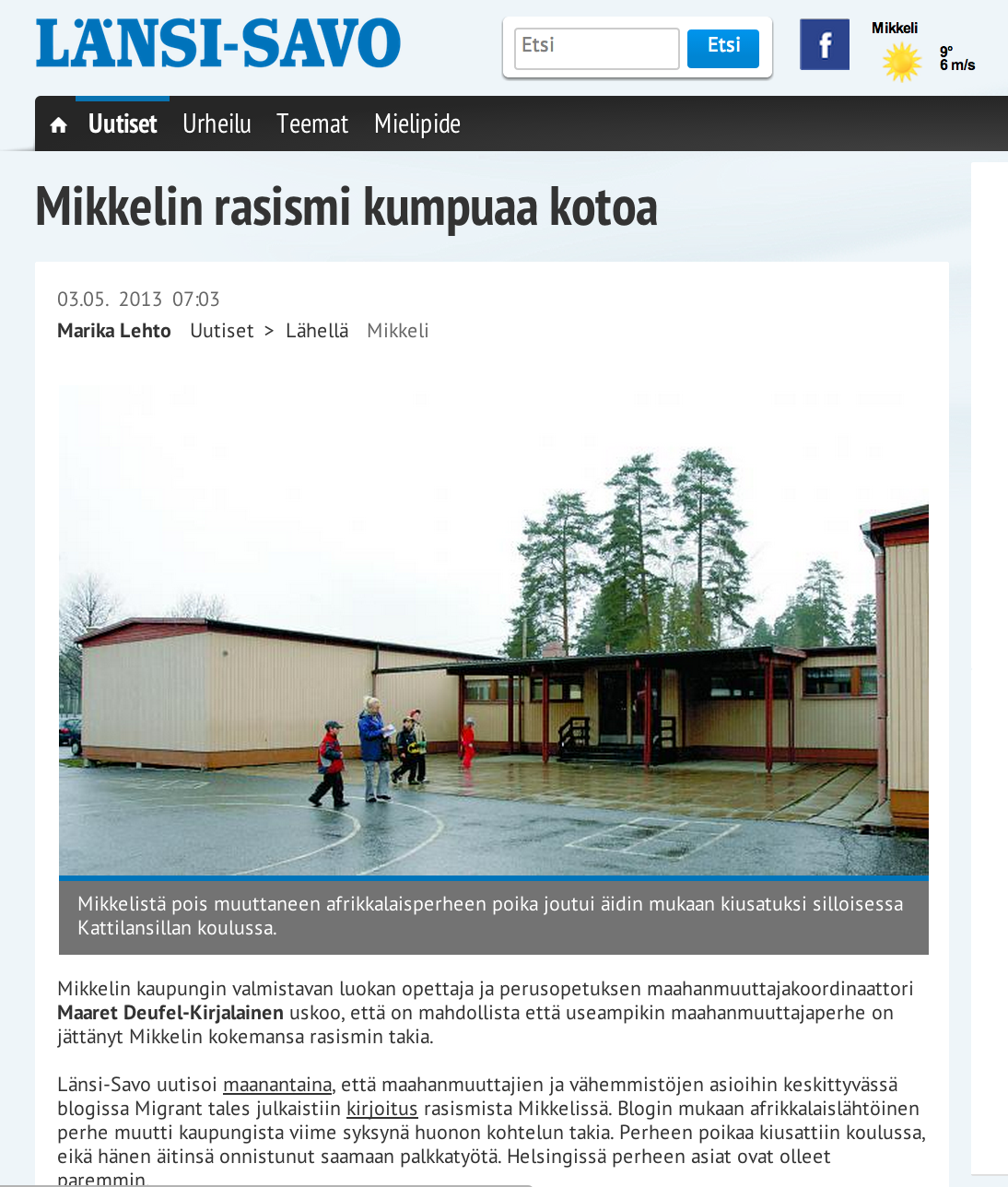
Migrant Tales story sheds more light on a wider problem at schools in Mikkeli

Posted on May 3, 2013 by Migrant Tales

Who says that writing cannot change matters? Migrant Tales published on Monday a story about a single mother who moved out of Mikkeli with her child because of the racist harassment at school. The story was picked up by Länsi-Savo, Itä-Savo, Peruopetus and commented widely in different national chat forums. 

Kuvankaappaus 2013-5-3 kello 10.16.24

Read whole story here.

On Friday Länsi-Savo wrote an interview with Maaret Deufel-Kirjalainen, Mikkeli’s school immigrant coordinator.

Deufel-Kirjalainen said that the single mother and her boy are not the only immigrant children who may possibly have moved out of Mikkeli because of racist harassment and bullying at school.

She said that these types of racist attitudes are learned at home.


We speak of two-way integration but too many still believe in assimilation

Posted on May 3, 2013 by Migrant Tales

Finland’s integration law is exemplary in many respects because it aims to integrate newcomers as equals in our society. No law is, however, written in stone and is only as good as the institutions and people that enforce it. One of the matters that some have a difficult time grasping is what two-way adaption, or integration, means and implies. 

Integration is the opposite to assimilation, which is one-way integration. Those who are in favor of assimilation, believe that most if not all of the adapting to cultural diversity will be done on their terms. One of their favorite arguments is: “Why should I adapt to them if they are in my country.”

Assimilation is a lazy and convenient way to exclude and keep others corralled with the help of our suspicion. This integration model is one of the reasons why intolerance is still the rule instead of the exception in many European countries.

Assimilation not only is a lazy model and sustains itself with the help of ethnocentrism, prejudice, white privilege, outright discrimination of whole groups and, worse, by defensive and repeated denials that we don’t have any issue with intolerance.

Take for example Finland’s Romany minority, which have suffered the greatest hostility in our society. They are a good example if any of outright social exclusion.

A US state department human rights report stated recently: ”Groups of Roma have lived in the country for centuries, and Roma are classified as a ’traditional ethnic minority’ in the ombudsman’s report. The Romany minority was the most frequent target of racially motivated discrimination, followed by Russian-speakers, Somalis, and Sami.”

Some Finns are still waiting after 500 years for the Roma, which number about 10,000 in Finland, to turn “white.” By turning white, I mean giving up their traditional dress, identity and ways of life in order to gain greater acceptance.

The paradox, however, is that if they gave up their identity they’d be in worse shape then they are today. The aim of  intolerance and the victimization of groups like the Roma, is to wipe them off the Finnish cultural map.

One matter we should be careful to avoid when promoting two-way integration is exclusion by default. The best of example of this is when elementary schools continue to call third-culture children as students with immigrant backgrounds (maahanmuuttajataustainen) irrespective that they were born and have lived all their lives in this country.

Living in a culturally diverse society where two-way adaption, or integration, is the rule is the most effective and less-expensive way to adapt newcomers.

Even if our society promotes mutual acceptance, our laws and human rights play important roles.

The greatest integrators of all are social justice and equal opportunities – the very values we promote in our laws.

  • Previous
  • 1
  • 2
  • 3
  • 4
  • 5
  • 6
  • Next
Read more about documentary film
Read more

Recent Posts

  • Finland’s tabloids Iltalehti and Ilta-Sanomat are the pits
  • Riikka Purra’s Dr Jekyll and Mr Hyde mask
  • Double standards
  • Perussuomalaiset: Uusi logo, sama vanha juttu
  • Taco Trump

Recent Comments

  1. Absolutely Socking: Racist Finnish Facebook group against human rights gets flooded with socks on Musta Barbaari’s mother and sister charged by the police in “ethnic profiling” case
  2. Ilkka Nuotio on Pekka Myrskylä: “Tilastot kertovat toista kuin poliittinen keskustelu”
  3. Genrih Soinkara on The war in Ukraine and the Russian-Finnish border crisis are showing Finland’s ugly side
  4. Ahti Tolvanen on Comment by Ahti Tolvanen on the Helsinki +50 conference
  5. Angel Barrientos on Angel Barrientos is one of the kind beacons of Finland’s Chilean community

Archives

  • June 2026
  • May 2026
  • April 2026
  • March 2026
  • February 2026
  • January 2026
  • December 2025
  • November 2025
  • October 2025
  • September 2025
  • August 2025
  • July 2025
  • June 2025
  • May 2025
  • April 2025
  • March 2025
  • February 2025
  • January 2025
  • December 2024
  • November 2024
  • October 2024
  • September 2024
  • August 2024
  • July 2024
  • June 2024
  • May 2024
  • April 2024
  • March 2024
  • February 2024
  • January 2024
  • December 2023
  • November 2023
  • October 2023
  • September 2023
  • August 2023
  • July 2023
  • June 2023
  • May 2023
  • April 2023
  • March 2023
  • February 2023
  • January 2023
  • December 2022
  • November 2022
  • October 2022
  • September 2022
  • August 2022
  • July 2022
  • June 2022
  • May 2022
  • April 2022
  • March 2022
  • February 2022
  • January 2022
  • December 2021
  • November 2021
  • October 2021
  • September 2021
  • August 2021
  • July 2021
  • June 2021
  • May 2021
  • April 2021
  • March 2021
  • February 2021
  • January 2021
  • December 2020
  • November 2020
  • October 2020
  • September 2020
  • August 2020
  • July 2020
  • June 2020
  • May 2020
  • April 2020
  • March 2020
  • February 2020
  • January 2020
  • December 2019
  • November 2019
  • October 2019
  • September 2019
  • August 2019
  • July 2019
  • June 2019
  • May 2019
  • April 2019
  • March 2019
  • February 2019
  • January 2019
  • December 2018
  • November 2018
  • October 2018
  • September 2018
  • August 2018
  • July 2018
  • June 2018
  • May 2018
  • April 2018
  • March 2018
  • February 2018
  • January 2018
  • December 2017
  • November 2017
  • October 2017
  • September 2017
  • August 2017
  • July 2017
  • June 2017
  • May 2017
  • April 2017
  • March 2017
  • February 2017
  • January 2017
  • December 2016
  • November 2016
  • October 2016
  • September 2016
  • August 2016
  • July 2016
  • June 2016
  • May 2016
  • April 2016
  • March 2016
  • February 2016
  • January 2016
  • December 2015
  • November 2015
  • October 2015
  • September 2015
  • August 2015
  • July 2015
  • June 2015
  • May 2015
  • April 2015
  • March 2015
  • February 2015
  • January 2015
  • December 2014
  • November 2014
  • October 2014
  • September 2014
  • August 2014
  • July 2014
  • June 2014
  • May 2014
  • April 2014
  • March 2014
  • February 2014
  • January 2014
  • December 2013
  • November 2013
  • October 2013
  • September 2013
  • August 2013
  • July 2013
  • June 2013
  • May 2013
  • April 2013
  • March 2013
  • February 2013
  • January 2013
  • December 2012
  • November 2012
  • October 2012
  • September 2012
  • August 2012
  • July 2012
  • June 2012
  • May 2012
  • April 2012
  • March 2012
  • February 2012
  • January 2012
  • December 2011
  • November 2011
  • October 2011
  • September 2011
  • August 2011
  • July 2011
  • June 2011
  • May 2011
  • April 2011
  • March 2011
  • February 2011
  • January 2011
  • December 2010
  • November 2010
  • October 2010
  • September 2010
  • August 2010
  • July 2010
  • June 2010
  • May 2010
  • April 2010
  • March 2010
  • February 2010
  • January 2010
  • December 2009
  • November 2009
  • October 2009
  • September 2009
  • August 2009
  • July 2009
  • December 2008
  • November 2008
  • October 2008
  • September 2008
  • August 2008
  • July 2008
  • June 2008
  • May 2008
  • April 2008
  • March 2008
  • February 2008
  • January 2008
  • November 2007
  • October 2007
  • September 2007
  • August 2007
  • July 2007
  • June 2007
  • May 2007

Categories

  • ?? Gia L?c
  • ????? ?????? ????? ???????? ?? ??????
  • ???????
  • @HerraAhmed
  • @mondepasrond
  • @nohatefinland
  • @oula_silver
  • @Varathas
  • A Pakistani family
  • äärioikeisto
  • Abbas Bahmanpour
  • Abdi Muhis
  • Abdirahim Hussein Mohamed
  • Abdirahim Husu Hussein
  • Abdirisak Mahamed
  • About Migrant Tales
  • activism
  • Adam Al-Sawad
  • Adel Abidin
  • Afrofinland
  • Ahmed IJ
  • Ahti Tolvanen
  • Aino Pennanen
  • Aisha Maniar
  • Alan Ali
  • Alan Anstead
  • Alejandro Díaz Ortiz
  • Alekey Bulavsev
  • Aleksander Hemon
  • Aleksanterinliitto
  • Aleksanterinliitto ry
  • Aleksanterinliitto ry:n hallitus
  • Alex Alex
  • Alex Mckie
  • Alexander Nix
  • Alexandra Ayse Albayrak
  • Alexis Neuberg
  • Ali Asaad Hasan Alzuhairi
  • Ali Hossein Mir Ali
  • Ali Rashid
  • Ali Sagal Abdikarim
  • Alina Tsui
  • Aline Müller
  • All categories
  • Aman Heidari
  • Amiirah Salleh-Hoddin & Jana Turk
  • Amin A. Alem
  • Amir Zuhairi
  • Amkelwa Mbekeni
  • Ana María Gutiérrez Sorainen
  • Anachoma
  • Anders Adlecreutz
  • Angeliina Koskinen
  • Anna De Mutiis
  • Anna María Gutiérrez Sorainen
  • Anna-Kaisa Kuusisto ja Jaakko Tuominen
  • Annastiina Kallius
  • Anneli Juise Friman Lindeman
  • Announcement
  • Anonymous
  • Antero Leitzinger
  • anti-black racism
  • Anti-Hate Crime Organisation Finland
  • Anudari Boldbaatar
  • Arshiya Nasser
  • Aspergers Syndrome
  • Asylum Corner
  • Asylum seeker 406
  • Athena Griffin and Joe Feagin
  • Autism
  • Avaaz.org
  • Awale Olad
  • Ayan Said Mohamed
  • AYY
  • Barachiel
  • Bashy Quraishy
  • Beatrice Kabutakapua
  • Beri Jamal
  • Beri Jamal and Enrique Tessieri
  • Bertolt Brecht
  • Boiata
  • Boodi Kabbani
  • Bruno Gronow
  • Carmen Pekkarinen
  • Çelen Oben and Sheila Riikonen
  • Chiara Costa-Virtanen
  • Chiara Costa-Virtanen
  • Chiara Sorbello
  • Christian Thibault
  • Christopher Wylie
  • Clara Dublanc
  • Dana
  • Daniel Malpica
  • Danilo Canguçu
  • David Papineau
  • David Schneider
  • Dexter He
  • Don Flynn
  • Dr Masoud Kamali
  • Dr. Faith Mkwesha
  • Dr. Theodoros Fouskas
  • Edna Chun
  • Eeva Kilpi
  • Emanuela Susheela
  • En castellano
  • ENAR
  • Enrique
  • Enrique Tessieri
  • Enrique Tessieri & Raghad Mchawh
  • Enrique Tessieri & Yahya Rouissi
  • Enrique Tessieri and Muhammed Shire
  • Enrique Tessieri and Sira Moksi
  • Enrique Tessieri and Tom Vandenbosch
  • Enrique Tessieri and Wael Che
  • Enrique Tessieri and Yahya Rouissi
  • Enrique Tessieri and Zimema Mhone
  • Epäluottamusmies
  • EU
  • Europe
  • European Islamophobia Report
  • European Islamophobia Report 2019,
  • European Union
  • Eve Kyntäjä
  • Ezequiel Caldeiro
  • Facebook
  • Fadumo Dayib
  • Faisa Kahiye
  • Farhad Manjoo
  • Fasismi
  • Finland
  • Fizza Qureshi
  • Flyktingar och asyl
  • Foreign Student
  • Fozia Mir-Ali
  • Frances Webber
  • Frida Selim
  • Gareth Rice
  • Ghyslain Vedeaux
  • Global Art Point
  • Great Replacement
  • Habiba Ali
  • Hami Bahadori
  • Hami Bahdori
  • Hamid
  • Hamid Alsaameere
  • Hamid Bahdori
  • Handshake
  • Harmit Athwal
  • Hassan Abdi Ali
  • Hassan Muhumud
  • Heikki Huttunen
  • Heikki Wilenius
  • Helsingin Sanomat
  • Henning van der Hoeven
  • Henrika Mälmsröm
  • Hser Hser
  • Hser Hser ja Mustafa Isman
  • Husein Muhammed
  • Hussain Kazemian
  • Hussain Kazmenian
  • Ibrahim Khan
  • Ida
  • Ignacio Pérez Pérez
  • Iise Ali Hassan
  • Ilari Kaila & Tuomas Kaila
  • Imam Ka
  • inside-an-airport
  • Institute of Race Relations
  • Iraqi asylum seeker
  • IRR European News Team
  • IRR News Team
  • Islamic Society of Norhern FInland
  • Islamic Society of Northern Finland
  • Islamophobia
  • Jacobinmag.com
  • Jallow Momodou
  • Jan Holmberg
  • Jane Elliott
  • Jani Mäkelä
  • Jari Luoto
  • Jari Taponen
  • Jegor Nazarov
  • Jenni Stammeier
  • Jenny Bourne
  • Jessie Daniels
  • Joe Davidow
  • Johannes Koski
  • John D. Foster
  • John Grayson
  • John Marriott
  • Jon Burnett
  • Jorma Härkönen
  • Jos Schuurmans
  • José León Toro Mejías
  • Josue Tumayine
  • Jouni Karnasaari
  • Juan Camilo
  • Jukka Eräkare
  • Julian Abagond
  • Julie Pascoet
  • Jussi Halla-aho
  • Jussi Hallla-aho
  • Jussi Jalonen
  • JusticeDemon
  • Kadar Gelle
  • Kaksoiskansalaisuus
  • Kansainvälinen Mikkeli
  • Kansainvälinen Mikkeli ry
  • Katherine Tonkiss
  • Kati Lepistö
  • Kati van der Hoeven-Lepistö
  • Katie Bell
  • Kättely
  • Kerstin Ögård
  • Keshia Fredua-Mensah & Jamie Schearer
  • Khadidiatou Sylla
  • Khadra Abdirazak Sugulle
  • Kiihotus kansanryhmää vastaan
  • Kirsi Crowley
  • Koko Hubara
  • Kristiina Toivikko
  • Kubra Amini
  • KuRI
  • La Colectiva
  • La incitación al odio
  • Laura Huhtasaari
  • Lauri Finér
  • Leif Hagert
  • Léo Custódio
  • Leo Honka
  • Leontios Christodoulou
  • Lessie Branch
  • Lex Gaudius
  • Leyes de Finlandia
  • Liikkukaa!
  • Linda Hyökki
  • Liz Fekete
  • M. Blanc
  • Maarit Snellman
  • Mahad Sheikh Musse
  • Maija Vilkkumaa
  • Malmin Kebab Pizzeria Port Arthur
  • Marcell Lorincz
  • Mari Aaltola
  • María Paz López
  • Maria Rittis Ikola
  • Maria Tjader
  • Marja-Liisa Tolvanen
  • Mark
  • Markku Heikkinen
  • Marshall Niles
  • Martin Al-Laji
  • Maryan Siyad
  • Matt Carr
  • Mauricio Farah Gebara
  • Media Monitoring Group of Finland
  • Micah J. Christian
  • Michael McEachrane
  • Michele Levoy
  • Michelle Kaila
  • Migrant Tales
  • Migrant Tales Literary
  • Migrantes News
  • Migrants' Rights Network
  • MigriLeaks
  • Mikko Kapanen
  • Miriam Attias and Camila Haavisto
  • Mohamed Adan
  • Mohammad Javid
  • Mohammad M.
  • Monikulttuurisuus
  • Monisha Bhatia and Victoria Canning
  • Mor Ndiaye
  • Muh'ed
  • Muhamed Abdimajed Murshid
  • Muhammed Shire
  • Muhammed Shire and Enrique Tessieri
  • Muhis Azizi
  • Musimenta Dansila
  • Muslimiviha
  • Musulmanes
  • Namir al-Azzawi
  • Natsismi
  • Neurodiversity
  • New Women Connectors
  • Nils Muižnieks
  • No Labels No Walls
  • Noel Dandes
  • Nuor Dawood
  • Omar Khan
  • Otavanmedia
  • Oula Silvennoinen
  • Paco Diop
  • Pakistani family
  • Pentti Stranius
  • Perussuomalaiset
  • perustuslaki
  • Petra Laiti
  • Petri Cederlöf
  • Pia Grochowski
  • Podcast-lukija Bea Bergholm
  • Pohjois – Suomen Islamilainen Yhdyskunta
  • Pohjois Suomen Islamilainen Yhyskunta
  • Polina Kopylova
  • Race Files
  • racism
  • Racism Review
  • Raghad Mchawh
  • Ranska
  • Rashid H. and Migrant Tales
  • Rasismi
  • Raul Perez
  • Rebecka Holm
  • Reem Abu-Hayyeh
  • Refugees
  • Reija Härkönen
  • Remiel
  • Reza Nasri
  • Richard Gresswell
  • Riikka Purra
  • Risto Laakkonen
  • Rita Chahda
  • Ritva Kondi
  • Robito Ibrahim
  • Roble Bashir
  • Rockhaya Sylla
  • Rodolfo Walsh
  • Roger Casale
  • Rostam Atai
  • Roxana Crisólogo Correa
  • Ruth Grove-White
  • Ruth Waweru-Folabit
  • S-worldview
  • Sadio Ali Nuur
  • Sami Rusanen
  • Sandhu Bhamra
  • Sara de Jong
  • Sarah Crowther
  • Sari Alhariri
  • Sarkawt Khalil
  • Sasu
  • Scot Nakagawa
  • Shabana Ahmadzai
  • Shada Islam
  • Sharon Chang blogs
  • Shenita Ann McLean
  • Shirlene Green Newball
  • Sini Savolainen
  • Sira Moksi
  • Sonia K.
  • Sonia Maria Koo
  • Steverp
  • Stop Deportations
  • Suldaan Said Ahmed
  • Suomen mediaseurantakollektiivi
  • Suomen Muslimifoorumi ry
  • Suomen viharikosvastainen yhdistys
  • Suomen viharikosvastainen yhdistys ry
  • Suomi
  • Supermen
  • Susannah
  • Suva
  • Syrjintä
  • Talous
  • Tapio Tuomala
  • Taw Reh
  • Teivo Teivainen
  • The Daily Show
  • The Heino
  • The Supermen
  • Thomas Elfgren
  • Thulfiqar Abdulkarim
  • Tim McGettigan
  • Tino Singh
  • Tito Moustafa Sliem
  • Tobias Hübinette and L. Janelle Dance
  • Transport
  • Trica Danielle Keaton
  • Trilce Garcia
  • Trish Pääkkönen
  • Trish Pääkkönen and Enrique Tessieri
  • Tuulia Reponen
  • Uncategorized
  • UNITED
  • University of Eastern Finland
  • Uyi Osazee
  • Väkivalta
  • Vapaa Liikkuvuus
  • Venla-Sofia Saariaho
  • Vieraskynä
  • W. Che
  • W. Che an Enrique Tessieri
  • Wael Ch.
  • Wan Wei
  • Women for Refugee Women
  • Xaan Kaafi Maxamed Xalane
  • Xassan Kaafi Maxamed Xalane
  • Xassan-Kaafi Mohamed Halane & Enrique Tessieri
  • Yahya Rouissi
  • Yasmin Yusuf
  • Yassen Ghaleb
  • Yle Puhe
  • Yuliet Tresa
  • Yve Shepherd
  • Zahra Khavari
  • Zaker
  • Zalina Ametova
  • Zamzam Ahmed Ali
  • Zeinab Amini ja Soheila Khavari
  • Zimema Mahone and Enrique Tessieri
  • Zimema Mhone
  • Zoila Forss Crespo Moreyra
  • ZT
  • Zulma Sierra
  • Zuzeeko Tegha Abeng
© 2026 Migrant tales | Powered by Minimalist Blog WordPress Theme