Migrant tales
Menu
  • #MakeRacismHistory “In Your Eyes”
  • About Migrant Tales
  • It’s all about Human Rights
  • Literary
  • Migrant Tales Media Monitoring
  • NoHateFinland.org
  • Tales from Europe
Menu

Month: May 2013

DNA, Saunalahti, IF, Nordea: “Backward-looking” rules and laws mirror Finland’s anti-foreign sentiment

Posted on May 14, 2013 by Migrant Tales

A comment on Migrant Tales by Chef summed up pretty well how “several backward-looking” rules used arbitrarily by mobile phone and insurance companies continue to discriminate and make life difficult for immigrants. Why does this still happen in Finland, a Nordic welfare state country that promotes and bases its values on social equality (tasa-arvo)?

The suspicion that some Finns have of foreigners is very real. It hinges on our difficult history with the former Soviet Union and being under Swedish and Russian rule for over 650 years. Irrespective of such explanations, they sound more like excuses than proactive solutions.

Our suspicion of foreigners is not only evident in our actions and attitudes but in our laws.

Take for instance the Restricting Act of 1939 (law 219/1939), which became redundant in 1992. The aim of the law was to keep key sectors of the economy off limits to foreigners.

The act prohibited foreigners from owning real estate and acquiring a majority stake in Finnish companies – limiting this to 20% normally and 40% under special permission. It stipulated as well that foreigners could not own shares in key sectors such as forestry, securities trading, transportation, mining, real estate and shipping.

When I moved to this country permanently in December 1978, non-Finns weren’t allowed to establish a newspaper, organize demonstrations, no habeas corpus never mind appeal a deportation.

Until 1983, or about 65 years after gaining independence,  Finland got its first Aliens’ Act. Before and even after new act came into force, foreigners were at the mercy of the aliens office, whose aim  was to hinder immigrants from moving here.

Why was it so difficult for a foreigner to establish a business in Finland or move to this country in the last century? The answer is clear: They didn’t want you to invest or move here.

We rarely speak about how our anti-foreign sentiment continues to influence us today. How do you think an anti-immigration and anti-EU party, the Perussuomalaiset, was able to score a historic election victory in 2011?

Fortunately matters have changed for the better after we became EU members in 1995. Even so, the remnants of Finland’s anti-foreign sentiment can still be found in some of its rules, laws and what’s most important in attitudes.

“Several backward-looking” restrictions imposed by mobile phone companies, insurers and banks are some examples.

The sooner we throw them in the dustbin of history, the better.
 

DNA and Saunalahti don’t openly advertise that immigrants must live in Finland for two years and pay a deposit

Posted on May 13, 2013 by Migrant Tales

Migrant Tales got in touch today with two telephone operators: DNA and Saunalahti. Both companies said that the minimum residence requirement of two years in Finland for an immigrant to get a mobile phone line or contract. Everything got complicated, however, when I asked them to tell me what they said in writing.

When I asked a DNA employee over the phone about a hypothetical friend who was a foreigner who has lived in Finland for a year, she said that there is a two-year minimum residence requirement and that the deposit could be anywhere from 300 to over 500 euros depending who was applying.

I did get a prompt SMS message from DNA: “Costumer service cannot determine beforehand the amount of the deposit to be paid. The customer will receive a personal letter stating if he has the possibility to get a contract [with DNA]. If a deposit is asked, we’ll tell the person why this is required. Greetings from DNA”

The Saunalahti employee couldn’t find on the company’s website any mention of a two-year residence requirement never mind any mention of a deposit.

Both operators offered a quick solution: Why not get a prepaid phone line or a friend to open a mobile phone line for you?

One of the valid questions that we could ask concerning these requirements is why they are required in the first place.

Is this the way DNA and Saunalahti build customer relations and mutual trust?


A case for the Ombudsman for Minorites: Finnish mobile phone and insurance companies

Posted on May 13, 2013 by Migrant Tales

Migrant Tales has reported on how difficult it has been for some immigrants to open a bank account in this country never mind get access to online banking services. We learned last week that immigrants are having similar problems with mobile phone operators and obtaining life insurance.  

Migrant Tales will send Monday to the Ombudsman for Minorities a list of cases whereby non-Finns have been required to make a 300-500-euro deposit to get a mobile phone line, and even be the bearer of a social security insurance Kela card for two years to get life insurance.

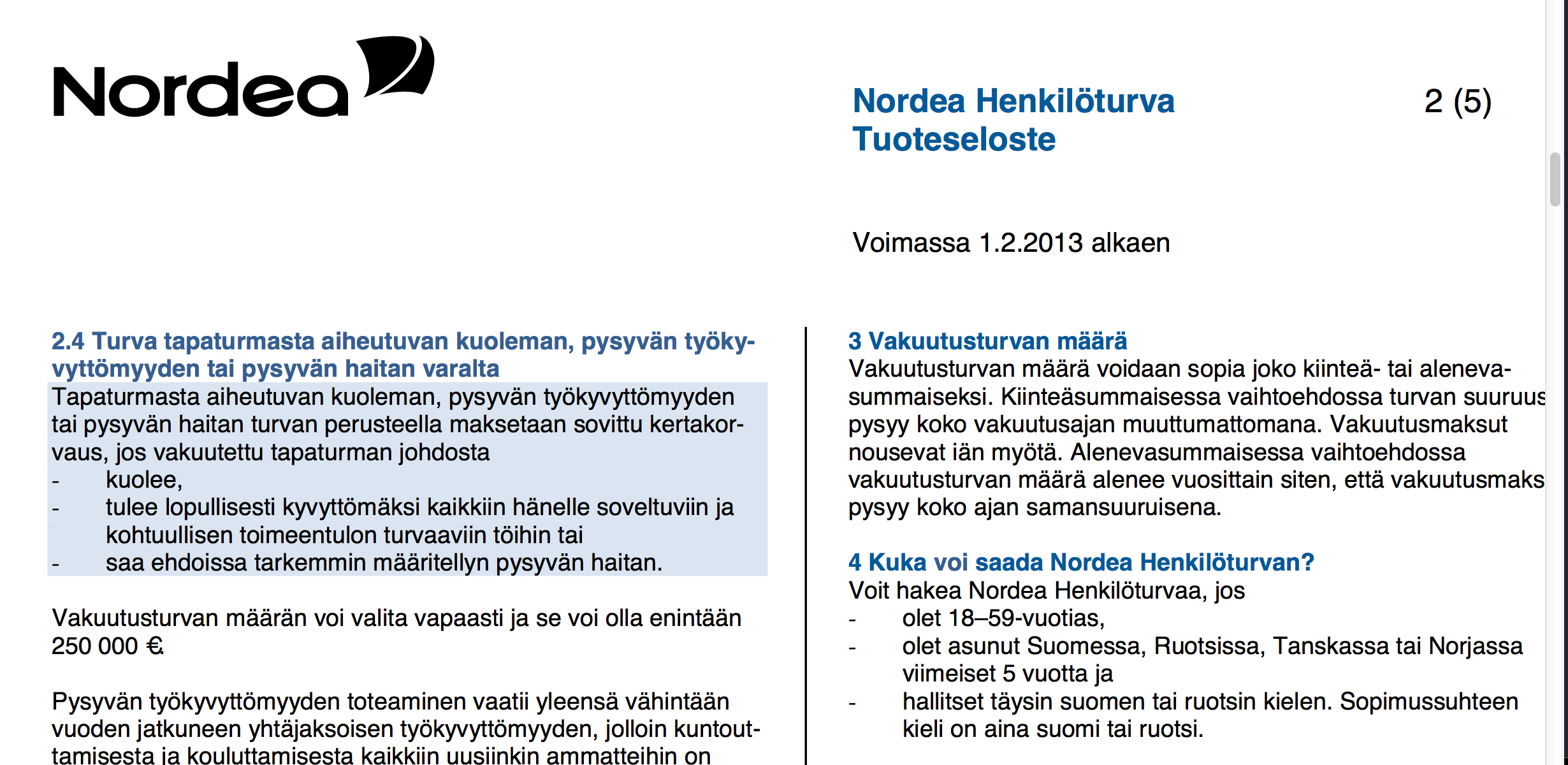
One reader, who is a British citizen, who wrote to us said that in order to get life insurance, Nordea required five-year residence in a Nordic country plus fluency in  Swedish or Finnish.

Unbelievable?

Kuvankaappaus 2013-5-13 kello 1.47.50

Here’s the link with the conditions in Finnish required by Nordea.

Apart from being between 18 and 59 years, it does state that you must have lived five years in the Nordic region and be fluent in Swedish or Finnish to get life insurance coverage from Nordea.

But that’s not all. Another Migrant Tales reader, who is a Swedish citizen, said that he was required to have a Kela card for two years in order to get life insurance at IF.

We hope that the efforts of our readers, and of this blog to address what we believe to be discriminatory behavior by large Finnish companies, will yield positive results.


Migrant Tales Literary: Building a home in the sub-arctic woods

Posted on May 12, 2013 by Migrant Tales

Leo Honka

A well where dreams flourish

splashing with ease

on a slow poke painted summer afternoon

which I wear with the help of a restless bow tie

just before stepping on a country path

that blushes

from my weight.

IMG_0104

By a gentle pond that turns into serenity

warned by towering trees of my presence

 swaying with the help of the wind:

It’s where I’ll build  my home,

right here,

where hope spreads roots.


Migrant Rights’ Network: UKIP has an advantage that is not based on concrete policy proposals

Posted on May 11, 2013 by Migrant Tales

By Awale Olad

The aftermath of the UKIP surge in the polls in the local elections has led to a lot of soul searching in mainstream politics. To the detriment of the Conservative Party whilst also hacking away at both the support of the Labour and Liberal Democrats parties, UKIP emerged as the third most popular party in Britain today.  

But a lot has to be said for the state parliament finds itself in 2013. In 2008, the UK entered its longest and harshest economic crisis in 60 years, mainly caused by an unhinged financial sector. Economic growth has been almost non-existent since then.

In 2009, parliamentarians were publicly crucified for living lavishly on expenses paid by the taxpayer and trust in politicians plummeted considerably. MPs are yet to be acquitted by the court of public opinion.

In 2010 the public decided that there was to be no overall winner at the General Election, which took the country into a new political direction – mainly consensus politics. And in 2011 the phone hacking scandal in the press erupted and shook the nation considerably.

With some in the public now openly engaged in warfare with mainstream politicians and further compounded by a politically apathetic majority, UKIP vacuuming up the votes in the space left unoccupied was inevitable.

The public managed to deliver a puncture to the political spectrum in revenge for what Andrew Rawnsley refers to a ‘resentment felt by many voters that Britain is run in their own interests and those of their friends by a lookalike metropolitan elite who are all implicated in the economic mess.’ However, there is a case to be argued for the need to modernise, and move with the changing demographics of the country, if the parties want to be seen to be fit for government.

YouGov’s analysis of the results for the Observor on Sunday shows that UKIP voters worry mostly about the economy (59%) and immigration (51%), very disproportionately to voters as a whole that worry about immigration (31%). They also tend to be Tory voters who live in the Midlands, who are older and predominantly working class men. But coming second in South Shields would have sent chills down the spine of Labour Party strategists as well.

UKIP doesn’t currently have a clear-cut policy on immigration. It’s ‘undergoing a review and update’ according to its website.  So rhetoric as opposed to actual policies drove its recent successes, which mobilised their supporters, who dislike today’s political class, to the ballot boxes.

David Cameron almost immediately came under pressure to change tack on a number of issues but mainly to bring forward the promised referendum on Europe. His Tory government and friendly backbench colleagues have toured the studios to pour cold water over the idea, and suggested the public needed to deliver a Tory majority in 2015 for the referendum, given that their Coalition partners and the Opposition would kill it off at the first reading in parliament. Good excuse, but will probably do little to win back support from their dissenting base.

Pollsters and political commentators will continue to dissect the results of last week’s local election results and will be conjuring up future predictions of how well UKIP will do at next year’s European and local elections. Cameron’s greatest difficulty is trying to effectively deliver his government’s programme of work without having to do a volte-face on a number of issues, in particular, immigration.

His record will show that he reduced immigration as promised and that’s how he should be judged – it’s also very likely that given the sluggish economy, senior minsters may have an allergic reaction to further draconian measures on immigration and a telling sign that senior Tories are happy with the current flow of immigration is the lack of primary legislation that has come forward to reduce immigration to the level of the early 90s.

The Coalition government continues to control immigration by tweaking Labour’s Points Based System (PBS). Not a single bit of primary legislation aimed at controlling immigration numbers has been introduced under a Tory Prime Minister since Edward Heath.

Nadine Dorries MP brainstormed the recent Eastleigh by-election results in which UKIP voters ‘lapped up’ the need for an Australian-style immigration system… much like the UK’s existing PBS, which is based on the Australian PBS. This is further confused by the fact that UKIP hasn’t got an immigration policy – so if the rhetoric is more draconian than its actual concrete proposals, then it can be argued that UKIP accepts the mainstream consensus on immigration policy, which gives them an illogical advantage that needs to be challenged.

The Tories are unlikely to change tack immediately in response to UKIP’s recent surge. They may (rightly) be banking on their tribe to return home and defend them against a Labour onslaught in 2015.

However, from now until the next General Election, the Conservatives are expected to experience a slump in their support at the ballot box. Now is the time to think of new ways to neutralise the UKIP appeal and attract Labour and Lib Dem supporters if they are to perform better in the 2015 election.

Read original story here.

This piece was reprinted by Migrant Tales with permission.


How ideologically alike is the PS with the UKIP and BNP?

Posted on May 11, 2013 by Migrant Tales

The recent local election victory of the anti-EU and anti-immigration UKIP of Britain is a good example of what Finland experienced with the rise of the Perussuomalaiset (PS) in April 2011. While the United Kingdom and Finland are vastly different countries, the knee-jerk reaction of the ruling parties to right-wing populism and rhetoric is strikingly similar.

Instead of challenging the anti-EU and anti-immigration stance of the UKIP or PS, the Tories of the UK and Kokoomus and Social Democrats of Finland bowed to the political threat by mimicking the UKIP’s and PS’ message, respectively.

In Finland, Kokoomus and the Social Democrats have paid a dear price for their lack of leadership in challenging an anti-EU, anti-immigration and especially anti-Islam party. The only party that didn’t parrot too much the PS’ rhetoric was the Center Party, which was the biggest loser in the 2011 election.

Apart from being aided by being in the opposition, the Center Party’s decision to not mimic the PS appears to have paid off handsomely.

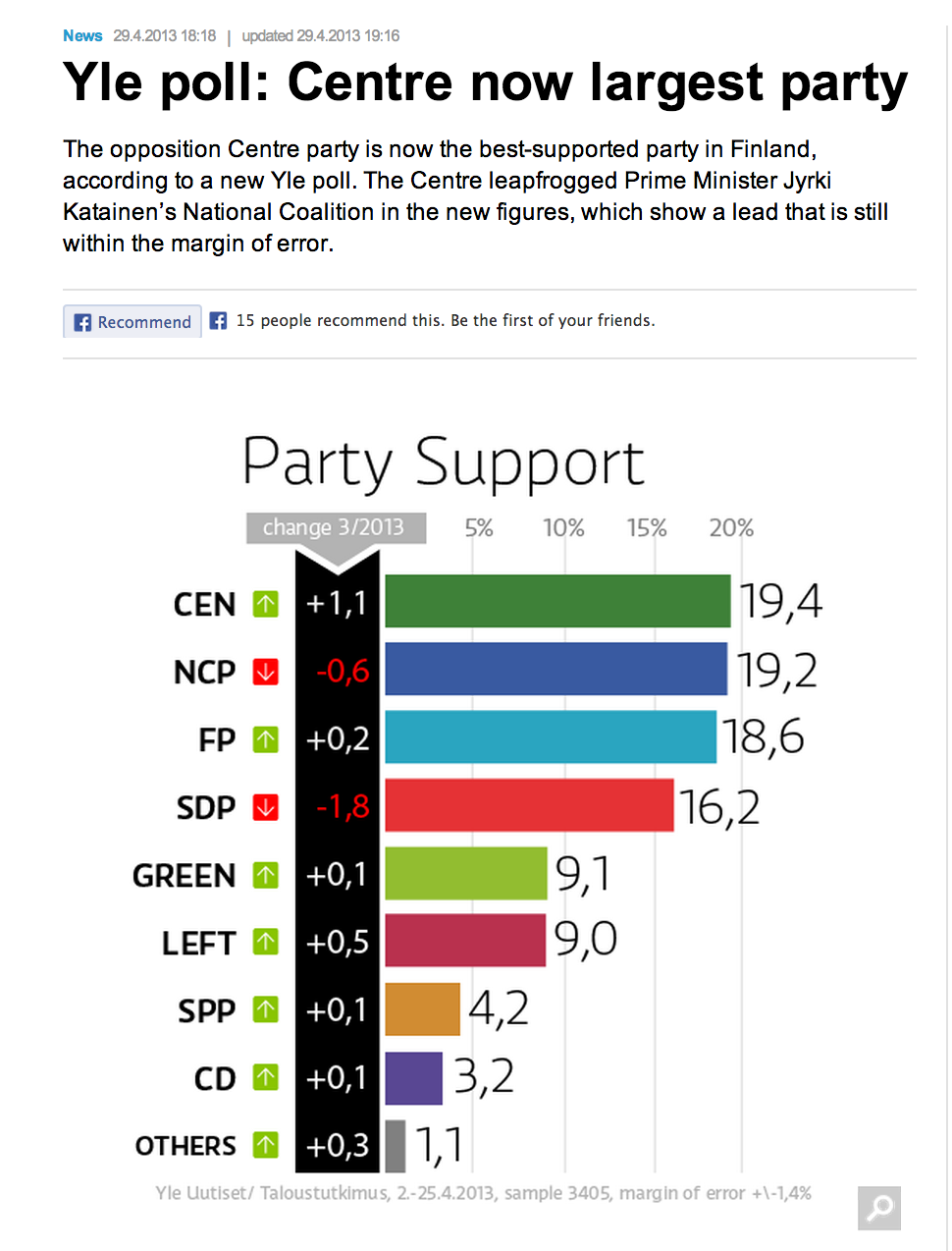
A recent YLE poll showed the Center Party to be the most popular in the country today.  Cameron, Kokoomus and the Social Democratic Party of Finland prove that you pay a high political price if you don’t challenge a threat posed by parties like the UKIP and PS.

Kuvankaappaus 2013-5-11 kello 11.56.39

Sweden offers a good example of how to deal with groups that rely on the far right extremist, anti-EU and anti-immigration vote.  All of the mainstream parties in Sweden have given the political cold shoulder to the Sweden Democrats. I am certain that in the long run, the Swedish answer to an intolerant party will pay off politically.

The political problem in Finland is the opposite to what is happening in Sweden. By accepting to sit at the same table as a party that promotes intolerance is synonymous to accepting their views and undermining your principles and values.

We must stand up for what we think is right. Accepting a society that basis itself on intolerance of immigrants, visible minorities and the outside world will end up doing more harm to a country than good.

What kind of country will Finland and Britain be if Timo Soini and Nigel Farage of the PS and UKIP, respectively, became prime ministers?

The answer: disaster.

One of the consequences of a UKIP and PS election victory would be to instigate a witch hunt against immigrants and visible immigrants.

That will happen in the UK when they reform Britain’s immigration system. Apart from regulating migrant access to the National Health Service (NHS), landlords will be able to check on immigrant tenants.

It is surprising that Cameron, who should know better, wants to scapegoat migrants and the EU to save his party’s hide from the UKIP.

Numerous studies show that immigrants use less social welfare than natives. This is logical since immigrants have to work twice as hard and be twice as good to match a native. Using social welfare would undermine a migrant’s competitiveness in the labor market.

Cameron will end up paying a costly political price for his anti-EU and anti-immigration stances.

Who are the PS?

One way of understanding who the PS is ideologically is by asking what are the differences between its close ally, the UKIP, and the far right anti-immigration and openly racist British National Party (BNP).

A survey published by The Guardian sheds light on this question.

Kuvankaappaus 2013-5-11 kello 11.55.06

The ideological similarities between the UKIP and BNP are strikingly alike on how the PS markets itself politically and its relationship with far right groups such as Suomen Sisu and Suomalaisuuden liitto. Is it a surprise why the  far-right Islamophobic English Defence League supports the UKIP and why some members of the PS support the Finnish Defense League?

Writes the Guardian: ”UKIP is not a right-wing extremist party, but on the doorsteps of voters it is often pushing the same message as the extreme right, and this is reflected in our results.”

This latter conclusion unveils the PS for what it is: A party like the UKIP that attempts to give a moderate view of itself because it would lure more voters but appeals to the extreme right. Thus there are more similarities between the UKIP, BNP and the PS than there are differences.

That is one of many reasons why Soini has spoken in the past to three UKIP party conferences as in this video clip.

The Finnish media should stop picturing immigrants on social rollators

Posted on May 10, 2013 by Migrant Tales

One of the problems when we challenge intolerance is to find its many hiding places and sources. Intolerance has many ways of surviving. One of these is microaggression that appears innocent on the surface but reinforces your exclusion, inferiority  and to walk about in your new homeland with a social rollator as a marked human being.

A social rollator will appear before you if you accept your low standing in society. Not allowing people to attain their potential because of prejudice and discrimination is a form of social exploitation.

Picturing and spreading stereotypes of immigrants as “helpless” is wrong. I personally raise my hat to Muslims, Africans and visible immigrants who move to Finland. It takes a lot of guts to live in a country where too many are openly hostile to you.

If our white media in Finland were to be believed, you’d think that immigration is not only a problem but that the biggest groups are Muslims, Somalis and Africans. Why are these groups monopolizing our attention in the media and in the speeches of some politicians when they only comprise a small fraction of total immigrants?

Finland’s immigrant population in 2012 accounted for a a mere 3.4% (183,133 persons) of the total country’s population, according to the Population Registration Center (Väestörekisterikeskus). Of these 183,133 non-Finns, the majority were Europeans and non-Muslims. Somalis, for example, only account for 0.26% of the country’s total population.

What about religious affiliation? Surprise: The overwhelming majority (77.3%) of people in Finland are Lutherans compared with 1.47% classified as “other” religions.

Kuvankaappaus 2013-5-10 kello 14.39.48


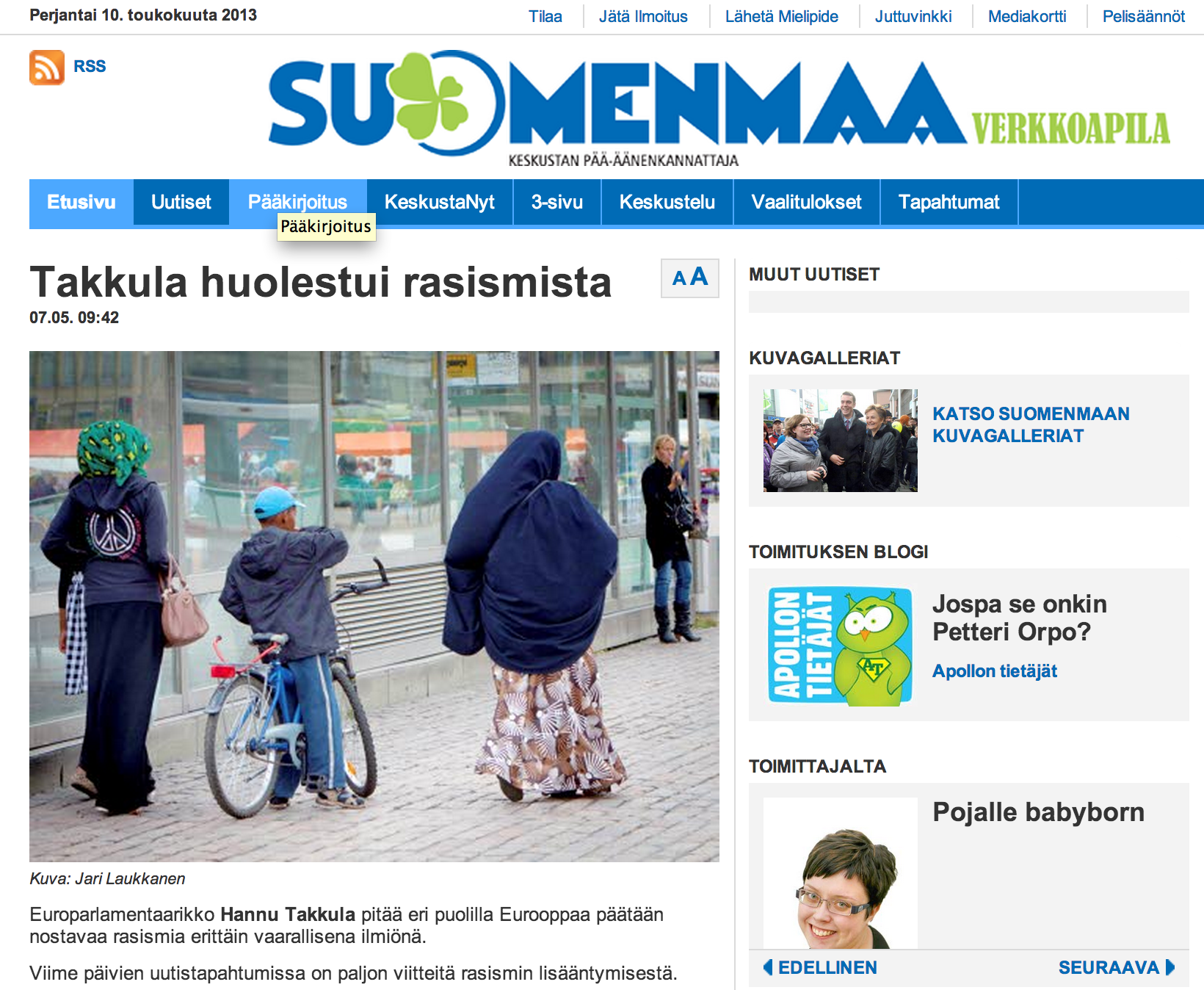
Here’s a “standard” story published by the Finnish media on immigration. While the story is about the rise of racism in Europe, Suomenmaa uses Muslim women and a child to drive home the point. The majority of immigrants living in Finland are white Europeans with Africans and Muslims acquiring for a fraction of the foreign population.

If those groups that receive so much attention in the public are a tiny minority, why do they receive so much attention by the media, politicians and general public?

The answer is clear: It shows a heavy dose of ignorance and prejudice.

I’ve learned the hard way: The next time I publish an opinion piece in the Finnish media, I will ask the editors not to put a picture of a Muslim woman, black African or Asians working for a cleaning company.

Kuvankaappaus 2013-5-10 kello 14.41.39


When we speak of immigrants, the Finnish media too often uses Muslims and black Africans to picture this phenomenon like on this Savon Sanomat story above. In the picture we see a black man learning to crochet from a white Finn, which again could suggest that only black immigrants are fit to do menial work.

Spreading stereotypes about immigrants is just as bad – if not worse – than a racist who comes out of the closet.  At least some of us know that what the racist is saying is wrong.

Too few of us, however, don’t see how the media reinforces the same social illness in an acceptable manner.

Microaggressions: How “law-abiding” community members discriminate

Posted on May 10, 2013 by Migrant Tales

Microaggressions, the subject of a book by Derald Wing Sue of the Teachers College, Columbia University, highlights perfectly one of the ongoing problems in Finland. Microaggressions occur unconsciously and underline inclusion-exclusion and superiority-inferiority.  They are everyday putdowns, insults that aim to undermine the dignity of visible minorities, women, LGBT (lesbian, gay, bisexual and transgender) rights or those who are marginalized, according to Sue. 

Microaggressions

One example of microaggressions that the video shows is between a student (Oriental background) and a university official (white). The official thinks he’s offering the student a compliment: “You know you speak excellent English,” he says.

The seemingly innocent comment disturbs the student, which implies that he isn’t a true US American and is made to feel like a perceived alien in his country.

How many times have we been in the same situation in Finland?

My son, who was born in Finland, was once told by a manager at work that he spoke “excellent Finnish.”

While the manager meant no harm, the comment revealed his narrow view of who he considers Finns. His comment suggests that Finns have Finnish first and last names.

Says Sue: “Microaggressions often appear to be a compliment but contain metaommunication or a hidden insult to the target group…it is delivered by people who engage in microaggression [and] are ordinary folks who experience themselves [as] good moral decent individuals.”

And adds: “Microaggressions occur because they are outside the level of conscious awareness of the perpetrator.”

So how should we challenge daily microaggressions?

Sue offers five points that we need to do individually:

  • Learn from constant vigilance (study your own biases and fears)
  • Experiential reality (interact with people who differ from you in terms of ethnicity and culture)
  • Don’t be defensive (don’t take it personally)
  • Be open to discussing your own attitudes and biases and how they may have hurt others
  • Be an ally (stand up against bias and discrimination)

Thank you Glenn Robinson of Community Village for the heads-up. 

Zuzeeko’s blog: Ask Finland’s Minister of Interior to stop detention of innocent children

Posted on May 9, 2013 by Migrant Tales

Zuzeeko Tegha Abeng

The International Convention on the Rights of the Child – to which Finland is party – outlaws the detention of children, unless as a last resort and for the shortest possible time (see article 37[b]) and obligates States Parties to ensure that a child seeking asylum receives appropriate protection and assistance (see Article 22). Despite obligations under international law, Finland detains, as a first resort, children seeking asylum for long periods of time.

Amnesty International, Finnish section, launched a petition to stop detention of children seeking asylum in Finland.

According to Amnesty International, children should be in day care centres, schools or skateparks – not in police detention. Finland detains thousands of people yearly, including people who have fled persecution, war or poverty. They are held in prison-like conditions, although guilty of no crime.

There are children seeking asylum in Finland who live behind closed doors on a daily basis.

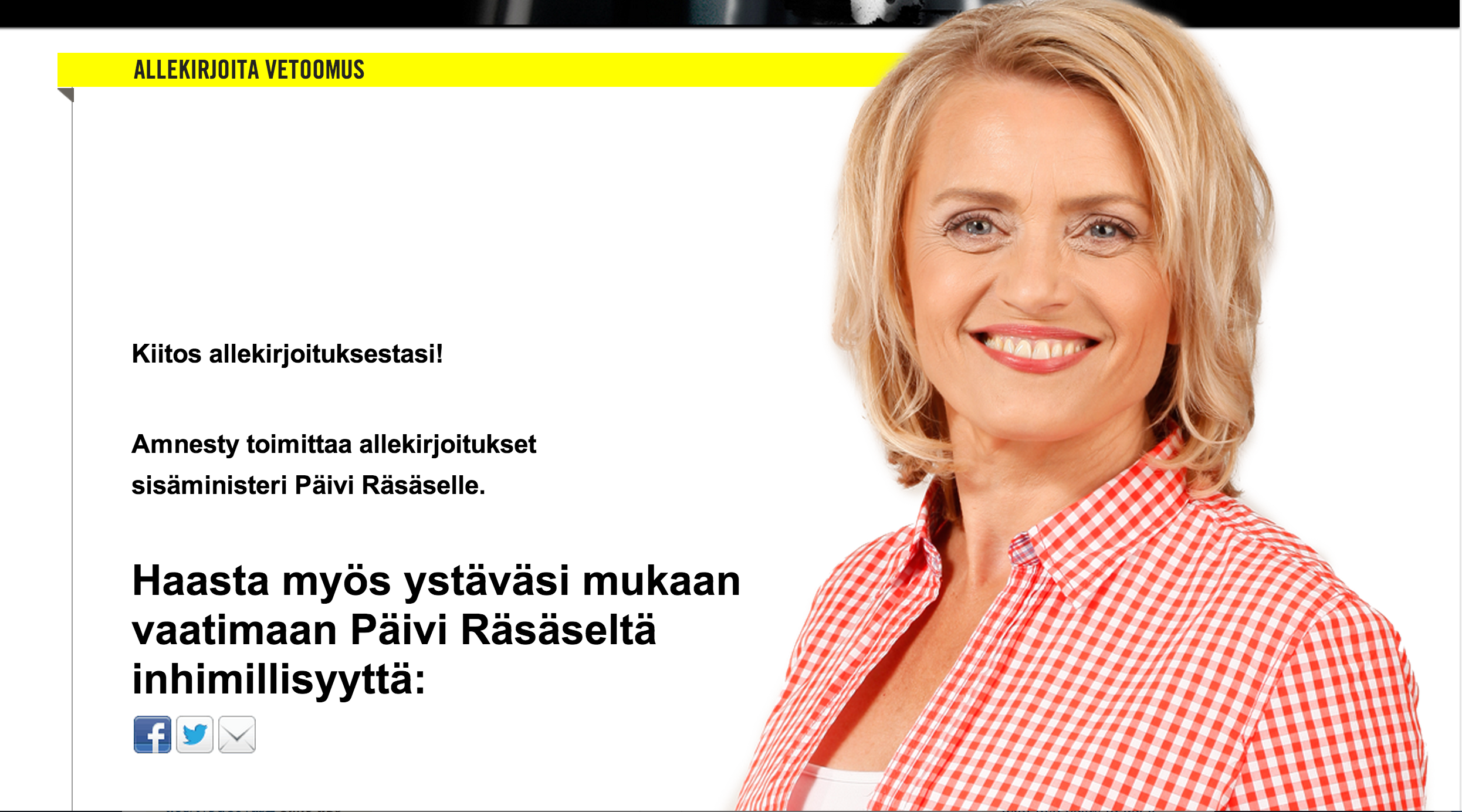
I have signed Amnesty International’s petition asking Minister of Interior Päivi Räsänen whether innocent children belong in police prisons. I believe children should be in homes, preschools, schools and playgrounds – not locked up.

Detention is not in the best interest of a child.

Kuvankaappaus 2013-5-10 kello 14.19.50 Kuvankaappaus 2013-5-10 kello 14.22.01
Sign the Amnesty International petition here. Finnish Interior Minister Päivi Räsänen.

Amnesty’s petition urges Minister Räsänen to:

  1. Fulfill the promise to stop detention of unaccompanied children.
  2. Immediately terminate detention of all children, expectant mothers and people traumatized by torture.
  3. Ensure that detention is used only as a last resort and for the shortest possible time. Detention places should develop less restrictive alternatives.
  4. Ensure that Finland comply with human rights obligations in detention.
Sign the petition.
According to Amnesty International, the government of Finland promised in 2011 to forbid the detention of unaccompanied children and to develop alternatives to detention. The promise was written in the government’s program, but it has not been fulfilled. Alternatives to detention have not yet been developed and children are still detained.
Amnesty International states that seeking asylum or a better life is not a crime and detained asylum seekers are not criminals.I have visited Metsälä Detention Centre, one of the facilities where asylum seekers in Finland are detained. It is located in Helsinki and I can confirm that the facility is like a prison. Children are detained there. It has one “playground” with no appropriate recreational facilities for kids.

In my view, the Metsälä facility is called a “detention centre”, but it is in fact a prison. It is no place for children, especially children who have done absolutely nothing wrong.

Read original blog entry here.

This piece was reprinted by Migrant Tales with permission.


Announcement: Youth and power are the focus of Helsinki African Film Festival this week

Posted on May 8, 2013 by Mikko Kapanen
Kenyan film Nairobi Half Life is part of Helsinki African Film Festival selection and its director Tosh Gitonga will be speaking today in Caisa starting at 5pm
Kenyan film Nairobi Half Life is part of Helsinki African Film Festival selection and its director Tosh Gitonga will be speaking today in Caisa starting at 5pm (free entrance)

(Announcement)

The annual Helsinki African Film Festival (HAFF) brings a selection of the best of African cinema to Finland for the fourth time this week. The festival has a broad range of films from all over the continent and this time both fact and fiction will be brought together by the overarching theme of Youth and Power.

“We will focus on the lives of young people across the diverse African continent and diaspora”, says the festival director Wanjiku wa Ngugi, and continues “Everyone agrees that young people are the future of Africa, but what are the challenges they face as they claim their place in their societies – whether they are pushing for political change and demanding justice, finding ways to make a living, or deciding how to live and love?”

The festival will take place this week between the 8th and the 12th of May in Helsinki at two cinemas: the Andorra and Kino Engel, as well as at the cultural centre Caisa. The opening film is Nairobi Half Life from Kenya and its director Tosh Gitonga will be speaking about the film and film making on the continent of Africa in general on the today (8.5.) in Caisa starting at 5pm. His views can also be heard on the ask from director event held as a part of the festival opening.

Another particularly notable film this year is Senegalese Tey(Today), which is directed by Alain Gomis and starring Saul Williams. Tey won the Golden Stallion award of FESPACO (Pan-African Film Festival of Ouagadougou) which can be compared to an African Oscar. The festival will also feature other films by Gomis.

The festival is organised by the Helsinki African Film Festival working group in collaboration with development cooperation organisation Shalin ry. The aim of the festival is to provide the Finnish audiences an opportunity to see top quality contemporary African films and act as a counter-balance to the dominant and one-sided news narrative from the African continent which leans on negative stereotypes and simplifications of Africa and Africans.

The full festival programme is available at www.haff.fi

Aside from the film festival, HAFF will be also organising an African street festival in the Helsinki city center, at Kansalaistori (between Sanomatalo and the new Music House) today starting at 13.00.

Welcome to the screenings and events.


  • Previous
  • 1
  • 2
  • 3
  • 4
  • 5
  • 6
  • Next
Read more about documentary film
Read more

Recent Posts

  • Finland’s tabloids Iltalehti and Ilta-Sanomat are the pits
  • Riikka Purra’s Dr Jekyll and Mr Hyde mask
  • Double standards
  • Perussuomalaiset: Uusi logo, sama vanha juttu
  • Taco Trump

Recent Comments

  1. Absolutely Socking: Racist Finnish Facebook group against human rights gets flooded with socks on Musta Barbaari’s mother and sister charged by the police in “ethnic profiling” case
  2. Ilkka Nuotio on Pekka Myrskylä: “Tilastot kertovat toista kuin poliittinen keskustelu”
  3. Genrih Soinkara on The war in Ukraine and the Russian-Finnish border crisis are showing Finland’s ugly side
  4. Ahti Tolvanen on Comment by Ahti Tolvanen on the Helsinki +50 conference
  5. Angel Barrientos on Angel Barrientos is one of the kind beacons of Finland’s Chilean community

Archives

  • June 2026
  • May 2026
  • April 2026
  • March 2026
  • February 2026
  • January 2026
  • December 2025
  • November 2025
  • October 2025
  • September 2025
  • August 2025
  • July 2025
  • June 2025
  • May 2025
  • April 2025
  • March 2025
  • February 2025
  • January 2025
  • December 2024
  • November 2024
  • October 2024
  • September 2024
  • August 2024
  • July 2024
  • June 2024
  • May 2024
  • April 2024
  • March 2024
  • February 2024
  • January 2024
  • December 2023
  • November 2023
  • October 2023
  • September 2023
  • August 2023
  • July 2023
  • June 2023
  • May 2023
  • April 2023
  • March 2023
  • February 2023
  • January 2023
  • December 2022
  • November 2022
  • October 2022
  • September 2022
  • August 2022
  • July 2022
  • June 2022
  • May 2022
  • April 2022
  • March 2022
  • February 2022
  • January 2022
  • December 2021
  • November 2021
  • October 2021
  • September 2021
  • August 2021
  • July 2021
  • June 2021
  • May 2021
  • April 2021
  • March 2021
  • February 2021
  • January 2021
  • December 2020
  • November 2020
  • October 2020
  • September 2020
  • August 2020
  • July 2020
  • June 2020
  • May 2020
  • April 2020
  • March 2020
  • February 2020
  • January 2020
  • December 2019
  • November 2019
  • October 2019
  • September 2019
  • August 2019
  • July 2019
  • June 2019
  • May 2019
  • April 2019
  • March 2019
  • February 2019
  • January 2019
  • December 2018
  • November 2018
  • October 2018
  • September 2018
  • August 2018
  • July 2018
  • June 2018
  • May 2018
  • April 2018
  • March 2018
  • February 2018
  • January 2018
  • December 2017
  • November 2017
  • October 2017
  • September 2017
  • August 2017
  • July 2017
  • June 2017
  • May 2017
  • April 2017
  • March 2017
  • February 2017
  • January 2017
  • December 2016
  • November 2016
  • October 2016
  • September 2016
  • August 2016
  • July 2016
  • June 2016
  • May 2016
  • April 2016
  • March 2016
  • February 2016
  • January 2016
  • December 2015
  • November 2015
  • October 2015
  • September 2015
  • August 2015
  • July 2015
  • June 2015
  • May 2015
  • April 2015
  • March 2015
  • February 2015
  • January 2015
  • December 2014
  • November 2014
  • October 2014
  • September 2014
  • August 2014
  • July 2014
  • June 2014
  • May 2014
  • April 2014
  • March 2014
  • February 2014
  • January 2014
  • December 2013
  • November 2013
  • October 2013
  • September 2013
  • August 2013
  • July 2013
  • June 2013
  • May 2013
  • April 2013
  • March 2013
  • February 2013
  • January 2013
  • December 2012
  • November 2012
  • October 2012
  • September 2012
  • August 2012
  • July 2012
  • June 2012
  • May 2012
  • April 2012
  • March 2012
  • February 2012
  • January 2012
  • December 2011
  • November 2011
  • October 2011
  • September 2011
  • August 2011
  • July 2011
  • June 2011
  • May 2011
  • April 2011
  • March 2011
  • February 2011
  • January 2011
  • December 2010
  • November 2010
  • October 2010
  • September 2010
  • August 2010
  • July 2010
  • June 2010
  • May 2010
  • April 2010
  • March 2010
  • February 2010
  • January 2010
  • December 2009
  • November 2009
  • October 2009
  • September 2009
  • August 2009
  • July 2009
  • December 2008
  • November 2008
  • October 2008
  • September 2008
  • August 2008
  • July 2008
  • June 2008
  • May 2008
  • April 2008
  • March 2008
  • February 2008
  • January 2008
  • November 2007
  • October 2007
  • September 2007
  • August 2007
  • July 2007
  • June 2007
  • May 2007

Categories

  • ?? Gia L?c
  • ????? ?????? ????? ???????? ?? ??????
  • ???????
  • @HerraAhmed
  • @mondepasrond
  • @nohatefinland
  • @oula_silver
  • @Varathas
  • A Pakistani family
  • äärioikeisto
  • Abbas Bahmanpour
  • Abdi Muhis
  • Abdirahim Hussein Mohamed
  • Abdirahim Husu Hussein
  • Abdirisak Mahamed
  • About Migrant Tales
  • activism
  • Adam Al-Sawad
  • Adel Abidin
  • Afrofinland
  • Ahmed IJ
  • Ahti Tolvanen
  • Aino Pennanen
  • Aisha Maniar
  • Alan Ali
  • Alan Anstead
  • Alejandro Díaz Ortiz
  • Alekey Bulavsev
  • Aleksander Hemon
  • Aleksanterinliitto
  • Aleksanterinliitto ry
  • Aleksanterinliitto ry:n hallitus
  • Alex Alex
  • Alex Mckie
  • Alexander Nix
  • Alexandra Ayse Albayrak
  • Alexis Neuberg
  • Ali Asaad Hasan Alzuhairi
  • Ali Hossein Mir Ali
  • Ali Rashid
  • Ali Sagal Abdikarim
  • Alina Tsui
  • Aline Müller
  • All categories
  • Aman Heidari
  • Amiirah Salleh-Hoddin & Jana Turk
  • Amin A. Alem
  • Amir Zuhairi
  • Amkelwa Mbekeni
  • Ana María Gutiérrez Sorainen
  • Anachoma
  • Anders Adlecreutz
  • Angeliina Koskinen
  • Anna De Mutiis
  • Anna María Gutiérrez Sorainen
  • Anna-Kaisa Kuusisto ja Jaakko Tuominen
  • Annastiina Kallius
  • Anneli Juise Friman Lindeman
  • Announcement
  • Anonymous
  • Antero Leitzinger
  • anti-black racism
  • Anti-Hate Crime Organisation Finland
  • Anudari Boldbaatar
  • Arshiya Nasser
  • Aspergers Syndrome
  • Asylum Corner
  • Asylum seeker 406
  • Athena Griffin and Joe Feagin
  • Autism
  • Avaaz.org
  • Awale Olad
  • Ayan Said Mohamed
  • AYY
  • Barachiel
  • Bashy Quraishy
  • Beatrice Kabutakapua
  • Beri Jamal
  • Beri Jamal and Enrique Tessieri
  • Bertolt Brecht
  • Boiata
  • Boodi Kabbani
  • Bruno Gronow
  • Carmen Pekkarinen
  • Çelen Oben and Sheila Riikonen
  • Chiara Costa-Virtanen
  • Chiara Costa-Virtanen
  • Chiara Sorbello
  • Christian Thibault
  • Christopher Wylie
  • Clara Dublanc
  • Dana
  • Daniel Malpica
  • Danilo Canguçu
  • David Papineau
  • David Schneider
  • Dexter He
  • Don Flynn
  • Dr Masoud Kamali
  • Dr. Faith Mkwesha
  • Dr. Theodoros Fouskas
  • Edna Chun
  • Eeva Kilpi
  • Emanuela Susheela
  • En castellano
  • ENAR
  • Enrique
  • Enrique Tessieri
  • Enrique Tessieri & Raghad Mchawh
  • Enrique Tessieri & Yahya Rouissi
  • Enrique Tessieri and Muhammed Shire
  • Enrique Tessieri and Sira Moksi
  • Enrique Tessieri and Tom Vandenbosch
  • Enrique Tessieri and Wael Che
  • Enrique Tessieri and Yahya Rouissi
  • Enrique Tessieri and Zimema Mhone
  • Epäluottamusmies
  • EU
  • Europe
  • European Islamophobia Report
  • European Islamophobia Report 2019,
  • European Union
  • Eve Kyntäjä
  • Ezequiel Caldeiro
  • Facebook
  • Fadumo Dayib
  • Faisa Kahiye
  • Farhad Manjoo
  • Fasismi
  • Finland
  • Fizza Qureshi
  • Flyktingar och asyl
  • Foreign Student
  • Fozia Mir-Ali
  • Frances Webber
  • Frida Selim
  • Gareth Rice
  • Ghyslain Vedeaux
  • Global Art Point
  • Great Replacement
  • Habiba Ali
  • Hami Bahadori
  • Hami Bahdori
  • Hamid
  • Hamid Alsaameere
  • Hamid Bahdori
  • Handshake
  • Harmit Athwal
  • Hassan Abdi Ali
  • Hassan Muhumud
  • Heikki Huttunen
  • Heikki Wilenius
  • Helsingin Sanomat
  • Henning van der Hoeven
  • Henrika Mälmsröm
  • Hser Hser
  • Hser Hser ja Mustafa Isman
  • Husein Muhammed
  • Hussain Kazemian
  • Hussain Kazmenian
  • Ibrahim Khan
  • Ida
  • Ignacio Pérez Pérez
  • Iise Ali Hassan
  • Ilari Kaila & Tuomas Kaila
  • Imam Ka
  • inside-an-airport
  • Institute of Race Relations
  • Iraqi asylum seeker
  • IRR European News Team
  • IRR News Team
  • Islamic Society of Norhern FInland
  • Islamic Society of Northern Finland
  • Islamophobia
  • Jacobinmag.com
  • Jallow Momodou
  • Jan Holmberg
  • Jane Elliott
  • Jani Mäkelä
  • Jari Luoto
  • Jari Taponen
  • Jegor Nazarov
  • Jenni Stammeier
  • Jenny Bourne
  • Jessie Daniels
  • Joe Davidow
  • Johannes Koski
  • John D. Foster
  • John Grayson
  • John Marriott
  • Jon Burnett
  • Jorma Härkönen
  • Jos Schuurmans
  • José León Toro Mejías
  • Josue Tumayine
  • Jouni Karnasaari
  • Juan Camilo
  • Jukka Eräkare
  • Julian Abagond
  • Julie Pascoet
  • Jussi Halla-aho
  • Jussi Hallla-aho
  • Jussi Jalonen
  • JusticeDemon
  • Kadar Gelle
  • Kaksoiskansalaisuus
  • Kansainvälinen Mikkeli
  • Kansainvälinen Mikkeli ry
  • Katherine Tonkiss
  • Kati Lepistö
  • Kati van der Hoeven-Lepistö
  • Katie Bell
  • Kättely
  • Kerstin Ögård
  • Keshia Fredua-Mensah & Jamie Schearer
  • Khadidiatou Sylla
  • Khadra Abdirazak Sugulle
  • Kiihotus kansanryhmää vastaan
  • Kirsi Crowley
  • Koko Hubara
  • Kristiina Toivikko
  • Kubra Amini
  • KuRI
  • La Colectiva
  • La incitación al odio
  • Laura Huhtasaari
  • Lauri Finér
  • Leif Hagert
  • Léo Custódio
  • Leo Honka
  • Leontios Christodoulou
  • Lessie Branch
  • Lex Gaudius
  • Leyes de Finlandia
  • Liikkukaa!
  • Linda Hyökki
  • Liz Fekete
  • M. Blanc
  • Maarit Snellman
  • Mahad Sheikh Musse
  • Maija Vilkkumaa
  • Malmin Kebab Pizzeria Port Arthur
  • Marcell Lorincz
  • Mari Aaltola
  • María Paz López
  • Maria Rittis Ikola
  • Maria Tjader
  • Marja-Liisa Tolvanen
  • Mark
  • Markku Heikkinen
  • Marshall Niles
  • Martin Al-Laji
  • Maryan Siyad
  • Matt Carr
  • Mauricio Farah Gebara
  • Media Monitoring Group of Finland
  • Micah J. Christian
  • Michael McEachrane
  • Michele Levoy
  • Michelle Kaila
  • Migrant Tales
  • Migrant Tales Literary
  • Migrantes News
  • Migrants' Rights Network
  • MigriLeaks
  • Mikko Kapanen
  • Miriam Attias and Camila Haavisto
  • Mohamed Adan
  • Mohammad Javid
  • Mohammad M.
  • Monikulttuurisuus
  • Monisha Bhatia and Victoria Canning
  • Mor Ndiaye
  • Muh'ed
  • Muhamed Abdimajed Murshid
  • Muhammed Shire
  • Muhammed Shire and Enrique Tessieri
  • Muhis Azizi
  • Musimenta Dansila
  • Muslimiviha
  • Musulmanes
  • Namir al-Azzawi
  • Natsismi
  • Neurodiversity
  • New Women Connectors
  • Nils Muižnieks
  • No Labels No Walls
  • Noel Dandes
  • Nuor Dawood
  • Omar Khan
  • Otavanmedia
  • Oula Silvennoinen
  • Paco Diop
  • Pakistani family
  • Pentti Stranius
  • Perussuomalaiset
  • perustuslaki
  • Petra Laiti
  • Petri Cederlöf
  • Pia Grochowski
  • Podcast-lukija Bea Bergholm
  • Pohjois – Suomen Islamilainen Yhdyskunta
  • Pohjois Suomen Islamilainen Yhyskunta
  • Polina Kopylova
  • Race Files
  • racism
  • Racism Review
  • Raghad Mchawh
  • Ranska
  • Rashid H. and Migrant Tales
  • Rasismi
  • Raul Perez
  • Rebecka Holm
  • Reem Abu-Hayyeh
  • Refugees
  • Reija Härkönen
  • Remiel
  • Reza Nasri
  • Richard Gresswell
  • Riikka Purra
  • Risto Laakkonen
  • Rita Chahda
  • Ritva Kondi
  • Robito Ibrahim
  • Roble Bashir
  • Rockhaya Sylla
  • Rodolfo Walsh
  • Roger Casale
  • Rostam Atai
  • Roxana Crisólogo Correa
  • Ruth Grove-White
  • Ruth Waweru-Folabit
  • S-worldview
  • Sadio Ali Nuur
  • Sami Rusanen
  • Sandhu Bhamra
  • Sara de Jong
  • Sarah Crowther
  • Sari Alhariri
  • Sarkawt Khalil
  • Sasu
  • Scot Nakagawa
  • Shabana Ahmadzai
  • Shada Islam
  • Sharon Chang blogs
  • Shenita Ann McLean
  • Shirlene Green Newball
  • Sini Savolainen
  • Sira Moksi
  • Sonia K.
  • Sonia Maria Koo
  • Steverp
  • Stop Deportations
  • Suldaan Said Ahmed
  • Suomen mediaseurantakollektiivi
  • Suomen Muslimifoorumi ry
  • Suomen viharikosvastainen yhdistys
  • Suomen viharikosvastainen yhdistys ry
  • Suomi
  • Supermen
  • Susannah
  • Suva
  • Syrjintä
  • Talous
  • Tapio Tuomala
  • Taw Reh
  • Teivo Teivainen
  • The Daily Show
  • The Heino
  • The Supermen
  • Thomas Elfgren
  • Thulfiqar Abdulkarim
  • Tim McGettigan
  • Tino Singh
  • Tito Moustafa Sliem
  • Tobias Hübinette and L. Janelle Dance
  • Transport
  • Trica Danielle Keaton
  • Trilce Garcia
  • Trish Pääkkönen
  • Trish Pääkkönen and Enrique Tessieri
  • Tuulia Reponen
  • Uncategorized
  • UNITED
  • University of Eastern Finland
  • Uyi Osazee
  • Väkivalta
  • Vapaa Liikkuvuus
  • Venla-Sofia Saariaho
  • Vieraskynä
  • W. Che
  • W. Che an Enrique Tessieri
  • Wael Ch.
  • Wan Wei
  • Women for Refugee Women
  • Xaan Kaafi Maxamed Xalane
  • Xassan Kaafi Maxamed Xalane
  • Xassan-Kaafi Mohamed Halane & Enrique Tessieri
  • Yahya Rouissi
  • Yasmin Yusuf
  • Yassen Ghaleb
  • Yle Puhe
  • Yuliet Tresa
  • Yve Shepherd
  • Zahra Khavari
  • Zaker
  • Zalina Ametova
  • Zamzam Ahmed Ali
  • Zeinab Amini ja Soheila Khavari
  • Zimema Mahone and Enrique Tessieri
  • Zimema Mhone
  • Zoila Forss Crespo Moreyra
  • ZT
  • Zulma Sierra
  • Zuzeeko Tegha Abeng
© 2026 Migrant tales | Powered by Minimalist Blog WordPress Theme