Migrant tales
Menu
  • #MakeRacismHistory “In Your Eyes”
  • About Migrant Tales
  • It’s all about Human Rights
  • Literary
  • Migrant Tales Media Monitoring
  • NoHateFinland.org
  • Tales from Europe
Menu

Month: April 2013

It’s the cultural diversity, stupid!

Posted on April 11, 2013 by Migrant Tales

Would it be fair to say that the biggest challenge facing Finland during this century is accepting its cultural diversity and deconstructing our white national identity in order to make our society more inclusive? Will this happen easily? 

The central issue being debated in Finland today about immigrants boils down to one question: How much cultural diversity are we willing to accept?

There aren’t any political parties in this country, except for the Perussuomalaiset (PS) and its extremist Suomen Sisu faction, which are openly against white  Finns marrying people of different ethnicities.  Even so, it’s clear that this attitude is quite widespread in our society.

If we’d like to see an even bigger picture of how this works in practice, we could take Cuba’s Fidel Castro example of how he got rid of  his political dissidents by allowing them to flee en masse to neighboring Miami.

Less dissidents, more perceived unity.

Finland has seen over 1.2 million emigrants move mainly to the Americas and Sweden between 1860 and 1999.  Just like Castro, Finland benefited in the same way. Apart from the socialists and communists that fled Finland after the Civil War of 1918, Finland was able to forge unchallenged a social construct like the “noble” white Finn.

It didn’t matter that hundreds of thousands of Finns had moved to other parts of the world and intermarried with other ethnicities. The way Finnish language evolved in Finnish immigrant communities, and how our view of our changing identity changed as a result, interested only a few.

Paradoxically, we wanted our Finnish expats to retain their Finnish culture and identity at all costs. Today, however, we want our immigrants and newcomers to do totally the opposite: Be like us (white Finnish) we tell them. Learn our culture, speak our language adopt our way of life.

Kuvankaappaus 2013-4-11 kello 8.24.30


The Finnish Lutheran Church has started to take a strong stand against racism like this story about multicultural families reveals about the discrimination their children face in our society. If there are people who are on the frontline of our ever-growing cultural diversity, they are these exemplary mothers.

Any person who thinks that immigrants don’t want to adapt and succeed in their new homeland know very little about immigration. An unsettling question arises: How can you integrate into a society that doesn’t accept you?

It’s clear that white Finland will not cede much of the high ground to cultural diversity. Expect then the following: lip service about two-way integration but what is really happening is one-way integration (assimilation) in most cases. Wherever two-way integration occurs, it usually happens on a short leash.

A good example of the latter is the following statement I heard from a politician in private. “There is room for immigrants in this country” but “building mosques is out of the question.”

Since it was easy to assimilate “foreigners” in the last century into Finns, it’s a bit more complicated in this century. It was easier in the previous century. All you needed was language, be white, adopt a Finnish surname and substitute your “foreign” background for ardent nationalism.

You’ll need much more than a surname change and a few nationalistic sound bites to be accepted as a Finn with equal rights in this century.
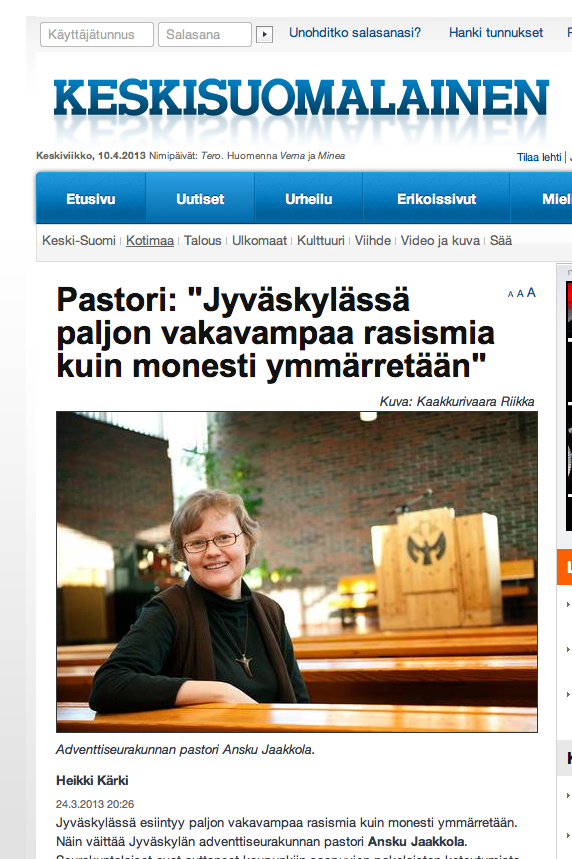


Pastor Ansku Jaakkola says that racism in Jyväskylä is far worse than many think

Posted on April 10, 2013 by Migrant Tales

Difficult times bring forth exceptional people. One of these is Pastor Ansku Jaakkola of the Adventist Church in Jyväskylä, who believes that racism in her Central Finnish city is far worse than many think.
Näyttökuva 2013-04-10 kohteessa 16.44.48
”Our new [foreign] friends have told us that yelling and harassment happens on a daily basis,” she was quoted as saying on Keskisuomalainen. ”It happens at stores, in the streets and at school.”Jaakkola admitted that it’s difficult for white Finns to understand what racism is if they have never experienced it.While she admits to having been treated well when she lived abroad in England, Marshall Islands and other countries, she states that our society should speak out more against intolerance.

?”It shames me when I hear about people treating others unfairly because of their ethnic background,” she told Migrant Tales. ”It surprised me how general and how much it occurs [in Jyväskylä].”

Jaakkola says that fear and ignorance are the causes for racism in our society.

Jyväskylä has been in the national spotlight recently because of an attack by neo-Nazis against a book presentation in January. In the same month there was a story in the local newspaper about a young dark-skinned woman who was in a toilet.One of the white Finnish women standing in line exclaimed upon seeing the black woman: ”I’m not going to [sit on the same toilet bowl] as that n-word,” she told a woman behind her. ”You go ahead if you dare.”

How can Finland tackle intolerance today if it cannot come to terms with its past?

Posted on April 9, 2013 by Migrant Tales

Finland’s present political and social dilemma could be best described in the following manner: On the one side it has a difficult time acknowledging ever-growing intolerance in its society, but on the other slowly understands that one major source of that intolerance are groups like the Perussuomalaiset (PS) party.

The PS has grown into a major political force in Finland not by its own merits per se, but because other political parties and the media have been near-silent to its right-wing populist anti-EU, anti-immigration and especially anti-Islam political message.

If the PS ever got to government, and if its chairman Timo Soini ever became prime minister, it would make conservative Christian Democrat interior minister, Päivi Räsänen, look like a liberal.

If this ever happened, the situation of immigrants and visible minorities in Finland would deteriorate further. They would feel the full brunt of populism and intolerance that is openly promoted by the PS.

While we can debate the extent of intolerance in Finland, probably one matter that we can state safely is that our tolerance for cultural diversity needs to improve. We cannot improve on this front as long as we close our eyes and plug our ears to the social ills that racism, prejudice and discrimination are fueling in our society.

It’s futile for a white Finn to state if there is racism or not in our society because he or she has never experienced it. How could he?

We do ourselves great harm by denying or playing down those voices that claim they are victims of racism, prejudice and outright discrimination.  This type of silence only encourages and fuels more intolerance.

But back to our dilemma: If we are to challenge the sources of our intolerance, our society needs to do a lot more soul-searching that will carry us back to the depths of the last century. Certainly there we’ll find the sources of our intolerance and the causes for the rise of an anti-immigration party like the PS.

Kuvankaappaus 2013-4-9 kello 1.02.06

Here’s an interesting article on Yliopppilaslehti about one of those historical skeletons in our collective closet.

It’s futile to understand who we are today if we don’t come to terms with our past. Some sticky unanswered questions include our relationship with Germany and the Nazi regime, the Continuation War, our hatred for the Russians, the Civil War of 1918, cold war-era censorship, and the social construct of Finnish national identity in the last century as well as other ones.

This is the dilemma facing Finland today: If we don’t come to grips with our past, we will be in danger of repeating the same mistakes.


Migrant Tales takes part in German Broadcasting Company program on hate speech

Posted on April 8, 2013 by Migrant Tales

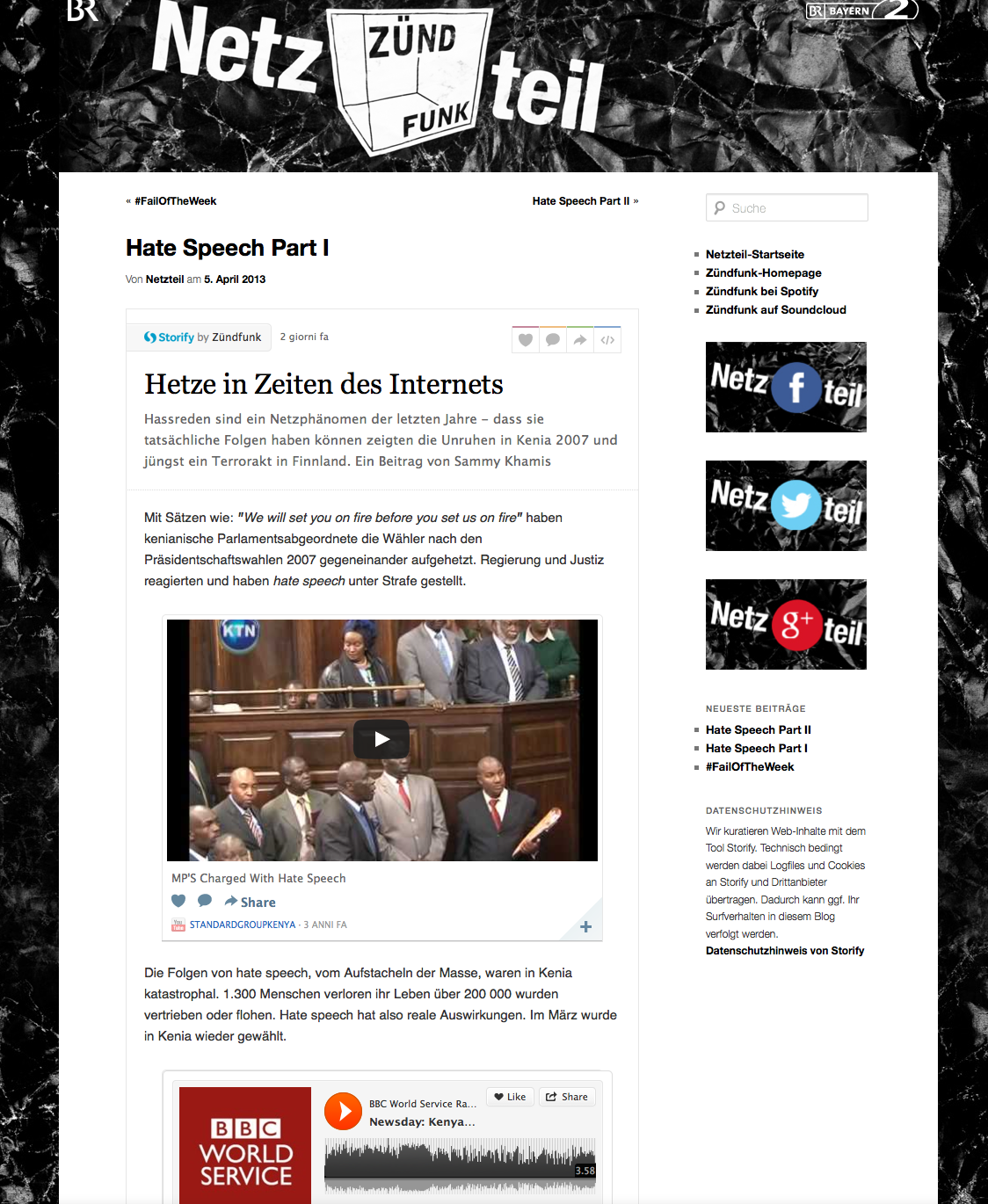
Those that promote anti-cultural diversity sentiment are not only out to destroy your arguments but your self-esteem. Migrant Tales has proven over again that what we say on this blog has importance and does get noticed in Finland and abroad.  The German Broadcasting Company aired on Friday a program on hate speech in which we took part.  

Kuvankaappaus 2013-4-8 kello 7.35.37


We have gotten noticed on publications like Time, Sveriges Radio, YLE’s Suora linja,UNHCR in Greece and others. The BBC and TV4 of Russia have gotten in touch with Migrant Tales as well.

The point is simple: If we have an important message to get out because it is heard faintly by the local media, politicians and public, that message gets eventually noticed. People think we get funding and that enables us to publish Migrant Tales. Wrong.  We are for now a hand-on-heart operation with a clear mandate.

Considering that we’ve been around for almost six years and grown to be an active anti-racist blog that promotes cultural diversity, isn’t it surprising how our most infamous counterjihadists and racists don’t dare come close to our blog.

Doesn’t that tell you something?

It tells me that most of these anti-immigration pundits and groups would rather avoid us because we can expose their false arguments but putting in jeopardy their political careers and credibility.

Another important matter to keep in mind is that nobody in the immigrant community controls which topics should be brought up. Our community is a democracy and defends the rights of others to express themselves as long as they don’t insult others. The more opinions we hear, the better.

Thank you for making Migrant Tales into what we are today.


Migrant Tales Literary: The racist and his rabid dog

Posted on April 7, 2013 by Migrant Tales

By Leo Honka 

The racist shows off

his rabid dog

on a short leash

footsteps and gleaming eyes

speak of  satisfaction

on the pavement and media attention

thanks to his rabid dog.

Like flies on flypaper

struggling to survive

the racist too owns a rabid dog.

On a short leash he walks, walks

but doesn’t know

the true nature of the beast

that knows no master

and can bite back, hard

like Anders Breivik.

What should we do!?

A racist and his rabid dog

in our midst and on our streets!

Send them both to the municipal racist pound!

Give them a shot of tolerance,  a possible cure!

So the racist

will no longer show off his rabid dog

on a short leash.


Finland’s tolerance for cultural diversity is being tested to the limit these days

Posted on April 7, 2013 by Migrant Tales

Finland’s tolerance to Otherness is being tested to the limit these days. If we look at it from a political perspective, the knee-jerk reaction is clear. Denying that there isn’t a connection between the stellar rise of an anti-EU, anti-immigration and anti-Islam party and our ever-growing cultural diversity is understanding a little or erroneously the issue at hand. 

It would be wishful thinking to believe that the Perussuomalaiset (PS), which won 39 seats in the 2011 election versus 5 in 2007, that there is a return to the past when the political landscape was dominated by three major parties: National Coalition Party, Social Democrats and Center Party.

Returning back to the political good old days without Timo Soini’s PS is just as unrealistic as stopping Finland’s ever-growing cultural diversity. Intolerance and cultural diversity are here to stay and will set the pace of things to come in Finland in the future.

As far as intolerance is concerned and the rise of parties like the PS appear to throw sand in the gears of cultural diversity, the good news is that history and our sheer numbers will have the final say. We will one day have the power to tell our own narrative as Finns.

IMG_0887

Professor Jeremy Gould spoke to Otava Opisto Folk High School students and staff on Friday. 

Professor Jeremy Gould of Jyväskylä University gave us the big picture in a recent talk he held near Mikkeli. According to him, there is very little narrative coming from immigrants and visible minorities concerning our ever-growing cultural diversity.

“Nearly everything written about ethnic relations in Finland is by researchers with no personal experience of racism,” said Gould. “Obviously, this limits the depth and relevance of their insights.”

It would be too simplistic to blame only the PS for Finland’s ever-growing intolerance. Such a social ill has been fueled as well by the silence of other political parties, the media and general public.

Not only is silence and lack of leadership a problem, associations that claim to further the rights of immigrants and visible minorities are just as guilty as those who decide to remain silent to the threat of intolerance.

If we accept white Finns, or visible minorities who speak like Uncle Toms, to champion for our rights and to our narrative, we have nobody else to blame but ourselves for our failures.

The big challenge in this century for Finland is deconstructing its twentieth century national identity. In its place there will be a more inclusive Finland where there is a lot of room for everyone to embrace this country as their home.


Maaseudun Tulevaisuus: Soini sees himself forming government after the 2015 elections

Posted on April 6, 2013 by Migrant Tales

What are we to think and believe about Timo Soini’s opinion piece on Maaseudun Tulevaisuus, where he claims that the next government formed after the 2015 parliamentary elections will comprise of three major parties? Certainly Soini sees his party emerging as the victor and Finland’s next prime minister. 

Kuvankaappaus 2013-4-6 kello 11.02.23

Read Maaseudun Tulevaisuus news story on Timo Soini here.

It’s clear that if Soini’s Perussuomalaiset (PS) party wins the 2015 elections, the National Coalition Party will not be in government due to that party’s big differences with the PS concerning the European Union and the euro.

Moreover, Soini has said in the past that he could never work with neither the Greens nor Swedish People’s Party.

The interesting question we should ask is why is Soini creating waves about elections that are two years off? Since the PS leader doesn’t have anything significant to show to voters after being two years in the opposition, he is apparently forced to play for high stakes: It’s government in 2015 or bust.

Even if opinion polls have shown the PS to be breathing down the necks of the National Coalition Party and Social Democrats, it’s still a question mark how well they will do when elections arrive.  After the historic victory in April 2011, the PS’ showing in the presidential and municipal election was a clear disappointment for the party.

It’s a good matter that Finnish voters have not fallen for the PS’ rhetoric and populism. Two years in the opposition have not helped the party’s credibility, which has been undermined by near-constant scandals, bursts of racism, ethnic agitation sentences, and anti-EU rhetoric without solutions.

If we are honest about the PS, voters have little idea what the party would actually do if they led the next government.

If the the PS is able match its historic result of 2011 and if any party, especially the Social Democrats, went to bed with Soini, it would be a kiss of political death.

Certainly that day would be one of the darkest days especially for immigrants, visible minorities, Swedish speakers and cultural diversity in general if the PS is able to match its 2011 result in 2014 EuroMP and 2015 parliamentary elections.

While such a threat may remain, some analysts believe that despite Soini’s popularity, most Finnish voters would not trust him as prime minister.

They like to see the PS as a sort of a show and a thorn in the traditional parties’ side.

Three news stories that expose the challenges facing Europe: Islamophobia, anti-Semitism, anti-Roma and official approval of the latter

Posted on April 6, 2013 by Migrant Tales

Three stories this week spoke volumes about the challenges facing Europe during these times: discrimination against Muslims is widespread in many European countries; a string of anti-Semitic attacks have been reported in Eastern Europe; and Hungary’s top journalism prize is awarded to an anti-Semitic and Roma basher. 

Despite their geographic differences, all three stories are related shedding light on the cancer that is spreading in our region. Intolerance is exceptionally resilient, surviving in the postcolonial era even after two devastating world wars that cost the lives of an estimated 100 million people.

If we had to picture how xenophobic groups are using hate speech to further their agendas, we could use a rabid vicious-looking dog being walked on a short leash by a zealous owner. The dog attracts lots of attention and the owner is happy about this.

What the owner doesn’t know is that the dog knows no master and can bite back hard like he did with Anders Breivik, who murdered on his counterjihadist crusade 77 victims in Norway in July 2011.

Another matter that the rabid dog owner doesn’t want to know, or is ignorant of, is that numerous rabid dogs on short leashes with owners can spark conflicts and wars between nations.

A shadow report on racism by ENAR, the European Network Against Racism, expresses concern about widespread Islamophobia in many European countries.

It claims:  ”…damage to Islamic buildings, and protests against the building of mosques even in countries, such as Poland, where some Muslim communities have been established and integrated for centuries. Muslim women and girls are particularly affected, facing an extreme form of double discrimination on the basis of both their religion and their gender. In France for instance, 85% of all Islamophobic acts target women.”

In Eastern Europe, where the economic recession has hit some countries very hard, nationalism and neo-Nazi anti-immigration groups have been on the rise. A spate of anti-Semitic attacks were recorded in the Ukraine, Poland and Hungary in recent days.

Anti-Semitism, which is one of the poisonous fruits of intolerance inflicting Europe these days, is not only on the rise in Eastern Europe but throughout the continent.

The media plays a crucial role in forging attitudes. Even so, the media mirrors what their readers think.

Rerenc Szaniszlo, an anti-Semitic radio broadcaster in Hungary who got fined for calling the Roma ”apes,” was awarded Hungary’s top journalism prize. He has a dubious reputation for spreading anti-Semitic conspiracy theories on his shows.

It’s a good matter that there are some self-respecting Hungarian journalists still around who saw this as a sham. Ten Transcics Prize for journalism winners from other categories handed their prizes in protest, according to The Independent.

All three cases above reveal something disturbing but known to us for a long time in Europe. Attacks on minorities have become so common in some parts of Europe that even journalists, who fuel such intolerance, are awarded coveted journalism awards.

The day will come when the crimes against minorities will be exposed. Their horrors, which reveal social exclusion, wrecked lives, abuse and exploitation, will one day awaken a wider audience to act and defend those democratic values we hold so dear and which are under threat these days.


Racism Review: Mixed Race, Pretty Face

Posted on April 5, 2013 by Migrant Tales

It was once thought multiracial children were destined to be confused, inwardly conflicted and maladjusted. “Think of the children”, used to be the warning used to discourage interracial couples from marrying. Mixed-race children often faced discrimination and prejudice. Experts worried that these children would suffer from poor self-esteem and lack of identity (Fields, Julianna. Multiracial Families: The Changing Face of Modern Families. Broomall, PA: Mason Crest, 2010.)

The “tragic mulatto” archetype was featured prominently in American culture (Show Boat, 1951).

Usually female, she embodied dislocation, incompatibility and confusion. Similarly we often saw the heartrending, Native American/White “half-blood” (Dances With Wolves, 1990) and in Yellow Peril fiction, the interracial love affair that ends tragically (Sayonara, 1951). (Nakashima, Cynthia L. “Servants of Culture: The Symbolic Role of Mixed-Race Asians in American Discourse,” Pp.35-57 in The Sum of Our Parts: Mixed Heritage Asian Americans.  Ed. Teresa Williams-León and Cynthia L. Nakashima. Philadelphia: Temple University Press, 2001. ).

Things have certainly changed.

In 1993, TIME Magazine published a special issue on multiculturalism in America. The now well-known cover featured an ethnically ambiguous woman over the caption “The New Face of America: How Immigrants Are Shaping the World’s First Multicultural Society”. Their model however was not a real person. Her image was computer generated by merging men and women from various racial and ethnic backgrounds. The editors felt she was a preview of what was likely to emerge in tomorrow’s America (). She was bold, beautiful, and significant enough to capture a prominent magazine cover. I remember being a young multiracial woman in Los Angeles when this issue was released (at a time when there weren’t near as many multiracial people). I was mesmerized. Perhaps I swelled with some pride and dignity knowing I was a part of the “future”.

Well that future seems to have arrived. According to the 2010 Census, those identifying with multiple races grew by 32% over the decade, for a total of 9 million while single-race identifiers grew by just 9.2%. A February 2012 Pew Research report showed the number of intermarriages has more than doubled since 1980. It credited growing public acceptance of mixed-race relationships as one reason for the rise.

Nowadays it’s all about “Multiracial Chic”. Being mixed is the coolest thing you can be. Take for example the 2006 Psychology Today article “Mixed Race, Pretty Face?” detailing a study which suggested part Asians are considered more beautiful than their monoracial counterparts.  Such pieces lauding the beauty of mixed race peoples abound. And this wide admiration is clearly visible in pop culture. Multiracial models are taking over advertising, plastered across billboards and magazines. Mixed race actors and pop stars are on the rise.


So what does this racial shift mean for our “global” future? Interestingly, the bodies of multiracial peoples (rather than their experiences) are now often being cited as proof that we have become a “postracial” society where racism is frowned upon and ethnic diversity is celebrated. Multiracial people supposedly breakdown racial boundaries just by their mere existence. Their ambiguous appearance alone is enough to destabilize and ultimately eradicate white privilege and the racial hierarchy. Others are beginning to contest this claim. Some predict that growing numbers of mixed race Americans will lead to a new racial hierarchy based on pigment, like those characterizing most Latin American countries. What may look like the “end of race” as more people of color gain political, social, and cultural visibility actually veils a redistribution of power. And multiracial people themselves are perhaps getting caught in the crosshairs, blurring the boundaries between whiteness and nonwhiteness even as they receive certain privileges that historically have been conferred upon those with white bodies (Park, Jane. “Virtual Race: The Racially Ambiguous ActionHero in The Matrix and Pitch Black”. Mixed Race Hollywood.  Ed. Mary Beltrán and Camilla Fojas. New York and London: New York University Press, 2008. 182-202. Print.).

It begs the question. How will the children of today feel about their multiraciality as they come of age in this new America? Will they be the enlightened world leaders of a model “postracial” society? Or will they find themselves entrenched in a new, confusing racial hierarchy with redefined standards. One in which some of them are privileged and others are not?

~ Sharon Chang’s blog is MultiAsian Families

Read original blog entry here.

This piece was reprinted by Migrant Tales with permission.

Finland’s response to extremism should be more openess and democracy

Posted on April 4, 2013September 10, 2023 by Migrant Tales

An editorial on Thursday’s Helsingin Sanomat comments about Anjem Choudary’s visit to Finland last week. It points out correctly that hate speech should be condemned irrespective who makes it. Living in a culturally diverse society requires more mutual acceptance, not less acceptance and respect.

Some of the controversial statements made by the cleric was that it was only a question of time when the flag of Islam would be waving on our parliament building. It was an interesting coincidence that on the same day of Choudary’s visit, Image magazine exposed a Perussuomalaiset (PS) councilman from Vaasa who gave a clock with Adolf Hitler and swastikas to a neo-Nazi club in that city.

Which of the two are the greatest danger to our democracy? Choudary or the Vaasa councilman who appears fascinated by a dictator who dragged Europe into World War 2, unleashing mass war that claimed an estimated 60 million lives?

How seriously should we take Choudary’s threats? If we react to them violently by censoring them, or as PS youth leader Simon Elo suggested that the cleric should be banned from coming to Finland, we’d do a favor to their causes.

It’s unfortunate that too many editorials like the one in today’s Helsingin Sanomat sideline the big picture: Why does radical Islam exist? If we look at the West’s colonial history with the Arab World as well as in other parts of the world, there are a lot of arguments and grievances to justify radicalism. Even so, our democratic system offers us the opportunity to challenge and correct those past and present injustices.

Just like radical Islam, we have to look at the causes of far right and right-wing populist anti-immigration sentiment in Europe these days. On this front, we have a lot of historical and sociological information on their causes. One of the most frightening of examples is the rise and fall of Nazi Germany.

We were horrified by 9/11 but some of us were even more alarmed by our reaction to it.  Former President George W. Bush’s so-called war on terror fueled greater radicalization among Muslims. If anything, the attack on the WTC Twin Towers showed the United States as a perpetrator of violence and not as a victim of terrorism.

Our reaction to terrorism and radicalism should be the total opposite to Bush’s. Norwegian Prime Minister Jens Stoltenberg showed the way after Norway was mourning 77 victims murdered in cold blood by Anders Breivik. Contrary to Washington’s reaction after 9/11, the Norwegian prime minister said that his country’s response to the mass killings will be more openness and more democracy.

We must be on our guard against those politicians and groups that demand less democracy during these difficult times, when far right anti-immigration radicalism is raising its head throughout Europe.  What is especially worrying is that such opinions are being echoed by the mainstream media as well.

  • Previous
  • 1
  • 2
  • 3
  • 4
  • 5
  • Next
Read more about documentary film
Read more

Recent Posts

  • Finland’s tabloids Iltalehti and Ilta-Sanomat are the pits
  • Riikka Purra’s Dr Jekyll and Mr Hyde mask
  • Double standards
  • Perussuomalaiset: Uusi logo, sama vanha juttu
  • Taco Trump

Recent Comments

  1. Absolutely Socking: Racist Finnish Facebook group against human rights gets flooded with socks on Musta Barbaari’s mother and sister charged by the police in “ethnic profiling” case
  2. Ilkka Nuotio on Pekka Myrskylä: “Tilastot kertovat toista kuin poliittinen keskustelu”
  3. Genrih Soinkara on The war in Ukraine and the Russian-Finnish border crisis are showing Finland’s ugly side
  4. Ahti Tolvanen on Comment by Ahti Tolvanen on the Helsinki +50 conference
  5. Angel Barrientos on Angel Barrientos is one of the kind beacons of Finland’s Chilean community

Archives

  • June 2026
  • May 2026
  • April 2026
  • March 2026
  • February 2026
  • January 2026
  • December 2025
  • November 2025
  • October 2025
  • September 2025
  • August 2025
  • July 2025
  • June 2025
  • May 2025
  • April 2025
  • March 2025
  • February 2025
  • January 2025
  • December 2024
  • November 2024
  • October 2024
  • September 2024
  • August 2024
  • July 2024
  • June 2024
  • May 2024
  • April 2024
  • March 2024
  • February 2024
  • January 2024
  • December 2023
  • November 2023
  • October 2023
  • September 2023
  • August 2023
  • July 2023
  • June 2023
  • May 2023
  • April 2023
  • March 2023
  • February 2023
  • January 2023
  • December 2022
  • November 2022
  • October 2022
  • September 2022
  • August 2022
  • July 2022
  • June 2022
  • May 2022
  • April 2022
  • March 2022
  • February 2022
  • January 2022
  • December 2021
  • November 2021
  • October 2021
  • September 2021
  • August 2021
  • July 2021
  • June 2021
  • May 2021
  • April 2021
  • March 2021
  • February 2021
  • January 2021
  • December 2020
  • November 2020
  • October 2020
  • September 2020
  • August 2020
  • July 2020
  • June 2020
  • May 2020
  • April 2020
  • March 2020
  • February 2020
  • January 2020
  • December 2019
  • November 2019
  • October 2019
  • September 2019
  • August 2019
  • July 2019
  • June 2019
  • May 2019
  • April 2019
  • March 2019
  • February 2019
  • January 2019
  • December 2018
  • November 2018
  • October 2018
  • September 2018
  • August 2018
  • July 2018
  • June 2018
  • May 2018
  • April 2018
  • March 2018
  • February 2018
  • January 2018
  • December 2017
  • November 2017
  • October 2017
  • September 2017
  • August 2017
  • July 2017
  • June 2017
  • May 2017
  • April 2017
  • March 2017
  • February 2017
  • January 2017
  • December 2016
  • November 2016
  • October 2016
  • September 2016
  • August 2016
  • July 2016
  • June 2016
  • May 2016
  • April 2016
  • March 2016
  • February 2016
  • January 2016
  • December 2015
  • November 2015
  • October 2015
  • September 2015
  • August 2015
  • July 2015
  • June 2015
  • May 2015
  • April 2015
  • March 2015
  • February 2015
  • January 2015
  • December 2014
  • November 2014
  • October 2014
  • September 2014
  • August 2014
  • July 2014
  • June 2014
  • May 2014
  • April 2014
  • March 2014
  • February 2014
  • January 2014
  • December 2013
  • November 2013
  • October 2013
  • September 2013
  • August 2013
  • July 2013
  • June 2013
  • May 2013
  • April 2013
  • March 2013
  • February 2013
  • January 2013
  • December 2012
  • November 2012
  • October 2012
  • September 2012
  • August 2012
  • July 2012
  • June 2012
  • May 2012
  • April 2012
  • March 2012
  • February 2012
  • January 2012
  • December 2011
  • November 2011
  • October 2011
  • September 2011
  • August 2011
  • July 2011
  • June 2011
  • May 2011
  • April 2011
  • March 2011
  • February 2011
  • January 2011
  • December 2010
  • November 2010
  • October 2010
  • September 2010
  • August 2010
  • July 2010
  • June 2010
  • May 2010
  • April 2010
  • March 2010
  • February 2010
  • January 2010
  • December 2009
  • November 2009
  • October 2009
  • September 2009
  • August 2009
  • July 2009
  • December 2008
  • November 2008
  • October 2008
  • September 2008
  • August 2008
  • July 2008
  • June 2008
  • May 2008
  • April 2008
  • March 2008
  • February 2008
  • January 2008
  • November 2007
  • October 2007
  • September 2007
  • August 2007
  • July 2007
  • June 2007
  • May 2007

Categories

  • ?? Gia L?c
  • ????? ?????? ????? ???????? ?? ??????
  • ???????
  • @HerraAhmed
  • @mondepasrond
  • @nohatefinland
  • @oula_silver
  • @Varathas
  • A Pakistani family
  • äärioikeisto
  • Abbas Bahmanpour
  • Abdi Muhis
  • Abdirahim Hussein Mohamed
  • Abdirahim Husu Hussein
  • Abdirisak Mahamed
  • About Migrant Tales
  • activism
  • Adam Al-Sawad
  • Adel Abidin
  • Afrofinland
  • Ahmed IJ
  • Ahti Tolvanen
  • Aino Pennanen
  • Aisha Maniar
  • Alan Ali
  • Alan Anstead
  • Alejandro Díaz Ortiz
  • Alekey Bulavsev
  • Aleksander Hemon
  • Aleksanterinliitto
  • Aleksanterinliitto ry
  • Aleksanterinliitto ry:n hallitus
  • Alex Alex
  • Alex Mckie
  • Alexander Nix
  • Alexandra Ayse Albayrak
  • Alexis Neuberg
  • Ali Asaad Hasan Alzuhairi
  • Ali Hossein Mir Ali
  • Ali Rashid
  • Ali Sagal Abdikarim
  • Alina Tsui
  • Aline Müller
  • All categories
  • Aman Heidari
  • Amiirah Salleh-Hoddin & Jana Turk
  • Amin A. Alem
  • Amir Zuhairi
  • Amkelwa Mbekeni
  • Ana María Gutiérrez Sorainen
  • Anachoma
  • Anders Adlecreutz
  • Angeliina Koskinen
  • Anna De Mutiis
  • Anna María Gutiérrez Sorainen
  • Anna-Kaisa Kuusisto ja Jaakko Tuominen
  • Annastiina Kallius
  • Anneli Juise Friman Lindeman
  • Announcement
  • Anonymous
  • Antero Leitzinger
  • anti-black racism
  • Anti-Hate Crime Organisation Finland
  • Anudari Boldbaatar
  • Arshiya Nasser
  • Aspergers Syndrome
  • Asylum Corner
  • Asylum seeker 406
  • Athena Griffin and Joe Feagin
  • Autism
  • Avaaz.org
  • Awale Olad
  • Ayan Said Mohamed
  • AYY
  • Barachiel
  • Bashy Quraishy
  • Beatrice Kabutakapua
  • Beri Jamal
  • Beri Jamal and Enrique Tessieri
  • Bertolt Brecht
  • Boiata
  • Boodi Kabbani
  • Bruno Gronow
  • Carmen Pekkarinen
  • Çelen Oben and Sheila Riikonen
  • Chiara Costa-Virtanen
  • Chiara Costa-Virtanen
  • Chiara Sorbello
  • Christian Thibault
  • Christopher Wylie
  • Clara Dublanc
  • Dana
  • Daniel Malpica
  • Danilo Canguçu
  • David Papineau
  • David Schneider
  • Dexter He
  • Don Flynn
  • Dr Masoud Kamali
  • Dr. Faith Mkwesha
  • Dr. Theodoros Fouskas
  • Edna Chun
  • Eeva Kilpi
  • Emanuela Susheela
  • En castellano
  • ENAR
  • Enrique
  • Enrique Tessieri
  • Enrique Tessieri & Raghad Mchawh
  • Enrique Tessieri & Yahya Rouissi
  • Enrique Tessieri and Muhammed Shire
  • Enrique Tessieri and Sira Moksi
  • Enrique Tessieri and Tom Vandenbosch
  • Enrique Tessieri and Wael Che
  • Enrique Tessieri and Yahya Rouissi
  • Enrique Tessieri and Zimema Mhone
  • Epäluottamusmies
  • EU
  • Europe
  • European Islamophobia Report
  • European Islamophobia Report 2019,
  • European Union
  • Eve Kyntäjä
  • Ezequiel Caldeiro
  • Facebook
  • Fadumo Dayib
  • Faisa Kahiye
  • Farhad Manjoo
  • Fasismi
  • Finland
  • Fizza Qureshi
  • Flyktingar och asyl
  • Foreign Student
  • Fozia Mir-Ali
  • Frances Webber
  • Frida Selim
  • Gareth Rice
  • Ghyslain Vedeaux
  • Global Art Point
  • Great Replacement
  • Habiba Ali
  • Hami Bahadori
  • Hami Bahdori
  • Hamid
  • Hamid Alsaameere
  • Hamid Bahdori
  • Handshake
  • Harmit Athwal
  • Hassan Abdi Ali
  • Hassan Muhumud
  • Heikki Huttunen
  • Heikki Wilenius
  • Helsingin Sanomat
  • Henning van der Hoeven
  • Henrika Mälmsröm
  • Hser Hser
  • Hser Hser ja Mustafa Isman
  • Husein Muhammed
  • Hussain Kazemian
  • Hussain Kazmenian
  • Ibrahim Khan
  • Ida
  • Ignacio Pérez Pérez
  • Iise Ali Hassan
  • Ilari Kaila & Tuomas Kaila
  • Imam Ka
  • inside-an-airport
  • Institute of Race Relations
  • Iraqi asylum seeker
  • IRR European News Team
  • IRR News Team
  • Islamic Society of Norhern FInland
  • Islamic Society of Northern Finland
  • Islamophobia
  • Jacobinmag.com
  • Jallow Momodou
  • Jan Holmberg
  • Jane Elliott
  • Jani Mäkelä
  • Jari Luoto
  • Jari Taponen
  • Jegor Nazarov
  • Jenni Stammeier
  • Jenny Bourne
  • Jessie Daniels
  • Joe Davidow
  • Johannes Koski
  • John D. Foster
  • John Grayson
  • John Marriott
  • Jon Burnett
  • Jorma Härkönen
  • Jos Schuurmans
  • José León Toro Mejías
  • Josue Tumayine
  • Jouni Karnasaari
  • Juan Camilo
  • Jukka Eräkare
  • Julian Abagond
  • Julie Pascoet
  • Jussi Halla-aho
  • Jussi Hallla-aho
  • Jussi Jalonen
  • JusticeDemon
  • Kadar Gelle
  • Kaksoiskansalaisuus
  • Kansainvälinen Mikkeli
  • Kansainvälinen Mikkeli ry
  • Katherine Tonkiss
  • Kati Lepistö
  • Kati van der Hoeven-Lepistö
  • Katie Bell
  • Kättely
  • Kerstin Ögård
  • Keshia Fredua-Mensah & Jamie Schearer
  • Khadidiatou Sylla
  • Khadra Abdirazak Sugulle
  • Kiihotus kansanryhmää vastaan
  • Kirsi Crowley
  • Koko Hubara
  • Kristiina Toivikko
  • Kubra Amini
  • KuRI
  • La Colectiva
  • La incitación al odio
  • Laura Huhtasaari
  • Lauri Finér
  • Leif Hagert
  • Léo Custódio
  • Leo Honka
  • Leontios Christodoulou
  • Lessie Branch
  • Lex Gaudius
  • Leyes de Finlandia
  • Liikkukaa!
  • Linda Hyökki
  • Liz Fekete
  • M. Blanc
  • Maarit Snellman
  • Mahad Sheikh Musse
  • Maija Vilkkumaa
  • Malmin Kebab Pizzeria Port Arthur
  • Marcell Lorincz
  • Mari Aaltola
  • María Paz López
  • Maria Rittis Ikola
  • Maria Tjader
  • Marja-Liisa Tolvanen
  • Mark
  • Markku Heikkinen
  • Marshall Niles
  • Martin Al-Laji
  • Maryan Siyad
  • Matt Carr
  • Mauricio Farah Gebara
  • Media Monitoring Group of Finland
  • Micah J. Christian
  • Michael McEachrane
  • Michele Levoy
  • Michelle Kaila
  • Migrant Tales
  • Migrant Tales Literary
  • Migrantes News
  • Migrants' Rights Network
  • MigriLeaks
  • Mikko Kapanen
  • Miriam Attias and Camila Haavisto
  • Mohamed Adan
  • Mohammad Javid
  • Mohammad M.
  • Monikulttuurisuus
  • Monisha Bhatia and Victoria Canning
  • Mor Ndiaye
  • Muh'ed
  • Muhamed Abdimajed Murshid
  • Muhammed Shire
  • Muhammed Shire and Enrique Tessieri
  • Muhis Azizi
  • Musimenta Dansila
  • Muslimiviha
  • Musulmanes
  • Namir al-Azzawi
  • Natsismi
  • Neurodiversity
  • New Women Connectors
  • Nils Muižnieks
  • No Labels No Walls
  • Noel Dandes
  • Nuor Dawood
  • Omar Khan
  • Otavanmedia
  • Oula Silvennoinen
  • Paco Diop
  • Pakistani family
  • Pentti Stranius
  • Perussuomalaiset
  • perustuslaki
  • Petra Laiti
  • Petri Cederlöf
  • Pia Grochowski
  • Podcast-lukija Bea Bergholm
  • Pohjois – Suomen Islamilainen Yhdyskunta
  • Pohjois Suomen Islamilainen Yhyskunta
  • Polina Kopylova
  • Race Files
  • racism
  • Racism Review
  • Raghad Mchawh
  • Ranska
  • Rashid H. and Migrant Tales
  • Rasismi
  • Raul Perez
  • Rebecka Holm
  • Reem Abu-Hayyeh
  • Refugees
  • Reija Härkönen
  • Remiel
  • Reza Nasri
  • Richard Gresswell
  • Riikka Purra
  • Risto Laakkonen
  • Rita Chahda
  • Ritva Kondi
  • Robito Ibrahim
  • Roble Bashir
  • Rockhaya Sylla
  • Rodolfo Walsh
  • Roger Casale
  • Rostam Atai
  • Roxana Crisólogo Correa
  • Ruth Grove-White
  • Ruth Waweru-Folabit
  • S-worldview
  • Sadio Ali Nuur
  • Sami Rusanen
  • Sandhu Bhamra
  • Sara de Jong
  • Sarah Crowther
  • Sari Alhariri
  • Sarkawt Khalil
  • Sasu
  • Scot Nakagawa
  • Shabana Ahmadzai
  • Shada Islam
  • Sharon Chang blogs
  • Shenita Ann McLean
  • Shirlene Green Newball
  • Sini Savolainen
  • Sira Moksi
  • Sonia K.
  • Sonia Maria Koo
  • Steverp
  • Stop Deportations
  • Suldaan Said Ahmed
  • Suomen mediaseurantakollektiivi
  • Suomen Muslimifoorumi ry
  • Suomen viharikosvastainen yhdistys
  • Suomen viharikosvastainen yhdistys ry
  • Suomi
  • Supermen
  • Susannah
  • Suva
  • Syrjintä
  • Talous
  • Tapio Tuomala
  • Taw Reh
  • Teivo Teivainen
  • The Daily Show
  • The Heino
  • The Supermen
  • Thomas Elfgren
  • Thulfiqar Abdulkarim
  • Tim McGettigan
  • Tino Singh
  • Tito Moustafa Sliem
  • Tobias Hübinette and L. Janelle Dance
  • Transport
  • Trica Danielle Keaton
  • Trilce Garcia
  • Trish Pääkkönen
  • Trish Pääkkönen and Enrique Tessieri
  • Tuulia Reponen
  • Uncategorized
  • UNITED
  • University of Eastern Finland
  • Uyi Osazee
  • Väkivalta
  • Vapaa Liikkuvuus
  • Venla-Sofia Saariaho
  • Vieraskynä
  • W. Che
  • W. Che an Enrique Tessieri
  • Wael Ch.
  • Wan Wei
  • Women for Refugee Women
  • Xaan Kaafi Maxamed Xalane
  • Xassan Kaafi Maxamed Xalane
  • Xassan-Kaafi Mohamed Halane & Enrique Tessieri
  • Yahya Rouissi
  • Yasmin Yusuf
  • Yassen Ghaleb
  • Yle Puhe
  • Yuliet Tresa
  • Yve Shepherd
  • Zahra Khavari
  • Zaker
  • Zalina Ametova
  • Zamzam Ahmed Ali
  • Zeinab Amini ja Soheila Khavari
  • Zimema Mahone and Enrique Tessieri
  • Zimema Mhone
  • Zoila Forss Crespo Moreyra
  • ZT
  • Zulma Sierra
  • Zuzeeko Tegha Abeng
© 2026 Migrant tales | Powered by Minimalist Blog WordPress Theme