Migrant tales
Menu
  • #MakeRacismHistory “In Your Eyes”
  • About Migrant Tales
  • It’s all about Human Rights
  • Literary
  • Migrant Tales Media Monitoring
  • NoHateFinland.org
  • Tales from Europe
Menu

Month: April 2013

Whiteness and white privilege speak European languages

Posted on April 18, 2013 by Migrant Tales

As we hold our collective breaths and await to know the identity of the bombings in Boston Monday, too many don’t see a suspect but a whole ethnicity or religious group. Tim Wise put it very well in an opinion piece where he makes some distributing revelations about the power of whiteness.

If we understand in Finland, the Nordic Region and Europe that white privilege in the United States means the same thing here, we can begin to understand the social ills that have inflicted us as well.

Being “white” in Europe means that you are a member and identify with the dominant ethnic group of a country. You can speak Italian, be a white Romanian, Estonian-speaking Estonian, or an Englishman or a white Englishwoman to enjoy white privilege over other groups that are visible minorities.

Wise affirms that the Boston bombings are another lesson about ethnicity, whiteness, and specifically of white privilege.

He writes: “White privilege is knowing that even if the Boston Marathon bomber  turns out to be white, his or her identity will not result in white folks generally being singled out for suspicion by law enforcement, or the TSA, or the FBI…And if he turns out [the killer] to be a member of the Irish Republican Army we won’t bomb Belfast. And if he’s an Italian American Catholic we won’t bomb the Vatican.”

Anders Breivik, who killed in cold blood 77 victims on July 22, 2011, is a good example of white privilege in the Nordic and Europe. Despite his horrific act, nobody in this part of the world thinks that all white people are mass murderers.

On the contrary. Whites privilege and time make us forget such horrors. Wasn’t Breivik a deranged lone wolf?

We should start to speak more about white privilege.

Not talking about it  shows another feat by white privilege: Playing down the issue.

The Boston bombings reveal a deadlier blowback

Posted on April 17, 2013 by Migrant Tales

I was shocked to hear about the twin bombs in Boston and my heart goes to the victims. Two days after the incident, however, speculation has been rife about the probable ethnicity of the perpetrator. The eerie silence of the killer suggests that this was probably carried out individually.  

Kuvankaappaus 2013-4-17 kello 10.16.30

The latest story on the Boston Globe reveals no clues on who the killers could be.

Anupreet Sandhu Bhamra, a Canadian journalist who has published on Migrant Tales, read the following tweet after the bombings: ”Oh God, please, let it not be a Muslim.”

The sense of dread that was mentioned in the tweet was felt by the small visible immigrant community in Finland after we learned about the assassination of Swedish Prime Minister Olof Palme on February 28, 1986.

I too hoped that the assassin that killed Palme isn’t an immigrant.

Not only was anti-immigration sentiment in Finland a fact of life back then, it was alive and kicking despite the fact that only 0.3% of the population (17,039 people) were immigrants.

Initial media coverage of the Boston tragedy revealed that US authorities suspected the killer to be a man who spoke with an accent. That man turned out to be a Saudi Arabian man who was later released by officials.

While the bombings were a cowardly act, the blowback from it proves even more devastating by revealing our prejudices and hatred of other groups.

You may have initially asked who could commit such a heinous crime in the US? It couldn’t be a white man, right?

The bombings raise an important question: If labeling, victimizing and generalizing of different groups are wrong, why do we persist in doing so?

The answer to that question should reveal the role that racism plays in our society and why the battle against this social ill is halfhearted.

Bhamra writes: ”The Oklahoma City bombing was a terrorist bomb attack in downtown Oklahoma on April 19, 1995. Initial news stories were quick to wrongly suggest Islamic terrorists were behind the attack. As a result, Muslims and people of Arab descent were attacked. Later, when the suggestions turned out to be incorrect and the suspect turned out to be a White man, the racial framework was quickly and conveniently dropped.”

On July 22, 2011, we suffered a similar tragedy when Anders Breivik went on the rampage in Norway and killed in cold blood 77 innocent victims. In the same way that initial coverage in Oklahoma pointed the finger at Muslims, some thought that the killer in Norway to be a Middle Easterner as well.

Norwegian Prime Minister Jens Stoltenberg showed exceptional leadership as Norway was mourning its victims. Contrary to Washington’s reaction to 9/11, the Norwegian prime minister said that his country’s response to the mass killings will be more openness and more democracy. According to him, Norway had become after July 22 “more tolerant, [and] more careful not to judge people” by ethnic origin.

Another tragedy that we are witnessing after 22/7 is how the media, politicians and public are collectively forgetting what Breivik did never mind its causes, which haver their roots in Islamophobia and anti-immigration sentiment.

While racism is an effective tool to divide and conquer other groups, we should never forget that it is a rabid dog on a short leash that can bite back and hard at its master.

European Network Against Racism statement: Europe is losing out by failing to recognise the talents of migrants and ethnic minorities

Posted on April 16, 2013 by Migrant Tales

March 9, 2013: Migrants and ethnic minorities contribute hugely to Europe’s economic, social, political and cultural life. But failing to recognise and value this contribution –or worse, setting barriers to migrants’ participation in society– results in a waste of these many talents. This has a damaging impact on Europe’s resilience to the economic crisis, its creativity, and on the well being of European residents. 

ENAR’s publication: Hidden Talents, Wasted Talents? The real cost of neglecting the positive contribution of migrants and ethnic minorities’, launched today, provides evidence that migrants and minorities do contribute to Europe and that many talents go unrecognised. For instance, despite misconstrued myths of migrants as ‘welfare scroungers’, migrants are in fact contributing more to welfare states overall than the rest of the population. In France, a study found that migrants contribute 12 billion Euro annually to the state. Migrants are also playing a particular role in care work –a sector which is critically important to ensure high levels of labour market participation– and in sustaining healthcare systems across the EU. In the UK, migrant workers account for 19% of care workers and 35% of nurses employed in longterm care. In Ireland, 17.4% of health professionals identify themselves as migrants.

Yet Europe is not taking full advantage of its rich variety of cultures, traditions and languages. Rather, the fight for equality meets strong opposition, with widespread racism, xenophobia and discrimination. High unemployment across much of the continent has also led to an exacerbation of fears, with many blaming migrants. The notion that migrants are ‘stealing’ jobs from natives is unfounded, however. The reality is that migrants are needed to secure the future well being of Europe, particularly as populations grow older and birth rates decline. Moreover, in the midst of the economic crisis, one in four employers in Europe have difficulty filling positions due to lack of qualified individuals. Creating more opportunities for migrants would thus be to the advantage of everyone and would contribute to putting European economies back on track. European leaders must take mbitious measures to break down structural barriers and policies that do not make economic sense or ensure human rights protections, and that further limit migrants’ opportunities to participate fully in society.

ENAR Chair Chibo Onyeji said: “Imagine , how many more migrant ‘success stories’ would come to light if we ceased wasting talents because of discriminatory and exclusionary practices? How much better off would we all be? Diversity is part of the very foundation of Europe, and we can only build a strong and successful Europe by recognising on the value of our differences and revealing the hidden talents among us.”

How can immigrants and visible minorities clear the minefields of misinformation?

Posted on April 15, 2013 by Migrant Tales

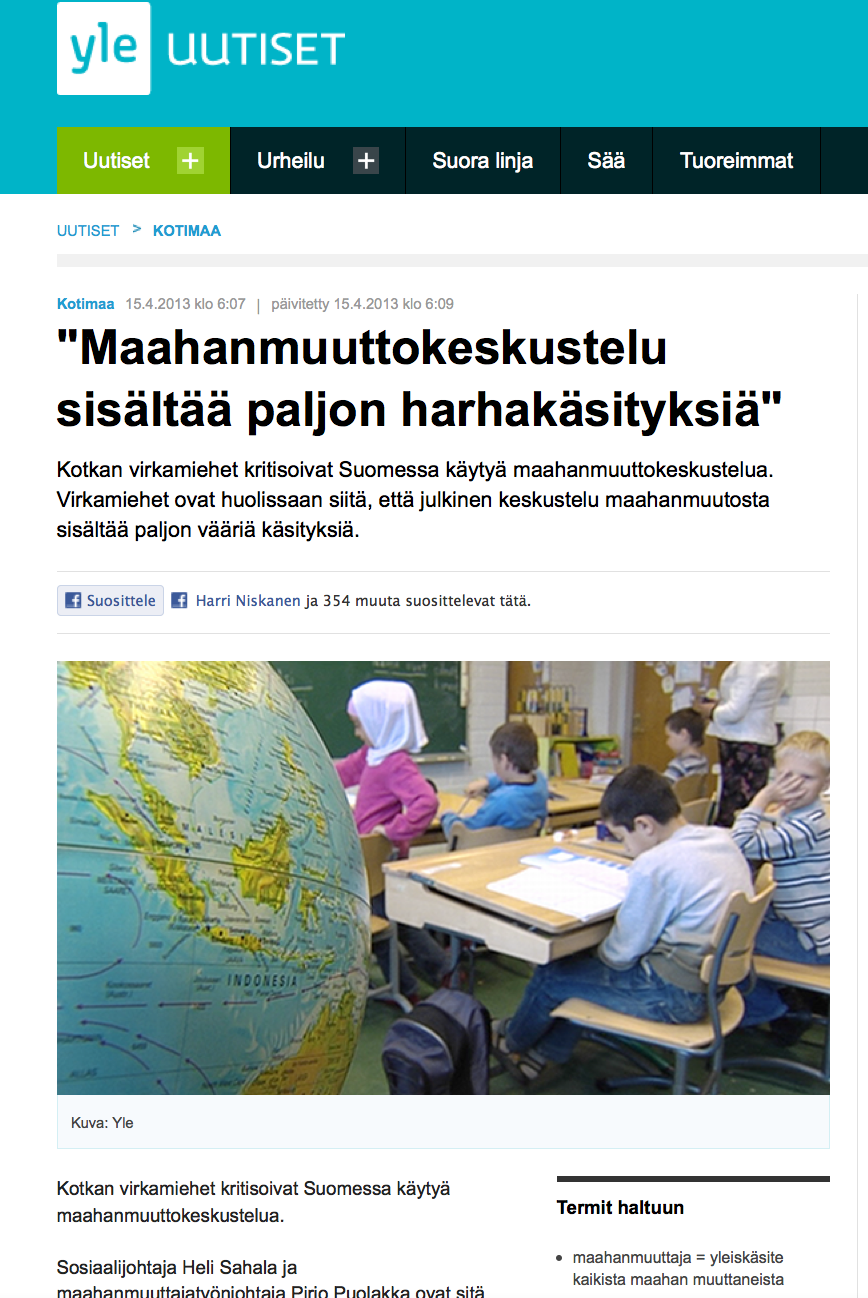
There is an interesting news story on today’s YLE that raises a timely question: Not why there is so much misinformation spead about immigrants, but what does this reveal about us as a society?

Kuvankaappaus 2013-4-15 kello 16.51.40

Does it bring to light ignorance or a subtle conspiracy that permits us to have and eat our racist cake simultaneously?

While it is a welcome matter that Finnish officials speak out against prejudice and racism in our society, why has so little been done on this front in the past, especially by those who claim to be anti-racist and work to better the lives of immigrants?

You’ll probably find the answer to that question in the eerie silence and tacit approval of that misinformation being spread against immigrants. It is telling you as well that we must raise our voices and lead ourselves if anything is to change.

What kind of wise tales are being spread in public about immigrants?

According to what Pirjo Puolakka of the city of Kotka’s immigration office, they are the following:

  • Immigrants and refugees are the same thing;
  • Immigrants get more social welfare than Finns.

Another topic that could be added to this  list are rape and crime statistics.

Misinformation could be pictured in the following manner. It could be seen as the deadly mines up ahead of our path towards greater social equality and acceptance. Since clearing that minefield would be suicidal, it’s clear that few white Finns will do the job. This only leaves us.

But beyond those killing fields we’ll eventually confront the greatest foe of all: ourselves.

Julian Abagond: The term “illegal immigrant”

Posted on April 14, 2013 by Migrant Tales

By Julian Abagond

The term “illegal immigrant” (1930s- ) means an undocumented immigrant, one without papers to stay in the country. The older term was ”illegal alien”, common in English in the 1970s and 1980s, rare in American news stories since 2003.

An illegal immigrant can mean someone who:

  1. crossed the border illegally,
  2. overstayed a student or tourist visa,
  3. was brought to the country as a child,
  4. is waiting for a green card,

Etc.

It was first applied to Jews in Palestine in the 1930s. In America it first appeared in the Republican platform in 1986, in the Democratic one in 1996.

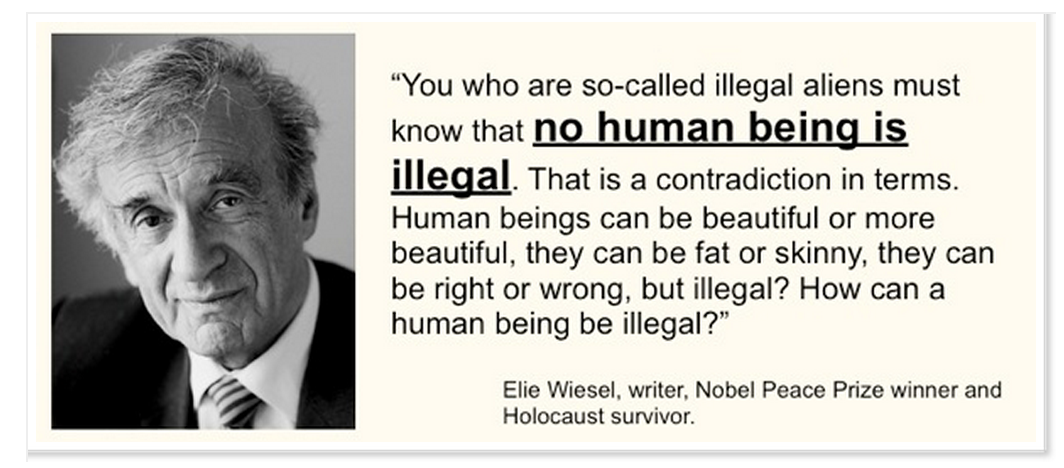
Since the 1980s there has been a push to get rid of it: actions are illegal, not people. Huffington Post got rid of it in 2008. The Miami Herald and MSNBC no longer use it. Then, on April 2nd 2013, the Associated Press (AP) stylebook got rid of it, saying in part:

illegal immigration Entering or residing in a country in violation of civil or criminal law. Except in direct quotes essential to the story, use illegal only to refer to an action, not a person: illegal immigration, but not illegal immigrant. Acceptable variations include living in or entering a country illegally or without legal permission.

That is huge: most American news reporters and editors follow the AP stylebook. The Los Angeles Times and the New York Times, two of the country’s biggest newspapers, are now thinking of getting rid of the term.

Why get rid of it:

  1. It makes racism respectable. It dehumanizes not just the 11 million people in America who are without papers, who are mostly people of colour (3 million are black), but 52 million Latinos, whom many assume to be undocumented even though most are American citizens. It has become a slur: Just before Marcelo Lucero was killed in a hate crime on Long Island he was called a “fucking illegal”. Yet, as Touré points out, no one calls Martha Stewart an “illegal business woman” – even though she was found guilty of insider trading in a court of law.
  2. It frames the debate on immigration: It pins the blame on immigrants, not those who employ them and often take advantage of them, whom no one ever seems to call “illegal employers”. Nor does it blame the American government’s immigration policy, which is at least 11 million cases behind in meeting the country’s labour needs. It makes it seem like the answer is to punish immigrants – even though some are undocumented through no fault of their own. It makes police raids on Latino neighbourhoods seem reasonable – as well as racial profiling (Arizona SB 1070). It makes it easy for Republicans to kill reasonable reform by calling it “amnesty for illegals”, as they did in 2006. And, worst of all, it makes it seem like undocumented immigrants should have no rights at all.

Linguist John McWhorter of Columbia University says in ten years “undocumented immigrant” will seem just as dismissive as “illegal immigrant”.

Linguist George Lakoff of UC Berkeley says that in debating and making laws framing is huge: words matter.

Kuvankaappaus 2013-4-14 kello 15.06.28


Read original story here.

 This piece was reprinted by Migrant Tales with permission.


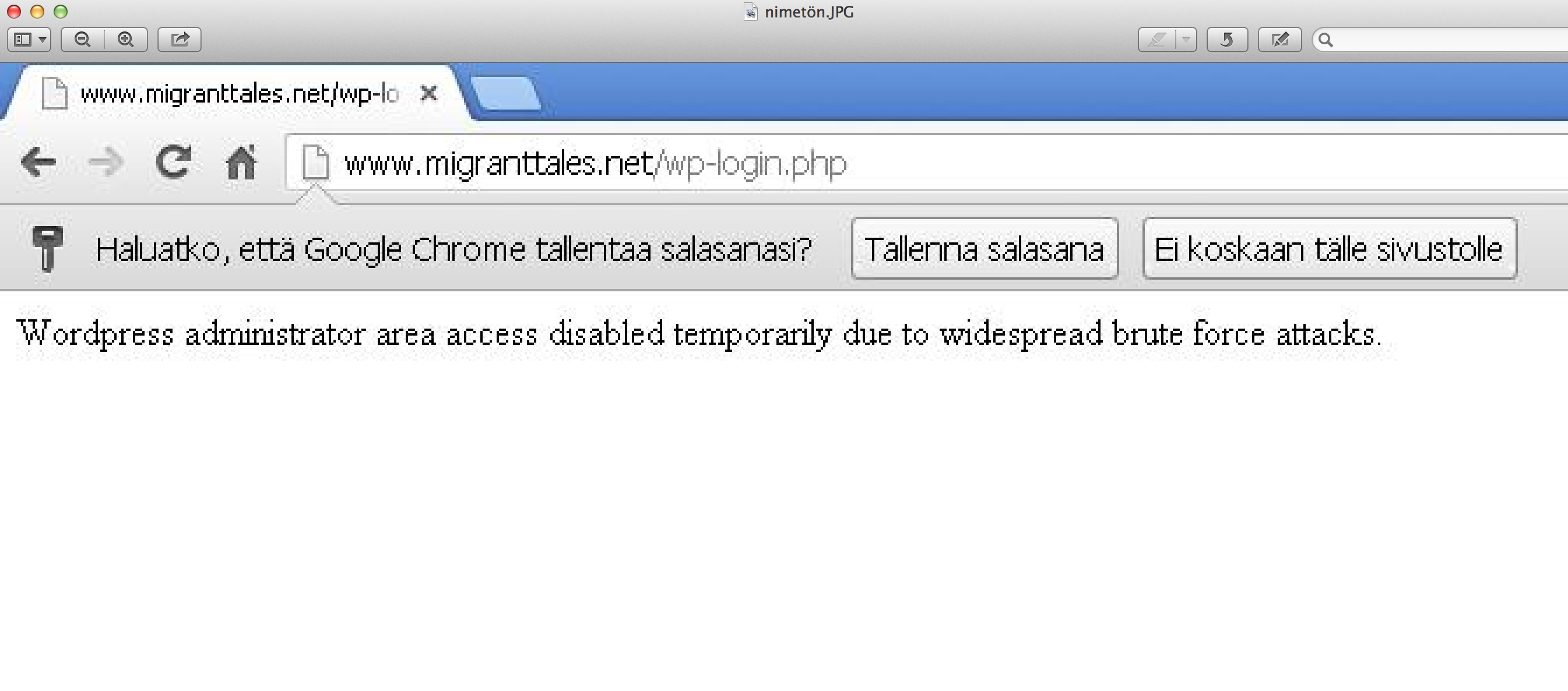
Migrant Tales administrator area access disabled temporarily due to widespread brute force attacks

Posted on April 14, 2013 by Migrant Tales

I noticed this message late-morning Sunday when I attempted to access Migrant Tales from another computer.  Let’s hope that this matter is resolved soon and that this is a general problem. 

Roughly a year ago we were deactivated for 13 hours and received hostile emails. Those who speak out for freedom of speech, or the right to spread hate speech about other groups, don’t want others to speak out.

Kuvankaappaus 2013-4-14 kello 12.59.29


Alppilan koulun tapaus: Tämänkin perussuomalainen katsomus pilasi

Posted on April 13, 2013 by Migrant Tales

Susannah

Suomessa käydään nyt Alppilan koulun tapauksen takia suurta keskustelua koulujen työrauhasta ja opettajien kannoista omasta työstään. Suurta adressia lähti vetämään perussuomalainen Sami Rautavuori Vantaalta.

http://www.adressit.com/pelastakaa_opettaja_antti_korhonen

Tänään la 13.4. kuitenkin, adressin facebookryhmässä, https://www.facebook.com/koulukurikuntoon käytiin asiatonta, törkeää keskustelua keskustelua Alppilan “pojan”, siis oppilaan perheen VAHVISTAMATTOMISTA taustoista, ja sillä alettiin tehdä perussuomalaista politiikkaa. Päivityksen oli julkaissut ryhmän toinen ylläpitäjä, Sami Rautavuori (ps).

Monet opettajat ja viisaat vanhemmat kävivät paheksumassa ryhmän adminin Sami Rautavuoren (ps) linjaa, opettajan rooli on suojata lasta, samoin monen vanhemman mielestä oppilaan tausta ei kuulu mitenkään asiaan. Rautavuori poisti sen päivityksen, mutta ei kadu julkaisuaan kovinkaan paljon, kuten kommentti osoittaa

Näin Sami Rautavuori, tärkeän keskustelun “perussuomalaistanut” pilaaja.

“Avoin keskustelu jatkukoot. Koska pahoinvoivan lapsen ja hänen vanhempiensa vetäminen mukaan tähän keskusteluun herätti melkoista pahoinvointia ryhmän keskuudessa, katsoin parhaaksi poistaa koko julkaisun, jonka siis itse melkoisen ärsyyntyneenä Ylen A-Stream -lähetystä ja toimittajien asennetta silmälläpitäen julkaisin. Luulen, että juttu tulee jokatapauksessa julkisuuteen… valitettavasti. Aroistakin asioista joudutaan pakostakin keskustelemaan, ja jakamaan monenlaisia mielipiteitä. Hyvää lauantain jatkoa kaikille! Sami”

Pitää siis valittaen todeta, että perussuomalainen pilasi hyvän ja arvokkaan keskustelun suomalaisen koulun tilasta ja opettajien työtä säätelevien tutkimusten ja laintulkintojen kautta keskustelua. Häviäjänä tässä on suuri, fiksu enemmistö.

Susannahin ikävä velvollisuus on nyt kertoa, että jos tällaisesta hankkeesta tulee kansalaisaloite, kehotan monia ihmisiä harkitsemaan kaksi kertaa, ennenkuin tukee perussuomalaista kiusaamispolitiikkaa. Kuka tässä voittaa mitään? Opettajat, oppilaat, vanhemmat, se poika? Ei, perussuomalainen asenne “sananvapaudesta”.

Susannah toivoo kuitenkin, että asiallinen keskustelu saisi jatkua, ja tutkimukset tapauksesta valmistuvat aikanaan.

Margaret Thatcher’s New Right and Finland’s Perussuomalaiset party

Posted on April 13, 2013 by Migrant Tales

As Perussuomalaiset (PS) leader Timo Soini promises that his party will become the biggest party in next year’s European parliamentary elections, which would give him a spring-board to score a similar election victory as in 2011, it’s still too early for the party to reveal how it would deal with its usual enemies like the Greens, homosexuals, immigrants, visible minorities, left-wingers and anyone it arbitrarily labels as “unpatriotic” or anti-PS. 

What is scarier about the PS? Is it its bravado and political saber-rattling taking place now or what it’s keeping under wraps in the stuffy closet: Do not let out until after the 2015 parliamentary election?

What isn’t surprising, and what few political journalists have failed to analyze, is how similar Soini’s political world view is to Margaret Thatcher’s New Right ideology, when she ruled Britain with an iron fist between 1979 and 1990.

Writes Owen Jones: “Thatcherism was a national catastrophe, and we remain trapped by its consequences. As her former Chancellor Geoffrey Howe put it: ‘Her real triumph was to have transformed not just one party but two, so that when Labour did eventually return, the great bulk of Thatcherism was accepted as irreversible.’”

Can the same happen in Finland if the PS are victorious in 2014 and 2015?

One post, published on Migrant Tales by Jenny Bourne of the Institute of Race Relations, highlights many similarities.

Like Thatcher, who ”was, without doubt, a xenophobe, an unapologetic imperialist with a natural penchant towards the far Right,” according to Bourne, Soini and the PS are without doubt “xenophobic, unapologetic racists with a weakness for the far Right.”

There are differences, however. While Thatcher was bent on destroying the power of the unions, the PS aims to build a “workers’ party without socialism.”

A workers’ party without socialism sounds more like what fascist Italian dictator Benito Mussolini founded in Italy. During his reign (1922-43), Mussolini wielded power with the help of powerful unions. The same model was copied during 1946-55 by Argentinean former strongman Juan Perón with disastrous consequences.

Another clear example of the New Right spirit of the PS is their economic policies. Part of these were revealed in January  by EuroMP Sampo Terho and PS strongman Matti Putkonen, who suggested how Finland could save 3.15 billion euros. While the usual culprit of development aide was mentioned, it was surprising that Terho and Putkonen suggested raising VAT, a PS policy no-no.

Thatcher’s suspicion of the outside world, nationalism and xenophobia are generously shared by the PS.

One recent example is the embarrassing revelation where the National Bureau of Investigation as well as Interior Minister Päivi Räsänen have had to apologize for the mistake in adding Russian President Vladimir Putin to a list of criminal suspects. It didn’t take long for PS MP Tom Packalen, a former police commissioner, from stating in a blog that there was no wrongdoing in placing Putin on such a list.

While the former prime minister admitted that if four million people from the new Commonwealth or Pakistan moved to England in the 1980s, she admitted that people were going to react in a hostile manner to those moving there.

Many PS and anti-immigration groups in Europe and elsewhere speak of “uncontrolled” immigration, which is only a synonym for permitting people to react in a hostile manner towards others.


Institute of Race Relations: ‘May we bring harmony’? Thatcher’s legacy on ‘race’

Posted on April 12, 2013 by Migrant Tales

Comment: Finland lags behind most European countries when it comes to immigration, ethnic relations and  populism. One cannot avoid some of the parallels with Margaret Thatcher’s Britain of the 1980s and Finland today. One reason why her New Right policies still exist after a quarter a century since she was forced from office, is because they were never effectively challenged by future governments. 

_____________________

Written by Jenny Bourne

Cameron’s nativist policies begin with Thatcher.

Thatcher’s attitude to foreigners can be summed up in two phrases: ‘people are really rather afraid that this country might be rather swamped by people with a different culture’ (January 1978) and the war cry ‘Sink the Belgrano’ (May 1983) over the Malvinas.  She was, without doubt, a xenophobe, an unapologetic imperialist with a natural penchant towards the far Right. She hosted and defended the former Chilean dictator Pinochet in London, supported the apartheid regime for many years (till uneconomic) and denounced as terrorist Mandela and the ANC.

But her legacy has to be judged beyond her personal traits. She presided in the ‘80s and ‘90s over two key processes – both of which have profound ramifications for ‘race’ today. Her governments facilitated the final balkanisation of Black politics into ethnicism, and under her aegis we witnessed the rise of a strident New Right ideology with a supply chain running from the dreaming spires, via parliament and think tanks, to the tabloids. Ethnicism or culturalism have no doubt contributed to the separatism now bemoaned by so many politicians and the denunciation of multiculturalism by David Cameron. While New Right ideas (against anti-racism and cultural relativism, for empire and patriotism), once drifting in the political shallows of the Monday Club and Peterhouse College fellows, are now become the common sense.

There is no doubt that Thatcher, on taking power, was to the Right in her party on race matters, an instinctive imperialist not averse to playing the numbers game. Witness her 1978 TV interview on immigration : ‘If we went on as we are then by the end of the century there would be four million people of the new Commonwealth or Pakistan here. Now, that is an awful lot and I think it means that people are really rather afraid that this country might be rather swamped by people with a different culture. The British character has done so much for democracy, for law and done so much throughout the world that if there is any fear that it might be swamped, people are going to react and be rather hostile to those coming in.’ She had indeed taken on the clothes of the far-right  National Front and given a fillip to racial violence which  was, in the 1970s, along with racist policing, the principal problem of the inner-city.

Riots and the rise of ethnicity

But it was the riots from April to July of 1981, which burned in twenty-six cities, which caused her to change tack. Her monetarist policies had blighted the futures of working-class youth and they were ripe for rebellion. They and the declining areas they came from had to be kept in check. Lord Heseltine was allowed a regeneration budget for Liverpool, one of the most affected cities.[1] But for the rest of the country, an ethnic policy of appeasement, following on Lord Scarman’s findings of ‘disadvantage’ would be implemented.[2] Thatcher’s government wanted the communities to police their own. The Urban Programme, which had hitherto had a small budget, was suddenly increased to £270m and 200 new ‘ethnic projects’ were approved in 1982/3. The monies from this programme, with a small contribution locally, were disbursed by local authorities to local projects meeting local needs. And those needs were being ethnically defined.

While Labour (even Ken Livingstone), Liberal and Tory politicians all seemed content with this result, it was left to organisations like the Institute of Race Relations, and especially A. Sivanandan, to point out the political damage being wrought.[3] For instead of actually addressing racial injustice, the programme redefined the problem as one of cultural disadvantage and went on to reinforce cultural differences without making any changes to a discriminatory system. (Though the riots in the northern towns of 2001 and bombings in 7/7 2005 brought politicians to question the wisdom of ethnic policies and opt instead for ‘cohesion’ strategies, they were never, any more than under Thatcher, to address the structural racism, around jobs, housing, schooling, policing, immigration, criminal justice, which lay behind much of the disaffection.)

Embedding of the New Right

The second legacy comes from the new form of racism which arose under Thatcher cultivated by politicians, academics, journalists who, as a group, became known as the New Right.[4] Not based, as the fascist extremists were, on biological difference and arguing fundamentally about numbers of immigrants, it was based on cultural difference and the need to defend our way of life (which effectively also  meant not interfering in racism’s free rein). Thatcher’s natural Edwardian views about British moral superiority might never have got such a political purchase had it not been for two things: that the advisers closest to her such as Alfred Sherman and Keith Joseph[5] were deeply influenced by free marketeer Milton Friedman and by free-from-all-state shackles F. A. Hayek, and that after some forty years of struggle against injustice and discrimination, black people, particularly those born here, were not prepared to accept second-class status. Thatcher and her coterie seemed quite aghast that the ‘uppity’ Blacks were openly fighting for their rights. And it was the collision over the legitimacy of cultural pluralism and the need for anti-racism that was to mark battle after battle with local authorities, over equality policies, multiracial education, including the curriculum and the teaching of history, during the 1980s.

The critiques from within the New Right spanned a number of concerns about anti-racism: that it was indoctrination, denied individuality and freedom, insisted on equality of outcome and therefore was a precursor to social engineering, was policing thought, was denigrating a noble British history. For in fact, they argued, racism was being massively overplayed as an issue affecting people’s lives by leftwing agitators. Multiculturalism and multicultural education were threats because they implied that all cultures were equally valid, valuable and moral, which they were not. We were at risk of diluting national, Christian values.

Anti-racism and cultural pluralism were the scourge of the New Right: be it the changing of street names to honour new heroes or the anti-racist year 1984/5 pronounced by the Greater London Council. And very often completely untrue stories, for example, about not being able to ask for ‘black coffee’, sing ‘Baa Baa Black sheep’ or the removal of Tufty the squirrel from a Lambeth road safety campaign, made for their exciting copy. And then there were the attacks on the Swann Report on multiracial education and the Institute of Race Relations, for producing anti-racist booklets for young people. Ray Honeyford, a Bradford head teacher, forced to take early retirement after making certain pejorative observations in the Times Educational Supplement and Salisbury Review about ethnic minorities, became a cause celebre as a race martyr and then a columnist in his own right.[6]

A few opinion-formers could not have changed the discourse so decisively, save that they had at their command the Daily Mail, the Sun, The Times, Daily Express, Sunday Express, Daily Telegraph and Sunday Telegraph.[7]Academics turned columnists, proprietors turned polemicists, politicians turned leader-writers, a whole host of New Rightists (many members of the Salisbury Group which grew out of Peterhouse College and later were to produce the Salisbury Review) managed to find a place time after time to denounce the anti-racist Left.  Academics like Roger Scruton, Caroline Cox, Anthony Flew and John Vincent always seemed to have an in on this subject. But then so too did Ronald Butt, Paul Johnson, Peregrine Worsthorne, Alfred Sherman, Andrew Alexander, T E Utley, Roy Kerridge,  Honor Tracy and so many more. The media, the many think tanks on the Right such as the Institute for Economic Affairs, the Centre for Policy Studies, the Social Affairs Unit, the Hillgate Group, working closely with politicians very close to Thatcher managed to have an inordinate impact.

It is almost a quarter of a century since Thatcher was forced from office and yet the ideological mark left by the New Right  is profound (in part because its influence was never challenged by the Major or Labour governments). The New Right managed to change the role of the press in forming opinion on race matters and hence terms of debate forever. It took anti-racism, a struggle for justice, and established it as a form of tyranny – to be denounced as ‘political correctness’. It reclaimed patriotism and reread the history of slavery and empire as an attempt to impose collective guilt. It denounced cultural pluralists for putting national values at risk. It recast black protestors as the cause of ‘racial mischief’ and the real bigots. And in a last gasp, over the Macpherson report, it attempted to redefine racism as needing intent so as to prove it could only be attributed to individuals not institutions.

Thatcher’s New Right established  what is today a commonsense nativism – which has stripped the political culture of group rights, internationalism, and history. It paved the way for Cameron’s landmark ‘multiculturalism has failed’ speech of 2011 and  Michael Gove’s whitening of the history curriculum, and the much more general acceptance of views, ranging from those of Andrew Green and Christopher Caldwell to David Goodhart, that the nation is under threat from cultural pluralism ie immigrants and we need a more assertive integration policy ie assimilation.

References: [1] Documents released under the thirty-year rule reveal that members of the cabinet actually opposed any such regeneration and wanted places like Liverpool left to rot. It was agreed that only Liverpool could have a regeneration task force and only for one year and that the amount of money involved be kept secret. [2] Lord Scarman was asked to investigate the causes of the disturbances in Brixton in 1981 and ‘found’ a distrust of the police and a racial disadvantage, in part caused by problems within the West Indian family. [3] ‘The ensuing scramble for government favours and government grants (channelled through local authorities) on the basis of specific ethnic needs and problems served on the one hand to deepen ethnic differences and foster ethnic rivalry and on the other, to widen the definition of ethnicity to include a variety of national and religious groups – Chinese, Cypriots, Greeks, Turks, Irish, Italians, Jews, Moslems, Sikhs – till the term became meaningless (except as a means of getting funds).’ A. Sivanandan in ‘RAT and the degradation of black struggle’, Race & Class, Spring 1985. [4] There were a number of different strains within the New Right –  ranging from libertarian beliefs in a laissez-faire economy and individual freedoms to the social authoritarian emphasis on maintaining order and a strong state. To learn more see New Right, New Racism by Paul Gordon and Francesca Klug, Searchlight, 1984 and The ideology of the New Right (ed) Ruth Levitas, Polity Press, 1986. [5] In 1974, with these two, Thatcher co-founded the rightwing Centre for Policy Studies. [6] A book setting out the New Right’s line on multiracial education and racism was published. Anti-racism an assault on education and value, edited by Frank Palmer, the Sherwood Press 1986.  See also Paul Gordon, ‘The New Right, race and education’, Race & Class, Winter 1988 for the debates in the New Right and its ultimate influence on Tory policy. [7] For an analysis on how this worked, see Nancy Murray ‘The press and ideology in Thatcher’s Britain’, Race & Class, Winter 1986.

The Institute of Race Relations is precluded from expressing a corporate view: any opinions expressed are therefore those of the authors.

Read original blog entry here.

This piece was reprinted by Migrant Tales with permission.

 

Scot Nakagawa: The Other Side of Anti-Black Racism

Posted on April 11, 2013 by Migrant Tales

Kuvankaappaus 2013-4-11 kello 11.11.40

Give me a place to stand on and I will move the earth

Archimedes

By Scot Nakagawa

I’ve argued in the past that the fulcrum of white supremacy is anti-black racism. A fulcrum, you probably already know, is what one rests a lever on to give it, well, leverage. Without it, a lever is just a stick.

I’ve called anti-black racism the fulcrum of white supremacy because I believe fear and loathing of black people is the driving force behind our racial politics. It has shaped everything from welfare policy to policing. While today unions may be working people’s best friend, regardless of race, the union movement in the U.S. has historically been as much about the exclusion of black workers as about the uplift of the working class. Today’s major unions are having to play catch-up behind this history in order to protect workers across the board because most new jobs today are like those historically reserved for blacks. In other words, non-union, low-wage, without benefits, contingent, and temporary.

Certainly we know that the original colonies were capitalized by the slave trade. And slave labor created the wealth that served both as an incentive for American independence and as the means by which it was won. And the policing of the black labor force, keeping it contained within highly exploitative systems, is the tap root of the modern American penitentiary. No wonder then that black people are so over-represented in our prison populations.

Our Constitution was designed to accommodate slavery. Even the electoral college is a remnant of a compromise that was struck between slave states and free states in forming the union.

Many have argued that anti-Indian hatred has been as powerful a force in shaping American racism. After all, native genocide was necessary in order to acquire the land and resources on which our country was founded. Anti-Indian wars were the drum beat dictating the rhythm of western expansion, and have ever since been part and parcel of the mythos of America. Any perusal of our cultural record, especially American literature and cinema, leads easily to the conclusion that murderous enmity toward American Indians has been a centerpiece of American identity.

Between slavery and native genocide, whites were able to accomplish something extraordinary in the history of the modern world. They were able to create a settler nation in which the settler class was able to almost entirely avoid participation in the exploited workforce.  Long after the founding of the United States, in fact until the Civil War, European immigrants were drawn to the American frontier, with all of its hardships and dangers, by the dream of acquiring land on which they could be free from wage labor. This is the basis of the American dream. And white supremacy is why a land founded in slavery has nonetheless convinced itself that it is exceptional in the world as a land of freedom and opportunity.

And, I acknowledge that Orientalism, by which I mean the particular brand of dehumanization and othering that is suffered by non-white immigrants, is an important part of the story of American racism. The introduction of Chinese workers to the Southern workforce after the civil war was a seminal event in racial politics, further enshrining white nativism in culture and law, and making the connection between  American and white more explicit than ever.

But, I still say that anti-black racism is the fulcrum of white supremacy.

Orientalism was the basis of Japanese American internment and contemporary Islamophobia. It informs our war and immigration policies. But American orientalism is rooted in ideological soil tilled by the justification for genocide and slavery.

Anti-Indian racism has always been about erasure. Genocide, relocation, containment, assimilation, these are the means by which we have attempted to vanquish Native Americans. In contemporary culture and politics we treat Native Americans as relics of the past or by never acknowledging native people at all. This vanishing facilitates tribal termination, violation of treaty rights, stealing land, minerals, and water, and the raiding of native trusts by our federal government to the tune of billions of dollars.

But while continued injustice toward Native Americans requires that we look away, white and black look one another squarely in the face in contemporary politics. The war on drugs, attacks on welfare queens and the food stamp president, and the notion that our social safety net facilitates dependency are all animated by anti-black racism.

Even the centrality of the story of the great American middle class in our politics revolves around anti-blackness. After all, when politicians exploit the proud history and current concerns of the American middle class, they are telling only half the story. The untold half shows that the massive government investment that created that middle class excluded black people and relied on their exploitation. That’s why the racial wealth gap actually grew larger and more durable during this period of so-called growth and opportunity. So when we stir the ire of middle class people over the erosion of their status, we stoke an anger rooted in white privilege.

For a fulcrum to be effective, it has to have a lever. Whiteness is that lever. Whiteness is shaped more powerfully by anti-blackness than by any other force because black and white people have lived in a deeply intimate and interdependent relationship throughout American history.

In America, all races fit together in a system of white political and cultural dominance. But in contemporary American life, black is the foil against which white is most powerfully defined.

Read original blog entry here.

This piece was reprinted by Migrant Tales with permission.

  • Previous
  • 1
  • 2
  • 3
  • 4
  • 5
  • Next
Read more about documentary film
Read more

Recent Posts

  • Finland’s tabloids Iltalehti and Ilta-Sanomat are the pits
  • Riikka Purra’s Dr Jekyll and Mr Hyde mask
  • Double standards
  • Perussuomalaiset: Uusi logo, sama vanha juttu
  • Taco Trump

Recent Comments

  1. Absolutely Socking: Racist Finnish Facebook group against human rights gets flooded with socks on Musta Barbaari’s mother and sister charged by the police in “ethnic profiling” case
  2. Ilkka Nuotio on Pekka Myrskylä: “Tilastot kertovat toista kuin poliittinen keskustelu”
  3. Genrih Soinkara on The war in Ukraine and the Russian-Finnish border crisis are showing Finland’s ugly side
  4. Ahti Tolvanen on Comment by Ahti Tolvanen on the Helsinki +50 conference
  5. Angel Barrientos on Angel Barrientos is one of the kind beacons of Finland’s Chilean community

Archives

  • June 2026
  • May 2026
  • April 2026
  • March 2026
  • February 2026
  • January 2026
  • December 2025
  • November 2025
  • October 2025
  • September 2025
  • August 2025
  • July 2025
  • June 2025
  • May 2025
  • April 2025
  • March 2025
  • February 2025
  • January 2025
  • December 2024
  • November 2024
  • October 2024
  • September 2024
  • August 2024
  • July 2024
  • June 2024
  • May 2024
  • April 2024
  • March 2024
  • February 2024
  • January 2024
  • December 2023
  • November 2023
  • October 2023
  • September 2023
  • August 2023
  • July 2023
  • June 2023
  • May 2023
  • April 2023
  • March 2023
  • February 2023
  • January 2023
  • December 2022
  • November 2022
  • October 2022
  • September 2022
  • August 2022
  • July 2022
  • June 2022
  • May 2022
  • April 2022
  • March 2022
  • February 2022
  • January 2022
  • December 2021
  • November 2021
  • October 2021
  • September 2021
  • August 2021
  • July 2021
  • June 2021
  • May 2021
  • April 2021
  • March 2021
  • February 2021
  • January 2021
  • December 2020
  • November 2020
  • October 2020
  • September 2020
  • August 2020
  • July 2020
  • June 2020
  • May 2020
  • April 2020
  • March 2020
  • February 2020
  • January 2020
  • December 2019
  • November 2019
  • October 2019
  • September 2019
  • August 2019
  • July 2019
  • June 2019
  • May 2019
  • April 2019
  • March 2019
  • February 2019
  • January 2019
  • December 2018
  • November 2018
  • October 2018
  • September 2018
  • August 2018
  • July 2018
  • June 2018
  • May 2018
  • April 2018
  • March 2018
  • February 2018
  • January 2018
  • December 2017
  • November 2017
  • October 2017
  • September 2017
  • August 2017
  • July 2017
  • June 2017
  • May 2017
  • April 2017
  • March 2017
  • February 2017
  • January 2017
  • December 2016
  • November 2016
  • October 2016
  • September 2016
  • August 2016
  • July 2016
  • June 2016
  • May 2016
  • April 2016
  • March 2016
  • February 2016
  • January 2016
  • December 2015
  • November 2015
  • October 2015
  • September 2015
  • August 2015
  • July 2015
  • June 2015
  • May 2015
  • April 2015
  • March 2015
  • February 2015
  • January 2015
  • December 2014
  • November 2014
  • October 2014
  • September 2014
  • August 2014
  • July 2014
  • June 2014
  • May 2014
  • April 2014
  • March 2014
  • February 2014
  • January 2014
  • December 2013
  • November 2013
  • October 2013
  • September 2013
  • August 2013
  • July 2013
  • June 2013
  • May 2013
  • April 2013
  • March 2013
  • February 2013
  • January 2013
  • December 2012
  • November 2012
  • October 2012
  • September 2012
  • August 2012
  • July 2012
  • June 2012
  • May 2012
  • April 2012
  • March 2012
  • February 2012
  • January 2012
  • December 2011
  • November 2011
  • October 2011
  • September 2011
  • August 2011
  • July 2011
  • June 2011
  • May 2011
  • April 2011
  • March 2011
  • February 2011
  • January 2011
  • December 2010
  • November 2010
  • October 2010
  • September 2010
  • August 2010
  • July 2010
  • June 2010
  • May 2010
  • April 2010
  • March 2010
  • February 2010
  • January 2010
  • December 2009
  • November 2009
  • October 2009
  • September 2009
  • August 2009
  • July 2009
  • December 2008
  • November 2008
  • October 2008
  • September 2008
  • August 2008
  • July 2008
  • June 2008
  • May 2008
  • April 2008
  • March 2008
  • February 2008
  • January 2008
  • November 2007
  • October 2007
  • September 2007
  • August 2007
  • July 2007
  • June 2007
  • May 2007

Categories

  • ?? Gia L?c
  • ????? ?????? ????? ???????? ?? ??????
  • ???????
  • @HerraAhmed
  • @mondepasrond
  • @nohatefinland
  • @oula_silver
  • @Varathas
  • A Pakistani family
  • äärioikeisto
  • Abbas Bahmanpour
  • Abdi Muhis
  • Abdirahim Hussein Mohamed
  • Abdirahim Husu Hussein
  • Abdirisak Mahamed
  • About Migrant Tales
  • activism
  • Adam Al-Sawad
  • Adel Abidin
  • Afrofinland
  • Ahmed IJ
  • Ahti Tolvanen
  • Aino Pennanen
  • Aisha Maniar
  • Alan Ali
  • Alan Anstead
  • Alejandro Díaz Ortiz
  • Alekey Bulavsev
  • Aleksander Hemon
  • Aleksanterinliitto
  • Aleksanterinliitto ry
  • Aleksanterinliitto ry:n hallitus
  • Alex Alex
  • Alex Mckie
  • Alexander Nix
  • Alexandra Ayse Albayrak
  • Alexis Neuberg
  • Ali Asaad Hasan Alzuhairi
  • Ali Hossein Mir Ali
  • Ali Rashid
  • Ali Sagal Abdikarim
  • Alina Tsui
  • Aline Müller
  • All categories
  • Aman Heidari
  • Amiirah Salleh-Hoddin & Jana Turk
  • Amin A. Alem
  • Amir Zuhairi
  • Amkelwa Mbekeni
  • Ana María Gutiérrez Sorainen
  • Anachoma
  • Anders Adlecreutz
  • Angeliina Koskinen
  • Anna De Mutiis
  • Anna María Gutiérrez Sorainen
  • Anna-Kaisa Kuusisto ja Jaakko Tuominen
  • Annastiina Kallius
  • Anneli Juise Friman Lindeman
  • Announcement
  • Anonymous
  • Antero Leitzinger
  • anti-black racism
  • Anti-Hate Crime Organisation Finland
  • Anudari Boldbaatar
  • Arshiya Nasser
  • Aspergers Syndrome
  • Asylum Corner
  • Asylum seeker 406
  • Athena Griffin and Joe Feagin
  • Autism
  • Avaaz.org
  • Awale Olad
  • Ayan Said Mohamed
  • AYY
  • Barachiel
  • Bashy Quraishy
  • Beatrice Kabutakapua
  • Beri Jamal
  • Beri Jamal and Enrique Tessieri
  • Bertolt Brecht
  • Boiata
  • Boodi Kabbani
  • Bruno Gronow
  • Carmen Pekkarinen
  • Çelen Oben and Sheila Riikonen
  • Chiara Costa-Virtanen
  • Chiara Costa-Virtanen
  • Chiara Sorbello
  • Christian Thibault
  • Christopher Wylie
  • Clara Dublanc
  • Dana
  • Daniel Malpica
  • Danilo Canguçu
  • David Papineau
  • David Schneider
  • Dexter He
  • Don Flynn
  • Dr Masoud Kamali
  • Dr. Faith Mkwesha
  • Dr. Theodoros Fouskas
  • Edna Chun
  • Eeva Kilpi
  • Emanuela Susheela
  • En castellano
  • ENAR
  • Enrique
  • Enrique Tessieri
  • Enrique Tessieri & Raghad Mchawh
  • Enrique Tessieri & Yahya Rouissi
  • Enrique Tessieri and Muhammed Shire
  • Enrique Tessieri and Sira Moksi
  • Enrique Tessieri and Tom Vandenbosch
  • Enrique Tessieri and Wael Che
  • Enrique Tessieri and Yahya Rouissi
  • Enrique Tessieri and Zimema Mhone
  • Epäluottamusmies
  • EU
  • Europe
  • European Islamophobia Report
  • European Islamophobia Report 2019,
  • European Union
  • Eve Kyntäjä
  • Ezequiel Caldeiro
  • Facebook
  • Fadumo Dayib
  • Faisa Kahiye
  • Farhad Manjoo
  • Fasismi
  • Finland
  • Fizza Qureshi
  • Flyktingar och asyl
  • Foreign Student
  • Fozia Mir-Ali
  • Frances Webber
  • Frida Selim
  • Gareth Rice
  • Ghyslain Vedeaux
  • Global Art Point
  • Great Replacement
  • Habiba Ali
  • Hami Bahadori
  • Hami Bahdori
  • Hamid
  • Hamid Alsaameere
  • Hamid Bahdori
  • Handshake
  • Harmit Athwal
  • Hassan Abdi Ali
  • Hassan Muhumud
  • Heikki Huttunen
  • Heikki Wilenius
  • Helsingin Sanomat
  • Henning van der Hoeven
  • Henrika Mälmsröm
  • Hser Hser
  • Hser Hser ja Mustafa Isman
  • Husein Muhammed
  • Hussain Kazemian
  • Hussain Kazmenian
  • Ibrahim Khan
  • Ida
  • Ignacio Pérez Pérez
  • Iise Ali Hassan
  • Ilari Kaila & Tuomas Kaila
  • Imam Ka
  • inside-an-airport
  • Institute of Race Relations
  • Iraqi asylum seeker
  • IRR European News Team
  • IRR News Team
  • Islamic Society of Norhern FInland
  • Islamic Society of Northern Finland
  • Islamophobia
  • Jacobinmag.com
  • Jallow Momodou
  • Jan Holmberg
  • Jane Elliott
  • Jani Mäkelä
  • Jari Luoto
  • Jari Taponen
  • Jegor Nazarov
  • Jenni Stammeier
  • Jenny Bourne
  • Jessie Daniels
  • Joe Davidow
  • Johannes Koski
  • John D. Foster
  • John Grayson
  • John Marriott
  • Jon Burnett
  • Jorma Härkönen
  • Jos Schuurmans
  • José León Toro Mejías
  • Josue Tumayine
  • Jouni Karnasaari
  • Juan Camilo
  • Jukka Eräkare
  • Julian Abagond
  • Julie Pascoet
  • Jussi Halla-aho
  • Jussi Hallla-aho
  • Jussi Jalonen
  • JusticeDemon
  • Kadar Gelle
  • Kaksoiskansalaisuus
  • Kansainvälinen Mikkeli
  • Kansainvälinen Mikkeli ry
  • Katherine Tonkiss
  • Kati Lepistö
  • Kati van der Hoeven-Lepistö
  • Katie Bell
  • Kättely
  • Kerstin Ögård
  • Keshia Fredua-Mensah & Jamie Schearer
  • Khadidiatou Sylla
  • Khadra Abdirazak Sugulle
  • Kiihotus kansanryhmää vastaan
  • Kirsi Crowley
  • Koko Hubara
  • Kristiina Toivikko
  • Kubra Amini
  • KuRI
  • La Colectiva
  • La incitación al odio
  • Laura Huhtasaari
  • Lauri Finér
  • Leif Hagert
  • Léo Custódio
  • Leo Honka
  • Leontios Christodoulou
  • Lessie Branch
  • Lex Gaudius
  • Leyes de Finlandia
  • Liikkukaa!
  • Linda Hyökki
  • Liz Fekete
  • M. Blanc
  • Maarit Snellman
  • Mahad Sheikh Musse
  • Maija Vilkkumaa
  • Malmin Kebab Pizzeria Port Arthur
  • Marcell Lorincz
  • Mari Aaltola
  • María Paz López
  • Maria Rittis Ikola
  • Maria Tjader
  • Marja-Liisa Tolvanen
  • Mark
  • Markku Heikkinen
  • Marshall Niles
  • Martin Al-Laji
  • Maryan Siyad
  • Matt Carr
  • Mauricio Farah Gebara
  • Media Monitoring Group of Finland
  • Micah J. Christian
  • Michael McEachrane
  • Michele Levoy
  • Michelle Kaila
  • Migrant Tales
  • Migrant Tales Literary
  • Migrantes News
  • Migrants' Rights Network
  • MigriLeaks
  • Mikko Kapanen
  • Miriam Attias and Camila Haavisto
  • Mohamed Adan
  • Mohammad Javid
  • Mohammad M.
  • Monikulttuurisuus
  • Monisha Bhatia and Victoria Canning
  • Mor Ndiaye
  • Muh'ed
  • Muhamed Abdimajed Murshid
  • Muhammed Shire
  • Muhammed Shire and Enrique Tessieri
  • Muhis Azizi
  • Musimenta Dansila
  • Muslimiviha
  • Musulmanes
  • Namir al-Azzawi
  • Natsismi
  • Neurodiversity
  • New Women Connectors
  • Nils Muižnieks
  • No Labels No Walls
  • Noel Dandes
  • Nuor Dawood
  • Omar Khan
  • Otavanmedia
  • Oula Silvennoinen
  • Paco Diop
  • Pakistani family
  • Pentti Stranius
  • Perussuomalaiset
  • perustuslaki
  • Petra Laiti
  • Petri Cederlöf
  • Pia Grochowski
  • Podcast-lukija Bea Bergholm
  • Pohjois – Suomen Islamilainen Yhdyskunta
  • Pohjois Suomen Islamilainen Yhyskunta
  • Polina Kopylova
  • Race Files
  • racism
  • Racism Review
  • Raghad Mchawh
  • Ranska
  • Rashid H. and Migrant Tales
  • Rasismi
  • Raul Perez
  • Rebecka Holm
  • Reem Abu-Hayyeh
  • Refugees
  • Reija Härkönen
  • Remiel
  • Reza Nasri
  • Richard Gresswell
  • Riikka Purra
  • Risto Laakkonen
  • Rita Chahda
  • Ritva Kondi
  • Robito Ibrahim
  • Roble Bashir
  • Rockhaya Sylla
  • Rodolfo Walsh
  • Roger Casale
  • Rostam Atai
  • Roxana Crisólogo Correa
  • Ruth Grove-White
  • Ruth Waweru-Folabit
  • S-worldview
  • Sadio Ali Nuur
  • Sami Rusanen
  • Sandhu Bhamra
  • Sara de Jong
  • Sarah Crowther
  • Sari Alhariri
  • Sarkawt Khalil
  • Sasu
  • Scot Nakagawa
  • Shabana Ahmadzai
  • Shada Islam
  • Sharon Chang blogs
  • Shenita Ann McLean
  • Shirlene Green Newball
  • Sini Savolainen
  • Sira Moksi
  • Sonia K.
  • Sonia Maria Koo
  • Steverp
  • Stop Deportations
  • Suldaan Said Ahmed
  • Suomen mediaseurantakollektiivi
  • Suomen Muslimifoorumi ry
  • Suomen viharikosvastainen yhdistys
  • Suomen viharikosvastainen yhdistys ry
  • Suomi
  • Supermen
  • Susannah
  • Suva
  • Syrjintä
  • Talous
  • Tapio Tuomala
  • Taw Reh
  • Teivo Teivainen
  • The Daily Show
  • The Heino
  • The Supermen
  • Thomas Elfgren
  • Thulfiqar Abdulkarim
  • Tim McGettigan
  • Tino Singh
  • Tito Moustafa Sliem
  • Tobias Hübinette and L. Janelle Dance
  • Transport
  • Trica Danielle Keaton
  • Trilce Garcia
  • Trish Pääkkönen
  • Trish Pääkkönen and Enrique Tessieri
  • Tuulia Reponen
  • Uncategorized
  • UNITED
  • University of Eastern Finland
  • Uyi Osazee
  • Väkivalta
  • Vapaa Liikkuvuus
  • Venla-Sofia Saariaho
  • Vieraskynä
  • W. Che
  • W. Che an Enrique Tessieri
  • Wael Ch.
  • Wan Wei
  • Women for Refugee Women
  • Xaan Kaafi Maxamed Xalane
  • Xassan Kaafi Maxamed Xalane
  • Xassan-Kaafi Mohamed Halane & Enrique Tessieri
  • Yahya Rouissi
  • Yasmin Yusuf
  • Yassen Ghaleb
  • Yle Puhe
  • Yuliet Tresa
  • Yve Shepherd
  • Zahra Khavari
  • Zaker
  • Zalina Ametova
  • Zamzam Ahmed Ali
  • Zeinab Amini ja Soheila Khavari
  • Zimema Mahone and Enrique Tessieri
  • Zimema Mhone
  • Zoila Forss Crespo Moreyra
  • ZT
  • Zulma Sierra
  • Zuzeeko Tegha Abeng
© 2026 Migrant tales | Powered by Minimalist Blog WordPress Theme